


6,99 €
Mehr erfahren.
- Herausgeber: Mnamon
- Kategorie: Gesellschafts- und Liebesromane
- Sprache: Englisch
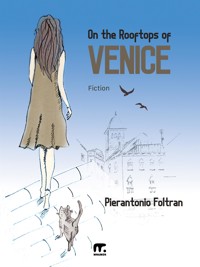
Thanks to Alvise the pages of an old diary come to light in a historic bookshop. What he discovers will change his life.
An elderly woman wanders barefoot across the rooftops immersed in memories, while her young daughter tries to leave behind a not-so-happy marriage.
Two love stories that intersect on the roof of a late nineteenth-century building, giving life to a comedy about the cycles of human existence. In the background a daily and wonderful Venice.
Das E-Book können Sie in Legimi-Apps oder einer beliebigen App lesen, die das folgende Format unterstützen:
Veröffentlichungsjahr: 2023
Ähnliche




















To Venice, my muse.
That room, for all of us, became a place of transgression. What a wonderland it was! Sitting around the large coffee table covered with bouquets of flowers, we moved in and out of the novels we read. Looking back, I am amazed at how much we learned without even noticing it. We were, to borrow from Nabokov, to experience how the ordinary pebble of ordinary life could be transformed into a jewel through the magic eye of fiction.
Azar Nafisi, Reading Lolita in Tehran
Alvise 2018
It was two days before my thirty-third birthday. I had heard from Giulia that colleagues and friends were preparing a little party for me at the Café dei Fiori bar. The whole thing was supposed to be a surprise, but really it wasn't; it had already happened the year before, and the year before that. For a long time, our clique had been celebrating birthdays and other things at the Café dei Fiori. I had been working in the Venice Law Court Offices for five years now, after having graduated from the University of Padua with a master's degree in law. Before that, I had worked for some notary firms in the province of Treviso and after a few years had sat the exam to enter the Public Prosecutor's Office in Venice. I had arrived in the lagoon city in September 2014 and had not left since. The thing that has given me the most pleasure for some time is frequenting the nearest bar, the Caffè dei Fiori, a Venetian cicchetteria that was lucky enough to still be run by locals.
I spent some weekends at my parents' place in Monastier, in the middle of the Veneto countryside. I had got into the habit of going to see them more or less every three weeks. I loved walking with my father through the vineyards; he would keep me up to date on the work he had done and the work still to do. Renovation of the farmhouse had kept him very busy in recent years, but now he was satisfied. As for me, for the time being I was happy living alone in my mini apartment in Venice, after two years spent commuting by train from Mestre. Thanks to some acquaintances of my colleagues in the public prosecutor's office, I had managed to get a small apartment not far from the office. In the afternoons, on my way home after work, I loved to stop in the middle of the Tre Ponti, with the sun still low on the horizon: I would lean against the parapet and watch the gondolas and motorboats anchored there, bobbing up and down by the Rio Novo.
On that Monday, the day promised plenty of sunshine and soon the whole world would be in motion. When I reached the café, Ennio, the owner, was setting up tables outside. I had been frequenting his café for a few years now and counted him and his wife Laura among my best friends. When I got there, I greeted him and politely asked him to make me a cappuccino. I still had a few minutes before going on duty in one of the prosecutor's offices.
Angelo, who shared the office with me, was originally from Lazio. A cheerful guy, married and happy to be so, so he declared at least once a day. Angelo and his wife Maria had become parents just a few months earlier, and like many others who worked in the building, were regulars at the Café dei Fiori.
However, my closest friend was Giulia, the waitress who served the tables in the bar, from late afternoon often until late at night.
A few years earlier, one evening it was pouring down and as I had an umbrella with me, I had offered to accompany her to the station where she would take the train to Mestre. Over the following weeks and months, keeping her company on that late-night walk had become a habit. I told Giulia almost everything. Not wanting to commit myself to long-term relationships – I was too fond of being free – I would tell her about my few occasional love affairs with young tourists and jokingly compare them to her ‘serious' relationship with her partner, who she hoped one day to take to the altar. At the time, as far as I was concerned, the only woman who really mattered to me was my mother.
In those often late-night chats, Giulia would fill me in on her hectic days, divided between studying – she was in her third year of the Art and Communication Languages course at the Academy of Fine Arts – and working at the Caffè dei Fiori. She spent the mornings mostly in the library or in the Academy workshops and in the afternoons she would join Gianni, her boyfriend in Mestre, who had recently graduated in economics. Then, by six p.m. she was back in Venice working in Ennio and Laura's bar. Since she also worked some Saturdays, those walks of ours were a way for her to catch her breath, relax and sometimes let off steam. As for me, I considered her a constant, like work, afternoons at the bar and visits to my parents.
Of my friends at the bar, I was still one of the few men not happily accompanied, and jokes about me were the order of the day. It was enough for some tourist to come and sit at the tables outside the bar for me to receive allusive glances and comments, often not in a whisper. My friendship with Giulia had also been the subject of gossip at the beginning: she had been forced several times to react to our friends' jokes, repeating that ours was just a friendship, that everything was going well with her boyfriend.
Petra
I met Petra for the first time at the entrance to the Accademia Gallery. It was a rather sunny and melancholic Saturday morning, and on Giulia's advice the previous evening I had decided to visit the Accademia Gallery. I got up around nine o'clock and walked at a leisurely pace towards the designated site. Crossing fondamenta, bridges, calli, campi and campielli, it took me a good half-hour to get there. As I walked, my good mood returned; the bright sun had beaten the clouds and a few steps away from the Grand Canal I could already feel the salty air brushing against my cheeks. As I approached the entrance to the Accademia, I immediately noticed a small agitated crowd, and I soon realised the reason; unfortunately, a sign at the entrance read “Today the Galleria is closed”, without any explanation. The most disappointed, bewildered and I would even say angry, was a young woman with blond hair and shapely curves. She was spinning around in disbelief, holding the tour guide like a missal, careful to keep it open at the right place.
I went a few steps closer and got a better look at her: she was wearing a long floral skirt that almost reached her ankles, on her feet white sandals with large heels, a white blouse above her waist that barely seemed to contain her breasts, and on top a well-made blue mackintosh, open. When she turned towards me, I had a better look at her face: I immediately noticed her beautiful mouth, a small but perfect nose and two blue eyes that at that juncture tended to grey.
- Italians! – she exclaimed through gritted teeth.
Now she was looking at me. I lowered my head for a moment: I felt guilty, as if I were the cause of the disruption.
Moving a few steps closer, I looked into her eyes, now level with mine:
- I'm sorry, I'm very sorry,' I told her, and continued: ‘Look, this city has much more to offer you, surely there are other museums open.
The young woman looked at me as if she only then realised I was standing in front of her. She closed her mackintosh, allowing me with that gesture to notice her manicured nails, varnished a delicate blue.
- I had a plan, a well-defined plan, and now? I don't know what to do. – She exclaimed.
- Your Italian is very good. – I encouraged her by noticing the accent.
Her disappointment was still very evident.
- Perhaps I can help you. What's your next item on the list?
She opened the guidebook, flipped through a few pages and then said: - Palazzo Cini Gallery.
I told her that she was just a stone's throw away and that if she crossed the bridge, she would then arrive at the Peggy Guggenheim Collection in Palazzo Venier; immediately afterwards, she would be able to access the Basilica of Santa Maria della Salute and, finally, the Punta della Dogana, one of the most beautiful and photographed parts of Venice: all there, just a short distance away. She noticed in bewilderment that neither the Basilica of Santa Maria nor the Punta della Dogana were on her list.
I decided to introduce myself. I stepped back about forty centimetres, held out my hand and said as I smiled at her: - My name is Alvise, and I would be happy to help you.
She let a few seconds pass, then extended her hand with little conviction and pronounced her name, which, to my ear, sounded like pietra (stone). I smiled, thinking of the city where we were, made entirely of stone and surrounded by water. The young woman smiled back at me.
- I'll accompany you to the Cini Gallery, if you like,' I said, walking alongside her. Petra smilingly accepted and we set off.
During the visit I remained mostly silent. Petra was looking through the guidebook for every piece of furniture, every object, statuette or painting from the 15th century onwards. For my part, I already knew that in such a place overflowing with art, it would be enough for me to let myself go for a few minutes in admiration of Lorenzo Tiepolo's two canvases depicting two eighteenth-century portraits, and then go up to the second floor and lose myself in the most representative drawings from the fifteenth to the twentieth century, belonging to the Giorgio Cini Foundation. I preferred to enjoy a few things at a time in Venice: it had been my home for a few years; I would discover it slowly, in no hurry.
But this was not the case for a tourist like Petra. She had to make the most of her days there. As young and curious as I thought she was, no amount of advice from me to slow down, to see fewer things, to enjoy them more, giving her the right amount of time to savour them, was going to have any effect.
After half an hour I went out into Campo San Vio and lingered, watching the choppy water of the Grand Canal. I had already been sitting for quite a while on one of the steps of the stone bridge in front of Palazzo Barbarigo when she too came out. She saw me and graced me with a big smile, probably not expecting me to be waiting for her outside. She walked towards me with her mackintosh over her arm, at that moment her long skirt opened to the lagoon breeze, and I immediately noticed her long white, well-shaped legs. I hesitated a moment; Petra was now standing in front of me in her white sandals. I looked up and saw her breasts barely contained by her blouse, her big blue eyes and, above us, an almost white sky. I got up from the step and, in doing so, I knew at that very moment that I would smile at her and that I could say goodbye to my quiet carefree days. I proposed that we stroll a little in the open air, the next museums could wait at least a few hours while we went around the tip of the Dogana and I would tell her some stories about the island of Giudecca – just a few more steps and the island would appear in front of us – that no-one else could tell her. Petra nodded and for the first time I saw her close her guidebook on Venice and make it disappear inside her bag. Her list was no longer a priority, I finally had her attention.
Before we parted that Saturday afternoon, tired of walking up and down bridges, I decided to invite her to my little birthday party on the following Monday. I told her I would introduce her to some of my friends and colleagues. She was delighted and, as I said goodbye, I told her the time and place of the appointment. All that remained was to go back to my flat, rest for a few hours, take a nice shower and then walk to the station. I would take the train to Monastier to spend the Sunday of my thirty-third birthday with my parents.
I left the office at five o'clock the following Monday and after a few minutes I was already sitting outside the Café dei Fiori, waiting to hear the news for the evening from Giulia, who arrived while I was still chatting with Ennio. She had put on high heels and her jeans wrapped around her skinny legs.
I got up to greet her. Her loose, black hair smelled of peach and almond, and she handed me a cake she was holding in her hands.
- This is for you, happy birthday, Alvise!
I leaned down a little to allow her to kiss both my cheeks: I felt her shy, cool lips brush against my skin.
Then she waved hello to Ennio who looked at the cake and said: - I'd better put this in the fridge. – And he walked away quickly towards the bar kitchen.
I followed Giulia. Seen from behind, wearing jeans and a white blouse, she looked even thinner and more fragile. I imagined for a moment that not being used to wearing high heels, at any moment she risked slipping on the stone floor, and, of course, I would be there, ready to support her. When we reached the bar counter, I thanked her for the cake. She looked at me with her dark eyes.
- Everything is ready! For days I've been spreading the word among the bar-goers who know you that tonight there's going to be a small party in your honour. I think there will be at least a dozen people with me, Ennio and his wife. – She smiled.
- Probably eleven then. – I replied, staring into her eyes, and continued: - I also invited a young German tourist I met a few days ago.
- Another German? Wasn't the one from last year enough for you? – Giulia asked, surprised and slightly annoyed.
She came out from behind the bar and stood in front of me again.
- Come on… come on, tell! What's she like?
- Don't get any ideas, I just took her around the city.
- Even last year you accompanied her first around town, then for seven days in a row until she left. Nobody saw you again, neither at the bar nor, as far as I know from your colleagues' gossip, even at work.
- I was sick.
- Yes, a nice strong summer flu. Never mind, what's this one called?
- Petra, her name is Petra.
- And…?
- She is pretty, intelligent, funny, blond and has big blue eyes.
- She's all curves, I guess! You like them like that! – this Giulia added in an ironic tone, and it irritated me not a little.
I answered her dryly that I did actually like women like that; we had only been at the bar a few minutes and were already arguing, which was nothing new.
Ennio approached me and almost whispered: - There are customers at the tables. Go take a walk, Alvise.
I left the café in the direction of Alle Burchielle, my favourite trattoria; I would return later to celebrate my birthday.
As I searched for the shrimp inside the salad with my fork, I thought of Petra. If it would please her, I would guide her around the city, at least in the afternoons. I would ask to leave the office at four o'clock and we would have several hours to ourselves. It was early May and the days were getting longer, although the evenings were often humid, with clouds ready for rain.
Leaving the trattoria, I walked along the Fondamenta Cossetti. Crossing the bridge over the Rio Novo, I skirted the whole of the Papadopoli garden, hands in my pockets and at a brisk pace, and proceeded to the Fondamenta della Croce. I had arranged to meet Petra in front of the railway station, an easy place for her to reach. As I crossed the Ponte degli Scalzi over the Grand Canal, I stopped to scan the sky: few clouds and no rain on the way, at least for that evening.
Petra had arrived early, I could see her standing at the top of the steps, the entrance to the railway station at her back. She was dressed like the previous Saturday, the same blue skirt and mackintosh, but this time the blouse was rust-coloured, matching the colours of the flowers on the skirt. She was holding the handle of her handbag tightly. When she saw me, she smiled. That smile and her big blue eyes inspired a lot of tenderness in me at that moment and when I reached her I kissed her cheeks several times. I immediately regretted it and apologised: I told her that I had acted on impulse, without thinking that, after all, we barely knew each other. Petra reassured me, telling me that from an Italian it was the least one could expect. So, I invited her to follow me, but careful not to touch her, at least for a while.
The evening promised to be pleasant and cheerful with friends and Petra. I was counting on the good organisation of Giulia and the bar managers. When we arrived at the Café dei Fiori, I immediately introduced Petra to friends and colleagues and thanks to her good Italian she had no difficulty bonding with the group, which soon increased in number, since some passing tourists invited themselves to the party without hesitation. After midnight, Angelo and Maria were the first to leave and before long the group thinned out. In the end, just Petra, Giulia, Ennio and his wife, and I were left. I thanked them for their hard work and assured them that this had certainly been one of the best birthday parties I had ever had.
Together, we stowed umbrellas, chairs and tables inside the bar. Then I told Giulia that I would be walking Petra to her hotel. She nodded sadly; I knew that she did not like to walk alone to the station at that late hour, but I could not have done otherwise on this occasion: I wanted Petra to sense that I was somehow interested in her. After a few minutes, we walked along the Fondamenta Tre Ponti. Venice at night was even more enchanting with the magic of the lights from the street lamps reflecting in the waters of the canals. While Petra talked about how she had enjoyed the party and described all the good things she had tasted, I remained silent, feeling a little sorry for Giulia. She had gone to a lot of trouble for my party and was now on her way to the station without my company. Petra also fell silent at one point. We crossed a bridge in silence to continue along the Fondamenta del Passamonte. At the light of the first street lamp Petra stopped, stared at me and thanked me again for the beautiful evening, without thinking about it I took her by the hand and we continued walking. After a few narrow alleys we reached Ponte Marcello, and before crossing it I told Petra that because she had been there, it had been a wonderful evening for me too. The darkness had grown thicker and it was only thanks to the yellow lights arranged along the calli that we could move on. In her opinion we were now close to where she was staying, she seemed to remember the area. We were passing through an inner park in the dark under the trees, which made her uncertain about which direction to take.
- Venice is like that,' I whispered to her, ‘always the same and always different. Just a little hesitation and you no longer know which way to go, that's why it's fascinating.
Soon we found a point where we could cross the Ramo Cimesin. The Hotel Ca' San Rocco, where she was staying, appeared in front of us almost suddenly. I accompanied her to the door, where we agreed to meet at six o'clock the next evening. I touched her cheeks with a kiss and then plunged into the total darkness of the night, until I reached the lights of the street lamps of the Fondamenta Minotto and the Marcello Bridge.
Corte Sconta
The next afternoon I decided to buy a guidebook on Venice, to help me show Petra how fascinating, seductive and enchanting this city was. I therefore asked her to come with me to the Acqua Alta bookshop, which in itself seemed to me the access to a mystical, even magical dimension. At a few minutes past six in the afternoon I was again sitting under the umbrella of the Café dei Fiori. I quickly raised my hand to greet Ennio. The day was not very hot, but I could see no clouds coming. I saw Petra enter the Rio Terà dei Pensieri. This is a wide avenue edged with trees and flowerbeds full of splendid red flowers. It starts from the Fondamenta Pignan, where, a hundred metres away from the Café, there is a kindergarten and further on a students' residence. Right on the corner, at the end of the avenue, stands a prison. It's a beautiful avenue for lovers, too bad that from its centre on, prison cameras watch over it.
Petra came towards me, her sandalled feet stepping daintily. She was wearing a white skirt above the knee and a black jumper open over a white shirt with puffed sleeves. I greeted her, she took off her sunglasses, returned the greeting and sat down. I asked her if she would like a drink, she nodded and, while waiting to order, I told her about my plan to go to that extravagant bookshop I had mentioned to buy what I thought was a peculiar guide to the city.
We set off towards our destination in no hurry, enjoying the afternoon. She kept looking around in wonder, especially at the facades of the buildings. Her physicality intrigued me and I sometimes deliberately let her walk a few metres ahead so I could admire her behind: I had not touched a woman in over a year and Petra awakened dormant desires in me. As I sat on the steps of one of the many churches, waiting for her to finish her tour inside, I thought of Giulia and wondered why, although I considered her an extraordinary friend, she had never kindled in me a sexual desire like the one I now felt for Petra. On Calle Lunga Santa Maria Formosa we finally entered the bookshop. It smelled musty: piles of books leaned against peeling walls and on old furniture, among which was an old gondola submerged by loose books. The impression was of an old warehouse that wanted to stay as it was for eternity. We entered at a leisurely pace, as if in a museum. We looked almost in dismay at the stacks of books reaching up to the ceiling. I walked deferentially up to the old solid wooden door that looked out onto Rio della Tetta; the green water of the canal slammed against the steps and seemed to give it all meaning. A motor transport boat was approaching. Petra was behind me; the sun was on my legs and I could smell the open sea in the distance. I stretched out my hand and met hers: from that moment on, I never let go. We walked hand in hand throughout the afternoon, she, without comment, let our hands search for themselves, as if moved by their own will.
The afternoons of that week passed quickly. I accompanied Petra from one place to another in the city following my new guidebook, The Secret Venice of Corto Maltese, written to honour the artist Hugo Pratt and his love for this city.




