


0,99 €
Niedrigster Preis in 30 Tagen: 1,99 €
Niedrigster Preis in 30 Tagen: 1,99 €
Mehr erfahren.
- Herausgeber: Booksell-Verlag
- Kategorie: Poesie und Drama
- Sprache: Englisch
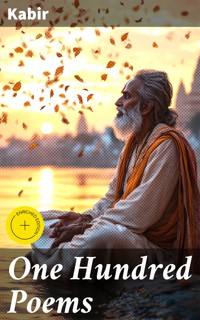
In "One Hundred Poems," Kabir presents a compelling collection of verses that delve into the profound interconnections between the self and the divine, as well as the essence of human existence. Written in a lyrical style rich with metaphors and vivid imagery, these poems transcend the boundaries of language and culture, embodying the philosophical underpinnings of the Bhakti movement. Kabir's use of simple yet powerful Hindi idioms and folk traditions invites readers into a contemplative space where they can reflect on love, spiritual awakening, and social reform. Each poem emerges as a testament to his unique voice, resonating with both contemporary and timeless themes. Kabir, a 15th-century Indian poet-saint, is revered for his ability to bridge religious divides, drawing from both Hindu and Sufi traditions. His life as a weaver in the town of Varanasi provided him with a unique perspective on spirituality, shaping his vision of a direct, personal relationship with the divine. His challenging of orthodox norms and advocacy for a path of love and introspection stem from his own experiences of marginalization and quest for truth. This collection is an essential read for anyone exploring the realms of spiritual literature, as it invites readers to immerse themselves in Kabir's revolutionary ideas. "One Hundred Poems" not only enriches our understanding of his philosophical insights but also serves as a timeless guide for those seeking deeper meaning in their own lives. In this enriched edition, we have carefully created added value for your reading experience: - A comprehensive Introduction outlines these selected works' unifying features, themes, or stylistic evolutions. - The Author Biography highlights personal milestones and literary influences that shape the entire body of writing. - A Historical Context section situates the works in their broader era—social currents, cultural trends, and key events that underpin their creation. - A concise Synopsis (Selection) offers an accessible overview of the included texts, helping readers navigate plotlines and main ideas without revealing critical twists. - A unified Analysis examines recurring motifs and stylistic hallmarks across the collection, tying the stories together while spotlighting the different work's strengths. - Reflection questions inspire deeper contemplation of the author's overarching message, inviting readers to draw connections among different texts and relate them to modern contexts. - Lastly, our hand‐picked Memorable Quotes distill pivotal lines and turning points, serving as touchstones for the collection's central themes.
Das E-Book können Sie in Legimi-Apps oder einer beliebigen App lesen, die das folgende Format unterstützen:
Veröffentlichungsjahr: 2021
Ähnliche















One Hundred Poems
Table of Contents
Introduction
One Hundred Poems brings together a concentrated selection of verse attributed to Kabir, offering readers an entry into one of the most influential poetic voices of the Indian subcontinent. The purpose of this collection is not to exhaust a vast and fluid corpus, but to present a representative hundred that highlight the breadth of Kabir’s concerns and the consistency of his vision. By gathering these poems in a single volume, the arrangement invites sustained reading rather than isolated encounter, allowing tone, argument, and image to echo across pieces and to build a cumulative portrait of a poet whose work moves between intimate counsel and public address.
The scope of this volume is deliberately focused: it provides a compact yet wide-ranging window on Kabir’s poetic practice, drawing together pieces that speak to devotion, critique, and insight in equal measure. Readers encounter poems that stand independently while also conversing with one another, creating a layered experience of recurrence and surprise. The selection aims to be approachable for first-time readers and rewarding for those returning to Kabir, foregrounding clarity of voice and thematic variety. In bringing these poems together, the collection underscores Kabir’s sustained engagement with questions of truth, conduct, and perception, and presents a cohesive space for reflection and study.
The texts included here are poems. Within that unifying category, readers will recognize several familiar modes associated with Kabir: aphoristic couplets that condense reflection into compact statements, lyrical songs that carry devotional intensity, and hymns that address the divine in a communal register. These forms have circulated orally and in writing, and they are known across different compilations under varying labels. What binds them in this volume is their shared commitment to concentrated expression and their ability to move between inward address and outward admonition. No prose narratives, essays, letters, or diaries are included; the emphasis remains on lyric, song, and sententious verse.
Kabir’s poetry is situated within the devotional milieus of North India, and has been transmitted by multiple communities over centuries. Verses attributed to him appear in several prominent anthologies and recensions, and some are included in the Sikh scripture. The poems have been sung, memorized, and adapted in diverse settings, ensuring their continued presence in everyday religious and literary life. Rather than fix a single historical moment, the poems speak from and to living practices, carried forward through performance and reading. This persistence across time and institution helps explain the poems’ durability and the breadth of their reception.
A unifying current in these poems is a dedication to direct experience of the divine, presented without reliance on elaborate ritual or sectarian boundary. The poetry often questions external markers of piety, urging attention to inward transformation and ethical clarity. Readers encounter challenges to social exclusion and habits of complacency, alongside reminders of mortality and the urgency of discerning what truly matters. Across the hundred pieces, one hears a steady insistence that truth must be realized rather than merely asserted, and that devotion must be lived. These themes, articulated with unadorned force, remain central to the collection’s coherence and appeal.
Kabir’s stylistic signatures are vivid and memorable. The poems favor colloquial directness and proverbial compression, yet they make room for daring leaps of image and thought. Everyday objects and trades supply metaphors that cut through abstraction, transforming common scenes into occasions for reflection. Paradox and inversion appear frequently, unsettling complacent understanding and inviting deeper attention. Irony sharpens the critique of hypocrisy, while an intimate, urgent voice sustains the devotional address. The language’s clarity does not preclude ambiguity; rather, it allows layered meanings to resonate, making the poems both immediately graspable and inexhaustible on repeated readings.
The speaking voice in these poems adopts multiple stances: teacher, friend, seeker, and witness. The address shifts fluidly—sometimes to a companion or community, sometimes to the divine, sometimes to the self—so that admonition, consolation, and inquiry share the same breath. Tradition remembers Kabir as a weaver, and the poetry reflects a craftsman’s attention to pattern, tension, and skill, turning thread, loom, and marketplace into instruments of thought. The tone can be tender or unsparing, lyrical or sardonic, but it consistently presses toward clarity. This range of register grounds the poems in lived experience while sustaining their spiritual urgency.
Performance has been central to the circulation of Kabir’s poetry. Many of these texts have been sung in congregational and household settings, where melody and refrain carry argument and devotion into shared memory. Oral transmission has encouraged variation and renewal, keeping the poems responsive to time and place while preserving their core concerns. The musical dimension heightens immediacy, but even on the page the cadences are palpable: short lines, emphatic turns, and recurring motifs guide the reader’s breath. The collection honors this heritage by presenting the poems as living speech, meant to be sounded as well as silently contemplated.
The textual history of Kabir’s poetry is plural. Verses circulate in different compilations and in variant forms, and attributions can reflect the practices of communities that preserved and performed them. Rather than attempting to settle questions that scholars and traditions continue to discuss, this collection emphasizes the experience of reading a carefully balanced hundred. It allows the poems’ internal resonances to emerge against the backdrop of acknowledged diversity in transmission. Recognizing that the corpus is open and layered clarifies why Kabir’s voice appears both familiar and freshly challenging: the poems remain anchored in shared themes while inviting renewed engagement.
Taken together, the hundred poems present a world in which spiritual insight is inseparable from ethical life. Critique serves compassion, and metaphysical intensity coexists with practical instruction. The persistence of these works owes much to their ability to cross boundaries—linguistic, regional, and religious—without diluting conviction. They speak to readers seeking orientation amid complexity, offering images and turns of thought that endure because they are adaptable, not vague. The poems’ influence on South Asian devotional and literary cultures is longstanding, and their continued reading and singing attest to a vitality that requires neither historical nostalgia nor doctrinal conformity.
Readers may find it fruitful to approach the collection with an ear for recurrence: images reappear in new configurations, and arguments develop through juxtaposition rather than linear sequence. The poems reward slow attention, allowing their compactness to open into reflection. They can be read in order or sampled individually, as each carries its own arc while contributing to the whole. Allowing for silence between poems can be as illuminating as tracing thematic clusters. The goal is not to decode a fixed system, but to dwell with speech that aims to awaken, unsettle, and steady, in proportions that shift with each encounter.
This collection is offered as a sustained encounter with Kabir’s voice, in the measured span of one hundred poems. It emphasizes the unity that arises from variety: a single poet speaking through couplet and song, counsel and challenge, plain word and sudden image. By concentrating attention within this finite set, the volume makes space for depth without claiming finality. The reader is invited to listen across time to a poetry that has traveled far while remaining close to lived realities. In gathering these pieces together, the collection honors a tradition that endures because it continues to ask essential questions.
Author Biography
Kabir was a seminal North Indian poet-saint of the fifteenth century, celebrated for a fearless voice that bridged devotional, social, and philosophical concerns. Associated especially with the region around Banaras, he is often placed within the broad Bhakti movement and the Sant tradition of nirgun (formless) devotion. His couplets and songs circulate widely in oral and written forms, prized for their concision, irony, and ethical force. Kabir’s verses challenge religious exclusivism while affirming a direct, interior experience of the divine. They have been preserved in several anthologies and remain among the most quoted lines in North Indian languages, shaping everyday moral reflection.
Biographical details about Kabir are uncertain and refracted through later hagiographies. Traditions connect him with Banaras and portray him as working among artisan communities, especially weavers, though the specifics of origin or family remain debated. Accounts variously present him as raised in a Muslim milieu and deeply engaged with Hindu devotional currents. Stories link him to the Vaishnava teacher Ramananda as a spiritual influence, a claim modern scholars treat cautiously. Whatever the precise genealogy, Kabir’s milieu brought him into contact with Sufi, Nath yogi, and Vaishnava bhakti ideas. His poetry reflects a learned engagement with these currents without reliance on scholastic training.
Kabir’s preferred forms include the short aphoristic doha or sakhi (a distich used for instruction) and the longer pada suited to singing. Composed in a fluid North Indian vernacular often called sadhukkadi, his language mixes elements of Avadhi and Braj with Persian and Arabic loanwords. He is renowned for striking paradoxes, earthy metaphors, and the genre known as ulatbansi, “upside-down” verse that unsettles conventional logic to provoke insight. The craft of condensation—pithy images of the body, labor, and household tasks—gives his poems mnemonic force. These features enabled circulation across communities, performers, and regions long before consistent manuscript transmission.
Across his attributed corpus, Kabir advances an uncompromising critique of ritualism, caste hierarchy, and sectarian boundary-making. He urges seekers to turn from external marks of identity to the inner remembrance of the divine Name, often voiced as “Ram” in a non-sectarian sense. The God he praises is formless and beyond image, yet intimately realized through attention, humility, and discernment under a true teacher. Kabir valorizes ethical living amid ordinary work, warning against hypocrisy, empty fasting, and showy pilgrimage. His satire targets both Brahmanical and Islamic orthodoxies, not to abolish tradition but to clear space for an experiential, egalitarian devotion.
Kabir’s poems traveled primarily through oral performance, shaping a living repertoire for singers and preachers. From the early modern period onward, communities devoted to his memory, often called the Kabir Panth, compiled anthologies. A prominent collection within these circles is the Bijak, which preserves sakhis, ramainis, and shabdas attributed to him. Beyond sectarian compilations, a significant body of his hymns appears in the Sikh scripture, the Guru Granth Sahib, testifying to his intercommunal reach. Attribution remains complex, with variant readings and regional recensions, but the durable core—memorable couplets and songs—has sustained pedagogy, devotion, and debate for centuries.
Modern readers encountered Kabir through vernacular singing lineages, print editions, and translations that carried his voice worldwide. In the early twentieth century, English renderings helped introduce him to global audiences and spurred comparative study of Bhakti and Sufi currents. Scholars have examined his poetics, social critique, and linguistic hybridity, while musicians across genres continue to reinterpret his verses. In North India his dohas function as moral aphorisms taught in schools and quoted in public life. While interpretations differ—some emphasizing radical egalitarianism, others interior mysticism—most agree that Kabir’s blend of spiritual intensity and common speech remains uniquely compelling.
Later traditions mark Kabir’s final years with accounts that underscore his challenge to sectarianism. One widely told story places his passing in Maghar, where side-by-side memorials—a samadhi and a maqbara—symbolize honor from Hindu and Muslim communities; similar commemorative sites exist around Banaras. Whatever the precise chronology, his afterlife is clear: songs attributed to Kabir continue to be sung in devotional gatherings, classrooms, and concert halls. His influence threads through the Sant tradition and beyond, shaping conversations about faith and social equality. Today his work is read as a living resource for ethical reflection and experiential devotion.




