


0,99 €
Mehr erfahren.
- Herausgeber: Wildside Press
- Kategorie: Fantasy und Science-Fiction
- Sprache: Englisch
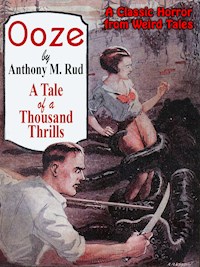
When Ooze debuted in 1923 in the first issue of the classic horror and fantasy magazine Weird Tales, it became the cover story—and a legendary tale that readers would talk about for years to come. Along with works by Otis Adelbert Kline, Farnsworth Wright (who would later become the editor), W.H. Holmes, Harold Ward, and many others, the self-style “Unique Magazine” would continue for decades and welcome such authors as Robert E. Howard (of Conan the Barbarian fame), H.P. Lovecraft (creator of the Cthulhu Mythos), Robert Bloch (author of Psycho), and many, many more.
Here is that first classic tale—along with a new introduction by former Weird Tales editor John Betancourt.
Das E-Book können Sie in Legimi-Apps oder einer beliebigen App lesen, die das folgende Format unterstützen:
Seitenzahl: 43
Veröffentlichungsjahr: 2021
Ähnliche




















Table of Contents
OOZE
COPYRIGHT INFORMATION
INTRODUCTION
CHAPTER 1
CHAPTER 2
CHAPTER 3
CHAPTER 4
CHAPTER 5
CHAPTER 6
CHAPTER 7
CHAPTER 8
CHAPTER 9
OOZE
by ANTHONY M. RUD
A Novelette of a Thousand Thrills
COPYRIGHT INFORMATION
Copyright © 2021 by Wildside Press LLC.
Originally published in Weird Tales, March 1923.
Published by Wildside Press LLC.
wildsidepress.com | bcmystery.com
INTRODUCTION
WHEN Ooze debuted in the first issue of the classic and fantasy magazine Weird Tales, it became the cover story—and a legendary tale that longtime readers would talk about for years to come. Along with works by Otis Adelbert Kline, Farnsworth Wright (who would later become the editor of Weird Tales and usher in its golden age), and pulp stalwarts W.H. Holmes, Harold Ward, and many others, the self-style “Unique Magazine” would continue for decades to come and become the home for such authors as Robert E. Howard (of Conan the Barbarian fame), H.P. Lovecraft (the Cthulhu Mythos), and many, many more.
Today, Anthony M. Rud (1893–1942) is probably remembered more for his mystery and detective work than his science fiction and fantasy. Ooze combines science fiction, horror, and mystery in an action-packed pulp tale. His one science fiction novel, The Stuffed Men, appeared in 1935—it’s a Yellow Peril story about a fungus that grows inside the human body, clearly inspired by Sax Rohmer. Indeed, The Encyclopedia of Science Fiction states that it “directly echoes the killer spores featured to more melodramatic effect in Rohmer’s The Mystery of Dr. Fu Manchu” which appeared in 1913.
Enjoy Ooze and a look back at the earliest days of genre fantasy, with a classic tale that still delivers chills.
—John Betancourt
Cabin John, Maryland
CHAPTER 1
IN THE heart of a second-growth piney-woods jungle of southern Alabama, a region sparsely settled by backwoods blacks and Cajans—that queer, half-wild people descended from Acadian exiles of the middle eighteenth century—stands a strange, enormous ruin.
Interminable trailers of Cherokee rose, white-laden during a single month of spring, have climbed the heights of its three remaining walls. Palmetto fans rise knee high above the base. A dozen scattered live oaks, now belying their nomenclature because of choking tufts of gray, Spanish moss and two-foot circlets of mistletoe parasite which have stripped bare of foliage the gnarled, knotted limbs, lean fantastic beards against the crumbling brick.
Immediately beyond, where the ground becomes soggier and lower—dropping away hopelessly into the tangle of dogwood, holly, poison sumac and pitcher plants that is Moccasin Swamp—undergrowth of ti-ti and annis has formed a protecting wall impenetrable to all save the furtive ones. Some few outcasts utilize the stinking depths of that sinister swamp, distilling “shinny” of “pure cawn” liquor for illicit trade.
Tradition states that this is the case, at least—a tradition which antedates that of the premature ruin by many decades. I believe it, for during evenings intervening between investigations of the awesome spot I often was approached as a possible customer by woodbillies who could not fathom how anyone dared venture near without plenteous fortification of liquid courage.
I know “shinny,” therefore I did not purchase it for personal consumption. A dozen times I bought a quart or two, merely to establish credit among the Cajans, pouring away the vile stuff immediately into the sodden ground. It seemed then that only through filtration and condensation of their dozens of weird tales regarding “Daid House” could I arrive at understanding of the mystery and weight of horror hanging about the place.
Certain it is that out of all the superstitious cautioning, head-wagging and whispered nonsensities I obtained only two indisputable facts. The first was that no money, and no supporting battery of ten-gauge shotguns loaded with chilled shot, could induce either Cajans or darky of the region to approach within five hundred yards of that flowering wall! The second fact I shall dwell upon later.
Perhaps it would be as well, as I am only a mouthpiece in this chronicle, to relate in brief why I came to Alabama on this mission.
I am a scribbler of general fact articles, no fiction writer as was Lee Cranmer—though doubtless the confession is superfluous. Lee was my roommate during college days. I knew his family well, admiring John Corliss Cranmer even more that I admired the son and friend—and almost as much as Peggy Breede whom Lee married. Peggy liked me, but that was all. I cherish sanctified memory of her for just that much, as no other woman before or since has granted this gangling dyspeptic even a hint of joyous and sorrowful intimacy.
Work kept me to the city. Lee, on the other hand, coming of wealthy family—and, from the first, earning from his short stories and novel royalties more than I wrested from editorial coffers—needed no anchorage. He and Peggy honeymooned a four-month trip to Alaska, visited Honolulu the next winter, fished for salmon on Cain’s River, New Brunswick, and generally enjoyed the outdoors at all seasons.




