


23,99 €
Mehr erfahren.
- Herausgeber: Packt Publishing
- Kategorie: Wissenschaft und neue Technologien
- Sprache: Englisch
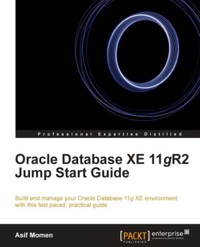
Oracle Database XE 11gR2 is an excellent beginner-level database and is a great platform to learn database concepts. "Oracle Database XE 11gR2 Jump Start Guide" helps you to install, administer, maintain, tune, back up and upgrade your Oracle Database Express Edition. The book also helps you to build custom database applications using Oracle Application Express.Using this book, you will be able to install Oracle Database XE on Windows/Linux operating system.This book helps you understand different database editions and it guides you through the installation procedure with the aid of screenshots. You will learn to interact with the database objects. You will gain a solid understanding of stored sub-programs which is followed by an introduction to Oracle Application Express (APEX). Solid database performance tuning strategies are also discussed in this book followed by backup and recovery scenarios. All in all, "Oracle Database XE 11gR2 Jump Start Guide" delivers everything that you should know to get started with Oracle Database administration.
Das E-Book können Sie in Legimi-Apps oder einer beliebigen App lesen, die das folgende Format unterstützen:
Seitenzahl: 134
Veröffentlichungsjahr: 2012
Ähnliche



















Table of Contents
Oracle Database XE 11gR2 Jump Start Guide
Oracle Database XE 11gR2 Jump Start Guide
Copyright © 2012 Packt Publishing
All rights reserved. No part of this book may be reproduced, stored in a retrieval system, or transmitted in any form or by any means, without the prior written permission of the publisher, except in the case of brief quotations embedded in critical articles or reviews.
Every effort has been made in the preparation of this book to ensure the accuracy of the information presented. However, the information contained in this book is sold without warranty, either express or implied. Neither the author, nor Packt Publishing, and its dealers and distributors will be held liable for any damages caused or alleged to be caused directly or indirectly by this book.
Packt Publishing has endeavored to provide trademark information about all of the companies and products mentioned in this book by the appropriate use of capitals. However, Packt Publishing cannot guarantee the accuracy of this information.
First published: July 2012
Production Reference: 1290612
Published by Packt Publishing Ltd.
Livery Place
35 Livery Street
Birmingham B3 2PB, UK.
ISBN 978-1-84968-674-7
www.packtpub.com
Cover Image by Mark Holland ( <[email protected]> )
Credits
Author
Asif Momen
Reviewers
Satishbabu Gunukula
Edgar Lanting
Marcin Przepiórowski
Carol A. Pena
Acquisition Editor
Dhwani Devater
Lead Technical Editor
Dayan Hyames
Technical Editors
Vrinda Amberkar
Devdutt Kulkarni
Prashant Salvi
Project Coordinator
Yashodhan Dere
Proofreader
Aaron Nash
Indexer
Rekha Nair
Graphics
Manu Joseph
Production Coordinators
Prachali Bhiwandkar
Shantanu Zagade
Cover Work
Shantanu Zagade
About the Author
Asif Momen has been working with Oracle Technologies for over 12 years and has expertise in Database Architecture, Performance Tuning, and High Availability. He has a Master's degree in Software Systems from Birla Institute of Technology and Science (BITS), Pilani.
Asif has been honored with the prestigious Oracle ACE award from Oracle Technology Network. He has the OCP 11g DBA and OCP 9i Forms Developer certifications and is an Oracle Certified Expert in RAC 10g.
Asif is a presenter for conferences such as Oracle OpenWorld-2010, All India Oracle User Group (AIOUG), and Brain Surface. In addition to this, he is a member of the Editorial Board for "Oracle Connect", the quarterly publication of AIOUG and the "Select" magazine of the United Kingdom Oracle User Group (UKOUG)
His articles have also appeared in Oracle Support Customer Knowledge Exchange. His particular interests are Database and SQL tuning, Oracle RAC, and Backup and Recovery. He posts his ideas and opinions on "The Momen Blog" (http://momendba.blogspot.com). Asif can be reached at <[email protected]>.
Acknowledgement
First and foremost, I would like to thank God for giving me the power to believe in my passion and pursue my dreams. I could never have done this without the faith I have in you, the Almighty.
To my parents, Masood and Naseem, for what I am today. I can barely find the right words to express all the wisdom, love, and support you have given me. I cannot forget the sacrifices and hardships you both have gone through just to see me smiling. You are the best parents one could wish for.
To my wonderful wife, Nazia. Your patient love enabled me to complete this work. You have always been supportive and motivating in continuing me to improve my knowledge and move ahead in my career.
To my daughters, Maria, Nida, and Zoha. You are the best children any dad could hope for — sweet, loving, and fun to be with. It's wonderful to watch you grow.
To my friends. You guys have given me the best support when I really needed it. Your silly jokes made me cheerful when I was down. Thanks for staying in touch even when I ignored you guys for a while and for listening to my boring topics for hours together.
Last but not least, the Packt team, thanks a bunch for all of you involved in the production and printing of this book.
About the Reviewers
Satishbabu Gunukula is an Oracle ACE. He has extensive experience in the Oracle and Microsoft SQL Server database technologies, has held various roles such as Tech Lead, Project Lead, and Project Manager, and specialized in High Availability. He has implemented many business critical RAC and MAA systems for fortune 500, 1000 companies. He has experience on a wide range of products such as Oracle Hyperion, SAP Basis, MySQL, Linux, and Business Apps administration.
Satishbabu has done his Master's degree and he is an Oracle Certified DBA in 8i/9i/10g and Oracle Certified Expert in 10g RAC. He has written several articles in technical journals and blogs in the US, and spoken at Oracle-related conferences. He shares his knowledge on his websites — www.oracleracexpert.com and www.sqlserver-expert.com.
Edgar Lanting has been an IT pro for over 18 years, starting out as a System Administrator on AS/400, Windows, and Unix. After this he made the move to being a DBA. Edgar is versatile and a very skilled Oracle, Microsoft SQL Server, and MySQL Server DBA, and in combination with his past as a System Administrator this has proven to help him see things from more than one perspective when working in the field. Edgar is also a certified Oracle specialist.
Edgar is currently working as a Database Consultant for Ciber in the Netherlands where he assists companies in managing their database environments. In his spare time he likes to go out photographing birds and nature, and enjoys hiking with his wife and dog.
He is currently reviewing the iWork for Mac OSX Cookbook for Packt.
Marcin Przepiórowski started his Oracle DBA activities in 2000. For the last nine years he has been working as a Senior Oracle DBA and Consultant for many various customers in Poland and Ireland. He is interested in performance bottlenecks (using end-to-end approaches and all available monitoring possibilities), High Availability solutions (such as Oracle Real Application Cluster and Oracle DataGuard) and Backup and Recovery technology.
Marcin is an Oracle ACE and maintainer of the open source Simulated Active Session History (S-ASH) project. He used to publish posts about Oracle technologies on his blog at http://oracleprof.blogspot.com/ and speaks at conferences in Europe.
www.PacktPub.com
Support files, eBooks, discount offers and more
You might want to visit www.PacktPub.com for support files and downloads related to your book.
Did you know that Packt offers eBook versions of every book published, with PDF and ePub files available? You can upgrade to the eBook version at www.PacktPub.com and as a print book customer, you are entitled to a discount on the eBook copy. Get in touch with us at <[email protected]> for more details.
At www.PacktPub.com, you can also read a collection of free technical articles, sign up for a range of free newsletters and receive exclusive discounts and offers on Packt books and eBooks.
http://PacktLib.PacktPub.com
Do you need instant solutions to your IT questions? PacktLib is Packt's online digital book library. Here, you can access, read and search across Packt's entire library of books.
Why Subscribe?
Free Access for Packt account holders
If you have an account with Packt at www.PacktPub.com, you can use this to access PacktLib today and view nine entirely free books. Simply use your login credentials for immediate access.
Instant Updates on New Packt Books
Get notified! Find out when new books are published by following @PacktEnterprise on Twitter, or the Packt Enterprise Facebook page.
Preface
Oracle Database XE 11gR2 Jump Start Guide helps you to install, administer, maintain, tune, back up, and upgrade your Oracle Database Express Edition. The book also helps you to build custom database applications using Oracle Application Express.
This book is a fast paced, practical guide including clear examples and screenshots to help you better understand the concepts, and details for building and managing your Oracle Database XE environment.
What this book covers
Chapter 1, Database Editions and Oracle Database XE, provides a brief introduction to the various editions of Oracle database and in particular, Oracle Database 11gR2 Express Edition.
Chapter 2, Installing and Uninstalling Oracle Database XE, is about installing and uninstalling Oracle Database XE on Windows and Linux environments.
Chapter 3, Connecting and Configuring Oracle Database 11g XE, focuses on Oracle Listener configuration and establishing client connections to the database, followed by Oracle memory management.
Chapter 4, Accessing Table Data, DML Statements, and Transactions, talks about SQL Developer, accessing table data, modifying table data, understanding transaction control statements, and the most commonly used SQL functions.
Chapter 5, Creating and Managing Schema Objects, deals with creating and managing database objects such as tables, indexes, constraints, views, sequences, and synonyms.
Chapter 6, Developing Stored Subprograms and Triggers, brings you the power of PL/SQL. In this chapter, you will learn to build stored procedures, functions, and triggers.
Chapter 7, Building a Sample Application with Oracle Application Express, provides a brief introduction to Oracle Application Express (APEX). You will learn how to create rich and responsive applications using Oracle Application Express.
Chapter 8, Managing Database and Database Storage, provides background information on Oracle memory management, and explains physical database structure and the Flash Recovery Area.
Chapter 9, Moving Data between Oracle Databases, explains how to move data between different Oracle Database XE versions using Oracle's export/import utilities.
Chapter 10, Upgrading Oracle Database 11g XE to Other Database Editions, explains in detail how to upgrade Oracle Database Express Edition to other Oracle Database Editions.
Chapter 11, Backup and Recovery, provides an insight to Oracle's backup and recovery procedures. Backups are to a database what fire fighters are to a city. In this chapter, you will learn how to protect and recover your database.
Chapter 12, Tuning Oracle Database 11g XE, provides a systematic approach to performance tuning, avoiding many of the most common application design and development mistakes and tracing of SQL statements.
Appendix, Features Available with Oracle Database 11g XE, lists all the features that are available with Oracle Database 11g Express Edition.
What you need for this book
The hardware requirements are:
The software requirements are:
Who this book is for
This book is intended for beginners who wish to learn Oracle Database administration, without the benefit of formal training.
Conventions
In this book, you will find a number of styles of text that distinguish between different kinds of information. Here are some examples of these styles, and an explanation of their meaning.
Code words in text are shown as follows: " Navigate to the Disk1 folder under c:\temp and double-click on setup.exe. A new window pops up."
A block of code is set as follows:
Any command-line input or output is written as follows:
New terms and important words are shown in bold. Words that you see on the screen, in menus or dialog boxes for example, appear in the text like this: "Click on the Install button to continue installing Oracle Database XE".
Note
Warnings or important notes appear in a box like this.
Tip
Tips and tricks appear like this.
Reader feedback
Feedback from our readers is always welcome. Let us know what you think about this book — what you liked or may have disliked. Reader feedback is important for us to develop titles that you really get the most out of.
To send us general feedback, simply send an e-mail to <[email protected]>, and mention the book title through the subject of your message.
If there is a topic that you have expertise in and you are interested in either writing or contributing to a book, see our author guide on www.packtpub.com/authors.




