


52,99 €
Mehr erfahren.
- Herausgeber: John Wiley & Sons
- Kategorie: Wissenschaft und neue Technologien
- Sprache: Englisch
Transition metals open up new opportunities for synthesis, because their means of bonding and their reaction mechanisms differ from those of the elements of the s and p blocks. In the last two decades the subject has mushroomed - established reactions are seeing both technical improvements and increasing numbers of applications, and new reactions are being developed. The practicality of the subject is demonstrated by the large number of publications coming from the process development laboratories of pharmaceutical companies, and its importance is underlined by the fact that three Nobel prizes have been awarded for discoveries in this field in the 21st Century already.
Organic Synthesis Using Transition Metals, 2nd Edition considers the ways in which transition metals, as catalysts and reagents, can be used in organic synthesis, both for pharmaceutical compounds and for natural products. It concentrates on the bond-forming reactions that set transition metal chemistry apart from "classical" organic chemistry. Each chapter is extensively referenced and provides a convenient point of entry to the research literature. Topics covered include:
- introduction to transition metals in organic synthesis
- coupling reactions
- C-H activation
- carbonylative coupling reactions
- alkene and alkyne insertion reactions
- electrophilic alkene and alkyne complexes
- reactions of alkyne complexes
- carbene complexes
- h3- or p-allyl -allyl complexes
- diene, dienyl and arene complexes
- cycloaddition and cycloisomerisation reactions
For this second edition the text has been extensively revised and expanded to reflect the significant improvements and advances in the field since the first edition, as well as the large number of new transition metal-catalysed processes that have come to prominence in the last 10 years – for example the extraordinary progress in coupling reactions using 'designer' ligands, catalysis using gold complexes, new opportunities arising from metathesis chemistry, and C-H activation – without neglecting the well established chemistry of metals such as palladium.
Organic Synthesis Using Transition Metals, 2nd Edition will find a place on the bookshelves of advanced undergraduates and postgraduates working in organic synthesis, catalysis, medicinal chemistry and drug discovery. It is also useful for practising researchers who want to refresh and enhance their knowledge of the field.
Sie lesen das E-Book in den Legimi-Apps auf:
Seitenzahl: 507
Veröffentlichungsjahr: 2012
Ähnliche



















Contents
Cover
Title Page
Copyright
Dedication
About the Author
Preface
Chapter 1: Introduction
1.1 The Basics
1.2 The Basic Structural Types
1.3 Just How Many Ligands Can Fit Around a Metal Atom?
1.4 Mechanism and the Basic Reaction Steps
1.5 Catalysis
Chapter 2: Coupling Reactions
2.1 Carbon–Carbon Bond Formation
2.2 Lithium and Magnesium: Kumada Coupling
2.3 Zinc: The Negishi Reaction
2.4 Aluminium and Zirconium
2.5 Tin: The Stille Reaction
2.6 Boron: The Suzuki Reaction
2.7 Silicon: The Hiyama Reaction
2.8 Copper: The Sonogashira Reaction
2.9 Other Metals
2.10 Homocoupling
2.11 Enolate and Phenoxide Coupling
2.12 Heteroatom Coupling
Chapter 3: C–H Activation
3.1 Arenes and Heteroarenes
3.2 Aldehydes
3.3 Borylation and Silylation
3.4 Allylic Functionalization
3.5 Unfunctionalized C–H Bonds
Chapter 4: Carbonylation
4.1 Carbonylative Coupling Reactions: Synthesis of Carbonyl Derivatives
4.2 Carbonylative Coupling Reactions: Synthesis of Carboxylic Acid Derivatives
4.3 Carbonylation of Alkenes and Alkynes
4.4 Hydroformylation
4.5 Stoichiometric Carbonylation Using Carbonyl Complexes
4.6 Carboxylation
4.7 Decarbonylation and Decarboxylation
Chapter 5: Alkene and Alkyne Insertion Reactions
5.1 The Heck Reaction
5.2 Insertion Reactions Involving Zirconium and Titanium
Chapter 6: Electrophilic Alkene and Alkyne Complexes
6.1 Electrophilic Palladium Complexes
6.2 Other Metals: Silver, Gold, Platinum and Rare Earths
6.3 Iron
6.4 Cobaloxime Π-Cations
Chapter 7: Reactions of Alkyne Complexes
7.1 Alkyne Cobalt Complexes
7.2 Propargyl Cations: The Nicholas Reaction
7.3 The Pauson–Khand Reaction
7.4 Synthesis Using Multiple Cobalt Reactions
Chapter 8: Carbene Complexes
8.1 Fischer Carbenes
8.2 Vinylidene Complexes
8.3 Metathesis Reactions Involving Carbene Complexes
8.4 Carbyne Complexes
8.5 Carbene Complexes From Diazo Compounds
Chapter 9: η3- or π-Allyl Complexes
9.1 Stoichiometric Reactions of Π-Allyl Complexes
9.2 Catalysis: Mostly Palladium
9.3 Propargyl Compounds
Chapter 10: Diene, Dienyl and Arene Complexes
10.1 η4-Diene Complexes
10.2 η5-Dienyl Complexes
10.3 η6-Arene Complexes
10.4 η2-Arene Complexes
Chapter 11: Cycloaddition and Cycloisomerization Reactions
11.1 Formal Six-Electron, Six-Atom Cycloadditions
11.2 Cycloadditions Involving Fewer Than Six Atoms
11.3 Cycloadditions Involving More Than Six Atoms
11.4 Isomerization
11.5 Cycloisomerization and Related Reactions
Abbreviations
Index of Principle Transition Metal Catalysts and Reagents
Index
This edition first published 2012 © 2012 John Wiley & Sons, Ltd
First Edition published in 2000
Registered office John Wiley & Sons, Ltd, The Atrium, Southern Gate, Chichester, West Sussex, PO19 8SQ, United Kingdom
For details of our global editorial offices, for customer services and for information about how to apply for permission to reuse the copyright material in this book please see our website at www.wiley.com.
The right of the author to be identified as the author of this work has been asserted in accordance with the Copyright, Designs and Patents Act 1988.
All rights reserved. No part of this publication may be reproduced, stored in a retrieval system, or transmitted, in any form or by any means, electronic, mechanical, photocopying, recording or otherwise, except as permitted by the UK Copyright, Designs and Patents Act 1988, without the prior permission of the publisher.
Wiley also publishes its books in a variety of electronic formats. Some content that appears in print may not be available in electronic books.
Designations used by companies to distinguish their products are often claimed as trademarks. All brand names and product names used in this book are trade names, service marks, trademarks or registered trademarks of their respective owners. The publisher is not associated with any product or vendor mentioned in this book. This publication is designed to provide accurate and authoritative information in regard to the subject matter covered. It is sold on the understanding that the publisher is not engaged in rendering professional services. If professional advice or other expert assistance is required, the services of a competent professional should be sought.
The publisher and the author make no representations or warranties with respect to the accuracy or completeness of the contents of this work and specifically disclaim all warranties, including without limitation any implied warranties of fitness for a particular purpose. This work is sold with the understanding that the publisher is not engaged in rendering professional services. The advice and strategies contained herein may not be suitable for every situation. In view of ongoing research, equipment modifications, changes in governmental regulations, and the constant flow of information relating to the use of experimental reagents, equipment, and devices, the reader is urged to review and evaluate the information provided in the package insert or instructions for each chemical, piece of equipment, reagent, or device for, among other things, any changes in the instructions or indication of usage and for added warnings and precautions. The fact that an organization or Website is referred to in this work as a citation and/or a potential source of further information does not mean that the author or the publisher endorses the information the organization or Website may provide or recommendations it may make. Further, readers should be aware that Internet Websites listed in this work may have changed or disappeared between when this work was written and when it is read. No warranty may be created or extended by any promotional statements for this work. Neither the publisher nor the author shall be liable for any damages arising herefrom.
Library of Congress Cataloging-in-Publication Data
Bates, Roderick. Organic synthesis using transition metals / Roderick Bates. – 2nd ed. p. cm. Includes bibliographical references and index. ISBN 978-1-119-97894-7 (hardback) – ISBN 978-1-119-97893-0 (paper) 1. Transition metals. 2. Organic compounds–Synthesis. I. Title. QD172.T6B383 2012 547'.056–dc23 2012003765
A catalogue record for this book is available from the British Library.
HB ISBN: 9781119978947 PB ISBN: 9781119978930
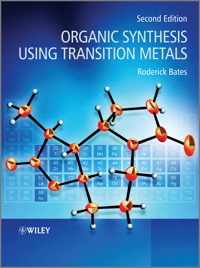
The cover shows the X-ray crystallographic structure of stemoamide, a stemona natural product, determined by Dr. Li Yongxin in the X-Ray Crystallography Laboratory of the Division of Chemistry and Biological Chemistry, Nanyang Technological University, Singapore. Syntheses of Steoamide can be found in chapter 4, scheme 44 and chapter 8, scheme 112.
About the Author
Roderick Bates received his PhD at Imperial College, London with Professor Steven Ley, using organoiron complexes for organic synthesis. After a postdoctoral stint at Colorado State University with Professor L. S. Hegedus working on chromium carbenes, he moved to the University of North Texas as an Assistant Professor and began independent research, working on palladium catalysed coupling reactions, organocobalt chemistry and applications of allenes. After some years spent in Thailand at Chulalongkorn University and the Chulabhorn Research Institute and a short stay in the ill-fated Department of Chemistry at Exeter, he joined Nanyang Technological University in Singapore as a pioneer member of the brand-new Division of Chemistry and Biological Chemistry. He is currently an Associate Professor and has research interests in the use of transition metals in natural product synthesis, and stereocontrol in alkaloid chemistry.
Preface
The gradual realization that complexes of transition metals have a place in organic synthesis has caused a quiet revolution. Organic chemists have used certain transition metal substances, such as palladium on carbon and OsO4, for many years. These kinds of reactions are not the subject of this book, as they appear in every standard text. The aim of this book is to provide an outline of the principle reactions of transition metal complexes that are used in organic synthesis, both catalytic and stoichiometric, with examples to show how they can be applied, and sufficient mechanistic information to allow them to be understood. The examples of syntheses are intended to place them in the context of the entire synthesis where space permits, so a great deal of non-transition metal chemistry can also be found in these pages. The molecular targets include natural products, novel structures and molecules of industrial, especially pharmaceutical, interest. The scale of the reaction for some of these molecules is indicated to show that these reactions are of more than just academic interest.
Tremendous progress has been made since the first edition of this work. The introduction of new ligands (``designer ligands'') has hugely expanded the scope of coupling reactions and is starting to impact other areas, while the introduction of NHC ligands has opened new possibilities in reactions of many types, from coupling to metathesis. Ten years ago, this field of chemistry was dominated by palladium; now other metals, once neglected, have become firmly established. In particular, the organic chemistry of gold has become a major area. Metathesis chemistry has gone from strength to strength. An old but also once neglected area, the activation of C-H bonds by transition metals, has achieved huge prominence and has earned itself its own chapter. Two more general trends have emerged. One is that the emphasis on catalytic reactions, rather than stoichiometric reactions has increased. While it is undeniable that catalytic reactions are the ones that will be used in industry, the stoichiometric chemistry of transition metal complexes can still provide transformations that are both elegant and interesting and, hence, retain their place. The other is the much greater acceptance of transition metal mediated reactions in the mainstream of organic synthesis. In the first edition, most syntheses might feature a single such transformation; it is now increasingly common for syntheses to include multiple, different transition metal mediated reactions. The different aspects of such syntheses can be found in various chapters of this text.
Roderick Bates January 2012




