


0,00 €
Mehr erfahren.
- Herausgeber: Adam Thielen
- Kategorie: Fantasy und Science-Fiction
- Sprache: Englisch
The war is over, and Earth's exiled fleet never stood a chance.
Their planet doomed and their civilization erased, humanity's remaining diaspora scatter into the darkness, desperate to escape the wrath of the Kraf collective.
On side A, Orphaned Voices follows three survivors of humanity's last stand. Lost in the darkness, the trio discovers a secret from Earth's past—a man preserved in a cryogenic capsule who awakens only to claim he knows how to conduct faster-than-light drives, something no human has ever been capable of.
Side B of this sci-fi epic travels into Earth's past where aspirant Nell Cordrey quickly ascends the ranks as an exo-armor pilot for the allied forces while peace talks cease and conflicts with eastern Europe ignite. On the other side of the globe, rock front man Thomas Larito plays his first gig in an empty dive. Dreaming of fame and glory, he is oblivious to the storm sweeping across the planet, transforming everything it touches.
Sagas of past and future intertwine to spin a tale of hope and despair, of victory and defeat, of a speck of dust and the vast ocean of stars that surrounds it. Orphaned Voices is a swashbuckling adventure that dares to be both gritty and fantastic.
Das E-Book können Sie in Legimi-Apps oder einer beliebigen App lesen, die das folgende Format unterstützen:
Veröffentlichungsjahr: 2019
Ähnliche




















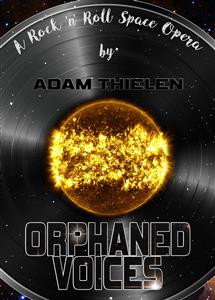
Some cover elements provided by NASA
SDO and the Hubble Heritage Team
Copyright © 2017 by Adam Thielen
All Rights Reserved
For questions, comments, or issues with the book, including mistakes, please contact the author at [email protected] - I value correspondence with readers!
Without limiting the rights under copyright reserved above, no part of this publication may be reproduced, stored in, or introduced into a retrieval system, or transmitted, in any form, or by any means without the prior written permission of the author.
This is a work of fiction. Names, characters, places, brands, media, and incidents are either the product of the author's imagination or are used in a fictitious manner.
Depictions of companies, brands, or corporations are fictitious and do not represent real activities, roles, or any other aspect of those entities. Mentions of actual brands or corporations are not endorsements, nor are used with the endorsement of any brand or corporation. Any resemblance to actual events is coincidental.
Dedicated to my family, both furry and less so.
Orphaned Voices
A Rock 'n'Roll Space Opera
Adam Thielen
Track 1 (Side A)
“They won't understand the truth about you,” spoke the perfectly poised man with his shiny round head and scholarly round spectacles to the younger man in front of him. The two stood upon freshly trimmed grass among many large buildings composed of limestone bricks.
The younger man wore short stiff hair upon his dark scalp. His words came out smoothly paced as if practiced beforehand, and his voice was low and imposing. “I determine what is true about me,” he declared. “I own who I am.”
Both stared at each other a moment while birds chirped in the background.
“I am scared,” admitted the young man, though his exterior remained solid and still.
“It matters not,” said his mentor. “The time has come, Angel, and no amount of fear or excitement will change your destiny.”
Angel pointed to the sky and glanced at a man-sized capsule standing next to them. “I do not know what awaits me, master Feng. The others fell silent years ago.”
The old man shrugged. “Nor do I.”
“I will miss you, all of you. I know there was more you could have taught me.”
“I could have taught you for a hundred years,” said the master with a short laugh. “But you know what you need to, and it is this—” he paused to poke Angel in the chest, “—that will ultimately guide you.”
Angel sighed in frustration. His heart had told him nothing about this day. Before he could protest, his mentor stepped forward and wrapped his arms around him in a tight hug. He let go and motioned toward the capsule.
Years of childhood programming kicked in, and Angel stepped back from his master. He forced his body to face the capsule and placed one foot forward, then the other. He did not speak further. He did not look back. No words would bring him any closure that would make his departure happier, and no further indulgence of the sight of Feng or the campus would make his journey any easier.
A rounded rectangular hatch slid to the side, exposing just enough room for his body to squeeze into. He rested his back and head against padding that lined the interior. As the door slid shut, he looked outside, but his master was gone. The door sealed, and all sights and sounds abated. No birds, no breeze, no words. Desolation beat upon his eardrums. His eyelids attempted to blink, but he could not be sure they were following his commands, the darkness was so absolute.
The padded lining seemed to expand, pressing against Angel's head from all sides, then tightened against his body. The capsule began to rumble, and the passenger grinned with exhilaration as he felt his body lift into the air, leaving his stomach behind. Every emotion filled his head at once, and all he could do was keep repeating with the most subtle movements of his mouth, “It matters not.”
* * *
“We don't know anything about it!” shouted a tall woman with short blonde hair intermingled with gray. She stabbed her finger toward a viewport on the starboard side of the small shuttle. Her button-down shirt and pants were wrinkled and dingy, matching that of her two shipmates. She spoke with a subtle eastern European accent.
The two men sitting along a short bench in front of her looked to each other. The one with greasy black hair and smudges decorating his face opened his mouth, then closed it. He faced the other man and raised his brow.
The cleanest-looking of the lot, as well as the heaviest, shook his head. “Doctor Popov,” he started, “We were lucky to make it this far. If that thing is hostile, it could kill us with a thrown rock. It doesn't need to trick us.”
“We're nobody,” said the rougher looking man with reddish brown skin in a southern U.S. accent almost too pronounced to be credible. “Goin’ nowhere.”
“Stag, you said we could make it to a mining base,” exclaimed Popov.
“And we still will,” replied the heavy set man. “But that capsule may have some parts we can use. It may even have food and water.”
“I hate to keep repeating myself,” said the rough man. “But, this mining 'roid ain't likely to save our skins anyhow.”
“Mack, we all hate that you keep repeating that,” said Stag.
“But there's a chance,” said Dr. Popov. “Why take this risk?”
“Someone is in that thing,” said Stag. “They may need our help. To broadcast low fuel reserves and vitals means it is desperate.”
“Or a trick,” retorted Popov.
“Or that,” agreed Mack.
“Then we ignore it,” she reasoned.
“The decision is made,” said Stag. “We are a tribunal, and you were outvoted.”
Without replying, Dr. Rina Popov slumped her shoulders and sat on the bench on the other side of the craft. The vessel needed no further piloting, having almost run out of fuel and directed toward a small, long-abandoned asteroid mining facility. So Mack, Stag, and Popov sat in the passenger slash storage compartment together and waited.
Popov turned her body to look out the viewport at the cylinder headed on an intercept course with their shuttle. Mack White stood and went to the airlock at the rear of their vessel as proximity alarms began to chime.
“We need to rotate this bucket about fifty degrees or so counter-clock on the x-axis,” he announced.
“Which way?” asked Stag, moving toward the cockpit.
“To the left,” said Popov.
“Yeah, that,” said Mack.
A one-eyed man among the blind, the medical doctor fiddled with the controls, a series of manual knobs meant to outlast capacitive touch controls, eventually finding those that activated the thrusts on the ships aft and bow to create a rotation without losing their current trajectory or speed. A single button press stabilized the craft once Mack gave the thumbs-up.
For an hour, the capsule sat on the floor of the airlock, enjoying the fractional inverted gravity the nMass drive could provide while conserving power. To the surprise of the boys, Rina was the first to break the silence.
“Let's get this over with.”
The three slid the capsule into the cabin and sealed the inner airlock door behind them. They then poked, prodded, and studied the container for another hour, all too timid to pry. An unexpected crack jolted the trio as a seam that had looked as subtle as an accent line widened, forming the outline of a featureless doorway.
The passengers stared intently, waiting for the container to open, but instead only a dense fog seeped from the broken seal and slowly traveled down to the metal deck plate. Mack moved his hand into the fog and Stag reacted with panic, grabbing Mack's arm.
“I thought it'd be cold,” said Mack, looking over to Stag. “Like dry ice or something.”
“Is it jammed?” asked Popov.
Stag shook his head. “Wait.”
After a few seconds of heeding his advice, Rina stood. “If it's stuck, it could endanger whoever is in there… or us.” She stuck her fingertips into the seam nearest to her, and Stag's eyes widened.
“Help me pry it open,” she said.
Mack shrugged off Stag's grip and pulled on his side of the door. The seam's lining cracked open starting at one end and moving to the other. Bill reluctantly joined them, and together they pried the door all the way off. Even at a fraction of a G, the metal felt heavy and clunked against the floor when released.
All three gazed upon the man resting quiet and still inside the capsule. Small goggles obscured his eyes, and a slow rise and fall of his chest assured them he was alive. Rina's eyes traveled down the man's chest and she stifled a giggle.
“He's nekkid,” remarked Mack.
“That he is,” replied Doctor Popov, still grinning.
“And hairless,” added Stag. “What now?”
Popov poked the man on his pectoral.
“What the hell are you doing?” said Stag.
Mack examined the inner lining of the pod, noting a feeding tube, still wet, sitting next to the man's head and needle marks covering his skin. “Y’all, I think this thing knew it was being rescued.”
“Probably has an AI unit,” said Stag coolly. “But I don't see any food.”
Popov gave Stag a look as he moved his hand to the pod man's neck. “Pulse is slow but steady.” He pinched the skin of his forehead and released, then felt the bicep. “Not sure how long he was in this thing, but he isn't suffering from long-term stasis effects.”
“Can you wake him?” asked Rina.
“We might all be dead in a few hours,” Stag replied. “Maybe we should let him sleep. I get the feeling he's going to wake on his own soon.”
“Mack, how long until we get to that asteroid?” queried Rina.
“About two hours,” he replied. “But then we need ta find a good landing spot and hope there's fuel nearby.”
The mysterious man continued his slumber as William Stag carefully landed the shuttle onto an asteroid the size of Ohio, happily giving the onboard computer most of the credit. The shuttle bounced several times before coming to rest, dislodging several inches of soot and creating a large cloud of dirt at the landing zone.
As the dust settled, Mack and Popov donned vac suits then entered the airlock.
“Each time we use this,” warned Mack. “We lose thirty minutes of air.”
“Good luck,” said Stag.
The two bounced along the surface, wary of falling off the rock despite several layers of iron plates on the bottom of their boots to help weigh them down. A four-wheeled motorized cart followed behind, its suspension on the loosest setting. It traveled as if floating on air while the tires bounced as they hit small rocks and emerged from shallow dips.
“Ya know,” said Mack as they approached the refuel station. “If Bill kills the podman and leaves us behind, he's tripled his air.”
“Stag,” warned Popov, turning to glare at Mack.
“That's tempting,” replied Stag. “Guess you better bring something good back.”
Rina looked around. She was surrounded by a horizon that came so quick that it made her queasy. The gray and brown rock was smooth except for small craters. Extraction machines had been set up every kilometer with wiring strung from the top of one to another in a zig-zag pattern across the dirtscape.
Mack yanked a thick hose free of a buried receptacle and twisted the nozzle while his eyes studied a gauge built into the coupling attached to it. He shook his head at Rina and dropped the heavy tube at his feet.
“Damn,” said Popov.
“What?” asked Stag.
“Nothing,” she replied. “Let's go inside the base.”
The base station was a simple dome with two round airlocks and a few windows. One of the entrances was a mess of twisted metal. Among the debris, a familiar form caught Popov's eye. She knelt down and brushed dirt aside, revealing a forearm of metallic composition.
“Androids,” she muttered.
Mack leaned his head toward the blown out door. “Kraf, you think?”
“Who else?”
“What's going on?” asked Stag.
“Well, suppose it could be pirates or any sort of vulture,” said Mack.
Popov stepped inside the airlock, spotting numerous android parts, as if inside a chopped salad of dirt and artificial intelligence. She smiled and pointed. Mack joined her.
“Well that's somethin’,” he said. “Now, if we could find some air.”
“Check the next room,” she ordered. “Got to be some tanks laying around.”
“Aye aye, Captain,” Mack mocked as he followed her directions. He stepped more confidently with a roof over his head, moving quickly through a small portal with a jammed door nestled into the wall. Inside the room were a series of lifts rising from the dirt-covered tile and various tubes lowered from the ceiling. Against the wall were a dozen pressurized tanks, some with rounded tops, others flattened. He turned the nozzle on two of them and looked for a warning label on the rest.
“No luck in here,” he reported. He turned and noticed an android lying in the other corner of the room. It was fashioned to look female in both facial features and body shape, and unlike the others, it was whole minus half her left leg. Mack skipped over to it, staring at its face. He then looked at the dirt around her, spotting the disjointed calf and foot.
“I think I found something,” said Popov. “Come help me.”
“What?” asked Stag.
Mack grabbed the leg and then the android body and carried both to the rover, where Rina was waiting. He dumped it onto the bed of the cart.
“What the hell is that?”
“I dunno, could be useful,” said Mack.
“Oh Jesus, put it back.”
“What?” asked Stag.
“If nothing else, these things are worth money,” insisted Mack.
“If nothing else?”
“Yeah? What?” Mack shrugged. “I'm keepin’ her—it. What'd you need help with?”
“Fine, come on,” she said, leading him outside and around the dome.
“These?”
“What the hell, guys, can you even hear me?” yelled Stag.
“Yes,” the other two replied.
“High-efficiency cells,” explained Popov. “Can you disconnect them from the grid without damage?”
“Do we even need the power?” asked Mack, examining the couplings and cables running from the solar panels to the dirt. He looked up to Tau Ceti, the largest of the bright white dots in the otherwise black sky.
“With the water, we can make oxygen and a limited amount of fuel,” she replied, poking her helmet.
Mack smiled and began gently twisting the couplings, hoping they would give without special tools. He grunted, then frowned, then stood to face Rina.
“How many we want?”
“Three?” questioned Popov. “Why?”
“I'll try others,” he replied. “If I have to get hardware, this'll get messy.”
Popov nodded. “I'll start loading the water, sorry if I smash your new toy.”
“Not on this rock,” said Mack.
“Uh, guys?” said Stag. “Can you get back here, like now?”
“What's going on, Bill?” asked Rina.
“There's a fleet destroyer headed this way,” he replied. “Won't get very close, but they say they can pick us up if we intercept.”
“Crap,” said Popov. “If we can get aboard, we don't need any of this.”
“Why can't they wait?” asked Mack.
“They are adjusting their route, but can't stop,” said Stag. “They say they are also low on fuel.”
“Tell them to slow and we'll bring water.”
“That destroyer should have fission,” noted Mack.
“They might be worse off than us,” said Stag. “I can see some hull damage just using the scope.”
Rina rapped her helmet and hummed before shooting her gaze to Mack. “Get one of those cells loaded while I get the water and haul ass.”
“Yes, ma’am,” said Mack, hopping to the next cell. He gripped and grunted on the tight connectors. “Dang that's tight. Tryin’ another.”
Popov grabbed the large clear jug of water and lifted. Its inertia pulled the physicist off her feet for a moment, slowing her progress and forcing a curse under her breath.
“Hurry up or I'm leaving without you,” said Stag.
“The hell,” yelled Mack.
“Just hurry.”
Mack pulled cutters from a small sheath at his hip and wedged the thick cabling between its blades. With both hands he squeezed, severing the cord below the coupling. Rina carefully tossed the second jug into the cart on top of the android body where it bounced twice before coming to rest.
“Get the rover going,” said Mack. “I can carry this.”
Popov flipped the small metallic toggle switch to reverse, cranked the throttle knob, and pressed down a green square with her thumb. The rover rumbled to life and began heading full speed, approximately ten klicks an hour, toward the shuttle. Rina realized she couldn't keep up and frantically grabbed the back rail of the cart, letting it drag her along.
The load of the solar cell, nearly twice Mack's height, weighed him down enough to push forward, nearly keeping up with Rina. The rover bounced over every small rock, lifting the water jugs from the cart bed, contained just barely by the side rails.
Rina reached the airlock ramp first with Mack on her tail. Before he stepped on, it began to rise from the ground, carrying dirt with it. He leaned forward with the panel and Popov grabbed one end of it and pulled him aboard.
“Secure the cargo before that nimrod thrusts,” yelled Popov, lowering the cell and placing it against the wall. Mack grabbed securing straps and tossed the ratchet end to Rina as she threw a net around the android body and water jugs.
“I heard that!” said Stag. “Tell me when.”
Popov yanked the strap tight and furiously cranked the ratchet. “Go!” She continued cranking as the shuttle began to rumble. Mack fell on his butt with a groan. Thrusters and the nMass drive struggled to lift the shuttle upward.
“Computer doesn't like the new weight, recalculating,” Stag announced. The rumbling lessened and Mack brushed himself off. The inside of the airlock had a fine coating of dirt resting in the treads of the compartment's plating and a layer of oily grime that had been building over a number of years of neglect.
Mack reached for one of the levers near the interior door.
“Wait,” ordered Rina. “Bill, we going to make it?”
“Hold on,” he returned. Then a few minutes later continued with, “They slowed a little, we should be good.”
Popov nodded and Mack pulled the lever, releasing air into the sealed compartment.
“What was the plan if we wasn't good?” asked Mack, pulling his helmet off.
“You were going to go back outside the shuttle and affix the cell so we could start producing oxygen,” she replied matter-of-factly. “But since we must continue to thrust our way to that ship, there's no point.”
“Of course not,” he replied sarcastically. He turned from her and took the co-pilot seat next to Stag.
“Strap in!” called out Stag. “Need to turn us sidelong.”
The craft had been moving away from the rock with its roof facing away. Small rocks and debris pinged off its surface. As it increased in speed, the smallest granules created loud cracks when they hit the hull flush. Stag disengaged the rear thrusters, allowing the shuttle to point itself forward. The metal creaked and whined under the strain. Once oriented, the sharp slope of heavy plating on the front of the craft brushed off even the larger rocks.
Popov released a lung full of air as she opened her helmet. She looked around the dingy spacecraft. Several small holes had been patched with small round plates. The seats were worn with orange plastic covers and frayed straps. What looked like a torn page from the operation manual had somehow wedged itself in between a metal bracket and the floor plating. Half of the recessed LEDs no longer functioned, keeping the interior dim.
Despite his surroundings, Mack wore a grin of victory, looking to Stag and then back at Rina. His grin faded and his eyes widened as groaning replaced the sound of creaking. Popov turned her body, pulling her seat belts taut. The man in the capsule had his arms raised and his mouth open. He squinted then relaxed his face repeatedly, rhythmically as he moaned.
“Stag, can you cut thrust?” asked Mack.
“Not yet,” he replied. “We won't make rendezvous.”
“If he wakes now and starts freaking out, we may have a problem,” stated Popov.
“We can't slow,” Stag insisted.
Mack leaned down and pulled a lever next to his seat, causing a recessed ladder to extend the length of the now-upright floor. “You'll have to climb down and keep him calm.”
Rina looked at the large red readout above the forward viewport indicating their acceleration of approximately one point eight Gs. She had never descended a ladder at double her normal weight. One slip and she'd break bones colliding with the rear airlock hatch.
“Damn it, Bill, I'm too heavy.”
“He'll be fine,” said Stag.
“Here,” said Mack, lowering a strap joining two carabiners.
The man in the capsule stopped groaning and stared at his hands held in front of his face. His pod was mag-locked to the floor with straps wrapped around it in several places. At their angle of ascent, his body was upright, and he began to push against his bindings.
Rung by rung, Rina Popov descended the ladder toward the capsule. Every other step, she unhooked the carabiner and lowered it two rungs. Her body was heavy, and her muscles strained when her knees bent.
“Hey, you, guy. Stop that,” she commanded as she looked down.
The man looked up then bent forward and stopped only when a strap supported his chest. When Popov reached the bottom, she planted her feet and leaned back, allowing her harness to support her weight. She reached out and pushed the man's head and chest back into his capsule.
He looked up at her. “Where am I?” His voice was hoarse and his breathing sounded congested.
“We found your capsule. You're on a shuttle. Try to relax,” advised Popov.
“Who are you?” he asked.
“I’m… Dr. Rina Popov,” she said. “What is your name?”
The man stared into her eyes for a moment as if searching. “It's Angel… Angel Salvador.”
Stag scoffed and looked over to Mack who didn't seem as impressed. “Angel savior,” he translated.
“Okay,” said Rina. “Do you know how long you've been in this pod?”
“Or why?” said Mack.
“I don't know,” said Angel. “I got in, felt it take off, now I'm here.”
“Well,” said Stag, looking down to them. “What year do you think it is?”
“Twenty seventy-nine, I think.”
Mack pushed his lower lip up. “Well, he's got that right.”
Rina studied the exterior of the pod, marred with innumerous dings. “Is this an escape pod?”
Salvador shook his head. “No, it was part of a small rocket.”
“Launched from where? A planet in this system?”
“Launched from Earth,” he replied.
Popov's eyes fell. Stag sighed. Mack twisted his body to face the top of Angel's pod.
“Hey man, you don't want to tell us, that's fine,” Mack said with a slight snarl. “But Earth isn't a joke.”
“There's still resistance,” said Salvador.
Popov met his eyes and shook her head. “That's not possible.”
“He's loony,” Stag remarked.
“What were you doing in this capsule, Angel?” asked Rina.
“It's complicated,” he replied. “But it was time for me to leave.”
“Hey, Mister Salvador, what's your trade?” asked Mack.
Angel tried to look up, but the shelter of his pod blocked his view. “My trade?”
“Well yeah. Bill here is a doctor—”
“Of sorts,” said Stag.
“Rina is a physicist, but technically also a doctor. And I'm an aerospace mechanic.”
“Oh,” said Angel. “I am well-trained. I can pilot, I can handle a weapon, and I'm a conductor.”
Stag laughed. “Of course you are.”
“I think we're gonna hold off on handing you a gun,” said Mack.
“I'm not crazy,” said Salvador. “But I can appreciate the skepticism.”
“Well, Angel, you are out of luck,” said Popov. “Our nMass drive is junk, we're starving, and the ship we are on an intercept course with may simply loot us and leave us.”
“Why'd you pick me up?”
“Your vessel hailed us,” she replied. “Told us you were going to run out of air and food soon.”
“I should have asked more questions.”
“To who?”
“Doesn't matter now.”
Rina placed a hand on his forehead. “Relax. Try to get comfortable. I need to take some readings on your vitals and get a sample of your blood for Bill to look at.”
Angel closed his eyes and pushed his head back against the padding inside his pod, his state of confusion yet unflagging.
Track 2 (Side B)
Shiro Ota donned his white lab coat with pride. Once but a student of biology and physics, he devoted his life to understanding microscopic life forms and was now master of his craft. Only he could perform the surgery he had scheduled because he had designed and patented the only tools that could perform it.
Stepping out of his small office, he was quickly joined by his team of young and eager assistants.
“The osmium molecules have been synchronized,” said one.
“The propionibacterium cells have been cooled at the fission threshold,” reported another.
“How many generations of exposure,” the master asked.
“Twelve, sir.”
Shiro nodded as they approached the glass containment doors leading to the lab. Ultraviolet light bathed the party before allowing them entrance, at which point Ota pressed a button on the wall, causing the tall pane glass segments that surrounded the room to go dark.
The lab was small, with only a few large machines, a computer terminal, and a wet station. The team moved to the largest of the machines. The round hunk of metal had three displays mounted at eye level, with several small storage bays covered by glass doors. It was littered with buttons and smaller screens, and as Ota approached, the machine began to emit a high-pitched whine.
Ota took a pair of white gloves with dozens of tiny lights decorating the outside from a counter and pulled them on. The display in front of him came to life.
“Get them in place,” he ordered. His assistants hurried to move to opposite sides of the machine, and after navigating a series of menus, caused robotic arms behind the glass to move a petri dish and metal plate into a viewing area surrounded by a hemisphere of needle-like sensors.
“Gear me,” said Ota. A young woman with a round face slid a large pair of goggles over Shiro's face. A single red light on its exterior surface switched to green, and a new universe appeared in front of the scientist.
He found himself in a blank white room with gray grid lines along the floor and ceiling, placed only to provide a sense of scale and movement. Occupying the space with him were several spindly metal arms, a huge steel slab with a black orb resting upon it, and a giant mouthless worm with delicate strands waving outward.
The horrific monster, sheathed in a translucent pale green skin, sat still as Ota brought his hand up and made a fist, creating a small red dot to appear on the germ's surface. The dot swept across the protective membrane. The monster gave a short shudder but otherwise remained motionless. One of the long metal arms reached down and pinched the black orb between its pincers and hovered over the incision. Ota's hand moved down, guiding the orb inside the creature's wound.
The pincers opened and slowly pulled out of the enlarged cell. Shiro watched as the orb floated, suspended in the cytoplasm near a cluster of proteins designed to signal a long tendril extending from the rear of the beast necessary for swimming. At first, the innards of the bacteria ignored the orb, as they had in previous attempts.
Then a large bundle of fibers that had been sitting quietly in the middle of the cell reached out, caressing the heavy metal molecule invading its body. The fiber then elongated and coiled around the orb. Ota allowed a smile for a brief moment.
“Are we receiving anything?” he asked.




