


Erhalten Sie Zugang zu diesem und mehr als 300000 Büchern ab EUR 5,99 monatlich.
- Herausgeber: Tilted Axis Press
- Kategorie: Gesellschafts- und Liebesromane
- Sprache: Englisch
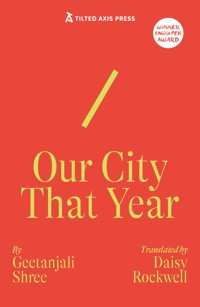
Winner, English PEN x SALT Award 2025 From the International Booker Prize-winning author-translator duo of Tomb of Sand, a powerful, kaleidoscopic novel about a fractured India, caught between rising fundamentalism and waning progressive ideals. A city teeters on the edge of chaos. A society lies fractured along fault lines of faith and ideology. A playground becomes a battleground. A looming silence grips the public. Against this backdrop, Shruti, a writer paralysed by the weight of events, tries to find her words, while Sharad and Hanif, academics whose voices are drowned out by extremism, find themselves caught between clichés and government slogans. And there's Daddu, Sharad's father, a beacon of hope in the growing darkness. As they each grapple with thoughts of speaking the unspeakable, an unnamed narrator takes on the urgent task of bearing witness. First published in Hindi in 1998, Our City That Year is a novel that defies easy categorisation. It's a time capsule, a warning siren, and a desperate plea. Geetanjali Shree's shimmering prose, in Daisy Rockwell's nuanced and consummate translation, takes us into a fever dream of fragmented thoughts and half-finished sentences, mirroring the disjointed reality of a city under siege. Readers will find themselves haunted long after the final page, grappling with questions that echo far beyond India's borders.
Sie lesen das E-Book in den Legimi-Apps auf:
Seitenzahl: 540
Veröffentlichungsjahr: 2025
Das E-Book (TTS) können Sie hören im Abo „Legimi Premium” in Legimi-Apps auf:
Ähnliche
















Our City That Year
Remembering beloved Ma, who taught us to love motherland, religion and humanity, in generosity and mutual respect
So this is the place. Our city.
Into this city the three of them came forth. Panicked. Determined to bring everything to the fore: the crime and the criminal; the wounded and the dead. All of it. They would see clearly, and clearly they would reveal whatever they saw. Sharad, Shruti and Hanif, who had resolved that they would write. That this time they could not remain silent. That everything must be brought out into the open. That the blowing wind was no breeze but a gale. That they could not allow it to uproot them.
It’s raining. Shruti has stepped off the train and stands on the platform. A vibration. A trembling agitation passes beneath her feet and departs with the train. People run stumbling, soaked, searching for passengers outside. The city’s cows and dogs have ambled in to laze on the flooded platform. The water flows towards the tracks. A wasteland.
There was a time that year when such rivers flowed in the streets, but they didn’t come from the rains. They came from the neighbourhood water tanks that were emptied into the streets for fear they’d been poisoned.
Sharad recognizes her from afar and approaches. She stands alone, waiting. They come face to face; their faces bound in an inhibited silence. They exit with measured steps.
The three of them understood that everything making us restless and frightened was right there, outside. They faced the same fear that filled me. I, too, began to panic. They’d try to write, then stop midstream. They’d find their writing hollow and say, all these words have been written before, nothing will be accomplished by recording them; the words have become utterly useless, grown empty, like government slogans.
It was then that I realized I’d have to do something, somehow or other. I’d have to write, whether I understood or not. If it couldn’t be the three of them—a professional writer and two intellectuals—it would have to be me. Me, who knows only how to copy down words.
At that time, it was barely possible to string together two words of sense. Nonetheless, I, who had neither the experience to string words nor the tenacity, could write. If you call copying down writing, then that’s what I was doing. That’s what I could do. I would pick up the fragments that flew up in their wake. Whatever caught my eye, wherever.
Before my eyes is that house, that gate, that letterbox. The flap of the letterbox hangs open, shivering in the rain. Shruti hesitates at the gate. Her sandals are soaking wet, as are her feet, up to the ankles. Sharad opens the gate. The front yard is overgrown with wild grasses.
Once a madhumalti vine had climbed here, and the sight beneath that vine, of a row of white teeth in pink gums, had sickened me. The pen had slipped from my hand, ink splattering. Later, I’d wonder why I hadn’t recalled the pink and white blossoms of the madhumalti vine when I saw the teeth and gums. Instead, madhumaltis now always remind me of those gums and those teeth. They nauseate me. Nor do I recall the rest of that face that used to blossom with laughter. That beautiful, hearty laugh. Instead, the face becomes a repulsive shape lying in the dust, its individuality erased, defiling all the beauty of the laughter, wiping out the entire existence of the person to whom it had belonged. Daddu used to say that if you recognize a thing by only a fragment of the whole then it becomes trapped in its own contour, a useless, lifeless caricature. True recognition bursts forth, spreading and wandering about in the open, enveloped by all things, melting into everything. It is light. If you trap it within a single fragment to purify it, you’ll simply extinguish the light. The shape will be rendered lifeless. A repulsive lump of flesh.
But I kept picking up the fragments. I didn’t have the time, let alone the ability, to fill in the middle parts, to search for fitting links. There was no time to act deliberately. Fearfully, quickly, I simply copied it all down. I wrote of here or there, scribbled down unnecessities, pasted the fragments willy-nilly. When life itself had become a collage in which slivers and scraps floated about, sticking hither and thither as in the aftermath of an explosion, forming and deforming shapes, how could we escape the incomplete, the scattered, the broken?
Who’s ever heard of a cauliflower crop growing in a field of corpses?
But listen:
There was such a crop in our city, that year.
Who’s ever heard of a crop of fresh plump white cauliflowers that can’t be sold for even a handful of cowries?
But that, too, happened in our city, that year.
There were many such things that made no sense at all, and I was incapable of gathering all the bits and pieces to create the true picture. For they were mere scraps, whose proper worth I could not gauge, nor did I have to. It was none of my business. I just had to copy.
I am copying down from the beginning.
From the beginning…or maybe not? I don’t really know; because no one knew where the beginning was. But from the moment, whenever it was, that I jumped up, frightened of their panic, grabbed paper, uncapped pen, and set to work in that dusty smoky season; because if you won’t, then I will; I’ll write it myself, that is, I’ll copy down whatever you say, whatever you see, whatever I can grasp; and if I don’t grasp, I’ll write anyway, I’ll write without comprehension.
Because someone had to write about that year, and that city. Someone had to bear witness.
And who knows, there could be some essence to be distilled from the unhinged language of incomprehension, and who knows, there could be other years after that year.
For example, the year in which Shruti stands, and Sharad pulls her inside and locks and chains the door.
‘Come in. Do look,’ he says.
‘No, no need,’ she refuses.
‘Look.’
‘No need.’
But Sharad walks ahead and opens another door. A bundle lies on the bed inside, its back to them. Two skinny stick-like things protrude from under the sheet.
Shruti does not walk through the door. She stares from a distance at the items set out on the small table next to the bed and turns to enter the hall directly. He who used to bask in the light that radiated from his body has shrunk to a tiny bundle. His spark has gone dark. Now all that remains is a contour, a shrunken caricature.
Sharad wishes to mention Hanif.
‘Hanif …?’ He falters and falls silent.
‘He’s writing,’ Shruti tells him. ‘And you?’ she asks.
Sharad shrugs.
I open my bundle of writing paper. Flip quickly through the sheets. Then slowly lay them out like rummy cards. But who will become the pairs here and who the sequences? The cards lie scattered, my pen uncapped.
No one’s listening.
They sit quietly, gazing at the rosewood divan from that year.
❀
That year, in our city, Hindus abandoned their pacifism. We’ve run out of other cheeks to turn, they proclaimed. We’re helpless! they screamed. They climbed atop mosques and waved the flag of Devi affixed to their tridents proclaiming, What was done to us will be visited on them! Wrong shall be answered with wrong! Holy men abandoned their meditations, and angry cries echoed in place of prayers: They killed our progeny, dishonoured our daughters! Sons, are you cowards or men? O, descendants of the heroes Shivaji, Bhagat Singh, Rana Pratap; O, sons of Arjun and Bhima, rise! Transform the neighbourhoods of your enemies into graveyards! Enough with your gentlemanly behaviour! Even the deities rage when the crimes of demons are on the rise.
Arise.
Awake.
Save us.
And out poured gangs upon gangs to tear the mosques in our city down to their foundations and erect the idols of goddesses and gods in their place.
The air in our city began to pulse. It echoed with their feelings of helplessness: boom boom. The gangs emerged with a clamour, raising clouds of ash which could turn to dust at any time and sting our eyes. They released fountains of Ganga water which could turn to blood at any time and splatter our eyes.
It was like a rollicking festival. So many hues, it could have been Holi in a storm of coloured powder. They held sacrifices and threw into the flames the cowardice that had been nurtured in the name of dispassion. They marked their brows with a tilak of ash, hurled sharp bits of metal at the sun, slicing it to ribbons, skewering the brilliant sun-scraps and waving them in the air as they fanned out into the streets, over the moon to discover in their clutches the joyous sun.
We shivered when we saw how the sun danced in their hands.
❀
‘Should I write from the perspective of a child?’ Shruti asks. Her hands drip red from peeling beets. ‘Of our unborn child? Who will see this, hear this, tell this?’
‘No,’ Hanif vetoes the idea at the outset. ‘For one,’ he says, ‘that narrative style is very old, it’s been going on since the time of the Mahabharata. For another …’ his voice is severe now, ‘we don’t even want a child. Who would want to inherit these times?’
Even the glancing thought of an unborn child’s testimony fills me with dread. But why?
If I just shadow them and keep copying, what do I have to fear?
❀
‘Why should we be afraid? We live over here. Your friend has no right to spread the psychosis of fear. He enjoys it even,’ frets Shruti.
They sit in the flat upstairs. Dirty dishes piled before them. Sharad has just gone home, downstairs. Earlier, the three of them had been eating, drinking, gossiping, and I’d been standing nearby, wondering if I should listen, if I should copy everything down, if I should just ignore. The three diners had pushed bay leaves, cloves, cinnamon sticks, black cardamom pods to one side on their plates. Sharad’s final utterance still lingers in the air: ‘The city’s on fire, and you’re laughing?’
That’s where I’ll start, I resolve; that’s where I’ll begin to record.
‘You’re humourless.’ Hanif ribs Shruti. ‘Sharad was teasing you because he knows you’ll blow up.’
‘That wasn’t teasing at all. Your friend is the completely humourless son of an overly humourful father.’ Shruti was angry when she started to speak, but by the end she smiles at her own mention of Daddu.
‘But the fire’s been lit.’
‘But not here, over there,’ Shruti objects.
‘But the fire can’t burn us. Sati is still in practice, tender-hearted women watch as their own kind are set aflame, fingers burn daily turning chapatis on hearths: fire is our familiar! Why should we fear it burning us?’
‘Arre, are you waxing philosophical or just telling tasteless jokes like your friend?’
❀
I am not omniscient. I write about wherever I am, whenever. I cannot weave things together. I wouldn’t know a warp from a woof. But I cannot escape writing. Will any witness survive this horrifying tongue that flickers about devouring our city? Because, who knows, tomorrow this tongue could find us…and you? And if we are no more …
And who knows if by some simple coincidence we survive, or you survive, then perhaps we’ll be able to understand something when we look back. Or preserve something.
But now, just write. Write without comprehension. And if not you, then I will write down whatever you say, write, see; whatever can be expressed in ink.
❀
Daddu begins to laugh. The divan bounces. His eyes narrow to slits and his wide-open mouth makes the rest of his face shrivel like a raisin. His ears stick out even further than usual. Truly, he begins to look like a chimpanzee, or a chimp-ahn-jee, as he pronounces it.
Sharad’s also bouncing on that same divan, but he isn’t laughing. The springs of the divan, Daddu always says, are ‘ancient, like me’. Daddu might be a bouncing raisin or a jumping chimpahnjee, but the sight of Professor Sharad bouncing up and down while reading a book like The Philosophical Discourse of Modernity with a grimace on his face would make any observer burst out laughing.
Daddu’s laughter gathers force with the chuckling of Shruti and Hanif. Any moment now, Sharad will surely bounce up and hit the ceiling reading his book, like a ball!
‘Write, write,’ says Daddu, his eyes shining. ‘You’re young, you’ll keep working. Fools! You’ll never grab hold of the sun.’
‘He’s laughing on purpose,’ whispers Shruti. ‘He’s got in the habit of bouncing violently. It must help him digest his food. It must help him sleep.’
‘Habit is a nefarious thing,’ says Hanif. He kicks Sharad in the leg to get his attention. ‘There once was a young fellow just like this one, who would nod off reading about modernity and such. Then a drunk moved in downstairs. Every night he returned home late and fell on to his bed with a thud. He unfastened one heavy boot and flung it up at the ceiling with a thunk, following which, he laboriously removed the second one and flung it up with another thunk. Then he fell into a blissful slumber. But our fellow’s sleep had been ruined. He went downstairs and gave the drunk a stern talking-to. And the decent drunk …’
Daddu screams. With laughter.
‘… grabbed both his ears and promised never again. But now listen to what happened next. Night came and so too the drunk. He sat down with a thud, removed one boot and …? Threw it up with a thunk. Took off the second one. When he remembered his promise, he bit his tongue. In slow motion he placed the second boot silently on the floor and fell fast asleep. But our fellow? He sat there waiting and waiting and waiting …’
‘For the second thunk!’ Daddu begins to bounce.
‘The third!’ Shruti laughs. ‘First he falls on the bed with a thunk …’
‘Falls with a thud,’ Daddu corrects. ‘Now he was waiting for the second thunk.’
‘Which didn’t come, nor did sleep …’ Hanif continues.
‘And why would it?’ Daddu has transformed into a ball, bouncing all the way to the ceiling.
‘Then our Sharad-esque fellow went downstairs, and pleaded, “For God’s sake, have mercy, toss the second boot, please, I beg of you!”’
Daddu laughs and laughs. He stands up, adjusts his dhoti and heads to the bathroom. In the meantime, Hanif jumps up and pours a couple of decent pegs into Sharad’s and his own glasses from the whiskey bottle that always stands by Daddu’s feet. The liquor effervesces, and all blandness disappears.
‘To decent drunks.’ Sharad raises his glass.
Shruti bursts out laughing. ‘See, see? There’s the habit! When the divan stops bouncing, he can’t seem to read.’
❀
Everyone’s eating dinner downstairs again. At Daddu’s full-length dining table. The hall is sparsely furnished, but everything in it is huge: there’s the divan where Daddu sits, the long sofa across from him where guests sit, and a tall floor lamp. So, so huge. There’s a cabinet that covers an entire wall on one side of the room, full of books behind wooden doors. Within the cabinet there’s also a niche for the television and the liquor bottles.
On this side, there’s a large glass door, which Daddu doesn’t open, and beyond that are the gate and the street.
On that side are the dining table, a stone fireplace and the old radiogram. So, so, so huge.
Besides these things, there’s only the heavy black telephone that sits on the floor wrapped in a metres-long cord, like a tail.
Sharad keeps eating raw carrots.
I sit at the ready with pen and paper.
I’m no researcher that I would quote my own original research, nor am I a creative writer that I would write a draft, scratch everything out in the next draft, then write again, then meditate on it, then write again, then edit again.
Are such things really editable, anyway?
I don’t have the leisure to go back and re-evaluate my writing. If I had the time, I would certainly want to do that, just to know what I’d written, and try to understand what it turned out to mean, or if it meant anything, or if it was just what it was. But who has the time! We belong to that cursed class of beings that has run out of time.
It would appear that Sharad wants to eat only carrots. He bites into a raw carrot with a crunch and Daddu watches with surprise, then smiles.
I can hear the crunchcrunch all the way from here.
But first, the part about how I’m not a researcher. And I’m not a creative writer. Nor yet am I Ganesha that I would jot down the Mahabharata as Vyasa speaks. Or should I put it this way: I could have been Ganesha if I were able to comprehend as I wrote, but in this case, I forgot even my own words, and the people whose words I had to record didn’t know what dictation was; so if there was no Vyasa, and no one who knew what the Mahabharata was, how could I possibly have been Ganesha?
So how should I describe myself? A copier, one who copies without comprehension, because who has the time? (And if I did have the time, would I comprehend? Are such things comprehensible?) But whose words? Their words, the words of those who cannot even claim to understand themselves. I’m busily writing as I gaze at them like a detective under orders from an undisclosed source: Don’t assess; just keep copying. If something floats before their eyes, or I catch something that pops up in their speech, I write it down; if they write something down on paper, copying is especially easy: I simply peer over their shoulder and note it down. Their scattered bits and pieces.
Sharad picks up another carrot. Then he sees it’s the last one and puts it back.
A single carrot stays put, for the sake of appearances. No one claims it.
❀
There are many riots in our city. Cross the bridge and you’ll encounter madmen.
❀
Our city is just like other cities. The station building is old, and back in the day, during the times of the English, there was a huge reclining armchair in the waiting room. I can’t say if it’s there now. There are shops for food and drink.
There’s a university too, with old domes occupied by pigeons. Pigeons and crows abound in this city. People too.
❀
‘You’ll do it too,’ teases Daddu. ‘Once I crumble, this building will crumble too. And then a skyscraper will be built here. And it will be called Sharad Shruti Hanif Apartments.’
‘Stop it.’ Sharad smiles. ‘We’re telling you about beautiful old buildings. Beautiful old homes. This house is actually new …’
‘It’s not that new, kid,’ chuckles Daddu, pleased. ‘And I am, after all, ancient.’
‘And beautiful,’ chuckles Hanif.
‘Name it after me then …’
‘Daddu Apartments!’ shrieks Shruti.
❀
Through the latticed window, Hanif and Sharad watch the white dome of the ashram, atop which flies a saffron banner.
The ashram has been visible ever since the brush was cleared.
There are few people in the department today. They’re all from this side of the bridge.
They all form a line, the university, the ashram and the field that’s currently subject to a lawsuit. The field that runs alongside one of the main streets of the city.
On one side are the university and the ashram, and down the middle runs the dry ravine that only fills with water in the rains but is called a river year-round. Across the river is the bridge, and on the other side is the entire confounded city.
‘Good morning, sir…sir …!’
‘Arre, bhai, why are you people wandering around outside? Stay home.’
‘No, Sharad Sir, we actually live here, not over there.’
❀
Daddu taps the divan and recites rhythmically:
Khari baat saidullah kahenSab ke man se utare rahenTruth was what the wise man said’Twas dismissed from every head‘What now?’ asks Shruti with a laugh.
‘Yeeesss,’ Daddu replies in rhythm with his recitation. Tap- tap-tapping on the divan.
❀
The staffroom is fairly empty, but the department head sahib is worked up, so he’s just lecturing at whomever is left. He’s got one sandalled foot up on his chair, and he holds a cup of tea while resting his elbow on his knee. He has a habit of nibbling and snipping at the edge of his moustache while speaking.
‘It’s horrendous! Children used to play—nibble—hide-and- seek—nibble—and now they play Hindus—nibble—and Muslims. We intellectuals have to do something. Yesterday my—nibble— granddaughter—nibble-nibble—said, “We know why you’ve gone quiet. You’re”—nibble—“talking about Muslims.” Six years old. We intellectuals feel very upset. We should write, we should speak. Did you see today’s paper? We’re being told there was a temple there before! Amazing! Nibble. So what! Before that there was a Buddhist temple, and before that there was something else. Once it was tribal territory. So what? We intellectuals are guilty of remaining silent …’
‘Wow, Head Sahib, what’s this outfit you’re sporting?’ Sharad whistles.
‘Black corduroys, yellow T-shirt; looks new …’
‘It is,’ Professor Nandan admits, but he’s displeased at his speech getting nibbled off in the middle.
‘Listen, this reminds me of a story,’ Hanif begins jovially. ‘Someone we know once put on a yellow T-shirt and black corduroy pants just like these and went to the bathroom. Suddenly there was a loud sound …’
‘Must have been a thunk,’ teases Sharad.
‘A thunk indeed. “What happened?” called out his wife. “My T-shirt fell!” our friend shouted back. “With such a loud thunk?” The wife was amazed. “I was inside it!” our friend clarified.’
Everyone laughs.
‘Do be careful, Head Sahib,’ says Sharad.
Professor Nandan is silent. His habit, when silent, is to tug at his moustache with two fingers and nibble on it…nibble…nibble…nibble …
❀
Our city became both an inspiration for and a reflection of the rash of riots in our country.
The Devi Ashram is here, and its branches were shooting up in other cities.
If you wander about here, rest assured you are getting a proper tour of India—Bharat bhraman!
❀
When I realized they’d decided to write, I found some peace of mind.
Peace of mind, in our city, that year!
Where peace of mind came to mean reading in the newspaper about riots arson looting breaking out in some neighbourhood and after a frisson of terror, breathing a sigh of relief because: we were far away, on this side of the bridge.
❀
Birds chirp on the branches of the neem tree.
‘Maybe I can write here.’ Shruti sits down in Hanif’s office.
Hanif leaves to teach a class. Today he has a class, so he’d better teach it.
The din from the department reaches his office.
‘No talking, no talking.’ It’s Shorty Josh’s voice. The sound of chairs being dragged.
Shruti stares out the window, paper spread out, pen uncapped. Forehead wrinkled. She’s pushed Hanif’s papers and books to one side. A light breeze ruffles the pages. She keeps glancing at them from the corner of her eye and starting. She has the sensation that they’re not papers, but a white kitten that suddenly darts by, tail held high like the tricolour.
❀
It’s morning. Hanif has come downstairs to open the front door. He stands in the doorway. There’s no one there. He looks back and forth at the deserted street as though it’s busy and he’s about to cross. He bends over quickly and searches for the rubber-banded newspaper. Doesn’t see it anywhere. He looks up at the sky, then out at the street. Has it rained? It doesn’t seem so. Nonetheless, he glances at the letterbox.
He opens the flap and is standing there when Shruti calls out to him from the balcony above: ‘It hasn’t come.’
Hanif stops. He looks up angrily. ‘Why didn’t you tell me?’ he asks.
No, this isn’t anger, it’s alarm. The city doesn’t feel normal without its quota of reported murders.
Sharad glances out of Daddu’s hallway.
‘Come in, the news is about to come on TV.’
It’s a cultural programme. Meerabai and her girlfriends are performing a rippling water dance. Their hair is braided with yellow garlands, and they’re surrounded by pointy lotus-shaped flowers made of cardboard or plastic.
Hanif calls out to Shruti, ‘Come down if you’re coming.’
The news is on. They’ll hear of killings, beatings, bombs, fires.
They learn there’s a curfew on.
‘But let’s listen to the radio.’ Sharad turns the knob of the large radiogram. ‘Maybe we’ll get more details.’
The phone rings. It’s Babu Painter.
They start to breathe more easily. Something’s happened far away in the city, over on that side of the bridge. Four youths of one community pushed an ikka driver of the other community to the ground and gouged out his eyes. A crowd gathered, and the police had to spray tear gas. Two dead in total, six wounded, but now the situation is under control. A precautionary curfew has been imposed, and the police are on high alert.
A song plays on the radio, and all three of them talk at once.
‘O, bade miyan divane…O, mad teacher of mine …’
‘Oh hell, the market will be closed for today then.’
‘I’ll go to the department anyway …’
‘Hasina kya chaahe yahi to…What women really want is …’
‘Class will be cancelled too …’
‘I don’t know …’
‘Humse suno…Listen to what I have to say …’
‘Uff, turn that off.’
Click.
And I’ll write this too: Daddu is asleep right now, and if he gets up, he’ll drink chai and laugh.
❀
Nothing appears clear or under control when the ashramites call for everyone to plant saffron flags on the domes of mosques. Not to the government, nor the uniformed, nor the administration, nor the wrestlers, nor Shruti, nor Hanif, nor Sharad, nor anyone else, because by then the stamping feet of the ashram’s procession have thrown dust in everyone’s eyes.
Such dust swirled that year.
❀
‘So what should we do?’ The cleaning lady sounds angry. ‘It’s not like we set the curfew!’
Shruti is seated in her writing pose.
The cleaning lady sets down the phenol-soaked rag by her feet and grumbles, ‘It’s a disaster for us. In all the houses, they say, “You didn’t come for three days, the clothes and dishes are piling up, finish them, then go.” What am I, a machine?’
‘Arre, baba, just do as much as you can. Why are you scolding me? I don’t set the curfew either.’
‘No…of course I’m not scolding you …’ The cleaner reddens. ‘I’ll do it all tomorrow, okay? Truly,’ she assures Shruti. ‘You soak all the clothes in Surf tonight, and I’ll wash them. Truly, tomorrow.’
‘Okay,’ said Shruti. ‘We’ll see what happens tomorrow.’ She closes the door and returns to her writing pose.
❀
Daddu’s divan.
Today, the divan becomes a kite.
When Daddu speaks of the wind, his feet rise slowly, and as he continues, he slowly rises until he’s suspended in the air, swinging lightly.
❀
Sharad and Shruti gather up food and clothing, and deliver them to some of the camps for those displaced by the riots.
They return before curfew, and Daddu has chai made when he sees them.
‘Nankau!’ he calls out to his servant.
❀
Shruti sits alone upstairs. Papers scattered about, pen uncapped. She sits on the bench, leaning against the wall, resting on rainbow- hued cushions. She leans over the low table, supporting herself on one elbow, her neck—like a bird’s, she thinks—outstretched so she can see the balcony in front and the street beyond the railing. The sliding door between the room and the balcony is open.
From downstairs comes the sound of Daddu’s laughter. Someone must have come.
He laughs again.
His laughter can be compared with that of a bird or an animal, thinks Shruti.
‘Why do I keep dredging up birds and animals?’ she mutters to herself.
What must Sharad and Hanif be doing over at the department?
Who knows? It’s not feasible for me to be in both places at once.
❀
But I breathed a sigh of relief when I heard they’d decided to write—a cowardly sigh, as when I hear about the riots.
Because they weren’t writing; they couldn’t write at all.
Events and time proceeded apace and would not wait for them.
Write, brothers; write, sister! I wanted to urge them on.
But I couldn’t come forward. So, I lost my mind, lost my cool, stared from one to the next to the third then the first again. They themselves stared at one another, fretting speaking tangled words getting tied in knots and falling silent.
They couldn’t figure out what they’d seen or what they’d said. Everything was happening so fast it seemed impossible to untangle, but things were such that as impossible as it was to untangle one’s understanding, it was even more impossible to do anything else. All other reasons for living had run out.
‘In terms of truly being a writer, you’re the only real one among us,’ points out Sharad, urging Shruti on.
‘Explain truly,’ says Shruti with a laugh.
‘And all you do is scratch your head,’ Hanif scolds. ‘Go wash your hair with shampoo.’
‘It’s dandruff,’ Shruti explains.
But it was paralysis: the thing that seized her after writing just one line. Every time I looked, she was doing it again, writing another first line.
‘Look at this one now, this one will work out. How is this for an opening?
It feels like something happened this year.
❀
Daddu’s radiogram, as ancient as he, is playing, but the strains of the sarangi are not enough to drown out the noise of the procession.
Daddu gets up and pulls the curtain across the glass door.
Shruti, Sharad and Hanif go out to the veranda to watch the ashramites and the crowd that accompanies them. They cry out:
Hindus awake, our country’s at stake! If you sleep, injustice against us will only grow. Our blood already flows in rivers, and it will only get worse. Temples and gurdwaras are being destroyed, and it will only get worse. Our honour and wealth are plundered, our daughters are openly abducted, and it will only get worse. Hindus wander about getting beaten like stray dogs and cats, and it will certainly get worse.‘Hindus are getting beaten all over the world, because they’re too tolerant!’ A scream rises from the crowd: ‘Stop being cowards or drown in the ocean of Hind, the Indian Ocean!’
‘Don’t say Hind,’ comes a growl. ‘Hindu. Say the Hindu Ocean. That’s the Hindu Ocean. Stop being cowards or drown in the Hindu Ocean, because there won’t be anywhere else for you to die. You are second- and third-class citizens in your own country. For others there are scores of countries, but for us there’s only Hindustan, only India.’
‘Say Hindoo-sthan! The land of the Hindus!’
‘Hindoo-sthan!’
‘But Hindoo-sthan has become a refuge for all, and the Hindus are the ones being chased out.’
‘How long will this go on?’ the leader asks through the loudspeaker. ‘We won’t put up with it any longer!’ comes the response, the cries increasingly sharp.
Two of the ashram leaders look over at the veranda and approach the gate.
‘Can we have a bit of water?’ they ask.
‘No,’ Daddu tells them. He motions for them to be on their way and goes inside.
No one knows when he came outside in the first place.
‘Beat the bastards,’ he mumbles. ‘Now you come in, too,’ he calls. ‘If you listen too much this will start sounding sweet to you, like that sarangi.’
❀
Furthermore, in all this disturbance, I can’t afford to worry about ink. But what if the ink runs out? Which could happen, because anything could happen. And what if, who knows, ink becomes unavailable? Bread, milk, kerosene, are all unavailable from time to time these days, no?
❀
‘We intellectuals …’ Professor Nandan is in an excitable mood today. Nearly all the teachers stand in the veranda of the department, from where the spire of the ashram is visible. The sounds of the aarti and Jai Jagadambe! recited in unison mingle and rise, launching an assault on the department.
‘They must have installed loudspeakers,’ explains Shorty Josh, aka Dr Josh, four and a half feet tall.
‘As intellectuals …’ the head continues.
Hanif shrugs. ‘We intellectuals must and will do something,’ he said. ‘But for now, allow me to break into this lament with a tale. Attend well, if you please. Four handsome horseback riders have set off on a journey. They are passing through a village when a pony rider joins them. Four handsome horseback riders in front, and our little ponyback rider bringing up the rear. As they ride through yet another village, the people cry out, “My, how smashing! How dashing! Where could these handsome horseback riders be going?” To which our tiny rider replies, “Sir, we five horseback riders are travelling to the capital.” And now let us intellectuals go and teach class.’
‘Bastard’s going to get smacked,’ chuckles Sharad outside the room.
‘What can I say?’ laughs Hanif. ‘Nowadays, everyone’s an intellectual.’
❀
This is what Shruti is thinking as she sits in Hanif’s office with her pen uncapped: Uff, it’s a hard wind blowing, but it blows in one direction only. What a strange sight. It flows in one direction with all its might and only progresses that way. The trees and all their leaves have bent with it, as though they’ll never grow straight again or lean in another direction. As though thousands upon thousands of people are reaching out, fingers outspread, performing calisthenics.
Uff, the ink is drying, she thinks.
How careless she is, and in these times particularly!
❀
‘Is it a laughing matter?’ Shruti’s expression is haughty, but secretly she feels comforted. She’s getting anxious sitting upstairs alone. When she stands on the balcony, those far-off things are just the lights on the bridge, and she fixes her eyes on them as though this will help her see something over there.
‘Arre.’ Daddu holds out his hand to touch her chin and winks. ‘Today our Dole truly seems upset.’ He calls Shruti Doll but pronounces it Dole. ‘Those two have gone together, and they’re both hearty young men.’
Shruti’s jaws hurt from laughing. She’s had this relationship with Daddu perhaps since the first day they became tenants in the upstairs flat.
‘You, too, have turned out to be a first-class loony,’ he teases her affectionately. ‘Why couldn’t you have chosen some nice village idiot with a pious Brahmin braid? If you’d told me, I’d have come and picked one for you from my village. I’m a villager. But, of course, you know this.’
‘Yes, yes.’ Shruti glances at him adoringly. ‘Ever since I’ve known you, you’ve not gone once to that village, but you’re always claiming to be a villager.’
‘Arre, Mousie.’ He also calls Shruti Mousie. ‘You people think you must actually go to a place to be called a thing. For me, I can concentrate on a place as I sit right here, and that’s enough to take me there. And look at those two weaklings: they’ve gone off to the city because they think that’s the way to get to know it.’
‘Should they have gone to the village, then?’
‘They don’t have the guts to go to the village. Only I can go there. There’s still time. If you want, I could grab you some nitwit, and you could travel cheerfully to your wedding in an oxcart with a long veil pulled down over your face; but instead, that wood- sniffer has carried you off. Know what a wood-sniffer is?’
‘Hanif?’ Shruti laughed.
‘A wood-sniffer makes you sniff his magic bit of wood. He does it to lure small children and carry them off. Reap what you sow. Your Daddu cannot save you now.’
The divan bounces along cheerfully like an oxcart transporting a bride.
Just then Sharad and Hanif return.
‘A crowd stopped a truck over there and beat the driver, and …’
‘What! Were you two there?’ Daddu’s alarmed.
‘We weren’t there, we’d already gone to the university. Some of the students passed that way; they were telling us. We heard many …’
Shruti’s listening.
The divan bounces along, absorbed in its journey. Daddu sticks out his hands and feet when he laughs.
‘Arre, you people! What are you crying about? It’s all about overpopulation. People have to die, some way or another. And truck drivers are a vile breed, they drive all night in a drunken stupor with their eyes shut tight, sending untold numbers to Allah’s durbar. Just consider it one scoundrel less in this world.’
❀
We were wretched. We’d begun to feel useless. When we fought, we were full of bravado and bluster. If we remained silent, we were martyrs. Speaking became mere sentimentality. We felt as though the sentences we spoke walled us off from our surroundings: all were useless. It wasn’t even a matter of the sentences between us and them. There were sentences inside of them, and there were sentences inside of us. What did emerge made no difference between them and us; they simply reached the surface like boils, hollowing us out in the process. We felt alone and wished someone would keep us company.
❀
It didn’t feel like a dream. It was true, those two had gone stamping by me.
They wore tall leather boots, marching left-rightleft-right, chests out.
No, they weren’t human, so I couldn’t tell you what they looked like. They were two words: Hindu and Muslim.
❀
The lamp glows. And Daddu glows, like a second lamp. He’s talking to himself. Or maybe to the divan?
❀
A far-off explosion. Could it be a firecracker?
❀
The Hanif–Sharad–Shruti band are out and about, visiting the narrow lanes of the city. It’s a landscape of uneven rubble, of burnt roofs and walls. The rioters have looted all the fans. Wires dangle like the tangled legs of a spider from the blackened broken ceilings. The people living there have either been burnt alive or fled.
‘Those with somewhere else to stay have gone,’ Babbu Khan the tailor tells them. ‘Our livelihood has been destroyed, but those with nowhere to go will stay here. Prepared.’
Sharad is gathering information for a newspaper report, and I’m copying.
‘Prepared! Everyone has learnt to be prepared; to live in a state of preparation. Prepared to examine one another’s faces, prepared when they open the newspaper, prepared whenever the phone rings, and Babbu Khan has had his broken window replaced and is prepared for it to break again.’
‘Don’t write that,’ says Shruti, ‘there’s no need to embroider your language.’
‘This sounds like embroidering to you?’ Sharad is ready to fight, right there in the gali.
‘Don’t start this argument here,’ scolds Hanif. He turns back to Babbu Khan and asks, ‘This didn’t used to happen, though?’ At which Babbu Khan replies that it has happened before, too, but now it’s come out in the open.
❀
‘Look, Hanif, it’s that yellow bird,’ Shruti points to the peelak sitting on the neem. ‘It’s a very common bird, you know. But doesn’t this one seem unique? It comes every day. But doesn’t it seem as though it’s only flown in today? It’s called a golden oriole in English. Yellow feathers with lamp-black eyes.’
‘Do you come here to write or to learn about birds?’
‘To write.’
Shruti makes a face and turns off her inner ornithologist. Her inner Sálim Ali.
‘Great writing going on,’ jokes Hanif.
Shruti again opens the page, where she has written very clearly:
It seems to me that something happened this year.❀
Our memory of the ashram only starts from that time, although the ashram had been there before too. Like that year. Right next to the university since the beginning of time. Before that time, it had sat there peacefully, or else no one had noticed it. Rapt in its yogic austerities. Behind the shrubberies.
It crouched among the brambles. And next to it, there was that large field, the maidan. Beyond that, the domed buildings of the university with their latticed windows. But in those days, it wasn’t visible from the windows. Children used to come to play in the maidan, Muslims to pray and dogs to pee.
Then, one day, from out of nowhere, came a rock—or was it a ball?—tossed by the playing children into the shrubberies. At which the ashram was disrupted, as was the beehive hidden in the brambles. They say the angry buzzing bees stung innumerable children, and great welts broke out on their faces. Then the whole business of the pruning began, which led to the incarnation of the ashram from behind the hedges. The maidan was put in the custody of the courts and has yet to be released. It has simply been announced that no one may consider it theirs until the matter is settled.
But it did not become deserted.
The dogs still showed up to do their business. A sympathetic ashramite might even throw them a bit of leftover prasad. The children continued to raise mayhem there. Well, not just the children, adults too rambled about the ashram fairs and melas that started popping up in the field. But one thing did stop happening there: namaz.
That year, the ashram fairs really took off.
❀
Sometimes nothing happened for days. If nothing special happened, we would get nervous and hold our breath. The city feared quiet. Like the Japanese, who, for many days after a small earthquake, feel anxious if no further tremors shake the earth. The earth regularly doles out its tremors, and too few tremors can only mean that the tremors are percolating underground, banding together and growing larger, in preparation for a powerful earthquake. A series of small tremors means a big one has been avoided, its power has dispersed; otherwise, the entire city could be destroyed. And us? We feared the next explosion would not confine itself to the small lanes over there, but spread over here, to this side of the bridge.
And then what?
❀
Shruti and Hanif are out for an after-dinner stroll. The street is deserted.
‘What will happen to your image, Professor Sahib, when people learn you jump like a mouse if someone makes the slightest attempt to tickle you?’
Shruti digs her fingers into Hanif’s side.
‘No, stop!’ Hanif writhes.
A woman watches them through the window bars of a nearby house, her face covered. In the faint light of the room, she appears as a shadow, but she believes herself to be completely invisible.
‘Did you see her?’ asks Hanif.
❀
‘Why don’t we know the history of our own country?’ Hanif asks his students. ‘This makes it possible for uncivilized souls to lift whatever they want from the pages of history, pulverize it, fit it on to poisoned arrows and shoot it out continuously. And we, in our ignorance, continue to believe them. Think about what sort of history we’re making!’
He’s referring to the sort of history that has no relation at all to lectures like this one and has only a superficial connection to the writings lifted from history books. This history is being created and circulated in homes, on the streets, in dhabas, in restaurants. Its authors are partly sinister and partly lost souls.
Hanif is attempting to link the discussions cropping up in his classes to the ones at the dhabas and restaurants, to demonstrate their inherent emptiness, to untangle prejudices linked with history books and point out the obvious bigotry therein.
‘There was an era of feudal values, not completely bygone either, of kings, zamindars, nawabs, whose methods included seizing the assets of others to increase one’s own power and land. They looted freely: money, women, slaves. They were both Hindus and Muslims, and there were others too. And in that age of feudal power, religion too became a rationale for looting; religion too became a tool for governments; religion too became an excuse for everything. But there were also peaceful times, when the rulers of both communities rewarded the people of all religions with knowledge, safety and honour.’
‘You are students of history,’ resumes Hanif. ‘Don’t just look at the Mughal records. Put aside the likes of Emperor Akbar, examine the records of small cities. There, too, you will see many such examples that demonstrate togetherness and goodwill.
‘And where did our mixed culture come from? It exists in every field: music, literature, architecture, philosophy, dance, cuisine, clothing. It’s everywhere!’
‘Where does it not exist?’ he asks again.
‘This is our past, one to which we are bound, which is intrinsic to our being: there’s no so-called “pure, unmixed past”, even when there was only one Vedic culture, and before that, Mohenjo- daro. Even in those eras, there were various bits and pieces that mixed together and continuously evolved. Our ancestors at that time were beef-eaters. Is that a problem? Do we have anything in common with them?’
‘Questions.’ His voice carries all the way to Professor Nandan’s office. ‘Ask questions, because that’s how you’ll contribute to the thinking of our society. Why don’t you ask why we hear only of oppression and only of Muslims during time periods when there was actually a mishmash of three factors: mutual oppression, comingling and peaceful coexistence? Politicians will be dishonest as they struggle for power. But why do we let them delude us? Why do we nod our heads in agreement like idiotic flunkies?’
‘What about me?’ he asks, practically shouting. ‘Do I belong here any less than you?’
His voice is shaking.
Hanif’s question rises on a wave of pain and anger, and spreads in every direction.
‘Hmph.’ Shorty Josh grimaces. ‘Of course, he’s talking about himself,’ he remarks to Professor Nandan.
Downstairs, the students answer, as do others, as we ourselves always do: Oh, but you’re different, Hanif, you’re special, and you and we are something else entirely.
The problem is with them, with those who are not us and not you; it’s those people, the ones on the other side of the bridge, the ones that riot: those people.
❀
‘Look.’ People in the lane are showing Sharad around. ‘If we aren’t getting any help from rich countries, should we just sit around and do nothing? We’ll help ourselves. We stuff paan zarda tins with sulfur and potassium nitrate. They’re bombs.’
‘These, too, they ignite and stick to people’s bodies.’
Babu Painter has asked Sharad to write for his newspaper regularly.
Sharad writes:
In this district, there’s a shoe factory. The solution used to fasten the soles on to shoes is highly flammable and sticks to the skin. They have filled earthen pots with it; the pots are covered with fabric and sit ready for use.❀
Ah, the rain has come, and the dust abates.
❀
Bang bang.
‘What’s that, Daddu?’ asks Sharad.
‘It’s nothing,’ Nankau responds, sticking his head out from the kitchen. ‘That Bose Sahib with the four-storey? He’s chasing away pigeons.’
‘Bang bang bang,’ says Sharad and sinks back into his book.
❀
Rain.
Shruti and Hanif sit on their balcony upstairs, drinking tea.
‘At our place nowadays, days are green and nights are damp,’ observes Shruti.
Hanif smacks his head. ‘You and your literary flourishes!’
‘And you, and your theatrical flourishes!’
‘Listen, Shruti Begum,’ says Hanif, ‘I’ve started to like this bird-watching idea of yours. There are no trees here, but if we train a fragrant vine up to the balcony, we’ll get less rain and more birds.’
‘Yes,’ says Shruti. ‘And then I’ll stop coming to the department, and I’ll write here.’
‘Just as Sálim Ali wrote, but better,’ laughs Hanif.
‘It should be a dense vine. Sun birds will come. The lal munia will come. The waxbill.’
‘Only sparrows will come.’
‘Nightingales will come! But we’ll have to talk to Daddu. If we train a vine up here, it will hang down below as well.’
‘Will you discuss it with him, Dole?’ asked Hanif. ‘There’s an empty space right in front of the house, so we don’t have to plant it outside the gate.’
‘Aha!’ Shruti’s dreaming now.
Hanif smiles affectionately. ‘And now I, too, have green longings.’
Shruti sings: ‘Our days here are oh-so-green. Our nights here are oh-so-damp.’
❀
‘If a poor soul passes by wanting to observe his festival, this too offends you modern folk?’ says Daddu with a laugh.
‘But did you see how aggressive he was? He can go ahead with his festival. But why is he asking us for money?’ demands Shruti with annoyance.
‘Do you intend to wipe out all the old traditions?’ Daddu enjoys her annoyance. ‘We used to wander from door to door with our begging bags, and the women of the house would come out and put whatever they wanted in them. Alms! We respected them and they us.’
‘Okay, enough with all the we we we,’ says Shruti. ‘And whatever he wanted, he didn’t come to receive it, he came to seize it. That’s not how alms are done. It’s started to seem like, whether you agree or not, the kingdom is ours, we will observe our festivals and you will support us, you’ll give us all the money we want.’
‘Festivals …’ Daddu sparkles and prepares to tease some more.
‘Not festivals. Noise. Loud music in the streets. Rude screaming. Disturbing everyone.’ Shruti babbles more and more as she goes on.
‘But did you run him off or not?’ asks Daddu, suddenly turning the tables. His laughter teasing everyone and everything, absurd but apt at the same time.
❀
Everyone is always going upstairs downstairs back and forth. Sometimes Sharad comes upstairs to eat, sometimes Shruti and Hanif come downstairs. Daddu, in the meantime, goes nowhere. He has only to sit on the divan!
Sharad and Hanif keep their scooters locked up in the garage downstairs. When the sabziwallah comes to sell vegetables, he never asks Shruti who’s who; he just assumes Sharad and Hanif are brothers when he sees them driving their scooters down the street, and says, ‘The brothers said for you to get some sweet potatoes.’
‘Who said they were brothers?’ Shruti laughs loudly. ‘If they were actually brothers, would they go everywhere together?’
❀
Yoga classes are held at the ashram, so foreigners start showing up.
Babu Painter likes to say that most of the yoga swamis are people who have run away from their villages and learnt yoga on the job. ‘And then, their devotees, have you noticed? There are more and more of them all the time.’
‘Okay, but what caste does Karmath Baba belong to, do you know?’
‘Well, where we come from,’ says Sharad, ‘there’s plenty of evidence that at some point, lower castes, or sometimes even people from other religious communities, used to create religious art for upper castes or other communities, like they would paint tales of the gods or sculpt idols, and so on. Just think. What would that interaction be like, what emotions could come up? It’s a fascinating puzzle!’
Sharad goes on and on, and Babu is left bewildered.
❀
… but today, if we muster all our powers of mental resolve and anti-communalism, we’ll defeat reactionary thought. We cannot ignore the fact that this fight is going on right now; and whether we sit at home or take to the streets, we’re all fighting on one side or the other …Sharad’s reading his report aloud from the newspaper. Daddu’s on the divan with another newspaper spread out, reading and drinking tea. There’s a group of noisy children outside at the bus stop.
‘The bell’s going to ring!’ screams one child.
Just then the phone rings. Sharad jumps up.
‘Okay…all right? Yes, exactly…a daily report? Look…thanks…’
He picks up the phone off the floor and places it on the wide
sofa arm, and proceeds to talk at great length.
❀
In our city that year, four hundred people were counted as dead during the communal riots in the official governmental tally. The non-governmental estimate was over 500.
And these three were as determined as ever to record the details they’d seen with their own eyes and heard with their own ears.
‘But I’ve never seen a corpse in my life,’ Shruti blurts out suddenly. And then, ‘Oh no, the toast is burning. Is anyone there?’
They don’t get loaves of bread every day; and anyway, it’s careless to burn food and throw it away. But Shruti doesn’t care as much about toast as about what’s going on around her.
‘Writing is very important,’ she says, flopping her loose flip-flops back and forth.
‘Write, Shruti, short story author and novelist!’ commands Sharad.
Shruti has given this same command to herself, Write! But not everything happens on the strength of commands.
Hanif begins to laugh. ‘She did write last week. A love story. In which the days were green and the nights were damp. Your writing feasts on the sensual, Begum Shruti.’
The flop-flop of the flip-flops stops suddenly.
‘I don’t want to write all this to fatten my writing. I don’t do it so I’ll feel clear and refreshed once I write. No, that’s not why I do it.’
Sharad also laughs at her outburst. ‘Writing love stories is what refreshes you, and you’re knocking them out one after another.’
‘This trolley is going to run over my foot.’ Hanif smiles as he pushes it away.
‘And you’re laughing?’ asks Shruti, picking up her teacup.
‘That’s why you’re having trouble writing.’ Hanif smiles. ‘Laughter’s important, otherwise you’ll end up writing something scrawny and malnourished. Well, you can’t help it. Why would you laugh now if you couldn’t before? Each to his own. Have I told you that story already? The one where a Bengali and a Punjabi go to see a film? When they come out, the Bengali is weeping and the Punjab is laughing. Boo-hoo, sobs, tears, boo-hoo, bhishaun bhaalo fillum, what a wonderful film, weeps Mr Bengali. But here’s our Punjabi slapping his thigh and endlessly guffawing, vah vah hahahaha, soni, ekdum sondi film, what a fantastic movie!’
Sharad laughs. ‘Must you always come up with ridiculous tales?’
‘What we need is a writer like Renu or Premchand,’ says Shruti.
If Renu and Premchand had made an entrance at that historic moment, they would have ably captured our history in their writing and left behind precious gems for the researchers of the future. But did our city need precious gems? Or a huge rock to hurl at people’s skulls so they could examine the blood and pus flowing from their wounds and understand how we’d changed?
Shruti feels furious. She hasn’t the slightest interest in producing precious gems that will make people touch hand to heart and cry, Vah-vah, wow, how beautifully you’ve written, I have tears in my eyes! How could she possibly fashion the horror all around her into a work of art? How could she beautify such coarse things? But wouldn’t it also be coarse to present it stripped bare for all to see? How could she consider our city and this year a windfall for a writer and make use of it?
Is this a contest for good writing? Or rather a time when we must think hard and get everything just right: the tone, the tightrope walking and the responsibility, in order to ensure our words don’t get accidentally used for ill, and don’t fall on this or that side of the tightrope and transform into weapons? This is the blade of a sharpened knife: it can cut me but also anyone else.
The sharpness enters Shruti, and I note it down sharply.
‘Who cares about love stories?’ cries Shruti angrily. ‘They’re so irresponsible. If they came splashing down and washed away centuries-old traditions, then maybe the writer would kiss her pen in gratitude. Who cares about love stories and where they end up?’
‘That’s why they say all’s fair in love and war,’ says Sharad with a wink.
‘This is no joke.’ Shruti’s eyes fill with accusations. ‘I can write a love story but …’ She stands up and walks over to her desk. ‘Now it’s wrong to write about anything besides this.’
She writes:
‘I have never seen a corpse,’ she said.She shows the line to Sharad and Hanif, and then sits down foolishly.
‘Does it work?’ she asks.
Under the circumstances, it’s the wrong question. All three of them bow their heads.
❀
Sharad comes running up the stairs.
‘When’s Hanif getting back?’
‘Why?’ Shruti panics when she sees his tense expression.
‘Tomorrow, on the morning bus.’
‘By bus? Oh.’ The lines of worry on Sharad’s face relax.
‘What happened?’
‘Shruti,’ says Sharad in a serious tone, ‘two bombs exploded at the railway station. There’s still no word about any casualties, or…’
❀
‘Hello.’ Daddu is squatting, talking on the phone, which is on the floor. The long fat cord lies densely coiled.
Ring ring.
‘Hello. No, bhai, your voice isn’t clear.’
Ring ring.
‘Hello. Yes, now I can hear you…How long will it stay this way? Hahahaha! If you people won’t tell me, who will? And, by the way, who are you? You’re at the telephone exchange, that I know, but…all right…so, Mr Jadeja, it sounds clearest when the call comes from you…hahahaha.’
He continues to squat for a while after replacing the receiver, his knees peeking out from the sides of his dhoti. Then he stands.
❀
Hanif has only just arrived when Shruti starts quarreling with him.
‘What’s the point of giving so many speeches? The smaller the city, the smaller the college, the quicker you are to rush off. Are you the only one left to educate everyone? Giving speeches like a politician: “We’re all one, all brothers, bhai-bhai.”’
When the phone rings downstairs they both jump.
‘Is it…?’
Ring ring. Ring ring.
Ring ring.
❀
‘Plant away, plant away,’ twinkles Daddu. ‘This is all that was wanting: for your Daddu to become genteel in his old age. Plant a garden. Let’s plant foreign roses!’
‘Not foreign roses, a vine! It will grow quickly, with lots of flowers, and wrap around our windows spreading fragrance everywhere …’
‘Oh, my dear,’ a light breeze begins to waft from the divan, ‘don’t you folks know what to buy if you need more fragrance? Perfume!’
He pronounces the word perfume as though it’s huge and cumbersome. Like this: paaarfyooom.
‘I’m talking about the fragrance of flowers. In the garden …’
‘The garden!’ Daddu growls with laughter.
‘Flower bed?’
‘Well, I’m a country man, you know. How could I have a garden, you loony girl? We’re plough-wielding folk. Fragrance for us is stagnant drain water…Yes, yes, there actually is a drain in our village …’
‘No mere village, you make it sound like paradise, that’s what you do!’ Shruti bursts out laughing.
Daddu also shrieks with laughter, and the divan fills with air. So much air it bounces back to the ceiling the moment it deflates.
And now Daddu’s reciting, or rather laughing out, a couplet by Ghalib:
Hum ko maloom hai jannat ki haqiqat, lekinDil ke khush rakhne ko, Ghalib, ye khyaal accha haiWe know the truth about heaven, but,Ghalib, this idea soothes the heart❀
Hanif is out ‘farming’ every day now. One day he removes large rocks with a pickaxe, another day he breaks the earth, and another day he mixes in the manure. Now he must go get the plant.
‘The curfew has great advantages.’ Daddu is laughing inside the house.
‘Now he’s a plougher, like you,’ teases Shruti.
‘Flower? Already?’ Sharad looks up from his reading.
‘Why are you asking about flowers?’ asks Shruti.
‘How should I know? You tell me.’
‘How should I know …?’
‘You were the one saying it …’
‘Sharad, your ears are ringing. Read your book.’
They can see Hanif outside, on the other side of the glass door. He’s softly patting the soil.
❀
When there isn’t a curfew, the three of them come out into the open to chase history, to see it face to face in those neighbourhoods and lanes where the stagnant drain water has now begun to flow with blood, and where people have left their braziers cold and wandered off with the coals to start fires elsewhere in the void, and the stench of burning chafes our nostrils and fills our insides.
All three are in a hurry. They have something to say. There’s no time for a detailed flowery speech in such a hullabaloo because everything has come out in the open. Somehow or other, very quickly, they must tell everyone the sad news about what’s come into the open, and that it must be stopped, and that you must do whatever you can.
❀
Sharad’s upset the whole way. ‘Yaar, they’ll stop you from entering, and it’ll be offensive. I’ll be offended. You’ll be offended.’




