


8,49 €
Mehr erfahren.
- Herausgeber: Verve Books
- Kategorie: Gesellschafts- und Liebesromane
- Sprache: Englisch
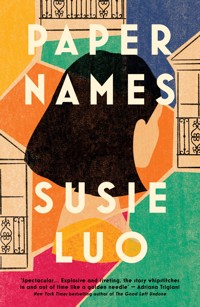
Taut, panoramic and powerful; Paper Names is an unforgettable debut about the long shadows of our parents, the ripple effects of our decisions and the ways in which our love transcends difference.
Outside a New York apartment building, an attempted mugging alters the lives of three people.
Tony, a Chinese-born engineer turned Manhattan doorman, who immigrated to the United States to give his family a better life.
His daughter, Tammy, who grapples with the expectations surrounding a first-generation American as she grows into an ambitious young woman.
And Oliver, a charming white lawyer with a dark family secret, who is continuously propelled towards Tammy and Tony, whether by fate or his choices.
Set in New York and China over three decades, Paper Names explores what it means to be American from three different perspectives. As Tony, Tammy and Oliver each strive for their own American dream, and make sacrifices to attain it, every joyous and heart-breaking twist in their stories begs the question: was it all worth it?
'Spectacular... Explosive and riveting, the story whipstitches in and out of time like a golden needle’ — Adriana Trigiani, New York Times bestselling author of The Good Left Undone
‘Unblinking, nimble, and written with the kind of clarity one expects from a seasoned author. The word stunning is not hyperbole here’ — Brian Castleberry, award-winning author of Nine Shiny Objects
‘With a keen eye for detail, a strong sense of pacing, and a deep understanding of human nature, Susie Luo crafts a moving portrait of two families whose fates intertwine’ — Christina Baker Kline, New York Times bestselling author of Orphan Train
Das E-Book können Sie in Legimi-Apps oder einer beliebigen App lesen, die das folgende Format unterstützen:
Veröffentlichungsjahr: 2023
Ähnliche




















Praise for Paper Names
*A Reader’s Digest Best Book of 2023 and a Good Morning America Buzz Book *
‘A moving story of immigrants in America’ – Town & Country
‘Gripping... Luo eloquently intertwines the struggles of a Chinese immigrant father and his first-generation daughter with the powerful fearlessness of a white lawyer with crippling family secrets. Paper Names explores love, class, identity and family, which are sure to create intriguing book club discussions’ – SheReads
‘Propulsive… An entertaining and touching debut from a new voice in Chinese American literature’ – Kirkus
‘Empathetic, propulsive, and timely, Luo’s confident plotting shines in this story of three Americans attempting to redefine themselves in a changing country as their pasts and futures collide. A magnificent debut’ – J Ryan Stradal, author of Kitchens of the Great Midwest
‘So alive and real, you don’t merely read this wondrous novel as much as you get to live it’ – Caroline Leavitt, author of With or Without You
‘Susie Luo’s debut is unblinking, nimble, and written with the kind of clarity one expects from a seasoned author. The word stunning is not hyperbole here’ – Brian Castleberry, author of Nine Shiny Objects
‘I found the book impossible to put down, as much for its propulsive narrative as for its carefully observed portrait of the imperfect nature of love, and the fraught, untamable state of being human’ – Jack Livings, author of The Blizzard Party
For my sister, Linda, my greatest champion, my light in the dark.
You are pure gold.
And for my parents.
Your journeys are more inspiring than you’ll ever know.
1
Tony
1997
There were bruises on his daughter. Tony counted three. One from when she fell off her bike. Another from a game of tag on the playground. The last one was fresh. Barely noticeable, a dash of pink on her cheek. It could even be mistaken for blush.
Tony scooped Frosted Flakes by the handful, straight from box to mouth. It tasted like sugary cardboard. His daughter was seated at the table with a rigid posture. Her straight back, a silent fuck you.
‘Your cereal is getting soggy,’ he said.
Tammy didn’t move, eyes glued to the floor, ignoring both her father and the bowl of golden specks in front of her. At fifty inches and sixty-two pounds, she hit the exact numbers for an average nine-year-old girl, but Tony knew that she was anything but. She had a ferocious curiosity beyond her years. And a stubborn will that impressed him as much as it ignited his temper.
He said, in a singsong voice this time, ‘Do you want something else for breakfast?’
Again, the little girl didn’t reply, and as she tugged on her dress, two sizes too big, Tony’s entire body tensed. For a moment, he thought the mark on her cheek had darkened, but it was only a flicker of shadow. He whispered his adopted American phrase of relief: thank God. Not that he believed in God. He could only count on himself.
If she’d let him, Tony would wrap his arms around his daughter and hold her until she softened. He would braid her hair the way that she liked, tell her how sorry he was for raising his hand to her the night before. But he knew that she wouldn’t let him off the hook that easily.
His wife, Kim, swept into the kitchen in a bakery uniform. She took one look at Tammy and the untouched bowl of cereal, rummaged through the cabinets, and stuck two Pop-Tarts in the toaster oven. As the scent of cinnamon filled the air, Tammy’s lips turned up. Tony clenched his jaw so forcefully that he felt the muscles in his neck twitch.
Kim could always sneak a smile out of Tammy.
‘Can I eat in my room?’ said Tammy.
Of course not. She knew the rules. Food stayed in the kitchen. Tony waited for Kim to say no, but instead, she brushed her hand against Tammy’s back, kissed her on the top of her head, and said, ‘Just this once.’ Without another word, Tammy disappeared.
‘What’s the point of having rules if you keep letting her break them?’ he said.
‘She’s still not talking to you?’
Tony shook his head, defeated.
‘You have to control your temper,’ said Kim, tsk-tsking.
‘My temper? If I had talked to my father that way –’
‘Tammy isn’t you,’ said Kim. ‘She’s stronger.’
Too strong, especially for a girl. He knew he’d lost control last night, but his daughter had provoked him. He had to parent her. Children needed discipline and boundaries. He was grateful that his father took the wild out of him. Tony handled Tammy with much more care. Unlike his father, he knew the difference between an open palm and a closed fist.
‘She mocked me. My English,’ said Tony.
Kim sneered. ‘Ni diu mian zi le?’
Did you lose face? A phrase that he’d grown up with. Defended against. His father used to spit it at him at every opportunity. That one time he missed top honors in the third grade. Or when, from the stern of a small fishing boat, he struggled to drag up the net, a three-meter-long cylindrical mesh contraption that was too unwieldy for a twelve-year-old boy. Or on his sixteenth birthday, when his father read out loud a newspaper’s rejection letter of his short story. Afterward, he tore up the paper. ‘You wrote about a talking calculator? You just made me lose my face.’
Tony hadn’t heard that phrase since he’d left the village for college. By then, he had made himself unobjectionable. Not only was Tony brilliant – the top engineering student at the Dalian University of Technology – but he also played basketball. A rare meld of brawn and brains in China. Girls hung around the court after his games, hoping for some attention. They all knew he was going places. Everyone – from his professors to his roommates – knew he was special.
Every department needs a student like him, they would say.
Golden boy.
His parents must be so proud.
Ta men dou gei ta mian zi. Everyone gave him face.
Now, his wife and daughter, his new country, his new life, kept clawing it away. He wasn’t sure how or when he’d earn it back.
‘I’m ready.’ Tammy had returned to the kitchen with her backpack, her hair swept back in a braid. The top section was uneven, and she had clearly missed a step in the 1-2-3 pattern near the tail. In recent months, she had insisted on styling her long locks herself.
‘Do you want me to redo your hair?’ asked Tony.
‘What’s wrong with my hair?’ she said, cutting him down with her gaze.
Kim gave him a look that said, See? Stronger.
He saw. His little girl could spar. She had confidence at her core, a quiet flame that neither he nor Kim possessed.
‘Don’t wait for me for dinner. My shift ends at ten,’ said Tony.
Kim nodded. ‘Buy something hot to eat.’
‘Let’s go,’ said Tammy, pacing around her mother.
Tony held the door open as the two most important people in his life walked out.
Alone, he fetched a pair of scissors from a sticky drawer that took a few tries to open. The drawer was like most things in the cramped kitchen: partially broken. Snipping the blades of the scissors anxiously, he wandered through the basement apartment and paused at Tammy’s room. Her stuffed Dalmatian sat in the middle of her queen-size bed, as if guarding it for her return. A diary lay on the nightstand, closed shut with a silver lock. Tammy always seemed to be writing in it. There were days when Tony wondered what her tiny hand was scribbling. Other days, he knew.
Tony carried on to the room he shared with Kim. The only things that fit in there were a frameless mattress and a dresser. Even though it was smaller than Tammy’s room, he never complained. She needed a desk for her homework.
Tony opened the small closet and picked out one of his three dress pants. He had steamed them last night but was checking for any stains he might have missed. With machine precision, he cut off the stitching that had started to fray. The material was so stiff that he had to wriggle his legs into it. He put on his button-down shirt, top hat, white gloves, and long-tailed overcoat. When he’d finished, he looked like a cartoon character, a bellhop from another century. The uniform, particular right down to the black socks and oxfords, signaled his status. I’m at your service, it said.
In China, he had been the lead mechanical engineer on a project for autonomous elevators that could calculate and adjust their own speeds – something that no university engineer had ever solved. It could’ve changed the way large buildings operated in the city of Dalian, in all of China. But he abandoned that path six years ago, in 1991, when he moved to New York. Not Manhattan, but Flushing, Queens. None of his degrees or awards had followed him across the Atlantic.
For the first two years, he renovated and repaired elevators, mechanically, with his hands, on his knees. His clothes were regularly stained with oil and smudged yellow and black. The company didn’t give him personal injury insurance, and he knew he had no bargaining chip to ask for it. After nearly losing a finger on a finicky cable wire, Kim demanded that he find a desk job, even if it meant less money for the family.
He became the on-call handyman at an Upper West Side co-op building called The Rosewood. Maintaining the building called for electrical, HVAC, and basic construction skills, but the most popular request he received from the residents was to fix their toilets. Those with delicate snowy skin refused to plunge their own hard turds down the pipes. He did battle with over a hundred overstuffed porcelain bowls before working his way up to the title of doorman.
At night, he took computer science classes at Queens College. Software didn’t hold a light to his old career in hardware, but at least they were two halves of a whole. Now he was only a year away from graduation and daydreamed about offers from the likes of Netscape and AOL. What his former colleagues in Dalian would think about him then.
The American-born were puzzled when he spoke of trading his successful life in China for this immigrant struggle. Sometimes, he questioned it too. His parents had taught him to chi ku – eat bitterness – but they hadn’t prepared him to eat shit.
Back in the kitchen, Tony squeezed three sandwiches into his backpack. Kim had made them the night before. Jif peanut butter in between slices of Wonder Bread. His usual, save for the weeks when ham and cheese were on sale at the grocery store.
His green JanSport was heavy, already carrying three large textbooks and his personal bible: the compact edition of the Oxford-English dictionary. One perk of the doorman job was the dependable lulls in the day for studying. Before he left the apartment, he made sure to check the stove. He pointed his finger at each knob and mouthed off, off, off, off as he went down the line.
On the crowded subway, Tony itched his sweaty neckline and unbuttoned his cuff links. The polyester wool blend suit grew tighter on him by the minute. Suddenly, the train jolted to a halt, wheels shrieking. The conductor garbled over the speakers about a signal malfunction – the first words of English that he’d heard that day. The other passengers checked their watches in a panic, muttering curses. Tony didn’t worry. He always gave himself extra time to arrive anywhere – thirty minutes for work and school, an hour for Tammy’s piano recitals, and three hours for any international flight. Being on time was simple – just plan ahead. He was always planning ahead.
Above him, colorful subway advertisements ran along the walls. A narrow-necked bottle of sparkling water ‘designed for the bold since 1981.’ A flower delivery service ‘guaranteed to make your wife fall in love with you all over again.’ And an antidepressant that declared ‘a new dawn.’ None of those ads appealed to Tony. Tap water served him just fine, Kim would kill him if he wasted money on roses, and he didn’t have time to be depressed. Another banner, with faded black lettering, warned that skipping fares on the subway could result in an arrest or fine. That one made Tony pull his jacket snug on his shoulders.
Above ground again, Tony checked his pant pocket for his wallet and felt a hard object lodged underneath it. A glass containing a dark coarse powder and labeled cat’s claw – immunity booster. Kim had purchased it on her weekly visit to the traditional medicine man on Kissena Boulevard. ‘Sprinkle some in your coffee,’ she’d told him as she unloaded the rest of her purchases onto their mattress. Valerian root and passion flower for sleeplessness. Gingko and pennywort for brain boosters. ‘Natural remedies are the secret to a long and healthy life,’ she said as she gazed at her collection of tiny corked bottles. Her nonsense powders. It was her way of staying close to her occupation in China: a medical doctor whose practice had been solely grounded in science.
During the early nineties, a wave of Chinese immigrants turned their backs on their old careers and descended upon the States as an army of software engineers. Anyone could quickly learn to speak in 1s and 0s and single-word functions and semicolons. Tony still didn’t understand why Americans themselves didn’t want such high-paying jobs. Kim guessed that it was too much work for too low of a profile. Regardless, they saw the opportunity and crawled through that hole to America. Neither of them regretted their decision, but it didn’t mean it was easy to live with either.
In China, they had had everything, but by way of a trusted grapevine, they learned that everything they had was better in America. In America, middle-class people could afford to live in single-family houses instead of cramped apartments. They didn’t only have a washing machine for laundry, but a dryer and a dishwasher. Indoor heat was theirs to adjust – not controlled by a building’s stingy landlord. The streets were cleaned by a small truck with a mechanical sweeper and vacuum instead of a man with a wooden broom. While only five percent of students could test into college in China, most American children who wanted to go to college could. Some even went to Ivy League schools. Still, the most memorable comparison they had heard was that in China, they could only spring for cake with cream once a year, but in America, they could eat it every week.
A block away from The Rosewood, an older gentleman in a three-piece suit cursed into his cell phone. The man growled, ‘I don’t care if it’s before 6:00 am in Los Angeles. He works on my time.’ A woman with puffy eyes wiped her nose on the sleeve of an oversized sweatshirt. Her face – sallow, carved with a desperate loneliness. Tony shrank as he passed her.
What a strange land he’d discovered. He had witnessed children screeching profanities at their nannies. Protesters marching with signs to arrest the nation’s president. Americans had no shame, no commitment to public decorum. He admired them. They were fearless; they were real.
The sun glared against the glass entrance of The Rosewood. Tony’s shoes made ugly, slapping sounds against the grand marble floor as he passed through the revolving door into the lobby. Magic, one of the other doormen, was at the front desk, already packing up to leave. He was a Polish immigrant, tall and wide as a giant, and a ceaselessly buoyant gossip hound. His name tag said ‘Maciej,’ but everyone called him Magic.
‘You can’t let Daphne into apartment 615 anymore,’ said Magic.
‘Mr Waldron’s girl?’ said Tony.
Magic nodded. ‘His lawyer is getting the paperwork together for the restraining order. Think she threatened to tell his wife about them.’
Daphne would soon be number seventy-four on the black-balled list, which mostly consisted of media outlets, stalkers, and ex-wives. The residents of The Rosewood were prone to filing restraining orders – drawing an invisible legal shield around their lives. The doormen were their first line of defense. Twice, Tony had had to use the bat he stored under the desk to chase off a man whose life goal was to sleep in Bruce Willis’s bed. Still, Tony preferred to work here over other, less dramatic apartment buildings. The residents of The Rosewood were particularly generous over the holiday season. Last year, he’d cobbled together fifteen thousand in cash bonuses – more than half his annual salary.
‘I haven’t seen Mrs Waldron in days. Do you think she found out about Daphne?’ said Magic, stroking his chin.
‘You’re the detective,’ said Tony. ‘Any theories?’
Magic lit up. ‘Maybe Mrs Waldron’s visiting her brother. I overheard her on the phone last month. He’s in a rehab facility upstate,’ he mused. ‘Or, she could be recovering from her third face-lift. The doctor’s office sent a new bill.’ Tony hated to admit it, but this was probably going to be the highlight of his day.
Tony used to despise gossip, but once he became a doorman, he began to understand its entertainment value. His twelve hours at the desk were filled with frivolous small talk, passing out the mail, and responding to convenience requests from the residents. Unit 204 needed a thirty-five-pound pail of cat litter carried to its front door. Ring the Carlsons on the fourteenth floor when a man in a dinosaur costume arrived. If it weren’t for Magic’s snooping, the job would be unbearably boring.
‘Did you hear?’ said Magic. ‘The Liddles are moving out. Sold their apartment for over three million.’
Tony gave a long whistle. The Rosewood address alone must’ve doubled the price of that unit. He’d been inside a few times to repair the air conditioner and shower drain. It was a modern and sleek three-bedroom, with an exceptionally elegant pass-through kitchen, but three million was absurd. He was developing a good eye for the cost of things.
On the first Saturday of each month, his little family would visit six or seven open houses. Sometimes, they stayed within the perimeter of the city, mostly looking at apartments and brownstones. Other times, they took a road trip to see the mansions out in the suburbs – Bronxville, Scarsdale, Pelham. Everything was comically out of their price range, but that was the fun of it.
The real estate agents hosting the open houses ranged from civil to outwardly annoyed, even though the Zhangs made it a point to be polite ghosts. One place, he remembered, had a plate of cookies on the kitchen counter. Golden-edged with generous chunks of chocolate. When Tammy went to take one, he tugged her arm away. ‘We don’t do that,’ he said. The real estate agent gave him a weird look. She was fine, thought Tony. He had barely touched her.
The Zhangs toured each house together – through the airy hallways, round the living room, up the stairs. ‘I would’ve placed the coffee table at the other end of the sofa,’ Kim would often opine. In a sun-filled room with a slanted ceiling, Tammy planted herself in a corner and said, ‘My bed could go here.’ Sometimes, they would look out the window at the houses next door. Wondering if the neighbors were as kooky as Steve Urkel in Family Matters or as rowdy as the Bundys from Married with Children – sitcoms they had watched to learn English.
In each house, Tony fantasized about the same imaginary routine. Kissing his wife on the cheek as he came in the door. Checking his daughter’s homework. Complaining about the furnace and then calling someone else to come fix it. Having a yard with a rosebush and a flag billowing in the wind. A house that they bought, a place they could call their own, that could never be taken away.
On his way out of the building, Magic said, ‘I finished sorting the mail already.’
‘Cool,’ said Tony. He studied Magic’s reaction. There was none, which meant that he had probably used the word in the right context. Tammy had been throwing around the word lately, but he wasn’t sure where it belonged and where it didn’t. He just knew from the way she said it that he had to sound casual. Quick and relaxed. He wouldn’t have dared to experiment with it on one of the residents.
Alone for the second time that day, Tony tidied up the desk. He neatly piled the paper clips next to stacked pads of Post-it notes. Gathered all of the pens into the mesh metal cup. Wiped down the desk with antibacterial spray. Then, finally, he opened his dictionary to the dog-eared page.
He underlined a word near the top: net. He thought that he could skip over it, having used it many times already. A volleyball net. Catching fish in a net. He had even known that it was an abbreviation for the internet. That should have been more than enough for one word. He had no idea that it was also an adjective. ‘Free from all charges, deductions, or debt,’ the dictionary gods had written. Net earnings, net worth.
His brain rolled over, overstuffed with the strange rules and allowances of the English language. Mandarin was simple. One sound for one word. A character might have the same pinyin, but accents set each apart. The four tones dictated whether ‘ma’meant mother, hemp, horse, or scold. No exceptions.
Tony had already studied six pages of the dictionary and was in the middle of reading the definition of noteworthy when he heard the elevator doors open.
A woman glided past the front desk. She was wrapped in a brilliant emerald scarf. It draped around her tiny shoulders and beneath her bony little elbows, finally ending in a tied ribbon in front of a well-fed belly.
Tony stood up and with a slight bow said, ‘Good morning, Miss Abadi.’
‘Oh, you? You’re still here?’ she said. ‘Remind me to fire that assassin I hired!’ She paused to hear Tony’s laugh before making her way out the door. Clara did this every morning – recited a line from one of her old films. Magic had told him during his first week on the job that Clara Abadi had been a movie star, famous in the fifties and sixties for a string of blockbusters and an even longer string of torrid affairs. Her Rolodex of lovers included all the obvious A-listers, publishing heirs, Saudi oil kings, even female Olympic athletes. The woman was blind to age, gender, geography, and marital status. ‘A tabloid sweetheart,’ Magic had called her, whatever that meant.
Over the years, Tony had sent crates of European wine, exotic birds that looked at him funny, and jewelers accompanied by their bodyguards up to her apartment. She also had deliveries that didn’t fit in the elevator. That month alone, Tony had to carry a painting wrapped in Mylar that kept threatening to slip off his back, and drag something heavy in a body bag, up the twenty-three flights of stairs.
Clara’s was the one unit in the entire building that Tony had never entered. Whenever she went on vacation, he dreamed of sneaking in with the extra key at the front desk. He imagined her apartment awash in gold – golden tables, chairs, beds, floors. Plush velvet covering every surface. Chandeliers, chilled champagne, and fresh fruit in every room. He was fascinated by Clara. She didn’t just live life. She luxuriated in it.
Clara was on the street now, but he could still see her through the glass doors. A bundle of bracelets laced her forearm. A Chanel purse, the color of a strawberry milkshake, in her hand. He was squinting at her shoes, trying to remember the term for a sandal with a high heel, when Oliver, the lawyer in unit 505, approached her on the street. From behind the desk, Tony observed the young man’s profile. Gelled brown hair, high-bridged nose, a strong chin. Even in a striped cotton shirt, Oliver looked more like a professional than Tony did in his suit.
Tony hoped that Tammy could carry herself with the same charm and easy confidence when she grew up. He did some mental math to see how quickly Tammy could graduate college, then law school, join a firm, save up and live in a place like The Rosewood. Maybe when she turned forty. But Oliver wasn’t even close to that age. Lawyers must make even more money than he had assumed.
Then Oliver strode into the building and greeted Tony. At least a hand over six feet, Oliver towered over him. ‘How’s your family? How’s your daughter, Tammy, doing?’ Oliver asked.
Some residents did this – engage a few inches in the shallow end with the doormen. It was a nice gesture, but Tony hated it. He called it pity attention. The residents paid him to be there. They didn’t have to pretend to be friends or equals.
‘Tammy got all As on her report card again,’ said Tony. ‘Her math teacher says she’s the smartest fourth grader she’s ever seen. She doesn’t need a pencil or paper for her multiplication problems. She does it all in her head! I can’t even do –’
But Oliver was already on his way to the elevator bank.
Tony bit his tongue. He should’ve just given a generic answer, a simple ‘Tammy’s good, thanks for asking,’ but when it came to talking about his daughter, he found it hard to stay quiet. He was still berating himself, hearing Kim’s reprimand – people don’t like to hear about your successes – when it happened.
He had heard it first.
A howl. It cut through the city noise and echoed through the lobby.
He scurried out from behind the front desk and sprinted outside.
The first thing he saw was blood. Clara’s blood, running down her face. She was lying on the ground.
A man grabbed her pink purse and began to run away.
Now Tony was running too. On instinct, on sheer nerve, that flame – alight in Tammy – now flickered in him.
He reached out and caught the hood. The man fell back. A strangled yell. They were on the ground together. The man on top of him. Tony took a blow to the chest, and the pain reverberated through his rib cage. A windmill of arms and wrestling. Knuckles crashed against his cheekbone. A rasp of tearing cloth.
The man hooked him with a fist to the side of his head, filtering his world red for a few seconds. His lungs hurt when he breathed, but he suddenly felt present in his body, pinned to the moment in a way he hadn’t been for years. He pushed off the ground and leapt at the assailant, grabbing him by the shoulders. The two of them scrambled upright – like two horses on their hind legs – before the man crumpled underneath him. Tony punched down, slamming the man’s skull against the concrete.
A small voice told him to stop fighting. But he was overwhelmed by how natural the movements felt. Each strike felt like a glimpse into the logic of the universe: his hands were made to curl into fists, to fight. Between punches, he met the eyes of the man. Frightened eyes, pleading. Like Tammy’s the night before.
The high-pitched scream of sirens.
Tony’s hands dropped to his sides. He was shaking and sweaty. Had he done something bad? Whatever it was, it was too late to take it back.
A metallic taste rose in his throat. The blood stained the sidewalk brown, already mixing with the city’s filth. Red blotches and ripped holes in his doorman suit – that would come out of his paycheck.
Now Clara pointed at him. She looked mad, her nose still spouting blood. She was ready to blame someone. It would be him. It was all his fault.
‘That China man,’ she cried, as a paramedic and two police officers surrounded her.
Finger still outstretched toward Tony’s face, she shouted, ‘That China man saved me.’
2
Oliver
Oliver was eating a chocolate croissant at La Belle Étoile, Kip’s go-to breakfast place for clients. Waiters in crisp vests wove by him, delivering trays of Colombian coffee with ceramic creamers. Shunning pancakes and bagels, the menu offered crepes, tartines, and twelve-dollar pots of organic loose-leaf tea.
He wore a pair of black-rimmed glasses that pinched his nose. No contacts today. No three-piece suit or loafers. This client called for a different kind of costume: a slim-fit T-shirt and jeans. Evan was practically a boy, a college dropout. He was only a few years younger than Oliver, but he’d already launched a digital music start-up with millions in venture capital backing.
‘Your company is the future,’ Oliver heard himself say. It came out flat. The exaggeration was supposed to express his admiration, even sound inspirational, but he still couldn’t sell what he didn’t believe.
But Kip could. ‘This technology is going to change billions of lives,’ he said.
Evan, whose long hair swept over his eyes, smirked. ‘Our version of the MP3 player is good. It’s amazing if you consider the extra storage space for songs,’ he said, ‘but it’s not going to change lives.’
‘You kidding me?’ said Kip, cutting into his rib-eye and eggs. ‘Songs give people courage. They give them a personal soundtrack, a boost to make them achieve something they would never otherwise believe they could. And the bigger the soundtrack? The more dreams you just green-lighted.’
‘If you put it that way,’ Evan said, as he lifted his chin in agreement. He took a forkful of his crepe. The sides of his mouth were lined with traces of powdered sugar. Kip knew how to stroke an ego – even a reluctant one.
That was why Kip Appleton was managing partner and had his name on the letterhead of one of the most prestigious white-shoe law firms in Manhattan: Steinway & Appleton. Kip had never even used an MP3 player. ‘It’s vinyl or it’s shit,’ he said when he saw Oliver’s CD player in the office. Oliver brought the electronics back to his apartment that night.
Still, he couldn’t complain about the old man. A mere second-year associate, Oliver wasn’t even supposed to be at this meeting. Client events were normally reserved for senior associates and partners. But Kip – who had been his grandfather’s protégé and best friend – always propped Oliver up, ever since he was little. Never wavering, even after the scandal broke. Unlike everyone else he knew.
Oliver didn’t even notice that the waitress had refilled his cup until it was suddenly brimming with coffee again. ‘Thank you, Danielle,’ said Oliver. She smiled back. How unique and thoughtful, she must be thinking, that a patron would bother to learn her name. Kip definitely didn’t know it, even though he had been coming here for years. But it was fine. Kip probably tipped her well.
‘So, you been hitting the clubs?’ said Kip.
Evan gave a small shrug. ‘Actually, I’ve –’
‘Oh, no, you’re cooler than the morons who hang out at the clubs. You’re a music guy. Bet you went straight to CBGBs from the airport to check out the talent,’ said Kip.
‘What’s CBGBs?’ said Evan.
‘Don’t worry about it,’ said Kip. ‘Whatever you’re into, Oliver can take you around, show you all the best places.’ He shot Oliver a look that said pay close attention. Kip believed that to win business, a lawyer needed to be more than a client’s confidant. He needed to be their best friend. Their genie. Their wish was his command. That included making their problems – from DUIs to sexual harassment – disappear. It also meant serving up fun. Kip had box seats at Yankee Stadium, a standing Saturday night table with bottle service at a members-only club, and privileges for backstage meet and greets with musical superstars at Madison Square Garden.
‘I like reading,’ said Evan.
Kip frowned a little. Not in his repertoire. He nodded toward Oliver.
‘Reading. That’s cool,’ said Oliver. ‘What kind of books?’
‘Fantasy,’ said Evan.
‘Like TheLord of the Rings?’
Evan perked up. ‘Yeah, have you read it? I read all the books twice when I was a kid and again last year. I heard they’re being made into movies. It’s going to be so sick.’ He said it all in one breath. Suddenly, the kid had come to life.
‘I love them. What an epic story,’ said Oliver, even though he had never read one word of The Lord of the Rings.
‘Sounds like you two have a date for a comic book convention,’ said Kip, leaning back in his chair.
‘Can we get VIP passes?’ asked Evan, almost knocking over his Sprite.
‘Done,’ said Oliver. He would rather stick his nose hair trimmer up his butt than hang out with cosplayers, but Kip was letting him handle a client alone. Already. He hadn’t realized that Kip believed in him this much.
After the client left, Kip ordered a Bloody Mary to go. ‘Good job, Big O,’ he said. ‘Want to ride to the office together? The chauffeur’s waiting at Columbus Circle.’
‘I have to go pick up some files from home,’ said Oliver. ‘The Rosewood isn’t too far. I’ll just walk.’
‘Don’t work too hard,’ said Kip. As if that meant something. As if they both didn’t know that the firm required their associates to bill three thousand hours a year.
No one made eye contact with Oliver as he strolled up Central Park West. Not the trio of mothers, pushing their identical prams. Or the professional dog walker, wrangling a pack of goldendoodles. Not even the teenager in a private school uniform, sprinting toward the subway station.
The only exception was the guy selling flowers on the sidewalk. ‘Flowers? Flowers? A guy like you definitely has got a girlfriend.’
‘Sorry, no, thanks,’ said Oliver. He did have a girlfriend, but bringing her flowers would be sending the wrong message.
‘Three dollars off,’ said the flower vendor, with a hint of desperation. The man blinked back rivulets of sweat. It wasn’t even noon yet, but he must have already been standing in the glaring sunlight for hours. Oliver knew how it worked. The man was parked here until all his flowers were sold. It almost made Oliver want to buy a bouquet just to help him out, but he continued walking.
He had met his girlfriend, Janna, last year at the Tenth Annual Blood Saves gala. Kip had bought a $5,000 table for the law firm, and after Oliver choked down his plate of overcooked chicken and limp asparagus, he went over to the blood donation station. A pretty nurse with a contagious smile asked him to roll up his sleeve. He could tell that she liked him by the way she avoided eye contact and fumbled with the tourniquet.
‘First time?’ he said.
‘I usually draw blood from children,’ she said. ‘At Memorial Sloan Kettering,’ she added, looking him square in the eye.
‘I’m just a big kid. I get a little squeamish.’
‘Don’t worry. This won’t hurt a bit,’ she said.
Needle still in his arm, he asked for her number. They went out to dinner the very next night, and Oliver brought her back to his apartment the night after that.
At the beginning, she had been easy in the best ways. She was independent. Busy with her own twelve-hour shifts at the hospital and volunteer activities on her days off, she barely noticed his long stints at the office. And she was endlessly patient and optimistic. One day, while they were waiting at an intersection, someone sneezed right on her bagel. She shrugged as she dropped it into the nearby trash can. ‘That Good Samaritan just saved me a gym session.’ At late-night dinners, she even had the sixth sense not to pry about his family when he clammed up. She didn’t seem to want anything from him other than to be with him. If there was a person he should fall in love with, it would be her.
But after a year of dating, she had been dropping hints that she wanted more. Pausing to examine his reaction after saying that she had never been to Paris. Mentioning that her parents were coming to town in September. Dropping by The Rosewood unannounced with a basket of Levain cookies when he said he had to spend the whole weekend working.
This was about the stage he’d ended it with his past girlfriends. Still, in the middle of the night, he’d wondered if it could be different with Janna, if he could tell her the truth. She was kinder than most, more open-minded. She took care of children who had terminal cancer, for God’s sake. Maybe she could draw the poison out of him as painlessly as she’d taken his blood at the gala. But time had a way of outing true intentions. She might be understanding in the first year, even flattered that he had confided in her. But in five years, when they had children, or ten years, or twenty, she’d grow to resent him. Worst yet – she might pity him.
His throat tightened. Relax, he told himself, there were more pressing matters to address. Like work. He refocused on the plan – home, files, office – and picked up the pace.
A few blocks later, The Rosewood appeared. The crown jewel of the Upper West Side. The building – with its gable dormers, terra-cotta spandrels, and pale red bricks – was home to two Nobel Prize recipients, a Beatle, a bevy of Oscar winners, and a C-suite member from each bulge bracket bank. The only thing more impressive than The Rosewood’s list of residents was the list of people it rejected: rock stars like Axl Rose and Mick Jagger, America’s sweetheart Julia Roberts, and even former president Jimmy Carter. There didn’t seem to be any rhyme or reason to the application process. Oliver only lived there by the grace of Kip. Oliver didn’t know what the old man had said to the board members to convince them to hand over the keys, but as usual, it worked.
A figure waved at him from under the building’s awning. As he got closer, he realized it was Clara. Her eyes, crinkly yet childlike, made him feel as though she had been waiting for him all along.
‘Could I interest you in a nooner?’ she said.
Zero inhibition – the classic affliction of aging coupled with Hollywood bravado. New Yorkers had the thinnest of filters, but Clara was pure thought. She looked expectantly at his face, but Oliver could only gape like a fish.
‘You’re no fun,’ she said with a smirk.
Oliver laughed. ‘Well, no one’s as fun as you are.’
‘True. There’s only one Clara Abadi.’
‘Where are you off to today?’ he asked.
‘Lunch with the girls. They’re going to choke on their mimosas when they see my new purse,’ she said, giddily clutching at her pink Chanel. The string of pearls across the front made little clacking sounds.
‘Very fashionable,’ he said, despite thinking that it looked like a cheap plastic bag that a child would carry to a tea party with her toy bunnies. The compliment was compulsory. She was famous, sort of his neighbor, and most importantly, a woman. Part of his job as a good-looking man was to make women of all ages feel pretty.
Inside the lobby, he passed the marble desk, where Tony, the doorman, was already standing. Oliver noticed the open dictionary. He couldn’t remember the last time he’d seen Tony without it. It was admirable that his doorman was trying to assimilate into American society, though it might already be too late for him. No matter how much he studied, he would always sound foreign, never capturing the tempo or the accent quite right. It was like a silver spoon – you were either born with it in your mouth or you weren’t.
‘Good morning, Tony. How’s your family?’ said Oliver. ‘How’s your daughter, Tammy, doing?’ He looked around quickly to see if anyone else heard. Not only did he know his doorman’s name, but he also knew the name of his daughter. Impressive.
‘Very good. Tammy got all As on her report card,’ said Tony.
‘Right on,’ said Oliver, walking to the elevator bank.
While waiting for the elevator, he caught his reflection in its brass doors. He brushed his fingers through his thick brown hair and turned his head this way and that. A sophisticated widow’s peak. A chiseled jaw and a pair of sapphires for eyes. Such a handsome face. He wondered if ugly people thought the same about their own. If it were a biological imperative for people to think of themselves as beautiful. Sometimes, he wished that he were more plain-looking. As it was, his sharp features were a constant reminder that he was jinxed. If genetic material were a deck of cards, he got dealt the same hand as his grandfather.
Suddenly, a scream echoed through the lobby. It sounded like it was coming from outside. Then a scurrying of footsteps. He turned toward the entrance just in time to see Tony rush outside.
Oliver crossed the lobby to the front door, and that was when he saw it: Clara was being attacked on the street by a man in a gray hoodie. For a moment, it looked like they were dancing. But no, they were tugging apart her pink purse. ‘Get off!’ she yelled, holding her ground.
Just as Oliver thought about running out to help, the hooded man punched Clara, breaking her nose. Blood poured down her face. Oliver backed away from the glass door, nauseous, wiping his own nose as though it were bleeding too.
The man began to run away, leaving a breadcrumb trail of pearls that had fallen off Clara’s purse, but Tony was racing outside now, and grabbed him by the hood.
It all happened so fast. A flurry of limbs, sounds of ribs cracking. Tony took two hits to the chest. As he staggered backward, the mugger used that momentum to push him to the ground. Oliver winced as the man threw a punch across Tony’s jaw.
The mugger was twice the size of the doorman. It wasn’t a fair fight. Oliver pushed against the glass door, but froze in place when Tony spit out blood.
Then his phone buzzed. Kip was calling. Maybe he could pretend that he had been busy on the phone and hadn’t seen anything. There were two other men nearby. They could intervene if Tony really needed it.




