


Erhalten Sie Zugang zu diesem und mehr als 300000 Büchern ab EUR 5,99 monatlich.
- Herausgeber: Nine Arches Press
- Kategorie: Poesie und Drama
- Sprache: Englisch
Exploring place and displacement, boundaries and borders, Passport is the second collection by Richie McCaffery, and follows his acclaimed debut Cairn (Nine Arches Press, 2014). In moving to the Belgian city of Ghent, McCaffery finds "What I see and what happens / are two different countries." In a place of dualities and unrealities, the poems find the usual definitions themselves becoming unstable; the old currency that is no longer valid, the postcards home unsent and the present tense ill at ease. Written in crisp detail, these fluent poems weigh up whether leaving is a form of running from or coming back to home, wherever that may be. At the heart of this tender and compelling collection, McCaffery writes directly of anxiety, loss and dislocation, asking us to consider what belonging is, and how we find our place in life, in love, and in language.
Sie lesen das E-Book in den Legimi-Apps auf:
Seitenzahl: 32
Veröffentlichungsjahr: 2018
Das E-Book (TTS) können Sie hören im Abo „Legimi Premium” in Legimi-Apps auf:
Ähnliche






Passport
Passport
Richie McCaffery
ISBN: 978-1-911027-43-0eISBN: 978-1-911027-67-6
Copyright © Richie McCaffery
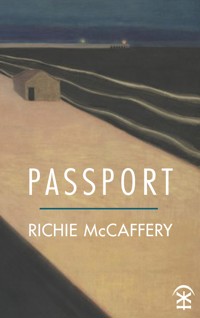
Cover artwork: Léon Spilliaert: ‘La digue’ (inv. 10224) – bestaande digitale illustratie © Royal Museums of Fine Arts of Belgium, Brussels / photo: J. Geleyns – Art Photography
All rights reserved. No part of this work may be reproduced, stored or transmitted in any form or by any means, graphic, electronic, recorded or mechanical, without the prior written permission of the publisher.
Richie McCaffery has asserted his right under Section 77 of the Copyright, Designs and Patents Act 1988 to be identified as the author of this work.
First published July 2018 by:
Nine Arches Press
Unit 14,
Sir Frank Whittle Business Centre,
Great Central Way, Rugby.
CV21 3XH
United Kingdom
www.ninearchespress.com
Printed in the United Kingdom by:
Imprint Digital
Nine Arches Press is supported using public funding by the National Lottery through Arts Council England.
for Stef
CONTENTS
They were worried about me
Breakdown
Postcard from Ostend
Looking for Léon Spilliaert
Double Dutch
Brick
Delft tile
Kongostraat
Ish
Beeldenstorm
University
Ballylar, Fanad
Spoor
Marrakech
Currency
Desert rose
Career change
Ghent statues
Moles
Roots
Auspex
Little farm
Light
Stones
Obituaries
Robin Hood’s Bay
Echo
Apple
Proof-reader
Spanish guitar
Janus
Present tense
The gifts
Calling
Ghent
Typical me
Baudelopark
The paper cut
Iconography
Oil and blood
Nowhere
Postcard
Bottle show
Resolution
Eye test
Day in the life
Balancing the books
The dippers
Spring-cleaning
Ballast
Left hand drive
Corner
An endangered bird made its nest
Acknowledgements and thanks
About the author & this book
They were worried about me
so they got together
to say how much I’m loved.
There are medieval churches
out there that still manage
to fend off the rain.
It sometimes seems like
their future depends on the sale
of a few mouldering paperbacks.
What I see and what happens
are two different countries.
I must try to remember this.
Breakdown
In bonding with my father and grandfather
we always seemed to break things.
With one I chopped down trees
and the other I tinkered with machines
so they never worked again.
The foundation of our love was destruction,
although all three of us had been created.
I’ve no kids of my own and no intention,
so I pull myself apart without knowing
how I can be put back together.
Postcard from Ostend
Even after the planes flew over,
levelling the city,
pre-War postcards were sold
of happy children and flowerbeds.
Like people, postcard photographs
came in generations.
Copies copied from copies,
an ebbing of definition.
Bombs and developers still couldn’t
change its name. But I worry if
you visit me here you might find
someone else answering to mine.
Looking for Léon Spilliaert
We’re here to find the grave
of Spilliaert, the symbolist artist,
and his wife Rachel. A hard ask
since all the ten-thousand granite
tombs look exactly the same.
You go your way, I go mine
until we’re lost to each other
and I give up the search for them
and start looking for you, your
red hair bobbing against the grey.
You too are nowhere to be seen
and must be looking for me.
Double Dutch
i.
In Catholic Belgium, the norm
is to have a crucifix hanging
in every classroom. Ours
is broken and lies in bits.
It looks like a gun someone
has been ordered to surrender.
No one mentions it.
I’m the one person in my class
not fleeing war or tyranny.
They accept me, even when I say
I’m only here for love. We bond
over coffees we buy each other
and the language we’re slowly
making our own.
ii.
There’s a cobbled path that leads
down to my Dutch language school,
its stones a Babel of coloured granites.
In class I watch a man who’s just
registered for lessons try to get




