


15,59 €
Mehr erfahren.
- Herausgeber: Independent Thinking Press
- Kategorie: Bildung
- Sprache: Englisch
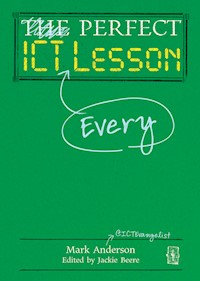
Technology is at the heart of learning for all of us and every teacher needs to be using social media, mobile technologies and transformational digital learning opportunities as an integral part of their range of strategies for helping students make the maximum progress. In this book in the 'Perfect' series, Mark Anderson, the ICT Evangelist, takes the technology-relatedelements of all the recent subject reports from Ofsted and using them offers clear and practical strategies that are proven to be successful in classrooms and offers up ideas for how they can be turned into a daily reality for all teachers.
Das E-Book können Sie in Legimi-Apps oder einer beliebigen App lesen, die das folgende Format unterstützen:
Veröffentlichungsjahr: 2013
Ähnliche
















Praise for Perfect ICT Every Lesson
Mark Anderson has a well-deserved reputation for his knowledge and enthusiasm for ICT in schools. He has a superb understanding of how ICT can enhance and even transform learning; it’s not about innovation for the sake of it or lots of flashy gimmicks. Perfect ICT Every Lesson provides an excellent framework for using ICT at a whole-school or classroom level, as well as giving teachers ideas for a range of different strategies and applications. Mark has a gift for making things seem possible. Reading this book will give teachers the confidence to try out some new approaches without worrying that they’re not ICT experts. It’s an intelligent book, which many teachers will find useful and inspiring.
Tom Sherrington @headguruteacher, Head Teacher, King Edward VI Grammar School, Chelmsford
Perfect ICT Every Lesson seeks to remove the fear some educators have when using ICT to enhance learning. The book dispels the myth that embracing technology in the classroom takes hours of discovery and days of practice before it is exposed to learners. Mark Anderson skilfully discusses techniques and tools whilst maintaining interest in the possibilities that are available to all. The developing pedagogy is outlined to the reader with relevant case studies and examples. There is real craft in the way the learning process is discussed with reference to a tool that should only be used where it is appropriate. Mark successfully informs and relaxes the reader in equal measure. Simple explanation scaffolds the wealth of experience that Mark possesses and it is testament to the author that we are eager to find out more about each suggestion.
I would highly recommend Perfect ICT Every Lesson to all educators seeking to continue their own development and enhance learning for their students. This book will sit on top of the reference list when it comes to improving my own methods and I’m thankful it has come along at this stage in my career.
Daniel Edwards @syded06, Director of Digital Strategy, Stephen Perse Foundation
In this book, Mark provides us with an exceptionally clear and dynamic vision; full of fantastic strategies, case studies, ‘top tips’ and suggestions on how to use ICT to transform learning in and out of the classroom. For someone who considers themselves tech-savvy, I still found it packed full of ‘Well, I didn’t know that’ information which had my brain whirring with new possibilities for my own teaching and my school’s approach to using technology as a platform for providing deep, creative and memorable learning experiences.
Pete Jones @Pekabelo, Assistant Head Teacher, Director of Learning, Les Quennevais School, Jersey
Mark Anderson’s Perfect ICT Every Lesson is the most comprehensive, yet accessible, overview of how ICT can be used by all teachers to enhance student learning that I have come across. Quite simply, there is something in it for teachers at every level of responsibility.
What I like most about this book, though, is that it constantly and unerringly sticks to Mark’s fundamental principle that it is the learning, not the tech, that is paramount. This is extremely refreshing coming from one of the most technically knowledgeable and proficient educators out there, and I thank him for it.
Fundamentally, the measure of any good educational book is what you learn from it and what you take away from it to implement in your practice. In Perfect ICT Every Lesson Mark has handed me the metaphoric ‘fish’ of some tweaks to make my PowerPoints more PowerFull and to help me use search engines better. More importantly, this book has given me the ‘fishing rod’ of a far clearer understanding of the SAMR taxonomy, a framework that will help me to think and plan carefully in order to move towards the ‘perfect ICT’ of the title.
Keven Bartle @kevbartle, Deputy Head Teacher, Canons High School, London
Jam-packed full of accessible and inspirational ideas, the ICT Evangelist has created a companion for every teacher in the land. Mark’s real-life shop floor experience instils the reader with the confidence with which to switch on the laptop and start experimenting. Be prepared – this is exciting stuff!
Jamie Portman @JamiePortman, Assistant Head Teacher, Campsmount (a Co-operative Academy), Norton
Mark has written an incredibly useful book, the title of which clearly suggests what it is about; it is not about a ‘one off’ ICT lesson but about integrating ICT in meaningful ways into everyday lessons to support and extend pupils’ learning. It starts with a clear explanation of the SAMR taxonomy, challenging us to think of ways in which we can truly plan for use of technology that will not merely replicate or substitute what could be achieved in a more traditional way; instead, there are illuminating examples of what our pupils can achieve that would have been impossible before. A strength of the book is its plethora of case studies and concrete examples of tasks, with a strong focus on sound pedagogy. Another strength is its plain language and avoidance of unnecessary jargon, making it really teacher-friendly.
Mark addresses current debates such as the use of mobile devices in schools, including a look at the BYOD strategy adopted by some schools. You will learn from this book – I certainly did – a sure sign of a great read.
Hélène Galdin-O’Shea @hgaldinoshea, Head of Media Studies and English teacher
For Oscar and Dougie
Contents
Acknowledgements
This book wouldn’t exist without the support and inspiration of many people. I would firstly like to acknowledge Jerome Hunt, my first head of department, who revolutionised my teaching from the very start. Secondly, I would like to recognise Sally Thorne, a history teacher from Bristol, who first opened my eyes, via a Twitter conversation, to TeachMeet. Whilst not discussed in this book, TeachMeets have helped me to affect a meteoric rise in my impact as a practitioner. Since attending Sally’s TeachMeet, and my subsequent organisation of TeachMeet Clevedon, I have been able to meet and be inspired by hundreds of amazing teachers.
I’d also like to acknowledge the support and vision of Caroline Lenton, Ian Gilbert and Jackie Beere at Crown House Publishing/Independent Thinking Press – without their support and belief in me, I would never have had the opportunity to write this book.
None of this, of course, would have been possible without the support of my colleagues at the amazing Clevedon School. My head teacher, John Wells, and his team – including the mighty Jim Smith – have afforded me opportunities to do things that I don’t think many other schools would have let me do, such as develop innovative ways of working, research new pedagogical techniques and try them out in my classroom, and take (measured) risks to bring about improved learning outcomes.
Thanks to those individuals who have offered ideas and encouragement that have inspired my imagination and hunger for educational technological brilliance, in particular Andy Hutt and Tim Rylands.
I must also acknowledge my amazing professional learning network on Twitter of whom there is a cast of thousands. Thank you.
My final acknowledgment must go to my wife (and two amazing boys) without whom this book would never have been written. Countless trips to the zoo and park and many other random destinations, so that Daddy could work on his book, have made this work possible. Without you I would never have had all of these opportunities. Thank you Emma.
Foreword
Teachers have always been in the job of information communication. Now, with the rise of digital media technologies, the means of communicating information is evolving exponentially. How many of us fully use the technology available – not just for the benefit of our pupils, but also for ourselves? How many brilliant lesson ideas have you picked up from Twitter recently, and then delivered using a range of digital media technologies in the classroom?
Teachers who aren’t yet using communication devices and social media as learning tools are missing out on some wonderful learning opportunities. But, at home, their pupils are not! They’re sharing, joining, blogging, participating, reviewing, filing, photographing, listening, commenting and observing in more amazing ways than ever before. Many children now grow up with smartphones and tablet computers at home, and as soon as they can reach out for them, they begin to play and learn.
Watching 3-year-olds download videos, post photos on their blogs and learn words through iPad games, you start to realise that many teachers are delivering lessons that date from a different era. To fully lead learning today, teachers must be willing to use technology to engage and motivate the young minds which are already immersed in this new world. This requires a mindset open to pushing ourselves out of our comfort zone and getting excited about trying out new technologies in our classrooms.
In this book, Mark Anderson helps teachers find new ways to incorporate ICT into the learning journey – whatever their age, background or familiarity with new technologies. Mark shows how all the key skills your pupils need can be taught using the remarkable new (and not so new) tools of technology and social media.
He is also clear that if we want to be the best teachers we can be, we also have to be learners in the world of ICT. Often, this means sharing expertise by teaching each other but it also involves learning from our pupils. Teachers also need to realise that we are entering a brave new world where CPD will never be the same again. There are huge opportunities to network and communicate using digital media such as Skype, Twitter and blogs linked to TeachMeets and learning forums which are providing a completely new context for professional development.
There has never been a better time to try out new technologies in the classroom and share your successes and challenges with each other in the profession. Mark makes this easy because his ideas are practical and applicable to all lessons and subjects. You will learn so much from just reading this book, but the challenge is to take the ideas and grow them in your classroom. From digital literacy to information searches to e-safety, Mark gives us the practical advice we need to use ICT in a way that suits us and our pupils.
Teachers often long for stability and consolidation rather than for more change or new initiatives. However, the high-speed world of new technology means that this is no longer an option. We all need to react to the world in which our young people live and provide an education that responds to it. If we fail to grasp these new technologies, we risk becoming irrelevant or, even worse, ignored.
Read this book and enjoy experimenting with the ideas it contains in your lessons. At times it may feel risky and scary – but that’s learning for you!
Jackie Beere, Tiffield
Introduction
‘Noooooo, not the ICT suite! I can’t believe I wrote on my performance management targets that I’d use more technology in my lessons!’
The thought of taking pupils from the safe confines of your regular teaching room to the dreaded ICT suite (or ‘Computing’ as it will be known as from now on) can send even the bravest of teachers running to the hills. The worry that the pupils will know more than you, that you won’t be the most knowledgeable person in the room, that there might be a problem and you won’t know how to fix it, even those chairs that spin round and offer endless opportunities for misbehaviour … or, perhaps, like many schools, you now have a bring your own device (BYOD) to school policy or have opted for a 1:1 programme with tablet devices. The trepidation over what pupils will get up to with those devices, and how to use them effectively to secure ‘outstanding’ use of technology in the classroom, feeds the insecurities of all teachers. It is OK to feel this way though: it is our concern about pupils’ success in the classroom that makes us outstanding teachers.
The aim of this book is to take the fears you have and to transform them into confidence – a self-belief that will empower you to use technology enthusiastically, not because you feel you have to, but because you know it will support and enhance the progress your pupils can make. And perhaps, along the way, you will also learn more about making use of devices that are core to 21st century learning.




