


Erhalten Sie Zugang zu diesem und mehr als 300000 Büchern ab EUR 5,99 monatlich.
- Herausgeber: Corvus
- Kategorie: Gesellschafts- und Liebesromane
- Sprache: Englisch
'Satisfyingly twisty plot, this intricate thriller ' - Daily Mail 'Crazily gripping, terrifying' - Chris Whitaker, author of All the Wicked Girls ______________________________ When Solomon's sister is found drugged and in a coma after an online date, Solomon can't believe this was just a terrible accident. Determined to find out what happened to his sister, and with the police unwilling to help, Solomon begins to investigate on his own. He soon uncovers a rash of similar cases of women who have been found brutally murdered or assaulted after an online date. There is a predator out there working the streets of London, preying on young women. Solomon sets out to bring him to justice, putting him on a collision course with a deadly killer who is fiendishly clever and more twisted than anyone could possibly imagine...
Sie lesen das E-Book in den Legimi-Apps auf:
Seitenzahl: 421
Veröffentlichungsjahr: 2018
Das E-Book (TTS) können Sie hören im Abo „Legimi Premium” in Legimi-Apps auf:
Ähnliche



















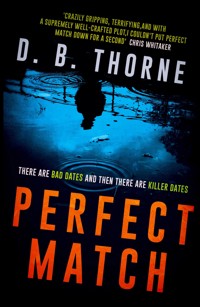
PERFECT MATCH
D. B. Thorne is a digital entrepreneur and founding member of a highly successful tech start-up in the UK. Thorne has long been fascinated by the intersection between the digital and real worlds, inspiring him to write the acclaimed thriller Troll and the brilliant follow-up, Perfect Match.
Also by D. B. Thorne
East of InnocenceNothing SacredPromises of BloodTroll
PERFECT MATCH
D. B. THORNE
Published in trade paperback and e-book in Great Britain in 2018 by Corvus, an imprint of Atlantic Books Ltd
Copyright © D. B. Thorne, 2018
The moral right of D. B. Thorne to be identified as the author of this work has been asserted by him in accordance with the Copyright, Designs and Patents Act of 1988.
All rights reserved. No part of this publication may be reproduced, stored in a retrieval system, or transmitted in any form or by any means, electronic, mechanical, photocopying, recording, or otherwise, without the prior permission of both the copyright owner and the above publisher of this book.
This novel is entirely a work of fiction. The names, characters and incidents portrayed in it are the work of the author’s imagination. Any resemblance to actual persons, living or dead, events or localities, is entirely coincidental.
A CIP catalogue record for this book is available from the British Library.
Paperback ISBN: 978 1 78239 599 7
E-book ISBN: 978 1 78239 598 0
Printed in Great Britain.
Corvus
An imprint of Atlantic Books Ltd
Ormond House
26–27 Boswell Street
London
WC1N 3JZ
www.corvus-books.co.uk
PERFECT MATCH
one
ROBBIE, THOUGHT TIFFANY, WALKING ALONG HACKNEY ROAD past shops that had once sold wholesale leather goods but now hawked artisan coffee at prices just the wrong side of crazy, could go screw himself. She was going on a date. If the date went well, anything might happen. She was ruling nothing out. And if Robbie parked outside her flat one more night, she’d call the police. No, scratch that, she’d go one better and call her brother, and there was only one way that was going to end.
The evening was warm and every other car seemed to have its roof down, each one pumping out different music, samba then rap then something African, diversity filling the rich city air around her. Somewhere up ahead was Shoreditch and her date, a guy who was unknown beyond a brief message exchange. And a photo, which she’d admit hadn’t exactly blown her away, but he had the right amount of eyes and noses, and she liked blonds, so that was a start. Anyway, pretty much anything beat Robbie White.
As she walked, she knew people were looking at her, men mostly, but she didn’t care. Hell, it was her job to have men look at her, so it wasn’t like it was anything new. Fact was, she looked amazing, and the long walk in preposterous heels wouldn’t do her calves any harm either. No, she felt good, as good as she’d felt for a long time, and if tonight wasn’t a success, it wouldn’t be for lack of trying.
‘Hey, darling, you want a ride?’ A car slowed next to her, a Golf with some kind of exhaust upgrade on it that made it sound, well, ridiculous, she thought. Exactly the kind of thing Robbie went for. She’d bet this guy had a decal on the rear bumper. What was it Robbie had had, until she’d made him take it off? Louder than your girlfriend last night. Sad didn’t begin to cover it.
‘No,’ she said. ‘Thanks.’
‘Where you going?’ the driver asked, his urban patois betrayed by his skinny white face.
‘I’ve got a date,’ she said, almost sang, and did a small pirouette on the pavement in celebration. The driver, barely more than a boy, tried to think of a comeback but instead just laughed, said, ‘You have a good one, my darling,’ and drove off with a throaty snarl of his ill-judged exhaust. Yes, thought Tiffany, tonight’s going to be a good, good night.
She’d never been to Convent before, didn’t really do trendy bars, or at least the Shoreditch hipster brand of trendy. She didn’t like men with beards, which kind of ruled out eighty per cent of the available talent, she figured. She turned off Curtain Road down a side street, but before she got to the lit sign, red neon spelling out Convent in cursive, a voice called to her.
‘Tiffany?’
She turned to see a man, blond hair, cross the street to catch her up. ‘Yeah?’
‘Tobes. Hi. Sorry. I didn’t book and the bar’s full. Since when was it all hen parties around here?’
‘Oh.’
‘I recognized you from your picture. You’re …’ He paused. ‘You’re really pretty.’
Tiffany giggled and pretended to fan her face with a flat hand. ‘Whatever. Where are we going?’
‘I’ve called an Uber. You know the Rooftop?’
‘No. Listen, I don’t want to be driving …’
‘It’s close.’ He paused. He wasn’t young, was older than she’d expected, but there was something immature about his face, and Tiffany felt sorry for him. Maybe he was out of his depth. Maybe he just needed a bit of mothering. ‘Look, I know, I feel stupid because it was my idea …’
‘It’s no problem,’ said Tiffany. ‘Though I’m gagging for a drink.’
‘Hold on,’ he said. He held out a hand. A car stopped, and the driver said through his open window, ‘Sam?’
‘We’re in.’ He opened the passenger door and held it for Tiffany, who slid in showing as little thigh as possible. He got in next to her and said to the driver, ‘Got the address?’
The driver turned and nodded, said, ‘Verona Street?’
‘That’s it.’
Tiffany relaxed into her seat and decided to let things go, to just enjoy the night, see where it took her. It looked like her date had it under control. She looked across at him and he wriggled out a hip flask, said, ‘You were saying?’
‘What?’
‘About gagging for a drink?’
He unscrewed the top and handed the flask to her, and she took it and drank, then he took it and put it to his mouth and handed it back to her, and this happened again and again, and as the taxi drove them through the busy, alive streets of east London, the night closed in around her like a warm blanket and she no longer cared where they were going, or why, or what was carrying her there, because she’d rarely felt so good in her life and things were going to be wonderful, just wonderful, of that she had no doubt, though actually, no, no, stop, why was it that the taxi driver had called her date Sam? Wasn’t he called Tobes? Wasn’t he?
two
HIS SISTER HAD BEEN VENTILATED BY A TUBE DOWN HER throat, and a cardiac monitor blipped her steady heart rate in green waves across a black screen above her head. Solomon kept an eye on her blood pressure, which looked reasonable, the systolic number on top holding fairly stable at around 101, the diastolic below maintaining a steady 63. Not bad, both a little on the low side, but what did he expect? She was in a coma, and both numbers were within the acceptable range, or at least the range that scientists had decided. Who knew?
He looked down at her sleeping face, her closed eyes and delicately arched nose, which also looked normal. Directly past her and in his line of sight was his brother, whose nose fell well outside any range that could be termed normal, bent and misshapen and broken he couldn’t guess how many times. The ventilator hissed and sucked and the cardiac monitor blipped quietly and it could almost have been peaceful, here in this room, if it hadn’t been for his brother. Solomon had never seen his brother calm, but right now he was a lean, shaven-headed vessel of barely controlled rage.
‘So tell me this, since you know everything,’ his brother said, as passive-aggressive an opening as Solomon could imagine. ‘If it was an accident, how come she’s missing teeth and her arm’s broken? Tell me that.’
Solomon didn’t answer, instead he turned and looked out of the window onto the hospital’s car park. An old man was helping an unsteady woman – Solomon assumed it was his wife – into the passenger side of an old-model something-or-other, it was hard to tell from up here. Maybe a Nissan. Yes, it was a Nissan. Good.
‘One hypothesis would be that it happened when she fell,’ he said, without turning around. This was the first time he had left his apartment in twenty-two months. Twenty-two months, one week and three days, to be exact.
He watched the old man start the car and navigate his way out of the car park, as carefully as if he was piloting a tanker through a crowded harbour. In his mind, Solomon idly transformed the car park into a geometric framework, planes and axes and angles, placing every car in theoretical motion and modelling a possible future in which each and every one was simultaneously attempting to find the exit. He played out alternative pathways and trajectories and velocities, a complex yet elegant piece of mathematical choreography.
‘That,’ his brother said behind him, ‘I’m not buying. What, she goes out for a drink, nearly drowns, ends up in a coma and it’s an accident? Please, Solly. Do me a favour. You know who did this, don’t you?’
Solomon was spared from answering this question by the sound of the hospital-room door opening. He still didn’t turn around, instead let his brother deal with whoever had come in. The room was well lit and the day was bright outside, which meant, Solomon knew, that light was refracting efficiently through the window. Which meant there was very little reflection, something Solomon was perfectly happy with.
‘I’m sorry,’ a woman’s voice said, ‘but we’re going to need you to leave.’
‘How come?’ Solomon’s brother said.
‘Hospital rules,’ the voice said. ‘And we need to change your sister’s dressings.’
‘Don’t need to leave for that. We’ll stay.’
‘Luke,’ said Solomon, still facing the window. ‘You must allow the lady to do her job.’ He raised his voice slightly and said, ‘Don’t worry. We’re going.’
‘I’ll give you a couple of minutes,’ said the voice, and Solomon waited until he heard the door close behind her before turning.
‘Please, Luke, don’t be difficult,’ he said. ‘They’re only following the rules.’
‘Not being difficult,’ said Luke. ‘Just saying.’
‘We’ll be coming back, remember that. Upsetting the hospital staff won’t make it easier for us to see Tiffany.’
Luke thought for a second, then smiled. ‘Point. Best to keep the wardens sweet, isn’t it?’
Something like that, thought Solomon, although probably not the analogy he would have deployed. But then, he wasn’t Luke, was he? Not even close. Taxonomically close but a metaphorical species apart. He put his hood on, took his Ray-Bans out of the pocket of his running top and put them on. ‘Are you ready?’
Luke stood up and leant over their sister’s sleeping face, giving her nose a quick kiss, careful of her broken arm in its plaster cast. ‘Later, Tiff.’ He paused, bent above her, and Solomon could sense his internal struggle, his unwillingness to leave her here, alone, in this room. But eventually he stood, picked his jacket up from the back of the chair and headed for the door. Whatever his brother’s faults, Solomon thought, he loved his sister. But then, with Tiffany, what wasn’t there to love?
It had been Solomon who’d got the call from the police, the land-line of his apartment ringing for what might have been the first time ever. Not that he didn’t get calls, people did call him, now and then. Occasionally. But on his mobile. He only had the landline because the phone networks ran an inelegant but efficient scam in which you needed a landline in order to get online. Probably a way of future-proofing their business, Solomon imagined, since landlines were as doomed as the Neanderthals, but it hardly mattered. Solomon lived his life in the virtual space. As far as he was concerned, the rise of the online community was the only thing that made his existence bearable, and he’d willingly hand over a kidney for an internet connection, never mind thirty pounds a month.
‘Hello?’ he’d said.
‘Solomon Mullan?’
‘Yes?’
‘We have you down as the next of kin of … Tiffany Mullan.’
‘My sister,’ he said, an unexpected wobble in his voice he tried to control by swallowing.
‘I’m afraid she’s at Royal London Hospital,’ the voice said, a man’s. By the detachment in his voice, this wasn’t the first time he’d made this kind of call. ‘In intensive care.’
‘Can you tell me what happened?’
‘She nearly drowned,’ the man said. ‘She’s in a coma, that’s all I can tell you.’
‘Drowned? How?’
‘Sorry, I don’t have that information.’
‘Well, is she stable? Has she been ventilated?’
‘I …’ The man on the other end didn’t seem used to this level of informed questioning. ‘I really couldn’t say. She was found in a canal, that’s all I can tell you. You’ll need to come in.’
‘I’ll be there,’ said Solomon. ‘As soon as I can.’ He hung up and stood for some time with his back against the wall of his hallway, trying to process what he’d just heard. His sister, Tiffany, in a coma. He’d need to go to her, need to go outside. How did that work? Shoes, he’d need shoes. Where were they? He hadn’t worn shoes in well over a year, had had no need to. And a coat. Did he need one? What month was he in? He felt anxiety flood his chest, anxiety for his sister but also for himself. He’d have to go out of the front door and into the world, where people were, where they talked and laughed and looked, always looked. God. Money. Did he have any? People still used it, right, out there? Of course they did. He rubbed his face and tried to think calmly. It would be okay. People did it all the time. Went out there, got things done, functioned as social animals. He could do it too.
He walked through to his bedroom and found his mobile. He looked through his recent calls, found his brother’s number. It was about the only one in there, the only person he spoke to, him and Tiffany. Before he thumbed the call button, he looked at the time: 3.15 a.m. He listened to the ringtone, wondering at the same time what exactly his brother would be up to at this time of the morning.
Outside the room the hospital corridors smelt clean, and that reassured Solomon slightly about his fear, which he acknowledged as irrational, of MRSA, the tabloid spectre of entering hospital for one ailment and rapidly dying of another.
‘You want a lift home, Solly?’ said Luke, walking slightly ahead of him. It made it easier not to make eye contact, Solomon suspected.
‘You drove here?’
‘Yeah. Why?’
Given the smell of booze on his brother’s breath when he’d arrived at the hospital at just gone five, he shouldn’t have been anywhere near a car. He probably shouldn’t even have been standing. But with Luke, the normal rules had never applied.
‘No,’ said Solomon, though he did want a lift, he really did, in fact he would have endured however many hours of his brother’s angry company if it meant avoiding public transport. Avoiding the public in general. But he had somewhere to go and he didn’t want Luke to know anything about it, so he’d just have to suck it up and face the world.
‘Sure?’ said Luke.
‘I’m sure.’
‘Suit yourself,’ said Luke. ‘I’ll call you, yeah? We need to get this sorted.’
Get what sorted? Solomon almost said, but stopped himself. He wasn’t ready to hear about his brother’s plans for revenge, whoever they were aimed at. Instead he gave a non-committal ‘Yes,’ and watched his brother walk away, or aggressively swagger to be more accurate, before he turned a corner and disappeared. His brother, a promising career criminal. His sister, a comatose stripper, sorry, burlesque dancer. And Solomon, whatever he was. The white sheep? As far as family dysfunction went, the Mullans were running away from the competition. He sighed, pulled his hood lower over his forehead and headed for the hospital exit, counting the black and white tiles beneath his feet as he walked.
three
‘WHAT HAPPENED?’ ASKED INSPECTOR FOX, KEEPING HER EYES on Solomon Mullan. She hoped that she came across as concerned, rather than intimidated by what she saw.
‘What matters is what happened to my sister,’ Solomon said quietly, his head bowed. ‘That’s what I’m here for. I’d appreciate it if we could talk about that.’
Fox would rather have talked about Solomon Mullan’s brother, Luke. He was the family member of interest as far as she was concerned. As far as the department was concerned. Not the sister. But there you were, and here Solomon Mullan was. And she had a job to do.
‘Fair enough,’ she said, and looked down at the notes she’d made about the case. They didn’t amount to a whole lot. ‘So Tiffany Eloise Mullan is your sister,’ she said.
‘You know she is.’
Fox looked up sharply at Solomon, who still had his head bowed. She didn’t need this attitude, was accustomed to dutiful respect from juniors and civilians. She was an inspector, after all. A young one, but as far as she was concerned that only meant she had more talent and ambition than the rest. She tried for her most condescending manner. ‘Are you in a fit state to do this?’ she asked.
‘Yes,’ said Solomon. ‘Why do you ask?’
But she didn’t bother answering, just went back to her notes. After a moment she said, not looking up, ‘She was a stripper.’
‘Was?’
‘Is.’
‘Yes, she is.’
‘How is that?’ Fox said. ‘For her?’
‘I believe it’s a living.’
Fox looked up again. She had very blue eyes and had developed a direct gaze that she knew people found hard to meet. But Solomon Mullan seemed equally practised at looking anywhere but at her, his face always averted. ‘Are you going to continue to be abrasive?’ she said. ‘I am here to help your sister.’
Solomon nodded down at the edge of the desk nearest to him and audibly swallowed. ‘Understood. I apologize. Please continue.’
‘Does she have any other sources of income?’
‘Such as?’ Still Solomon didn’t look at her, kept talking down to the desk in front of him. Fox sighed.
‘Such as, I don’t know. Waitressing. Minicab driving.’ She paused. ‘Prostitution.’
Solomon shook his head and rocked slightly forward. Fox watched the hair on the top of his head – black, wavy, thick – and waited. ‘Mr Mullan?’
‘No,’ he said eventually.
‘No?’
‘No, she isn’t a waitress, no, she doesn’t drive a cab, and no, she doesn’t solicit men for sex.’ There was an edge to his voice now, and Fox knew that the prostitute barb had stuck, and had hurt.
‘As far as you know,’ she said, giving it a twist.
‘Let me ask you a question,’ said Solomon. ‘Are you conducting an investigation into my sister’s attack, or her reputation?’
He looked up at this and Fox forced herself to maintain her gaze. She even smiled slightly, allowing him his objection. ‘Point taken,’ she said, and looked down, away from Solomon, back at her sparse notes. ‘Though there is, so far, no evidence that she was attacked.’
‘Or that she wasn’t.’
Fox nodded quickly. ‘That’s what I need to find out.’
Her phone rang and she picked it up without speaking. She listened for a few seconds before saying, ‘No, I can’t do that.’ She listened to the reply, closed her eyes and said, ‘At once.’ She replaced the handset, picked up the notes she’d been reading from and said, ‘Excuse me,’ before walking out of the office.
Inspector Fox’s office was in a police station in east London made of rough grey concrete that looked as if it had been poured sixty years ago, in a hurry. The reception was lined with posters warning against car theft and burglary and mugging, and populated with exactly the demographic of people Solomon suspected carried out those very acts. He had been called by Fox just after he’d arrived at the hospital, and it was now gone two in the afternoon. It felt as if he’d been up for a long time, and he’d sat in the reception with his head hung between his knees, a forlorn posture that hadn’t looked out of place.
‘Mr Mullan? Solomon Mullan?’ A uniformed officer had opened a door next to the reception desk and waited for Solomon to pass him before showing him down a corridor and up a flight of stairs, eventually to an office with frosted glass on it and a name card: Inspector Fox. He’d knocked on the door and waited for a female voice to say, ‘Come in,’ before opening the door and stepping inside.
Now, with Fox gone, Solomon looked around her office. There wasn’t a lot to take in: a monitor and keyboard on her desk, a pile of papers, a desk tidy with four identical black pens in it, a telephone. She was young, couldn’t have been that much older than Luke. Thirty? Young for an inspector. She was probably on some fast-track programme, held a first in PPE from Oxford and the force couldn’t believe they’d managed to get hold of her. But they had done, and to prove it, there was a certificate on the wall behind the desk telling Solomon that Helen Fox was, beyond doubt, an officer of the Metropolitan Police. Just as his sister was indubitably a stripper and, as far as he was aware, nothing else. Not a waitress or a cab driver or a prostitute. Extra work wasn’t in her character. Tiffany had never been what people would term a grafter.
The door opened and Fox came back in, sat behind her desk and without a pause looked over at Solomon and said, ‘And your brother is Luke Michael Mullan.’
‘Yes.’
‘We know about him.’
‘I imagine you would,’ said Solomon. ‘He has a record.’
‘Quite a record,’ said Fox, a laugh in her voice that might have been an attempt at levity, at building rapport. Or it might have been simple malice. ‘What’s he doing nowadays?’
‘He collects,’ said Solomon.
‘Collects?’
‘For wayward women and afflicted children,’ said Solomon, knowing as he said it that he shouldn’t, but finding it enjoyable nonetheless. Why did he want to goad this cold, uninterested woman? ‘Rickets, that kind of thing,’ he added.
‘I see.’ Fox was silent for some time and Solomon wished he had the confidence to meet the gaze he was sure she was levelling at him. ‘I think,’ she said at last, ‘that we should talk about your family.’
If he had to choose one word to describe the Mullan family, Solomon thought, that word would probably be ‘motley’. His father had been an amateur boxer in his youth, but he’d had more desire than skill, or in his words, ‘I liked fighting, but fighting didn’t like me.’ During Solomon’s upbringing his father had worked on offshore rigs, coming home at unexpected moments with large presents and a lot of noise. Solomon had adored him, but he’d been dead over ten years now, his mother soon after, apparently deciding that life wasn’t much worth living without Sean Mullan in it. Solomon was twenty-three, an orphan since the age of thirteen. But at least he’d always had his brother and sister.
For a time they’d been taken in by distant family, travellers who had treated the three of them like their own, which essentially meant, Solomon now realized, as indentured labour. After several months, an exasperated social worker had had them removed and they’d been placed in care, left feeling like aliens recently landed on a faraway planet. But almost immediately their father’s sister Dorothy had, in her words, ‘sprung them’, and taken them with her to live on her farm in the Essex countryside. In the car on the way there she had explained to them that she was happy to give them somewhere to stay, but she didn’t have any money, and any she did have she wasn’t keen on sharing. So they’d have to pay their own way, something the eldest sibling, Luke, immediately saw to, mostly via burglary.
‘How is my family relevant?’ said Solomon.
‘It’s unconventional,’ said Fox.
‘Hardly unusual nowadays.’
‘And you,’ said Fox, frowning. ‘You’re not what I’d expect.’
‘You mean …’
‘No, no, I mean …’ She paused, tried to find the right words. ‘You seem educated.’
Solomon frowned. ‘I shouldn’t be?’
‘I wouldn’t have expected it, no.’
‘Would you mind explaining why?’
Fox looked at the monitor on her desk. ‘Parents deceased, chaotic upbringing, limited education. The three of you.’
‘Books are freely available,’ Solomon said. ‘There’s no tax on reading.’
‘You don’t have a record.’
‘I’d need to commit a crime in order to have one.’
‘I’m just surprised—’
‘Inspector Fox,’ said Solomon. ‘Please. My sister is lying in a coma. Most of my family is dead. I’m tired, both physically and of this line of questioning.’ He took a breath. ‘I would like to know what happened.’
Fox raised her eyebrows and sat back in her chair. ‘I told you as much as I know on the phone,’ she said. ‘Someone saw her and raised the alarm. A passing couple dragged her out, attempted resuscitation. The ambulance crew took her to the Royal London, where she remains. Her blood alcohol level was high, which suggests she had been out beforehand.’
‘Do you know who raised the alarm?’
‘No.’
‘Well, was it a man? A woman?’
‘We don’t know.’
‘Have you spoken to Robert White?’
‘Not yet.’
‘You’re aware that there’s a restraining order out on him?’
‘Yes,’ said Fox, in a way that suggested no.
Solomon shook his head at the floor. ‘You don’t think that would be a good place to start? Looking for the man with a record of violence towards her?’ He took a deep breath and tried to will himself calm.
Fox was silent for a moment and he heard the sound of pen on paper, the inspector making a note. Then she said, ‘We do know she had been on a date.’
‘Oh?’
‘She had an app. On her phone.’
‘Do you have a picture? Of this date?’
Fox opened a drawer in a pedestal beneath her desk and pulled out a plastic ziplock bag. She opened it and took the phone out. ‘You do much online dating?’ she said.
‘Do I look as though I do?’
She turned the phone around so that Solomon could see it. ‘Know him?’
A picture of a man, young, blond hair. Not bad-looking. Nice eyes. Something about the mouth, pouty, sullen. Solomon had never seen him before. He would remember. ‘No. Has he got a name?’
‘Tobes.’
‘Tobes?’ said Solomon. ‘I’m assuming that’s short for Toby?’
‘We don’t know.’
‘You don’t have a surname?’
‘We’re looking into it.’
‘Well, that’s reassuring,’ said Solomon.
‘They’d arranged to meet. Had some communication.’
‘Could I see?’
Fox picked the mobile up, swiped at it, put it back down. ‘This was the exchange.’
Drink?
When?
Can u do Saturday?
Day off! Where shall we go?
To a convent.
???
Convent. A bar. Dwkd. I mean awkward. Have you been?
To Convent? No.
You should!
OK …
What hour now?
??? Hour?
Time. What time.
Oh. 9?
C u then.
Solomon looked up. ‘That’s it?’
‘That’s all we’ve got right now.’
‘Did anybody see them there?’
‘At the bar?’ Fox shook her head. ‘No. Not on CCTV either. Looks like they either changed plans or he stood her up.’
‘I can’t imagine anybody standing Tiffany up.’
‘Is that right?’ said Fox.
‘And you can’t match the photo? You’ve tried social media, I imagine?’
‘We know what we’re doing,’ said Fox. ‘We’ve run the algorithms. Nothing’s turned up yet, but we’re still working on it.’
Solomon nodded. ‘Is that all?’
‘You’ve definitely never seen that face before?’
‘No.’
‘Then there is just one more thing. Where were you between, say, eleven p.m. and three a.m. last night?’
‘At home.’
‘Can anybody vouch for that?’
‘You could check my building’s CCTV,’ said Solomon, ‘if you have the time. Apart from today, I haven’t been outside for years.’ He stood up. ‘But I’d appreciate it if you used that time to find out what happened to my sister.’
Fox opened a drawer and retrieved a card, holding it out to Solomon without looking up. Dismissed. He took it, then pulled his hood over his head and found his Ray-Bans. But before he put them on, he looked down at Inspector Fox and waited for her to acknowledge him. When she did, he met her gaze properly for the first time. To her credit, she didn’t flinch.
‘My sister is one of the finest people I have ever known,’ he said. ‘Whatever you think of my family, please do the right thing by her.’ He didn’t wait for a reply. Putting the inspector’s card into his back pocket, he turned and opened the office door and found his own way out.
four
ONCE, IN BETTER DAYS, YEARS AGO, SOLOMON AND HIS OLDER brother Luke had been close, bonded by common misfortune and the need to grow up fast. He supposed they had been a team, one the brains, the other the muscle. And I wasn’t the muscle, Solomon thought as he let himself into his flat, feeling a surge of relief at its safe familiarity, its order and predictability. He hadn’t realized how on edge he had been, every second that he had been outside. How anxious, how scared, how terrified of other people’s reactions.
On 1 January just over two and a half years ago, Solomon had woken up in Luke’s spare bedroom after a New Year’s Eve party that still hadn’t finished when he’d gone to bed at four. As he walked downstairs that morning, his brother’s house had had the look of a post-apocalyptic disaster, sleeping bodies arranged randomly on chairs, sofas, under tables, propped against walls. He hadn’t been drinking, didn’t drink, never had. He got to the kitchen and put on coffee, checked the fridge for milk. None. Obviously. He’d walked to the front door, not imagining that there would be any waiting on the doorstep, but living in bleary post-party hope.
He opened the door, but before he could look down he sensed movement in his peripheral vision and then felt something splash in his face, a cold feeling to begin with, freezing, but that sensation soon turned to burning and his heart began to beat so quickly that he thought he would pass out. He turned and felt his way back to the kitchen and found the sink, splashed water into his face as fast as he could, kept on and on and on until he felt hands on his shoulders and realized that he was screaming, a sound he didn’t recognize as his own, that couldn’t be coming from him. He turned and could make out his brother, Luke, and he saw the look on Luke’s face and he managed to stop screaming and said to him, an animal moan, ‘How bad is it?’
Of course Solomon knew that bad was a relative term and that he hadn’t died, hadn’t really come close, certainly after the medic had shot him full of adrenaline. But he had lost the sight in his right eye, which now looked like a small white half-boiled egg. The skin on that side of his face was shiny and had the texture of a plastic bag that had been screwed up and rudimentarily straightened out. Half of his ear was gone, and one side of his mouth was almost lipless and pulled down into a permanent expression of sardonic disapproval. How bad was it? It was bad, very bad, and a year of operations had only made it worse, the closer each procedure brought him to normality, the more obviously the project was doomed to failure. He would never look human again, and nobody would ever be able to look at him without surprise, dismay, disgust or, in most cases, fear.
What made it worse was that he knew, and Luke knew, that he had never been the intended victim. Luke had been the target, for any of a number of reasons, and Solomon had done nothing, nothing at all to deserve it. But neither had said anything and it was only because they were brothers, and needed each other, that they hadn’t drifted apart, each repelled by the force of that denial.
He’d had a place at Cambridge lined up, reading philosophy. He’d given it up. He’d had a girlfriend, or at least kind of, but that hadn’t lasted beyond the first viewing of what was left of his face. He’d had a future, friends, had escaped the fetters of his upbringing, but that was all lost. All he had left was a flat, which was crucial, because as soon as he could, he made sure he never had to leave it again.
Solomon was late back, and so he headed straight for his living room, which to any outside observer would have looked more like a laboratory with easy chairs. One wall was taken up by a large desk, several laptops, four flat-screen monitors, speakers, routers and a Gordian tangle of wiring. He opened a laptop and waited for an animated spinning wheel to catch up. He tapped softly at keys, and on the central monitor an image of a table appeared, four people at it, drinking. They all met together twice a week in the same pub. Well, all of them except Solomon.
‘He lives,’ said a man, enormously bearded, in his fifties. He raised a pint of beer to the screen.
‘I’m sorry,’ said Solomon, sitting down. ‘There was a family emergency.’
‘Oh my good Lord,’ said a grey-haired woman. ‘What in heaven’s name happened?’
‘My sister,’ said Solomon. ‘She’s in hospital.’
‘Nothing serious, I do hope,’ she said.
‘The words “emergency” and “hospital” would rather preclude that, don’t you think?’ the bearded man said. Which effectively summed this group up, Solomon thought, pedantry trumping sentiment every time.
‘For God’s sake,’ said a younger woman, pretty, with long hair in ringlets. ‘Phil, don’t be a pest. Ignore him, Fran.’
Phil, the man with the beard, raised his eyebrows at this unwarranted accusation, but kept quiet.
‘Welcome, welcome, in any case,’ said a middle-aged man, raising a glass. ‘We extend to your sister all the best.’ Masoud, as cultured a person as Solomon could hope to meet.
‘Thank you,’ said Solomon. ‘I’ve interrupted.’
‘Oh, not really,’ said Fran. ‘In fact you’ve arrived at just the very moment. We were debating …’
‘Gently discussing,’ said Phil.
‘… the merits of this question,’ Fran continued, ignoring Phil. ‘Ready?’
‘Yes.’
‘Kandinsky was a member of which Munich-based art movement?’
‘Kandinsky?’
‘Yes.’
‘I should know this,’ said Solomon. He paused. ‘I should. This is irritating.’
‘That’s what I said,’ the younger woman agreed. ‘Kind of.’
‘What is it for?’ said Solomon.
‘A new show,’ said Masoud, then added importantly, ‘Channel 4.’
‘Arts based?’
‘No, but it’s got specialized sections, and art’s one of them,’ the younger woman said. ‘Think Trivial Pursuit, with some kind of overcooked elimination mechanic.’
‘With you,’ said Solomon, closing his eyes. ‘Kandinsky.’
‘Yes,’ said Fran patiently.
If Solomon had ever known the answer, he’d still know it now. But he didn’t, which he found surprising.
‘Die Brücke,’ he said. A guess, not like him.
‘No,’ said Phil, delight in his voice, no attempt to hide it, Phil being Phil.
‘Unlucky,’ said Masoud. ‘That was Berlin. Ludwig Kirchner.’
‘Who shot himself in the face,’ said Phil.
‘Thank you, Philip,’ said Masoud. ‘So the answer is Der Blaue Reiter. But please, do not feel bad. Nobody else got it either.’
‘Which means it’s too difficult,’ the younger woman said, in a way that suggested she’d been advocating the same view for some time.
‘Kay is right,’ said Masoud. ‘It is too obscure.’
‘Or people are too stupid,’ said Phil.
‘Considering that you also got it wrong, I imagine you would need to place yourself within that bracket,’ said Fran. Phil began to reply but thought better of it and went back to his drink.
This was the Brain Pool, or alternatively what Solomon could accurately describe as All the Friends I Have in the World. He joined them two nights a week, although the relationship was one-sided in the sense that they’d never met him, not face to face, had had to make do with an avatar of a spinning question mark for the past eighteen months. He dialled in remotely, but given the varying levels of social ineptitude within the group, Phil occupying the furthest reaches, it wasn’t an issue. They’d asked why to begin with, but ultimately they were more interested in the questions they set together for TV programmes and radio shows and newspapers and any other quizzing forum they could find.
Solomon did know that Phil was an anarchist, though that didn’t qualify as a profession. Fran had told them that she had a private income, which meant she was rich and didn’t have to do anything. Masoud was an Iranian refugee who had been a nuclear physicist in Tehran but wasn’t allowed anywhere near a British nuclear facility so drove an Uber instead. And nobody really understood what Kay did, something at the intersection of neurology and computer code, biological algorithms or organic computation or bio-organic algorithmic computation. It was complex, even for Solomon.
Solomon had never questioned why he knew so much, or how he retained such vast amounts of knowledge. He just did, storing complex information in ways he considered normal even if nobody else did. Chronological sequences lived in his mind as abstract many-coloured landscapes, whole swathes of history reduced to patchwork configurations he could recall at will. Entire knowledge systems, geometry or thermodynamics or organic chemistry, lay coiled up in elegant multi-threaded helixes, springing into words and facts whenever he called upon them. Names, events, physical laws, anything he ever learnt was absorbed, converted into abstract forms and patterns, complex polyhedrons and kaleidoscopic panoramas. He didn’t know why. It just was. He never forgot anything, and he had learnt a lot. A whole lot. Which was why the Brain Pool felt so right when so much in his broader life now felt so wrong.
Fran had the contact that had got them this new Channel 4 gig, and she spent the rest of the time explaining the format, the kind of contestants they could expect, the level of questioning. Just below PhD level, she rather thought: think enthusiastic amateur, probably professional, likely postgraduate with some kind of failed-doctorate axe to grind. Their kind of contestant. Meant they didn’t have to demean themselves with questions on characters from Dickens or the periodic table. Yawn.
Last orders came and the meeting ended and Solomon hung up, the picture on his monitor switching back to his desktop image of Diego Maradona facing down five Brazilian players. He sat staring at it for some time, knowing that he should eat, drink, do something, but too drained to move.
A notification slid onto the screen, just to the right of Maradona’s head. From Kay. It read: Hey. Nothing more. Solomon looked at it without moving, without expression. After a long time, minutes, he leant forward and typed:
Hello.
Sorry about your sister.
Thank you.
Any news?
No.
The last news Solomon had had was that afternoon, the ward sister telling him that no, there had been no change, yes, Tiffany was still stable, and yes, visiting hours were the same the next day, ten until four. Would she call if the situation changed? Of course, she had him down as next of kin. Who else was she going to call?
Well. Good luck.
Thank you.
Kay had never messaged him before, not directly, and Solomon typed his replies as if each key of his keyboard might be wired to an IED. A new message appeared:
Hey, I wanted to ask you a question. Questions.
Okay.
Do you mind?
No.
Okay. So … Are you married?
No.
In prison?
No.
Hmm.
Hmm?
I have another question. But I have no right to ask it.
You can ask.
Sure?
Sure. Go ahead.
Are you differently abled?
Sorry?
You know. Do you have … Are you in a wheelchair or something?
Oh. No.
Okay …
Solomon didn’t reply, just watched the ellipsis that Kay had left, its implication that she hadn’t finished, that there was more to say.
Then why? Why can’t I see you?
I. Solomon looked at the word, the single letter. Not we, not the group, the Brain Pool. I. Why can’t I see you? He had no idea how to answer, what to write in reply. It was as far out of his grasp as thermodynamic engineering. No, it was a lot further than that.
It’s complicated.
Sorry. I shouldn’t have asked.
That’s okay.
It’s none of my business. I’m sorry.
No, really. It’s fine.
You might be horribly disfigured!
Seriously, forget it.
Solomon stared at Kay’s last line, read it again and again. Did this mean he had a moral duty of disclosure? She might have meant it as a joke, but there it was. The question was implicit. You might be. Meaning, if you are, you should say. Wouldn’t ignoring it constitute a lie? He was so tired that he didn’t know, had no way of telling. He told himself to stop thinking. He did too much of it, and how often did it help? He blinked, then typed:
Horribly is a relative term.
He sat back in his chair, immediately wishing that he could unwrite the words yet at the same time infused with an almost indecent release, as if he had just shared something exciting, taboo. He could not take his eyes from the screen, but when the reply came, it was agonizingly prosaic.
Oh God. I’m sorry.
There was nothing left to say, and Solomon simply waited until Kay’s status went inactive. He was left with an anticlimactic feeling, like that of an unsatisfactory first sexual encounter, a leap into a tantalizing unknown that had proved shabby, embarrassing and unfulfilling. He lost track of how long he sat, staring at those last words, but eventually he stood up and went to bed. He needed to be up to see his sister. She was what mattered.
five
LUKE WAS SITTING IN THE HOSPITAL CHAIR, BADLY REGRETTING most of the events of the night before, when his brother walked in, head to the ground and hood up, dragging himself along, Luke thought, like a walking apology for existence. Luke winced at the stabbing pain in his head and managed a rough ‘Here he is.’
Solomon turned his head minutely towards him and said, ‘It sounds as if you had quite a night.’
‘Needed to let off some steam,’ said Luke. ‘You know.’
‘I’m not sure that I do,’ said Solomon, and Luke watched him carefully, trying to work out whether there was any judgement implied in that answer. Solomon walked to the window and said, his back to Luke, ‘How is she?’
‘Same. Listen, you’re here now. I’m going to get myself some coffee. Something stronger. You be all right?’
‘Of course.’
Solomon waited for his brother to leave before turning around. Two years without going outside, he thought, and now he had done it twice in two days. His sister looked the same apart from a bruise on her cheek that had been purple the day before but was now changing colour, Solomon imagining the haemoglobin breaking down, producing biliverdin, turning the bruise green like a flower going putrid. The blip of the cardiac monitor and the suck and hiss of the monitor transmitted its illusion of calm, a calm that could be broken at any moment by a frantic bleeping as any one of a million internal human processes failed. Solomon hated, no, despised uncertainty. Hated processes beyond his control.
‘Mr Mullan?’
He looked up, surprised by the voice, and saw a doctor in a white coat, carrying a clipboard. ‘Yes?’
His face caused the doctor only a moment’s pause, and the first thing he said was ‘Acid?’
‘Sulphuric.’
‘Looks like it hurt.’ The doctor was young, and Solomon could not help but smile at his clinical humour.
‘A little.’
The doctor smiled back briefly, then looked down at his notes. His name tag read Dr Mistry. ‘Well, we’re not here for you, are we? I have some questions about your sister.’
‘I’ll help if I can.’
‘Does she use drugs?’
‘Recreationally? I imagine so,’ Solomon said.
‘You imagine so?’
‘She’s young, she’s pretty, her job is … unconventional. So yes, I imagine so, now and then.’ He paused, remembered he wasn’t talking to the police. ‘Why do you ask?’
‘The amount of pentobarbital in her bloodstream was high,’ Dr Mistry said. ‘Be good to know if she had any kind of dependency.’
‘No,’ said Solomon. ‘I’m sure of that. How long do you expect her to be unconscious?’
‘At the moment we’re keeping her under,’ the doctor said. ‘Induced coma. She’d been in the water for a while, and until we know more … What she’s been through, we don’t want any seizures. No sense risking it.’
‘Which doesn’t answer my question. How long?’
The doctor raised his shoulders, not quite a shrug but as good as. ‘Comas are strange things,’ he said. ‘Meaning there’s a fairly hefty chasm in our knowledge of them.’
‘Right,’ said Solomon, grateful for his honesty. ‘I was aware of that.’
‘Best we can do right now is keep monitoring her and hope for signs of change. Change for the good,’ Dr Mistry added.
‘You said pentobarbital,’ said Solomon. ‘Which is a barbiturate.’
‘Right. You’re a medical man?’
‘No, just, I must have read it somewhere,’ said Solomon. He paused, then said awkwardly, ‘Thank you.’
‘No problem.’ The doctor looked at his face, a professional scrutiny. ‘How do you cope with that?’
‘Cope?’
‘It must be difficult, out here.’ He nodded towards the window. ‘In the world.’
‘I do my best to avoid it,’ said Solomon. ‘Unless I absolutely can’t.’
The doctor nodded, then put his head to one side, still looking at Solomon. Eventually he said, ‘Well, don’t give up on it. The world, I mean.’
‘And if I already have?’
‘That’s not the impression you give,’ the doctor replied. He tapped a pen against his clipboard, then said, ‘Good to have met you.’ Solomon was still wondering how to respond when he turned and left.
Luke arrived back half an hour later and immediately slumped into the hospital-room’s chair, closed his eyes and groaned, long and loud.
‘Are you all right?’
‘Solly, Solly, I’m not,’ his brother said. ‘I’m a long way from. Any news?’ he asked, opening one eye, the one nearest their sister.
‘I saw the doctor. He told me that she’d tested positive for barbiturates.’
Luke didn’t answer, slid forward in the chair so that his head rested on the back, his legs straight, feet crossed. ‘Oh?’ he said eventually.
‘Does that sound like Tiff to you?’
‘Course it doesn’t,’ Luke said. ‘But she didn’t take them herself, did she?’ He settled his chin onto his chest, eyes still closed. Solomon watched him for a while, wondering if he was asleep, but then Luke said, ‘Fucking Robbie, wasn’t it?’
‘Maybe,’ said Solomon.
‘Maybe? Ain’t no maybe, Solly.’
Solomon didn’t answer, knew there was little point arguing with his brother. And Luke was probably right anyway. Robbie White was as nasty an individual as he could imagine, and he wouldn’t put a lot past him. But still. It didn’t feel right, even though he couldn’t exactly say why.
Luke shook his head, chin rubbing the front of his Adidas top. ‘Boy’s going to wish he could crawl back inside his mother, start all over again.’
It was strange how, in this hospital room, his brother got the chair, his sister got the bed and Solomon got to do the standing up. Got to do the right thing, the expected thing, which was to be subordinate to the needs of his siblings. Hadn’t it always been the same?
‘I don’t know.’
‘We’ll know it soon’s I ask him,’ said Luke, as if to himself, sprawled on the chair. ‘It’s the way you ask, that’s what I’ve always said.’ He said nothing for a long time and Solomon thought that he really had gone to sleep, right up to the point when he said, with a lack of humanity that made Solomon close his own eyes in dismay, ‘Fucking Robbie. I’ll be seeing you.’
Robbie White had been Tiffany’s on-and-off boyfriend for years. Almost four. Three years, nine months and a number of days, depending on the official start date of their relationship, which wasn’t confirmed, as far as Solomon knew. Which was nearly four years too many, if you asked Luke. If you asked anyone, Solomon supposed, or at least anyone who cared about Tiffany. Because Robbie White was one of the most unpleasant, unpredictable and manipulative people Solomon had ever met, and during his chaotic upbringing he’d encountered more than his share.
He wasn’t big, or imposing. He wasn’t aggressive in his demeanour. He had a job, a normal job installing satellite dishes. He had no police record, at least nothing serious, and had never been near prison. Yet there was something wrong with him, something Solomon had difficulty articulating. Adjectivally, he was narcissistic, malignant, sadistic. And he simply would not, apparently could not, listen to reason.




