


1,99 €
Mehr erfahren.
- Herausgeber: Quickie Classics
- Kategorie: Geisteswissenschaft
- Sprache: Englisch
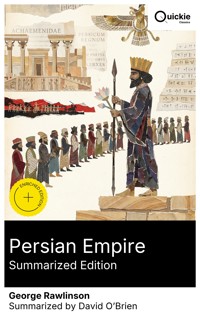
Persian Empire surveys Achaemenid history from the rise of Cyrus to the defeat of Darius III, blending political narrative with chapters on administration, religion, warfare, and court life. Rawlinson juxtaposes Herodotus, Xenophon, and Ctesias with the newly read Behistun inscription, yielding a lucid, source-aware account. In measured Victorian prose, he favors clear chronology, typological comparison, and careful notes on disputed episodes. George Rawlinson, Camden Professor of Ancient History at Oxford, wrote at the junction of classical philology and the emergent Assyriology advanced by his brother, Sir Henry. His translation of Herodotus and his studies of the great Eastern monarchies trained him to reconcile literary tradition with epigraphic data. A churchman as well as scholar, he brings ethical seriousness and institutional focus to antiquity. Readers of ancient history and Persian studies will value this volume as both introduction and reference. Though Victorian perspectives occasionally surface, its organization, command of sources, and vivid portraits of rulers and regions endure. For students and curious generalists alike, Persian Empire remains a rewarding guide. Quickie Classics summarizes timeless works with precision, preserving the author's voice and keeping the prose clear, fast, and readable—distilled, never diluted. Enriched Edition extras: Introduction · Synopsis · Historical Context · Brief Analysis · 4 Reflection Q&As · Editorial Footnotes.
Das E-Book können Sie in Legimi-Apps oder einer beliebigen App lesen, die das folgende Format unterstützen:
Veröffentlichungsjahr: 2026
Ähnliche

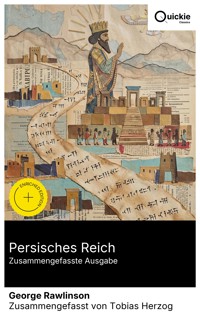
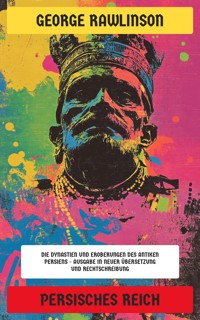

Persian Empire (Summarized Edition)
Table of Contents
Introduction
Between the shock of conquest and the calm of administration lies the puzzle that animates George Rawlinson’s study of the Persian Empire. Written by a nineteenth‑century English historian of the ancient world, the book examines how a single imperial framework could stretch across languages, religions, and landscapes without dissolving into chaos. Rawlinson’s central concern is coherence: how rule was asserted, stabilized, and explained. He approaches Persia as both an historical subject and a test case in comparative empire, inviting readers to see the mechanisms—political, cultural, and logistical—that sustained authority at scale. The result is a learned narrative that prizes clarity over ornament and synthesis over speculation.
As a work of historical scholarship set in the ancient Near East, the book traces the rise and reach of the Persian monarchy across Asia and into points west, treating the empire’s geography as an active force in its politics. Its publication context is Victorian, a period in which European scholars organized newly accessible evidence into expansive, systematizing histories. Rawlinson writes within that milieu, attentive to the boundaries of what his sources can bear while still proposing a comprehensive portrait. The setting is vast—mountain ranges, royal roads, and port cities—yet consistently grounded in institutions that shaped daily governance and long‑term legitimacy.
The premise is straightforward but ambitious: to reconstruct the architecture of Persian power and the character of its rule, from the consolidation of authority to the maintenance of a multiethnic commonwealth. Readers encounter a firm, measured voice that balances narrative momentum with careful exposition. The style is formal yet approachable, building from concrete administrative practices to broader reflections on imperial identity. The tone remains judicious, avoiding melodrama while acknowledging grandeur. Without dwelling on battle minutiae or court intrigue, Rawlinson foregrounds structures—satrapies, communications, taxation, and law—that give the empire its distinctive profile and help explain its resilience across challenging terrains and cultures.
Several interlocking themes emerge. First is the tension between central command and local autonomy, a dynamic managed through provincial governance and a calibrated use of loyalty, oversight, and reward. Second is the role of infrastructure—roads, posts, and waterways—in knitting together distant communities and speeding information. Third is cultural policy: the ways in which rulers acknowledged diverse traditions while articulating a unifying imperial vision. Rawlinson also explores religion’s public dimension, examining how beliefs and rituals informed authority without reducing politics to theology. Finally, he considers the symbolism of power—art, ceremony, and space—as a language intelligible across frontiers.
Methodologically, Rawlinson operates as a synthesizer, bringing classical narratives into conversation with the then‑developing study of the ancient Near East. He reads Greek and Roman historians alongside emerging epigraphic and archaeological findings, weighing agreements and frictions to triangulate plausible accounts. This approach models transparency about evidentiary limits while extracting the strongest common threads. The analysis is neither credulous nor dismissive; instead, it tests claims against comparative experience and administrative logic. In doing so, the book demonstrates how disciplined inference can illuminate periods where the record is uneven, and why historical method matters as much as the events it seeks to describe.
The book’s continuing relevance lies in its lucid anatomy of empire as a problem of organization, legitimacy, and culture—concerns that transcend antiquity. Contemporary readers will recognize questions about governing diversity, balancing security with openness, and coordinating vast flows of people and goods. Rawlinson’s emphasis on logistics, information networks, and institutional design anticipates modern discussions of state capacity. His attention to cross‑cultural exchange complicates caricatures of East‑West opposition, revealing pragmatic accommodations and durable shared practices. By treating power as a system rather than a spectacle, the study equips readers to interpret large‑scale governance in any era with sharper critical tools.
Approached as both narrative and inquiry, this volume offers a disciplined, spoiler‑safe passage through the Persian world: enough context to orient, enough analysis to provoke, and enough restraint to let readers draw further connections. It rewards close reading, inviting reflection on how empires claim continuity amid change and how historical memory shapes present understanding. For newcomers, it provides a stable scaffold; for seasoned readers, a coherent synthesis that clarifies debates without closing them. In an age still grappling with the management of complexity, Rawlinson’s Persian Empire stands as a durable guide to the possibilities and perils of rule at continental scale.
Synopsis
George Rawlinson presents a comprehensive account of the Persian Empire by assembling classical testimony, royal inscriptions, and material remains into a connected portrait. He opens by defining the geographic and cultural setting of the Iranian plateau and by situating Persia among its Near Eastern neighbors. A recurring concern is the reliability of sources; he weighs Greek narratives against epigraphic evidence and uses each to verify the other. With this framework, he explains how an Iranian-speaking people emerged from regional obscurity to dominate a vast domain, preparing readers for a study that blends political history with discussions of administration, religion, warfare, and art.
Rawlinson traces the empire’s rise to the consolidation achieved under Cyrus, whose campaigns transformed a cluster of Iranian tribes and Median structures into a coherent monarchy. He outlines the absorption of neighboring powers in Anatolia and Mesopotamia, emphasizing policies that allowed local traditions and elites to continue under imperial oversight. The narrative stresses strategy over spectacle: careful diplomacy, measured force, and the creation of a loyal core of commanders and provincial governors. By following this sequence, he shows how a regional kingdom rapidly extended from the Aegean shores to the highlands and river valleys of the Near East, establishing durable rule.
The succession after Cyrus introduces questions of legitimacy and governance that Rawlinson addresses through close reading of inscriptions and historians. Cambyses’ extension of authority into Egypt is treated alongside the instability that followed, culminating in Darius’s emergence, attested in the Behistun inscription. With Darius, the study turns to structures: a satrapal system with supervision by royal inspectors, standardized tribute, and improved communications along great roads. Monetary reform, especially the widespread gold coinage, is linked to more regular taxation and trade. Rawlinson presents these measures as the empire’s backbone, explaining how distant provinces were integrated without erasing their distinctive institutions.
Military organization receives sustained attention, from levies drawn across the provinces to specialized contingents and a seaborne arm supplied by subject maritime peoples. Rawlinson examines logistics, roads, and depots that enabled long campaigns, as well as frontier management in regions from Egypt to Central Asia. The western theater brings Persia into recurrent contact and conflict with the Greek world. He follows the stages by which imperial interests in Ionia, the Aegean, and the Balkans produced both advances and reversals, using these episodes to explore command practice, coalition-building, and the limits of projecting power across seas and mountain corridors.
Beyond campaigns, Rawlinson devotes chapters to court life and belief. He interprets royal proclamations invoking Ahura Mazda to outline a religious framework that shaped kingship while accommodating the diverse cults of an imperial population. The role of priestly specialists, ceremonial etiquette, and the symbolism of homage and audience are treated as instruments of cohesion. Social sections consider household organization, legal appeals to the throne, and the interplay of imperial law with customary practice. Administrative multilingualism and the circulation of scribes, couriers, and artisans illustrate how messages, orders, and skills moved between center and provinces without dissolving local identities.
Material culture anchors this analysis. Rawlinson describes the monumental complexes at Pasargadae, Susa, and Persepolis as statements of authority and cosmopolitan craftsmanship, reading reliefs, columns, and processional spaces for their political messages. He links such centers to an engineered network of roads and relay stations that conveyed royal commands efficiently. Economic chapters survey tribute in bullion and produce, standardized measures, and the circulation of coined money, arguing that these promoted trade from the Levant to Inner Asia. Gardens, hunting grounds, and ceremonial banquets appear as expressions of abundance, but also as managed systems that fed and displayed the court.
As the chronology advances, Rawlinson notes recurring tensions: overextension, struggles among court factions, and challenges from ambitious governors. He follows attempts at reform and renewed campaigning, while observing how repeated mobilizations strained provincial loyalties. The narrative ends with the empire confronted by a rising western power, whose rapid successes transform the political map. Rather than closing on catastrophe, Rawlinson emphasizes institutional legacies: techniques of long-distance rule, habits of toleration, and the fusion of regional traditions under imperial patronage. The study thereby frames Persia not only as a subject of conquest narratives, but as a benchmark for later empires.
Historical Context
George Rawlinson (1812-1902), an English churchman and historian, produced his account of the Persian Empire in the mid-nineteenth century, when Assyriology and classical studies were rapidly expanding in Britain. Serving as Camden Professor of Ancient History at Oxford and active in the Royal Asiatic Society, he drew on resources of the British Museum and recent field reports. His Persia volume formed part of his larger project on the Great Monarchies of the Ancient Eastern World, issued from the 1860s into the 1870s in serial and book form. Its setting reflects a scholarly milieu shaped by new inscriptions, classical philology, and imperial-era comparative history.
Rawlinson's evidentiary base combined classical narratives and newly read royal inscriptions. He used Herodotus, Xenophon, and later Greek compilers, while weighing them against cuneiform texts—above all the Behistun Inscription of Darius I, whose decipherment (1830s-1840s) by Sir Henry Rawlinson established Old Persian values and supplied a dynastic narrative. He cited Achaemenid inscriptions from Persepolis and Naqsh-e Rustam, and reports from travelers such as Flandin, Coste, and Ker Porter. Recent excavations by Layard in Assyria and by Loftus at Susa, along with philological work by scholars including Oppert and Hincks, enabled cross-checks between archaeology, epigraphy, and Greek accounts.
The historical subject is the Achaemenid Persian Empire, established by Cyrus II around 550 BCE and extending from the Aegean to the Indus before its overthrow by Alexander in 330 BCE. Rawlinson traces the rise from Median, Lydian, and Babylonian conquests through institutional consolidation under Darius I: satrapal administration, the Royal Road and courier system, standardized tribute, the gold daric, and use of Imperial Aramaic for chancery affairs. He outlines court structures, military levies from subject peoples, and religious policies often characterized by local accommodation. Zoroastrian concepts appear through royal inscriptions, though their scope and dating remain subjects of scholarly debate.




