


89,99 €
Mehr erfahren.
- Herausgeber: John Wiley & Sons
- Kategorie: Wissenschaft und neue Technologien
- Sprache: Englisch
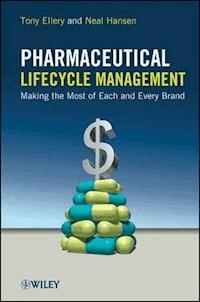
A comprehensive guide to optimizing the lifecycle management of pharmaceutical brands The mounting challenges posed by cost containment policies and the prevalence of generic alternatives make optimizing the lifecycle management (LCM) of brand drugs essential for pharmaceutical companies looking to maximize the value of their products. Demonstrating how different measures can be combined to create winning strategies, Pharmaceutical Lifecycle Management: Making the Most of Each and Every Brand explores this increasingly important field to help readers understand what they can--and must--do to get the most out of their brands. Offering a truly immersive introduction to LCM options for pharmaceuticals, the book incorporates numerous real-life case studies that demonstrate successful and failed lifecycle management initiatives, explaining the key takeaway of each example. Filled with practical information on the process of actually writing and presenting an LCM plan, as well as how to link corporate, portfolio, and individual brand strategies, the book also offers a look ahead to predict which LCM strategies will continue to be effective in the future. While the development of new drugs designed to address unmet patient needs remains the single most important goal of any pharmaceutical company, effective LCM is invaluable for getting the greatest possible value from existing brands. Pharmaceutical Lifecycle Management walks you through the process step by step, making it indispensable reading for pharmaceutical executives and managers, as well as anyone working in the fields of drug research, development, and regulation.
Sie lesen das E-Book in den Legimi-Apps auf:
Seitenzahl: 763
Veröffentlichungsjahr: 2012
Ähnliche



















Table of Contents
Cover
Title page
Copyright page
DEDICATION
ACKNOWLEDGMENTS
INTRODUCTION
PART A: LIFECYCLE MANAGEMENT BUSINESS ENVIRONMENT
CHAPTER 1: Challenges Facing the Branded Drug Industry
1.1 DEPLETED NME PIPELINES/LOWER R&D EFFICIENCY
1.2 HIGHER DEVELOPMENT COSTS
1.3 SAFETY CONCERNS
1.4 TOUGHER ENVIRONMENT FOR PRICING, REIMBURSEMENT, AND LISTING
1.5 INCREASED COMPETITION
1.6 EARLIER GENERICIZATION
1.7 FASTER SALES EROSION FOLLOWING PATENT EXPIRY
1.8 POOR IMAGE OF BRANDED DRUG INDUSTRY
1.9 DIVERSIFICATION
CHAPTER 2: The Life Cycle of Industries, Technologies, and Brands
2.1 DIFFUSION OF INNOVATIONS
2.2 THE LIFECYCLE CURVE
2.3 LIFECYCLE PHASES
CHAPTER 3: The Life Cycle of a Pharmaceutical Brand
3.1 LIFECYCLE CURVE OF PHARMACEUTICALS
3.2 FACTORS AFFECTING RATE OF CONVERSION TO GENERICS
3.3 THE LIFE CYCLE OF A PHARMACEUTICAL BRAND
PART B: LIFECYCLE MANAGEMENT REGULATORY AND LEGAL ENVIRONMENT
CHAPTER 4: The Generic Approval Process
4.1 UNITED STATES
4.2 EUROPE
4.3 JAPAN
CHAPTER 5: Hatch–Waxman Legislation and Its Effects on LCM
5.1 HATCH–WAXMAN ACT OF 1984
5.2 MEDICARE MODERNIZATION ACT OF 2003
5.3 FDA AMENDMENTS ACT OF 2007
5.4 Q1 PROGRAM SUPPLEMENTAL FUNDING ACT OF 2008
5.5 DISCUSSION OF HATCH-WAXMAN LEGISLATION
CHAPTER 6: U.S. Health-Care Reform 2010
CHAPTER 7: European Sector Inquiry
PART C: PATENTS AND EXCLUSIVITIES
CHAPTER 8: Patents and Other Intellectual Property Rights
8.1 NONPATENT INTELLECTUAL PROPERTY RIGHTS
8.2 WHAT ARE PATENTS?
8.3 WHAT IS PATENTABLE?
8.4 HOW LONG DOES A PATENT LAST?
8.5 PATENT TERM RESTORATION IN THE UNITED STATES
8.6 SUPPLEMENTARY PROTECTION CERTIFICATES IN EUROPE
8.7 PATENT TERM EXTENSION IN JAPAN
8.8 HOW ARE PATENTS OBTAINED?
8.9 PATENT ENFORCEMENT
8.10 TYPES OF PATENTS
8.11 KSR VERSUS TELEFLEX—RAISING THE NONOBVIOUSNESS BAR
8.12 PATENT STRATEGY
CHAPTER 9: Nonpatent Exclusivities
9.1 NCE EXCLUSIVITY (UNITED STATES)
9.2 NEW CLINICAL STUDY EXCLUSIVITY (UNITED STATES)
9.3 DATA AND MARKETING EXCLUSIVITY (EUROPE)
9.4 DATA EXCLUSIVITY (JAPAN)
9.5 ORPHAN DRUG EXCLUSIVITY
9.6 PEDIATRIC EXCLUSIVITY
9.7 180-DAY GENERIC PRODUCT EXCLUSIVITY
CHAPTER 10: Patent Settlements
PART D: DEVELOPMENTAL LCM
CHAPTER 11: Strategic Principles of Developmental LCM
11.1 DEVELOPMENTAL LCM GOAL 1: PROVIDE A MEANINGFUL IMPROVEMENT IN CLINICAL PROFILE
11.2 DEVELOPMENTAL LCM GOAL 2: INCREASE THE POTENTIAL REAL-WORLD PATIENT POTENTIAL FOR THE BRAND
11.3 DEVELOPMENTAL LCM GOAL 3: THE ABILITY TO GENERATE AN ROI
11.4 DEVELOPMENTAL LCM GOAL 4: THE ABILITY TO ENHANCE MARKET EXCLUSIVITY OF THE BRAND FRANCHISE
CHAPTER 12: Indication Expansion and Sequencing
12.1 CATEGORIES OF INDICATION EXPANSION
CHAPTER 13: Patient Subpopulations and Personalized Medicine
13.1 WHAT DOES A GOOD PATIENT SELECTION STRATEGY LOOK LIKE?
13.2 PATIENT SELECTION WITHOUT PREDICTIVE CRITERIA: POST HOC APPROACHES
13.3 WHAT ABOUT THE PATIENTS WHO ARE NOT SELECTED?
CHAPTER 14: New Dosage Strengths, New Dosage Regimens
14.1 NEW DOSAGE STRENGTHS
14.2 NEW DOSAGE REGIMENS
CHAPTER 15: Reformulation, New Routes of Administration, and Drug Delivery
15.1 REFORMULATION AND NEW ROUTES OF ADMINISTRATION
15.2 DRUG DELIVERY DEVICES
CHAPTER 16: Fixed-Dose Combinations (FDCs) and Co-Packaging
CHAPTER 17: Second-Generation Products and Modified Chemistry
17.1 ISOMERISM
17.2 POLYMORPHISM
17.3 SALTS, ETHERS, AND ESTERS
17.4 PRODRUGS AND METABOLITES
CHAPTER 18: Other Developmental LCM Strategies
18.1 MANUFACTURING STRATEGIES
18.2 WHITE PAPERS AND CITIZEN PETITIONS
PART E: COMMERCIAL LCM
CHAPTER 19: Strategic Principles of Commercial LCM
19.1 COMMERCIAL LCM GOAL 1: THE ABILITY TO DRIVE WIDESPREAD AND PREFERENTIAL PATIENT ACCESS TO THE BRAND
19.2 COMMERCIAL LCM GOAL 2: THE ABILITY TO DEFEND MARKET ACCESS AND FORMULARY POSITION
19.3 COMMERCIAL LCM GOAL 3: THE ABILITY TO OPTIMIZE PROFITABILITY OF THE BRAND FRANCHISE
CHAPTER 20: Geographical Expansion and Optimization
20.1 GEOGRAPHIC EXPANSION
20.2 HARMONIZATION AND RATIONALIZATION
CHAPTER 21: OTC Switching
21.1 WHAT TO SWITCH: CHOOSING THE BEST APPROACH
21.2 WHERE TO SWITCH: DEALING WITH INTERMARKET VARIABILITY
21.3 WHEN TO SWITCH: BALANCING THE PRODUCT LIFE CYCLE?
21.4 HOW TO MAKE THE SWITCH SUCCESSFUL: WHAT CORPORATE SUPPORT IS REQUIRED?
CHAPTER 22: Brand Loyalty and Service Programs
CHAPTER 23: Strategic Pricing Strategies
23.1 PRICING STRATEGY AND TACTICS IN THE LAUNCH AND GROWTH PHASES
23.2 PRICING STRATEGY AND TACTICS FOLLOWING PATENT EXPIRY
CHAPTER 24: Generic Strategies and Tactics
BUILDING A GENERIC PORTFOLIO: OLD VERSUS NEW THINKING
CHAPTER 25: Exit Strategies
EXECUTING THE EXIT STRATEGY
PART F: BIOLOGICS AND BIOSIMILARS
CHAPTER 26: Biologics and LCM
26.1 EMERGENCE OF BIOTECH
26.2 SOME DEFINITIONS
26.3 UPTAKE AND VALUE OF BIOLOGICS
26.4 LCM OF BIOLOGICS
CHAPTER 27: Biosimilars and Their Impact on Biologic LCM
27.1 CHANGING TERMINOLOGY: BIOGENERICS, BIOSIMILARS, AND FOBS
27.2 WHY ARE BIOSIMILARS A BIG DEAL?
27.3 HOW ARE BIOSIMILARS DIFFERENT?
27.4 BIOSIMILAR APPROVAL PATHWAYS
27.5 SUBSTITUTION OF BIOSIMILARS
27.6 INNOVATOR RESPONSES TO BIOSIMILAR THREATS
27.7 THE FUTURE FOR BIOLOGICS LCM
27.8 THE EMERGENCE OF THE “INNOVASIMILAR” BIOPHARMA COMPANY
27.9 FINAL WORDS
PART G: THE INTEGRATED BRAND LCM STRATEGY AND ITS IMPLEMENTATION
CHAPTER 28: Strategic Goals of LCM Brand Plans
28.1 POSITION TO MARKET
28.2 COMPARATIVE CLINICAL PROFILE VERSUS GOLD STANDARD
28.3 LEVEL OF MARKET UNMET NEED
CHAPTER 29: Ten Keys to Successful LCM
29.1 EXCELLENT FUNCTIONAL EXPERTISE
29.2 VISIBLE MANAGEMENT SUPPORT
29.3 UNAMBIGUOUS OWNERSHIP
29.4 AN EARLY START
29.5 A ROBUST “BROAD TO BESPOKE” PROCESS
29.6 FOCUS ON “HIGH LCM VALUE BRANDS”
29.7 ADEQUATE RESOURCES
29.8 MEASUREMENTS AND REWARDS
29.9 TRAINING AND SUPPORT
29.10 REALISM
CHAPTER 30: Organizational Structures and Systems for Ensuring Successful LCM
30.1 ORGANIZATION OF PROJECT AND BRAND MANAGEMENT
30.2 PROJECT AND BRAND LCM STRUCTURES
30.3 LCM CENTER OF EXCELLENCE
30.4 COMPOSITION OF THE LCM COE
CHAPTER 31: The LCM Process: Description, Timing, and Participants
31.1 PURPOSE OF THE LCM PROCESS
31.2 TIMING OF THE LCM PROCESS
31.3 DESCRIPTION OF THE LCM PROCESS
PART H: INTEGRATING LCM WITH PORTFOLIO MANAGEMENT
CHAPTER 32: Principles of Portfolio Management
CHAPTER 33: LCM Projects in the Development Portfolio
CHAPTER 34: Managing Established Brand Portfolios
34.1 WHAT DO YOU DO WITH A PRIORITY ESTABLISHED BRAND?
34.2 WHAT ABOUT THE NONPRIORITY BRANDS?
34.3 BUILDING THE IDEAL ESTABLISHED BRANDS PORTFOLIO
CONCLUSIONS
APPENDIX: Case Histories
A.1 MARKET AND PRODUCT-SHAPING DYNAMICS IN ACTION
A.2 OPTIMIZING CLINICAL PROFILE VERSUS GOLD STANDARDS
A.3 PARTNERING TO ENSURE REIMBURSEMENT AND COLLECTION OF COST-EFFECTIVENESS DATA
A.4 ACTIVE METABOLITES AND LATE-LISTED PATENTS
A.5 A FIXED-DOSE COMBINATION (FDC) THAT COULD NOT FAIL, OR COULD IT?
A.6 INDICATION EXPANSION
A.7 KILLING A FRANCHISE THROUGH OVER-THE-COUNTER (OTC) SWITCHING
A.8 MOVING FDCS TO THE FORE IN DIABETES
A.9 FDCS AND MULTIPLE DOSAGE STRENGTHS
A.10 BUILDING A COMPLIANCE SUPPORT PROGRAM
A.11 TARGETING RESPONDERS WITH HIGH-PRICE CANCER AGENTS
A.12 FAILURE OF A “NO-BRAINER” LCM STRATEGY
A.13 AT-RISK LAUNCHES AND PRODRUG PATENTS
A.14 NEW DOSAGES, FDC, AND PATENT LITIGATION
A.15 HIGH REGULATORY HURDLES FOR LIFESTYLE DRUGS
A.16 BIG MONEY FROM ORPHAN INDICATIONS
A.17 NOT GIVING UP ON A CONTROVERSIAL BRAND
A.18 EXPANDING A MEDICAL AESTHETICS FRANCHISE WITH AN OPHTHALMIC DRUG
A.19 PATENT EXPIRY OF THE BIGGEST DRUG BRAND EVER
A.20 EARLY OUT-LICENSING BY BIOTECH: TAKE THE MONEY AND RUN
A.21 CODEVELOPMENT AND COMARKETING DEALS END IN A MEGAMERGER
A.22 A HUGELY SUCCESSFUL LLCM SWITCH STRATEGY: BUSINESS NEEDS AND REPUTATIONAL ISSUES COLLIDE
A.23 COMBINING PRODUCTION OUTSOURCING WITH SETTLEMENT WITH A GENERIC COMPETITOR
A.24 REFORMULATING FOR SUCCESS IN OSTEOPOROSIS
A.25 ISOMERISM, POLYMORPHISM, AND SETTLEMENTS
A.26 PAYERS VERSUS BRAND FOR PATIENT SELECTION
A.27 LITIGATION CAN DELAY GENERIC ENTRY IN THE OTC FIELD TOO
A.28 INCONSISTENT COURT DECISIONS CAN HURT BOTH BRAND AND GENERIC COMPANIES
A.29 HOLDING ON TO AN ANTIPSYCHOTIC FRANCHISE
A.30 LCM CREATES AN ALMOST IMMORTAL BRAND
A.31 LCM OF A WOMEN’S HEALTH FRANCHISE
A.32 INDICATION EXPANSION/NEW DOSAGE STRENGTH
Index
Copyright © 2012 by John Wiley & Sons, Inc. All rights reserved
Published by John Wiley & Sons, Inc., Hoboken, New Jersey
Published simultaneously in Canada
No part of this publication may be reproduced, stored in a retrieval system, or transmitted in any form or by any means, electronic, mechanical, photocopying, recording, scanning, or otherwise, except as permitted under Section 107 or 108 of the 1976 United States Copyright Act, without either the prior written permission of the Publisher, or authorization through payment of the appropriate per-copy fee to the Copyright Clearance Center, Inc., 222 Rosewood Drive, Danvers, MA 01923, (978) 750-8400, fax (978) 750-4470, or on the web at www.copyright.com. Requests to the Publisher for permission should be addressed to the Permissions Department, John Wiley & Sons, Inc., 111 River Street, Hoboken, NJ 07030, (201) 748-6011, fax (201) 748-6008, or online at http://www.wiley.com/go/permissions.
Limit of Liability/Disclaimer of Warranty: While the publisher and author have used their best efforts in preparing this book, they make no representations or warranties with respect to the accuracy or completeness of the contents of this book and specifically disclaim any implied warranties of merchantability or fitness for a particular purpose. No warranty may be created or extended by sales representatives or written sales materials. The advice and strategies contained herein may not be suitable for your situation. You should consult with a professional where appropriate. Neither the publisher nor author shall be liable for any loss of profit or any other commercial damages, including but not limited to special, incidental, consequential, or other damages.
For general information on our other products and services or for technical support, please contact our Customer Care Department within the United States at (800) 762-2974, outside the United States at (317) 572-3993 or fax (317) 572-4002.
Wiley also publishes its books in a variety of electronic formats. Some content that appears in print may not be available in electronic formats. For more information about Wiley products, visit our web site at www.wiley.com.
Library of Congress Cataloging-in-Publication Data:
Ellery, Tony.
Pharmaceutical lifecycle management : making the most of each and every brand / Tony Ellery, Neal Hansen.
p. ; cm.
Includes index.
ISBN 978-0-470-48753-2 (cloth)
I. Hansen, Neal. II. Title.
[DNLM: 1. Drug Industry–economics. 2. Drug Approval–economics. 3. Economics, Pharmaceutical–legislation & jurisprudence. 4. Marketing–methods. 5. Pharmaceutical Preparations–economics. QV 736]
338.4'76153–dc23
2011041435
ISBN: 9780470487532
This book is dedicated to
Judith, Glyn, Simon, and David Ellery
and to Nicky, Bethany, and Alex Hansen.
ACKNOWLEDGMENTS
Many other experts stand behind the authors in a book of this type, and it is impossible to thank them all. The authors are grateful to Duncan Emerton, Principal Consultant and Head of Biosimilars Practice at Datamonitor Consulting for his insights and expertise that support the chapter on lifecycle management (LCM) for biologics, and to Bruce D. Sunstein of Sunstein Kann Murphy & Timbers in Boston, Massachusetts, USA, for reviewing the chapters on patents and the Hatch–Waxman legislation. Several industry experts also gave invaluable advice, but asked to remain anonymous, an understandable request in view of some of the sensitivities surrounding LCM, and especially late-stage lifecycle management (LCM). The authors are also grateful to Krishna Balakrishnan, Emma Law, and Ruch De Silva of Datamonitor Consulting for support with reviewing the text, completing figures and several of the case studies. Any inaccuracies remain the responsibility of the authors.
INTRODUCTION
The global research-based pharmaceutical industry lies increasingly between the rock of empty pipelines and the hard place of cost containment and more aggressive generic competition. In this environment, it is essential to exploit the whole spectrum of available lifecycle management (LCM) options to maximize the performance of existing brand assets.
This book is intended to pull together all of these potential measures into one reference manual, and to show how different LCM options can be combined to create winning brand strategies. The book contains many real-life case histories, collected in the Appendix, which illustrate specific situations where LCM has been successful, and also instances of attempts to enhance product life cycles that have failed. From each case history we have endeavored to derive lessons which other companies can apply to their projects and brands, or to highlight the mistakes that were made.
Our book will also look ahead to predict which LCM strategies will continue to be effective in the future. Many that have worked well in the past, even the recent past, will not be sustainable as health-care cost containment bites deeper in developed markets, and as generic companies become more expert in challenging brand exclusivities. As Yogi Berra stated, “The future ain’t what it used to be.”
LCM is highly cross-functional, and the book will evaluate alternative organizational structures and processes, and recommend which of these are optimal to ensure that excellent LCM can be reduced to practice in a company, and how to ensure that best practices are institutionalized and applied by successive project and brand teams, and across different geographies. The effectiveness of the organizational memory is a key aspect of LCM, as LCM strategies frequently do not deliver value until many years after they were initiated, during which time the brand has probably been managed by a succession of three or more project leaders and brand directors.
Included in the book is a practical, hands-on section for project/brand teams on the mechanics of how to actually design and write a convincing LCM Plan. We will also give some advice on how to present the plan to senior management. Having a great LCM strategy is not very helpful if the project or brand team is unable to express clearly and credibly to senior management what can be achieved with the brand, and thus compete successfully with other investment opportunities to get the resources required to implement the LCM strategies included in the plan. In such situations, internal marketing of product ideas is just as important as external marketing of the product itself to regulatory authorities, payers, physicians, and patients. Never, ever, assume that a good LCM Plan will speak for itself.
Finally, the book will show how to link corporate, portfolio, and individual brand LCM strategies, and will address the challenges faced by a branded drug company contemplating creating its own generics division.
Throughout, the book will also sound a note of warning. Effective LCM will not ensure the survival of the large, globally active research-based pharmaceutical companies. The value that can be squeezed out of existing brands can never diminish the need for strongly patented new molecules that address unmet patient needs at an affordable price. Big Pharma has been conspicuously less successful at achieving this goal during the last 20 years than in the 20 years before, and that fact is a prime driver of today’s emphasis on LCM, namely the need to make existing brands deliver more profits for longer. But excellent LCM can only ever be a supplementary strategy for such large companies, or serve as a temporary bridge between the current product portfolio and the next crop of NMEs. (Note: We will consistently use the term “NME” = new molecular entity, rather than the almost synonymous “NCE” = new chemical entity.)
Before we go any further, we must first define the scope of our book, and the initial step must be to agree on what we mean when we write “lifecycle management” or LCM.
A good short definition of LCM as it relates to brand management in the branded drug industry is:
“Optimizing lifetime performance of pharmaceutical prescription brands, every time, within the context of the company’s overall business, product, and project portfolio.”
Every word in this definition is carefully selected. A company with a portfolio of projects and brands can never hope to maximize the potential of each and every one. Choices have to be made.
This definition is a little broader than the scope of our book, as it covers the processes involved in taking an NME to market in its first indication/first formulation. We will use the term LCM in a narrower sense to cover all of the measures taken to grow, maintain, and defend the sales and profits of a pharmaceutical brand following its development, launch, marketing, and sales in its first formulation and its first indication. There are already plenty of excellent books covering the processes of developing and marketing a new drug, and we do not want to duplicate these efforts here. Moreover, because this book has to cover a vast amount of ground, we will not go into the operational details of how to implement LCM measures. For example, we will not be explaining how to write a patent, how to design a clinical trial, or how to test a new formulation.
But we will also not be making a mistake which is very common in the branded drug industry, and even in Big Pharma, that of using the term LCM to cover only those measures taken to protect brand exclusivity or to capture more of the genericized market once exclusivity has expired. We will certainly include this important aspect of LCM in our deliberations, and we will call it “late-stage LCM,” abbreviated to LLCM. LLCM is just one area of LCM, and an excessive focus on LLCM in a company can be very dangerous. Because of the need of companies with weak new product pipelines to lengthen the life cycle of their older brands, LLCM has gained so much in importance in recent years that in some companies LCM is synonymous with LLCM. This is a grave mistake, for at least four reasons:
Focusing on LLCM means that the life cycle of the brand is not optimized during the period when the price is high and the composition of matter patent still provides robust protection.
Many investments are made in LLCM measures which will not provide a financial return as cost containment efforts are making ever more of these measures nonviable. It may well be preferable to invest these resources in building younger brands.
Emphasizing LLCM inevitably leads companies to start considering LCM too late in the brand life cycle for many of the good ideas to be implemented in a timely manner.
Some LLCM measures are cynical and even illegal, and should not be considered if the company wishes to avoid criticism and a deteriorating public image.
From now on we will consistently use the term “branded drug industry” to cover the innovation-based prescription pharmaceutical industry that depends for the bulk of its sales and profits on patented active drug substances. The large multinational branded drug companies we will call “Big Pharma.”
As a last remark on definitions, you should note that the term “product lifecycle management” or PLM is widely used in the literature to describe something completely different from the subject of our book. “PLM” is used to describe the process of managing the entire life cycle of an industrial product from its conception, through design and manufacture, to service and disposal. PLM concepts were first introduced where safety was especially important, for example, in the aerospace, medical device, military, and nuclear industries. Since then, manufacturers of other instruments and machinery have also adapted the principles. Books on PLM thus often focus on areas like engineering, cost cutting, and managing product data. Books about PLM are not necessarily going to help you manage the life cycle of a pharmaceutical brand, and you should examine the tables of contents very carefully before investing in such books. If there are chapters on system architecture, database management, and computer-integrated manufacturing, then this is probably not the book you have been looking for!
Finally, you will see that we have not overloaded this book with references. Googling key words will generally provide the reader with a much broader and more up-to-date selection of background reading than we the authors could ever provide. In any case, many of the links that we used to source information will no longer be active by the time the book is published.
TONY ELLERYEllery Pharma ConsultingNEAL HANSENDatamonitor Limited
PART ALIFECYCLE MANAGEMENT BUSINESS ENVIRONMENT
CHAPTER 1
Challenges Facing the Branded Drug Industry
In 2004, Capgemini conducted an industry-wide survey on pharmaceutical lifecycle management (LCM) (“Increasing the lifetime value of pharmaceutical products,” Capgemini Vision & Reality Research, 2004). They held a series of interviews with pharmaceutical industry executives, asking them how important LCM had been for their business in the past 5 years and how they expected its importance to change during the coming 5 years. As can be seen in Figure 1.1, these executives felt that LCM had been important, but 90% predicted that its importance would grow during the 5 years following the publication of the report (2006–2010), with 60% expecting it to become much more important.
FIGURE 1.1. Increasing importance of lifecycle management.
Source: Capgemini 2004 Vision & Reality Research, 60 Responses.
Today, just after the time horizon of this prediction, we can look back and state that it has proven to be very accurate, with more and more attention paid to LCM in company statements, conferences, and industry reports.
Why did these executives expect LCM to gain in importance, and why has their prediction proven to be correct?
To set the scene for any discussion of LCM of pharmaceuticals, it is essential that one fully understands the challenges facing the branded drug industry. On the one hand, many of these factors are drivers of the increased interest in LCM; on the other hand, some of the factors actively discourage LCM and put into question the sustainability of certain LCM strategies that were successful in the past.
As we see it, the main challenges are the following:
Depleted new molecular entity (NME) pipelines/lower R&D efficiency
Higher development costs
Safety concerns
Tougher environment for pricing, reimbursement, and listing
Increased competition
Earlier genericization
Faster sales erosion following patent expiry
Poor image of branded drug industry
Diversification
1.1 DEPLETED NME PIPELINES/LOWER R&D EFFICIENCY
Since the mid-1990s, the number of NMEs approved by the Food and Drug Administration (FDA) and other health authorities has been declining, as shown in Figures 1.2 and 1.3. In the period from 2006 to 2010, the FDA approved half as many NMEs as in the period 1996–2010.
FIGURE 1.2. Reducing R&D productivity—Approvals.
Source:www.fda.gov.
FIGURE 1.3. Reducing R&D productivity—Launches.
Sources:www.fda.gov & www.pharmatimes.com.
There is also mounting concern that many of the NMEs that do reach market are not adding significantly to the value of what is already there. In other words, the lack of innovation is not only quantitative in terms of the number of approvals and launches, but also qualitative in terms of the level of innovation as it translates into value for the patient.
A good example of this can be found in the treatment of hypertension. There are two levels at which we can consider “me-too-ism”: first, at the level of the drug class, and second, at the level of the disease. Until recently, there were five classes of safe and effective antihypertensives on the U.S. and European markets: the beta blockers, ACE-inhibitors, angiotensin receptor blockers (ARBs), Ca-antagonists, and diuretics. Well over a dozen different beta-blockers are available, over a dozen diuretics, and a good half-dozen each of ACE-inhibitors, Ca-antagonists, and ARBs. Some duplication in each class is acceptable from the medical perspective, as different patient groups may respond differently even if there are only tiny variations in the molecular structure of the drugs, but this high level of duplication was not driven by patient need, but by the commercial reality that large companies with a stake in cardiovascular medicine wanted to have their own patented drug in this highly profitable indication. Big Pharma will explain the duplication somewhat differently, particularly emphasizing two aspects which do also indeed play a role:
Lesen Sie weiter in der vollständigen Ausgabe!
Lesen Sie weiter in der vollständigen Ausgabe!
Lesen Sie weiter in der vollständigen Ausgabe!
Lesen Sie weiter in der vollständigen Ausgabe!
Lesen Sie weiter in der vollständigen Ausgabe!
Lesen Sie weiter in der vollständigen Ausgabe!
Lesen Sie weiter in der vollständigen Ausgabe!
Lesen Sie weiter in der vollständigen Ausgabe!
Lesen Sie weiter in der vollständigen Ausgabe!
Lesen Sie weiter in der vollständigen Ausgabe!
Lesen Sie weiter in der vollständigen Ausgabe!
Lesen Sie weiter in der vollständigen Ausgabe!
Lesen Sie weiter in der vollständigen Ausgabe!
Lesen Sie weiter in der vollständigen Ausgabe!
Lesen Sie weiter in der vollständigen Ausgabe!
Lesen Sie weiter in der vollständigen Ausgabe!
Lesen Sie weiter in der vollständigen Ausgabe!
Lesen Sie weiter in der vollständigen Ausgabe!
Lesen Sie weiter in der vollständigen Ausgabe!
Lesen Sie weiter in der vollständigen Ausgabe!
Lesen Sie weiter in der vollständigen Ausgabe!
Lesen Sie weiter in der vollständigen Ausgabe!
Lesen Sie weiter in der vollständigen Ausgabe!
Lesen Sie weiter in der vollständigen Ausgabe!
Lesen Sie weiter in der vollständigen Ausgabe!
Lesen Sie weiter in der vollständigen Ausgabe!
Lesen Sie weiter in der vollständigen Ausgabe!
Lesen Sie weiter in der vollständigen Ausgabe!
Lesen Sie weiter in der vollständigen Ausgabe!
Lesen Sie weiter in der vollständigen Ausgabe!
Lesen Sie weiter in der vollständigen Ausgabe!
Lesen Sie weiter in der vollständigen Ausgabe!
Lesen Sie weiter in der vollständigen Ausgabe!
Lesen Sie weiter in der vollständigen Ausgabe!
Lesen Sie weiter in der vollständigen Ausgabe!
Lesen Sie weiter in der vollständigen Ausgabe!
Lesen Sie weiter in der vollständigen Ausgabe!
Lesen Sie weiter in der vollständigen Ausgabe!
Lesen Sie weiter in der vollständigen Ausgabe!
Lesen Sie weiter in der vollständigen Ausgabe!
Lesen Sie weiter in der vollständigen Ausgabe!
Lesen Sie weiter in der vollständigen Ausgabe!
Lesen Sie weiter in der vollständigen Ausgabe!




