


4,00 €
Niedrigster Preis in 30 Tagen: 5,49 €
Niedrigster Preis in 30 Tagen: 5,49 €
Mehr erfahren.
- Herausgeber: Sebastiano B. Brocchi
- Kategorie: Fantasy und Science-Fiction
- Sprache: Englisch
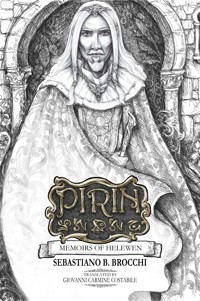
The day after, when he opened his eyes, Domenir saw there were leaves of papyrus and a hand-writer's pen on the sheets. He collected them, and was surprised to realize all the leaves were blank. “What kind of message is this?”, he asked himself while raising on his arms and leaning his head on the headboard. He took from his nightstand the bell which he used every morning to call a carer charged to dress him, wash his face, help him getting on his chair and escorting him to breakfast. As soon as he had come before his foster-father, Domenir could not wait a second before asking for an explanation for the unusual handwriting set waiting for his wake on the sheets. “What does it mean?” he asked Helewen, while putting pen and scrolls on the table. Untroubled, the King was staring at the boy, and he promptly clarified any doubt about his reasons: “You shall write my story, Nhalfòrdon-Domenir. Thus the memories of an old King shall not get lost through his death”, the Pirin announced.
Das E-Book können Sie in Legimi-Apps oder einer beliebigen App lesen, die das folgende Format unterstützen:
Veröffentlichungsjahr: 2020
Ähnliche

















Sebastiano B. Brocchi
Credits
I dedicate this book to my mum.
Having promised to dedicate her each book
I would have written is too little a thing, compared
to the love she dedicates to me every day,
for which no gratitude might ever suffice.
For more than ten years I endeavoured to write
this romance, and she was always there,
listening, advising, offering
her insights and ideas, often correcting mistakes and
criticizing me when necessary,
as well as letting me grow alongside my tale
of "Memoirs of Helewen".
To you, reader, I say:
in this labyrinth of tales
it is easy to get lost
but one might also find oneself...
NOTES
First Italian Edition October 2012
© Casa Editrice Kimerik
Second Italian Edition May 2017 – Third Italian Edition June 2019
© Sebastiano Brocchi
Translated into English by Giovanni Carmine Costabile
Reproduction and translation rights are reserved. No portion of this book can be utilized, reproduced or disseminated by any means without explicit, prior authorization in writing by the author.
Lyrics, cover and illustrations by the author.
BIOGRAPHICAL NOTES
TRANSLATOR'S PREFACE
“As ivy climbs upon these walls...”
Clive Staples Lewis in 1954, after the press release of The Fellowship of the Ring by John Ronald Reuel Tolkien, commented the book by stating, in a rather excited tone:
The Fellowship of the Ring is like lightning from a clear sky. (…) Here are beauties which pierce like swords or burn like cold iron; here is a book that will break your heart. (C.S. Lewis)
Such enthusiastic remarks may well be applied to Sebastiano B. Brocchi's romance Memoirs of Helewen, a title sorting a similar response from both Swiss and Italian readers, flabbergasted before the young author's talent and the magnitude and scope of his work. By the originality of the concept. By the sheer ambition manifested in each word, never betrayed by the pen. And, above all, by the power of a prose which is able to enchant us, to bring us above what we are used to in literature nowadays, as high as the Nhirklordi Mountains encircling Lothriel, or even the Pélori chain surrounding Valinor in The Silmarillion.
Besides being awestruck at my very first opening the book, I actually met the author face to face, as soon as we agreed I would be the translator of his work into English. We met at lunchtime, in a restaurant in the peaceful Swiss village of Ponte Tresa. Mr. Brocchi immediately strikes one's attention as a smart person, humorous and full of inventive. I asked him about his sources of inspiration, and he made a joke about thieves stealing from churches. Perhaps, I gather from the hints, he is alluding to the bitter observation based on the human condition, according to which, despite our freedom, we are compelled to make a choice: either we steal from the Gods' fire, like Theoson, or Prometheus, or we shall never accomplish anything really impressive, such as the present work undoubtedly is.
Although I have a confession to make: it was not the first time I was asking the same question to Mr. Brocchi. In fact, I had already interviewed him, about eleven months earlier, on behalf of the Società Tolkieniana Italiana, the Italian branch of the broader Tolkien Society, based in Oxford, but counting members worldwide. That time as well, Sebastiano had been quite dismissive concerning my guesses as far as sources went: he was really clear it never ran across his mind to rewrite Tolkien, on one hand, while on the other he suggested how, perhaps, one may better get on the right track by rather surveying the Eastern traditions, as he specifically mentioned the Arabian Nights.
Tolkien heads West, while Brocchi goes East. Is it the breaking of a fellowship? Or the revelation of the Union of the Opposites, when West is East, and East is West? After all, to quote from Tolkien, how do we count “East of the Sun, West of the Moon”, line stolen from a popular folktale, if both celestial bodies, and the Sun in particular, even constitute the very reference upon which our cardinal points are based? And did not Dante Alighieri classify the Earthly Paradise as the place which “neither West did ever know, nor East”? Did we not even hear something related when watching Game of Thrones on TV, as Daenerys received the terrible reply from the witch Mirri Maz Duur, according to which she would meet her beloved once more only “when the sun rises in the West and sets in the East”?
But Brocchi's poetry is indeed Eastern in a sheer, auroral sense, as proved by the title of one among many fine compositions, which was the funniest part of my job as his translator to render. The poem, or rather hymn, I am referring to is titled “ Atthùdimth Nhalnar”, in the Pirin language, while in English it sounds: “Remember, Dawn”. It is usually reputed that poetry is highly subjective, although one honestly wonders according to which point of view might the idea of addressing Dawn itself as a living person, perhaps a Goddess, result distasteful. Prosopopoeia, the ancient Greeks called it, meaning “personification”. A word, I have to recall, strictly related to Tolkien's concept of Mythopoeia, at least in their second half, - poeia, from poesis, “making”, or, more specifically, “poetry”, indeed.
I hope I am not guilty of haughtiness, a risk often unavoidable for whoever wishes to check, or mention, an etymology, or a figure of speech. But, even in the case when my blame was actually proved to be unquestionable, Mr. Brocchi would instead be innocent, nonetheless: each and every of his page is a treasure of immediacy and straightforwardness, even so much so to be exemplar, and, again, “Eastern” in its purpose to be always essential, precisely as the beauty of swords cutting hearts to pieces.
And, maybe, as in Lewis' remarks that the book will “break your heart”, perhaps Memoirs of Helewen may also be itself that lover who within its pages sings:
As ivy climbs upon these walls,
Heading toward their summit,
My heart shall find its only end in you,
Struggling, in the attempt to reach your own
And Memoirs, like said lover, like Theoson, like Prometheus, like Fëanor, like Aladdin, like ivy, in attempting to reach the reader's heart, eventually always gets over the wall's top.
Giovanni Carmine Costabile
Gemonio, 06/03/2020
PART ONE
Nhalfòrdon-Domenir, the Scribe
From the golden haze
CHAPTER I
An elegant mansion
It was in the sixteenth year of the Eighth Age of the world. The spring was now fading in the summer warmth.
From the golden haze, which as a moist canopy of vapour fluttered on the river in large, slow swirls, there came the shadow of a boat. A raft, more precisely. Long. With a wooden cabin astern, and an oarsman. Well made. It flowed on a shimmering carpet, with the accompaniment of the lilting, gentle, lapping water. In its wake some squawking ducks took flight, and well-feathered herons, and cormorants, which thereafter glided once again on the river, not too far away.
The river Pafantehes-yedo, which, as a quiet herdsman, led southward the waters of lake Pàndihalbar, was elegantly bordered by green cane thickets and tall shady trees. The tree-tops, almost still, only now and then shaken, were superbly pierced by countless blades of light; and with these they played, and danced, creating a carousel of a thousand flashes. When the trees thinned out, there one could see white sheds belonging to fishermen, or the little hunting castle of some nobleman. Peaceful riverside villages, country buildings raised alongside the banks… And then again, thick woods, on a long journey which the raft undertook without ever docking.
Eventually it came close to an elegant mansion lying in the delicate embrace of an inlet of the large river-mouth. The white plasters, the precious roofing in brown tiles, the stony turrets for watch, the put-out torches and the iron-beaten grate whence thin lines of rust would drip, the many porches and the chimneys, the archways… All of them saluted the approaching of the vessel, thereby joining the choir of sweet whispering leaves and the singing of the songbirds, luring the observer’s eye as a great artist’s sculptures would.
The raft came closer to the towering estate, bowing before a bridge of grey stone overcome by moss, and finally docking in an inward dock where the quay and other boats lay unarmed.
The rich landlord was standing on a stairway beside the docks, surrounded by a few servants awaiting his dispositions.
He was a tall man, with long, wealthy,cream-coloured clothes
He was a tall man, dressed in long, wealthy, cream-coloured clothes, enameled with metal-hued arabesques, and bearing many richly-wrought jewels. His hair was smooth, shiny as silk, the colour of winter snow, as his moustaches, the fine goatee and the eyebrows; and golden eyes, like glowing honey-drops. He was looking at the raft-cabin, whence a few servants helped a wheel-chaired boy getting off: olive-skinned, sharp features, black-haired, and a lively brown look in his eyes, alight with amber-like reflections.
The boy’s parents got off as well: a good-looking woman, also brown-skinned, and a blonde man of princely looks and fine hair, both of them richly dressed. They came closer to the landlord, waving their hands enthusiastically in his direction, as people coming back from a long trip, or those who are leaving for one. After their handshaking, the white-dressed man raised his glance to the disabled boy, with the expression of marvel one displays at seeing how much a long-unseen relative has grown, and with a gesture of his hand he commanded his servants to escort the boy inside the estate and to take his luggage from the raft.
The boy’s parents, moved, hugged the landlord and thanked him with great commotion, but, even more than their voices, it was their looks and abrupt silences talking, painstakingly, as it seemed, troubling the witnesses’ mind and filling their hearts with sorrow.
Some boxes filled with goods were disembarked by the servants, then the couple saluted the white-dressed man once more, bidding him their heartfelt farewell with barely a hint of a raised hand, which got lost in an air full of moist, peace and silence.
They got back on the raft and left the estate, sailing up the river and getting soon lost once more in the mist. The white-dressed man was still looking at the profile of the vessel fading on the horizon, after which, with a long sigh, he came back home to his guest.
He put his hands on the boy’s shoulders, then slightly caressed his head. “This is your home, so make yourself comfortable”, he told him. “After you get a change of dress and rest a while, we shall have dinner. Tomorrow I will introduce you to the servants, who are now also your servants. Ask them and you shall have whatever you want”. He halted a while, then added: “Welcome, boy”. The young man nodded and took his leave from the landlord with a look that would have been gratitude, but could not speak anymore. Maybe he had lost his voice. He had just bidden farewell to his mother and father, and he knew he would never see them again.
A great room, richly furnished
CHAPTER II
Nhalfòrdon-Domenir. Glowing Narcissus. That was the name of the wheel-chaired boy. The day he was entrusted to his foster-father’s care he was fifteen. His parents had left in an expedition in search of unknown lands across the ocean, whence they would not come back. If Domenir had been a boy like any other, able to walk, maybe, he thought, his parents would have taken him with them. Actually, though, they probably would not have taken him whatever the case, since they were sailing toward the unknown and an almost certain death.
Anyway he must come to terms with it. His life, now, was there, in that estate on the river, with Lord Helewen, his wealthy foster-father, who surely would have taken care of his every need; but whom, until then, he had only met in the occasion of some festivity or special recurrence, and whom he practically lacked any knowledge about, except that he had once been a powerful sovereign, belonging to an almost-extinct lineage of men: the Pirin, demigods dwelling on the high mountains of the East, about whom, and about whose land, a great wealth of legends had developed, but only a few assured facts were known.
He also knew that Helewen had forsaken the throne to retire in that forgotten place, on river Pafantehes-yedo, but he did not know why. He knew Helewen was very, very old, and his age must be about two hundreds and forty years, but through the strange magic surrounding his lineage, he was blessed with eternal youth. He knew he was a quite lonely man, unwilling to have guests and never holding feasts, who much rarely would get into town, rather preferring the quietness of his riverside estate, where he lacked nothing to live a more-than-dignified life, but could stay away from mundanity and noise.
Domenir would have had time to find out more about him. Now he was tired, wanted to sleep and try not to think anymore. He said he would not have dinner and, the morning later, when they came to say ‘good morning’, he said he wanted to sleep some more. Such was the routine for more than a week, only eating a little of what his foster-father had had him brought and only saying ‘thank you, thank you for everything’, and that he wanted to stay alone, and that he was sorry for the landlord but he would rather stay in his room for a while.
Helewen understood and told his servants, asking for dispositions, to do as Domenir would have asked them, until he had himself decided to come home spontaneously.
Domenir, meanwhile, slept, but could not avoid thinking.
And, when he could not sleep, he sat on his bed, leaning on the headboard, and ever thought of his parents, his fate, his life elsewhere. And, between a thought and the next, he also looked at his new bedroom. It was nice. Nicer than the one in the house he had been brought up in, in Sandovelia.
It was a great room, richly furnished, on the first floor of the mansion. Also the bed was large, covered with soft fabric coloured in plum, pink, and green jay, embroidered with pictures of villages and fortified towns, adorned with flowers and plant motifs, beaded with precious trimming. In front of the bed there was an elegant and large fireplace, looking as though it was made in jay.
The floor was in gray stone, raw-looking but cut in complex geometries. On the floor a marvelous carpet had been laid, black, or maybe dark-smoke, with brown motifs, finely wrought with starry skies, neighborhoods asleep under moonlight, shimmering lakes, high palaces with elegant domes, pinnacles of bell-towers, and temples with burning braziers alight in the night.
On the walls, one could see bookshelves carved in wood, and on the shelves there were books, pots, sculptures, and a thousand more items; they framed tremendous frescoes with pastel tones, depicting scenes from mythology as well as from countryside.
There was also an old table in painted, inlaid wood; a few comfortable chairs with historiated backs with idylls and game; a massive wardrobe, alternating light and dark woods. And then, on Domenir’s left as he watched from the bed, three gracious arched windows, facing a side of the garden where great magnolias grew. From them the whole mansion took its name, since its landlord had called it Matir-ath-Adurini, or Magnolias Estate.
Domenir watched his room quietly, but could not avoid the dark thoughts constricting his heart.
Breakfast
CHAPTER III
By the end of the first week, Nhalfòrdon-Domenir decided to have breakfast with his foster-father. The servants had him wear a nice dress and escorted him before Helewen. In order to allow Domenir to visit the upper stairs of the estate, Helewen had had them mount an elevator in strong chestnut wood, working on pulleys, which Domenir might easily access on his wooden chair. This way, the young guest could go up and down the five floors of the mansion as he wished, if only with the help of a carer.
Meanwhile, anyway, the corridor leading to the dining hall was plain, and it turned about on its wide course through the ancient high doors.
Helewen was seated at the head of a princely table laden for breakfast. He wore, as usual, a white dress, and was looking serenely at the boy led before him.
“Listen to me, lad”, the lord started, comfortably seated, as though he were continuing a dialogue which had just been interrupted. “You know my son is sailing on that ship, am I right?”
The reference to the ship upset Domenir pretty much, and Helewen immediately recognized the sad look the boy had assumed. “I am telling you this so that you know I, as well, like yourself, have had to comply with the sorrow for the separation from a person I loved. The loss of this son, leaving while aware of sailing toward a place we do not even know the existence thereof, is perhaps even harder to live with than the sorrow for his brother, who already took his last breath”.
Domenir felt an inner motion of deep compassion for his interlocutor, although he managed to hide it. “You still have a daughter, my lord. I only saw her once. I was a child back then, but she seemed the most gracious and radiant creature in our universe”, he said, trying the best he could think of to console his generous lord.
“Indeed, you are right, Domenir. As you know, though, my daughter lives away from here, alongside her mother. She does not manage to visit me but once each three or four years, even then spending only a few months here, in Magnolias Estate. The bitter truth is I am left alone, here in this huge mansion of more than a hundred halls”. The King stopped for a little while. “I do not regret any of my choices… but it is good to be aware that any choice entails some renunciation”.
“Why did you leave your country? Why did you leave your beloved to end your days in this forgotten, scarcely-populated place, away from the Gods’ sight, my lord? I… cannot understand”.
Helewen looked intensely in the fifteen-years-old’s direction, who even looked him back. Domenir was too well aware he had asked a bold, tactless question, and was a bit afraid of the possible reaction of the old monarch, but Helewen appreciated the sincere intentions of the boy. He had lived too long to desire hypocrisy and formal manners. Therefore he did not comment the tone, perhaps too harsh, of his foster-son. He talked slowly and meekly. “I have no answers to this question, Nhalfòrdon-Domenir. But perhaps one day, when you better understand the happenings of my life and the story that led me in this silent habitation, you shall realize what has brought me to this choice… and my renunciation”.
The two of them stayed silent for a while, while they slowly savoured the prelibacies filling the long table.
When the meal was over, Helewen got up and had Domenir led to one of the adjacent rooms, a wide hall where he gathered his workers and servants. “These men and women, Domenir, are all here to serve you and satisfy your requests. Therefore I wish you come to know them, as though they were members of your family”.
The landlord came close to a tall, well-dressed man who, as he himself, was a Pirin, and tried to flaunt his best smile. He was a thin figure, with his hair braided, effeminate features and a sort of awkward shyness. “This,” Helewen continued, “is Hybàr-biltòin, son of Desisida. He is the butler at Magnolias Estate, besides my personal secretary. He is learned, eclectic, tidy, and a fine speaker. He could stand witty exchanges with our most honoured guests and the great intellectuals of our time. It has to be said, though, that the unbecoming and hermit-like quality of his host does not allow him to frequent his intellectual peers”, the monarch concluded with a smile, while proudly shaking his trustworthy secretary’s arm.
“He, instead”, he said, coming but a few steps from a man who looked as though he came from the south, “is Irinambhidan, my accountant”. Domenir, who had just moved his glance from the first collaborator, fixed his deep dark eyes on the second. The man had bronze skin, dark hair, black eyes, and a long, thin beard that, masterfully beaded with rings in gold, zinc, and copper, arrived about the height of his chest.
“You know, Domenir,” the sovereign reprised, “we Pirin lack a monetary system. In our country economics is not based on money, things are neither sold nor bought. One day I shall tell you more precisely about the laws governing our country… When I established myself here, in Magnolias Estate, I had to assume somebody who could administer my conspicuous wealth. Irinambidhan comes from the desert territories of the Kingdom of Noghard. Like your mother. He is a son of merchants, who in their turn were sons of merchants from thirty generations. Only a little older than childhood, he had doubled his parents’ fortune by acquiring and selling goods throughout the Country. Even the sultan asked him as his personal accountant. When the sultan died, Irinambidhan became my collaborator. Today his economics treatises are taught in the great universities! Thanks to Irinambidhan, my fortune in three years has tripled”.
Domenir struggled to follow the foster-father’s dissertations, who knew stories, anecdotes, romances, about each secretary, domestic, cook or peasant alike, and by listening to him one got the impression he was telling one about the lives of his brothers and sisters, children and relatives. Among them there were Men, Elves, Dwarves, Giants, and even some belonging to the curious people of the Fhegòlnori, who, besides some hair on the top of their ears, like lynches and squirrels, also have funny moustaches which, together with their thick eyebrows, depart from the bridge of the nose, similarly to owls.
That day, Helewen introduced Domenir to his three valiant cooks, his four gardeners, the stewards, the household of the peasants who took care of the orchards, the yards and the other fields of the mansion, as well as the servants who kept the mansion clean and ordered, the two guardians, the stable-boys and the squires.
Eventually, the old King introduced the boy to the three carers who, in turn, would take care of him, of his clothes, and his movements across the estate. Dhaldèrien, not much older than Domenir, blonde and thin, coming from the town of Oghenvill; Naroghesis, a stout thirty-years-old, chestnut curly hair, long till his knees, a son of artisans from a village in Folklord; and, last but not least, the awesome Kadman, disinherited from his rich family in Duhjum for wanting to marry the daughter of a smith and a waitress…
Shapes veiled by other shapes
CHAPTER IV
In the following days, Nhalfòrdon-Domenir asked to visit the mansions and its gardens. He found that in each room, in each corner of the enchanted haven of King Helewen, an actual universe was disclosed to him. Wherever he set his eyes, Domenir could see marvelous works, fairy-like vistas, and items from far and different places. Halls and chambers looked like art workshops, antiquarian stores, bazaars filled with collections, memories, devices and unique creations, which the landlord had carefully collected throughout the long years of his life. On the shelves, on the furniture, on the ground, hanging from the walls or the ceilings, there was a wealth of sculptures, statues, illuminated manuscripts, journals, diaries, herbal notes, scrolls, ancient maps, trophies, stuffed animals, pots, lamps, chandeliers, unknown musical instruments, busts, tapestries, carpets, curtains and clothes, jewels and works of refined gold-smithing, necklaces, weapons, precious stones, astrolabes, armillary spheres, instruments to measure time and curious inventions… and each of these items told a different story. It seemed, somehow, as though Helewen wanted to keep the entire world in that estate.
And each time Domenir though he had now explored the whole of it, his foster-father showed him things he had missed at first glance, items previously hidden by others, shapes veiled by other shapes.
Thus from an ancient pot a scroll was taken, or by opening the curtains a fresco was revealed, or a hidden niche. By pulling out the drawers of some ancient nightstand in historiated wood, one could take out some old decorated boxes, which contained other boxes, which in their turn contained mysterious items, historically significant. By turning the pages of ponderous manuscripts, there appeared notes, drawings, or dried leaves of rare essences.
Domenir, who had begun with amazement – but kept silent, for his heart was veiled by sadness – as the days passed started to ask questions, desiring his noble foster-father to clarify the fascinating vicissitudes of the wealth of items kept in those rich chambers.
In the estate, without taking account of the building which was used as an annex for the household and the servants, there were dozens of bedrooms besides the landlord’s, offices and ateliers, a breakfast hall, a lunch hall and a dinner hall, two break halls, a workshop, a great library, a small natural science museum, four exhibition halls for artworks, a hall of inventions, a frescoed hall with maps, a private chapel, a theatre with about forty seats, two large living halls and three reading halls, twelve bathrooms. There were also storages, stables, barns, cellars and docks. On the outer walls there were dozens of loggias, balconies, corridors, stairways and porches.
Since the summer was getting warmer and warmer, Helewen could show his young guest also the large gardens of Matir-ath-Adurini, for that was the most advisable period for long walks in the shade of its trees, reflected as green clothes in the quiet mirror of the river; and then to climb the delicate green hills, stopping by to contemplate the vista from the meditative stone of the gazebos watching over the whole park; and smelling the fresh, dripping spray which casual winds raised from the fountains. Every now and then in the large park, one could see gray sentinels of stone silently lurking, scratched emblems of fantastic beasts, mysterious sculptures, still witnesses of a long-lost past.
That long summer
CHAPTER V
In the first long summer spent at Matir-ath-Adurini, Domenir little by little forgot his sorrow for having been left behind by his parents. In daytime he would always think less about it, overwhelmed as he was by so many news offered to his eyes and by the loving care of his foster-father. Besides, his mother, before leaving, had told the few friends Domenir had to come visit him at the estate, at least for a while, so that the change might be less abrupt. She had also asked Helewen to take Domenir to Sandovelia, a few times a year, so that he could see the place where he had been brought up some times more. His friends had come pay a visit to him at Magnolias Estate about ten times that summer, and Helewen had not forgotten about taking his young foster-son to the capital, where they spent a few days for the solstice celebration.
Only in the evening, before falling asleep, or in some rainy days spent in his room or in the estate’s loggias, when everything was silent around him, young Domenir’s heart cried without a sound. Dreams, smiles, words, all reminded him of his sorrow. When the wind’s gloomy song molested the tree-tops, and the noisy, jingling choir of the storm, pierced by the strike of thunder, fell upon the dale of river Pafantehes-yedo, the young man’s spirit was shaken, as by an icy poison, a fit of heavy, oppressing nostalgia. A shadow Domenir tried to suppress, as though he were sending the crows away from the field after the sowing. He wished he could imagine his parents were alive, straight on their course in days of calm, or even already docked in prosperous countries, sunny, flourishing lands where people were kind to their guests.
Only an awareness, or even a feeling, allowed Domenir to quiet his troubled heart: that long summer he had understood, or so it seemed to him, that lord Helewen somehow needed him. That he had accepted his presence for the opportunity it provided to him of being a father once more.
Now the summer was finished, and Domenir could leave the estate ever less. Everybody around him was busy preparing, each in their own way, for winter: gardeners and farmers, who had spent many hours in summer with the newcomer, inviting him to look at the several works to be done and the many little secrets of taking care of the park, were now absent, each of them busy in their own activity. Domenir, who almost felt as though he were disturbing so many industrious activities, decided to spend more time in the house, reading, helping in small businesses, or talking to the servants when they were not working. But mostly, now that Helewen seemed to have forsaken the enthusiasm he had until then entertained his guest with, enumerating, describing and exhibiting characters, items, food and places in the vast household he administered, Domenir felt like he should investigate his foster-father’s life and origins, to learn who the Pirin really were, and how their legendary Kingdom was. Therefore one day, when autumn was setting the stage for winter, as he was spending the afternoon with the old King, Domenir asked Helewen to tell him his story.
Leaves of papyrus and a hand-writer's pen
CHAPTER VI
A play of chiaroscuro separated a column from the other in the loggia, following the lines of the arches and casting on the inside the shadows of the changing lights of the outer landscape. From that elevated spot, one could enjoy a panoramic view of the river and the woods that, set alight by the autumn and the declining sun approaching the horizon, looked like sculptures in bronze and copper.
Helewen sat beside Domenir on a comfortable high-backed seat, as he cast his uninterested look on the ducks and swans floating in water. Every now and then he would ask Domenir some question, or inform him about his plans for the next day (or days).
When, abruptly, the boy asked him about his story and his people’s, Helewen did not immediately reply, as though he were surprised by that unexpected question. Or, to be more precise, he did expect that question, but could not tell the time of its being asked.
“My story, Domenir, is a story made by the interlace of many other stories. In my life I witnessed great events, some of them changing once and for all the way the world we live in looks like…” The nobleman stopped. The young boy looked at Helewen while slightly moving the head in his direction, his eyes impatient that the speaker continued his tale, but, as soon as he saw Helewen had no intention to keep up, came back to rest his head on the pillow of his wheel-chair, although he still kept his gaze on his foster-father. Helewen spoke no more. Domenir could not figure out what such a silence meant, but did not speak either. They stood in the loggia until sunset, then Helewen got up, inviting the boy to join him for dinner in the hall.
The day after, when he opened his eyes, Domenir saw there were leaves of papyrus and a hand-writer's pen on the sheets. He collected them, and was surprised to realize all the leaves were blank. “What kind of message is this?”, he asked himself while raising on his arms and leaning his head on the headboard. He took from his nightstand the bell which he used every morning to call a carer charged to dress him, wash his face, help him getting on his chair and escorting him to breakfast. As soon as he had come before his foster-father, Domenir could not wait a second before asking for an explanation for the unusual handwriting set waiting for his wake on the sheets. “What does it mean?” he asked Helewen, while putting pen and scrolls on the table. Untroubled, the King was staring at the boy, and he promptly clarified any doubt about his reasons: “You shall write my story, Nhalfòrdon-Domenir. Thus the memories of an old King shall not get lost through his death”, the Pirin announced.
The young man rolled his eyes, then slightly frowned; eventually, after a brief hesitation, he smiled at his foster-father. “That would be a honour, sir”.
“Yes, but not straightaway. Now finish your breakfast. Then we shall get into the hall. Before dictating my memoirs, I want to tell you about the origin and the customs of my people…” Helewen added, sipping a perfumed juice from a chalice.
When they had moved to the adjacent hall, where a warm fireplace was waiting for them, the couple took seats, and Helewen told Naroghesis to put on Domenir’s chair’s arms a wooden board, upon which the boy could put the leaves of papyrus and an inkwell. Thereafter the King dipped the pen in the ink, and put it in the boy’s hand.
“Write, Domenir. Title: Concerning the origin of the Kingdom of Lothriel”. The young man turned the long pen between his fingers for a while, then timidly but convincingly made his first marks on the paper. He raised his glance toward his foster-father’s, seeking his approval. Helewen looked at the page, took in his hand and tore it in pieces, to the fifteen-years-old’s bewilderment. “Do not write in Arionvallis characters. Use the hieratic alphabet instead”.
“But why utilizing the holy alphabet, my lord, to compose memoirs?” Domenir asked.
“Because those alphabetic character, revealed by the Gods to my people, who then taught them to the other races, although they are now known and currently used only by a few learned men, are the signs of the only language spread throughout the known world! Thus, what you shall write, can be read by all the civilized people of this continent. Men, divided into the eight lines Arion, Fhegòlnori, Duharion, Noghardroi, Onifaroi, Pegmenjabari, Rodiarion and Welahirin. The Elves called Asi. The Giants of the Sandarion people. The Gottilsi Dwarves. And even the people who dwell in the underground, the great realm of Hagardtyh. This is the reason why all the most important books are written in the Pirin alphabet, the universal language.
Domenir then tried to write again, on a new leaf of papyrus
Domenir then tried to write again, on a new leaf of papyrus, the title decided by Helewen, this time using the ancient signs of the Lothriel alphabet. His hand now seemed slightly more insecure, his writing less elegant. Although Domenir had taken calligraphy lessons from the best masters in his town, anyway he had been born in a country, Arionvallis (the land of the Men of the West), that had by and large forgotten that language, keeping it for the liturgy in the temples, the trials in courts, the scientific treatises, the dust of the libraries, as a dead language.
As a token of love
CHAPTER VII
It is told that one day, many millennia ago, the great and powerful God Ghaladar, Lord of light, fell deeply in love for the fair Goddess Uhilyn, Nymph of the lotus flowers and Queen of the Flower-Fairies. Indeed, before the first lotus flower bloomed, only at times and barely did the light cast her gaze upon the dark waters of the marshes. But then, upon seeing the chest of white petals opening and blooming, as if a whiteness like that had never before appeared in the pools, and within that flower the fairest of the Nymphs did stand, the eyes of Ghaladar could never cease to behold that marvel.
Convinced he should marry his beloved, the God asked for the advice of the other Gods concerning how he should confess his feelings to her, thereafter winning her unsullied heart. All the Gods agreed in suggesting the bright Ghaladar to perform a feat so wonderful as to deeply impress his beloved, to make her an amazing gift that proved the greatness of his feelings. Ghaladar spent much time meditating and contemplating from afar the fair Uhilyn. He sat on the sun and, from dawn to dusk, he followed with his gaze the magnet of his feelings. As a Queen of the Flower-Fairies, Uhilyn was constantly travelling in different countries, in order to pay a visit to each arboreal species, checking their inflorescences, cheering up the corollas to open and spread their sweet aroma. Only a thought could trouble the Nymph: how to cross the frosty lands of the snowy realms, during winter, without seeing, neither in woods nor in meadows, a single colourful petal? More than once did Ghaladar hear the fair Uhilyn stop and think to herself: “Oh, if there ever could be a place where I saw the land and the waters covered with an overwhelming wealth of flowers, without then, as soon as the cold snowy curtain fell, the fair, many-coloured inflorescences must wither! A place where the air was filled with golden, perfumed pollen… Oh, how I would love to dwell in a similar realm… If there ever was one, I would not hesitate to set my court there, surrounded by my many sisters, who would surely equally rejoice in the experience”. Ghaladar heard her conceiving such thoughts, and had an idea.
Thus it happened that, one night, he appeared in a dream to a prophet named Mindhab, a man who lived in the region of On-Ifar. Ghaladar had chosen him as his messenger since childhood: as a child, Mindhab stayed for hours staring at the sun, so much that he almost lost his sight, and his parents, worried, had come to the temple of Ghaladar to ask for the God’s intervention. Ghaladar had then spoken to the mind of his devout follower: “My dear Mindhab, I know well you dedicated your heart to me, but if you keep looking at me, you will lose your sight. If you really wish to see me, you have to look the other direction, and see the things I shine upon. For it is there where all my light goes, and it is there where I pour myself out. Thus it shall be for all Gods. They are the source of things, but their accomplishment is in the things they originate”. From that day on, Mindhab never stopped looking at the things Ghaladar shone upon, in order to understand what Ghaladar himself was.
Mindhab was now a grown man, when Ghaladar came again to him, visiting his dreams. Immediately the prophet kneeled before the God, awaiting his dispositions: “Listen carefully to what I say to you, Mindhab: at the break of dawn you shall go to the village market and buy a basket. It must be a well-braided basket, wide and large. Not a basket such as those the merchants utilize to move vegetables from a stand to another, but a coloured basket, one you could use to put a gift there. You shall also buy flowers, fruits and seeds. You shall choose the best fruits, with the liveliest colours and the most delightful looks, without any stain or dent. You shall choose the most colourful flowers, with the richest corollas and the sweetest perfume. When you choose the seeds, you shall be careful to pick the seeds of the most exquisite plants, the most revered trees that grow in the gardens of princes. Thereafter you shall fill the basket with the flowers, the fruits and the seeds, then add some branches of the abundant and shiny leaves you shall pick in the woods, and a handful of gold coins. When the basket is thus filled and adorned with ribbons and other decorations improving it, you shall take it to a snowy scree and leave it there. Your brother shall help you carrying it, so that the weight does not overcome you, nor the composition gets ruined. But be careful, the scree must be visible from a beaten path, so that anyone there passing might see it. To whom, amongst those, shall ask you the meaning of your gesture, you shall say I commanded it, and that the great and powerful God Ghaladar, the Bright Lord, by this gesture announces he shall put a fertile and thriving country, incomparably rich, among the highest and steepest mountains of the East; doing it as a token of love for she who stole his heart! If my beloved reciprocated my love, be aware that, amongst the Men of this land, I shall invite to my wedding only those who stopped to ask you the meaning of the basket left in the scree”.
After the devout Mindhab performed, one after another, the tasks commanded him by his Lord, Ghaladar led Uhilyn to the snowy scree, showed her the basket shining amidst the bare dale, and told her the meaning of that symbol. “By my powerful voice”, the God said to the Nymph whose fairness won everybody, “I shall command the mountains to open. I shall create amongst the snowy peaks a realm eternally preserved from the cold. The mountains shall listen to my voice, the roaring of which is as thunder. The peaks shall bend, the mountainsides shall be torn apart in sweet dales. A dale shall be born between the whitening mountains. The peaks shall move aside in order to welcome a verdant garden, and winter shall never come there, and the trees shall bear fruit twice a year. A great lake, like a silver mirror, shall wet the bottom of that luxurious place. Its shores shall be covered in white lotus flowers, the inflorescences of which are so big that a child could not manage to hug them, and each petal of such outstanding corollas shall be wide as a hand’s palm and more. But what is more important, my beloved, is that each sod of the earth, each drop of water, each breath of the wind, each leaf and each blade of grass of this paradise, I give it to you, so that you make this place your home, if you wish so”.
The Fairy-Queen was very impressed by that gift, yet, before accepting the marriage proposal, she considered: “Excellent Ghaladar, o brightness giving light to the world, I indeed think I do not deserve your gift. What am I, when compared to you? What is a flower, blooming and withering in a swift season, compared to light, eternally casting its uncorrupted rays upon everything? I give birth to, and rule, little, unimportant things, while you control the most important thing”. To such questions, he replied: “And what good would it be to cast light on the world, if no beauty therein were shown? Indeed, in a blooming flower more beauty can reside than in a century of light falling in the void”.
“If your feelings truly match your words, well, I shall be honoured to become your bride, my Lord”.
Pleased to hear that, the God took the basket from the scree, flew over the mountain-tops, and from there poured over the glaciers the content of the basket, casting several spells. And, as soon as flowers, fruits, branches of many leaves, seeds and gold coins fell upon the snowy ground, the ground itself trembled, as a snail’s horn does upon being touched. As a loud sound was heard, the mountains were opened, verily as a chest, and, where earlier one would have peaks and rocks, shaken by grey storms, now the lake appeared, and the flowered meadows, and the green forests, indeed as promised by the God to his bride. Soon the marriage was celebrated, and only those among Men who had stopped to wonder about the meaning of the basket in the scree could participate. Starting from the day when the God of Light married the Queen of the Flower-Fairies, all flowers in this world turn their corollas, with love, towards light”.
While Domenir carefully entrusted the tale to the pages, the old Pirin came to an alcove in the wall, whence he delicately took a little statue which he then handed to the boy, who immediately left the pen on the board. The statue, sculpted in alabaster, black stone, gold, silver and tiny emeralds, depicted the fairest of Nymphs, Uhilyn. “Where does this statue come from?”, Domenir asked, who had never seen jewels so finely wrought. “From my country. The Kingdom of Lothriel”.
Domenir put the item back into the hands of its owner, who in his turn put it back with great care in the alcove dedicated to it. He stayed for a while there, contemplating the image, shimmering with the reflections of the saffron glow of some candles, then he reminded the tale he had begun. He turned to look at the window, almost as though he were reading the follow-up to his narrative in the dark-hued play of the ash-like clouds, and he started telling the young boy about the origin of the Pirin people…
PART TWO
Theoson, the Goldsmith
The bride that was promised
CHAPTER I
Here follows the tale of the vicissitudes of Theoson the goldsmith, loved by the Gods, as it was told by King Helewen and written by Nhalfòrdon-Domenir:
In the early centuries of the Third Age, a bee-keeper called Sigh-Ymramar lived on the fishy shores of Hèrodin. Sigh-Ymramar, a widower at an early age, nevertheless had a smart and strong son called Theoson, who at thirteen had learned the art of gold-smithing.
When the young man turned seventeen, the village where they lived was devastated by a tidal wave and a large portion of the shoreline was swallowed by the sea. Even so, father and son managed to survive, also saving some goods, and migrated north, where they stayed at the place of the relatives of Sigh-Ymrarar’s deceased wife. The hosts provided them with a place to live until they could buy a house in the suburbs of Sandovelia, which was then but a little town made of stone and wood buildings, with only a fortified castle where now the royal palace stands. Sigh-Ymramar also bought a workshop in town, where Theoson could keep his gold-smithing business.
At that time the Kingdom of Sandovelia was ruled by King Bhali-Woesiskanka, from the Aries household. The King had a daughter suitable for marriage, the bride that was promised to prince Makhbel of Oghenvill. Nonetheless, it unexpectedly happened that the gracious princess, whose name was Atthù-ath-Hir, fell in love for the young goldsmith Theoson.
Theoson
It occurred that the princess had gone with her handmaid to Theoson’s workshop to commission him the jewels she was going to wear on the day of her wedding to prince Makhbel, and as soon as she saw the handsome foreigner, her heart was stolen.
Therefore, after a while, with the excuse of collecting the jewels for the wedding, princess Atthù-ath-Hir sent her handmaid to Theoson’s workshop inviting the young man to follow her. Theoson agreed and the handmaid led him to the noblewoman’s apartments by passing through a secret corridor in the castle. As soon as she and the young man were alone, the fair Atthù-ath-Hir confessed her feelings to her beloved, who, burning with passion, proved to strongly reciprocate her. And how does it end?
Theoson, feeling proud, asked the King for the princess’ hand in marriage, but the monarch burst in a thundering laughter. “Fool! Do you not know my daughter is already promised to prince Makhbel of Oghenvill? Besides, what do you, dog, have to offer to a King’s daughter? Consider yourself lucky if I do not have your head cut after such an outrage!” Then he had the guards take him, commanding them to throw that insolent out! Theoson left the castle in a very bad mood and came back to his country house, where he told everything to his old father. His parent tried to console him, but then rebuked him, telling him for such an outrage he might have been sentenced to death.
Meanwhile, at court, Atthù-ath-Hir complained to the King, telling him she would never marry prince Makhbel, for her heart belonged to Sigh-Ymramar’s son. The King tried to persuade her in every way, explaining her he would not allow her daughter to marry a baseborn man. The princess insisted, asking him to test Theoson, but the strict Bhali-Woesiskanka was impossible to convince and the discussion was over.
Princess Atthù-ath-Hir, partly out of hopelessness, partly out of revenge toward her father, stopped eating for many days. Upon seeing his daughter starving, King Bhali-Woesiskanka was caught by a sense of despair, but he did not change his mind concerning Theoson, and in his heart he was devising a plot to get rid of the suitor without being hated by fair Atthù-ath-Hir. Therefore, after a few days, unable to stand the sight of his daughter crying and complaining all day long, the King had the young goldsmith brought to the throne room, telling him he had had time to think and maybe he would consent to his marrying the princess, upon one condition. Following his daughter’s advice, the King of Sandovelia had decided to test the Theoson, but Bhali-Woesiskanka knew too well the love token he would ask the boy to fetch was unattainable to a baseborn and that, even if he had accepted the task, that would mean his death. Thus he spoke: “Listen, lad, to what I have to say. I accept to give you my enchanting daughter, princess Atthù-ath-Hir, as your bride, provided that, before a year is past, you bring me a lotus flower from lake Mystir. What do you have to say?”
Princess Atthù-ath-Hir
Theoson agreed without even thinking about what he had heard and asked the King for a further guarantee of his word. Bhali-Woesiskanka, although angered by a similar request, had to keep his anger at bay, for he had the princess carefully staring at him, and feigned his approval. He had his vizier issue a proclamation, and the vizier, as soon as he had written the text and had the King sign it, handed the scroll to Theoson. The young man immediately put it in his sack, and left the hall with a curtsy…
The brilliant goldsmith ran home to old Sigh-Ymramar and told him everything had happened to him. The old bee-keeper, at hearing what his son had come to tell him, was astonished and despaired. “Fool!” he said. “Have you not realized the King is sending you to certain death? He wants to get rid of you!” Theoson was surprised: “Father, I shall accomplish the task I was given, and marry princess Atthù-ath-Hir!”
The young man ignored what exactly the King’s request entailed, but his father was not late in bringing him back on earth: “The lotus flowers of lake Mystir only grow in the far realm of Lothriel. A land encircled by the highest and steepest mountains of the East. The road to get there crosses hostile countries, full of dark forests, hills haunted by monsters, and steep slopes beaten by storms, and rocky spurs frozen in the grip of the eternal snow… but, even if you managed to overcome any peril, thereby coming to the thriving paradise that the bright God Ghaladar created as a home for his bride – the realm of Neverwinter – and here you were even granted to pick one of the unsullied, sacred water lilies, you could never return to Sandovelia in time before the end of the year, because, in case you have forgotten, only a few months are left before winter solstice!”
Brave and deeply in love, Theoson told his father that, may the Gods help him, he would overcome all trials and come back in time, bringing back a divine flower of lake Mystir. At that point good Sigh-Ymramar understood the seriousness of his son’s intentions and thought that, maybe, the Gods might really look at the honest young man’s plans with favourable eyes.
Therefore he gave Theoson his blessing and, after disappearing for a while in the messy and dusty attic of that country house, he emerged thence with a chest in his hands, which he carefully put down before his son on a worktable. He took from there a pair of leather shoes, which looked cheap. “These shoes, my son, belonged to a druid, long ago, and have marvelous virtues. They do not fear any consumption, they do not slide on ice, and most importantly they allow their bearer to walk rapidly, without feeling any fatigue”.
Then, Sigh-Ymramar produced from the chest a pouch in jute, which contained a dragon-tooth, and on its gold-plated root there were four tiny gems, some motives historiated in watermark and a ring wherein a lace could be inserted and which could then be worn as a pendant. “This dragon-tooth shall protect its bearer from the attack of wild beasts, lurking in the shadows of the woods, ready to assault unwary travelers”.
Eventually Sigh-Ymramar, with great care, from a tiny, red as sealing wax, casket, entirely padded in silk, produced a golden bee of the finest workmanship, with ruby eyes. Theoson was amazed at seeing that incredible jewel – which must be worth a fortune – in his father’s hands; but he was even more amazed when, by reciting the formula of a spell, the old man made the golden bee fly, as it twirled, humming, in the room.
“This precious insect will show you the way to any place you might wish to come to. All it takes is to read the signs it makes in the air by flying. Half a circle, when the arch goes up, means you should go East; a whole circle clockwise means south; half a circle with a downward arch to go toward sunset, and an anticlockwise circle to head North”.
Theoson affectionately thanked the old man, asking him how he came to possess those mystic items. “The druid I was talking about was my grandfather. I received the dragon-tooth from a noble Southern warrior shipwrecked, after a storm, on the coast of our village. I had saved his life and given him a roof and hot meals until he was fine and once more able to leave in order to return to his country. The golden bee, instead, is the gift I received from an Elven Queen I freed from a Sprite’s spell, which had turned her into an orange-tree. So remember, my son, be generous and always offer your help to whomever asks you for it”.
Mystic items
The next day, Theoson left Sandovelia, heading towards the far realm of Lothriel…
Helewen interrupted his tale, when he saw that Domenir had already written a lot, the hour was late and he also had other businesses to attend. He took his leave from his foster-son by promising to continue the narrative the day after. Domenir put down his pen and put the leaves in order. Even though he was impatient to learn about the outcome of Theoson’s story, his hand was tired. He thanked the old gentleman and asked him where to put the written papyri. Helewen, who had not yet thought about that, looked around with an undecided face, then he realized that the Dwarf Crodarewen might look for a leather folder lying, still unused, in a dresser in his office. He took it from the hands of the servant and gave it to Domenir, who put the handwritten pages therein.
Heading East
CHAPTER II
The next day Helewen continued his tale in the estate park, thanks to the particularly mild weather of that autumn day. The air was soaked with the perfume of the dew-dripping grass, little by little getting dried by the morning rays. Between the branches one could hear the harmonious choir of the songbirds, only now and then interrupted by the squawking of the ducks sliding on the river.
“At what point in my story did I stop, Domenir?” The fifteen-years-old turned the pages, rapidly scrutinizing each sentence, now looking as a flock of black sparrows, orderly resting on hay-coloured meadows. “You interrupted your narrative, my lord, immediately after saying Theoson left his father’s house heading east”. There the tale continued:
The young Theoson, loved by the Gods, walked for days without getting tired, thanks to the druid’s shoes he wore. He stopped, when he did stop, only because of hunger; or when it was too dark to proceed. The evening of the third day, Theoson stopped at an inn in the neighbourhood of the ancient village of Mastrithal. That evening, a hunchbacked little old woman entered the inn to ask for help. The young goldsmith offered to help her by asking the reason of her troubles. The old woman said she had lost a ring, much precious to her, on the bottom of a pool, and asked Theoson whether he could dive in to retrieve it. Theoson said the day after he would have to continue travelling, but since the old woman said he would be blessed by the Gods if he helped her, the young man was convinced, always mindful of his father’s recommendations, and told her to come again to the inn the next morning. At the break of dawn, the woman came once more to the inn, asking for the boy, who, having been told by the innkeeper, got dressed, took his things, paid for the night and followed her. The two of them headed towards a pool not too far away, close to the woman’s house.
The water was cool and slightly dirty, but Theoson dived in all the same. He emerged and came back underwater over and over, without any result, until eventually, after a last try, he surfaced with the shiny jewel in his hand. The ring had been stuck in a branch at the bottom of the pool. The old woman could smile again, and could not stop thanking the boy, inviting him to her house where he was given warm clothes and a hot beverage.
“To show you my gratitude, lad, I want to give you a very special item” she said, looking for something in a wardrobe. She came back with a bag in jute. From the bag she produced what looked like a common square mirror in silver, with a decorated handle. “Despite its appearance, this mirror is no common item, my dear lad”, the old woman began. “Time runs slower in there… the images you see therein mirrored do not depict what happens today, but only what took place yesterday”.
Theoson respectfully took the item from the gnarly hands of the old woman, and what he saw on the silver glass left him astonished: he saw himself travelling, and the landscapes he had left behind the day before. And that was not all: he could even hear the sounds he had heard along the path: the singing birds, the flowing of a stream, the breeze between the branches. He wanted to refuse such a gift, but the hunchbacked woman insisted that he took it because, she said, he was a good boy who deserved the benevolence of the Gods and only good luck in his destiny. Therefore Theoson, thanking the woman once more, put the mirror in the bag and the bag in his travelling sack.
In the clear waters of the fountain
CHAPTER III
Theoson proceeded swiftly towards East and came in sight of the town of Mason Gottbin, a fortress of the Dwarves. Before entering the town, though, the young man was stopped by a luminous and iridescent Sprite who, coming towards him on butterfly wings, asked him to follow in his trail. You should know that, although they rarely appear to mortals, there are many fairy creatures in woods. When they take male form, they are generally called Sprites, whereas, when their appearance is female, they are called Nymphs or Fairies; to conclude, when one of them appears as an old man, he is called a Genie. Contrarily to those who believe that flowers, trees, stones, or the water of streams, are inanimate bodies, actually within each of them dwells a Sprite or a Nymph keeping them alive.




