


1,99 €
Niedrigster Preis in 30 Tagen: 0,00 €
Niedrigster Preis in 30 Tagen: 0,00 €
Mehr erfahren.
- Herausgeber: e-artnow
- Kategorie: Gesellschafts- und Liebesromane
- Sprache: Englisch
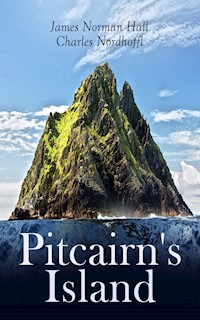
Pitcairn's Island follows the Bounty mutineers as they try to settle and found colony in the islands of the South Seas. After two unsuccessful attempts to settle on the island of Tubuai, the Bounty mutineers returned to Tahiti where they parted company. Fletcher Christian and eight of his men, together with eighteen Polynesians, sailed from Tahiti in September 1789, and for a period of eighteen years nothing was heard of them. Then, in 1808, the American sailing vessel Topaz discovered a thriving community of mixed blood on Pitcairn Island under the rule of Alexander Smith.
Das E-Book können Sie in Legimi-Apps oder einer beliebigen App lesen, die das folgende Format unterstützen:
Veröffentlichungsjahr: 2022
Ähnliche










Pitcairn's Island
Table of Content
The Bounty Route
Chapter I
On a day late in December, in the year of 1789, while the earth turned steadily on its course, a moment came when the sunlight illuminated San Roque, easternmost cape of the three Americas. Moving swiftly westward, a thousand miles each hour, the light swept over the jungle of the Amazons, and glittered along the icy summits of the Andes. Presently the level rays brought day to the Peruvian coast and moved on, across a vast stretch of lonely sea.
In all that desert of wrinkled blue there was no sail, nor any land till the light touched the windy downs of Easter Island, where the statues of Rapa Nui’s old kings kept watch along the cliffs. An hour passed as the dawn sped westward another thousand miles, to a lone rock rising from the sea, tall, ridged, foam-fringed at its base, with innumerable sea fowl hovering along the cliffs. A boat’s crew might have pulled around this fragment of land in two hours or less, but the fronds of scattered coconut palms rose above rich vegetation in the valleys and on the upper slopes, and at one place a slender cascade fell into the sea. Peace, beauty, and utter loneliness were here, in a little world set in the midst of the widest of oceans—the peace of the deep sea, and of nature hidden from the world of men. The brown people who had once lived here were long since gone. Moss covered the rude paving of their temples, and the images of their gods, on the cliffs above, were roosting places for gannet and frigate bird.
The horizon to the east was cloudless, and, as the sun rose, flock after flock of birds swung away toward their fishing grounds offshore. The fledglings, in the dizzy nests where they had been hatched, settled themselves for the long hours of waiting, to doze, and twitch, and sprawl in the sun. The new day was like a million other mornings in the past, but away to the east and still below the horizon a vessel—the only ship in all that vast region—was approaching the land.
His Majesty’s armed transport Bounty had set sail from Spithead, two years before, bound for Tahiti in the South Sea. Her errand was an unusual one: to procure on that remote island a thousand or more young plants of the breadfruit tree, and to convey them to the British plantations in the West Indies, where it was hoped that they might provide a supply of cheap food for the slaves. When her mission on Tahiti had been accomplished and she was westward bound, among the islands of the Tongan Group, Fletcher Christian, second-in-command of the vessel, raised the men in revolt against Captain William Bligh, whose conduct he considered cruel and insupportable. The mutiny was suddenly planned and carried swiftly into execution, on the morning of April 28, 1789. Captain Bligh was set adrift in the ship’s launch, with eighteen loyal men, and the mutineers saw them no more. After a disastrous attempt to settle on the island of Tupuai, the Bounty returned to Tahiti, where some of the mutineers, as well as a number of innocent men who had been compelled to remain with the ship, were allowed to establish themselves on shore.
The Bounty was a little ship, of about two hundred tons burthen, stoutly rigged and built strongly of English oak. Her sails were patched and weather-beaten, her copper sheathing grown over with trailing weed, and the paint on her sides, once a smart black, was now a scaling, rusty brown. She was on the starboard tack, with the light southwesterly wind abaft the beam. Only nine mutineers were now on board, including Fletcher Christian and Midshipman Edward Young. With the six Polynesian men and twelve women whom they had persuaded to accompany them, they were searching for a permanent refuge: an island so little known, so remote, that even the long arm of the Admiralty would never reach them.
Goats were tethered to the swivel stocks; hogs grunted disconsolately in their pens; cocks crowed and hens clucked in the crates where several score of fowls were confined. The two cutters, chocked and lashed down by the bulwarks, were filled to the gunwales with yams, some of them of fifty pounds weight. A group of comely girls sat on the main hatch, gossiping in their musical tongue and bursting into soft laughter now and then.
Matthew Quintal, the man at the wheel, was tall and immensely strong, with sloping shoulders and long arms covered with tattooing and reddish hair. He was naked to the waist, and his tanned neck was so thick that a single unbroken line seemed to curve up from his shoulder to the top of his small head. His light blue eyes were set close together, and his great, square, unshaven chin jutted out below a slit of a mouth.
The light southwesterly air was dying; presently the ship lost way and began to roll gently in the calm, her sails hanging slack from the yards. Clouds were gathering on the horizon to the north. Quintal straightened his back and turned to glance at the distant wall of darkness, rising and widening as it advanced upon the ship.
Christian came up the ladderway. He was freshly shaven and wore a plain blue coat. The tropical sun had burned his face to a shade darker than those of the girls on the hatch. The poise of his strong figure and the moulding of his mouth and jaw were the outward signs of a character instant in decision, resolute, and quick to act. His black eyes, deep-set and brilliant, were fixed on the approaching squall.
“Smith!” he called.
A brawny young seaman, who had been standing by the mainmast, hastened aft, touching his turban of bark cloth.
“Clew up the courses, and make ready to catch what water you can.”
“Aye, aye, sir!”
Smith went forward, shouting: “All hands, here! Shorten sail!”
A group of white seamen appeared from the forecastle. The brown men turned quickly from the rail, and several of the girls stood up.
“To your stations!” Smith ordered. “Fore and main courses—let go sheets and tacks! Clew lines—up with the clews!”
The lower extremities of the two large sails rose to the quarters of the yards, the native men and half a dozen lusty girls shouting and laughing as they put their backs into the work. Smith turned to the seaman nearest him.
“McCoy! Take Martin and rig the awning to catch water. Look alive!”
Christian had been pacing the quarter-deck, with an eye on the blackening sky to the north. “To the braces, Smith!” he now ordered. “Put her on the larboard tack.”
“Braces it is, sir.”
Edward Young, the second-in-command, was standing in the ladderway—a man of twenty-four, with a clear, ruddy complexion and a sensitive face, marred by the loss of several front teeth. He had gone off watch only two hours before and his eyes were still heavy with sleep.
“It has a dirty look,” he remarked.
“Only a squall; I’m leaving the topsails on her. By God! It will ease my mind to fill our casks! I can’t believe that Carteret was mistaken in his latitude, but it is well known that his timekeeper was unreliable. We’re a hundred miles east of his longitude now.”
Young smiled faintly. “I’m beginning to doubt the existence of his Pitcairn’s Island,” he remarked. “When was it discovered?”
“In 1767, when he was in command of the Swallow, under Commodore Byron. He sighted the island at a distance of fifteen leagues, and described it as having the appearance of a great rock, no more than five miles in circumference. It is densely wooded, he says in his account of the voyage, and a stream of fresh water was observed, coursing down the cliffs.”
“Did he land?”
“No. There was a great surf running. They got soundings on the west side, in twenty-five fathoms, something less than a mile from the shore.... The island must be somewhere hereabout. I mean to search until we find it.” He was silent for a moment before he added: “Are the people complaining?”
“Some of them are growing more than restless.”
Christian’s face darkened. “Let them murmur,” he said. “They shall do as I say, nevertheless.”
The squall was now close, concealing the horizon from west to north. The air began to move uneasily; next moment the Bounty lurched and staggered as the first puff struck her. The topsails filled with sounds like the reports of cannon: the sun was blotted out and the wind screamed through the rigging in gusts that were half air, half stinging, horizontal rain.
“Hard a-starboard!” Christian ordered the helmsman quietly. “Ease her!”
Quintal’s great hairy hands turned the spokes rapidly. In the sudden darkness and above the tumult of the wind, the voices of the native women rose faint and thin, like the cries of sea fowl. The ship was righting herself as she began to forge ahead and the force of the wind diminished. In ten minutes the worst was over, and presently the Bounty lay becalmed once more, this time in a deluge of vertical rain. It fell in blinding, suffocating streams, and the sound of it, plashing and murmuring on the sea, was enough to drown a man’s voice. Fresh water spouted from the awnings, and as fast as one cask was filled another was trundled into its place. Men and women alike, stripped to their kilts of tapa, were scrubbing one another’s backs with bits of porous, volcanic stone.
Within an hour the clouds had dispersed, and the sun, now well above the horizon, was drying the Bounty’s decks. A line of rippling dark blue appeared to the southwest. The yards were braced on the other tack, and the ship was soon moving on her course once more.
Young had gone below. Christian was standing at the weather rail, gazing out over the empty sea with an expression sombre and stern beyond his years. In the presence of others, his features were composed, but oftentimes when alone he sank into involuntary reflections on what was past and what might lie ahead.
A tall young girl came up the ladderway, walked lightly to his side, and laid a hand on his shoulder. Maimiti was not past eighteen at this time. Of high lineage on Tahiti, she had left lands, retainers, and relatives to share the dubious fortunes of her English lover. The delicacy of her hands and small bare feet, the lightness of her complexion, and the contours of her high-bred face set her apart from the other women on the ship. As she touched his shoulder, Christian’s face softened.
“Shall we find the land to-day?” she asked.
“I hope so; it cannot be far off.”
Leaning on the bulwarks at Christian’s side, Maimiti made no reply. Her mood at the moment was one of eager anticipation. The blood of seafaring ancestors was in her veins, and this voyage of discovery, into distant seas of which her people preserved only legendary accounts, was an adventure to her taste.
Forward, in the shadow of the windlass, where they could converse unobserved, two white men sat in earnest talk. McCoy was a Scot who bore an Irish name—a thin, bony man with thick reddish hair and a long neck on which the Adam’s apple stood out prominently. His companion was Isaac Martin, an American. Finding himself in London when the Bounty was fitting out, Martin had managed to speak with her sailing master in a public house, and had deserted his own ship for the prospect of a cruise in the South Sea. He was a dark brutish man of thirty or thereabouts, with a weak face and black brows that met over his nose.
“We’ve give him time enough, Will,” he said sourly. “There’s no such bloody island, if ye ask me! And if there is, it’s nowheres hereabout.”
“Aye, we’re on a wild-goose chase, and no mistake.”
“Well, then, it’s time we let him know we’re sick o’ drifting about the like o’ this! Mills says so, and Matt Quintal’s with us. Brown’ll do as we tell him. Ye’ll never talk Alex over; Christian’s God Almighty to him! I reckon Jack Williams has had enough, like the rest. That’ll make six of us to the three o’ them. What’s the name o’ that island we raised, out to the west?”
“Rarotonga, the Indians said.”
“Aye. That’s the place! And many a fine lass ashore, I’ll warrant. If we do find this Pitcairn’s Island, it’ll be nothing but a bloody rock, with no women but them we’ve fetched with us. Twelve for fifteen men!”
McCoy nodded. “We’ve no lasses enough. There’ll be trouble afore we’re through if we hae no more.”
“In Rarotonga we could have the pick o’ the place. It’s time we made him take us there, whether he likes it or not!”
“Make him! God’s truth! Ye’re a brave-spoken fellow, Isaac, when there’s none to hear ye!”
Martin broke off abruptly as he perceived that Smith had come up behind him unaware. He was a powerfully made man in his early twenties, under the middle stature, and with a face slightly pitted with smallpox. His countenance was, nevertheless, a pleasing one, open and frank, with an aquiline nose, a firm mouth, and blue eyes set widely apart, expressing at the same time good humour and self-confident strength. He stood with brawny tattooed arms folded across his chest, gazing at his two shipmates with an ironic smile. Martin gave him a wry look.
“Aye, Alex,” he grumbled, “it’s yourself and Jack Williams has kept us drifting about the empty sea this fortnight past. If ye’d backed us up, we’d ha’ forced Christian to take us out o’ this long since.”
Smith turned to McCoy. “Hearken to him, Will! Isaac’s the man to tell Mr. Christian his business. He knows where we’d best go! What d’ye say, shall we make him captain?”
“There’s this must be said, Alex,” remarked McCoy apologetically, “we’re three months from Tahiti, and it’s nigh three weeks we’ve spent looking for this Pitcairn’s Island! How does he know there’s such a place?”
“Damn your eyes! D’ye think Mr. Christian’d be such a fool as to search for a place that wasn’t there? I’ll warrant he’ll find it before the week’s out.”
“And if he don’t, what then?” Martin asked.
“Ask him yourself, Isaac. I reckon he’ll tell ’ee fast enough.”
The conversation was interrupted by a hail from aloft, where the lookout stood on the fore-topmast crosstrees.
“Aye, man, what d’ye see?” roared Smith.
“Birds. A cloud of ’em, dead ahead.”
Pacing the afterdeck with Maimiti, Christian halted at the words.
“Run down and fetch my spyglass,” he said to the girl.
A moment later he was climbing the ratlines, telescope in hand. One of the native men had preceded him aloft. His trained eyes made out the distant birds at a glance and then swept the horizon north and south. “Terns,” he said, as Christian lowered his glass. “There are albacore yonder. The land will be close.”
Christian nodded. “The ship sails slowly,” he remarked. “Launch a canoe and try to catch some fish. You and two others.”
The native climbed down swiftly to the deck, calling to his companions: “Fetch our rods, and the sinnet for the outrigger!”
The people off watch gathered while the Polynesian men fetched from the forecastle their stout rods of bamboo, equipped with handmade lines and curious lures of mother-of-pearl. The cross-booms were already fast to the outrigger float; they laid them on the gunwales of the long, sharp dugout canoe, and made them fast with a few quick turns of cord. They lowered her over the side, and a moment later she glided swiftly ahead of the ship.
The Bounty held her course, moving languidly over the calm sea. The canoe drew ahead fast, but at the end of an hour the ship was again abreast. One man was angling while the two paddlers drove the light vessel back and forth in the midst of a vast shoal of albacore. A cloud of sea birds hovered overhead, the gannets diving with folded wings, while the black noddy-terns fluttered down in companies each time the fish drove the small fry to the surface. Schools of tiny mullet and squid skipped this way and that in frenzied fear, snapped at by the fierce albacore below and the eager beaks of the birds. The angler stood in the stern of the canoe, trailing his lure of pearl shell far aft in the wake. Time after time the watchers on the ship saw the stiff rod bend suddenly as he braced himself to heave a struggling albacore of thirty or forty pounds into the canoe.
While the people of the Bounty gazed eagerly on this spectacle, one of the native men began to kindle a fire for cooking the fish. It was plain that there would be enough and to spare for all hands. Presently the canoe came alongside and two or three dozen large albacore were tossed on deck. Alexander Smith had relieved the man at the masthead, and now, while all hands were making ready for a meal, he hailed the deck exultantly: “Land ho-o-o!”
Men and women sprang into the rigging to stare ahead. Christian again went aloft, to settle himself beside Smith and focus his telescope on the horizon before the ship. The southerly swell caused an undulation along the line where sea met sky, but at one point, directly ahead, the moving line was interrupted. A triangle, dark and so infinitely small that none but the keenest of eyes could have made it out, rose above the sea. With an arm about the mast and his glass well braced, Christian gazed ahead for some time.
“By God, Smith!” he remarked. “You’ve a pair of eyes!”
The young seaman smiled. “Will it be Pitcairn’s Island, sir?” he asked.
“I believe so,” replied Christian absently.
The land was still far distant. The wind freshened toward midday, and after their dinner of fish all hands gazed ahead at the rugged island mounting steadily above the horizon. The natives, incapable of concern over the future, regarded the spectacle with pleased interest, but among the white men there was more than one sullen and gloomy face.
While the island changed form as it rose higher and higher before the ship, Christian sat in his cabin on the lower deck. With him were two of the Polynesian men, leaders of the others, whom he had asked to meet him there.
Minarii, a native of Tahiti, was a man of huge frame, with a bold, stern countenance and the assured, easy bearing of a man of rank. His voice was deep and powerful, his body covered with tattooing in curious and intricate designs, and his thick, iron-grey hair confined by a turban of white bark cloth. His companion, Tetahiti, was a young chief from Tupuai, who had left his island because of the friendship he felt for Christian, and because he knew that this same friendship would have cost him his life had he remained behind when the ship set sail. The people of Tupuai were bitterly hostile to the whites; good fortune alone had enabled the mutineers to leave the island without loss of life. Tetahiti was a powerfully made man, though of slighter build than Minarii; his features were more gently moulded, and his expression less severe. Both had been told that the Bounty was seeking an island where a settlement might be formed; now Christian was explaining to them the true state of affairs. They waited for him to speak.
“Minarii, Tetahiti,” he said at last, “there is something I want you two and the other Maoris to know. We have been shipmates; if the land ahead of us proves hospitable, we shall soon be close neighbours ashore. For reasons of policy, I have not felt free to tell you the whole truth till now. Too much talk is not good on shipboard. You understand?”
They nodded, waiting for him to proceed.
“Bligh, who told the people of Tahiti that he was Captain Cook’s son, lied to them. He was not a chief in his own land, nor had he the fairness and dignity of a chief. Raised to a position of authority, he became haughty, tyrannical, and cruel. You must have heard tales in Tahiti of how he punished his men by whipping them till the blood ran down their backs. His conduct to all grew unbearable. As captain, he drew his authority direct from King George, and used it to starve his crew in the midst of plenty, and to abuse his officers while the men under them stood close by.”
Minarii smiled grimly. “I understand,” he said. “You killed him and took the ship.”
“No. I resolved to seize the ship, put him in irons, and let our King judge between us. But the men had suffered too much at Bligh’s hands. For sixteen moons they had been treated as no Maori would treat his dog, and their blood was hot. To save Bligh’s life, I put the large boat overboard and sent him into her, with certain men who wished to go with him. We gave them food and water, and I hope for the sake of the others that they may reach England. As for us, our action has made us outlaws to be hunted down, and when our King learns of it he will send a ship to search this sea. You and the others knew that we were looking for an island, remote and little known, on which to settle; now you know the reason. We have found the island. Minarii, shall you be content to remain there? If the place is suitable, we go no further.”
The chief nodded slightly. “I shall be content,” he said.
“And you, Tetahiti?”
“I can never return to my own land,” the other replied. “Where you lead, I shall follow.”
Four bells had sounded when Christian came on deck, and the Bounty was drawing near the land. At a distance of about a league, it bore from east-by-north to east-by-south, and presented the appearance of a tall ridge, with a small peak at either end. The southern peak rose to a height of not less than a thousand feet and sloped more gently to the sea; its northern neighbour was flanked by dizzy precipices, against which the waves broke and spouted high. Two watercourses, smothered in rich vegetation, made their way down to the sea, and midway between the peaks a slender thread of white marked where a cascade plunged over a cliff. The coast was studded with forbidding rocks, those to the north and south rising high above the spray of breaking seas. Clouds of sea fowl passed this way and that above the ship, regarding the intruders on their solitude with incurious eyes. Everywhere, save on the precipices where the birds reared their young, the island was of the richest green, for vegetation flourished luxuriantly on its volcanic soil, watered by abundant rains. No feature of the place escaped the native passengers, and exclamations of surprise and pleasure came from where they were grouped at the rail.
The leadsman began to call off the depths as the water shoaled. They had thirty fathoms when the northern extremity of the island was still half a mile distant, and Christian ordered the sails trimmed so that the ship might steer southeast along the coast. The wind was cut off as she drew abreast of the northern peak; the Bounty moved slowly on, propelled by the cat’s-paws that came down off the land. The shore, about four cables distant, rose steeply to a height of two hundred feet or more, and there was scarcely a man on board who did not exclaim at the prospect now revealed. Between the westerly mountains and others perceived to the east lay a broad, gently sloping hollow, broken by small valleys and framed on three sides by ridges and peaks. Here were many hundreds of acres of rich wooded land, sheltered on all sides but the northern one.
The sea was calm. Before an hour had passed, the sails were clewed up and the Bounty dropped anchor in twenty fathoms, off a cove where it seemed that a boat might land and the steep green bluffs be scaled.
Standing on the quarter-deck, Christian turned to Young. “I fancy we shall find no better landing place, though we have not seen the southern coast. I shall take three of the Indians and explore it now. Stand offshore if the wind shifts; we can fend for ourselves.”
The smaller canoe was soon over the side, with Tetahiti and two other men as paddlers. Christian seated himself in the bow, and the natives sent the little vessel gliding swiftly away from the ship. Passing between an isolated rock and the cape at the eastern extremity of the cove, the canoe skirted the foot of a small wooded valley, where huge old trees rose above an undergrowth of ferns and flowering shrubs. The pandanus, or screw pine, grew everywhere above the water’s edge, its thorny leaves drenched in salt spray and its blossoms imparting a delicious fragrance to the air. Presently they rounded the easternmost cape of the island, which fell precipitously into the sea, here studded with great rocks about which the surges broke.
As the canoe turned westward, a shallow, half-moon bay revealed itself to Christian’s eyes. The southerly swell broke with great violence here, on a narrow beach of sand at the foot of perpendicular cliffs, unscalable without the aid of ropes let down from above. A cloud of sea fowl hovered along the face of the cliffs, so high overhead that their cries were inaudible in the lulls of the breakers.
“An ill place!” said Tetahiti, as the canoe rose high on a swell and the beach was seen, half-veiled by smoking seas. “No man could climb out, though a lizard might.”
“Keep on,” ordered Christian. “Let us see what is beyond.”
The southern coast of the island was iron-bound everywhere, set with jagged rocks offshore and rising in precipices scarcely less stupendous than those flanking the half-moon bay. On the western side there was a small indentation where a boat might have effected a landing in calm weather, but when they had completed the circuit of the island Christian knew that the cove off which the ship lay at anchor offered the only feasible landing place.
The sun was setting as he came on board the Bounty; he ordered the anchor up and the sails loosed to stand off to windward for the night.
Chapter II
At dawn the following morning the island bore north, distant about three leagues. Close-hauled, on the larboard tack, the ship slid smoothly through the calm sea, and toward seven o’clock she passed the southeastern extremity of the island. About half a mile to the northwest, after rounding this point, was the shallow indentation where the Bounty had been anchored the previous day. Sounding continuously, with lookouts aloft and in the bows, she approached the land and again came to anchor half a mile from the beach, in seventeen fathoms.
Christian and Young stood together on the quarter-deck while the sails were clewed up and furled. With his spyglass Christian examined the foreshore carefully. Presently he turned to his companion.
“I shall be on shore the greater part of the day,” he said. “In case of any change in the weather, heave short and be ready to stand off.”
“Yes, sir.”
“We are fortunate in having this southwesterly breeze; I only pray that it may hold.”
“It will, never doubt it,” Young replied. “The sky promises that.”
“Be good enough to have one of the Indian canoes put into the water.”
This order was quickly complied with, and a few minutes later Christian, taking with him Minarii, Alexander Smith, Brown, the gardener, and two of the women, Maimiti and Moetua, set off for the beach. Minarii sat at the steering paddle. The bay was strewn with huge boulders against which the sea broke violently. To the right and left, walls of rock fell all but sheer to the cove, but midway along it they discovered a ribbon of shingly beach, the only spot where a boat might be landed in safety. Steering with great skill, directing the movements of the paddlers and watching the following seas, Minarii guided the canoe toward this spot. They waited for some time just beyond the break of the surf, then, seizing a favourable opportunity, they came in on the crest of a long wave, and, immediately the canoe had grounded, they sprang out and drew it up beyond reach of the surf.
Directly before them rose a steep, heavily wooded slope, the broken-down remnant of what must once have been a wall of rock. Casuarina trees, some of them of immense size, grew here and there, the lacy foliage continually wet with spray. Coconut palms and the screw pine raised their tufted tops above the tangle of vegetation, and ferns of many varieties grew in the dense shade. For a moment the members of the party gazed about them without speaking; then Maimiti, with an exclamation of pleasure, made her way quickly to a bush that grew in a cleft among the rocks. She returned with a branch covered with glossy leaves and small white blossoms of a waxlike texture. She held them against her face, breathing in their delicate fragrance.
“It is the tefano,” she said, turning to Christian. Moetua was equally delighted, and the two women immediately gathered an armful of the blossoms and sat down to make wreaths for their hair.
“We shall be happy in this place,” said Moetua. “See! There are pandanus trees and the aito and purau everywhere. Almost it might be Tahiti itself.”
“But when you look seaward it is not like Tahiti,” Maimiti added wistfully. “There is no reef. We shall miss our still lagoons. And where are the rivers? There can be none, surely, on so small an island that falls so steeply to the sea.”
“No,” said Christian. “We shall find no rivers like those of Tahiti; but there will be brooks in some of these ravines. What do you think, Minarii?”
The Tahitian nodded. “We shall not lack for water,” he said. “It is a good land; the thick bush growing even here among the rocks proves that. Our taro and yams and sweet potatoes will do well in this soil. We may even find them growing here in a wild state; and there are sure to be plantains in the ravines.”
Christian threw back his head, gazing at the green wall of vegetation rising so steeply above them. “We shall have work and to spare in clearing the land for our plantations,” he said.
“I’ll take to it kindly, for one,” Smith replied warmly. “It does my heart good to smell the land again. Brown and me is a pair will be pleased to quit ship here, if that’s your mind, sir. Eh, Will?”
The gardener nodded. “Shall we stop, sir?” he asked. “Is this Pitcairn’s Island, do ye think?”
“I’m convinced of it,” Christian replied. “It is far off the position marked for it on Captain Carteret’s chart, but it must be the island he sighted. Whether we shall stay remains to be seen.”
The women had now finished making their wreaths. They pressed them down over their thick black hair, which hung loosely over their shoulders. Christian gazed at them admiringly, thinking he had never seen a more beautiful sight than those two made in their kirtles of tapa cloth, with flecks of sunlight and shadows of leaves moving as the wind would have it across their faces and their slim brown bodies. Maimiti rose quickly. “Let us go on,” she said. “I am eager to see what lies beyond.”
The party, led by Minarii, was soon toiling up the ridge, the natives, Smith among them, far in advance. Christian and Brown followed at a more leisurely pace, stopping now and then to examine the trees and plants around them. The ascent was steep indeed, and in places they found it necessary to pull themselves up by the roots of trees and bushes. Two hundred feet of steady climbing brought them to a gentler slope. Here the others were awaiting them.
Before them stretched a densely wooded country that seemed all but level, at first, after the steep climb to reach it. Far below was the sea, its colour of the deepest blue under the cloudless sky. In a southerly direction the land rose gently for a considerable distance, then with a steeper ascent as it approached the ridge which bounded their view on that side. To the northwest another ridge could be seen, culminating at either end in a mountain peak green to the summit, but the one to the north showed sections of bare perpendicular wall on the seaward side. The land before them was like a great plateau rather than a valley, traversed by half a dozen ravines, and lying at an angle, its high side resting upon the main southern ridge of the island, its lower side upon the cliffs that fronted the sea. The ridges to the west and south rose, as nearly as they could judge, five or six hundred feet above the place where they stood.
“That peak to the southwest must be all of a thousand feet above the sea,” said Christian.
“Aye, sir,” Smith replied. “We’ll be high and safe here, that’s sure. Ye’d little think, from below, there’s such good land.”
At a little distance before them the ground fell away to a small watercourse so heavily shaded by great trees that scarcely a ray of sunlight penetrated. Here they found a tiny stream of clear water and gladly halted to refresh themselves. Christian now divided his party.
“Minarii, do you and Moetua bear off to the left and climb the main ridge yonder. Smith, you and Brown follow the rise of the land to the westward; we must know what lies beyond. I will proceed along this northern rim of the island. Let us meet toward midday, farther along, somewhere below the peak you see before us. The island is so small that we can hardly go astray.”
They then separated. Keeping the sea within view on the right, Christian proceeded with Maimiti in a northwesterly direction. Now and then they caught glimpses through the foliage of the mountain that rose before them, heavily wooded to the topmost pinnacle, but descending in sheer walls of rock on the seaward side. Save for the heavy booming of the surf, far below, the silence of the place seemed never to have been broken since the beginning of time; but a few moments later, as they were resting, seated on the trunk of a fallen tree, they heard a faint bird-call, often repeated, that seemed to come from far away. They were surprised to discover the bird itself, a small dust-coloured creature with a whitish breast, quite near at hand, darting among the undergrowth as it uttered its lonely monotonous cry. They saw no other land birds, no living creatures, in fact, save for a small brown rat, and a tiny iridescent lizard scurrying over the dead leaves or peering at them with bright eyes from the limbs of trees. Of a sudden Maimiti halted.
“There have been people here before us,” she said.
“Here? Nonsense, Maimiti! What makes you think so?”
“I know it,” she replied gravely. “It must have been long ago, but there was once a path where we are now walking.”
Christian smiled incredulously. “I can’t believe it,” he said.
“Because you are not of our blood,” the girl replied. “But Moetua would know, or Minarii. I felt this as we were climbing up from the landing place. Now I am sure of it. People of my own race have lived here at some time.”
“Why have they gone, then?”
“Who knows?” she replied. “Perhaps it is not a happy place.”
“Not happy? An island so rich and beautiful?”
“The people may have brought some old unhappiness with them. It is not often the land that is to blame; it is those who come.”
“You can’t be right, Maimiti,” Christian said, after a moment of silence. “What could have brought them so far from any other land?”
“It is not only you white men with your great ships who make long voyages,” she replied. “There is no land in all this great ocean that people of my blood have not found before you. Even here they have come.”
“Perhaps.... Don’t you think we shall be happy here?” he asked presently. “You’re not sorry we came?”
“No ...” She hesitated. “But it is so far away.... Shall we never go back to Tahiti?”
Christian shook his head. “Never. I told you that before we came,” he added gently.
“I know....” She glanced up with a wistful smile, her eyes misted with tears. “You must not mind if I think of Tahiti sometimes.”
“Mind? Of course I shall not mind! ... But we shall be happy here, Maimiti. I am sure of it. The land is strange to us now; but soon we shall have our houses built, and when our children come it will be home to us. You will never be sad, then.”
The relationship between Christian and this daughter of Polynesian aristocrats was no casual or superficial one. It was an attachment that had its beginning shortly after the Bounty’s first arrival at Tahiti, and which had deepened day by day during the months the vessel remained there, assembling her cargo of young breadfruit trees. During the long sojourn on the island, Christian had made a serious effort to learn the native speech, with such success that he was now able to converse in it with considerable fluency. The language difficulty overcome, he had discovered that Maimiti was far more than the simple, unreflecting child of nature that he had, at first, supposed; but it was not until the time came when it was necessary for her to choose between him and giving up, forever, family and friends and all that had hitherto made life dear to her that he realized the depth of her loyalty and affection. There had been no hesitation on her part in deciding which it should be.
Presently she turned toward him again, making an attempt to smile. “Let us go on,” she said. She took Christian’s hand, as though for protection against the strangeness and silence of the place, and they proceeded slowly, peering into the thickets on either side, stopping frequently to explore some small glade where the dense foliage of the trees had prevented the undergrowth from thriving. Of a sudden Maimiti halted and gazed overhead. “Look!” she exclaimed. “Itatae!”
Coming from seaward, outlined in exquisite purity against the blue sky, were two snow-white terns. They watched them in silence for a moment.
“These are the birds I love most of all,” said Maimiti. “Do you remember them at Tahiti? Always you see two together.”
Christian nodded. “How close they come!” he said. “They seem to know you.”
“Of course they know me! Have I never told you how I chose the itatae for my own birds when I was a little girl? Oh, the beautiful things! You will see: within a week I shall have them eating out of my hand.”
She now looked about her with increasing interest and pleasure, pointing out to Christian various plants and trees and flowers familiar to her. Presently a parklike expanse, shaded by trees immemorially old, opened before them. On their right hand stood a gigantic banyan tree whose roots covered a great area of ground. Passing beyond this and descending the slope for a little way, they came to a knoll only a short distance above the place where the land fell steeply to the sea. It was an enchanting spot, fragrant with the odours of growing, blossoming things, and cooled by the breeze that rustled through the foliage of great trees that hemmed it in on the seaward side. Beyond, to the north, they looked across a narrow valley to the mountain which cut off the view in that direction. Christian turned to his companion.
“Maimiti, this is the spot I would choose for our home.”
She nodded. “I wished you to say that! It is the very place!”
“All of our houses can be scattered along this northern slope,” he added, “and we are certain to find water in one of these small valleys.”
Maimiti was now as light-hearted as she had been sad a little time before. They sat down on a grassy knoll and talked eagerly of plans for the future, of the precise spot where their house should stand; of the paths to be made through the forests, of the gardens to be planted, and the like. At length they rose, and, crossing the deeply shaded expanse above, they came to a breadfruit tree which towered above the surrounding forest. It was the first they had seen. Another smaller tree had sprung from one of its roots, and by means of this Maimiti climbed quickly to the lower branches of the great one, which was loaded with fruit. She twisted off a dozen or more of the large green globes, tossing them down to Christian.
“We shall have a feast to-day,” she called down. “Did you bring your fire-maker?”
Christian brought forth his flint and steel; they gathered twigs and leaves and dry sticks, and when the fire was burning briskly they placed the fruit in the midst of it to roast. When the rough green rinds had been blackened all round, they left the breadfruit among the hot ashes and again set out to explore further. Upon returning, an hour later, they found Minarii and Moetua squatting by the fire roasting sea birds’ eggs which they had collected along the tops of the cliffs beyond the southern ridge. And Minarii had brought a cluster of green drinking coconuts and a bunch of fine plantains he had found in the depths of the valley.
“We shall eat well to-day,” he said. “It is a rich land we have found. We have no need to seek further.”
“So I think,” Christian replied. “Did you climb the ridge to the south’ard?”
“Yes. There is good land beyond, better even than that in this valley. I was surprised to find it so; but on this side is where we should live.”
“That is good news, Minarii,” Christian replied. “I, too, supposed that the sea lay directly below the southern ridge. How wide are the lands beyond?”
“In some places they extend for all of five or six hundred paces, sloping gently down from the ridge to the high cliffs that front the sea.”
“Have you found any streams?”
“One. It is small, but the water is good.”
“We shall not lack for sea fowls’ eggs,” said Moetua. “All the cliffs on that southern side are filled with crannies where they nest. I collected these in little time, but there is danger in gathering them; it made my eyes swim to look below.”
It was now getting on toward midday, but the lofty trees spread for them their grateful shade, and the breeze, though light, was refreshingly cool. While preparations for the meal went forward, Christian again strolled to the seaward side of the plateau, where he had a view of the full half-circle of the horizon. Far below, to the east, he could see the Bounty, looking small indeed under the cliffs, against the wide background of empty sea. Her anchors were holding well. Having satisfied himself that the ship had maintained her position, he seated himself with his back to a tree, hands clasped around his knees, and remained thus until he heard Maimiti’s voice calling him from above. He rose and went slowly back to the others.
Their meal was under way before Smith and Brown appeared. Both were enthusiastic over what they had found.
“It’s as fine a little place as ever I see, Mr. Christian,” Smith said, warmly. “We climbed to the top of that peak, yonder.”
“How much land is there beyond the western ridge?”
“Little enough, sir, and what there is, is all rocks and gullies.”
Christian turned to Brown. “What have you found in the way of useful plants and trees?”
“I needn’t speak of the coconut palms and the pandanus, sir. Ye’ve seen for yourself that there’s more than enough for our needs. Then there’s miro and sandalwood, and the tutui ...”
“The candlenut? There is a useful find indeed!”
“There’s a good few scattered about; and the miro, as ye know, is a fine wood for house-building. As for food plants, it’s as well we’ve a stock on board. We’ve found wild yams and a kind of taro, but little else.”
“You could overlook the whole of the island from the peak?”
“Aye, sir,” Smith replied.
“What would you say of its extent, judging roughly?”
“It can’t be much over two miles long, sir, if that; and about half as wide. What do ye think, Will?”
“Aye, it’s about that,” the gardener replied. “There’s a fine grove of breadfruit on the shelf of land ye can see from here, sir, but I’m as glad we brought some young trees with us. We’ve varieties I didn’t see, here, in looking about this morning.”
“Have you found any evidence that people have been here before us?”
“To say the truth, sir, I never even thought of that,” Brown replied.
“Ye don’t mean white men, Mr. Christian?” Smith asked.
“No. We are the first, I am sure, who have ever landed here; but Maimiti thinks Indians have once inhabited the place.”
“If they did, it must have been long ago. Never a trace did we see of anything of the kind.”
Christian now turned to Minarii, addressing him in the native tongue. “Minarii, is it possible, do you think, that Maoris have ever visited this land?”
“É,” he remarked, quietly. “There has been a settlement here, where we now are. It is the place that would have been chosen for a village, and that great banyan tree has been planted. The breadfruit as well.”
Maimiti turned to Christian. “You see?” she said. “Did I not tell you so?”
Christian smiled, incredulously. “I have great respect for your judgment, Minarii,” he said, “but in this case I am sure you are wrong. Before us sea birds alone have inhabited this land.”
Minarii inserted his hand into the twist of tapa at his waist and drew forth a small stone adze, beautifully made and ground to perfect smoothness. “Then the sea fowl brought that?” he asked.
It was late afternoon when the party returned to the ship. Smith and Brown went forward, where they were surrounded at once by the other seamen, eager for a report of conditions ashore. Christian retired to his cabin and supped there, alone. Toward sunset he joined Young on deck. For some time he paced up and down, then halted by his companion, who stood at the rail gazing at the high slopes before them, all golden now in the light of the sinking sun.
“We will call this ‘Bounty Bay,’ Mr. Young, unless you have a better suggestion?”
“I was thinking that ‘Christian’s Landing’ would be a suitable name, sir.”
Christian shook his head. “I wish my name to be attached to nothing here,” he said, “not even to one of those rocks offshore. Tell me,” he added, “now that we have found the place, how do you feel about it?”
“That we might have searched the Pacific over without having discovered a more suitable one.”
“There is no real anchorage here,” Christian went on. “The place where we lie is the best the island affords. You can imagine what this cove will be in a northerly blow. No ship would be safe for ten minutes in such an exposed position. You realize what a decision to remain here means? Our voyages are over until our last day.”
“That is of course, sir,” Young replied, quietly.
“And you are content that it shall be so?”
“Quite.”
Christian turned his head and gave him a swift, scrutinizing glance. When he spoke again it was not as the Bounty’s captain addressing an inferior officer. There was a friendly gleam in his eyes, and a note of appeal in his voice.
“Old friend,” he said, “from this time on, let there be no more ship’s formality between us. The success or failure of the little colony we shall plant here depends largely upon us. I shall need your help badly, and it may be that you will need mine. Whatever happens, let us stand by each other.”
“That we shall,” Young replied warmly, “and there is my hand upon it.”
Christian seized and pressed it cordially. “We have rough men to handle,” he continued. “It was to be expected that the more unruly ones should have come here with me.... Tell me frankly, why did you come? There was no need. You took no part in the mutiny; you might have remained on Tahiti with the other innocent men to wait for a ship to take you home. Once there, a court-martial would certainly have vindicated you.”
“Let me assure you of this,” Young replied, “I have never regretted my decision.”
Christian turned again to look at him. “You mean that,” he said, “I can see that you do. And yet, when I think what you have given up to throw in your lot with me ...”
“Do you remember Van Diemen’s Land,” Young asked, “where Bligh had me seized up at one of the guns and flogged?”
“I am not likely to forget that,” Christian replied, grimly.
“I was a mutineer at heart from that day,” Young went on. “I have never told you of this, but, had there been an opportunity, I would have deserted the ship before we sailed from Tahiti—for home, as we then thought. As you know, I slept through the whole of the mutiny. When I was awakened and ordered on deck, the thing was done. Bligh and those who went with him had been cast adrift, and the launch was far astern. Had I known in advance what you meant to do ...” He paused. “I will not say, Christian, that I would have given you my active support. I think I should have lacked the courage ...”
“Let us speak no more of that,” Christian interrupted. “You are here. You little know what comfort that thought brings me.... I was thinking,” he added presently, “what a paradise Pitcairn’s Island might prove, could we have chosen our companions here. We have an opportunity such as chance rarely grants to men—to form a little world cut off from the rest of mankind, and to rear our children in complete ignorance of any life save what they will find on this small island.”
Young nodded. “Whom would you have chosen, could you have had your wish, from the Bounty’s original company?”
“I prefer not to think of the matter,” Christian replied, gloomily. “We must do what we can with those we have. The Indians are fine fellows, with one or, perhaps, two exceptions. I have few regrets concerning them. As for the men of our own blood ...” He broke off, leaving the sentence unfinished.
“Brown and Alex Smith might have been chosen in any event,” Young remarked.
“I should have excepted them. They are good men, both.”
“And their respect and admiration for you are very near idolatry,” Young added, with a faint smile. “That of Smith in particular; you’ve a loyal henchman there.”
“I’m glad you think so. I’ve a great liking for Smith. What do you know of him? Where does he come from?”
“I’ve learned more about him these past three months than I did during the whole of the voyage out from England. He was a lighterman on the Thames at the time Bligh was signing on the Bounty men, but he hated the business and was only waiting for a suitable opportunity to go to sea again. He has told me that his true name is Adams, John Adams, and that he was born and reared in a foundling home near London.”
“Adams, you say? That’s curious! Why did he change his name?”
“He volunteered no information on that score, and I didn’t feel free to question him.”
“No, naturally not. Well, whatever scrape he may have been in, I’ll warrant there was nothing mean or underhanded in his share of it.”
“I’d be willing to take my oath on that,” Young replied, heartily. “He’s rough and uncouth, but you can depend upon him. He hasn’t a tricky or a dishonest bone in his body.”
“There is a decision we must make soon,” Christian said, after a moment of silence. “It concerns the vessel.”
“You mean to destroy her?”
“Yes. Do you agree to the plan?”
“Heartily.”
“There is nothing else we can do, the island being what it is; but I want the suggestion to come from the men themselves. They must soon see the necessity, if they have not already.”
“Supposing there were a safe anchorage?”
“Not even then should I have wanted to keep her. No, we must burn all bridges behind us. I fancy there is not a lonelier island in the Pacific, and yet the place is known, and there is always the possibility of its being visited. A ship can’t be concealed, but once we are rid of the Bounty we can so place our settlement that no evidence of it will appear from the sea. The landing is a dangerous one and not likely to be attempted by any vessel that may pass this way; certainly not if the place is thought to be uninhabited. We shall have little to fear, once we are rid of the vessel.”
“May I make a suggestion?”
“Please do. Speak your mind to me at all times.”
“The men are impatient, I know, to learn of your plans. Would it not be well to tell them, to-night, how the island impresses you?”
Christian reflected for a moment. “Good. I agree,” he said. “Call them aft, will you?”
He paced the quarter-deck while Young was carrying out this order. The men, both white and brown, gathered in a half-circle by the mizzenmast to await Christian’s pleasure. The women assembled behind them, peering over their shoulders and talking in subdued voices. It was a strange ship’s company that gathered on the Bounty’s deck to listen to the words of their leader.
“Before anything more is done,” he began, “I wish to be sure that you are satisfied with this island as a home for us. You were all agreed that we should search for the place, and that, if we found it suitable, we should settle here. You will have learned from your shipmates who went ashore with me what the island has to offer us. Remember, if we go ashore, we go to stay. If any object, now is the time to speak.”
There was an immediate response from several of the men.
“I’m for stopping, Mr. Christian.”
“It’s a snug little place. We couldn’t wish for better, sir.”
Mills was the first of the dissenting party to speak.
“It’s not my notion of a snug little place.”
“Why not?” Christian asked.
Addressed thus directly by his commanding officer, Mills shifted from one foot to the other, scowling uneasily at his companions.
“I’ve spoke my mind, Mr. Christian; it ain’t my notion of a place, and I’ll stand by that.”
“But that’s no reason, man! You must know why you’re not satisfied. What is it that you object to?”
“He’d be satisfied with no place, Mr. Christian; that’s the truth of it,” Williams, the blacksmith, put in.
“You prefer Tahiti. Is that it?” Christian asked.
“I’m not sayin’ I’d not go back if the chance was offered.”
Christian regarded him in silence for a moment.
“Listen to me, Mills,” he proceeded. “And the rest of you as well. I have spoken of this matter before. I will repeat what I’ve said, and for the last time. We are not English seamen in good standing, in our own ship, free to do as we choose and to go where we choose. We are fugitives from justice, guilty of the double crime of mutiny and piracy. That we will be searched for, as soon as the fact of the mutiny is known, is beyond question.”
“Ye don’t think old Bligh’ll ever reach England, sir?” Martin interrupted.
Christian paused and glanced darkly at him.
“I could wish that he might,” he said, “for the sake of the innocent men who went with him. As matters stand, it is not likely that any of them will ever again be heard of. Nevertheless, His Majesty will not suffer one of his vessels to disappear without ordering a wide and careful search to be made, to learn, if possible, her fate. A ship-of-war will be sent out for that purpose, and Tahiti will be her destination. There she will learn of the mutiny from those of our company who remained on that island. The Pacific will then be combed for our hiding place; every island considered at all likely as our refuge will be visited. Should we be discovered and taken, death will be the portion of every man of us. For my own part, I mean never to be taken.”




