


53,99 €
Mehr erfahren.
- Herausgeber: John Wiley & Sons
- Kategorie: Wissenschaft und neue Technologien
- Serie: Wiley Works
- Sprache: Englisch
Defending society against natural hazards is a high-stakes game of chance against nature, involving tough decisions. How should a developing nation allocate its budget between building schools for towns without ones or making existing schools earthquake-resistant? Does it make more sense to build levees to protect against floods, or to prevent development in the areas at risk? Would more lives be saved by making hospitals earthquake-resistant, or using the funds for patient care? What should scientists tell the public when – as occurred in L’Aquila, Italy and Mammoth Lakes, California – there is a real but small risk of an upcoming earthquake or volcanic eruption? Recent hurricanes, earthquakes, and tsunamis show that society often handles such choices poorly. Sometimes nature surprises us, when an earthquake, hurricane, or flood is bigger or has greater effects than expected from detailed hazard assessments. In other cases, nature outsmarts us, doing great damage despite expensive mitigation measures or causing us to divert limited resources to mitigate hazards that are overestimated. Much of the problem comes from the fact that formulating effective natural hazard policy involves combining science, economics, and risk analysis to analyze a problem and explore the costs and benefits of different options, in situations where the future is very uncertain. Because mitigation policies are typically chosen without such analysis, the results are often disappointing. This book uses general principles and case studies to explore how we can do better by taking an integrated view of natural hazards issues, rather than treating the relevant geoscience, engineering, economics, and policy formulation separately. Thought-provoking questions at the end of each chapter invite readers to confront the complex issues involved.
Readership: Instructors, researchers, practitioners, and students interested in geoscience, engineering, economics, or policy issues relevant to natural hazards. Suitable for upper-level undergraduate or graduate courses.
Additional resources can be found at: http://www.wiley.com/go/Stein/Playingagainstnature
Sie lesen das E-Book in den Legimi-Apps auf:
Seitenzahl: 468
Veröffentlichungsjahr: 2014
Ähnliche


















“This is truly an amazing book! The product of a unique collaboration between a renowned economist and renowned seismologist (who happen to be father and son), Playing against Nature lays out a clear story, in easy-to-read prose, of what natural disasters are, what the limitations of risk prediction can be, and how society's response to them has to account for the reality that we have limited economic resources. The authors present fascinating case studies to illustrate examples of where predictions have failed, and why. They also take a bold step by showing how natural disasters and economic disasters provide similar challenges, and provide a clear description of how risk should be assessed, and how it can be mitigated reasonably. This is a book that researchers, policy makers, and the general public should read. It can even serve as valuable text for the new generation of interdisciplinary college courses addressing the interface between science and social science.” – Stephen Marshak, Professor and Director of the School of Earth Society and Environment, University of Illinois at Urbana-Champaign
“I very highly recommend this book for anyone dealing with or interested in natural hazards assessment and mitigation. It is a tour de force with examples, descriptions, illustrations, reference lists, and explanations for understanding natural disasters and negotiating the often perilous and misguided approaches for hazards mitigation. This book is a huge achievement in that it has collected an enormous amount of relevant information, case studies, economics and engineering factors, loss statistics, references, and even study guides and questions for students. It is both highly technical with all the probability and statistics formulations needed to express necessary relationships but on the other hand, so well written that professionals in government, business, and education will find it exceedingly readable. In my everyday work experience, I attempt to communicate principles of hazard occurrences and risks. This book gives me far more useable material than I have ever had to achieve my goals for advising public officials, teaching university students, and educating citizens. This is the best resource in existence for understanding natural hazards and hazard mitigation.” – James C. Cobb, State Geologist and Director, Kentucky Geological Survey, University of Kentucky
“Playing against Nature is a virtuoso performance by a father-son duo. A distinguished economist and seismologist have produced a pioneering work that promises to enhance our ability to integrate assessment science, cost-benefit analysis and mitigation design and engineering. The result will be more informed, bottom-up, hazard mitigation policies. This outstandingly researched book is highly readable and destined to become a classic.” – Steve H. Hanke, Professor of Applied Economics, The Johns Hopkins University
“Elegantly written in Seth Stein's usual memorable prose, Playing against Nature treats jointly seismic and economic catastrophes in a thought-provoking and readable way. How blindingly obvious something can be after the event! Ringing oh so very true, it provides insight into why science and scientists don’t get things right all the time. Enriched with gems of quotes, and an unusual mix of hard science and philosophy, Playing against Nature will make a great supporting text for any course on hazards – geologic, engineering, political or economic – and judging from current trends, we could all use as much understanding of this topic as possible.” – Gillian R. Foulger, Professor of Geophysics, University of Durham
“Authored by a remarkable father and son team, Playing against Nature is a comprehensive, lucid assessment of the interplay between natural hazards and economics of many kinds. As world population continues to increase to more and more unsustainable numbers, and demand for economic growth plagues the world, human activities continue to place us in more and greater vulnerability as Earth processes go on, as they have over deep time. We need to better recognize and thus more responsibly prepare for inevitable natural events. Blunt, forceful, and true statements (e.g., ‘Humans have to live with natural hazards’ and ‘Hazards are geological facts that are not under human control’) characterize Playing against Nature and make reading this contribution, by anyone, a sobering and enlightening experience. I highly recommend Playing against Nature to those who care about the future of the human race.” – John Geissman, Professor of Geosciences, University of Texas at Dallas
“In the wake of recent natural disasters and economic crises, the authors question the inability of specialists – of earth and planetary sciences on one side and economists on the other – to predict such events. Beyond these two spheres, this work also reveals a bridge between seemingly distinct fields of science, which meet as soon as one starts to focus on concepts that are fundamental for both, such as hazard, risk or vulnerability. This book discusses the laws of probability and the most appropriate models for predicting rare events; it also offers strategies to optimize mitigation plans. Playing against Nature thus is an innovative work that should encourage researchers in different disciplines to collaborate. It may also become a useful tool for graduate students. This book furthermore constitutes an ideal reference work for policy makers.” – Serge Rey, Professor of Economics, University of Pau
“Insightful and provocative, Playing against Nature by Stein and Stein explains in a brilliant yet playful way why experts missed many of the recent natural and manmade disasters, from the 2011 Tohoku earthquake to the 2008 financial crisis. It makes an enjoyable read for anyone who has ever wondered how society prepares and responds to natural disasters. The authors, an economist father and a geophysicist son, provide a unique perspective of how scientific study of natural disasters interplays with policy making for hazard mitigation. As a student of earthquake science, I found many arguments and facts in the book compelling and intriguing. Facing many unknowns and with limited resources, we are gambling with nature in hazard preparation and mitigation, as the authors put it. We may not expect to win every hand, but we need to understand our odds. Playing against Nature offers a fresh way to look at nature's games. It should be helpful to professionals, and delightful to everyone who opens the book.” – Mian Liu, Curators' Distinguished Professor in Geological Sciences, University of Missouri
“How can policy defend society better against natural disasters whose probabilities are uncertain and in flux? In Playing against Nature, Seth Stein, a geologist, and his late father Jerome, an economist, joined forces. Their book is a clear Guide for the Perplexed, combining scholarship and exposition to show how to prepare more wisely for hurricanes, earthquakes, and tsunamis.” – Shlomo Maital, Professor Emeritus, Institute for Advanced Studies in Science and Technology, Technion-Israel Institute of Technology
“What do natural disasters and economic disasters have in common, and how is it possible to efficiently mitigate their effects? You will find the answer in this scholarly book. But there is more to it than meets the eye: this important monograph is based on what I call ‘the Steins' synergy’ (after the late Jerome Stein, an economist, and his son Seth Stein, a geoscientist). The interaction between these two scientists has been such that the combined result of their joint research, reported in this book, is much greater than the sum of the individual results: the quintessential example of what interdisciplinarity can achieve.” – Giancarlo Gandolfo, Professor, Accademia Nazionale dei Lincei, Rome, Research Fellow, CESifo, Munich, Professor of International Economics, Sapienza University of Rome (retired)
“ ‘Nature's smarter than us’ might be a good subtitle for this well-written and illustrated tome by a father-son team. Reviewing numerous natural disasters from Katrina to Haiti to Sandy to the Japan earthquake, the authors find most disaster responses to be seriously wanting. Their accounts of nature at its most violent range from humorous to appalling. The solution: a better understanding of the uncertainties of disaster response, free of politics, tradition and too narrow science.” – Orrin H. Pilkey, Professor Emeritus of Earth and Ocean Sciences, Duke University
Jerome and Seth Stein, spring 2012. Photo by Hadassah Stein.
This edition first published 2014 © 2014 by John Wiley & Sons, Ltd
This work is a co-publication between the American Geophysical Union and Wiley
Registered office: John Wiley & Sons, Ltd, The Atrium, Southern Gate, Chichester, West Sussex, PO19 8SQ, UK
Editorial offices: 9600 Garsington Road, Oxford, OX4 2DQ, UK
The Atrium, Southern Gate, Chichester, West Sussex, PO19 8SQ, UK
111 River Street, Hoboken, NJ 07030-5774, USA
For details of our global editorial offices, for customer services and for information about how to apply for permission to reuse the copyright material in this book please see our website at www.wiley.com/wiley-blackwell.
The right of the author to be identified as the author of this work has been asserted in accordance with the UK Copyright, Designs and Patents Act 1988.
All rights reserved. No part of this publication may be reproduced, stored in a retrieval system, or transmitted, in any form or by any means, electronic, mechanical, photocopying, recording or otherwise, except as permitted by the UK Copyright, Designs and Patents Act 1988, without the prior permission of the publisher.
Designations used by companies to distinguish their products are often claimed as trademarks. All brand names and product names used in this book are trade names, service marks, trademarks or registered trademarks of their respective owners. The publisher is not associated with any product or vendor mentioned in this book.
Limit of Liability/Disclaimer of Warranty: While the publisher and author(s) have used their best efforts in preparing this book, they make no representations or warranties with respect to the accuracy or completeness of the contents of this book and specifically disclaim any implied warranties of merchantability or fitness for a particular purpose. It is sold on the understanding that the publisher is not engaged in rendering professional services and neither the publisher nor the author shall be liable for damages arising herefrom. If professional advice or other expert assistance is required, the services of a competent professional should be sought.
Library of Congress Cataloging-in-Publication Data
Stein, Seth.
Playing against nature : integrating science and economics to mitigate natural hazards in an uncertain world / Seth Stein and Jerome Stein.
pages cm
Includes bibliographical references and index.
ISBN 978-1-118-62082-3 (cloth)
1. Hazard mitigation. 2. Hazard mitigation–Economic aspects. 3. Natural disasters–Economic aspects. 4. Natural disasters–Risk assessment. 5. Emergency management. I. Stein, Jerome L. II. Title.
GB5014.S83 2014
363.34'6–dc23
2013046062
A catalogue record for this book is available from the British Library.
Wiley also publishes its books in a variety of electronic formats. Some content that appears in print may not be available in electronic books.
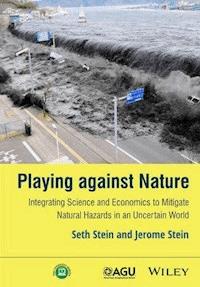
Cover image: Photo 1 from Moment of the tsunami slideshow. A wave approaches Miyako City from the Heigawa estuary in Iwate Prefecture after the magnitude 8.9 earthquake struck the area, March 11, 2011. Reuters/Mainichi Shimbun.
Cover design by Steve Thompson
Preface
This book considers how to make policy to defend society against natural hazards more effective. Recent events including Hurricane Katrina in 2005, the 2011 Tohoku earthquake and tsunami, and Hurricane Sandy in 2012 show that in its high-stakes game of chance against nature, society often does poorly. Sometimes nature surprises us, when an earthquake, hurricane, or flood is bigger or has greater effects than expected from detailed natural hazard assessments. In other cases, nature outsmarts us, doing great damage despite expensive mitigation measures being in place, or causing us to divert limited resources to mitigate hazards that are overestimated.
This situation may seem surprising because of the steady advances being made in the science of natural hazards. In our view, much of the problem comes from the fact that formulating effective natural hazard policy involves using a complicated combination of science and economics to analyze a problem and explore the costs and benefits of different options, in situations where the future is very uncertain. In general, mitigation policies are chosen without this kind of analysis. Typically, communities have not looked at different options, and somehow end up choosing one or having one chosen for them without knowing how much they're paying or what they're getting for their money. This is like buying insurance without considering how much a policy will cost and what the benefits would be. Not surprisingly, the results are often disappointing. Thus it is worth thinking about how to do better.
This book explores these issues, taking a joint view from geoscience and economics. My view is that of a seismologist interested in the science of large earthquakes and earthquake hazard mitigation. My coauthor and late father, Jerome Stein, brought the view of an economist interested in public policy.
As my father told the Brown Daily Herald in November, 2012, he viewed this book as derived from the day in 1960 that he took his 7-year old son to hear a lecture about the new discoveries of continental drift that would soon transform modern geology. Apparently I was intrigued by the idea, and asked the speaker whether drifting continents were like bars of soap floating in the bathtub.
Over the years, my father and I often talked about science. We discussed natural hazards, starting in 1998, when I became skeptical of widely-touted claims that parts of the central US faced earthquake hazards as high as California's, and that buildings should be built to the same safety standards. To my surprise, it turned out that the federal government was pressing for these measures without undertaking any analysis of the huge uncertainties in the hazard estimates or of whether the large costs involved would yield commensurate benefits to public safety. To my further surprise, my father said that this was typical, in that economists had found that many health and safety regulations were developed without such analysis or consideration of alternative policies. In such cases, no one knew whether these policies made sense or not. I became interested in this question, and started working with colleagues and students to investigate how large the uncertainties in earthquake hazard estimates were.
Our discussions on this topic ramped up in 2011, following the Tohoku earthquake and tsunami. Japanese hazard planners had assumed that an earthquake and tsunami that big could not occur there, whereas my colleague Emile Okal and I had found before the earthquake that they could. At the same time, my father was studying how the 2008 US financial disaster had occurred, despite the fact that both Wall Street and the US government had been sure – based on economic models – that it could not. We realized that although one disaster was natural and the other was economic, they had much in common. Both resulted from overconfidence in how well hazards could be assessed, both had vulnerabilities that were not recognized, and the result in both cases was poorly formulated policies.
We decided to explore these issues in a series of journal articles that became the basis of this book. Because there are many fine books on natural hazard science and on economics, we focused on the interface between the two fields. Our discussions of the challenging questions involved and how to present them had special intensity because we started the book after my father's illness was diagnosed and knew we had only a short time to finish it.
For simplicity, we decided to primarily use earthquake and tsunami hazards as examples, although the approach applies to other natural hazards. Our goal is to introduce some key concepts and challenges, and illustrate them with examples and questions that we pose at the end of each chapter. We decided to introduce some relevant mathematics, which can be skipped by readers without losing the key themes. We illustrate the key themes with examples and questions at the end of each chapter. As is typical for natural hazards, many of the questions are difficult and few have unique or correct answers.
In this sprit of looking toward the future, we hope the book will help researchers, especially younger ones, to develop an interdisciplinary outlook as they work at the interface between the two fields. Hopefully their work, both about hazards and how to make better policies, will help society fare better in its game against nature.
Seth Stein
Glencoe, Illinois
April 2013
Royalties from this book go to the Division of Applied Mathematics at Brown University to support the Jerome L Stein award, which recognizes undergraduate students who show outstanding potential in an interdisciplinary area that involves applied mathematics.
Acknowledgments
Although science is always a human endeavor, this book is especially so because of its father–son collaboration. It would not have been completed, given my father's illness, without the support of Hadassah and Carol Stein. Their encouragement when the task seemed too big and progress slowed is even more impressive given that both went through it all for our previous books.
This book grew from ideas developed over many years via research carried out with coworkers, fruitful discussions with them and other researchers studying these or related problems, and knowledge from the broad communities of geoscientists, economists, and others interested in natural hazards. In that spirit, I would like to thank many people. All should feel free to share credit for parts of the book with which they agree, and disclaim parts with which they disagree.
I thank my coauthors on the research papers discussed here, including Eric Calais, Carl Ebeling, Robert Geller, Richard Gordon, James Hebden, Qingsong Li, Mian Liu, Jason McKenna, Andres Mendez, Andrew Newman, Emile Okal, Carol Stein, John Schneider, Laura Swafford, and Joe Tomasello.
I have also have benefited from discussions with John Adams, Amotz Agnon, Rick Aster, Roger Bilham, Eric Calais, Thiery Camelbeeck, Dan Clark, Nick Clark, Sierd Cloetingh, Jim Cobb, Mike Craymer, Bill Dickinson, Tim Dixon, Roy Dokka, Joe Engeln, Andy Freed, Tom James, John Geissman, Bob Hermann, David Hindle, Tom Holzer, Sue Hough, Ken Hudnut, Alex Forte, Anke Friedrich, Alan Kafka, Steve Kirby, Jonas Kley, Cinna Lomnitz, Mike Lynch, Steve Marshak, Ailin Mao, Glenn Mattiolli, Miguel Merino, Brian Mitchell, Antonella Peresan, Orrin Pilkey, Hans-Peter Plag, Paul Rydelek, Jim Savage, Gary Searer, Giovanni Sella, Norm Sleep, Bob Smalley, Bob Smith, Bruce Spenser, Ross Stein, Roy van Arsdale, David Wald, Zhenming Wang, John Weber, Steve Wesnousky, Rinus Wortel, Michael Wysession, Dave Yuen, and many others.
I thank Gillian Foulger, Peter Clark, Serge Rey, Hadassah Stein and an anonymous reader for reviewing the manuscript. Finally, I thank the Alexander von Humboldt Foundation for supporting my stay at the University of Gottingen, where the book's editing was completed.
Note on Further Reading and Sources
Natural hazards and disasters are so dramatic that a wealth of information is easily available. One source is introductory texts. Another is general audience books about specific disasters such as the 1906 San Francisco earthquake, the 2004 Indian Ocean tsunami, or Hurricane Katrina. The World-Wide Web has lots of information about individual disasters, including news stories, photographs, and video. Information on the Web is convenient but variable in quality. That on technical topics, such as high-precision GPS or earthquake-resistant construction, is often excellent. In addition, many primary sources such as the Japanese parliament's Fukushima nuclear accident commission report or the American Society of Civil Engineers report about Hurricane Katrina are available online. However, because websites are easily created and copied from each other, some contain information that is wrong or out of date. For example, a Google search found more than 32,000 references, including the online encyclopedia Wikipedia, to the incorrect legend that the 1811–1812 New Madrid earthquakes rang church bells in Boston.
Technical information on the scientific topics discussed here is often more easily accessible from textbooks than from research papers written tersely by scientists for scientists familiar with the topics under discussion. We list several textbooks for specific chapters. Research papers mentioned, including those from which a figure is used, are listed in the references by their authors.
The scientist has a lot of experience with ignorance and doubt and uncertainty, and this experience is of very great importance, I think. When a scientist does not know the answer to a problem, he is ignorant. When he has a hunch as to what the result is, he is uncertain. And when he is pretty damn sure of what the result is going to be, he is still in some doubt. We have found it of paramount importance that in order to progress, we must recognize our ignorance and leave room for doubt.
Richard Feynman, 1988
About the Companion Website
This book is accompanied by a companion website:
www.wiley.com/go/stein/nature
The website includes:
Powerpoints of all figures from the book for downloading
PDFs of tables from the book
1A Tricky, High-Stakes Game
Earthquake risk is a game of chance of which we do not know all the rules. It is true that we gamble against our will, but this doesn't make it less of a game.
Lomnitz (1989)1
1.1 Where We Are Today
Natural hazards are the price we pay for living on an active planet. The tectonic plate subduction producing Japan's rugged Tohoku coast gives rise to earthquakes and tsunamis. Florida's warm sunny weather results from the processes in the ocean and atmosphere that cause hurricanes. The volcanoes that produced Hawaii's spectacular islands sometimes threaten people. Rivers that provide the water for the farms that feed us sometimes flood.
Humans have to live with natural hazards. We describe this challenge in terms of hazards, the natural occurrence of earthquakes or other phenomena, and the risks, or dangers they pose to lives and property. In this formulation, the risk is the product of hazard and vulnerability. We want to assess the hazards – estimate how significant they are – and develop methods to mitigate or reduce the resulting losses.
Hazards are geological facts that are not under human control. All we can do is try to assess them as best we can. In contrast, risks are affected by human actions that increase or decrease vulnerability, such as where people live and how they build. We increase vulnerability by building in hazardous areas, and decrease it by making buildings more hazard resistant. Areas with high hazard can have low risk because few people live there. Areas of modest hazard can have high risk due to large population and poor construction. A disaster occurs when – owing to high vulnerability – a natural event has major consequences for society.
The harm from natural disasters is enormous. On average, about 100,000 people per year are killed by natural disasters, with some disasters – such as the 2004 Indian Ocean tsunami – causing many more deaths. Although the actual numbers of deaths in many events, such as the 2010 Haiti earthquake, are poorly known, they are very large.
Economic impacts are even harder to quantify, and various measures are used to try to do so. Disasters cause losses, which are the total negative economic impact. These include direct losses due to destruction of physical assets such as buildings, farmland, forests, etc., and indirect losses that result from the direct losses. Because losses are hard to determine, what is reported is often the cost, which refers to payouts by insurers (called insured losses) or governments to reimburse some of the losses. Thus the reported cost does not reflect the losses to people who do not receive such payments. Losses due to natural disasters in 2012 worldwide are estimated as exceeding $170 billion (Figure 1.1). Damages within the US alone cost insurers about $58 billion. Disaster losses are on an increasing trend, because more people live in hazardous areas. For example, the population of hurricane-prone Florida has grown from 3 million in 1950 to 19 million today.
Figure 1.1
(a) Natural disasters in 2012.
(Munich Re, 2013a. Reproduced with permission from Munich Reinsurance Company AG.)
(b) Overall and insured losses since 1980 due to natural disasters.
(Munich Re, 2013b. Reproduced with permission from Munich Reinsurance Company AG.)
Society can thus be viewed as playing a high-stakes game of chance against nature. We know that we will lose, in two ways. If disaster strikes, direct and indirect losses result. In addition, the resources used for measures that we hope will mitigate the hazards and thus reduce losses in the future are also lost to society, because they cannot be used for other purposes.
Thus the challenge is deciding how much mitigation is enough. More mitigation can reduce losses in possible future disasters, at increased cost. To take it to the extreme, too much mitigation could cost more than the problem we want to mitigate. On the other side, less mitigation reduces costs, but can increase potential losses. Hence too little mitigation can cause losses that it would make more sense to avoid. We want to hit a “sweet spot” – a sensible balance. This means being careful, thoughtful gamblers.
We want to help society to come up with strategies to minimize the combined losses from disasters themselves and from efforts to mitigate them. This involves developing methods to better assess future hazards and mitigate their effects. Because both of these are difficult, our record is mixed. Sometimes we do well, and sometimes not.
On the hazard assessment side, the problem is that we lack full information. Geoscience tells us a lot about the natural processes that cause hazards, but not everything. We are learning more by using new ideas and methods that generate new data, but still we have a long way to go. For example, meteorologists are steadily improving forecasts of the tracks of hurricanes, but forecasting their strength is harder. We know a reasonable amount about why and where earthquakes will happen, have some idea about how big they will be, but much less about when they will happen. We thus need to decide what to do given these uncertainties.
This situation is like playing the card game of blackjack, also called “21.” Unlike most other card games, blackjack is considered more a game of skill than a game of chance. As mathematician Edward Thorp showed, despite the randomness in the cards drawn, skilled players can on average win by a small fraction using a strategy based on the history of the cards that have already been played. MIT student blackjack teams using these winning strategies formed the basis of the fictionalized 2008 film “21.” A key aspect of the game is that players see only some of the casino dealer's cards. Dealing with natural hazards has the further complication that we do not fully understand the rules of the game, and are trying to figure them out while playing it.
On the mitigation side, methods are getting better and cheaper. Still, choosing strategies is constrained because society has finite resources. There's no free lunch – resources used for mitigating hazards are not available for other purposes. Funds spent by hospitals to strengthen buildings to resist earthquake shaking cannot be used to treat patients. Money spent putting more steel in school buildings does not get used to hire teachers. Spending on seawalls and levees comes at the expense of other needs. Choosing priorities is always hard, but it is especially difficult when dealing with natural hazards, because of our limited ability to forecast the future.
When natural hazard planning works well, hazards are successfully assessed and mitigated, and damage is minor. Conversely, if a hazard is inadequately mitigated, sometimes because it was not assessed adequately, disasters happen. Disasters thus regularly remind us of how hard it is to assess natural hazards and make effective mitigation policies. The earth is complicated, and often surprises or outsmarts us. Thus although hindsight is always easier than foresight, examining what went wrong points out what we should try to do better.




