


112,99 €
Mehr erfahren.
- Herausgeber: John Wiley & Sons
- Kategorie: Wissenschaft und neue Technologien
- Sprache: Englisch
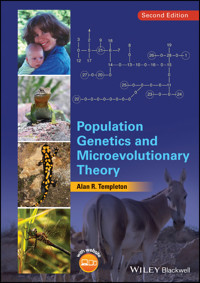
Population Genetics and Microevolutionary Theory
Explore the fundamentals of the biological implications of population genetic theory
In the newly revised Second Edition of Population Genetics and Microevolutionary Theory, accomplished researcher and author Alan R. Templeton delivers a fulsome discussion of population genetics with coverage of exciting new developments in the field, including new discoveries in epigenetics and genome-wide studies. The book prepares students to successfully apply population genetics analytical tools by providing a solid foundation in microevolutionary theory.
The book emphasizes that population structure forms the underlying template upon which quantitative genetics and natural selection operate and is a must-read for future population and evolutionary geneticists and those who wish to work in genetic epidemiology or conservation biology.
You’ll learn about a wide array of topics, including quantitative genetics, the interactions of natural selection with other evolutionary forces, and selection in heterogeneous environments and age-structured populations. Appendices that cover genetic survey techniques and probability and statistics conclude the book.
Readers will also benefit from the inclusion of:
- A thorough introduction to population genetics, including the scope of the subject, its premises, and the Hardy-Weinberg Model of Microevolution
- An exploration of systems of mating, including a treatment of the use of runs of homozygosity to show pedigree inbreeding in distant ancestors
- A practical discussion of genetic drift, including the use of effective sizes in conservation biology (with a discussion of African rhinos as an example)
- A concise examination of coalescence, including a treatment of the infinite sites model
Perfect for graduate students in genetics and evolutionary biology programs and advanced undergraduate biology majors, Population Genetics and Microevolutionary Theory will also earn a place in the libraries of students taking courses in conservation biology, human genetics, bioinformatics, and genomics.
Sie lesen das E-Book in den Legimi-Apps auf:
Seitenzahl: 1958
Veröffentlichungsjahr: 2021
Ähnliche



















Population Genetics and Microevolutionary Theory
Second Edition
Alan R. Templeton
Department of Biology
Washington University
St. Louis, MO, USA
This second edition first published 2021© 2021 John Wiley & Sons, Inc.
Edition History2006 John Wiley & Sons, Inc.
All rights reserved. No part of this publication may be reproduced, stored in a retrieval system, or transmitted, in any form or by any means, electronic, mechanical, photocopying, recording, or otherwise, except as permitted by law. Advice on how to obtain permission to reuse material from this title is available at http://www.wiley.com/go/permissions.
The right of Alan R. Templeton to be identified as the author of this work has been asserted in accordance with law.
Registered OfficeJohn Wiley & Sons, Inc., 111 River Street, Hoboken, NJ 07030, USA
Editorial Office9600 Garsington Road, Oxford, OX4 2DQ, UK
For details of our global editorial offices, customer services, and more information about Wiley products, visit us at www.wiley.com.
Wiley also publishes its books in a variety of electronic formats and by print‐on‐demand. Some content that appears in standard print versions of this book may not be available in other formats.
Limit of Liability/Disclaimer of WarrantyThe contents of this work are intended to further general scientific research, understanding, and discussion only and are not intended and should not be relied upon as recommending or promoting scientific method, diagnosis, or treatment by physicians for any particular patient. In view of ongoing research, equipment modifications, changes in governmental regulations, and the constant flow of information relating to the use of medicines, equipment, and devices, the reader is urged to review and evaluate the information provided in the package insert or instructions for each medicine, equipment, or device for, among other things, any changes in the instructions or indication of usage and for added warnings and precautions. While the publisher and authors have used their best efforts in preparing this work, they make no representations or warranties with respect to the accuracy or completeness of the contents of this work and specifically disclaim all warranties, including without limitation any implied warranties of merchantability or fitness for a particular purpose. No warranty may be created or extended by sales representatives, written sales materials, or promotional statements for this work. The fact that an organization, website, or product is referred to in this work as a citation and/or potential source of further information does not mean that the publisher and authors endorse the information or services the organization, website, or product may provide or recommendations it may make. This work is sold with the understanding that the publisher is not engaged in rendering professional services. The advice and strategies contained herein may not be suitable for your situation. You should consult with a specialist where appropriate. Further, readers should be aware that websites listed in this work may have changed or disappeared between when this work was written and when it is read. Neither the publisher nor authors shall be liable for any loss of profit or any other commercial damages, including but not limited to special, incidental, consequential, or other damages.
Library of Congress Cataloging‐in‐Publication Data
Names: Templeton, Alan Robert, author.Title: Population genetics and microevolutionary theory / Alan R. Templeton.Description: Second edition. | Hoboken, NJ : Wiley-Blackwell, 2021. | Includes bibliographical references and index.Identifiers: LCCN 2021006543 (print) | LCCN 2021006544 (ebook) | ISBN 9781118504239 (hardback) | ISBN 9781118504369 (adobe pdf) | ISBN 9781118504345 (epub)Subjects: LCSH: Population genetics. | Evolution (Biology)Classification: LCC QH455 .T46 2021 (print) | LCC QH455 (ebook) | DDC 576.5/8–dc23LC record available at https://lccn.loc.gov/2021006543LC ebook record available at https://lccn.loc.gov/2021006544
Cover Design: WileyCover Image: Courtesy of Alan R. Templeton
To Bonnieand to the Memory of Leon Blaustein
Preface
Much has changed in population genetics since the first edition came out in 2006, and much has stayed the same. The scope, questions, and methods of population genetics have always been constrained by the techniques available for surveying genetic variation, and the DNA/genomics revolution continues to alter these constraints. Yet, the basic premises of population genetic theory and practice have remained the same. These core premises allow this second edition to grow smoothly out of the first edition, so the basic structure of this edition is identical to that of the first. However, the revolution in DNA technologies and genomics leads to a significant expansion of topics and scope. The concepts and methods from population genetics are now widely used in almost all fields of biology, from molecular biology to ecology, and in applied fields from genetic epidemiology to conservation biology.
This expanded applicability of population genetics is illustrated well by the final research project of my long‐term collaborator and friend, Leon Blaustein, who sadly died all too young in 2020. By training and career, Leon was a freshwater population/community ecologist with a great concern for conservation applications. His final project focused on plasticity in aquatic resource use in the endangered species Salamandra infraimmaculta at its southernmost boundary in northern Israel. Most salamanders specialize in the type of aquatic habitat they use for their larval phase, but S. infraimmaculta can use permanent ponds and springs, permanent and seasonal streams, as well as rock pools that fill with rainwater for only a few months of the year. Leon assembled a diverse team of graduate students, post‐docs, and collaborators to address this system from multiple directions. Leon first sought to define the evolutionary and ecological context in which this plasticity is manifest. Leon and his group performed surveys of molecular genetic diversity, maximum entropy modeling of habitat data to determine optimal and sub‐optimal areas, and phylogeographic analyses to uncover historical effects. His group performed mark/recapture studies to estimate adult population sizes in a diversity of habitats. These studies revealed that this southernmost boundary was highly heterogeneous, varying from areas of optimal habitat with high levels of genetic diversity and gene flow, to areas of marginal habitat that were strongly subdivided genetically, and to an area of optimal habitat that was an historical isolate with a severe reduction in genetic diversity due to a past founder event. Field and laboratory experiments on larval developmental and morphological plasticity as well as on their transcriptomes revealed that plasticity at both the organismal and transcriptome levels displayed both genetically based differences among these populations and direct individual responsiveness to environmental variation. Coupling climate projection models with the maximum entropy models revealed diverse conservation challenges in these different areas of the southernmost boundary. Hence, both the evolvability of plasticity and current individual environmental plasticity could play an important role in the survival of this endangered species. Although not a population geneticist, Leon's final project illustrates well the importance of using population genetics and genomics in other fields of biology.
The increasing scope and relevance of population genetics to many fields of basic and applied biology also means an expanded audience that needs to be knowledgeable of population genetic theory and practice. This edition is written with this expanded audience in mind. Many examples are given from conservation biology, human genetics, and genetic epidemiology, yet the focus of this book remains on the basic microevolutionary mechanisms and how they interact to create evolutionary change. This book is intended to provide a solid understanding of the core concepts in population genetics both for those students primarily interested in evolutionary biology and genetics and for those students primarily interested in applying the tools of population genetics in other areas such as conservation biology, genetic epidemiology, and genomics. Without a solid foundation in population genetics, the analytical tools emerging from population genetics will frequently be misapplied and incorrect interpretations can be made. This book is designed to provide that foundation both for future population and evolutionary geneticists and for those who will be applying population genetic concepts and techniques to other areas.
I thank David Queller for reading over a draft of this edition. His many suggestions and corrections were highly valuable, and I greatly appreciate his efforts. David also used some of the drafts of this edition in the 2020 class on Population Genetics at Washington University. I thank the students of that class for their suggestions and corrections. Finally, I thank all the past students of my course on population genetics and my former graduate students and post‐docs. They were the inspiration for this book in the first place, and they contributed valuable input to the first edition, much of which has carried over to the second edition.
About the Companion Website
This book is accompanied by a companion website.
www.wiley.com/go/templeton/populationgenetics2
This website includes:
Powerpoint slides of Figures from the book
Problem and Answer sets




