


41,99 €
Mehr erfahren.
- Herausgeber: John Wiley & Sons
- Kategorie: Wissenschaft und neue Technologien
- Sprache: Englisch
"What's the Crack?"
When cracking is observed in a building the most common reaction is that it must be the foundations and that it must be serious.
Many surveyors are nervous about diagnosing cracks. This is understandable, as the interpretation of cracks can be difficult to teach, with university courses providing little or no time for field experience. Yet by understanding one straightforward principle the majority of cracks can be diagnosed in just a few minutes. Linking this with a good knowledge of construction techniques, the factors that distort cracking patterns and the key features of common causes of cracking, almost all cracks can be diagnosed quickly and with confidence.
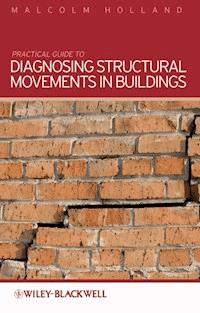
Practical Guide to Diagnosing Structural Movement in Buildings provides a methodology by which cracks and movement in buildings can be diagnosed. Written in four parts, part one describes the key principles of movement and cracking. Parts two and three describe the main features of common forms of movement and the associated crack patterns. Part two covers causes other than ground or foundation movement and part three covers movement caused by ground or foundation problems. Part four briefly describes the techniques used to arrest further movement or repair damage cause by movement.
Primarily intended for the relatively inexperienced surveyor or engineer and undergraduate students of surveying as a practical guide for use on site, it focuses on identification and diagnosis. It will not only help in correctly diagnosing the problem but it will also demonstrate a methodical approach to show and record how the diagnosis was reached – critical when giving advice to third parties.
"What's the crack?" - In the vast majority of cases it's not foundation related and in most cases it's not indicating a serious defect.
Sie lesen das E-Book in den Legimi-Apps auf:
Seitenzahl: 227
Veröffentlichungsjahr: 2012
Ähnliche



















Contents
Introduction
List of Figures
Acknowledgements
Part 1 First Principles
1.1 First Principles
1.2 Crack Patterns and Cracks
1.3 Rotational Movement
1.4 Contra Rotational Movement
1.5 Weak Routes
1.6 Load Distribution
1.7 Movement and Orientation
1.8 Summary of First Principles and Process
Part 2 Cracks in Buildings not Related to Foundations
2.1 Expansion Cracking
2.2 Cavity Wall Tie Corrosion
2.3 Corrosion of Metal Built into Walls
2.4 Vibration of Built in Fixings
2.5 Roof Spread
2.6 Springing from Deflected Beams
2.7 Lack of Lateral Stability
2.8 Lack of Lateral Stability in Modern Gable Walls
2.9 Overloaded Beams
2.10 Absence of Lintels (Beams) Over Openings in Cavity Walls
2.11 Overloaded Floors
2.12 Overloaded Walls
2.13 Differential Movement
2.14 Arch Thrust and Arch Flattening
2.15 Load Path Cracking
2.16 Bulging of Walls due to Decay of Bonding Timbers
2.17 Bulging and Separation in Solid Brick Walls
2.18 Separation of Rubble Filled Stone Walls
2.19 Floor Slab Settlement (Compaction)
2.20 Load Concentrations
2.21 Sulphate Attack
2.22 Concrete Block Shrinkage
2.23 Shrinkage of Calcium Silicate Bricks
Part 3 Cracks in Buildings Related to the Foundations and Ground Movement
3.1 Introduction
3.1.1 Design for Load
3.1.2 Design for Stability
3.1.3 Identifying Below Ground Defects
3.2 Foundation Movement caused by Clay Shrinkage
3.3 Clay Heave
3.4 Seasonal Expansion of Clay Subsoil
3.5 Eccentric Loading on Foundations
3.6 Uneven Loading
3.7 Load Concentrations on Foundations
3.8 Differential Foundation Movement
3.9 Initial Settlement after Construction or Alterations
3.10 Leaking Drains and Water Discharge Near to Buildings
3.11 Drains and Drain Trenches
Part 4 Repair Methods
4.1 Introduction
4.2 Re-pointing
4.3 Re-pointing with Epoxy Mortar
4.4 Stitching in Brickwork
4.5 Reinforcing Brick Mortar Joints
4.6 Tie Bars
4.7 Restraint Straps
4.8 Buttresses/Piers
4.9 Preventing Roof Spread
4.10 Underpinning
4.11 Expanding Foam Underpinning
4.12 Grouting
4.13 Root Barriers
Index
This edition first published 2012 © 2012 by John Wiley & Sons, Ltd
Wiley-Blackwell is an imprint of John Wiley & Sons, formed by the merger of Wiley’s global Scientific, Technical and Medical business with Blackwell Publishing.
Registered OfficeJohn Wiley & Sons, Ltd, The Atrium, Southern Gate, Chichester, West Sussex, PO19 8SQ, UK
Editorial Offices9600 Garsington Road, Oxford, OX4 2DQ, UKThe Atrium, Southern Gate, Chichester, West Sussex, PO19 8SQ, UK2121 State Avenue, Ames, Iowa 50014-8300, USA
For details of our global editorial offices, for customer services and for information about how to apply for permission to reuse the copyright material in this book please see our website at www.wiley.com/wiley-blackwell.
The right of the author to be identified as the author of this work has been asserted in accordance with the UK Copyright, Designs and Patents Act 1988.
All rights reserved. No part of this publication may be reproduced, stored in a retrieval system, or transmitted, in any form or by any means, electronic, mechanical, Figurecopying, recording or otherwise, except as permitted by the UK Copyright, Designs and Patents Act 1988, without the prior permission of the publisher.
Designations used by companies to distinguish their products are often claimed as trademarks. All brand names and product names used in this book are trade names, service marks, trademarks or registered trademarks of their respective owners. The publisher is not associated with any product or vendor mentioned in this book. This publication is designed to provide accurate and authoritative information in regard to the subject matter covered. It is sold on the understanding that the publisher is not engaged in rendering professional services. If professional advice or other expert assistance is required, the services of a competent professional should be sought.
Library of Congress Cataloging-in-Publication Data
Holland, Malcolm.Practical guide to diagnosing structural movement in buildings / Malcolm Holland.p. cm.Includes bibliographical references and index.
ISBN 978-0-470-65910-6 (pbk. : alk. paper)1. Buildings–Defects. 2. Earth movements and building. 3. Structural analysis(Engineering) 4. Building failures. 5. Buildings–Repair and reconstruction. I. Title. TH441.H635 2012690′.21–dc23
2011051077
A catalogue record for this book is available from the British Library.
Wiley also publishes its books in a variety of electronic formats. Some content that appears in print may not be available in electronic books.
Cover image courtesy of ShutterstockCover design by Edge Creative www.edgecreativestudio.com
Introduction
It is often the layman’s first reaction when cracking is observed in a building, that it must be the foundations and that it is serious. This is not true.
In the vast majority of cases it is not subsidence or settlement of the foundations and in most cases cracks do not indicate a serious defect.
So when analysing cracks, it is essential to always keep an open mind. A good rule of thumb for the beginner is to try to find what has caused the crack other than foundation movement. Only when all other possibilities have been ruled out, consider then whether it is foundation movement. In my experience (teaching university students and graduate surveyors) it is very difficult to instil this discipline. There is a great temptation to jump to a conclusion or to shortcut the process of analysis.
Many people, including surveyors, are nervous about diagnosing cracks. This is understandable, as the consequences of getting it wrong can be potentially onerous. It is a subject that is difficult to teach in the lecture theatre and there may be little or no time for field experience within an academic syllabus at university. Most text books on the subject are aimed more towards Engineers or Building surveyors, who specialize in this area. Necessarily such books are very technical in nature. This book is not aimed at the experienced engineer or surveyor. It is primarily intended for the relatively inexperienced surveyor, engineer, undergraduate or even competent layman. It is intended as a practical guide or as on site manual. The intention is to remain as un-technical as possible. It avoids references to regulations, digests and other technical sources. These can be found elsewhere in other books on the subject. The book is concerned with identification and diagnosis not the detailed specification of remedial work.
The intention is to know, with a reasonable level of confidence, when movement is potentially serious or not. To know when it is necessary to call in the more experienced or qualified professional to deal with it.
The purpose of this book is to show that by understanding one simple first principle and by following a simple methodology, the vast majority of cracks, probably as many as nine out of ten cracks, can be diagnosed in just a few minutes.
By looking at the cracks in a little more detail and by understanding the factors that distort crack patterns, this diagnosis rate can be raised even further.
Couple this with a reasonably good knowledge of building construction and the key features of the most common causes of cracking; and almost all cracks can be diagnosed relatively quickly and with a high degree of confidence. There will however always be some cracks that cannot be diagnosed from a single inspection. Inevitably, when movement first starts to develop, the evidence can be insufficient to reach a conclusion. In some cases movement will have to be monitored for a period of time. In other cases the only way to obtain enough evidence to make a diagnosis, might involve opening up the structure of a building or carrying out excavations to expose the foundations. Material or sub soil samples may need to be taken for testing. A building may need to be monitored for a period of time to make a diagnosis or to confirm a preliminary opinion. The number of cases where such action is necessary is likely to be small providing that the basic principles are understood and applied in an objective manner.
This may seem too easy and too good to be true but why should it not be true? Cracks are caused by a simple physical process and the physics always acts in the same way. It is a ‘law’ of physics; there is no hidden agenda, no politics; just a simple physical process. Tension in a material or structure will act to try to pull it apart.
When the tension is sufficiently large in relation to the strength of the material it will pull it apart and cause a crack. It is a simple physical process in the same way that adding heat to a liquid causes a physical process of temperature rise and when enough heat is added in relation to the boiling point of the liquid it will cause it to boil. It will always give the same result.
This book provides a methodology by which cracks and movement in buildings can be diagnosed.
The book is in four parts. The first part describes the first principles. The second part of the book contains ‘swatches’ which describe the key features of the most common forms of movement in buildings and the crack patterns associated with them. This part covers movement and cracks NOT caused by ground or foundation movement. The third part of the book contains similar ‘swatches’ giving the key features relating to movement caused by ground or foundation problems. Part four describes the techniques used to repair damage cause by movement and to arrest further movement.
By applying the FIRST PRINCIPLE and then referring to the ‘swatches’ there should be a high probability that the correct diagnosis can be reached.
The methodology contained within this book will not only help to derive the correct diagnosis but it will also demonstrate a process to show and record how the diagnosis was reached. When giving advice to a third party, the ability to demonstrate a proper methodology, a chain of thought and logical process is critically important should it ever become a negligence claim. When advising a third party it is also imperative to make clear that any diagnosis is an opinion, not a guarantee. In theory an opinion can turn out to be wrong without negligence automatically occurring provided that a correct methodology has been followed and that other reasonably competent persons would have arrived at the same opinion. In the light of previous case law some might argue this to be an over optimistic view for a professional working in this field to take; but objectively that should be the case.
So it is absolutely critical that one understands the FIRST PRINCIPLES before moving on to the second part of this book. It is straight forward and relatively simple but if on first reading you do not completely grasp it, read it again. Do not be tempted to short cut the process by simply looking at the examples or photographs in the book and finding one that looks similar.
And finally, good luck.
List of Figures
Figure 1.1.1
Diagonals of equal length.
Figure 1.1.2
Diagonal B–D stretched.
Figure 1.1.3
Crack at right angles to tension.
Figure 1.1.4
Imaginary arrows at right angles to tension.
Figure 1.1.5
Imaginary arrows of tension intersecting on a supporting beam.
Figure 1.1.6
Imaginary arrows of tension point to left hand pier.
Figure 1.3.1
Rotational movement.
Figure 1.4.1
Contra rotational movement.
Figure 1.4.2
Graph paper exercise of counter rotational movement.
Figure 1.5.1
Typical subsidence crack at about 45°
Figure 1.5.2
Angle reduced below 45° due to position of openings.
Figure 1.5.3
Angle steeper above 45° due to position of openings.
Figure 1.5.4
Typical subsidence crack.
Figure 1.5.5
Typical expansion crack.
Figure 1.5.6
Lesen Sie weiter in der vollständigen Ausgabe!
Lesen Sie weiter in der vollständigen Ausgabe!
Lesen Sie weiter in der vollständigen Ausgabe!
Lesen Sie weiter in der vollständigen Ausgabe!
Lesen Sie weiter in der vollständigen Ausgabe!
Lesen Sie weiter in der vollständigen Ausgabe!
Lesen Sie weiter in der vollständigen Ausgabe!
Lesen Sie weiter in der vollständigen Ausgabe!
Lesen Sie weiter in der vollständigen Ausgabe!
Lesen Sie weiter in der vollständigen Ausgabe!
Lesen Sie weiter in der vollständigen Ausgabe!
Lesen Sie weiter in der vollständigen Ausgabe!
Lesen Sie weiter in der vollständigen Ausgabe!
Lesen Sie weiter in der vollständigen Ausgabe!
Lesen Sie weiter in der vollständigen Ausgabe!
Lesen Sie weiter in der vollständigen Ausgabe!
Lesen Sie weiter in der vollständigen Ausgabe!
Lesen Sie weiter in der vollständigen Ausgabe!
Lesen Sie weiter in der vollständigen Ausgabe!
Lesen Sie weiter in der vollständigen Ausgabe!
Lesen Sie weiter in der vollständigen Ausgabe!
Lesen Sie weiter in der vollständigen Ausgabe!
Lesen Sie weiter in der vollständigen Ausgabe!
Lesen Sie weiter in der vollständigen Ausgabe!
Lesen Sie weiter in der vollständigen Ausgabe!
Lesen Sie weiter in der vollständigen Ausgabe!
Lesen Sie weiter in der vollständigen Ausgabe!
Lesen Sie weiter in der vollständigen Ausgabe!
Lesen Sie weiter in der vollständigen Ausgabe!
Lesen Sie weiter in der vollständigen Ausgabe!
Lesen Sie weiter in der vollständigen Ausgabe!
Lesen Sie weiter in der vollständigen Ausgabe!
Lesen Sie weiter in der vollständigen Ausgabe!
Lesen Sie weiter in der vollständigen Ausgabe!
Lesen Sie weiter in der vollständigen Ausgabe!
Lesen Sie weiter in der vollständigen Ausgabe!
Lesen Sie weiter in der vollständigen Ausgabe!
Lesen Sie weiter in der vollständigen Ausgabe!
Lesen Sie weiter in der vollständigen Ausgabe!
Lesen Sie weiter in der vollständigen Ausgabe!
Lesen Sie weiter in der vollständigen Ausgabe!
Lesen Sie weiter in der vollständigen Ausgabe!
Lesen Sie weiter in der vollständigen Ausgabe!
Lesen Sie weiter in der vollständigen Ausgabe!
Lesen Sie weiter in der vollständigen Ausgabe!
Lesen Sie weiter in der vollständigen Ausgabe!
Lesen Sie weiter in der vollständigen Ausgabe!
Lesen Sie weiter in der vollständigen Ausgabe!
Lesen Sie weiter in der vollständigen Ausgabe!
Lesen Sie weiter in der vollständigen Ausgabe!
Lesen Sie weiter in der vollständigen Ausgabe!
Lesen Sie weiter in der vollständigen Ausgabe!
Lesen Sie weiter in der vollständigen Ausgabe!
Lesen Sie weiter in der vollständigen Ausgabe!
Lesen Sie weiter in der vollständigen Ausgabe!
Lesen Sie weiter in der vollständigen Ausgabe!
Lesen Sie weiter in der vollständigen Ausgabe!
Lesen Sie weiter in der vollständigen Ausgabe!
Lesen Sie weiter in der vollständigen Ausgabe!
Lesen Sie weiter in der vollständigen Ausgabe!
Lesen Sie weiter in der vollständigen Ausgabe!




