


Erhalten Sie Zugang zu diesem und mehr als 300000 Büchern ab EUR 5,99 monatlich.
- Herausgeber: Independent Thinking Press
- Kategorie: Bildung
- Serie: How to Teach
- Sprache: Englisch
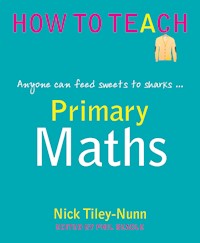
Primary maths is stereotypically loved by a few hairy oddballs, tolerated by most sane primary practitioners; loathed by many. With the right approach, however; the right mindset and sense of the impossible being achievable, maths can be moulded into the diamond in the rough of the primary curriculum. Enter Nick Tiley-Nunn: Britain's most imaginative, most exciting primary maths specialist. Over years of practice he has generated ideas about the teaching of maths that are so distinct, so far out and so utterly brilliant that any primary teacher struggling to grasp the nettle of teaching long division will emerge from communing with his ideas not just with some cliched sense that 'maths can be fun', but that it can be brilliant, life-enhancing and truly hilarious. This book presents ideas for primary maths teaching so wildly creative and so full of the joy of life that any classroom of kids will be grateful you read it.
Sie lesen das E-Book in den Legimi-Apps auf:
Seitenzahl: 289
Veröffentlichungsjahr: 2014
Das E-Book (TTS) können Sie hören im Abo „Legimi Premium” in Legimi-Apps auf:
Ähnliche






ACKNOWLEDGEMENTS
My thanks go, first, to Dr Brendan Stones for being more inspiring than he will ever know. I would also like to thank Phil Beadle and all the wonderful staff at Crown House Publishing and Independent Thinking Ltd for taking a chance on me. Finally, I would like to thank my darling wife, Rachel, and all my family for helping me to keep putting one foot in front of the other. Without all of them this would never have happened.
CONTENTS
FOREWORD BY PHIL BEADLE
Nick Tiley-Nunn might be the best teacher in the world. He is certainly the best I’ve seen. Ever. I’ve never seen anyone, ever, who has gifts anywhere near the level he’s quite so blithe and modest about. “I do my best,” he shrugs with a disarming and ingenuous smile. Seated at the back of his class in a small room in an area of London I’m never really comfortable in, having taken a job doing a teaching and learning audit for a quite brilliant school, Radnor House, I witnessed, for probably the second time in my career, an untutorable genius at work. Halfway through the lesson, I turned round to an awestruck 9-year-old girl, who was learning about division through seeing how many sweets a shark might eat given the opportunity. I asked her a question, “Is he the best teacher in the world?” She was utterly certain, “Yehhhhhhhhh! Of course. Everyone knows that!”
My observation notes from the time noted: “This is the best maths lesson I have ever sat in on. The students adore him and rightly think he is the most brilliant teacher they have ever had. He has invented techniques that every maths teacher in the country could learn from, combines rote and kinaesthetic learning, which is something that only the most profoundly brilliant teachers are able to conceive of, and, like the masterful football player who vibrates on a different string to anyone else, has enough time on the ball to divert into accidentally teaching kids about alliteration. He is a stunning talent.”
And this is not my opinion alone. Here is the view of one of Nick’s former colleagues, Kate Ryan who currently leads a group of eminent educators in driving improvement in education systems globally: “Nick is simply unparalleled. He is limitless.”
The idea of the ‘How to Teach’ series of books is that teachers encounter the geniuses of the form (next year there will be a book in this series by Darren Mead, perhaps the most significant thinker about teaching in Britain). Primary maths is not a realm I have any real knowledge of, but I know class when I see it, and Nick Tiley-Nunn, as a practitioner, is next level brilliant.
Of the man who wrote this book: he is unassuming, doesn’t recognise the fact that he is even talented, and is the kind of quiet, deeply gentle and sweet man you would want your grown-up daughter to bring home. Where his genius came from, I don’t know. It appears either a genetic accident or the result of a boisterous child who was taught, at school, that maths was really boring, and who wanted to prove it didn’t have to be, and that it was a matter of the teacher’s intent: their seriousness in finding the (surface level) frivolity. Wherever it came from, it is there, and I leave you to commune with it, and see if you agree with me; furthermore, to see if you can infect your class with the same total absence of boredom any child who is lucky enough to be taught by Mr Tiley-Nunn experiences every day.
Chapter 1
NUMBER
If people do not believe that mathematics is simple, it is only because they do not realize how complicated life is.
John von Neumann, keynote speech at the national meeting of the Association for Computing Machinery (1947)
I challenge anyone to live a day without using numbers. It is simply impossible to imagine a world without them, such is their integral role in everyday life. Make a list of everything you plan to do today. Would you be able to do any of them if numbers ceased to exist? The world is vastly complicated and, contrary to what some in your class/staffroom might believe, is actually made more simple by the presence of numbers. The ten little digits from 0 to 9 form the basis of a universal language that enables our world to tick ever onwards. Numbers are, therefore, inherently interesting, and a sound understanding of them unlocks almost limitless possibility. So why do some people despise them, or at least despise maths? If numbers have such incredible potential for improving our lives, why are some people indifferent towards developing their understanding of them? It is not the numbers themselves that are the problem but the uniform they’re dressed up in. If numbers are the steps, then mathematics is the choreography that turns those numbers from something that your dad might light up the dance floor with at a wedding to a rhythmic masterpiece that is a pleasure to behold.
Unfortunately, the sheer amount of time that is spent on arithmetic and work on the four operations (addition, subtraction, multiplication and division) effectively kills off all interest in numbers for many individuals. Ensuring that all children can carry out an increasingly demanding list of written calculation methods often results in there being too little time devoted to the simple enjoyment of numbers. We have to afford ourselves a little time to become cosier with them, to enjoy spending time in their company.
Rogerson’s Book of Numbers, by Barnaby Rogerson, is a fascinating book that delves into the role that numbers play in the arts, culture, religion and belief systems of our world, and includes the following quote that I love: “And as one reads it becomes clear that all our supposedly separate cultures are magnificently interlinked and interrelated by a shared belief in the magical significance of numbers.”1 As I read this book for the first time, I could not help but sit in stupefied awe and fascination as I found out that Bach can be linked by gematria (substituting numbers for letters – algebraic thinking?) to the number 14, or that the average distance between the earth and the moon of 237,000 miles equates to 30 times the diameter of the earth! Maybe I am a bit of an anorak here,2 but isn’t this just awesomely interesting? Rogerson’s book shows just how much we should value numbers and sets out why we should place them at the centre of what we do and what we strive for. This is what I want my pupils to buy into. I want them to believe that what we are doing is not only fascinating and important, but that it also relates to who they are as a person: to what they do, what they believe and what they want to or can achieve.
What follows in this chapter is a playful look at how we can encourage pupils to see numbers as vastly more than just a vehicle or conduit for classroom boredom. I have split the chapter into the basics, which you simply have to teach, and the exciting stuff, which you simply have to teach!
BASICS: A, B, C AS EASY AS 1, 2, 3
Numbers are as vital to maths as letters are to English. Number recognition and counting should be the starting point for the teaching of mathematics to any child. The importance of learning to count is undeniable and, therefore, in the early years of education, a great deal of emphasis is placed on making sure the little darlings know how to get from 1 to 10 (in the correct order). However, this is just the start. The key to developing a sound understanding of numbers is not in just learning to count upwards, but in learning from an early age exactly where a number fits in relation to others. I have met many a mini-mathematician who could count upwards with complete confidence, but could not tell me what would be the third number on from 4 or what number came two places before 6 without counting on or backwards using their fingers. Initially, counting while using the fingers is fine. However, being able to count upwards from 1 to 20 is merely a rote skill; it is the same as being able to sight read words without having any comprehension of what the word means (barking at text). Children need to learn how our number system works: that you can count forwards, backwards and in steps of multiples, and that there is a specialist vocabulary related to numbers.
Counting backwards, in particular, can cause small kids real problems, and it is one of the main reasons why children encounter greater difficulty in both mental and written methods of subtraction, compared to their ability to solve addition calculations. Getting children comfortable with counting forwards, backwards and in steps is absolutely vital for building a solid foundation in arithmetic. The investment of time in developing an understanding of numbers at an early age pays off massively in the future. Even more important, though, is ensuring that we encourage pupils to be playful with numbers and to foster positive feelings about them right from the start.
Little ones should count everything: the number of steps they take, how many carrots they’ve eaten (or nudged around the plate), the number of leaves on a branch, the freckles on their face, the number of cracks in the pavement on the walk to school. The trouble with counting is that it gets a bit samey after a while, and the last thing we want is for them to get bored with numbers before we get on to the good stuff. So, we have to inject some life into this most basic of tasks.
Counting challenges are a good way forward. Even little learners like a challenge. The more ridiculous the counting challenge the better: how many shoes can you stack in a pile? How many items of clothing can you put on? How many tennis balls can you fit inside a hat? How many teddy bears can sit on one chair? How many pieces of spaghetti tall are you? How many grapes can you grasp in your hand? What about the other hand? Can you get more in one hand than the other? Does it matter if the grapes are red or white? Why are they called red and white when they look green and purple? It sounds silly, but it’s all about sending out the right messages: being challenged can be fun; there is not just one way of doing maths; exploring different approaches pays off. And it doesn’t have to be serious – counting can be a bit of a giggle.
Another simple way to develop counting skills is to play games with a pack of cards. Assign an operation to each suit: hearts mean count on one place, diamonds count on two places, spades count backwards one place and clubs count backwards two places. Shuffle the deck and place it in the centre of the table. Pupils take it in turns to turn over a card and count forwards or backwards depending on the suit. This game can be played with the whole class, with pupils split into small groups or in pairs or threes. To begin with, support the pupils by giving them a number line to work with. Once they are more comfortable with the game, you can see how quickly the pupils can work through the pack of cards, either in groups against each other or as a whole class racing against the clock to beat a previous time. You can also add in a further element of competition by dealing out the cards and setting the rule that the pupils have to answer without hesitation: the first to hesitate loses all of their cards so far (a bit like Snap) and the aim of the game is to




