


Erhalten Sie Zugang zu diesem und mehr als 300000 Büchern ab EUR 5,99 monatlich.
- Herausgeber: Nine Arches Press
- Kategorie: Poesie und Drama
- Sprache: Englisch
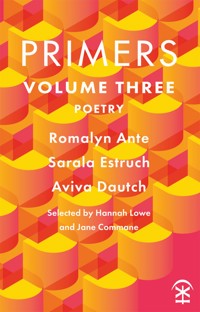
The Poetry School and Nine Arches Press are delighted to announce the arrival of Primers Volume Three, the third year of an annual scheme which creates a unique opportunity for talented poets to find publication and receive a programme of supportive feedback, mentoring and promotion. The scheme will select three poets whose work will feature together in Primers Volume Three, a book showcasing short debut collections of work. The Primers scheme provides an important platform for emerging poets who are seeking to develop their writing and build towards a full collection of poems. With the involvement of Jane Commane (Nine Arches' poetry editor), Hannah Lowe (poet) and the Poetry School, Primers Three will nurture and support new talent that may otherwise not find an outlet. It also aims to provide an important opportunity for poets to develop their skills, work on their poetry practice, and find audiences for their work. Following editing and mentoring with Hannah and Jane, the Primers Volume Three collection will be published by Nine Arches Press, and a further series of live events will showcase the three chosen poets at festivals and shows around the country.
Sie lesen das E-Book in den Legimi-Apps auf:
Seitenzahl: 53
Veröffentlichungsjahr: 2018
Das E-Book (TTS) können Sie hören im Abo „Legimi Premium” in Legimi-Apps auf:
Ähnliche
















PRIMERS
Volume Three
Primers: Volume Three
Romalyn Ante, Aviva Dautch, Sarala Estruch
Selecting Editors: Hannah Lowe and Jane Commane
ISBN: 978-1-911027-40-9
Copyright © Romalyn Ante, Aviva Dautch, Sarala Estruch
Cover artwork / Primers logo © 3Men2
www.3men.co.uk
All rights reserved. No part of this work may be reproduced, stored or transmitted in any form or by any means, graphic, electronic, recorded or mechanical, without the prior written permission of the publisher.
The individual authors have asserted their rights under Section 77 of the Copyright, Designs and Patents Act 1988 to be identified as the authors of this work.
First published April 2018 by:
Nine Arches Press
Unit 14, Sir Frank Whittle Business Centre
Great Central Way, Rugby
CV21 3XH
United Kingdom
www.ninearchespress.com
Printed in the United Kingdom by:
Imprint Digital Ltd.
Nine Arches Press is supported using public funding by Arts Council England.
Primers
Volume Three
is produced in partnerhip with:
About the Selecting Editors
Hannah Lowe’s first poetry collection Chick (Bloodaxe, 2013) won the Michael Murphy Memorial Award for Best First Collection and was shortlisted for the Forward, Aldeburgh and Seamus Heaney Best First Collection Prizes. In September 2014, she was named as one of 20 Next Generation poets. She has also published three chapbooks: The Hitcher (Rialto 2012); R x (sine wave peak 2013); and Ormonde (Hercules Editions 2014). Her family memoir Long Time, No See was published by Periscope in July 2015 and featured as Radio 4’s Book of the Week. Her second collection, Chan, is published by Bloodaxe. (2016). She is the current poet in residence at Keats House
Jane Commane is a poet, editor and publisher. Her first full-length collection, Assembly Lines, was published by Bloodaxe in 2018. In 2016, she was chosen to join Writing West Midlands’ Room 204 writer development programme. A graduate of the Warwick Writing Programme, for a decade she also worked in museums and archives. Jane is editor at Nine Arches Press, co-editor of Under the Radar magazine, and is co-author, with Jo Bell, of How to Be a Poet, a creative writing handbook (Nine Arches Press). In 2017 she was awarded a Jerwood Compton Poetry Fellowship.
CONTENTS
Introduction
Romalyn Ante
Half-empty
Anosmia
Way back home
Sayang
The Making of a Smuggler
Antiemetic for Homesickness
Learning Nihongo
Check-mate
Magpagpag
The Importance of Surgeons
Self-Portrait as Medicines
Dalampasigan
Aviva Dautch
The House
Returning
The Emptying
Mamaloshen
Habonim
Knots
The Gathering
DNA
The Bottle Lid
What She Kept
Shame
Tahara
Clearance
Yeridah
Ghazal
The Foundry
Sarala Estruch
England: A Love Story, or The English Dream
Kesh
They Came for Us in the Night
Dreaming of Love in Uttar Pradesh
Cracked Pavement
Blame
My Indian grandmother
The Measure of Water
Something Like Purgatory
Red Delhi
Consequences of Not Knowing My Father Tongue
To the Wounded Among Us
Thoughts While Kissing
When Bolt lost (his final race)
Acknowledgements and Thanks
INTRODUCTION
Primers is a mentoring and publication scheme developed and run by the Poetry School and Nine Arches Press, which seeks to find, nurture and develop exceptional new poets.
The programme – now in its third year, and looking forward to a fourth – is a perfect example of what the Poetry School aims to do in all its activities: to encourage poets and poetry to flourish. With the support of Arts Council England, the Poetry School provides inspiring tuition at their teaching centres and online, from beginners’ courses right through to an accredited MA with Newcastle University, as well as a wide range of opportunities for poets, including the Poetry in Aldeburgh Festival, and the Ginkgo ecopoetry prize.
But what unites all these strands is our aim to inspire poets, get them in front of an audience, and develop their careers. And that is exactly what Primers does. Each selected poet receives mentoring from a successful writer, this year from the brilliant Hannah Lowe, with editorial support from Jerwood Compton Poetry Fellow Jane Commane, and publication with Nine Arches Press, as well as a series of launches and festival readings to promote their work.
To find the perfect poets for Primers: Volume Three, the Poetry School, Jane Commane, and guest editor and mentor Hannah Lowe read through hundreds of submissions – each of which was a distillation of the hard work, love and craft of its author – searching for manuscripts that showed outstanding promise. Above all, we were looking for writers on the cusp of something – writers who, with a bit of guidance and support, could become vital and exciting new voices in contemporary poetry. And we’re happy to say that we found them in Romalyn Ante, Aviva Dautch and Sarala Estruch.
The three poets in this year’s Primers collection are writers of an exceptionally high quality, drawn from a pool of exceptionally high quality writing. What made these three poets stand out was the sense that they were at the right place for the kind of mentoring and editing that Primers offers, and that the manuscripts they submitted all had a clear and compelling arc and theme. This isn’t necessarily a requirement of the Primers selection, but in these cases, it did stand out.
Aviva Dautch’s poems are characterised by a beautiful fluency and precision of image. The subject matter of many of them is a mother and daughter relationship affected by the emotional disorder of hoarding. Thus, the poems are ‘hoards’ themselves, of words, objects and images, but what struck us about them is the way in which the poems provide order in the face of such chaos. We felt this possibility at work in the exquisite poems of Sarala Estruch as well – how poetry can help structure and perhaps process complex emotional material, in Sarala’s case, the possibilities and challenges of cross-cultural relationships, both as a legacy of parents and in the current moment. Romalyn Ante’s work also deals with cross-cultural dynamics – the experiences of a Filipino nurse in Wolverhampton – with a careful and nuanced approach to how language communicates these crossings and differences, and also with a persuasive sense of wonder.
What is remarkable about the work of all three poets, and what further stood out to us as readers, judges and editors, is their instinctive and distinctive feel




