


156,99 €
Mehr erfahren.
- Herausgeber: John Wiley & Sons
- Kategorie: Wissenschaft und neue Technologien
- Sprache: Englisch
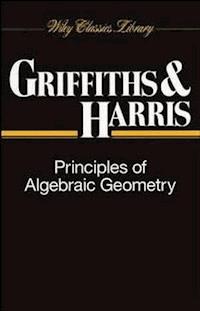
A comprehensive, self-contained treatment presenting general results of the theory. Establishes a geometric intuition and a working facility with specific geometric practices. Emphasizes applications through the study of interesting examples and the development of computational tools. Coverage ranges from analytic to geometric. Treats basic techniques and results of complex manifold theory, focusing on results applicable to projective varieties, and includes discussion of the theory of Riemann surfaces and algebraic curves, algebraic surfaces and the quadric line complex as well as special topics in complex manifolds.
Sie lesen das E-Book in den Legimi-Apps auf:
Seitenzahl: 1273
Veröffentlichungsjahr: 2014
Ähnliche


















CONTENTS
PREFACE
0 FOUNDATIONAL MATERIAL
1. Rudiments of Several Complex Variables
2. Complex Manifolds
3. Sheaves and Cohomology
4. Topology of Manifolds
5. Vector Bundles, Connections, and Curvature
6. Harmonic Theory on Compact Complex Manifolds
7. Kähler Manifolds
1 COMPLEX ALGEBRAIC VARIETIES
1. Divisors and Line Bundles
2. Some Vanishing Theorems and Corollaries
3. Algebraic Varieties
4. The Kodaira Embedding Theorem
5. Grassmannians
2 RIEMANN SURFACES AND ALGEBRAIC
1. Preliminaries
2. Abel’s Theorem
3. Linear Systems on Curves
4. Plücker Formulas
5. Correspondences
6. Complex Tori and Abelian Varieties
7. Curves and Their Jacobians
3 FURTHER TECHNIQUES
1. Distributions and Currents
2. Applications of Currents to Complex Analysis
3. Chern Classes
4. Fixed-Point and Residue Formulas
5. Spectral Sequences and Applications
4 SURFACES
1. Preliminaries
2. Rational Maps
3. Rational Surfaces I
4. Rational Surfaces II
5. Some Irrational Surfaces
6. Noether’s Formula
5 RESIDUES
1. Elementary Properties of Residues
2. Applications of Residues
3. Rudiments of Commutative and Homological Algebra with Applications
4. Global Duality
6 THE QUADRIC LINE COMPLEX
1. Preliminaries: Quadrics
2. The Quadric Line Complex: Introduction
3. Lines on the Quadric Line Complex
4. The Quadric Line Complex: Reprise
INDEX
Copyright © 1978 by John Wiley & Sons, Inc.
Wiley Classics Library edition published 1994.
No part of this publication may be reproduced, stored in a retrieval system or transmitted in any form or by any means, electronic, mechanical, photocopying, recording, scanning or otherwise, except as permitted under Sections 107 or 108 of the 1976 United States Copyright Act, without either the prior written permission of the Publisher, or authorization through payment of the appropriate per-copy fee to the Copyright Clearance Center, 222 Rosewood Drive, Danvers, MA 01923, (978) 750-8400, fax (978) 750-4470. Requests to the Publisher for permission should be addressed to the Permissions Department, John Wiley & Sons, Inc., 111 River Street, Hobokcn, NJ 07030, (201) 748-6011, fax (201) 748-6008.
Library of Congress Cataloging in Publication Data
Griffiths, Phillip, 1938– Principles of algebraic geometry.
(Pure and applied mathematics) “A Wiley-Interscience publication.” Includes bibliographical references. 1. Geometry, Algebraic. I. Harris, Joseph, 1951– joint author.II. Title.
QA564.G64 516’.35 78-6993
ISBN 0-471-05059-8
PREFACE
Algebraic geometry is among the oldest and most highly developed subjects in mathematics. It is intimately connected with projective geometry, complex analysis, topology, number theory, and many other areas of current mathematical activity. Moreover, in recent years algebraic geometry has undergone vast changes in style and language. For these reasons there has arisen about the subject a reputation of inaccessibility. This book gives a presentation of some of the main general results of the theory accompanied by—and indeed with special emphasis on—the applications to the study of interesting examples and the development of computational tools.
A number of principles guided the preparation of the book. One was to develop only that general machinery necessary to study the concrete geometric questions and special classes of algebraic varieties around which the presentation was centered.
A second was that there should be an alternation between the general theory and study of examples, as illustrated by the table of contents. The subject of algebraic geometry is especially notable for the balance provided on the one hand by the intricacy of its examples and on the other by the symmetry of its general patterns; we have tried to reflect this relationship in our choice of topics and order of presentation.
A third general principle was that this volume should be self-contained. In particular any “hard” result that would be utilized should be fully proved. A difficulty a student often faces in a subject as diverse as algebraic geometry is the profusion of cross-references, and this is one reason for attempting to be self-contained. Similarly, we have attempted to avoid allusions to, or statements without proofs of, related results. This book is in no way meant to be a survey of algebraic geometry, but rather is designed to develop a working facility with specific geometric questions. Our approach to the subject is initially analytic: Chapters 0 and 1 treat the basic techniques and results of complex manifold theory, with some emphasis on results applicable to projective varieties. Beginning in Chapter 2 with the theory of Riemann surfaces and algebraic curves, and continuing in Chapters 4 and 6 on algebraic surfaces and the quadric line complex, our treatment becomes increasingly geometric along classical lines. Chapters 3 and 5 continue the analytic approach, progressing to more special topics in complex manifolds.
Several important topics have been entirely omitted. The most glaring are the arithmetic theory of algebraic varieties, moduli questions, and singularities. In these cases the necessary techniques are not fully developed here. Other topics, such as uniformization and automorphic forms or monodromy and mixed Hodge structures have been omitted, although the necessary techniques are for the most part available.
We would like to thank Giuseppe Canuto, S. S. Chern, Maurizio Cornalba, Ran Donagi, Robin Hartshorne, Bill Hoffman, David Morrison, David Mumford, Arthur Ogus, Ted Shifrin, and Loring Tu for many fruitful discussions; Ruth Suzuki for her wonderful typing; and the staff of John Wiley, especially Beatrice Shube, for enormous patience and skill in converting a very rough manuscript into book form.
PHILLIP GRIFFITHSJOSEPH HARRIS
May 1978Cambridge, Massachusetts
0
FOUNDATIONAL MATERIAL
In this chapter we sketch the foundational material from several complex variables, complex manifold theory, topology, and differential geometry that will be used in our study of algebraic geometry. While our treatment is for the most part self-contained, it is tacitly assumed that the reader has some familiarity with the basic objects discussed. The primary purpose of this chapter is to establish our viewpoint and to present those results needed in the form in which they will be used later on. There are, broadly speaking, four main points:
1. RUDIMENTS OF SEVERAL COMPLEX VARIABLES
Cauchy’s Formula and Applications
For U an open set in , write C∞(U) for the set of C∞ functions defined on U; for the set of C∞ functions defined in some neighborhood of the closure of U.
The cotangent space to a point in is spanned by {dxi, dyi}; it will often be more convenient, however, to work with the complex basis
and the dual basis in thetangent space
With this notation, the formula for the total differential is
In one variable, we say a C∞ function f on an open set U ⊂ is holomorphic if f satisfies the Cauchy-Riemann equations . Writing , this amounts to
We say f is analytic if, for all z0 ∈ U, f has a local series expansion in z – z0, i.e.,
in some disc Δ(z0, ε)= {z : |z – z0| < ε}, where the sum converges absolutely and uniformly. The first result is that f is analytic if and only if it is holomorphic; to show this, we use the
Cauchy Integral Formula.For Δ a disc in,
where the line integrals are taken in the counterclockwise direction (the fact that the last integral is defined will come out in the proof).
Proof. The proof is based on Stokes’ formula for a differential form with singularities, a method which will be formalized in Chapter 3. Consider the differential form
we have for z ≠ w
and so
which tends to f(z) as ε→0; moreover,
so
Thus is absolutely integrable over Δ, and
as ε→0; the result follows.
Q.E.D.
Now we can prove the
Proposition.For U an open set inand f ∈ C∞(U), f is holomorphic if and only if f is analytic.
so, setting
we have
for z ∈ Δ, where the sum converges absolutely and uniformly in any smaller disc.
Suppose conversely that f(z) has a power series expansion
We can then differentiate under the integral sign to obtain
since for z ≠ w
Q.E.D.
We prove a final result in one variable, that given a C∞ function g on a disc Δ the equation
can always be solved on a slightly smaller disc; this is the
-Poincaré Lemma in One Variable.Given, the function
is defined and C∞in Δ and satisfies
Proof. For z0 ∈ Δ choose ε such that the disc Δ(z0, 2ε) ⊂ Δ and write
where g1(z) vanishes outside Δ(z0, 2ε) and g2(z) vanishes inside Δ(z0, ε). The integral
is well-defined and C∞ for z ∈ Δ(z0, ε); there we have
Since g1(z) has compact support, we can write
which is clearly defined and C∞ in z. Then
but g1 vanishes on ∂Δ, and so by the Cauchy formula
Q.E.D.
Several Variables
In the formula
Using the series expansion
we find that f has a local series expansion
Q.E.D.
Hartogs’ Theorem.Any holomorphic function f in a neighborhood of U – V extends to a holomorphic function on U.
Q.E.D.
Hartogs’ theorem applies to many pairs of sets V ⊂ U ⊂ ; it is commonly applied in the form
A holomorphic function on the complement of a point in an open set U ⊂ (n > 1) extends to a holomorphic function in all of U.
Weierstrass Theorems and Corollaries
In one variable, every analytic function has a unique local representation
from which we see in particular that the zero locus of is discrete. Similarly, the Weierstrass theorems give local representations of holomorphic functions in several variables, from which we get a picture of the local geometry of their zero sets.
Lesen Sie weiter in der vollständigen Ausgabe!
Lesen Sie weiter in der vollständigen Ausgabe!
Lesen Sie weiter in der vollständigen Ausgabe!
Lesen Sie weiter in der vollständigen Ausgabe!
Lesen Sie weiter in der vollständigen Ausgabe!
Lesen Sie weiter in der vollständigen Ausgabe!
Lesen Sie weiter in der vollständigen Ausgabe!
Lesen Sie weiter in der vollständigen Ausgabe!
Lesen Sie weiter in der vollständigen Ausgabe!
Lesen Sie weiter in der vollständigen Ausgabe!
Lesen Sie weiter in der vollständigen Ausgabe!
Lesen Sie weiter in der vollständigen Ausgabe!




