


137,99 €
Mehr erfahren.
- Herausgeber: John Wiley & Sons
- Kategorie: Wissenschaft und neue Technologien
- Sprache: Englisch
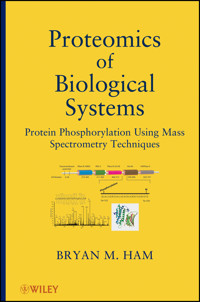
Phosphorylation is the addition of a phosphate (PO4) group to a protein or other organic molecule. Phosphorylation activates or deactivates many protein enzymes, causing or preventing the mechanisms of diseases such as cancer and diabetes. This book shows how to use mass spectrometry to determine whether or not a protein has been correctly modified by the addition of a phosphate group. It also provides a combination of detailed, step-by-step methodology for phosphoproteomic sample preparation, mass spectral instrumental analysis, and data interpretation approaches. Furthermore, it includes the use of bioinformatic Internet tools such as the Blast2GO gene ontology (GO) tool, used to help understand and interpret complex data collected in these studies.
Sie lesen das E-Book in den Legimi-Apps auf:
Seitenzahl: 396
Veröffentlichungsjahr: 2011
Ähnliche


















Table of Contents
Cover
Title page
Copyright page
Dedication
PREFACE
ACKNOWLEDGMENTS
ABOUT THE AUTHOR
1 Posttranslational Modification (PTM) of Proteins
1.1 OVER 200 FORMS OF PTM OF PROTEINS
1.2 THREE MAIN TYPES OF PTM STUDIED BY MS
1.3 OVERVIEW OF NANO-ELECTROSPRAY/NANOFLOW LC-MS
1.4 OVERVIEW OF NUCLEIC ACIDS
1.5 PROTEINS AND PROTEOMICS
2 Glycosylation of Proteins
2.1 PRODUCTION OF A GLYCOPROTEIN
2.2 BIOLOGICAL PROCESSES OF PROTEIN GLYCOSYLATION
2.3 N-LINKED AND O-LINKED GLYCOSYLATION
2.4 CARBOHYDRATES
2.5 THREE OBJECTIVES IN STUDYING GLYCOPROTEINS
2.6 GLYCOSYLATION STUDY APPROACHES
3 Sulfation of Proteins as Posttranslational Modification
3.1 GLYCOSAMINOGLYCAN SULFATION
3.2 CELLULAR PROCESSES INVOLVED IN SULFATION
3.3 BRIEF EXAMPLE OF PHOSPHORYLATION
3.4 SULFOTRANSFERASE CLASS OF ENZYMES
3.5 FRAGMENTATION NOMENCLATURE FOR CARBOHYDRATES
3.6 SULFATED MUCIN OLIGOSACCHARIDES
3.7 TYROSINE SULFATION
3.8 TYROSYLPROTEIN SULFOTRANSFERASES TPST1 AND TPST2
3.9 O-SULFATED HUMAN PROTEINS
3.10 SULFATED PEPTIDE PRODUCT ION SPECTRA
3.11 USE OF HIGHER ENERGY COLLISIONS
3.12 ELECTRON CAPTURE DISSOCIATION (ECD)
3.13 SULFATION VERSUS PHOSPHORYLATION
4 Eukaryote PTM as Phosphorylation: Normal State Studies
4.1 MASS SPECTRAL MEASUREMENT WITH EXAMPLES OF HELA CELL PHOSPHOPROTEOME
4.2 THE HELA CELL PHOSPHOPROTEOME
4.3 NONPHOSPHOPROTEOME HELA CELL ANALYSIS
4.4 REVIEWING SPECTRA USING THE SPECTRUMLOOK SOFTWARE PACKAGE
5 Eukaryote PTM as Phosphorylation: Perturbed State Studies
5.1 STUDY OF THE PHOSPHOPROTEOME OF HELA CELLS UNDER PERTURBED CONDITIONS BY NANO-HIGH-PERFORMANCE LIQUID CHROMATOGRAPHY HPLC ELECTROSPRAY IONIZATION (ESI) LINEAR ION TRAP (LTQ)-FT/MASS SPECTROMETRY (MS)
6 Prokaryotic Phosphorylation of Serine, Threonine, and Tyrosine
6.1 INTRODUCTION
6.2 OPTIMIZED METHODOLOGY FOR PHOSPHO SER/THR/TYR STUDIES
6.3 IDENTIFICATION OF THE COMPONENTS OF THE SER/THR/TYR PHOSPHOPROTEOME IN C. CRESCENTUS GROWN IN THE PRESENCE AND ABSENCE OF GLUCOSE
7 Prokaryotic Phosphorylation of Histidine
7.1 PHOSPHOHISTIDINE AS POSTTRANSLATIONAL MODIFICATION (PTM)
7.2 BACTERIAL KINASES AND THE TWO-COMPONENT SYSTEM
7.3 MEASUREMENT OF PHOSPHORYLATED HIS (PH)
7.4 IN VITRO AND IN VIVO STUDY OF PH-CONTAINING PEPTIDES BY NANO-ESI TANDEM MS
7.5 SUPPLEMENTARY MATERIAL
APPENDIX I: Atomic Weights and Isotopic Compositions
APPENDIX II: Periodic Table of the Elements
APPENDIX III: Fundamental Physical Constants
GLOSSARY
Index
Copyright © 2012 by John Wiley & Sons, Inc. All rights reserved.
Published by John Wiley & Sons, Inc., Hoboken, New Jersey.
Published simultaneously in Canada.
No part of this publication may be reproduced, stored in a retrieval system, or transmitted in any form or by any means, electronic, mechanical, photocopying, recording, scanning, or otherwise, except as permitted under Section 107 or 108 of the 1976 United States Copyright Act, without either the prior written permission of the Publisher, or authorization through payment of the appropriate per-copy fee to the Copyright Clearance Center, Inc., 222 Rosewood Drive, Danvers, MA 01923, (978) 750-8400, fax (978) 750-4470, or on the web at www.copyright.com. Requests to the Publisher for permission should be addressed to the Permissions Department, John Wiley & Sons, Inc., 111 River Street, Hoboken, NJ 07030, (201) 748-6011, fax (201) 748-6008, or online at http://www.wiley.com/go/permissions.
Limit of Liability/Disclaimer of Warranty: While the publisher and author have used their best efforts in preparing this book, they make no representations or warranties with respect to the accuracy or completeness of the contents of this book and specifically disclaim any implied warranties of merchantability or fitness for a particular purpose. No warranty may be created or extended by sales representatives or written sales materials. The advice and strategies contained herein may not be suitable for your situation. You should consult with a professional where appropriate. Neither the publisher nor author shall be liable for any loss of profit or any other commercial damages, including but not limited to special, incidental, consequential, or other damages.
For general information on our other products and services or for technical support, please contact our Customer Care Department within the United States at (800) 762-2974, outside the United States at (317) 572-3993 or fax (317) 572-4002.
Wiley also publishes its books in a variety of electronic formats. Some content that appears in print may not be available in electronic formats. For more information about Wiley products, visit our web site at www.wiley.com.
Library of Congress Cataloging-in-Publication Data:
Ham, Bryan M.
Proteomics of biological systems : protein phosphorylation using mass spectrometry techniques / Bryan M Ham.
p. cm.
Includes index.
ISBN 978-1-118-02896-4 (cloth)
1. Proteomics–Methodology. 2. Phosphorylation–Research–Methodology. 3. Phosphoproteins–Synthesis. 4. Mass spectrometry. 5. Biological systems–Research– Methodology. I. Title.
QP519.9.M3H367 2012
572'.62–dc23
2011019941
oBook ISBN: 9781118137048
ePDF ISBN: 9781118137017
ePub ISBN: 9781118137031
MOBI ISBN: 9781118137024
This Book Is Dedicated to the Most Important Person in My Life, My Ever Loving Wife.
PREFACE
This book is a review of posttranslational modification (PTM) of proteins, including a special focus on a collection of mass spectral studies of phosphorylation as a PTM of both eukaryotic and prokaryotic proteomes utilizing the most recent advances and approaches in analytical chemistry. Protein PTM studies have now been studied for over 30 years in recognition of its importance in cellular processes. In particular, the study of protein phosphorylation as a PTM has received much attention in the last 5 years. The timing of this book is in accordance with the new advances in protein phosphorylation studies. A major focus of the book is in the first time reporting of the study of prokaryote phosphoproteomes, in particular the extensive study of the phosphorylation of the histidine residue that is extremely important in prokaryote signaling processes, with very little or no examples previously reported. The focus of the measurement of the phosphoproteomes is based on state-of-the-art mass spectrometry instrumentation and techniques. Also discussed are specific methodologies for performing PTM phosphoproteome studies, which include from cell cultures, through important steps during sample preparation, instrumental analysis using the most recent mass spectral approaches, the handling of the extensive data collected, and finally, recent tools available to the scientific community free of charge on the Internet currently being used to help understand and interpret the extensive and complex data collected during these studies. The data reduction approach utilizes the current “systems biology” viewpoint to rationalize the observations. The primary focus of the book is to teach the basic skills and methodologies needed for studies of phosphorylation as a PTM of proteins using real-life examples of actual phosphoproteome studies of both eukaryotic and prokaryotic systems. The book is a mixture of the fundamentals of sample preparation, nano-liquid chromatographic separation/nano-electrospray ionization, tandem mass spectrometry instrumental analysis, followed by bioinformatic data interpretation concerning phosphoproteome studies.
The book is presenting a number of first-time observations and studies involving the phosphoproteomes of prokaryotes. This is a subject area that is timely and new with few previous examples in the literature. There is currently an overwhelming need and interest in the scientific community concerning phosphoproteomic studies of prokaryotic systems. This involves both the normal type of phosphoproteomes that are studied in eukaryotic systems and the novel areas of phosphorylation observed in prokaryotes. Researchers are currently applying the phosphoproteomic approaches that have now been well-optimized in eukaryotic systems to those of prokaryotic systems, and examples of these types of studies are presented in the book. However, the tremendously challenging area of phosphorylation of the histidine residue or “phosphohistidine proteomes” of prokaryotes has just begun to be studied. The book presents numerous first-time studies of this current topic of interest that has not been observed nor reported yet anywhere in the literature. The book describes the in vitro synthesis of phosphohistidine-containing peptides along with the mass spectral characterization of the peptides.
Specifically, the book presents optimized methodologies for performing both eukaryotic phosphoproteome studies and prokaryotic phosphoproteome studies. The materials presented in the book are tried-and-tested sample preparation and analysis methods and approaches. While this can be collected in the literature for eukaryotic systems through exhaustive and time-consuming searches, the book has compiled the most recent approaches into one place. The methodologies that are presented for prokaryotic systems are, however, novel and new and not available in the literature in a systematic approach as presented in the book. In fact, the book is reporting prokaryotic study approaches that have not previously been reported before. This covers a new and quite challenging area of phosphohistidine prokaryote phosphoproteome studies. The book also presents methodologies for time-based studies of a prokaryote model that is undergoing a food-starved environment study. This is a first-ever reported quantitative differential study of a prokaryotic system under perturbed conditions. All studies reported in the book are actual laboratory experiments giving step-by-step sample preparation protocols using laboratory benchtop methodologies and the most recent vendor-optimized kits. For example, an immunoprecipitation study of phosphorylated tyrosine enrichment is described along with the associated mass spectral instrumental analysis results.
The work and studies reported in the book can be an invaluable asset to the student and the researcher due to the combination of detailed step-by-step methodology for phosphoproteomic sample preparation, mass spectral instrumental analysis, and data interpretation approaches. The book also includes the use of some of the most recent systems biology bioinformatic internet tools such as the Blast2GO gene ontology (GO) tool. Also described are the most recent data processing approaches that have been developed by Dr. Richard Smith’s proteomics group at Pacific Northwest National Laboratory. The book is also an extensive reference concerning cell signaling studies associated with phosphorylation of proteins.
Bryan M. Ham
ACKNOWLEDGMENTS
I would like to acknowledge all those whose input, review, and criticisms helped enormously in the early structuring and final content of this book. I would like to include in the acknowledgement Pacific Northwest National Laboratory where much of the inspiration for this book was instilled within me while I was conducting research in Dr. Richard D. Smith’s proteomics group. Finally, and most important of all, is the acknowledgment of my wife, Dr. Aihui Ma Ham, whose consultations, support, reviewing, and invaluable encouragement saw through the entire process of this book from start to finish with an unending presence of which the project would most certainly not have completed to this level without.
B. M. H.
ABOUT THE AUTHOR
Bryan M. Ham, PhD, is a member of the American Society of Mass Spectrometry and the American Chemical Society. He has conducted proteomics and lipidomics research at The Ohio State University and Pacific Northwest National Laboratory in Richland, WA. He is currently working for the Department of Homeland Security at the U.S. Customs and Border Protection New York Laboratory. His research interests include the application of mass spectrometry for biomolecular analysis in the areas of proteomics, lipidomics, and metabolomics.
1
Posttranslational Modification (PTM) of Proteins
The study of posttranslational modification (PTM) of proteins using mass spectrometry (MS) approaches has now become a well-matured area of study. There are numerous approaches toward applying chromatography coupled with MS for PTM studies. The liquid chromatography (LC) front-end separation approach of choice is now nanoflow/nano-electrospray, which allows increased sensitivity over previous LC methodology. This book looks at recent developments in PTM studies using MS and proteomic techniques with a focus upon a number of actual studies designed to instruct and highlight modern methodological approaches. A brief overview of nano-electrospray/nanoflow LC-MS is presented in Section 1.3.
1.1 OVER 200 FORMS OF PTM OF PROTEINS
In the genomic sequencing field, the use of robotic gene sequencers allowed large-scale sequencing that was essentially automated. The robotic automation of determining gene sequences is possible because the sequences involved with genes involve only four bases (see “Overview of Nucleic Acids” in Section 1.4), and there are no variations induced in the form of postmodification. This has resulted in the well-publicized entire sequencing of the human genome (Human Genome Project, Nature, February 2001). This is not the case with proteins where there is not only the observance of spliced variants from alternative splicing from the messenger ribonucleic acid (mRNA), there are also PTMs that can take place with the amino acids contained within the protein. There are over 200 PTMs that can take place with proteins as has been described by Wold.1 As examples, here are 22 different types of PTMs that can take place with proteins: acetylation, amidation, biotinylation, C-mannosylation, deamidation, farnesylation, formylation, flavinylation, gamma-carboxyglutamic acids, geranyl-geranylation, hydroxylation, lipoxylation, myristoylation, methylation, N-acyl diglyceride (tripalmitate), O-GlcNAc, palmitoylation, phosphorylation, phosphopantetheine, pyrrolidone carboxylic acid, pyridoxyl phosphate, and sulfation.2 There are also artifactual modifications such as oxidation of methionine (Met). A brief overview of proteins and an introduction to proteomics is presented in Section 1.5.
1.2 THREE MAIN TYPES OF PTM STUDIED BY MS
Of these, the three types of PTM that are primarily observed and studied using mass spectrometric techniques are glycosylation, sulfation, and phosphorylation. The observance of PTM is increasingly being used in expression studies where a normal state proteome is being compared with a diseased state proteome. However, the PTM of a protein during a biological or physiological change within an organism may take place without any change in the abundance of the protein involved and often, is one piece of a complex puzzle. Methods that measure PTM using mass spectrometric methodologies often focus on the degree (increase or decrease, or alternatively, upregulation or downregulation) of PTM for any given protein or proteins. We shall briefly look at glycosylation and sulfation, which are less involved in cellular processes than phosphorylation, a major signaling cascade pathway for the response to a change in cellular condition(s).
Lesen Sie weiter in der vollständigen Ausgabe!
Lesen Sie weiter in der vollständigen Ausgabe!
Lesen Sie weiter in der vollständigen Ausgabe!
Lesen Sie weiter in der vollständigen Ausgabe!
Lesen Sie weiter in der vollständigen Ausgabe!
Lesen Sie weiter in der vollständigen Ausgabe!
Lesen Sie weiter in der vollständigen Ausgabe!
Lesen Sie weiter in der vollständigen Ausgabe!
Lesen Sie weiter in der vollständigen Ausgabe!
Lesen Sie weiter in der vollständigen Ausgabe!
Lesen Sie weiter in der vollständigen Ausgabe!




