


105,99 €
Mehr erfahren.
- Herausgeber: John Wiley & Sons
- Kategorie: Wissenschaft und neue Technologien
- Sprache: Englisch
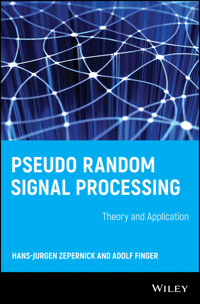
In recent years, pseudo random signal processing has proven to be a critical enabler of modern communication, information, security and measurement systems. The signal’s pseudo random, noise-like properties make it vitally important as a tool for protecting against interference, alleviating multipath propagation and allowing the potential of sharing bandwidth with other users.
Taking a practical approach to the topic, this text provides a comprehensive and systematic guide to understanding and using pseudo random signals. Covering theoretical principles, design methodologies and applications, Pseudo Random Signal Processing: Theory and Application:
- sets out the mathematical foundations needed to implement powerful pseudo random signal processing techniques;
- presents information about binary and nonbinary pseudo random sequence generation and design objectives;
- examines the creation of system architectures, including those with microprocessors, digital signal processors, memory circuits and software suits;
- gives a detailed discussion of sophisticated applications such as spread spectrum communications, ranging and satellite navigation systems, scrambling, system verification, and sensor and optical fibre systems.
Pseudo Random Signal Processing: Theory and Applicationis an essential introduction to the subject for practising Electronics Engineers and researchers in the fields of mobile communications, satellite navigation, signal analysis, circuit testing, cryptology, watermarking, and measurement. It is also a useful reference for graduate students taking courses in Electronics, Communications and Computer Engineering.
Sie lesen das E-Book in den Legimi-Apps auf:
Seitenzahl: 675
Veröffentlichungsjahr: 2013
Ähnliche



















Contents
Preface
List of abbreviations
List of common symbols
1 Introduction
1.1 PROLOGUE
1.2 ELEMENTS OF PSEUDO RANDOM SIGNAL PROCESSING
1.3 OUTLINE OF THE BOOK
2 Characterization of signals and sequences
2.1 CLASSIFICATION OF SIGNALS AND SEQUENCES
2.2 TRANSFORMATIONS OF SIGNALS AND SEQUENCES
2.3 CORRELATION MEASURES
2.4 POWER SPECTRAL DENSITY
2.5 PSEUDO RANDOM SIGNALS AND SEQUENCES
3 Mathematical foundations
3.1 ALGEBRAIC STRUCTURES
3.2 POLYNOMIALS OVER FINITE FIELDS
4 Binary pseudo random sequences
4.1 CLASSIFICATION
4.2 MAXIMAL-LENGTH SEQUENCES
4.3 BINARY SEQUENCES WITH GOOD AUTOCORRELATION
4.4 BINARY SEQUENCES WITH SPECIAL CROSSCORRELATION
5 Nonbinary pseudo random sequences
5.1 CLASSIFICATION
5.2 INTERFERENCE-FREE WINDOW SEQUENCES
5.3 COMPLEX-VALUED SEQUENCES
5.4 POLYPHASE SEQUENCES WITH SPECIAL CORRELATIONS
6 Generating pseudo random signals
6.1 LINEAR AUTONOMOUS AUTOMATA
6.2 GENERATING MAXIMAL-LENGTH SEQUENCES
6.3 TRANSFORMATIONS OF MAXIMAL-LENGTH SEQUENCES
6.4 COMBINATIONS OF MAXIMAL-LENGTH SEQUENCES
6.5 PSEUDO RANDOM SIGNAL PROCESSING WITH MICROPROCESSORS AND MEMORY CIRCUITS
7 Applications of pseudo random signal processing
7.1 SPREAD SPECTRUM COMMUNICATIONS
7.2 RANGING AND NAVIGATION SYSTEMS
7.3 SCRAMBLING
7.4 AUTOMATIC TESTING AND SYSTEM VERIFICATION
7.5 CRYPTOLOGY
7.6 OTHER APPLICATIONS
Bibliography
Index
Copyright © 2005
John Wiley & Sons Ltd, The Atrium, Southern Gate, Chichester, West Sussex PO19 8SQ, England
Telephone (+44) 1243 779777
Email (for orders and customer service enquiries): [email protected]
Visit our Home Page on www.wiley.com
All Rights Reserved. No part of this publication may be reproduced, stored in a retrieval system or transmitted in any form or by any means, electronic, mechanical, photocopying, recording, scanning or otherwise, except under the terms of the Copyright, Designs and Patents Act 1988 or under the terms of a licence issued by the Copyright Licensing Agency Ltd, 90 Tottenham Court Road, London WIT 4LP, UK, without the permission in writing of the Publisher. Requests to the Publisher should be addressed to the Permissions Department, John Wiley & Sons Ltd, The Atrium, Southern Gate, Chichester, West Sussex PO19 8SQ, England, or emailed to [email protected], or faxed to (+44) 1243 770620.
Designations used by companies to distinguish their products are often claimed as trademarks. All brand names and product names used in this book are trade names, service marks, trademarks or registered trademarks of their respective owners. The Publisher is not associated with any product or vendor mentioned in this book.
This publication is designed to provide accurate and authoritative information in regard to the subject matter covered. It is sold on the understanding that the Publisher is not engaged in rendering professional services. If professional advice or other expert assistance is required, the services of a competent professional should be sought.
Other Wiley Editorial Offices
John Wiley & Sons Inc., 111 River Street, Hoboken, NJ 07030, USA
Jossey-Bass, 989 Market Street, San Francisco, CA 94103-1741, USA
Wiley-VCH Verlag GmbH, Boschstr. 12, D-69469 Weinheim, Germany
John Wiley & Sons Australia Ltd, 42 McDougall Street, Milton, Queensland 4064, Australia
John Wiley & Sons (Asia) Pte Ltd, 2 Clementi Loop #02-01, Jin Xing Distripark, Singapore 129809
John Wiley & Sons Canada Ltd, 22 Worcester Road, Etobicoke, Ontario, Canada M9W 1L1
Wiley also publishes its books in a variety of electronic formats. Some content that appears in print may not be available in electronic books.
British Library Cataloguing in Publication Data
A catalogue record for this book is available from the British Library
ISBN-13 978-0-470-86657-3 (HB)ISBN-10 0-470-86657-8 (HB)
Preface
Pseudo random signal processing has emerged from space and military applications with a history of research and development in these areas spanning a period of more than 40 years. The main focus in these applications was on signal formats and processing techniques that can ensure signal integrity, especially immunity against jamming attacks. The evolution of digital mobile radio systems and the increasing demand for positioning systems along with the advances in integrated circuit complexity have resulted in frequent use of pseudo random signal processing as a viable technique for many civilian and commercial applications. Especially with the introduction of cellular mobile radio systems, pseudo random signal processing has received increased attention during the course of the late 1980s. The numerous features of these processing techniques that are important for cellular radio include the ability to eliminate or alleviate multipath propagation, the resistance to interference, and the potential of sharing allocated bandwidth with other users or even sharing it as an overlay with other communication systems. More recently, successful applications in commercial satellite navigation systems and third-generation mobile communication systems have proven the concepts of pseudo random signal processing as being an important and critical enabler of modem communication and information systems. In addition, the methodology of pseudo random signal processing has evolved into fields such as acoustics, biomedicine, and sensor systems, to mention just a few of the specialized application areas. It can be expected that an in-depth knowledge of pseudo random signal processing will provide the basis for the development of many new applications in communication, information, and computer technologies, in both the short and long term.
The objective of this book is to provide an important transition from covering the mathematical foundations to conveying the powerful engineering concepts of pseudo random signal processing. In particular, the far-reaching signal processing principles will serve as the connecting link between theory and practice. The book is intended to provide comprehensive coverage of the theoretical foundations of pseudo random signal processing, which makes it timeless and independent of the actual state of the art in circuit and system technology. The reader will also gain insights into the increasingly sophisticated applications of the described techniques in modem communication and information technologies such as mobile radio systems, navigation systems, scrambling, circuit testing, cryptology, and a number of selected specialized applications. The combination of theory and practice makes the book attractive as a practically oriented introduction to researchers and it provides essential reading for practicing engineers.
The book is based on our experience in the area of pseudo random signal processing obtained from numerous research projects, teaching senior graduate courses at universities, and delivering short courses to industry. The book is based on a course entitled “Digital Signal Structures,” which has been taught by Adolf Finger. It also draws upon material from the senior graduate courses “Advanced Communications” and “Error Control Coding,” which have been taught by Hans-Jürgen Zepernick. These courses are aimed at students in their final year of studies to provide insights into the areas of advanced communications theory and how it can be utilized in practice.
The book is aimed at academics and students in the areas of electrical, electronic, and computer engineering as well as scientists and practicing engineers in research and development. It is suitable for a wide audience working in the fields of telecommunications, information technology, and computer science. The book is accessible to readers with at least an undergraduate electrical engineering or computer science background in signals and systems, communications, and electronics. The book is written at an advanced level and will enable the reader to access the more specialized technical articles and textbooks.
We are grateful to the many researchers whose original contributions form the foundations of pseudo random signal processing and who basically have made this book possible. We would also like to thank the anonymous reviewers who provided constructive suggestions and valuable comments that guided us in the early stages to shape the content of the book into its present form.
We would like to extend warm thanks to our students from Europe, the United States, Asia, and Australia, whose questions have helped us to refine the presentation. Special thanks go to our doctoral students and post-doctoral research fellows for the intellectual stimulation they have provided over the years. We would like to thank our friends and colleagues for many helpful discussions and support during the course of writing this book. We also wish to express our deep gratitude to Dr. Manora Caldera and Dr. Helmut Wiehl for proof-reading various parts of the manuscript and their valuable comments and suggestions which have helped us to improve the book.
Finally, we wish to thank the editorial and publishing team of John Wiley & Sons for their enormous assistance in the preparation of this book. In particular, we are very grateful to Birgit Gruber, Sarah Corney, Kathryn Sharples, Claire Twine, Simone Taylor, Emily Bone, and Wendy Hunter for guiding us safely through all the phases of the book project and for their professional work.
Hans-Jürgen ZepernickAdolf Finger
List of abbreviations
3GPP
Third-generation partnership project
AACF
Aperiodic autocorrelation function
ACCF
Aperiodic crosscorrelation function
ACF
Autocorrelation function
ACL
Asynchronous connectionless
ADSL
Asymmetric digital subscriber line
AMPS
Advanced mobile phone service
AO
Auto-optimal
ASIC
Application-specific integrated circuit
ATM
Asynchronous transfer mode
AU
Astronomical unit
AWGN
Additive white Gaussian noise
BCD
Binary-coded decimal
BCH
Bose–Chaudhuri–Hocquenghem
BER
Bit error rate
B-ISDN
Broadband integrated services digital network
BIST
Built-in self-test
BOC
Binary offset carrier
BOT
Broadcast online television
BPF
Bandpass filter
BPSK
Binary phase shift keying
BS
Base station
CA
Conditional access
CCD
Charge-coupled device
CCD-PNMF
CCD pseudo noise matched filter
CCF
Crosscorrelation function
CD
Collision detection
CDMA
Code-division multiple-access
CIW
Container identification word
CMOS
Complementary metal oxide semiconductor
CO
Cross-optimal
CQI
Channel-quality indication
CS
Commercial service
CSMA
Carrier sense multiple-access
CSMA-CD
CSMA with collision detection
CSS
Content scrambling system
CUT
Circuit-under-test
CVBS
Composite video blanking and synchronization
CW
Control word
DAB
Digital audio broadcast
DAC
Digital-to-analog converter
DC
Direct current
DECT
Digital enhanced cordless telecommunications
DEMUX
Demultiplexer
DES
Data encryption standard
DGPS
Differential GPS
DH
Data high
DK
Distribution key
DLL
Delay-lock loop
DMT
Discrete multi-tone
DPCCH
Dedicated physical control channel
DPDCH
Dedicated physical data channel
DS
Direct-sequence
DS-CDMA
Direct-sequence code-division multiple-access
DSL
Digital subscriber line
DSP
Digital signal processing
DSR
Digital satellite radio
DSS
Distributed sample scrambling
DSSS
Direct-sequence spread spectrum
DVB
Digital video broadcast
DVD
Digital versatile disc
ECL
Emitter coupled logic
EEG
Electroencephalograph
EGNOS
European geostationary navigation overlay service
EK
Entitlement key
EOE
Equivalent odd and even
EPROM
Erasable programmable read-only memory
ESA
European Space Agency
ETSI
European Telecommunications Standards Institute
EU
European Union
EUVE
Extreme Ultraviolet Explorer
FBG
Fiber Bragg grating
FBI
Feedback information
FCC
Federal Communications Commission
FCSR
Feedback with carry shift register
FDD
Frequency-division duplex
FDMA
Frequency-division multiple-access
FFH
Fast frequency hopping
FH
Frequency hopping
FH-CDMA
Frequency hopping CDMA
FHS
Frequency hop synchronization
FHSS
Frequency hopping spread spectrum
FLL
Frequency-lock loop
FM
Frequency modulation
FPGA
Field programmable logic gate array
FSK
Frequency shift keying
FSS
Frame synchronous scrambling
FZC
Frank–Zadoff–Chu
Gbps
Gigabits per second
GLONASS
Global navigation satellite system
GMW
Gordon–Mills–Welch
GPS
Global positioning system
GRO
Gamma Ray Observatory
GSM
Global system for mobile communication
GSRx
Ground station reference receiver
HARQ
Hybrid automatic repeat request
HARQ-ACK
HARQ acknowledgment
HBI
Horizontal blanking interval
HDSL
High-bit-rate digital subscriber line
HEC
Header error control
HPA
High-power amplifier
HPSK
Hybrid PSK
HS-DPCCH
High-speed dedicated physical control channel
HS-PDSCH
High-speed dedicated physical downlink shared channel
IEEE
Institute of Electrical and Electronics Engineers
IE
Intermediate frequency
IFW
Interference-free window
IR
Infrared
IS-95
Interim Standard 95
ISDN
Integrated services digital network
ISI
Intersymbol interference
ISM
Industrial, scientific, and medical
ITU
International Telecommunications Union
LA
Large-area
LAB
Logic array block
LAP
Lower address part
LAS
Large-area synchronous
LC
Linear complexity
LED
Light-emitting diode
LEO
Low earth orbit
LFSR
Linear feedback shift register
LORAN
Long-range navigation
LPF
Lowpass filter
LS
Loosely synchronous codes
LSB
Least significant bit
LSE
Least sidelobe energy
LTI
Linear time-invariant
LUT
Look-up table
MAC
Medium access control
MAI
Multiple access interference
MASER
Microwave amplification by stimulated emission of radiation
MC
Multi-carrier
MCC
Master control center
MC-CDMA
Multi-carrier CDMA
MEO
Medium earth orbit
MF
Merit factor
MFSK
M
-ary FSK
MLSSA
Maximal-length sequence system analyzer
MPDU
MAC sublayer protocol data unit
MPEG
Moving Pictures Experts Group
MS
Mobile station
MSAC
Mean-square out-of-phase aperiodic autocorrelation
MSAS
MT sat-based augmentation system
MSB
Most significant bit
MSCC
Mean-square aperiodic crosscorrelation
MSPD
Maximum peak-to-side-peak distance
MSPR
Maximum peak-to-side-peak ratio
MT-CDMA
Multi-tone CDMA
MUI
Multi-user interference
MUX
Multiplexer
NASA
National Aeronautics and Space Administration
NAVSTAR
Navigation system time and ranging
NCO
Number-controlled oscillator
NLES
Navigation land earth station
OCQPSK
Orthogonal complex quadrature phase shift keying
OFDM
Orthogonal frequency-division multiplexing
OOK
On–off keying
OQPSK
Offset quadrature phase shift keying
OS
Open services
OSI
Open system interconnection
OVSF
Orthogonal variable spreading factor
PACF
Periodic autocorrelation function
PAL
Phase alternate line
PAR
Peak-to-average ratio
PCCF
Periodic crosscorrelation function
PCM
Pulse code modulation
PCPCH
Physical common packet channel
PCS
Personal communications system
PD
Photo diode
Probability density function
PHY
Physical layer
PLA
Programmable logic array
PLCP
Physical layer convergence protocol
PLD
Programmable logic device
PLL
Phase-lock loop
PN
Pseudo noise
PPDU
PLCP protocol data unit
PRACH
Physical random access channel
PRBS
Pseudo random bit sequence
PRC
Pseudo random code
PRN
Pseudo random noise
PRPG
Pseudo random pattern generator
PROM
Programmable read-only memory
PRS
Public regulated services
PSC
Primary synchronization code
P-SCH
Primary SCH
PSD
Power spectral density
PSDU
PLCP service data unit
PSK
Phase shift keying
QAM
Quadrature amplitude modulation
QoS
Quality-of-service
QPSK
Quadrature phase shift keying
RAM
Random access memory
RARASE
Recursion-aided RASE
RASE
Rapid acquisition by sequential estimation
RF
Radio frequency
RIMS
Ranging and monitoring station
RNSS
Radio navigation satellite system
ROM
Read-only memory
RSA
Rivest–Shamir–Adleman
SA
Selective availability
SAR
Search and rescue
SAW
Surface acoustic wave
SCH
Synchronization channel
SDH
Synchronous digital hierarchy
SDU
Service data unit
SFD
Start frame delimiter
SFH
Slow frequency hopping
SIG
Special interest group
SK
Service key
SNR
Signal-to-noise ratio
SOH
Section overhead
SOL
Safety-of-life
S/P
Serial-to-parallel
SS
Spread spectrum
S-SCH
Secondary SCH
SSS
Self-synchronous scrambling
STM
Synchronous transport module
TD-CDMA
Time-division CDMA
TDD
Time-division duplex
TDL
Tau-dither loop
TDMA
Time-division multiple-access
TDRSS
Tracking and data relay satellite system
TFC
Transport format combination
TFCI
Transport format combination indicator
THSS
Time hopping spread spectrum
TIA
Telecommunications Industry Association
TPC
Transmit power control
TPG
Test pattern generator
TTL
Transistor-transistor logic
TV
Television
UAP
Upper address part
UHF
Ultra high frequency
UMTS
Universal mobile telecommunications system
U-NII
Unlicensed national information infrastructure
UTRA
UMTS terrestrial radio access
VBI
Vertical blanking interval
VCO
Voltage controlled oscillator
VDSL
Very high-bit-rate digital subscriber line
VEP
Visual evoked potential
VHDL
Very high-speed integrated circuit hardware description language
WAAS
Wide area augmentation system
WCDMA
Wideband CDMA
WLAN
Wireless local area network
WPAN
Wireless personal area network
WSS
Wide-sense stationary
XNR
Exclusive-NOR
ZC
Zadoff–Chu
ZCZ
Zero correlation zone
List of common symbols
1
Introduction
1.1 PROLOGUE
The performance of modem communication and information systems is influenced by the potential of the available integrated circuits and by the efficiency of the algorithms chosen for the actual signal processing. The tremendous advances in integrated circuit technology facilitate the implementation of increasingly sophisticated signal processing algorithms. This has resulted in strong interactions between theoretical concepts and technological developments, which in turn have produced a wide range of practical applications.
This general trend applies in particular to the fields of pseudo random signals and sequences, which constitute an important element of efficient signal processing in almost every modem communication and information system. These types of signals and sequences are strictly deterministic in nature but offer similar characteristics as random signals. The strong mathematical structure associated with pseudo random signals not only provides a solid foundation for systematic signal set design but also guides the development of extremely powerful signal processing techniques. The distinct benefits of pseudo random signal processing compared to standard processing techniques include a very robust immunity to hostile jamming and a superior operation against several forms of unintentional interference. These advantages have been exploited first for military applications, where a secure, reliable, and robust communication link is of major concern. Later, with the advent of multi-user communications along with rapid advances in technology, more intricate pseudo random signal processing techniques were introduced to the civilian and commercial fields. In the meantime, implementation costs for these techniques have been largely reduced and this allows the many attractive features of pseudo random signal processing to be used extensively in practice.
Lesen Sie weiter in der vollständigen Ausgabe!
Lesen Sie weiter in der vollständigen Ausgabe!
Lesen Sie weiter in der vollständigen Ausgabe!
Lesen Sie weiter in der vollständigen Ausgabe!
Lesen Sie weiter in der vollständigen Ausgabe!
Lesen Sie weiter in der vollständigen Ausgabe!
Lesen Sie weiter in der vollständigen Ausgabe!
Lesen Sie weiter in der vollständigen Ausgabe!
Lesen Sie weiter in der vollständigen Ausgabe!




