


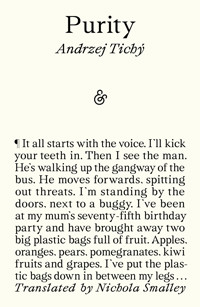
Erhalten Sie Zugang zu diesem und mehr als 300000 Büchern ab EUR 5,99 monatlich.
- Herausgeber: And Other Stories
- Kategorie: Gesellschafts- und Liebesromane
- Sprache: Englisch
2021 Nordic Council Literature Prize Finalist The stories in Purity take the reader through cities and suburbs, apartments and streets, to find characters struggling to survive in modern society: a man has an outburst on a bus; a fugitive finds insight in a colour wheel; a social realist kills his friend with a hammer; a thief finds himself in books. And cleaners reluctantly go on cleaning. With gravity and humour, against the backdrop of a violent civilization, people are depicted as fallen, or waiting to fall, rendered by Tichý with the fury, compassion and emotional complexity of Kendrick Lamar.
Sie lesen das E-Book in den Legimi-Apps auf:
Seitenzahl: 294
Veröffentlichungsjahr: 2024
Das E-Book (TTS) können Sie hören im Abo „Legimi Premium” in Legimi-Apps auf:
Ähnliche



















First published in English in 2024 by And Other StoriesSheffield – London – New Yorkwww.andotherstories.org
Copyright © 2020 Andrzej TichýFirst published as Renheten by Albert Bonniers Förlag, SwedenTranslation copyright © Nichola Smalley, 2024
All rights reserved. The rights of Andrzej Tichý to be identified as the author of this work and of Nichola Smalley to be identified as the translator of this work have been asserted.
Quotation from the following sources gratefully acknowledged:‘Stairway to Heaven’ by Led Zeppelin, ‘Stairway To Heaven’ by Dolly Parton, ‘Turn! Turn! Turn!’ by The Byrds, ‘Don’t Feel Right’ by The Roots, ‘Dear God 2.0’ by The Roots, ‘Eins. Zwei. Polizei’ by Mo-Do, ‘In Da Club’ by 50 Cent, ‘N.Y. State of Mind’ by Nas, ‘Gallons’ by Kojey Radical, ‘ROCKABYE BABY’ by Joey Bada$$.
Whilst all attempts have been made to find the copyright holders of quoted passages and secure permission where relevant, the publishers and author would welcome approaches in the case of omission.
ISBN: 9781913505981eBook ISBN: 9781913505998
Editor: Anna Glendenning; Copy-editor: Bella Bosworth; Proofreader: Madeleine Rogers; Typesetting and eBook by Tetragon, London; Series Cover Design: Elisa von Randow, Alles Blau Studio, Brazil, after a concept by And Other Stories; Author Photo: Carla Orrego Veliz.
A catalogue record for this book is available from the British Library.
And Other Stories gratefully acknowledge that our work is supported using public funding by Arts Council England and that the translation of this book was partially funded by the support of a grant from English PEN’s PEN Translates programme, which is supported by Arts Council England, and by a grant from the Anglo-Swedish Literary Foundation. The cost of this translation was supported by a subsidy from the Swedish Arts Council, gratefully acknowledged.
Contents
Outburst The Usual Thoughts The Runaway Strength and Unity On the Waves Trajectories The Reading Thief Notions Purity Twelve Tales on the Art of Building Bridges One Last AnecdoteOutburst
It all starts with the voice. I’ll kick your teeth in. Then I see the man. He’s walking up the gangway of the bus. He moves forwards, spitting out threats. I’m standing by the doors, next to a buggy. I’ve been at my mum’s seventy-fifth birthday party and have brought away two big plastic bags full of fruit. Apples, oranges, pears, pomegranates, kiwis and grapes. I’ve put the bags down in between my legs, and now I push them closer to the side, carefully so the fruit doesn’t tumble out, as I think about how he must be on the phone to someone. It’s like I’m making space for him and his threats. But then I look up again, just as he’s passing me, and see that he’s not on the phone; it’s us, the other passengers, he’s addressing. Not anyone in particular, but everyone, and somehow no one. You don’t know who you’re dealing with. A monster. I’ll fuck you up. Get me? I’m a monster. He’s wearing a black T-shirt with a martial arts logo, DOJO-something-or-other, it says. He’s short and muscular, with big letters tattooed on his forearms, but I don’t catch what they say. I can only see the swaying, the neck, the big triceps. He’s holding a pale grey bundle in one hand, a jacket maybe, or a sweater. What are you looking at? I’ll beat the shit out of you, get me, I’ll beat the shit out of you. Then I can’t see him any more, I just hear his voice. I prepare myself for something but I’m not sure what. How far will he go? Who’s going to intervene if he jumps someone? Is he armed? Should I risk my life for the sake of a stranger? I take a deep breath and suddenly feel horribly tired. It’s warm on the bus. I note the play of looks – averted, curious, fearful, cautious. Lucky I’m getting off soon, I think. I’m not cut out for this stuff. And then the bus pulls in at my stop by Nobeltorget, without anything else happening. But when I’ve got off the bus, with my bags of fruit, I see he’s also on the pavement. For some reason I don’t leave, I just stand there, staring at him, along with two or three other people. A man shakes his head, an older woman says with a crystal-clear Eastern European accent:
‘This is actual verbal abuse. This is actually an attack. You’re attacking us all.’
He doesn’t seem to hear anything, makes a few more threats, kicks the headlights and smashes the bus’s big wing mirror with an advanced elbow strike.
‘Not just verbal, now,’ someone smirks.
The bus driver is on the phone.
The dojo guy walks off in one direction, I in another.
When I get home, I make coffee in the moka pot my brother gave me for my birthday, rinse some of the fruit and sit to jot down a few lines about the bus journey. It puts me in mind of the plot, so to speak, or the content, the events described, in Raymond Queneau’s Exercises in Style. An encounter on a bus. A dispute, or some form of staged hostility. And then a repeat encounter. Wasn’t that it? In ninety-nine different ways. Is that what’s awaiting me? Ninety-nine different versions of getting my teeth kicked in? Is the monster going to beat the shit out of me? Am I going to bump into him in one of the doorways down here? Is he going to offer me drugs? Are we going to pass each other in a nightclub, stand there, heads bobbing, a few metres from one another on the dancefloor? Or am I just going to catch sight of him, in the distance, somewhere else? See him when he’s in a completely different frame of mind. In the library, leant over a pocket calculator, glasses on his nose, with an orange pencil that he’s twirling on his finger. With his kids in a playground. Tired and unshaven, his daughter’s flowery jumper shoved into his back pocket and a grimy teddy in one hand. Or sitting with some friends outside a café, a cappuccino or a beer in front of him. Funny stories and laughter. Or maybe he’ll sit next to me on the train tomorrow. We’ll say a reserved but friendly hello and then fight, in silence and without touching each other more than is necessary, over the little armrest between the seats. That familiar old ritual. But at least he’ll say Excuse me when he has to push past to go and buy a drink or go and take a piss in the little toilet where the paper’s all gone and the floor is wet.His mum will call him. Maybe it’s her he’s going to see. I can hear they’re speaking Albanian, but I only understand a few words, among other things Të dua, which means ‘I love you’. I recognise it because I had a girlfriend once who was from Kosovo, and sometimes she used to say those very words to me. Valentina, she was called. I think about her and am struck by the fact I haven’t seen her in sixteen years.
I slice a pear and cut a pomegranate in two, then I take a heavy wooden spoon and beat the kernels into a bowl. I still haven’t learned that trick where you just cut into the skin and open up the fruit like a flower. Of course I get juice all over my T-shirt, it’s always the way. Tiny little blood-red specks on the white fabric. I put the fruit down and watch the juice collecting in the lines on my palms.
Valentina. She told me she was named after Valentina Tereshkova, the first woman in space, but I don’t know if she just made that up. I used to call her Valle. She moved to the US later, to study, something to do with biochemistry. I wonder how things went for her. Well, I guess. She was always so serious and disciplined, not like her brother Valon, who also got called Valle and who did a few stints for various petty crimes. But he sorted himself out after a while and got a job at a carwash on Norra Grängesbergsgatan. He threatened my life once because he got it into his head that I’d hit his sister. It was a misunderstanding, I’ve never hit a woman in my life. All this was in the early noughties. At that time, after 9/11, there was a lot of chat in my family about ‘the Muslims’, and I knew many people disliked the fact I was seeing an Albanian girl. Not that they ever said anything to me, they weren’t confrontational like that. They didn’t need to be, I could tell something was up. My grandma had suddenly started referring to herself as ‘Christian’ and wearing a gold cross she’d inherited from a relative. But I knew she wasn’t religious, she probably hadn’t set foot in a church since leaving Albufeira, a town in southern Portugal, at the end of the fifties, to live with my grandpa, who was a Russian sailor. They spent a few years in Holland in the sixties, then Germany and Denmark, and finally Sweden, Gothenburg at first and then Malmö. My grandma’s brother and my grandpa’s niece moved there with their families. Then Grandpa got cancer and died. The last few months he just lay around reading Joseph Conrad novels and Plato’s Phaedo and seemed so elated and jolly people thought he’d gone mad.
The pear is hard and unripe. The pomegranate, on the other hand, is overripe; at least half the kernels are bad. I eat the pear anyway and start thinking about the time I drank freshly pressed pomegranate juice on the street by the Galata Bridge in Istanbul. I was there with Valle, her friend Sandra and my friend Bülent, who we called Bullet. We were hungover, because we’d been out dancing the night before. It was at a separatist gay club, with a women-only section. Bullet had gone off somewhere so I stood around drinking beer on my own for a while, then the girls came back to the mixed side and we danced to Destiny’s Child and what I remember as hard Eurotechno, I can’t tell you what exactly, it’s not really my music. But I remember clearly: that pomegranate tasted absolutely fantastic. Then we ate some fish and started drinking raki again.
I sit down at the kitchen table and try to remember whether Beyoncé was in Destiny’s Child, as I crush the kernels in the bowl. Then I drain the deep red juice into a glass and drink it in two or three gulps. I think about the people who were fishing on the Galata Bridge and I think about the Golden Horn, and the Bosphorus and the Aynur concert and how I’d suddenly, unexpectedly burst into tears when she and her band played an intense yet tranquil song. I started sobbing uncontrollably and felt deeply embarrassed, because I realised I was disturbing the concert. I toss the crushed kernels into the food waste bag and think about the boats of the Bosphorus and about the mosques, about the little glasses of sweet tea, about Valentina’s black hair, which she tied up in a big low bun while telling me she’d really like to take a walk on her own the next day.
Të dua, I say aloud as I sit at the table, and realise it feels like I dreamt all that, as though it never really happened. As though I’d made it all up, these Albanian words in Istanbul. Then I remember where the phrase came from and again I see the guy on the train before me. He feels completely real.
A while after he speaks to his mum, he calls someone – a friend, I guess.
‘Hey, it’s Dardan,’ he says.
He turns away from me, in towards the window, but he’s talking so loudly I can’t help hearing every word. It becomes hard to concentrate on anything else and I regret not choosing the quiet carriage.
‘No, listen, listen,’ he says. ‘Yeah. We were at the gym. Me and Blerim as usual. We did an evening session – it’s quieter then, not so many people. Yeah, it was pretty late, so it was dark and so on, and it was just us and two guys we didn’t know, but I knew they were fresh off the boat, like from Syria or Iraq or something, we’d said hello to them and stuff, chatted a few times, you know, and Blerim put some music on, like, some nineties gangsta rap or something, I don’t know what exactly, but you know, it was pretty hard and so on, like, Wu-Tang or whatever, and don’t say it, I know Wu-Tang’s not gangsta rap, but like, you know what I mean, ah come on, stop it, and anyway, we’re doing our reps, nice and chill, you know, and these guys are totally green, running round from one machine to the next, taking selfies the whole time, lifting here a little, there a little, then here again, yeah you know, curls by the squat rack, kind of thing, trying to look totally serious, and fiddling with their phones non-stop, and Blerim burst out laughing, and then suddenly there was a little skit, you know, one of those interlude things, between the songs, that was like some fucking murder or something, on the record I mean, like shots firing, shouts, you know, bitches screaming hysterically and more shots and like a load of furniture falling over, and bam bam bam, it’s noisy as hell, chaos, you know, pure chaos, and the thing was, so like, I was sitting right next to these guys, and the thing was, I saw them leap up, and their eyes, like, it was panic, man, real panic, I swear, they looked over at the door, the windows, and you know it’s totally black out there, completely dark, like a wall, you get me, it was only a few seconds, but I could see their pulses had gone right up, to like 150, 200 beats per minute, yeah, and then afterwards, when they realise it’s only on the record, that it was just a skit, one of those interlude things, like, it was just on the record, it wasn’t for real, that’s when they start feeling a bit embarrassed, and the vibe gets weird, everyone laughs, what the fuck, chill man, and I said to Blerim afterwards that’s the last fucking time you play that shit in there, you get me, and he agreed 100 per cent, there was no doubt at all, he’d seen it too, those looks, I swear man, it was no joke, you get me, something happened there, it was for fucking real, and to be honest, it’s not something you can hack seeing day in day out, you know, it’s like, not a look you want to see, I mean, like, maybe it sounds like ego or something, but that’s just how it is, you don’t want to be faced with that panic, get me, you don’t want to be standing next to someone who’s feeling that panic, I mean, I don’t know, that’s just how it is, I mean, go ahead and shoot me, yeah, but I just want to go down the gym with my mate in the evening, cool, calm, do my reps, chat shit, wind down, you know, my job is stressful too, getting so much shit the whole time, so I need space, you know, a free space, where I can forget about other people’s problems, you get me, so I don’t want to have to take their panic, it’s got nothing to do with me, you get me, I mean a man’s got to fucking be able to listen to skits, really, a man’s got to be able to listen to his interludes without some guy next to him flipping out, to be honest.’
Something like that. Then he starts talking about a competition in Copenhagen, some martial arts thing, I lose focus and start thinking about Valle again. Because I never cared what other people said about me, and us. I met my family occasionally, went to see Grandma, ate her fish soup and kissed her on the cheek and all that. And then I cycled back to Valle’s. I didn’t say anything about the disharmony in my family, but I think she got it anyway, because I never wanted her to join me on those visits. We mostly met at her place, watched films, drank wine and had sex. We slept in her stripy single bed, ate breakfast at the little kitchen table, which was full of her uni books and notepads. Then I usually smoked a fag out of the window before she threw me out because she had to study or go to Espresso House and work her shift. At that time I was mostly just hanging around, working part-time at the grocery store in Nydala, sitting at home, reading books and waiting, naïve and unfocused, for something interesting to happen.
‘Why don’t you quit?’ I used to say.
‘Let’s pack this all in and move to Portugal and become fishermen.’
Or: ‘Let’s save up for a fishing boat and just take off.’
Or: ‘Let’s move to Kosovo and be farmers. Or English teachers.’
Neither of us took these words seriously, but somehow they amused us both for quite a while.
Several years after we broke up, I bumped into her, in a nightclub on Stortorget. At first I was happy, but then I realised she’d taken something. I don’t know what, I’m not good at seeing that kind of thing and I’ve never been interested in drugs, but I noticed something was up, you could see it in her eyes and in her sort of slurred manner. For some reason it made me feel really awful; I felt almost disgusted, nauseous. I don’t know if it was jealousy. Maybe it was – I could see she was with some guy, some muscular, tanned guy who looked rich.
Hadn’t he looked like the guy on the bus? Is that why I think he’s Albanian? No, I don’t know, they probably didn’t look similar at all, it’s totally improbable, really. Though sometimes I guess it’s the improbable things that are true.
She looked at me with that drugged delight in her eyes and said, ‘Good to see you.’ I remember her emphasising the word see in a way I found odd.
Good to see you.
As though she needed drugs to see me. Or as though she’d been blind before, and it was only now, once it was over, once it was too late, once we no longer had anything to give each other, that she was, for the first time, really seeing me. I went back to my friends. They were partying – really going for it – in honour of Bullet, whose birthday it was, and who, what’s more, had got a job with the EU and was moving to Turkey (in a sick twist, he joined a fascist organisation two years later, but that’s another story). Later I saw Valentina on the dancefloor and started thinking about how we used to have oral sex, how I used to go down on her while I had two fingers in her arse and my thumb in her cunt. I don’t know why these thoughts came to me, I didn’t get turned on or anything, not excited in a warm or positive way, it just made me sad and my head felt kind of heavy. I tried to think about something else, but after a couple of hours I realised it wasn’t going to happen and I told Bullet and my other friends I wasn’t feeling great and was going home. Some of them offered to come with me, but I said it wasn’t necessary, I was just going to go to bed anyway. It was good to get out in the fresh air so I skipped the taxi and the night bus, even though it was cold and quite a long walk. I thought the stroll would make me feel better and disperse the thoughts. But when I got home it just got worse. After frying two eggs and eating them with a baguette and some mayonnaise, then washing it all down with a few gulps of Prosecco that was left over from the pre-party, I snooped through Valentina’s Facebook until I started feeling really sick and feverish. I must have been sitting there for a quarter of an hour, studying an image of the muscular, bleached-toothed tanning studio guy sitting in a shining black Range Rover, I was struck by such strong self-hatred that I couldn’t hold back the tears. I slammed my laptop shut and got into bed. I’d been up at six that morning and now it was almost four so I fell asleep quickly. I don’t know why that night in particular turned so weird, I didn’t actually feel anything for Valentina – it had been several years, after all, and I’d already had two other relationships – but there was still something, there, something heavy, a surprisingly enduring pain.
When I woke the next day at around twelve, I felt better, despite the fact I’d dreamt of Valle in the night. It was a weird dream, sexual but also not. Almost anti-sexual. In the dream, she was criticising me for the fact that our sex life was bad, back when we were together, that she didn’t come enough, that it ‘revolved around your cock’ far too much, even though I argued and said I didn’t want to hear it, that she had this guy now, the guy I’d seen on the dancefloor of course, the Range Rover guy, who went down on her, and all kinds of other stuff that made her relax, and come, and so on. But that was exactly what I used to do when we were together. I went down on her and made her come, not infrequently several times in a row, even when she was on her period (at first she didn’t want to let me do it when she was bleeding, but soon she realised it didn’t bother me and she relaxed after that).
Or am I remembering wrong, I thought, am I just trying to convince myself that’s how it was?
I look at my hands and see the juice has started drying.
I also remember waking that morning with Led Zeppelin’s ‘Stairway To Heaven’ in my head: Cause you know sometimes words have two meanings. Then I realised it was Dolly Parton’s version I heard within me, and that she’d added these lines: If we listen and hold fast / To every question that we asked / The truth will come to us at last. I wonder what it could mean? I thought. Did it have anything to do with the events of the previous night? With Valentina? As I recalled, there was a time when she listened to Parton a lot – ‘Little Sparrow’, one of the records was called, and there was that green one too, whatever its name was. I never got on very well with that music, that whole country thing, but apparently something had stuck.
A few years later, when Kosovo declared independence, I thought of her again as I saw the motorcade come driving up Bergsgatan with their Albanian and American flags. I stood there with Željko, an old friend from back when I played basketball. He was Serbian and he told me how a relative of his had had his house destroyed during the NATO bombing of Belgrade. He said that many civilians had died, that they’d bombed refugee camps and prisons as well, and that ethnic cleansing was now happening in Kosovo, thanks to independence. I remember thinking he was so calm as he talked about it. As though it was already ancient history, that it didn’t have a bearing on us or anyone close to us. Not even when I pointed out that you had to understand their joy and their striving for independence, not even then did he get annoyed. He just looked at me with an expression that could, basically, have meant anything at all. That I was an idiot? That I was right, but that I was speaking in platitudes? That it was meaningless to talk about this stuff? Or that I had no right to an opinion, since my forefathers, both Russians and Portuguese, had been colonisers and imperialists? A heavy silence surrounded us. I looked at the Coke can, so tiny in his enormous hands. He swirled it and I heard the liquid sloshing about inside.
Now, as I sit here, recollecting these things, I start thinking too about how I once told Valentina about a sexual assault I was subjected to when I was eleven. It was nothing serious, but it was still an adult man touching me in a way that was far from OK. I’d never told anyone about it. When she found out about it, she was silent at first and then said I ‘was maybe exaggerating’. She phrased it as a question.
‘Maybe you’re exaggerating? Bit drama queen to start talking about assault, no?’
And then she changed the subject. I remember feeling weirdly speechless and confused, I got dizzy and felt like a child. Or an adult who’d said something unfathomably stupid.
I hear again her drunken and somehow empathetic, warm voice, in the darkness of the dancefloor:
‘Good to see you.’
Suddenly Dardan turns towards me. He’s finished his phone call and holds up the phone.
‘Excuse me,’ he says. ‘I noticed you’ve got the same kind. I forgot my charger. Could I borrow yours?’
‘Course,’ I say, after a few seconds’ confusion. ‘No worries.’
I give him the charger and we start talking about batteries, about our dependence on technology, about stress and frustration. He seems like a nice guy, so suddenly I say:
‘Are you Albanian? I heard you talking before.’
I realise at once that I’m only bringing it up because I want to talk about Valentina.
He looks bemused, and says:
‘Er, no. I’m not Albanian. I’m Polish. Or, half-Polish. But I was talking Polish just now, with my sister.’
‘Didn’t you say të dua?’
He laughs.
‘No, what’s that?’
Now I feel like I’ve made a fool of myself.
‘Weird,’ I say. ‘I thought I heard it, and other Albanian words.’
‘Maybe I was singing Te Deum.’
‘What?’
‘No, just joking. I don’t know what I said. Weird that it sounded Albanian.’
‘Yeah, sorry.’
‘It’s cool. I’m not offended. I’ve got nothing against Albanians, you know.’
‘No, me neither.’
I hold out my hand.
‘David, by the way.’
‘Darek.’
We go on talking. He tells me about his parents, his Polish father and his Swedish-German mother, both dead for fifteen years or so. He talks about the final stage of the Second World War, describes how Poland’s borders were redrawn after the war, how people in his family were deported and expelled.
‘It’s a long story, complicated, I barely remember it myself. Everything changes places in your head when you think about it.’
‘How do you mean?’
‘Well, I don’t know, really. It’s like… I don’t think I can find a better way to describe it, really.’
‘OK.’
Neither of us speaks for a while. Then he says:
‘Or, it’s like those optical illusions with the dots. The ones that disappear the moment you try to focus on them. You know the ones I mean?’
‘Yeah,’ I say. ‘I think I know what you mean.’
‘You have to look to the side, or you can’t see them.’
‘Yeah, I know. I know what you mean.’
‘Yeah, you know. It’s sort of like that.’
Our eyes meet and I can tell I’ve got a big smile on my face. He smiles too and shakes his head gently.
‘And what’s your background?’ he asks.
I tell him briefly about Grandpa and then about Grandma and my Portuguese relations in Albufeira. About the beaches and the turquoise sea. He says he’s been to Lisbon several times, that he likes bacalhau and port.
‘And fado!’ he exclaims. ‘Fado!’
I laugh, mostly at this sudden enthusiasm, but he apologises, says it probably sounds clichéd, or touristy, to me.
‘No, no,’ I say, ‘that’s how it is. I like it too. My grandma used to listen to Amália Rodrigues as she crocheted in the evening. I used to lie on a mattress in their bedroom, I thought it was so cosy. You know, the crackle of the LP and Grandma singing along to certain lines.’
‘I can imagine. It was such sorrowful music. Heavy and melancholic.’
‘True. But she was proud of it. She and Grandpa used to fight, mostly for fun, but there was something serious behind it, about which nation’s people had the most melancholic soul, Portugal or Russia.’
We laugh.
‘OK. And who won?’ he asked.
‘Hard to say,’ I reply. ‘I don’t know. They were both really cheerful people. They really knew how to enjoy life. But in some way it was also important to suffer well, if that’s the right way to express it.’
When the train arrives at the station I tell him it was nice to talk, in spite of the little misunderstanding.
‘Yeah,’ he says, ‘take care of yourself.’
‘Same to you, my friend.’
We shake hands and go our separate ways.
I take the bus to the part of town my mother lives in, get off and walk towards her house. The sun is out and there’s a festival on the square. Lots of people out, music, food smells, bunting. Something feels very wrong, but I can’t put my finger on what it is. In the lift I stand very close to the mirror and look myself in the eye. I can’t see anything special, nothing of note.
Pull yourself together, I think. Mum’s turning seventy-five today and that’s really something worth respecting, especially when you consider everything she’s been through in her life.
The Usual Thoughts
Every time I approach a car on a bend I imagine us colliding head-on. It’s either me, veering over to the left-hand side of the road, or the approaching car – whose driver has fallen asleep or is drunk or is trying to commit suicide – that veers over to the right. Then, regardless of how fast I’ve been driving, I slow down so I’m going at just under eighty kilometres an hour, because I once heard a science journalist interviewing a researcher who said that the chance of surviving a head-on collision is violently reduced if the vehicle is travelling at a rate of over eighty kilometres an hour. Violently reduced. Could she really have said that? Or did she use the word violently to describe the slope of the curve in the graph that correlated death and head-on collisions? Or was it maybe survival and head-on collisions? I don’t recall, but I often think about it, as I’m rounding the bend, preparing myself for a crash, for a head-on collision, for either death or survival, and wonder if this applies to both vehicles or just one of them, because if it applies to both it’s over regardless, since no one, or at least as good as no one, only half-blind ninety-five-year-olds and anally retentive pedants, sticks to the speed limit on these seventy-kilometre-an-hour roads. Not even me, at the mercy of these thoughts and images every time I meet another car on a bend. On the straight sections I drive as fast as I can, and then I slow down again on the bends. I slow down and speed up, and slow down and speed up, and so it goes on, as though I were waging a battle, a low-key battle with myself. Then sometimes I think about my brother.
My brother, a critic and lecturer in literary studies, working in a field that, despite his anxious assertions, can only be described as an obscure part of an increasingly irrelevant, castle-in-the-clouds area of public life. He always says that all people, whether or not they are conscious of it, understand life as a battle between two sides. Between rich and poor, for example. Between men and women, labour and capital. Between reality and illusion, between devout and unbelieving. Or, in the case of intellectuals, between those who think and those who are incapable of mental activity. The ranks of the affected. Those who remain stuck in, as he says, ressentiment and reaction.
His words touch upon a discussion we’ve been having since our teens. Back then, it was a recurring ritual in which we playfully fell into traditional gender roles – probably a way for us to deal with the fact that we both, in various ways, transgressed these roles. Me as a mouthy, taekwondo-training ‘tomboy’; him with his slender-limbed awkwardness and cerebral air.
‘Hey,’ I say then to my brother, since I’m not particularly interested in that game any more, ‘the only battle that interests me is the struggle of common sense and good against idiocy and evil. Or, if you prefer different terminology, I might say the struggle of truth and compassion, or maybe of restraint and silence, of reverence and circumspection, of contemplation and prayer, of humility or even the savagely resigned grin, against the torrential and cascading verbal diarrhoea that pours forth whenever intellectuals set up their soap-boxes.’
And we go on like this, squabbling. But afterwards I often regret the harsh words. Because I know his superior attitude is just a role he slips into to hide his insecurity, his fear of dying alone, in some dingy room he’s renting temporarily or in some equally dingy apartment he lives in alone, an apartment that reminds him of the seventies and the beginning of the eighties, when our dad lived in a so-called bachelor’s hostel. Dad’s neighbours made a big impression on us. They were all friendly, smiling and (in our eyes) big men. Most were alcoholics, addicts, mentally ill or troubled in some way or another. And since then I’ve thought of all these tramps you see around as my family members, on some inaccessible, hidden level. I know it sounds pathetic and empty, but that’s how I think and feel. It’s not something I’m in the habit of talking about. Just like with those compulsive thoughts on the bends. My brother, on the other hand, he seems to harbour some kind of hatred for these fallen people. A hatred which is also self-contempt, of course. And fear that he too will fall, in spite of his academy and his World Literature.
‘Don’t be so afraid,’ I say to him. ‘What are you afraid of? Loneliness? Death? Or is it survival?’
My brother and I are sitting in my Volvo estate. Me behind the wheel, him in the passenger seat. We’re talking. Nice and calm. Our relationship can be like this too. Kind, sensitive, empathetic. We’re remembering our childhood, telling each other things.




