


27,99 €
Mehr erfahren.
- Herausgeber: John Wiley & Sons
- Kategorie: Wissenschaft und neue Technologien
- Serie: Special Publications
- Sprache: Englisch
Published by the American Geophysical Union as part of the Special Publications Series.
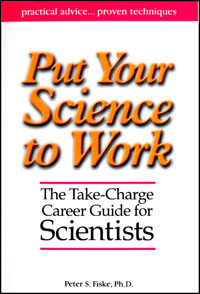
Whether you are a science undergraduate or graduate student, post-doc or senior scientist, you need practical career development advice. Put Your Science to Work: The Take-Charge Career Guide for Scientists can help you explore all your options and develop dynamite strategies for landing the job of your dreams. Completely revised and updated from the best-selling To Boldly Go: A Practical Career Guide for Scientists, this second edition offers expert help from networking to negotiating a job offer. This is the book you need to start moving your career in the right direction.
Sie lesen das E-Book in den Legimi-Apps auf:
Seitenzahl: 309
Veröffentlichungsjahr: 2013
Ähnliche



















Contents
Foreword
Preface
Acknowledgments
1 Beyond the Event Horizon: Science Employment Trends in the New Millennium
What will federal R&D support look like in my future?
Are there important trends in how the U.S. government is investing in science and technology?
Will industrial R&D continue to grow?
I remain seriously interested in a career in academia. Are such careers possible today?
Beyond science, what general job trends should I watch out for?
What about Ph.D. supply?
Summing It All Up: The Scientist of the 21st Century
2 Now the Good News: The World of Opportunity Open to Scientists
In other words, they are seeking people like you.
Revenge of the Nerds
You’re Smarter than You Think!
The Bottom Line
The Curse of the Ph.D.
What can you do to improve the weaknesses of your science training?
Presenting the Best Side to Employers
Some Who Have Made the Change
You Could Be One, Too
3 The Science of Change Let’s get one thing straight: nobody likes change.
Let’s get one thing straight: nobody likes change.
Becoming a Change Master
The Transition Curve
A Final Note
4 The career Planning Process: How Do I Start?
In fact, you are at a significant competitive and professional disadvantage if you treat career planning as simply getting a job; it is much more.
Most importantly, the process of career planning will also help you to become a better scientist.
The Career Planning Process
Career Planning Is Your Friend
What about head hunters, search firms, and placement agencies?
A Note About Career Books, Career Counselors, and Centers
5 Self-Assessment: Making Your Neuroses Work for You!
Enter Self-Assessment
Self-Assessment Tools of the Trade
Formal Self-Assessment Exercises
Lies, Damn Lies, and Career Tests
Informal Self-Assessment Exercises
Work-related values
Self-Assessment Is IMPORTANT: Don’t Skip It!
6 Beyond the Endless Frontier: Exploring the World of Work
How do scientists learn about potential career options and opportunities beyond science? By doing what they do best: research!
Sometimes the greatest opportunities are found furthest away from your present situation.
How Do You Start?
Informational Interviewing
Networking: How Most of the People Around You Got Their Jobs
Exploring for Life
7 Exploring a Career That You Know: Research Science
Not All Science Careers Are Equal
The Life Cycle of a Scientist
Grad School and Beyond
Beyond Graduate School: The Postdoc
Ingredients for a “GOOD” Postdoc
Good Attribute #1
Good Attribute #2
Good Attribute #3
Good Attribute #4
Good Attribute #5
Good Attribute #6
Oh, The Places You’ll Go: Considering Academia, Industry, and Government Labs
How do I choose?
Do I stay or do I go?
8 Focusing on Specific Opportunities
Seeking Your Dream Job
Remember Your Passion
Seeking an Employer of Choice or Fun Place to Work
Sleuthing an Organization
The Final Element: The Potential Job and the Potential Boss
Ingredients for the JOB FROM HELL
How Do You Find Out About Specific Openings?
Specific Job Resources on the Internet
A Cautionary Note About Resume Banks
Get Inside Information: Ask Questions
Getting Experience While Looking for a New Career
9 CVs and Resumes (There IS a Difference)
The main purpose of a CV or a resume is to get you an interview.
OK, so what IS the difference between a CV and a resume?
Your resume is your only bullet: Don’t fire it until you have aimed as precisely as you can!
Basic Parts of a CV
Other Sections
Letters of Reference
What is a good letter of recommendation?
Think Like Your Advisor
The Keys to Superior Letters of Reference
Know Their Mind BEFORE Asking for a Letter!
What if my advisor will NOT write a strong letter?
Teaching and Research Statements
First, Some Definitions
The Three Most Important Rules for Writing Teaching and Research Statements
Teaching and Research Statements, the Final Frontier: Tenure
Cover Letter
Resumes
Basic Parts of a Resume
When to use and not use a summary statement
Unpacking Your Thesis: Using Action Verbs to Describe Your Experience
Preparing the Ideal Scannable Resume
Should I prepare a separate “scannable” resume?
One-Paragraph and One-Page Biographies
Final Pointers, Tips, and Advice
10 Six Resume Case Studies
Case Study Number 1: Janet Tangent
Case Study Number 2: Dr. Sigmund Becker
Case Study Number 3: Dr. William M. S. Dos
Case Study Number 4: Harriet Dean Stanchion
Case Study Number 5: Richard Fineman
Case Study Number 6: Karen Smote
Conclusion
11 Cover Letters: Going from Huh? to Wow!
A good cover letter is like bonus points—pulling your grade up from a B+ to an A.
Structure of the Cover Letter
Issues for the Scientist Applying for a Non-science Job
Cover Letter Writing Tips
Cover Letters: A Before-and-After Example
Conclusion
12 The Interview and Beyond
Be Relaxed, Be Confident
Be Prepared
The Ethology of Job Interviews
Practice Makes Perfect
Techniques for Answering Questions
What Shouldn’t They Ask?
What Should I Ask?
Send a Thank You Note After the Interview
Some Final Advice on Interviewing
The Other Side of the Interview
Negotiating an Offer
Conclusion
13 Perceptions and Realities
Challenging Your Own Stereotypes
You Are More than a Scientist
The Scientist in the “Real World”
References and Resources
Index
Published under the aegis of the AGU Education and Human Resources Committee
Copyright 2001 American Geophysical Union. All rights reserved. No part of this publication may be reproduced in any form or by any means without written permission from the American Geophysical Union.
Library of Congress Cataloging-in-Publication Data
Fiske, Peter S., 1966-Put Your science to work: the take-charge career guide for scientists/Peter S. Fiskep. cm.Rev. ed. of: To Boldly Go. 1996Includes bibliographical references and index.ISBN 0-87590-295-21. Science--Vocational guidance.I. Fiske, Peter S., 1966- To Boldly Go. II. Title.Q147.F58 2000502′.3--dc2100-052578CIP
The transferable skills (page 12) and personal qualities (page 13) lists are modified, with permission, from lists compiled by Stanford Career Planning and Placement Center, Stanford University, California.
American Geophysical Union2000 Florida Avenue, N.W.Washington, DC 20009
Foreword
The training of graduate scientists and engineers is a crucial investment—one that provides great dividends by producing both the knowledge and the personnel that America needs, if we are to remain a leading nation in the twenty-first century.
The job market today presents challenges and opportunities for young scientists. Many new graduates remain concerned about the “traditional” job market in academic research and teaching. Yet, from my viewpoint in Washington, DC, it is clear to me that we also need scientifically educated people in many other places besides universities. The traditional value system in academia has seemed to be: you are not really a scientist unless you are actively doing research. Research has been the litmus test, regardless of its quality.
This attitude is changing today. When I took my first job at Princeton University as an assistant professor in the Department of Chemistry, I unconsciously adopted the attitude of other professors. I thought that my job was to take these bright young undergraduates, decide who could really do science like mine and who couldn’t, and get those young people who were not like me in their interests or abilities out of science and into some other university department.
In order to get our faculty members excited about the true breadth of career opportunities out there for the next generation of scientists, we need to get them to adopt an enlarged view of who is a scientist. We must expand our conventional view of the scientific community and invite all those scientists who have turned journalist, teacher, policy maker, or whatever back to our science departments on our campuses to tell their stories and to act as role models and mentors for students.
We older scientists have an obligation to younger scientists: we must offer you a broader pathway for using your science in productive careers. Our nation needs many more scientifically trained young people. But the scientific community must broaden its view of who is a scientist, and what constitutes a successful career for someone with a strong scientific education.
I hope that this book helps you recognize your strengths, identify your opportunities, and explore your options.
I wish you the best of luck in your future endeavors.
Dr. Bruce AlbertsPresident, National Academy of Sciences
Preface
There is a tendency on the part of faculty to want to clone themselves and, by their attitude, to make students feel that “success” means a career in research at a university or at one of the few large industrial laboratories that are left. This tendency is misguided, for most jobs for our graduates have always been in industry and not in research. One of the reasons society supports us is to train people who will transform the work done at universities into something of more direct benefit to society.
Burton Richter, 1995Past President, American Physical Society
What a Difference 5 Years Makes!
In 1996, when the first edition of this book (To Boldly Go) hit the bookstands, it was a grim time for young scientists. Across all fields of science, newly minted Ph.D.s and Masters students were facing the combined effects of falling employment for young scientists, rising Masters and Ph.D. production, and a glut of job seekers in academia. The crisis was covered in leading newspapers and news magazines and was even featured in the popular cartoon series “Doonesbury.”
Fast-Forward 5 Years.
The landscape of science employment has changed dramatically. Unemployment rates in the United States have fallen to historically low levels and economic growth and low inflation have fueled one of the longest economic expansions in American history. Much of the growth in the “New Economy” has been stimulated by the innovations of scientists and engineers. Some fields in science and technology are so hot that graduate departments are scarcely able to keep their students in their seats. Given today’s booming economy and low unemployment figures, especially in the technology sector, it might be tempting to conclude that the scientist glut of the early 1990s was an aberration, a temporary downturn on an otherwise robust path of growth.
Today, young scientists face a dizzying array of career choices that were barely conceivable 5 years ago. Entire new scientific disciplines have sprung up to address new opportunities in biology, engineering, mathematics, and computer science. Universities are becoming increasingly entrepreneurial, cultivating partnerships with technology companies and building start-up business incubators. Twenty-two-year-old computer science grads are starting their own companies. These would seem to be the best of times for a young, smart person such as yourself.
However, amidst all this innovation and growth, graduate education in the sciences hasn’t changed very much. Despite calls for change from the National Research Council, the U.S. Congress, professional societies, and many individuals, graduate education in the United States still focuses on the preparation of young scholars for careers in academia, a minority employer of today’s Ph.D. scientists and engineers.
Young scientists today are asking a range of questions about career prospects and opportunities that their advisors, department chairs, and universities are unable to answer. This process of exploration is often difficult and frustrating. While in graduate school, students are rarely exposed to career fields outside research science and, at its root, graduate education remains a process of apprenticeship in which students prepare themselves for a life in science. Having completed an advanced degree, many graduates find themselves far from their schools, without access to on-campus career centers and other resources that can provide information and counseling.
To be fair, graduate students and young scientists are as much to blame for our current job predicament as the institutions that trained us. Very few of us objectively surveyed the landscape of the research science career, weighed the relative merits and drawbacks of the lifestyle, or dispassionately asked ourselves if the geometric growth that employed our advisors could continue indefinitely. Most of us went to graduate school because we loved doing science, we were good at it, and at the time it seemed a relatively secure profession. We pitied our college friends who spent their senior years applying for job after job, and we assumed that the hard time we would spend in graduate school would allow us to side-step such unpleasantness. In reality, we simply deferred it for a while.
This Book Is About Creating Options and Recognizing Opportunities
Career planning is a process of professional development that is important for every type of career, including research science. This book is not an exhortation for you to abandon your research career goals. Rather, its goal is to show you that a wealth of opportunities exist for you in many career fields, especially because you have an advanced degree in science. Far from being a liability, a scientific training provides powerful problem-solving tools that are valuable in nearly every type of career. We scientists have much to offer the world beyond scholarly research. Ph.D. and Masters degree holders do encounter perceptions from the scientific community, the “outside world,” and even within themselves that tend to reduce their career options. This book will help you attack those preconceptions and explore your true range of career options.
Exploring alternative careers can be a liberating, empowering, and enjoyable experience. Who knows? Maybe your exploration will confirm your original career goals. No matter what the outcome, you will be better off for the experience both in terms of your own career development and in the advice you may give to your students in the future.
Only you can be in control of your career and nobody cares more than YOU about your future.
Acknowledgments
This second edition would not have been possible without the support, encouragement, ideas and suggestions of many individuals. I am grateful to those who made direct contributions to this edition. I thank all the individuals profiled in Chapter 2 for allowing their interesting stories to be retold, in some cases, for a second time. I am also grateful to the individuals whose true stories and resumes form the basis for the case studies in Chapter 10. I am indebted to my colleague and friend Margaret Newhouse for allowing the use of some of her self-assessment exercises in Chapter 5, and to Stanford University’s Career Planning Center for use of their career planning pyramid. Al Levin guided me through the field of career counseling for the first edition. His guidance resonates through this edition as well. Chris Gales edited an early version of this edition. Finally, I am grateful to my cartoonist, Aaron Louie, for wielding his wit and pen on this project.
I have benefited enormously from the suggestions, ideas, and support of young scientists, activists, administrators, and career counselors around the country. Wendy Yee and Nicole Ruediger, two founding staff members of Science’s Next Wave (www.nextwave.org), gave early support and encouragement for this second edition and have provided me with information and resources along the way. Emily Klotz, Crispin Taylor, and the current staff of Next Wave have continued that support and encouragement. Members of the Association for Science Professionals (ASP), especially Victoria McGovern, Steve Smith, Kevin Aylesworth, Finley Austin, Bob Rich, and Patricia Bresnahan, have fed me stories, statistics and research material that have greatly enriched this edition. Geoff Davis, my friend and partner on the Grad School Survey (http://survey.nagps.org/frontpage.shtml), provided a wealth of material through his web site, Phds.org. Eliene Augenbraun and Kelly Kirkpatrick supplied ground truth and much more.
Many of the changes in this edition have come about from conversations I have had with the students, post-docs, administrators, career counselors, and the parents of young scientists I have met in the course of my lectures around the country. Thank you all for sharing your thoughts and insights.
My heartfelt thanks go to Michael Teitelbaum and the Alfred P. Sloan Foundation for supporting this project through a grant to the Center for Science and the Media, and to Lawrence Livermore National Laboratory for allowing me leave to pursue this endeavor.
Finally, this book would not have the quality, depth, and accuracy it has without the care and editorial precision of Jennifer Giesler. Her tireless efforts to improve and extend career development services at AGU, and her research on the job market, have improved the lives and careers of many young scientists. Her career data for geoscientists can be found at: http://www.agu.org/sci_soc/cpst/employment_survey.html.
Science has a great tradition of unselfish cooperation and community service. In this spirit I hope you, the reader, will share your thoughts, observations, and suggestions about jobs, careers, and this book with me and other readers. AGU has set up a companion web site for this book which will feature additional information and resources. Please visit us at: http://www.agu.org/careerguide
Peter S. Fiske, September 14, [email protected]
Lesen Sie weiter in der vollständigen Ausgabe!
Lesen Sie weiter in der vollständigen Ausgabe!
Lesen Sie weiter in der vollständigen Ausgabe!
Lesen Sie weiter in der vollständigen Ausgabe!
Lesen Sie weiter in der vollständigen Ausgabe!
Lesen Sie weiter in der vollständigen Ausgabe!
Lesen Sie weiter in der vollständigen Ausgabe!
Lesen Sie weiter in der vollständigen Ausgabe!
Lesen Sie weiter in der vollständigen Ausgabe!
Lesen Sie weiter in der vollständigen Ausgabe!
Lesen Sie weiter in der vollständigen Ausgabe!
Lesen Sie weiter in der vollständigen Ausgabe!
Lesen Sie weiter in der vollständigen Ausgabe!
Lesen Sie weiter in der vollständigen Ausgabe!
Lesen Sie weiter in der vollständigen Ausgabe!




