


117,99 €
Mehr erfahren.
- Herausgeber: John Wiley & Sons
- Kategorie: Wissenschaft und neue Technologien
- Sprache: Englisch
Provides the latest QMRA methodologies to determine infection risk cause by either accidental microbial infections or deliberate infections caused by terrorism
• Reviews the latest methodologies to quantify at every step of the microbial exposure pathways, from the first release of a pathogen to the actual human infection
• Provides techniques on how to gather information, on how each microorganism moves through the environment, how to determine their survival rates on various media, and how people are exposed to the microorganism
• Explains how QMRA can be used as a tool to measure the impact of interventions and identify the best policies and practices to protect public health and safety
• Includes new information on genetic methods
• Techniques use to develop risk models for drinking water, groundwater, recreational water, food and pathogens in the indoor environment
Sie lesen das E-Book in den Legimi-Apps auf:
Seitenzahl: 821
Veröffentlichungsjahr: 2014
Ähnliche



















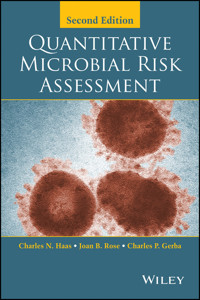
Second Edition
Quantitative Microbial Risk Assessment
Charles N. Haas
Joan B. Rose
Charles P. Gerba
Copyright © 2014 by John Wiley & Sons, Inc. All rights reserved
Published by John Wiley & Sons, Inc., Hoboken, New JerseyPublished simultaneously in Canada
No part of this publication may be reproduced, stored in a retrieval system, or transmitted in any form or by any means, electronic, mechanical, photocopying, recording, scanning, or otherwise, except as permitted under Section 107 or 108 of the 1976 United States Copyright Act, without either the prior written permission of the Publisher, or authorization through payment of the appropriate per-copy fee to the Copyright Clearance Center, Inc., 222 Rosewood Drive, Danvers, MA 01923, (978) 7508400, fax (978) 7504470, or on the web at www.copyright.com. Requests to the Publisher for permission should be addressed to the Permissions Department, John Wiley & Sons, Inc., 111 River Street, Hoboken, NJ 07030, (201) 748-6011, fax (201) 748-6008, or online at http://www.wiley.com/go/permission.
Limit of Liability/Disclaimer of Warranty: While the publisher and author have used their best efforts in preparing this book, they make no representations or warranties with respect to the accuracy or completeness of the contents of this book and specifically disclaim any implied warranties of merchantability or fitness for a particular purpose. No warranty may be created or extended by sales representatives or written sales materials. The advice and strategies contained herein may not be suitable for your situation. You should consult with a professional where appropriate. Neither the publisher nor author shall be liable for any loss of profit or any other commercial damages, including but not limited to special, incidental, consequential, or other damages.
For general information on our other products and services or for technical support, please contact our Customer Care Department within the United States at (800) 7622974, outside the United States at (317) 5723993 or fax (317) 5724002.
Wiley also publishes its books in a variety of electronic formats. Some content that appears in print may not be available in electronic formats. For more information about Wiley products, visit our web site at www.wiley.com.
Library of Congress Cataloging-in-Publication Data:
Haas, Charles N.Quantitative microbial risk assessment / Charles N. Haas, Joan B. Rose, Charles P. Gerba. – Second edition. p. cm Includes bibliographical references and index.
ISBN 978-1-118-14529-6 (cloth : alk. paper)1. Communicable diseases–Epidemiology–Methodology. 2. Health risk assessment. 3. Infection--Mathematical models. 4. Environmental health–Mathematical models. I. Rose, Joan B. II. Gerba, Charles P., 1945- III. Title. RA643.H22 2014 615.9'02–dc23
2014002690
Preface
In the 14 years since we prepared the first edition, there has been an explosion in knowledge of and need for quantitative microbial risk assessment (QMRA). While our motivation for the first edition stemmed from concerns (principally in water) about enteric bacteria, viruses, and protozoa, the motivation has now exploded to new domains and agents. SARS, influenza, biothreat agents, and zoonotic pathogens have all become of greater concern.
The 2001 anthrax letters have highlighted the need for risk assessment of inhaled agents. Both biothreat agents and emergence of new strains of virulent contagious organisms have raised concern for modeling pathogen dynamics in populations.
In this edition, we have retained the fundamental approach of the risk assessment methodology as a central paradigm. We have added new material on modern pathogen analytical methods, predictive microbiology (of pathogen growth and decay), dynamic risk models (explicitly considering incubation time), and disease propagation models in populations. Of necessity we have removed some material—it is no longer possible to present comprehensive tables of microbial dose–response parameters.
In the years since the first edition, the authors have gained experience in teaching this material to generations of students—in the form of formal classes, tutorials, independent studies, and short courses. We know this book can be valuable in instructing advanced students in environmental sciences, environmental engineering, public health, and microbiology. It is also a useful reference for practitioners and regulatory personnel. Some prior statistical background would be useful in approaching the material, but not necessary; the key requirement for any risk assessor is the absence of fear from mathematical constructs and concepts.
The three of us have been on a QMRA journey for almost 30 years. We have learned that doing high-quality risk assessments is of necessity a team sport, requiring individuals with different skills and interests. We have learned a tremendous amount from each other, from our students, from our collaborators, and from the problems that we have sought to approach. Practitioners of the art of quantitative microbial risk assessment should be advised to cast a wide net with respect to colleagues and collaborators to perfect their craft.
We encourage comments and feedback from users of this work, and look forward to observing and participating in developments in coming years, and ultimately to handing the baton off to our students and their students.
Charles N. Haas
Joan B. Rose
Charles P. Gerba
November 2013
Lesen Sie weiter in der vollständigen Ausgabe!
Lesen Sie weiter in der vollständigen Ausgabe!
Lesen Sie weiter in der vollständigen Ausgabe!
Lesen Sie weiter in der vollständigen Ausgabe!
Lesen Sie weiter in der vollständigen Ausgabe!
Lesen Sie weiter in der vollständigen Ausgabe!
Lesen Sie weiter in der vollständigen Ausgabe!
Lesen Sie weiter in der vollständigen Ausgabe!
Lesen Sie weiter in der vollständigen Ausgabe!
Lesen Sie weiter in der vollständigen Ausgabe!
Lesen Sie weiter in der vollständigen Ausgabe!
Lesen Sie weiter in der vollständigen Ausgabe!
Lesen Sie weiter in der vollständigen Ausgabe!
Lesen Sie weiter in der vollständigen Ausgabe!




