


44,99 €
Mehr erfahren.
- Herausgeber: John Wiley & Sons
- Kategorie: Wissenschaft und neue Technologien
- Sprache: Englisch
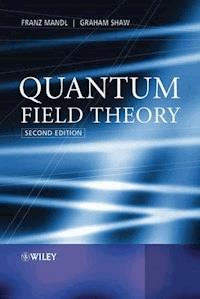
Following on from the successful first (1984) and revised (1993) editions, this extended and revised text is designed as a short and simple introduction to quantum field theory for final year physics students and for postgraduate students beginning research in theoretical and experimental particle physics.
The three main objectives of the book are to:
Explain the basic physics and formalism of quantum field theory
To make the reader proficient in theory calculations using Feynman diagrams
To introduce the reader to gauge theories, which play a central role in elementary particle physics.
Thus, the first ten chapters deal with QED in the canonical formalism, and are little changed from the first edition. A brief introduction to gauge theories (Chapter 11) is then followed by two sections, which may be read independently of each other. They cover QCD and related topics (Chapters 12-15) and the unified electroweak theory (Chapters 16 - 19) respectively. Problems are provided at the end of each chapter.
New to this edition:
Five new chapters, giving an introduction to quantum chromodynamics and the methods used to understand it: in particular, path integrals and the renormalization group.
The treatment of electroweak interactions has been revised and updated to take account of more recent experiments.
Sie lesen das E-Book in den Legimi-Apps auf:
Seitenzahl: 699
Veröffentlichungsjahr: 2013
Ähnliche


















Contents
Preface
Notes
1 Photons and the Electromagnetic Field
1.1 Particles and Fields
1.2 The Electromagnetic Field in the Absence of Charges
1.3 The Electric Dipole Interaction
1.4 The Electromagnetic Field in the Presence of Charges
1.5 Appendix: The Schrödinger, Heisenberg and Interaction Pictures
Problems
2 Lagrangian Field Theory
2.1 Relativistic Notation
2.2 Classical Lagrangian Field Theory
2.3 Quantized Lagrangian Field Theory
2.4 Symmetries and Conservation Laws
Problems
3 The Klein–Gordon Field
3.1 The Real Klein–Gordon Field
3.2 The Complex Klein–Gordon Field
3.3 Covariant Commutation Relations
3.4 The Meson Propagator
Problems
4 The Dirac Field
4.1 The Number Representation for Fermions
4.2 The Dirac Equation
4.3 Second Quantization
4.4 The Fermion Propagator
4.5 The Electromagnetic Interaction and Gauge Invariance
Problems
5 Photons: Covariant Theory
5.1 The Classical Fields
5.2 Covariant Quantization
5.3 The Photon Propagator
Problems
6 The S-Matrix Expansion
6.1 Natural Dimensions and Units
6.2 The S-Matrix Expansion
6.3 Wick’s Theorem
7 Feynman Diagrams and Rules in QED
7.1 Feynman Diagrams in Configuration Space
7.2 Feynman Diagrams in Momentum Space
7.3 Feynman Rules for QED
7.4 Leptons
Problems
8 QED Processes in Lowest Order
8.1 The Cross-Section
8.2 Spin Sums
8.3 Photon Polarization Sums
8.4 Lepton Pair Production in (e+e−) Collisions
8.5 Bhabha Scattering
8.6 Compton Scattering
8.7 Scattering by an External Field
8.8 Bremsstrahlung
8.9 The Infrared Divergence
Problems
9 Radiative Corrections
9.1 The Second-Order Radiative Corrections of QED
9.2 The Photon Self-Energy
9.3 The Electron Self-Energy
9.4 External Line Renormalization
9.5 The Vertex Modification
9.6 Applications
9.7 The Infrared Divergence
9.8 Higher-Order Radiative Corrections
9.9 Renormalizability
Problems
10 Regularization1
10.1 Mathematical Preliminaries
10.2 Cut-Off Regularization: The Electron Mass Shift
10.3 Dimensional Regularization
10.4 Vacuum Polarization
10.5 The Anomalous Magnetic Moment
Problems
11 Gauge Theories
11.1 The Simplest Gauge Theory: QED
11.2 Quantum Chromodynamics
11.3 Alternative Interactions?
11.4 Appendix: Two Gauge Transformation Results
Problems
12 Field Theory Methods
12.1 Green Functions
12.2 Feynman Diagrams and Feynman Rules
12.3 Relation to S-Matrix Elements
12.4 Functionals and Grassmann Fields
12.5 The Generating Functional
Problems
13 Path Integrals
13.1 Functional Integration
13.2 Path Integrals
13.3 Perturbation Theory
13.4 Gauge Independent Quantization?
Problems
14 Quantum Chromodynamics
14.1 Gluon Fields
14.2 Including Quarks
14.3 Perturbation Theory
14.4 Feynman Rules for QCD
14.5 Renormalizability of QCD
Problems
15 Asymptotic Freedom
15.1 Electron–Positron Annihilation
15.2 The Renormalization Scheme
15.3 The Renormalization Group
15.4 The Strong Coupling Constant
15.5 Applications
15.6 Appendix: Some Loop Diagrams in QCD
Problems
16 Weak Interactions
16.1 Introduction
16.2 Leptonic Weak Interactions
16.3 The Free Vector Boson Field
16.4 The Feynman Rules for the IVB Theory
16.5 Decay Rates
16.6 Applications of the IVB Theory
16.7 Neutrino Masses
16.8 Difficulties with the IVB Theory
Problems
17 A Gauge Theory of Weak Interactions
17.1 QED Revisited
17.2 Global Phase Transformations and Conserved Weak Currents
17.3 The Gauge-Invariant Electroweak Interaction
17.4 Properties of the Gauge Bosons
17.5 Lepton and Gauge Boson Masses
18 Spontaneous Symmetry Breaking
18.1 The Goldstone Model
18.2 The Higgs Model
18.3 The Standard Electroweak Theory
19 The Standard Electroweak Theory
19.1 The Lagrangian Density in the Unitary Gauge
19.2 Feynman Rules
19.3 Elastic Neutrino–Electron Scattering
19.4 Electron–Positron Annihilation
19.5 The Higgs Boson
Problems
Appendix A: The Dirac Equation
A.1 The Dirac Equation
A.2 Contraction Identities
A.3 Traces
A.4 Plane Wave Solutions
A.5 Energy Projection Operators
A.6 Helicity and Spin Projection Operators
A.7 Relativistic Properties
A.8 Particular Representations of the γ-Matrices
Problems
Appendix B: Feynman Rules and Formulae for Perturbation Theory
Index
This edition first published 2010 © 2010 John Wiley & Sons, Ltd
Registered office John Wiley & Sons Ltd, The Atrium, Southern Gate, Chichester, West Sussex, PO19 8SQ, United Kingdom
For details of our global editorial offices, for customer services and for information about how to apply for permission to reuse the copyright material in this book please see our website at www.wiley.com.
The right of the author to be identified as the author of this work has been asserted in accordance with the Copyright, Designs and Patents Act 1988.
Reprinted July 2010
Reprinted with corrections September 2011
All rights reserved. No part of this publication may be reproduced, stored in a retrieval system, or transmitted, in any form or by any means, electronic, mechanical, photocopying, recording or otherwise, except as permitted by the UK Copyright, Designs and Patents Act 1988, without the prior permission of the publisher.
Wiley also publishes its books in a variety of electronic formats. Some content that appears in print may not be available in electronic books.
Designations used by companies to distinguish their products are often claimed as trademarks. All brand names and product names used in this book are trade names, service marks, trademarks or registered trademarks of their respective owners. The publisher is not associated with any product or vendor mentioned in this book. This publication is designed to provide accurate and authoritative information in regard to the subject matter covered. It is sold on the understanding that the publisher is not engaged in rendering professional services. If professional advice or other expert assistance is required, the services of a competent professional should be sought.
The publisher and the author make no representations or warranties with respect to the accuracy or completeness of the contents of this work and specifically disclaim all warranties, including without limitation any implied warranties of fitness for a particular purpose. This work is sold with the understanding that the publisher is not engaged in rendering professional services. The advice and strategies contained herein may not be suitable for every situation. In view of ongoing research, equipment modifications, changes in governmental regulations, and the constant flow of information relating to the use of experimental reagents, equipment, and devices, the reader is urged to review and evaluate the information provided in the package insert or instructions for each chemical, piece of equipment, reagent, or device for, among other things, any changes in the instructions or indication of usage and for added warnings and precautions. The fact that an organization or Website is referred to in this work as a citation and/or a potential source of further information does not mean that the author or the publisher endorses the information the organization or Website may provide or recommendations it may make. Further, readers should be aware that Internet Websites listed in this work may have changed or disappeared between when this work was written and when it is read. No warranty may be created or extended by any promotional statements for this work. Neither the publisher nor the author shall be liable for any damages arising herefrom.
Library of Congress Cataloging-in-Publication Data
Mandl, F. (Franz), 1923–2009 Quantum field theory / Franz Mandl, Graham Shaw. — 2nd ed. p. cm. Includes bibliographical references and index. ISBN 978-0-471-49683-0 (cloth : alk. paper) 1. Quantum field theory. I. Shaw, G. (Graham), 1942– II. Title. QC174.45.M32 2010 530.14′3—dc22
2010000255
A catalogue record for this book is available from the British Library.
ISBN 978-0-471-49683-0 (H/B) 978-0-471-49684-7 (P/B)
Preface
Preface to the Second Edition
The first edition of this book aimed to give an easily accessible introduction to QED and the unified theory of electromagnetic and weak interaction. In this edition, we have added five new chapters, giving an introduction to QCD and the methods used to understand it: in particular, path integrals and the renormalization group. At the same time, the treatment of electroweak interactions has been updated to take account of more recent experiments. When the first edition was published in 1984, only a handful of W and Z boson events had been observed and the experimental investigation of high energy electroweak interactions was in its infancy. Now it is a precise science, despite the fact that crucial questions about Higgs bosons and the nature of neutrinos remain unanswered.
The structure of the book is as follows. The first ten chapters deal with QED in the canonical formalism, and are little changed from the first edition. A brief introduction to gauge theories (Chapter 11) is then followed by two sections, which may be read independently of each other. They cover QCD and related topics (Chapters 12–15) and the unified electroweak theory (Chapters 16–19) respectively.
Sadly, my close friend and collaborator, Franz Mandl, passed away on 4th February 2009 after a long illness. He retained his passion for physics, and his active commitment to this project, almost to the end. It was a privilege to work with him, and he remains an inspiration to all who knew him.
November 2009
GRAHAM SHAW
Preface to the First Edition
Our aim in writing this book has been to produce a short introduction to quantum field theory, suitable for beginning research students in theoretical and experimental physics. The main objectives are: (i) to explain the basic physics and formalism of quantum field theory, (ii) to make the reader fully proficient in perturbation theory calculations using Feynman diagrams, and (iii) to introduce the reader to gauge theories which are playing such a central role in elementary particle physics.
The theory has been applied to two areas. The beginning parts of the book deal with quantum electrodynamics (QED) where quantum field theory had its early triumphs. The last four chapters, on weak interactions, introduce non-Abelian gauge groups, spontaneous symmetry breaking and the Higgs mechanism, culminating in the Weinberg-Salam standard electro-weak theory. For reasons of space, we have limited ourselves to purely leptonic processes, but this theory is equally successful when extended to include hadrons. The recent observations of the W± and Z° bosons, with the predicted masses, lend further support to this theory, and there is every hope that it is the fundamental theory of electro-weak interactions.
The introductory nature of this book and the desire to keep it reasonably short have influenced both the level of treatment and the selection of material. We have formulated quantum field theory in terms of non-commuting operators, as this approach should be familiar to the reader from non-relativistic quantum mechanics and it brings out most clearly the physical meaning of the formalism in terms of particle creation and annihilation operators. We have developed the formalism only to the level we require in the applications. These concentrate primarily on calculations in lowest order of perturbation theory. The techniques for obtaining cross-sections, decay rates, and spin and polarization sums have been developed in detail and applied to a variety of processes, many of them of interest in current research on electro-weak interactions. After studying this material, the reader should be able to tackle confidently any process in lowest order.
Our treatment of renormalization and radiative corrections is much less complete. We have explained the general concepts of regularization and renormalization. For QED we have shown in some detail how to calculate the lowest-order radiative corrections, using dimensional regularization as well as the older cut-off techniques. The infra-red divergence and its connection with radiative corrections have similarly been discussed in lowest order only. The scope of this book precludes a serious study of higher order corrections in QED and of the renormalization of the electro-weak theory. For the latter the Feynman path integral formulation of quantum field theory seems almost essential. Regretfully, we were not able to provide a short and simple treatment of this topic.
This book arose out of lectures which both of us have given over many years. We have greatly benefited from discussions with students and colleagues, some of whom have read parts of the manuscript. We would like to thank all of them for their help, and particularly Sandy Donnachie who encouraged us to embark on this collaboration.
January 1984
FRANZ MANDL GRAHAM SHAW
Notes
Acknowledgements
In preparing this new edition, we have again benefited from discussions with many of our colleagues. We are grateful to them all, and especially Jeff Forshaw, who read all the new chapters and made many helpful suggestions. We are also grateful to Brian Martin: Sections 15.1 and 15.3.3 draw heavily on his previous work with one of us (G.S.) and he also generously helped prepare many of the new figures.
Illustrations
Some illustrations in the text have been adapted from diagrams that have been published elsewhere. In a few cases they have been reproduced exactly as previously published. We acknowledge, with thanks, permission from the relevant copyright holders to use such illustrations and this is confirmed in the captions.
Data
Except when otherwise stated, the data quoted in this book, and their sources, are given in “Review of Particle Physics”, Journal of PhysicsG33 (2006) 1 and on the Particle Data Group website http:pdg.lbl.gov, which is regularly updated.
Webpage
This book has its own website:www.hep.manchester.ac.uk/u/graham/qftbook.html. Any misprints or other necessary corrections brought to our attention will be listed on this page. We would also be grateful for any other comments about this book.
1
Photons and the Electromagnetic Field
1.1 Particles and Fields
The concept of photons as the quanta of the electromagnetic field dates back to the beginning of the twentieth century. In order to explain the spectrum of black-body radiation, Planck, in 1900, postulated that the process of emission and absorption of radiation by atoms occurs discontinuously in quanta. Einstein, by 1905, had arrived at a more drastic interpretation. From a statistical analysis of the Planck radiation law and from the energetics of the photoelectric effect, he concluded that it was not merely the atomic mechanism of emission and absorption of radiation which is quantized, but that electromagnetic radiation itself consists of photons. The Compton effect confirmed this interpretation.
The foundations of a systematic quantum theory of fields were laid by Dirac in 1927 in his famous paper on ‘The Quantum Theory of the Emission and Absorption of Radiation’. From the quantization of the electromagnetic field one is naturally led to the quantization of any classical field, the quanta of the field being particles with well-defined properties. The interactions between these particles are brought about by other fields whose quanta are other particles. For example, we can think of the interaction between electrically charged particles, such as electrons and positrons, as being brought about by the electromagnetic field or as due to an exchange of photons. The electrons and positrons themselves can be thought of as the quanta of an electron–positron field. An important reason for quantizing such particle fields is to allow for the possibility that the number of particles changes as, for example, in the creation or annihilation of electron–positron pairs.
These and other processes of course only occur through the interactions of fields. The solution of the equations of the quantized interacting fields is extremely difficult. If the interaction is sufficiently weak, one can employ perturbation theory. This has been outstandingly successful in quantum electrodynamics, where complete agreement exists between theory and experiment to an incredibly high degree of accuracy. Perturbation theory has also very successfully been applied to weak interactions, and to strong interactions at short distances, where they become relatively weak.
The most important modern perturbation-theoretic technique employs Feynman diagrams, which are also extremely useful in many areas other than relativistic quantum field theory. We shall later develop the Feynman diagram technique and apply it to electromagnetic, weak and strong interactions. For this a Lorentz-covariant formulation will be essential.
In this introductory chapter we employ a simpler non-covariant approach, which suffices for many applications and brings out many of the ideas of field quantization. We shall consider the important case of electrodynamics for which a complete classical theory – Maxwell’s – exists. As quantum electrodynamics will be re-derived later, we shall in this chapter, at times, rely on plausibility arguments rather than fully justify all steps.
1.2 The Electromagnetic Field in the Absence of Charges
1.2.1 The classical field
Classical electromagnetic theory is summed up in Maxwell’s equations. In the presence of a charge density ρ(x, t) and a current density j(x, t), the electric and magnetic fields E and B satisfy the equations
(1.1a)
(1.1b)
(1.1c)
(1.1d)
where, as throughout this book, rationalized Gaussian (c.g.s.) units are being used.1
From the second pair of Maxwell’s equations [Eqs. (1.1c) and (1.1d)] follows the existence of scalar and vector potentials ϕ(x, t) and A(x, t), defined by
(1.2)
Eqs. (1.2) do not determine the potentials uniquely, since for an arbitrary function f(x, t) the transformation
(1.3)
leaves the fields E and B unaltered. The transformation (1.3) is known as a gauge transformation of the second kind. Since all observable quantities can be expressed in terms of E and B, it is a fundamental requirement of any theory formulated in terms of potentials that it is gauge-invariant, i.e. that the predictions for observable quantities are invariant under such gauge transformations.
Expressed in terms of the potentials, the second pair of Maxwell’s equations [Eqs. (1.1c) and (1.1d)] are satisfied automatically, while the first pair [Eqs. (1.1a) and (1.1b)] become
(1.4a)
(1.4b)
where
(1.5)
We now go on to consider the case of the free field, i.e. the absence of charges and currents: ρ=0; j=0. We can then choose a gauge for the potentials such that
(1.6)
The condition (1.6) defines the Coulomb or radiation gauge. A vector field with vanishing divergence, i.e. satisfying Eq. (1.6), is called a transverse field, since for a wave
Eq. (1.6) gives
(1.7)
i.e. A is perpendicular to the direction of propagation k of the wave. In the Coulomb gauge, the vector potential is a transverse vector. In this chapter we shall be employing the Coulomb gauge.
(1.8)
The corresponding electric and magnetic fields are, from Eqs. (1.2), given by
(1.9)
and, like A, are transverse fields. The solutions of Eq. (1.8) are the transverse electromagnetic waves in free space. These waves are often called the radiation field. Its energy is given by
(1.10)
With the periodic boundary conditions
(1.11)
the functions
(1.12)
form a complete set of transverse orthonormal vector fields. Here the wave vectors k must be of the form
(1.13)
so that the fields (1.12) satisfy the periodicity conditions (1.11). ε1(k) and ε2(k) are two mutually perpendicular real unit vectors which are also orthogonal to k:
(1.14)
The last of these conditions ensures that the fields (1.12) are transverse, satisfying the Coulomb gauge condition (1.6) and (1.7).2
We can now expand the vector potential A(x, t) as a Fourier series
(1.15)
(1.16)
These are the harmonic oscillator equations of the normal modes of the radiation field. It will prove convenient to take their solutions in the form
(1.17)
Eq. (1.15) for the vector potential, with Eq. (1.17) and its complex conjugate substituted for the amplitudes ar and , represents our final result for the classical theory. We can express the energy of the radiation field, Eq. (1.10), in terms of the amplitudes by substituting Eqs. (1.9) and (1.15) in (1.10) and carrying out the integration over the volume V of the enclosure. In this way one obtains
(1.18)
Note that this is independent of time, as expected in the absence of charges and currents; we could equally have written the time-dependent amplitudes (1.17) instead, since the time dependence of ar and of cancels.
As already stated, we shall quantize the radiation field by quantizing the individual harmonic oscillator modes. As the interpretation of the quantized field theory in terms of photons is intimately connected with the quantum treatment of the harmonic oscillator, we shall summarize the latter.
1.2.2 Harmonic oscillator
The harmonic oscillator Hamiltonian is, in an obvious notation,
These satisfy the commutation relation
(1.19)
and the Hamiltonian expressed in terms of a and a† becomes:
(1.20)
This is essentially the operator
(1.21)
which is positive definite, i.e. for any state |Ψ〉
Hence, N possesses a lowest non-negative eigenvalue
It follows from the eigenvalue equation
and Eq. (1.19) that
(1.22)
i.e. a|α〉 and a†|α〉 are eigenfunctions of N belonging to the eigenvalues (α − 1) and (α + 1), respectively. Since α0 is the lowest eigenvalue we must have
(1.23)
and since
(1.24)
(1.25)
These are also the eigenfunctions of the harmonic oscillator Hamiltonian (1.20) with the energy eigenvalues
(1.26)
The operators a and a† are called lowering and raising operators because of the properties (1.24). We shall see that in the quantized field theory |n〉 represents a state with n quanta. The operator a (changing |n〉 into |n − 1〉) will annihilate a quantum; similarly, a†, will create a quantum.
(1.27)
with the solution
(1.28)
1.2.3 The quantized radiation field
The harmonic oscillator results we have derived can at once be applied to the radiation field. Its Hamiltonian, Eq. (1.18), is a superposition of independent harmonic oscillator Hamiltonians (1.20), one for each mode of the radiation field. [The order of the factors in (1.18) is not significant and can be changed, since the ar and are classical amplitudes.] We therefore introduce commutation relations analogous to Eq. (1.19)
(1.29)
and write the Hamiltonian (1.18) as
(1.30)
The operators
(1.31)
The eigenfunctions of the radiation Hamiltonian (1.30) are products of such states, i.e.
(1.32)
with energy
(1.33)
The interpretation of these equations is a straightforward generalization from one harmonic oscillator to a superposition of independent oscillators, one for each radiation mode (k, r). ar(k) operating on the state (1.32) will reduce the occupation number nr(k) of the mode (k, r) by unity, leaving all other occupation numbers unaltered, i.e. from Eq. (1.24):
(1.34)
(1.35)
which leads to the above interpretation. We shall not consider the more intricate problem of the angular momentum of the photons, but only mention that circular polarization states obtained by forming linear combinations
(1.36)
are more appropriate for this. Remembering that (ε1(k), ε2(k), k) form a right-handed Cartesian coordinate system, we see that these two combinations correspond to angular momentum ±ħ in the direction k (analogous to the properties of the spherical harmonics ), i.e. they represent right- and left-circular polarization: the photon behaves like a particle of spin 1. The third spin component is, of course, missing because of the transverse nature of the photon field.
The state of lowest energy of the radiation field is the vacuum state |0〉, in which all occupation numbers nr(k) are zero. According to Eqs. (1.30) or (1.33), this state has the energy . This is an infinite constant, which is of no physical significance: we can eliminate it altogether by shifting the zero of the energy scale to coincide with the vacuum state |0〉. This corresponds to replacing Eq. (1.30) by
(1.37)
[The ‘extra’ term in Eq. (1.35) for the momentum will similarly be dropped. It actually vanishes in any case due to symmetry in the k summation.]
The representation (1.32) in which states are specified by the occupation numbers nr(k) is called the number representation. It is of great practical importance in calculating transitions (possibly via intermediate states) between initial and final states containing definite numbers of photons with well-defined properties. These ideas are, of course, not restricted to photons, but apply generally to the particles of quantized fields. We shall have to modify the formalism in one respect. We have seen that the photon occupation numbers nr(k) can assume all values 0,1,2, … Thus, photons satisfy Bose–Einstein statistics. They are bosons. So a modification will be required to describe particles obeying Fermi–Dirac statistics (fermions), such as electrons or muons, for which the occupation numbers are restricted to the values 0 and 1.
We have quantized the electromagnetic field by replacing the classical amplitudes ar and in the vector potential (1.15) by operators, so that the vector potential and the electric and magnetic fields become operators. In particular, the vector potential (1.15) becomes, in the Heisenberg picture [cf. Eqs. (1.28) and (1.17)], the time-dependent operator
(1.38a)
with
(1.38b)
(1.38c)
The operator A+ contains only absorption operators, A− only creation operators. A+ and A− are called the positive and negative frequency parts of A.4 The operators for E(x, t) and B(x, t) follow from Eqs. (1.9). There is an important difference between a quantized field theory and non-relativistic quantum mechanics. In the former it is the amplitudes (and hence the fields) which are operators, and the position and time coordinates (x, t) are ordinary numbers, whereas in the latter the position coordinates (but not the time) are operators.
1.3 The Electric Dipole Interaction
In the last section we quantized the radiation field. Since the occupation number operators ar(k) commute with the radiation Hamiltonian (1.37), the occupation numbers nr(k) are constants of the motion for the free field. For anything ‘to happen’ requires interactions with charges and currents so that photons can be absorbed, emitted or scattered.
The complete description of the interaction of a system of charges (for example, an atom or a nucleus) with an electromagnetic field is very complicated. In this section we shall consider the simpler and, in practice, important special case of the interaction occurring via the electric dipole moment of the system of charges. The more complete (but still non-covariant) treatment of Section 1.4 will justify some of the points asserted in this section.
Firstly it is permissible to neglect the interactions with the magnetic field.
Secondly, one may neglect the spatial variation of the electric radiation field, causing the transitions, across the system of charges (e.g. across the atom). Under these conditions the electric field
(1.39)
(1.40)
where the electric dipole moment is defined by
(1.41)
If there are selection rules forbidding a transition in the electric dipole approximation, it might still occur via the magnetic interactions or via parts of the electric interactions which are neglected in the dipole approximation. It may happen that a transition is strictly forbidden, i.e. cannot occur in first-order perturbation theory, even when the exact interaction is used as perturbation instead of HI [Eq. (1.40)]. In such cases, the transition can still occur in higher orders of perturbation theory or, possibly, by some quite different mechanism.7
Let us now consider in some detail the emission and absorption of radiation in electric dipole transitions in atoms. The atom will make a transition from an initial state |A〉 to a final state |B〉 and the occupation number of one photon state will change from nr(k) to nr(k) – 1. The initial and final states of the system will be
(1.42)
where the occupation numbers of the photon states which are not changed in the transition are not shown. The dipole operator (1.41) now becomes:
(1.43)
where the summation is over the atomic electrons and we have introduced the abbreviation x. The transverse electric field ET(0, t) which occurs in the interaction (1.40) is from Eqs. (1.38)
Let us consider radiative emission. The transition matrix element of the interaction (1.40) between the states (1.42) then is given by
(1.44)
where the last line follows from Eq. (1.24).
The transition probability per unit time between initial and final states (1.42) is given by time-dependent perturbation theory as
(1.45)
where EA and EB are the energies of the initial and final atomic states |A〉 and |B〉.8 The delta function ensures conservation of energy in the transition, i.e. the emitted photon’s energy ħωk must satisfy the Bohr frequency condition
(1.46)
The delta function is eliminated in the usual way from Eq. (1.45) by integrating over a narrow group of final photon states. The number of photon states in the interval (k, k+ dk), all in the same polarization state (ε1(k) or ε2(k)), is9
(1.47)
From Eqs. (1.44)–(1.47) we obtain the probability per unit time for an atomic transition |A〉→|B〉 with emission of a photon of wave vector in the range (k, k+ dk) and with polarization vector єr(k):
(1.49)
If we perform the integration with respect to k (= ωk/c) and substitute (1.43) for D, the last expression reduces to
(1.50)
where xBA stands for the matrix element
(1.51)
Eqs. (1.50) and (1.51) represent the basic result about emission of radiation in electric dipole transitions, and we only briefly indicate some consequences.
To sum over the two polarization states for a given k, we note that ε1(k), ε2(k) and form an orthonormal coordinate system. Hence,
where the last line but one defines the angle θ which the complex vector xBA makes with . Hence, from Eq. (1.50)
(1.52)
we obtain
(1.53)
The lifetime τ of an excited atomic state |A〉 is defined as the reciprocal of the total transition probability per unit time to all possible final states |B1〉, |B2〉, …, i.e.
(1.54)
In particular, if the state |A〉 can decay to states with non-zero total angular momentum, Eq. (1.54) must contain a summation over the corresponding magnetic quantum numbers.
The selection rules for electric dipole transitions follow from the matrix element (1.51). For example, since x is a vector, the states |A〉 and |B〉 must have opposite parity, and the total angular momentum quantum number J of the atom and its z-component M must satisfy the selection rules
Finally, we note that very similar results hold for the absorption of radiation in electric dipole transitions. The matrix element
1.4 The Electromagnetic Field in the Presence of Charges
After the special case of the electric dipole interaction, we now want to consider the general interaction of moving charges and an electromagnetic field. As this problem will later be treated in a relativistically covariant way, we shall not give a rigorous complete derivation, but rather stress the physical interpretation. As in the last section, the motion of the charges will again be described non-relativistically. In Section 1.4.1 we shall deal with the Hamiltonian formulation of the classical theory. This will enable us very easily to go over to the quantized theory in Section 1.4.2. In Sections 1.4.3 and 1.4.4 we shall illustrate the application of the theory for radiative transitions and Thomson scattering.
1.4.1 Classical electrodynamics
We would expect the Hamiltonian of a system of moving charges, such as an atom, in an electromagnetic field to consist of three parts: a part referring to matter (i.e. the charges), a part referring to the electromagnetic field and a part describing the interaction between matter and field.
(1.55a)
where HC is the Coulomb interaction
(1.55b)
The electromagnetic field in interaction with charges is described by Maxwell’s equations [Eqs. (1.1)]. We continue to use the Coulomb gauge, , so that the electric field (1.2) decomposes into transverse and longitudinal fields
where
(A longitudinal field is defined by the condition .) The magnetic field is given by .
The total energy of the electromagnetic field
can be written
The last integral can be transformed, using Poisson’s equation . into
(1.56)
Thus the energy associated with the longitudinal field is the energy of the instantaneous electrostatic interaction between the charges. With
Eq. (1.56) reduces to
(1.57)
where, in the last line, we have dropped the infinite self-energy which occurs for point charges. The term HC has already been included in the Hamiltonian Hm, Eqs. (1.55), so we must take as additional energy of the electromagnetic field that of the transverse radiation field
(1.58)
Eqs. (1.55) allow for the instantaneous Coulomb interaction of charges. To allow for the interaction of moving charges with an electromagnetic field, one must replace the matter-Hamiltonian (1.55a) by
(1.59)
(1.60)
where Ei and Bi are the electric and magnetic fields at the instantaneous position of the ith charge.11
We can regroup the terms in Eq. (1.59) as
(1.61)
where HI, the interaction Hamiltonian of matter and field, is given by
(1.62)
In the quantum theory pi, the momentum canonically conjugate to ri, will become the operator . Nevertheless, the replacement of by in the second line of Eq. (1.62) is justified by our gauge condition . Eq. (1.62) represents the general interaction of moving charges in an electromagnetic field (apart from HC). It does not include the interaction of the magnetic moments, such as that due to the spin of the electron, with magnetic fields.
Combining the above results (1.55), (1.58), (1.59) and (1.62), we obtain for the complete Hamiltonian
(1.63)
Just as this Hamiltonian leads to the correct equations of motion (1.60) for charges, so it also leads to the correct field equations (1.4), with , for the potentials.12
1.4.2 Quantum electrodynamics
The quantization of the system described by the Hamiltonian (1.63) is carried out by subjecting the particles’ coordinates ri and canonically conjugate momenta pi to the usual commutation relations (e.g. in the coordinate representation , and quantizing the radiation field, as in Section 1.2.3. The longitudinal electric field El does not provide any additional degrees of freedom, being completely determined via the first Maxwell equation by the charges.
The interaction HI in Eq. (1.63) is usually treated as a perturbation which causes transitions between the states of the non-interacting Hamiltonian
(1.64)
The eigenstates of H0 are again of the form
with |A〉 and |… nr(k)…〉 eigenstates of Hm and Hrad.
Compared with the electric dipole interaction (1.40), the interaction (1.62) differs in that it contains a term quadratic in the vector potential. This results in two-photon processes in first-order perturbation theory (i.e. emission or absorption of two photons or scattering). In addition, the first term in (1.62) contains magnetic interactions and higher-order effects due to the spatial variation of A(x, t), which are absent from the electric dipole interaction (1.40). These aspects are illustrated in the applications to radiative transitions and Thomson scattering which follow.
1.4.3 Radiative transitions in atoms
We consider transitions between two states of an atom with emission or absorption of one photon. This problem was treated in Section 1.3 in the electric dipole approximation, but now we shall use the interaction (1.62).
We shall consider the emission process between the initial and final states (1.42). Using the expansion (1.38) of the vector potential, we obtain the matrix element for this transition [which results from the term linear in A in Eq. (1.62)]
(1.65)
Using this matrix element, one calculates the transition probability per unit time as in Section 1.3. Instead of Eqs. (1.50) and (1.51), one obtains:
(1.66)
These results go over into the electric dipole approximation if in the matrix elements in Eqs. (1.65) and (1.66) we can approximate the exponential functions by unity:
(1.67)
Hence, in the approximation (1.67), Eqs. (1.65) and (1.66) reduce to the electric dipole form, Eqs. (1.44) and (1.50).
If selection rules forbid the transition |A〉 to |B〉 via the electric dipole interaction, it may in general still occur via higher terms in the expansion of the exponentials
With the second term, the expression within the modulus sign in Eq. (1.66) becomes
where α, β (= 1,2, 3) label the Cartesian components of the vectors εr, k, ri and pi. The matrix element can be written as the sum of an antisymmetric and a symmetric second-rank tensor
The first term contains the antisymmetric angular momentum operator and corresponds to the magnetic dipole interaction. (In practice this must be augmented by the spin part.) The symmetric term corresponds to the electric quadrupole interaction. The parity and angular momentum selection rules for the transitions brought about by these matrix elements are easily determined from their forms. We obtain in this way an expansion into electric and magnetic multipoles, i.e. photons of definite parity and angular momentum. As usual, a better procedure for such an expansion, except in the simplest cases, is to use spherical rather than Cartesian coordinates.13
The result (1.66) can again be adapted to the case of absorption of radiation by replacing the factor [nr(k) + 1] by nr(k) and the appropriate re-interpretation of the matrix element, etc.
1.4.4 Thomson scattering
(1.68)
where |k′|=|k|. Dividing this transition probability per unit time by the incident photon flux (c/N), one obtains the corresponding differential cross-section
(1.69)
where the classical electron radius has been introduced by
(1.70)
Similarly
where θ is the angle between the directions k and k′ of the incident and scattered photons, i.e. the angle of scattering. From the last two equations
(1.71)
and hence the unpolarized differential cross-section for scattering through an angle θ is from Eq. (1.69) given as
(1.69a)
Integrating over angles, we obtain the total cross-section for Thomson scattering
(1.72)
1.5 Appendix: The Schrödinger, Heisenberg and Interaction Pictures
These three pictures (abbreviated S.P., H.P. and I.P.) are three different ways of describing the time development of a system. In this Appendix, we shall derive the relationships between the three pictures. Quantities in these three pictures will be distinguished by the labels S, H and I.
In the S.P., the time-dependence is carried by the states according to the Schrödinger equation
(1.73)
where H is the Hamiltonian of the system in the S.P. This can formally be solved in terms of the state of the system at an arbitrary reference time t0
(1.74)
where US(t) is the unitary operator:
(1.75)
By means of US(t) we can carry out a unitary transformation of states and operators (O) from the S.P. to the H.P., in which we define
(1.76)
and
(1.77)
(1.78)
Since the transformation from the S.P. to the H.P. is unitary, it ensures the invariance of matrix elements and commutation relations:
(1.79)
Differentation of Eq. (1.77) gives the Heisenberg equation of motion
(1.80)
For an operator which is time dependent in the S.P. (corresponding to a quantity which classically has an explicit time dependence), Eq. (1.80) is augmented to
(1.81)
We shall not be considering such operators.
The I.P. arises if the Hamiltonian is split into two parts
(1.82)
In quantum field theory, HI will describe the interaction between two fields, themselves described by H0. [Note that the suffix I on HI stands for ‘interaction’. It does not label a picture. Eq. (1.82) holds in any picture.] The I.P. is related to the S.P. by the unitary transformation
(1.83)
i.e.
(1.84)
and
(1.85)
Thus the relation between I.P. and S.P. is similar to that between H.P. and S.P., but with the unitary transformation U0 involving the non-interacting Hamiltonian H0, instead of U involving the total Hamiltonian H. From Eq. (1.85):
(1.86)
Differentiating Eq. (1.85) gives the differential equation of motion of operators in the I.P.:
(1.87)
Substituting Eq. (1.84) into the Schrödinger equation (1.73), one obtains the equation of motion of state vectors in the I.P.
(1.88)
where
(1.89)
Finally, from the above relations, one easily shows that the I.P. and H.P. are related by
(1.90)
(1.91)
where the unitary operator U(t) is defined by
(1.92)
The time development of the I.P. states follows from Eq. (1.91). From this equation
Hence
(1.93)
where the unitary operator U(t1, t2), defined by
(1.94)
satisfies the relations
(1.95a)
(1.95b)
Problems
2 With this choice of εr(k), Eqs. (1.12) represent linearly polarized fields. By taking appropriate complex linear combinations of εt and ε2 one obtains circular or, in general, elliptic polarization.
3 See the appendix to this chapter (Section 1.5) for a concise development of the Schrödinger, Heisenberg and interaction pictures.
5 For a discussion of coherent states see R. Loudon, The Quantum Theory of Light, Clarendon Press, Oxford, 1973, pp. 148–153. See also Problem 1.1.
6 In Eq. (1.39) we have written ET, since we now also have the Coulomb interaction between the charges, which makes a contribution to the electric field. [See Eqs. (1.2) and (1.4a) and Section 1.4.]
7 For selection rules for radiative transitions in atoms, see H. A. Bethe and R. W. Jackiw, Intermediate Quantum Mechanics, 2nd edn, Benjamin, New York, 1968, Chapter 11.
8 Time-dependent perturbation theory is, for example, developed in A. S. Davydov, Quantum Mechanics, 2nd edn, Pergamon, Oxford, 1976, see Section 93 [Eq. (93.7)]; E. Merzbacher, Quantum Mechanics, 2nd edn, John Wiley & Sons, Inc., New York, 1970, see Section 18.8; L. I. Schiff, Quantum Mechanics, 3rd edn, McGraw-Hill, New York, 1968, see Section 35.
9 Since we are using a finite normalization volume V, we should be summing over a group of allowed wave vectors k [see Eq. (1.13)]. For large V(strictly V → ∞)
(1.48)
The normalization volume V must of course drop out of all physically significant quantities such as transition rates etc.
10 See, for example, L. I. Schiff, Quantum Mechanics, 3rd edn, McGraw-Hill, New York, 1968, Chapter 11, or Bethe and Jackiw, referred to earlier in this section, Chapter 10.
11 For the Lagrangian and Hamiltonian formulations of mechanics which are here used see, for example, H. Goldstein, Classical Mechanics, 2nd edn, Addison-Wesley, Reading, Mass., 1980, in particular pp. 21–23 and 346.
12 See W. Heitler, The Quantum Theory of Radiation, 3rd edn, Clarendon Press, Oxford, 1954, pp. 48–50.
13 See A. S. Davydov, Quantum Mechanics, 2nd edn, Pergamon, Oxford, 1976, Sections 81 and 95.
14 See J. J. Sakurai, Advanced Quantum Mechanics, Addison-Wesley, Reading, Mass., 1967, p. 51.




