


Erhalten Sie Zugang zu diesem und mehr als 300000 Büchern ab EUR 5,99 monatlich.
- Herausgeber: Mijnbestseller.nl
- Kategorie: Wissenschaft und neue Technologien
- Sprache: Englisch
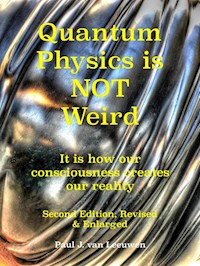
Quantum Physics shows us that we create what we observe. Countless experiments confirm that it is our information which manifests reality. Matter and time are created by our observation. This is not only true when we do experiments in laboratories, but it works the same way in everyday reality. We manifest our own experiences. Science does not prove that our consciousness must be a product of our material brain. On the contrary. Consciousness emerging from the brain is just a belief. This book tells the story how physics did develop from a quest to understand nature into its current highly myopic materialistic paradigm. The profound spiritual message of Quantum Physics is ignored, to our detriment. "A wonderful, very readable book that will convince thousands upon thousands of serious readers, including students of science, why consciousness is necessary to understand quantum physics and why materialist science is not adequate. I give the book my highest recommendation." –– Amit Goswami, PhD, author of The Self-Aware Universe. "A monumental book. A masterpiece in disguise" - Prof Emer dr. Dirk K.F Meijer, University of Groningen.
Sie lesen das E-Book in den Legimi-Apps auf:
Seitenzahl: 632
Veröffentlichungsjahr: 2022
Das E-Book (TTS) können Sie hören im Abo „Legimi Premium” in Legimi-Apps auf:
Ähnliche

















Quantum Physics
is NOT weird
“Paul van Leeuwen’s book Quantum Physics is NOT weird is a wonderful, very readable book that will convince thousands upon thousands of serious readers, including students of science, why consciousness is necessary to understand quantum physics and why materialist science is not adequate. I give the book my highest recommendation. This book will also give the inquisitive reader an introduction to the aborning quantum science of consciousness.”
–– Amit Goswami, PhD, author of The Self-Aware Universe, The Everything Answer Book, and with Valentina Onisor, The Quantum Brain
The monumental book of Paul van Leeuwen on “Quantum Physics is Not Weird”, by title, is a masterpiece in disguise. Of course, Quantum Physics is not easy to digest and even weirder than we sometimes can imagine. Yet, this book should be praised due to its transparent treatment and related educational illustrations, that highly facilitate the mastering of the intriguing contents. Many of the 15 chapters, in a critical manner, treat the historical experiments that supported the very creation of this crucial field in physics, that evidently represents the best theory we currently have for understanding the fabric of reality. The cunning explanations also include the dangers of misinterpretation of such studies, clearly exhibiting the professional insights of the writer. An aspect of reader self-control is integrated by ending each subject with “What did we learn from this Chapter”. The chapters, may here and there, require re-reading and re-thinking, but ultimately will make sense not only to more experienced scientists, but also for students and interested laymen. By all this, the book almost offers a crash-course into proper scientific thinking, and it reminded me of the famous book of Fritjof Capra on “the Tao of Physics” of about 50 years ago, that became a classic in academic education. Conclusion: the book of Paul van Leeuwen is unique through its superb writing and educational strength and is highly recommended for a broad circle of readers. As a result of their rewarding study efforts, they will see the world in an entirely different perspective, since the writer is not afraid to finally touch upon the implications for Near Death Experiences and other Psi phenomena.
–– EM Prof. dr. Dirk K.F Meijer, University of Groningen, The Netherlands
Quantum Physics
is NOT weird
It is how our consciousness creates our reality
Paul J. van Leeuwen
Second English ebook edition – ISBN: 978-94-0365-249-8
Text and coverphoto: Ir. Paul J. van Leeuwen MSc
ISBN: 978-94-6367-560-4 (Paperback – 1st edition – Dutch)
ISBN: 978-94-6342-703-6 (E-book – Dutch)
ISBN: 978-94-6342-719-7 (Paperback – 2nd edition – Dutch)
ISBN: 978-94-6342-719-7 (E-book - English)
ISBN: 978-94-0361-798-5 (paperback – 1st edition – English)
ISBN: 978-94-0365-095-1 (paperback – 2nd edition – English)
Copyright © 2022, Paul J. van Leeuwen
The scanning, uploading, and distribution of this book without permission is a theft of the author’s intellectual property. If you would like permission to use material from the book (other than for review purposes), please contact [email protected]. Thank you for your support of the author’s rights.
All pictures in this book are made by the author or found at Wikimedia Commons, unless otherwise stated. In that case the source – when known – will be mentioned
Preface
This book may present you with a challenge. If you grew up in the Western world where you were told at home, at school, at university and through the media, that the world exists independently of you, indifferent to you being there or not being there. Where you were told that your consciousness is a product of your brain. That life is a matter of the survival of the fittest and that death is the absolute end of every individual. If you are still satisfied with that interpretation of reality, quantum physics could turn out to be a rather uncomfortable branch of science the moment you start to consider its implications. Indeed, a lot of physicists become visibly uneasy when they must explain quantum physics to lay persons, especially when it comes to the interpretation.
This book may take effort. Working through each chapter, you could have the uneasy experience of encountering some utterly strange ideas about the world in which you thought to exist. Uneasy, not so much because quantum physics is a weird tricky mind-bending subject, but mainly because you are asked to temporarily abandon your firm conviction that the universe is always outside somewhere over there, objective, and independent of you. Quantum physics seems to imply that you, yes you, are the creator of your world just by observing it. It contradicts the common western idea of consciousness as a product of the brain. Such a message could give you the feeling of losing the solid ground under your feet. Some little voice in you may insist, 'No, no, that cannot be true'.
Given this uneasy feeling of losing ground, it’s not surprising that the outcome of the quantum physics experiment in Delft in 2015 with entangled electrons caused the media to report in large headlines 'Quantum physics is definitely weird'.
That is why it is natural and expected that you put the book occasionally aside a while to ponder its ideas, or even just to put it out of your mind for a while. Let that happen. Let the book rest for a while on a place where it invites you to be picked up again in due time. Paper, real or virtual, is patient. Those readers who act in such a way, after such a rest, are likely to find the material more digestible on re-reading. Re-reading is a good strategy for this book. I hope you will, upon review of the evidence I will present, become convinced that the world exists thanks to us, not the other way around.
We will start with the dawn of Western science in Greece and man’s idea of his place in the cosmos and of the earth on which he walks. The roots of our western image of the world around us start there.
We will look at the Ptolemaic model of perfectly circular planetary and solar movements around a stationary earth that lasted a good 14 centuries, despite its erroneous and complex model. We will look at the famous foursome Copernicus, Kepler, Galilei, and Newton, that positioned the sun in the middle amidst the planets, in stark opposition to the belief of their contemporaries in the god(s)-driven circular revolutions of the planets.
The birth and first impressive successes of classical physics came about by them. Its fundamental assumption was that everything in the universe consisted of little hard balls of various sizes moving under the influence of a mysterious force called gravity. We follow the growing confidence of scientists in their assumption that classical physics will be able to explain all the phenomena in the universe. Their confidence is severely undercut at the end of the 19th century by the unexpected discovery of the Planck quantum. The subsequent heated discussions about the interpretation of quantum physics continue until this day. We will examine in detail the most intriguing quantum experiments, performed first as thought experiments and later in practice. These experiments confirm the vision of an observer manifested reality of the universe.
I will describe the role of quantum phenomena in living nature that were not recognized before the beginning of the 21st century. I will address the effect that information, when it reaches our minds, has on the world. However, I do not support the idea of a non-material mind influencing physical matter, that would be plain magic. Finally, I shall introduce, based on the above-mentioned quantum physics experiments the hypothesis of a cosmic consciousness. That hypothesis will answer a lot of the mind-bending questions evoked by quantum physics ... and many more.
This book is the product of my personal journey of discovery in the world of quantum physics and the astonishing role of our consciousness in it. It is also a tale of the journey of discovery of mankind in the search for what the universe really is and what we are doing in it. The reader with an open mind will discover that the universe is not the objective, material, and indifferent stage in which man accidentally happened to be caught up. It is an environment that we ourselves continuously create and that invites us in turn to use our greatest possible creativity.
Ir. Paul J. van Leeuwen MSc. The Hague, 2022
Reading guide
Browsing the Internet, I find awkward titles like ‘Quantum mechanics for beginners’, ‘Quantum physics for beginners’ and even ‘Quantum physics for dummies’. Well, I assure you, quantum physics is not a subject for dummies. If you really want to understand the message of the quantum world then you will have to think and ponder long and deep. When you hear or read something like 'A quantum object is at the same time a particle and a wave’ and you don’t feel the slightest urge to tackle that paradox, I doubt you will ever master the real message of quantum physics. I recommend that, when you really want to make the contents of this book part of your intellectual property, read, re-read, and re-read again. Save the parts in every chapter, that do not really seem to land safely on first reading, just for later and read the chapter conclusion. You can always pick up later. Take your time.
Chapters 2 and 3 deal with the beginning and development of classical Newtonian physics until the moment that quantum physics made its ground-breaking entry at the start of the 20th century.
Chapters 4 and 5 are about how the quantum phenomena confronted the physicists with stunning problems and how they tried to deal with that.
Chapter 6 deals with eight of the most common quantum hypotheses and seven important experiments. Each experiment is carefully weighted concerning the significance of its results for the sustainability of those eight key hypotheses.
Chapter 7 deals in rigorous detail with the delayed choice experiments and explains and defends their logical implications for our concept of objective reality.
Chapters 8 to 10 discuss the possible connections between information, entropy and consciousness, the elusiveness of the photon and the character of time.
Chapter 11 is dedicated to that highly interesting new branch of biology, quantum biology, with emphasis on quantum tunneling in living systems.
Chapter 12 speculates about possible models of reality that could explain consciousness and its relationship with our experienced reality.
Chapter 13 deals with some proposals for experiments to falsify the models presented in chapter 12.
Chapter 14 deals with the concept of consilience and why that is an important way of mutual scientific confirmation for the existence of a consciousness being independent of the body.
Chapter 15 Contains a small but challenging collection of blogs from my website.
In the appendices you will find:
At the end you will find the notes and the glossary.
Notes: References to internet content are numbered [1], underlined,blue and in italic, like this: Internet[1]. The numbers correspond to the Notes section. Notes in each Chapter start with number 1. To spare you the copying of the URL’s there manually, go to the Notes page on my website.
Glossary: Newly introduced concepts will be explained in detail. When such a concept is highlighted and dark grey it is to be found in the glossary at the end of this book. You will find there a concise explanation as well as the page number where it was introduced for the first time. This can be of great help when you encounter the concept somewhere else and you would like to refresh your memory.
The most important thing through almost the entire book is to try to understand the workings and the implications of the double-slit experiment.
Quantum Physics in science and in the media
“If quantum mechanics hasn't profoundly shocked you, you haven't understood it yet.”
Niels Bohr, quantum physicist 1885-1962
‘Feynman was fond of saying that all of quantum mechanics can be gleaned from carefully thinking through the implications of the double-slit experiment’.
From ‘The Elegant Universe: Superstrings, Hidden Dimensions, and the Quest for the Ultimate Theory’, by Brian Greene, 1999
At the end of the 19th century, promising students were strongly discouraged from studying physics and were advised to strive for a different career since the practice of physics would from then on only be a matter of determining the next decimals.
However, at the beginning of the 20th century, the understanding of the workings of nature by physics – Newtonian mechanics – became dramatically overturned with publications by Planck, Bohr, Einstein, De Broglie, Schrodinger, Heisenberg, and many others. Quantum physics was born, shaped, and applied, but poorly understood. The bewildering impression taking shape was that the act of measurement materializes the measured particles. Because of that, Schrödinger formulated his 'simultaneously dead and living cat in a closed box' paradox.
The following quote from the famous physicist and Nobel Prize winner Richard Feynman is often repeated: "If you think you understand quantum mechanics, you don't understand quantum mechanics." Pretty discouraging for someone who really wants to understand quantum physics. Meanwhile, the technical applications of quantum physics – the transistor, the laser, the LED, the computer, the Internet, quantum cryptography, quantum biology, superconductivity, MRI scanners, etc. – have become indispensable for us and can no longer be ignored. In 2015, the media, the daily papers, the science magazines, and the Internet, wrote excitedly with capitals about an experiment carried out by Delft University of Technology researchers that allegedly proved Einstein definitively wrong. The experiment was performed using pairs of entangled electrons with an intermediate distance of 1.3 kilometers and it proved that there had to exist an interaction between them requiring faster-than-light communication. Quantum physics was definitely weird.
In the present time many academically educated people are still living in a mainly Newtonian universe, where everything is objective and must obey immutable laws. This Newtonian image is, now already since more than 100 years, proven as false. It is my deeply felt opinion that a true understanding of the reality where we experience our existence is of enormous importance for the way we deal with ourselves and our environment. What I’m going to tell here could seriously undermine your idea of an objective reality outside and independent of us, by turning it inside out. Hold on and watch your properties.
The Newtonian model of the world is an excellent and extremely powerful tool. I do not mean to diminish that. However, when it is the only tool that we allow ourselves in our search for understanding the universe, it will become a confusing stumbling block. If you choose a hammer as your only tool, everything you encounter will start to look like a nail. In a lot of articles and books popularizing physics by ‘hammering’ physicists and other physics writers it seems obvious that Newton’s objective material reality is still unrefuted in their way of thinking, and often precisely when it concerns quantum physics. This leads to literally incomprehensible statements, like particles being simultaneously waves and traveling physically every possible path. Trying to preserve Newtonian materialism as the only allowed description of the real world ensures misinterpretation and clouds our minds in quantum confusion. Especially when the mind of the observer enters the stage.
In my opinion, you don’t really need mathematics to understand the meaning of quantum physics. Any formula that you will encounter in this book can be skipped without any consequences for your understanding. Being able to do mathematic calculations is not the same as understanding physical processes. However, do not skip the double-slit experiments that will be discussed.
Understanding the workings and the meaning of the double-slit is an essential part of the argumentation in this book. For that task I recommend the full dedication of your imaginative quantum coherent grey cells and also some perseverance.
To show you the eyebrow raising confusion concerning quantum physics, I present on the next page a small anthology of interesting quotes on quantum physics I encountered in different media:
The aim of this book is that the reader should ultimately be able to judge, understand and value messages and statements like above on its own. At the end, we will investigate whether we can arrive at an explanatory model of nature in which all basic quantum phenomena are given a suitable place. The aim is that we can understand it without having to suffer inexplicable paradoxes. To achieve that lofty goal, we shouldn’t be scared off by paradoxes we will meet on the way. Instead, I aim to use these as the important road marks and signposts on the path to understanding reality.
When you have finished this book, I advise you refresh your opinion on the above quotes.
In this book I will approach quantum physics in the way I learned at the university, the scientific way: hypothesis, observations, predictions, and experiments. From this should rise an explanation of the quantum world, as simple, acceptable, and satisfying as possible.
1: Paradoxes – ‘I know how it works’
“The opposite of a fact is falsehood, but the opposite of one profound truth may very well be another profound truth.”
Niels Bohr, quantum physicist 1885-1962
What are paradoxes? Paradoxes are apparent contradictions with the emphasis on ‘apparent’. My approach in this book will be that every paradox we encounter is telling us that at least one of our basic assumptions is wrong. Thus, if we encounter a paradox, we are essentially invited to investigate where and how we went wrong. Such an investigation could uncover astounding new views on reality, views we deemed impossible. We just assumed that we knew 'how it is’. Fortunately, quantum physics abounds with interesting paradoxes and counter-intuitive statements such as:
‘Each physical object is simultaneously both a wave and a particle or a composite of elementary particles.’
‘
A particle – or a composite of particles – can exist simultaneously in several places – almost everywhere and every time
’. Statements like this are often expressed in articles describing new quantum physics experiments and in popular science books on quantum physics.
‘
Two or more physical objects with a shared history remain connected, even when they are on opposite sides of the galaxy’
. How does this relate to the fundamental statement of the theory of relativity that nothing – including information – can travel faster than the speed of light?
‘According to the interpretation of the Copenhagen school of quantum physicists, Bohr and Heisenberg, an object only exists in a physical sense when measured’. Where was the object prior to the measurement? What is the definition of a measurement? How does a measurement accomplish this feat?
The Ames room, how our brain deceives us
Knowing already 'how things work' can be an obstacle to perceiving things as they are. Let’s experience the Ames Room illusion.
The image below shows how we are visually deceived by the ‘Ames Room'. Such a room has its dimensions adjusted to such an extent that – from a certain point of view – the objects and people in it seem to be too big or too small. We are being tripped up visually.
Figure 1.1: Ames room.
Source: siz.io
We ‘know’ what a room is. The concept of a room as a rectangular box seems to be a hardwired concept in our brains. So, if people tinker with this box form, they can play tricks on your visual system. Our brain keeps stubbornly telling us 'how it works’, even in spite of better information. Your visual neural network persists in telling you that the woman in figure 1.1 is a dwarf and that the man is a giant. Such an illusion is a visual paradox. On the Internet[1] you can find a lot of examples where your visual cortex is leading you astray.
Now imagine some stubborn person Mr. S who does not want to accept the distorted dimensions of the Ames room. What he sees, he says, is real. This Mr. S then will need a satisfactory explanation for his observation of objects changing their apparent sizes when moving through the room. He might for example, come up with an ‘Ames’ form field hypothesis. A hypothesis which assumes a certain kind of field that, depending on the position of objects in that field, enlarges or reduces its dimensions. This Ames field hypothesis can be formulated easily in such a way that it is predictive despite its wrongness.
Figure 1.2: Ames Room.
Source: commons.wikimedia.org
Assume the Ames form field hypothesis being set up so that depending on the location of objects in the Ames room those objects grow or shrink physically. The stubborn rectangular box room believer, Mr. S, will now be able to predict correctly what will happen to the ball when it is thrown at the person in the – in reality far-away – corner. The ball will shrink physically.
Incidentally, S should also be able to explain with his theory why the two people throwing the ball to each other do seem not to look entirely straight at each other. If you had not noticed this yet, watch this Ames Room animation[2] carefully.
In the following chapter we will see what the "Ames Room" and the Ptolemaic world view with our earth in the centre have in common and how they both should warn us about scientific hypotheses that misrepresent reality, while seeming right because of their apparent success. The Ames Room will prove to be an apt metaphor to help us to rethink the many current interpretations of the quantum phenomena so that we can free ourselves from the physics ‘rectangular-box-room’ view when we start a journey of discovery for a valid and meaningful interpretation of quantum physics. We are going to think ‘out of the box’.
2: The discovery of the solar system
“The shape of the heaven is of necessity spherical; for that is the shape most appropriate to its substance and also by nature primary.”
Aristotle, Greek philosopher, 384 BC. – 322 BC.
As a child, you get to know the physical world as stable, solid, and trustworthy. You don’t notice that the earth is a sphere with a radius of almost 6,400 km (4000 mi) doing a complete rotation every day which means that you are spinning with a speed of about 1650 km/h (1025 mph) at the equator and at a somewhat lower speed of 1040 km/h (646 mph) at a latitude of 51 degrees in – say – Amsterdam. You also don’t notice that the earth also revolves around the sun at a speed of about 30 km/s (18 mi/s). These speeds are completely contrary to what you experience standing on the ground, which appears to you to be completely at rest. They are also in contradiction with the experience that tomorrow and the day after tomorrow your home will still be located where it always was. The earth’s gravity which ensures that your feet stay firmly on the ground is so normal and ubiquitous that you probably never realize that you might have a different weight elsewhere. This must have been the experience of ancient man. The earth under his feet at rest and the sun, the moon and the stars reliably revolving through their fixed orbits every day. Even having been educated about our solar system we still say, although knowing better, that the sun rises and sets.
For the ancient farmer, and his clients, it was important for a good harvest to know when to sow and to be able to predict the run of the seasons. The position of the sun, the moon and the stars provided a reliable clock, but before this heavenly clock was usable for predicting it had to be brought into a model fit for arithmetic forecasting. Seafaring man had to be able to navigate by the fixed stars. This is the way the study of the objects in our night sky, astronomy, must have begun. This study of the sky led to the observation that there were stars that had no fixed place in the night sky. They moved with respect to the fixed stars and sometimes they even went back in their own trajectory. Planets or wandering stars they were called, derived from the Greek word planastai: to wander around. Because of their deviant behavior a special meaning became assigned to those wandering stars.
To get an idea of how quantum theory originated and why it is so contrary to how we think our world functions, it will be a good idea to investigate first how our current western image of the universe originated. That western image has a history of at least 24 centuries, so no wonder it has become so naturally self-evident to us. But the question is, is this image correct?
The geocentric Ptolemaic model
Aristotle (384 BC – 322 BC) created one of the first known geocentric models of our universe of the western world. The Greek philosopher conceived a cosmos with the imperfect earth at the centre, surrounded by perfect celestial bodies, each one attached to its own perfectly circular revolving transparent sphere. The stars had their home on the most outermost and in approximately 24 hours revolving sphere.
Figure 2.1: Aristotle’s Universe.
Source: Wikimedia Commons.
Down here on imperfect earth all movements were also imperfect, which means they were rectilinear as opposed to the perfect circular movements in the heavens. A cast stone was supposed to travel in a straight line to right above the location where it would fall and then, upon arriving there, supposed to fall straight down. That a keen observation would show otherwise was no problem apparently, people clearly observed what they thought they should see. Phenomena, of which they 'were sure' that could not happen, were not observed. This is a very common human psychological trait. Aristotle’s geocentric model of the cosmos was unsatisfactory, it could not explain the seemingly backwards (retrograde) movement of the planets in their paths through the heavens.
As an echo of things to come, Aristotle also coined the word "hylomorphism", a concept which says that every individual experienced thing is a combination of substance, matter, and form. Form has no material cause but originates from potential. Change and manifestation is caused by the transition from potential to action. With this idea Aristotle seemed already to be on track toward quantum physics, as we shall see.
Hipparchus (about 190 BC – 120 BC) improved on the Aristotelian model by means of epicycles. According to Hipparchus each planet moved in a circular orbit – the epicycle – around a fixed point on its appointed revolving sphere, the deferent. These epicycles explained the erratic retrograde movement. Hipparchus also calculated the distance from the earth to the moon and even to the sun. His achievement was not very far from the mark.
For an idea of the functioning of an epicycle, see figure 2.2. The big circle is the deferent representing the revolving sphere. The arrow indicates the direction of the main revolving movement of the deferent. The small circle in the middle represents the earth. The lesser circle with its centre, a dot, positioned on the deferent is the epicycle. The planet revolves along the epicycle in the direction of the arrow while the centre of the epicycle revolves along the deferent.
Imagine a children's bike wheel with its axis attached to the rim of a normal bicycle wheel. Try then to imagine how the valve of the smaller wheel will move if you set both wheels moving. The valve of the small wheel represents the planet, and the axis of the larger wheel represents the earth. So, if the planet moves from position 2 to 3, it will be, as observed from the earth, seem to be moving backwards. Like sitting in a fairground teacup carousel[1] with sets of three or four teacup gondolas revolving around a centre that in its turn is also revolving around the centre of the carousel. Standing in the middle of the carousel you will see people in the teacup gondolas moving backwards at times. The geocentric cosmos with its epicycles can be seen as a very large carousel with planets as teacup gondolas.
Figure 2.2: Planet movement in epicycles, small circles, around the deferent, the centre of the bigger circle is the earth.
Source: Wikimedia Commons. Author: M.L. Watts.
Claudius Ptolemy (87 AD – 150 AD) improved further on the epicycles of Hipparchus by placing the earth a little bit off-center as regards to the deferents. He created in fact the simulation of an ellipse. Thus optimized, the complex Ptolemaic model had reached a forecasting accuracy which was correct within a few percent. This amazing accuracy could be the reason that, despite its complex calculations, this – from our current viewpoint – ostensibly wrong planetary model, lasted from its introduction until its abolition for almost fourteen centuries. Which is understandable when you consider that predictability of the world is a much-valued feature.
For a visual demonstration, you may enjoy the Ptolemaic System Simulator[2].
The heliocentric model of Copernicus, Galilei and Kepler
Nicolaus Copernicus (1473 – 1543) had several well-founded objections to the Ptolemaic model. Among objections concerning its complexity, he pointed to the enormous centripetal force that would be needed to keep the 24-hour spinning fixed star sphere together. These concerns led him to devise a heliocentric model with perfectly circular planet trajectories around the central sun with the sun however positioned just a little bit off-center. Gravity as a universal principle was still unthought of at that time. The nature of the force that constrained the planets to their orbits and what powers pushed them along on their trajectories were unknown to him. He imagined angelic beings charged with these heavenly tasks.
In 1543, shortly before his death, Copernicus published his life work – “De Revolutionibus Orbium Coelestium”[3]. Dying shortly after publication was a wise action seen in the light of the views of his bread and butter, the church, and because of the wrath of the Inquisition. Remarkable is its foreword, written by the Lutheran theologian Andreas Osiander. Osiander wrote that this new hypothesis should be considered as just a less complex mathematical method to calculate the planetary positions – when compared to Ptolemaic calculations – but that it should not be considered as representing reality. This is rather reminiscent of the situation in which quantum physics is still held at the present day. Quantum mechanics makes extremely accurate predictions, but most physicists prefer to ignore its actual meaning: 'Shut up and calculate'. The message was anyway that established science, and especially the church, could still avoid the real message of Copernicus and keep their own beliefs intact.
Incidentally, his heliocentric model had quite a few serious shortcomings. Its predictive accuracy was even inferior to that of the Ptolemaic geocentric model. In addition, one was not relieved of those unwieldy epicycles. In fact, eight extra epicycles had to be added by the religious canon Copernicus, because he couldn’t say goodbye to the divine perfectly circular motions in the heavens.
Copernicus is nowadays an exuberantly honored person in Poland, considering the post stamps, taxi companies, T-shirts, and cafeterias, all bearing his name. You cannot avoid it when visiting Torún, his hometown, or Olsztyn, the town where he worked as canon. A salient detail is, that in the days of the German-speaking and Latin-writing Copernicus, Poland did not even exist as a nation.
Figure 2.3: Dialogo di Galileo Galilei Lincio
The Italian scholar and skilled experimenter Galileo Galilei (1564-1642) bought a Dutch spyglass on the market and improved it considerably. A spyglass presenting an upright image is called a 'Dutch spyglass’. This type of spyglass was invented simultaneously in 1609 by two lens grinders and polishers, Sacharias Jansen and Hans Lipperhey, both citizens of the Dutch city of Middelburg. Lipperhey was the first one applying for a patent for his invention ‘voor de buyse waarmede men verre kan sien’(‘a tube for seeing things far away as if they were nearby’). Lipperhey’s request for a patent was rejected however, because ‘just everyone should be able to fix two pieces of glass behind each other'. Contrary to its intended use, the early detection of ships at sea, Galileo pointed it straight up to the night sky and discovered four moons circling around Jupiter.
Based on his observation of the moons of Jupiter and of the moonlike phases of Venus, Galileo concluded that it was the sun that should be at the centre of the solar system and that Copernicus had it right. He published his "Dialogo" in 1632 for which he had managed to obtain the church's imprimatur by stating in the preface, just like Osiander in Copernicus publication, that its message was purely hypothetical. The book contains four dialogues conducted between three persons of which one, Simplicio, is the dumb fool. He argues for the earth in the centre.
Simplicio’s arguments were easily recognizable as the same arguments that the then pope Urban VIII expressed. Although the pope was, until then, on friendly terms with Galilei, both being from the same region in Italy, and had protected Galilei thus far against the alarming attention of the Inquisition, the pope in his indignation then unleashed the Inquisition on Galilei. To protect his life and limbs Galilei had to withdraw his hypothesis publicly. He thus kept his life but was under house arrest for the rest of his life. In 1992, only after 450 years, the church of Rome offered her apologies. The Vatican even considered placing a bust of Galilei in its gardens, but to date this has not been realized.
Galilei was well acquainted with the publication of Johannes Kepler (1571-1630) – "Astronomia Nova" – which appeared in 1609. Kepler had studied the observations of the Danish astronomer Tycho Brahe intensively, which were the most accurate registered measurements given the technology of the time. Kepler discovered, by his study of Tycho’s tables, that the orbits of the planets were not God's perfect circles, but that they were elliptical. He discovered also that the planets did not move at uniform velocities along their trajectories. Which is now Kepler’s first law.
Kepler’s second law, the law of equal areas, is the best known by far. See figure 2.4. When a planet moves from A to B, in the same time span as from C to D, the grey marked areas in figure 2.4 are of equal size.
Figure 2.4: Kepler’s second law.
Kepler’s third law is also called the harmonic law[4]. The square of the orbital time of a planet is proportional to the third power of average distance from the sun.
Kepler found a mathematical equation, now called the Kepler’s equation[5], with which the deviation of a fictitious circular trajectory of the planet in its orbit around the sun can be calculated.
Kepler’s three laws[6] together with his equation formed the basis for Isaac Newton's law of gravitation in 1687.
The publications of Copernicus, Kepler and Galilei marked the end of an era of more than 1400 years during which the geocentric Ptolemaic model had been supreme. Until that moment, almost every respected scholar had committed himself to the Ptolemaic model, at least publicly. These conservative scholars, stubbornly holding on to their trusted old views, even refused to look through Galilei's telescope because they knew 'how the world was' and called it an instrument inspired by the devil that only showed you hallucinatory misleading images. This is cognitive dissonance, a common human behavior, avoiding world view disturbing facts. Proclaiming in those days that the earth was not at the centre of the cosmos was at the very least a bad career choice and could even be risky for your neck.
Sir Isaac Newton (1643 – 1727)
In the first two thirds of the twentieth century the physics taught in high school, and for an important part of that century also at universities, was still 100% Newtonian physics, also known as Newtonian mechanics. This foundation of Newton mechanics on which physics education nowadays is still resting for a large part is a great and rightful compliment to its original creator, Sir Isaac Newton[7].
In favorable contrast with Galileo, Newton did not live under the oppressing shadow of the Catholic church when compared to the unlucky Inquisition hounded Italian scholar. His was a country that had founded, by a king’s whim, its own independent Christian church in 1534. In that respect he had little to fear from the Inquisition, on the European continent still a fear instigating institution. So, he had few godly qualms when putting the sun in the centre of the planets bound in their elliptical trajectories by indifferent gravity instead of by caring angels. Incidentally, Newton was a very godly man, however entertaining very private ideas concerning biblical correctness and its Roman Catholic dogmatic interpretations.
In the field of mathematics Newton developed, among other things, the differential calculus, and the integral calculus (simultaneously with and independently of Leibniz), the binomial theorem and various approximation methods.
In his most important and influential publication in 1687 ‘Philosophiae Naturalis Principia Mathematica’ [8] Newton explained, among other things, his law of gravity and the three laws of mechanics, with which he created the foundation of classical mechanics.
In 1704 Newton published Opticks[9], considered as a standard work in optics. He invented the Newtonian mirror telescope to overcome the chromatic aberration problems of glass lenses, and developed a theory about the colors of light, based on the way a prism separates white light into a visible spectrum of colors. He also studied the speed of sound, thermodynamics, and hydrodynamics.
According to a 2005 poll, members of the British Royal Society then regarded Newton as the greatest scientist in the entire history of science. Unlike Albert Einstein, Newton was not only a theoretician but also a brilliant experimenter.
The driving reason for the enormous success of Newton's theories and formulas was its predictive power. The day when a comet, which we know now as Halley’s comet, would reappear in the heavens was accurately predicted by Edmond Halley in 1705 by applying Newton’s gravity theory. Halley didn’t live to see his prediction verified. It was 16 years after his death that – right on schedule, in 1758 – the comet did return. With this success, Newton’s name and fame was carved in stone for the coming centuries.
Newton’s laws of motion can be summarized as:
Newton’s law of universal gravitation:
According to Newton, everything in our universe was composed of tiny, hard, indestructible particles, called point masses, which could be assembled in an unlimited number of different ways to shape thus all the material forms we encounter in the world. That idea possibly sheds light on his preference for alchemy experiments. According to Newton, light also consisted of tiny hard particles, corpuscles. His corpuscle view of light would be reconfirmed, in a certain way, by quantum physics in de 20th century.
Important assumptions of Newton about space, time and matter are:
The space in which the universe "takes place" is absolute. Everything in the universe moves relative to that fixed absolute “stage”.
Time is absolute and objective. Clocks will run at the same speed everywhere in the universe in every situation.
Space and time are both continuous. This means, they cannot be divided into their smallest parts.
Everything exists independent from the observer and is therefore an objective fact.
Everything in the universe – including light – is composed of utterly small particles.
According to current insights Newton has turned out to be wrong in all these assumptions. This does not diminish in the least his undeniably important contributions to science. With his theory of gravity and his laws of motion, Newton was able to explain why, among other things, the moon did not fall on the earth, how low and high tide came about, and why heavy and light objects fell equally fast in a vacuum. Newton, incidentally, had no real idea what caused gravity and found it extremely unsatisfactory that he had to assume a force that applied at a distance ('Hypotheses non fingo' – I do not make up any hypothesis).
Newton thus created a mathematical model of our environment with immense predictive power. Its enormous success has led us to equate reality with its mathematical model. The accurate predictive power of Newton's theories affected the thinking of all scientists coming after him in a very deep way. It still affects current thinking. Yet, already in the time of the ancient Greeks, there had been philosophers pointing to serious problems with this vision of reality.
Zeno of Elea (ca. 490 BC) and his paradoxes
The assumption by Newton that space and time are continuous is in direct contradiction with the insights of Parmenides and Zeno of Elea. They expressed their ideas by formulating paradoxes that are not as easy to disprove as results of incorrect reasoning, as one might think.
Parmenides was Zeno’s teacher. To support the message of his teacher about the impossibility of diversity and change, Zeno produced several paradoxes that are still known today. With his paradox about the impossibility of movement, Zeno disputed in fact the idea that space is continuous and that each distance can be divided unlimitedly into smaller and smaller parts.
His most cited paradox is his idea of the arrow that will never reach its target because it must travel an infinite number of distances of its trajectory. After the arrow has traveled the first half, it must travel the first half of the remaining distance. After that it must travel again the first half of the remaining distance. This halving of distances is repeated ad infinitum and the arrow will never reach the target because it has to travel an infinite number of distances. There exists even an interesting quantum effect that is named after Zeno and his paradox, to be discussed later.
The mathematical "proof" of the logical error in Zeno's paradox is a good example of how we allow our concept of reality to be dictated by mathematical models. Anyhow, Zeno’s paradox appears not so easy to be reasoned away and keeps popping up its mocking face.
Zeno did not mean to say that the arrow won’t reach its target in our experience. His paradox was meant to support his message that reality must be an illusion. This idea seems perhaps far-fetched, but it will turn out that it offers an excellent road sign, pointing at how to understand and solve the difficult interpretation problems that quantum physics presents to us.
In this connection, Democritus, a contemporary of Zeno, should also be mentioned. Democritus was a Greek philosopher who proclaimed the hypothesis that all matter consisted of very small indivisible particles, called atoms. The underlying idea was related to that of Zeno and Parmenides, namely that infinity is not a characteristic of nature. You cannot, therefore, keep splitting a piece of matter endlessly. This splitting will always come to an end. Democritus is therefore viewed as the father of the idea of the atom. Incidentally, Zeno in his turn did not wholly agree with the ideas of Democritus.
Pierre-Simon Laplace (1749-1827)
The influence of Newton's theory on philosophy and theology was enormous. With the right mathematical instruments everything seemed computable, and God could be sidelined in his creation regarding his direct intervention. And, of course, with God everything that had to do with church and religion. Some people who did not like the position and the demands of the church preferred that idea, as did Pierre-Simon Laplace, a French mathematician and astronomer. He is the one who replaced the geometry-based classical mechanics with analytical methods which facilitated mechanics calculations considerably.
Laplace is famous for his hypothetical demon[11] who knows exactly the starting positions, masses and speeds of all objects in the entire universe and is able to use this knowledge to calculate the course of all events in the universe. The demon is of course hypothetical.
The demon does not have to exist to confirm Laplace’s conclusion: all matter – including past and future – has ultimately fixed knowable properties and will therefore obey Newton mechanics for 100%. The universe becomes a gigantic machine, a clockwork where coincidence is vanished. According to Laplace, coincidence, as we experience it, therefore only exists for humans because they do not have sufficient information and computing power to calculate everything in advance.
His idea turned coincidence and man’s free will into an illusion. People, animals, and plants became nothing more than very complex machines. Which is an idea that is still strongly expressed by many in the current scientific community. Fortunately, our legal system is still based on free will, meaning that we basically assume that the offender did have a choice. The judge will not easily honor your lawyer pleading that weaving errors in your DNA caused you to take a grab out of the supermarket till. It is however striking that when something goes wrong in a company's administration, for example, when you receive a payment reminder concerning your own obituary, the computer will often get the blame. In that case we apparently grant it some free will.
Light as little hard balls or as waves
Newton also studied the nature of light. After experiments with refraction of light by prisms, he correctly concluded that white light was a composition of colored light. Colored light could not be split further by prisms. He concluded that light, like all other matter in the universe, consisted of utterly tiny hard colored balls, corpuscles. That corpuscle idea explained the observation that light traveled in straight lines. It also explained the reflection of light in mirrors quite well by the collision laws of his own mechanics. However, not with refraction. How was it possible that those corpuscles did travel so easily through a solid medium like glass? In addition, a French scientist demonstrated experimentally that these corpuscles should travel even faster in a solid medium than in a vacuum.
Newton, however, had an illustrious contemporary, the Dutch scientist Christiaan Huygens[12] (1629-1695), who contested those light corpuscles and Newton’s idea of absolute movement. In "Traité de la lumière" [13], published in 1678, Huygens put forward that light should be considered as a wave phenomenon. Huygens also convincingly demonstrated that space and all movement within it were only relative, an idea that Einstein later applied in his special theory of relativity. Nevertheless, Newton's scientific fame and status ensured that his corpuscle model and his absolute space both went uncontested in scientific circles throughout the next two hundred and fifty years.
How did Huygens arrive at his idea about waves? He observed how light behaved in birefringent crystals. In these crystals, for instance calcite, an incident light beam will be split into two beams that each follow a different direction. To explain this effect, Huygens assumed that light was a wave phenomenon in which the wave oscillated perpendicular to the direction of the light beam.
When that oscillation is only in one direction, the light is called polarized. Sunlight is not polarized and therefore oscillates in all directions perpendicular to the light beam. So, polarization[14] is the direction in which a light wave oscillates. Polarization is not limited to light waves. You could say that a surface wave, as on water, is vertically polarized because the water particles are mainly oscillating in the vertical direction. In birefringent crystals, the propagation speed of the light wave depends on the angle the polarization direction makes with the orientation of the crystal lattice. This is because the properties of a birefringent crystal lattice are different when viewed from different angles. This phenomenon is called anisotropy. The two emerging bundles therefore have obtained polarizations that are perpendicular to each other.
Figure 2.5: Birefringence: splitting the incoming wave in two different polarized waves.
Figure 2.5 shows the principle of birefringence in a calcite crystal. The parallelogram represents the crystal. The incoming non-polarized wave arrives from the left on the surface of the crystal. Inside the crystal, the portion that is vertically polarized retains its speed and therefore continues in a straight line. The speed of the horizontally polarized portion of the wave is however reduced, causing it to break twice, both on incidence and exit. The result is two separate parallel and perpendicularly polarized beams of light.
Figure 2.6: Huygens principle of light propagation.
Figure 2.6 shows the propagation of light according to Huygens. He proposed that each part of a wave front became the source of a new circular expanding wave front extending forward, something he named an elementary wave source. The new wave front could be found by drawing the tangent line along those elementary waves.
Imagine yourself now looking down from above at a swimming pool with a deep part C1 and a shallow part C2. See figure 2.7.
Parallel running wave fronts enter from above left – crests light gray, troughs dark gray – arriving at an oblique angle at the border between C1 and C2, which is here a border between deep and shallow water. Waves slow down when rolling from deep into shallow water. The wave speed in C2, which is the shallow part of the swimming pool, will therefore be less than in C1. So the distance between the wave crests, which is the wavelength, will have to be smaller in C2. In order not to lose the continuity of the wavefronts across the boundary between the two media, the waves in C2 have to change their direction. According to Huygens principle, this new angle can be found by supposing that each part of the wavefront passing the boundary between C1 and C2 becomes a source of a circularly expanding wave– an elemental wave source – with the radius of the expanding circular front now corresponding to the slowed wave speed in C2.
Figure 2.7: Huygens principle of light refraction.
Source: Wikimedia Commons.
The tangent line along the resulting circular wavefronts represents the new wave front. So the direction of the movement of the wave – drawn here with the black arrows, pointing perpendicular to the wave fronts – bends away from the boundary. According to Huygens, this explains Snell’s law[15] for the refraction of light waves.
So it was Huygens' idea that each point of a wavefront can be considered as a new elemental wave source expanding in a circular fashion and that the resulting wave would be simply the sum of all those elemental waves. However, he could not explain with this elementary wave model why the backwards expanding wave fronts from those elementary sources could not be treated in the same way.
Figure 2.8: Wave refraction explained with contiguous wave fronts. φ1 is the angle of incidence, φ2 is the angle of refraction.
To understand Huygens’ wave refraction in another way, it is enough when you just think about the wavefronts having to be contiguous when crossing the boundary. The parallel lines in figure 2.8 depict the parallel traveling wavefronts. The waves in C2 do run slower than in C1 while their frequency remains the same, which means that their wavelength λ2 in C2has to be smaller than their wavelength λ1 in C1. This should be clear from figure 2.8.
To remain both contiguous and parallel, the wave fronts entering C2 must change their direction at the boundary. In C2they will have to run more parallel to the boundary. The dashed line in figure 2.8, drawn perpendicular to the boundary between C1 and C2, is called the normal. The angles with the normal, φ1 and φ2, are called the angles of incidence and of refraction. You should understand from this that the angle of refraction is smaller than the angle of incidence when the wave speed is slower in medium C2.
So, in general, when the wave speed is slower in the medium it enters, the wave fronts will tend to run more parallel to the boundary between the two media. This effect explains a phenomenon that you can easily observe walking along the beach. Perhaps you have noticed that incoming waves often will run almost parallel to the beach as they reach the shore. That is because the shallower the water, the slower the wave speed will be. Running slower and slower the closer they get to the shore, the wave fronts will, with each further slowing, change direction a little bit, finally running almost parallel to the shore.
We can imagine Huygens, living near the coast, wandering along the beach of The Hague enjoying the calming sound of the breaking waves while pondering the behavior of light. With his observant mind, he eventually noticed this wave phenomenon, which perhaps gave him the first inklings for his wave theory of light.
Huygens' wave theory of light has become high school curriculum, but you should realize that his model is purely a mathematical and mechanical model and therefore not necessarily in true accordance with reality. His contemporaries also expressed several objections:
Why is the new wave front formed by the tangent line to the elemental waves?
What happens to the parts of those circularly expanding elemental waves which do not participate in the new wave front?
Why don’t the backwards running elemental waves create backward running wave fronts?
How do circular elemental waves explain the observed linear propagation of light?
What is it that is oscillating, Christiaan?
So, the end of Newton’s corpuscle model was still a long way off. His theory of light corpuscles would last until 1803 when Thomas Young, through interference experiments with sunlight, demonstrated convincingly the wave character of light and presented his findings to the Royal Society in London.
What we learned in this chapter:
The wrong Ptolemaic model of the solar system survived for fourteen centuries because of its excellent predictive power and of course because of the all too human resistance to change.
Newton created his gravity model of the solar system based on the work of his predecessors Copernicus, Kepler and Galilei and published his theory of gravity and mechanics in 1687. The correct prediction of the appearance of Halley's comet – by Edmund Halley – established Newton’s preeminence and fame for centuries to come.
Newton’s gravity model of the solar system corresponds perfectly with our observations of the movements of its components but does not explain the nature of gravity.
Zeno's paradox is intended by him to demonstrate the false idea of the infinite divisibility, or the continuity, of distance and time because every motion would become impossible.




