


Erhalten Sie Zugang zu diesem und mehr als 300000 Büchern ab EUR 5,99 monatlich.
- Herausgeber: Luath Press
- Kategorie: Poesie und Drama
- Sprache: Englisch
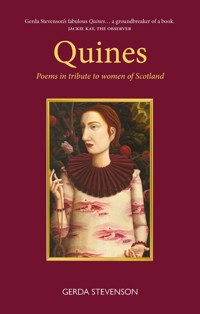
Singers, politicians, a fish-gutter, queens, a dancer, a marine engineer, a salt seller, sportswomen, scientists and many more – Quines celebrates and explores the richly diverse contribution women have made to Scottish history and society.
Sie lesen das E-Book in den Legimi-Apps auf:
Seitenzahl: 131
Veröffentlichungsjahr: 2020
Das E-Book (TTS) können Sie hören im Abo „Legimi Premium” in Legimi-Apps auf:
Ähnliche








GERDA STEVENSON is an award-winning writer, actor, theatre director and singer-songwriter. She has worked on stage, television, radio, film and in opera, throughout the UK and abroad. She is a recipient of Scottish Arts Council and Creative Scotland writers’ bursaries, won the YES Arts Festival Poetry Challenge in 2013, and the Robert Tannahill Poetry Prize in 2017. Her stage play Federer Versus Murray, directed by the author, toured to New York in 2012 and was published there by Salmagundi. In 2014 she was nominated as Scots Singer of the Year for the MG Alba Scots Trad Music Awards, following the launch of an album of her own songs Night Touches Day. She has written extensively for radio, including original plays and dramatisations of Scottish novels. Her first poetry collection, If This Were Real (Smokestack Books, 2013), was published in 2017 by Edizioni Ensemble, Rome, as Se Questo Fosse Vero, translated into Italian by Laura Maniero. Gerda wrote the biographical introduction and a series of poems for the book Inside & Out: The Art of Christian Small, which she also edited (Lyne Press, 2018, now published by Scotland Street Press, 2019). Her most recent book is Edinburgh, a collaboration with Scottish landscape photographer Allan Wright, for which she wrote the introduction and a sequence of twenty-two poems (Allan Wright Photographic, 2019). A seasoned performer, she won a BAFTA Best Film Actress award for her role in Margaret Tait’s feature film Blue Black Permanent, and is the founder of Stellar Quines, Scotland’s leading women’s theatre company.
By the same author:
Poetry
If This Were Real (Smokestack Books, 2013)
Se Questo Fosse Vero / If This Were Real (Edizioni Ensemble, Rome, 2017)
Inside & Out: The Art of Christian Small, with an introduction and poems by Gerda Stevenson (Lyne Press, 2018, Scotland Street Press, 2019)
Edinburgh (Allan Wright Photographic, 2019)
Plays for stage
Pentlands At War, a community play, co-written with the Pentlands Writers’ Group (Scottish Borders Council Library Services, 2006)
Federer Versus Murray (Salmagundi, USA, 2012)
Skeleton Wumman (2014)
Out of Eden, a collaboration with artist Gwen Hardie (2017)
The Rime of the Ancient Mariner, an opera libretto, with composer Dee Isaacs, for the University of Edinburgh (2018)
Plays for BBC radio
Island Blue, co-written with Iain Finlay MacLeod (2007)
The Apple Tree (2011)
Secrets (2011)
Homeless (2013)
A Day Off (2015)
Room For Refugees (2017)
For children
The Candlemaker and Other Stories, illustrated by the author (Kahn & Averill, 1987)
Praise for Quines
‘Gerda Stevenson’s fabulous Quines – the old Aberdonian word for women – which takes us through a vivid, moving history of outstanding Scottish women in poetry. It’s a groundbreaker of a book, rich and resonant, strong of voice.’ Jackie Kay, Best Summer Books, 2018, THE OBSERVER
‘An inspiring collection, celebrating Scottish women throughout the ages… ranging from queens to fish-gutters and, chronologically, from a 5,000-year-old reconstructed head in a Shetland museum to the only recently departed Tessa Ransford of the Scottish Poetry Library. The challenge of writing so many poems on a theme and keeping them all distinct from each other is a mammoth undertaking, but Stevenson is more than up to the task, taking on a variety of styles, voices and perspectives… not only an absorbing and uplifting book but educational too.’ Alastair Mabbott, SUNDAY HERALD
‘Gerda Stevenson’s brilliant collection, Quines.’ The Best of Scottish Books, BOOKS FROM SCOTLAND
‘This is a project of dazzling literary scope and vision. These poems entertain but they also educate. The collection shines a radiant light into the dark corners of unwritten women’s history. It has been reported that Stevenson would love a copy of Quines to go into every Scottish high school and university. I can’t think of a more worthy ambition.’ Sue Whisler, DUNDEE UNIVERSITY REVIEW OF THE ARTS
‘Although Gerda Stevenson is a hugely distinguished actor, director, musician and playwright, her poetry is less well-known. Her second collection Quines will surely change that.’ THE MORNING STAR
‘Quines is simply mind-blowing. It should be a coming-of-age gift to every Scotswoman.’ Lady Judy Steel
‘Clutch this book of wondrous odes to your bosom – it will gladden your heart, sadden it, but also fill you with pride. What women they were that birthed our Scottish nation and here they are, exquisitely brought to vibrant life, by that contemporary cultural quine, Gerda Stevenson.’ Baroness Helena Kennedy QC
‘Quines is a vivid explosion of thought, description and bold opinion, clothing Scots history at last with the myriad contribution of its women. Gerda Stevenson personifies figures often left as dry as dust and reinstates the dignity and complexity of female characters who have helped shape society and reach across the centuries to modern women today. Her use of Scots language and Gaelic phrasing adds authenticity and smeddum. This is a wonderful, life-affirming book.’ Lesley Riddoch
‘A terrific selection of poems, with their sheer variety of character and personality, emotional range, richness of social and cultural reference, metrical and linguistic shifts, a marvellous mix of musicality, energy, gravity and humour, and depth of feeling threaded throughout.’ Stewart Conn
‘There’s a telling verse about Jesus in Mark’s gospel: ‘Where did this man get all this? Is not this the carpenter, the son of Mary and brother of James and Joses and Judas and Simon, and are not his sisters here with us?’ The italics tell the story. The sisters are not named! And rarely have been in a history written by men. In this piercingly challenging and beautiful collection by Gerda Stevenson they are being named at last. And reading it bites the heart.’ Richard Holloway
First published 2018
Second edition 2020
eISBN: 978-1-912387-78-6
The author’s right to be identified as author of this book under the Copyright, Designs and Patents Act 1988 has been asserted.
The paper used in this book is recyclable. It is made from low chlorine pulps produced in a low energy, low emission manner from renewable forests.
Printed and bound by Bell & Bain Ltd., Glasgow
Typeset in 11 point Sabon
© Gerda Stevenson 2018, 2020
For my mother, Marjorie Stevenson – nurse, archivist, gardener, nurturer – inspirational bonnie fechter
Isabella MacDuff, Countess of Buchan, pencil drawing by Anna Wiraszka
Contents
Acknowledgements
Preface to the Second Edition
Introduction
Prologue:
Reconstructed Head of a Young Woman
Quines:
Nessie
Sgàthach
Teneu
Unn the Deep-Minded
Saint Margaret
The Dwaum Isabella MacDuff, Countess of Buchan
Queen o the Bean Mary Fleming
The Abdication of Mary Queen of Scots
Nine Haiku for Esther Inglis
A Dochter’s Dreame Elizabeth Melville
The Killing Times Margaret Wilson
‘Columbine’ Cameron Jean Cameron
Hauf-hingit Maggie Maggie Dickson
‘A Curious Herbal’ Muses Elizabeth Blackwell
It’s Aye Sang wi Me Carolina Oliphant, Lady Nairne
Self-Control Promotes Herself Mary Brunton
In Her Ninety-Second Year Mary Somerville
Captain Betsy Miller’s Fareweel tae Clytus
Terpsichore Reflects on Her Master Maud Sulter
Fanny Wright Meditates on Mary Shelley’s Death
Demerara Eliza Junor
Seeing Red Helen Macfarlane
Òran / Song Mary MacPherson
Mary Slessor Takes St Paul to Task
Janie Annan Slessor Keeps Vigil
Horsehead Nebula Speaks Williamina Paton Fleming
Scotland Celebrates 3-0 at Easter Road
My Birth in Her Hands Margaret Macdonald
Skull Isabel Emslie Hutton
Diva Mary Garden
Rest Time in the Life Class Dorothy Johnstone
Helen Crawfurd’s Memoirs in Seven Chapters
The Scaur Ethel Baxter
Ma Ain Country Violet Jacob
Elsie Inglis Prepares for Her Last Journey
Justice, Persons and Peace Chrystal Macmillan
The Red Duchess Katharine Stewart-Murray
Jane Haining
SSBonita Praises Victoria Drummond
The River Kens Nancy Riach
The Penny Pledge Ena Lamont Stewart
At Miss Eardley’s Joan Eardley
‘Admiral of the Bering’ Recalls Alaska Isobel Wylie Hutchison
The Flyting of the Red Shoes and Blue Shoes Moira Shearer
Anna Buchan’s Obituary
Mairi Anndra Gives Thanks to Margaret Fay Shaw
I am Jennie Lee’s Open University
All It Takes Margaret Blackwood
The Ballad of Craigmillar Helen Crummy
What a Voice Lizzie Higgins
Margaret Tait’s Portrait of Ga
A Megan Boyd Fishing Fly for Prince Charles, July, 1981
Maggie’s Centre, Edinburgh, Tells of Its Conception and Growth Maggie Keswick Jencks
Daith Salutes Margo MacDonald
Kantha Sari Heirloom Mina Ray
Orkney Recalls Gunnie Gunnie Moberg
The Living Mountain Addresses a £5 Banknote Nan Shepherd
Rose Stalks in Snow Christian Small
And the Women’s Coalition Danced Elizabeth Meehan
Tessa Thinks the Scottish Poetry Library Tessa Ransford
Epilogue:
In Memoriam Catriona White and Great Tapestry of Scotland stitchers
Glossary (Scots and Gaelic)
Further Reading
Acknowledgements
Several poems in this collection have appeared in the following publications: PENning Magazine; Scotia Nova (Luath Press); Authors’ Reading Month anthology (Czech Republic); Hunterian Poems (Freight Books); Umbrellas of Edinburgh (Freight Books); Northwords Now; Scots Language Centre.com; L’Ombra delle Parole Rivista; scotiaextremis.wordpress.com; Dangerous Women Project, IASH, University of Edinburgh; the Gunnie Moberg Archive; Read Raw Ltd; The One o’ Clock Gun; Elsie Inglis and the Scottish Women Hospitals (WW100 Scotland); Edinburgh (Allan Wright Photographic).
Thanks to: my family, friends and colleagues for their suggestions, support and patience – in particular: my parents Marjorie and Ronald Stevenson; Aonghas, Rob and Galina MacNeacail; Anna-Wendy Stevenson; Jenny Alldridge; Professor Meg Bateman of Sabhal Mor Ostaig (UHI); David Betteridge; Dr Michel Byrne; Chloe Cheeseman; Andy Croft of Smokestack Books; Lorna Davidson (former Director of New Lanark Trust); Sally Evans; Professor Marco Fazzini of Ca’ Foscari University, Venice; Oriana and Maurice Franceschi; Bashabi Fraser; Simon Fraser; Glasgow Women’s Library; Richard Holloway; Gwyneth Hoyle; Baroness Helena Kennedy, QC; Dolina Maclennan; Laura Maniero; Rebecca Marr of the Gunnie Moberg Archive; Dr Sarah Neely of the University of Stirling; Alex Norton; John Quinn and Professor Gina Wall of Glasgow School of Art; Professor Alan Riach of the University of Glasgow; Lesley Riddoch; Juliet Stevenson; Zillah Jamieson, Abby Richards and Ken Thomson of the National Wallace Monument’s Scotland’s Heroines project; Dr Louise Yeoman.
I am deeply indebted to Dr Jamie Reid Baxter for his generous editorial assistance and encouragement over a sustained period, which has been invaluable.
Special thanks to Anna Wiraszka for her beautiful frontispiece illustration and to Creative Scotland for their support towards researching this collection.
I wish to express my admiration and grateful thanks to the women who have responded creatively to the first edition of Quines: Scottish artist Helen Flockhart, who painted her hauntingly beautiful work Lover’s Eye, after hearing me read my poem ‘The Abdication of Mary Queen of Scots’. Helen included Lover’s Eye in her exhibition Linger Awhile, inspired by the life of Mary Queen of Scots, and she has kindly given permission for this painting to be the cover image for the second edition of Quines; also to the members of EDGE: Textile Artists Scotland, who have created an ambitious touring exhibition of textile panels, inspired by forty poems from Quines, opening on International Women’s Day, 2020.
Preface to the Second Edition
WE OFTEN LEARN about the deceased too late. When the first edition of Quines was about to be sent off to the printer in January 2018, I attended the funeral of Scottish academic, Elizabeth Meehan. I knew that she and I had attended the same primary and high schools, although at different times. Her father was an Irish upholster, who renovated the chairs in my parents’ house. Her Scottish mother was a woman of many parts, who served as a nurse in the VAD during WW11, and, years later, ran a youth club for deprived children in Edinburgh. I have a vivid early childhood memory of sitting at a long table one bright summer day in the Meehan’s garden, where Elizabeth’s mother made a bob or two by serving high teas for local farmers and passers-by. The white table cloth rippled in the breeze, the Pentland Hills stretching out before me as I sipped, for the first time, home-made lemonade.
I had become aware that Elizabeth was an important academic, but hadn’t realized until she died that she was the first female professor of politics on the island of Ireland, author of a significant body of highly influential work, with a dazzling string of prestigious posts and accolades to her name. Her book Women’s Rights at Work: Campaigns and Policy in Britain and the United States (1985), was particularly influential in bringing the study of equal opportunities to international attention. The Irish Times revealed in her obituary:
Meehan was the quintessential scholar, with a deep and abiding interest in citizenship, the European Union, equal opportunities and gender equality… she argued persuasively for a new conception of citizenship flowing from EU membership. She saw this new citizenship being tied to a shared moral order and not to the traditional nation state.
When Elizabeth retired, she returned to Scotland, settling once again in the Borders, close to our childhood homes, where I too now live. There she was, like many brilliant women, wearing her experience and achievements so lightly, living quietly just down the road from me, and I had missed the opportunity of receiving wisdom from the mare’s mouth.
I learned at her funeral that she had been involved in the Northern Ireland Women’s Coalition, many of whose meetings during the late 1990s, leading up to the Good Friday Agreement, she hosted in her Belfast home. The Women’s Coalition was an inclusive group, incorporating both sides of the deep political and religious divide.
On a table of mementos at the funeral reception lay a family scrap book. Inside it was a newspaper cutting of women dancing – among them Elizabeth, jubilant, her whole body expressing exhilaration. The wild, celebratory spirit of these women reminded me of the iconic scene in Brian Friel’s great play Dancing at Lughnasa. I was curious as to what exactly was going on in that photograph – clearly something important. ‘Ask them,’ Elizabeth’s sisters told me, pointing to a group of Irish women seated at a table. That’s when I met Bronagh Hinds of DemocraSHe, who gave me the story: people were gathered in King’s Hall, Belfast, including the world’s media, cameras poised, awaiting the result of the referendum – simultaneously held in Northern Ireland and the Republic – on whether there was support for the Good Friday Agreement. When it came – a resounding Yes – the Reverend Ian Paisley, leader of the DUP, the only party to oppose the Agreement, got up to speak. In an inspired moment of communal telepathy, the Women’s Coalition, determined that the world should recognise this as a landmark to be celebrated rather than condemned, leapt onto the platform in front of Paisley, and danced. In so doing, they seized victory from the jaws of a defeatist before he could utter a single word. This was the image that the press captured – the newspaper cutting from The Observer, in Elizabeth’s family album.
Along with new poems about three other remarkable quines – Elizabeth Blackwell, Helen Crummy and Margo MacDonald – I’m now glad to be able to include in this second edition the poem I have written in tribute to Elizabeth Meehan and the Northern Ireland Women’s Coalition – a story which continues to be urgently relevant today.
Gerda Stevenson
February 2020
Introduction
She was a brilliant woman, of beauty and estate, who was never satisfied unless she was busy doing good – public good, private good… we all loved her; fell down before her; her very appearance seemed to enthral us… the noblest Roman of them all… a woman of the noblest make-up whose orbit was a great deal larger than theirs – too large to be tolerated for long by them: a most maligned, lied about character – one of the best in history though also one of the least understood.




