


1,99 €
Mehr erfahren.
- Herausgeber: Quickie Classics
- Kategorie: Poesie und Drama
- Sprache: Englisch
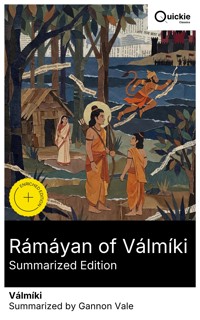
The Rámáyan of Válmíki, the Sanskrit ādi-kāvya, narrates Rāma's exile, Sītā's abduction, alliance with the vānaras, Hanumān's leap to Laṅkā, and Rāvaṇa's defeat across seven kāṇḍas. In lucid anuṣṭubh ślokas, it marries itihāsa and kāvya, exploring dharma, kingship, and fidelity. Its disciplined similes and symmetrical design shaped aesthetics from classical India to Southeast Asian performance and devotion. Little is certain of Válmíki beyond tradition naming him Ādi Kavi. Legend recasts the reformed bandit Ratnākara, whose grief at a felled krauñca births the first śloka. The poem's frame—Sītā sheltered at the hermitage; the twins Lava and Kuśa taught to sing before Rāma—locates authorship in an ascetic witness attuned to speech, justice, and the cost of virtue. Readers of epic literature, ethics, and political thought will find this work inexhaustible: a rigorously patterned narrative that invites close comparison with later retellings and commentarial traditions. In Sanskrit or translation, the Rámáyan of Válmíki rewards attentive reading, stirring reflection on right action amid love, loyalty, violence, and statecraft. Quickie Classics summarizes timeless works with precision, preserving the author's voice and keeping the prose clear, fast, and readable—distilled, never diluted. Enriched Edition extras: Introduction · Synopsis · Historical Context · Author Biography · Brief Analysis · 4 Reflection Q&As · Editorial Footnotes.
Das E-Book können Sie in Legimi-Apps oder einer beliebigen App lesen, die das folgende Format unterstützen:
Veröffentlichungsjahr: 2026
Ähnliche
















Rámáyan of Válmíki (Summarized Edition)
Table of Contents
Introduction
In the Rāmāyaṇa, the demands of righteousness are tested where duty to law, kin, and truth meets the urgencies of love, loss, and power. Traditionally attributed to Vālmīki, this ancient Sanskrit epic traces how a prince, a family, and a realm confront upheaval that exposes the costs and consequences of moral choice. Revered across South and Southeast Asia, it has guided reflection on conduct and leadership while sustaining a living performance culture. Approached today, it offers not a single lesson but a capacious story-world where ethical clarity and human vulnerability continually illuminate one another without diminishing their tensions.
Valmiki’s Rāmāyaṇa is a foundational kāvya, an epic poem composed in classical Sanskrit and transmitted through recitation and manuscripts since antiquity. Set across the Indian subcontinent—from the court of Ayodhyā to forest hermitages and onward to the ocean’s edge—it unfolds in landscapes that juxtapose polity, wilderness, and liminal seas. Tradition organizes the poem into seven kāṇḍas, allowing a movement from youth and city rites to journeys, alliances, and reckonings. While the text exists in multiple recensions and countless translations, its narrative core has remained remarkably stable, inviting readers into a world where political order and spiritual aspiration intersect.
At the outset, the narrative follows Rāma, a prince renowned for adherence to dharma, as circumstances compel exile from his homeland; Sītā and Lakṣmaṇa accompany him into the forest, where ascetic retreats and shadowed clearings become stages for loyalty and trial. A rupture separates the couple through the action of a formidable adversary, redirecting the journey into search, alliance, and resolve. Vālmīki’s voice balances stately composure with emotional immediacy, using vivid nature imagery, measured pacing, and rhythmic ślokas to sustain momentum. The tone is elevated yet intimate, allowing private griefs to coexist with the public weight of kingship.
Central concerns arise from the interplay of dharma and desire: how a leader earns legitimacy, how vows constrain and liberate, how compassion tempers justice, and how grief can coexist with steadfast action. The poem probes the obligations among rulers and subjects, spouses and siblings, humans and the more-than-human world. Exile frames ethical testing, hospitality signals civilization, and speech itself becomes a measure of character. Without resolving all ambiguities, the story shows that right action may demand renunciation, patience, and imaginative courage. These explorations remain pertinent wherever institutions strain, familial responsibilities collide, and communities seek a language for shared duty.
Its characters embody ideals while resisting simplification. Rāma’s exacting self-command challenges readers to weigh principle against compassion. Sītā’s resilience and clarity of purpose anchor the poem’s moral imagination, while Lakṣmaṇa models vigilant care under pressure. Allies encountered along the way—among them the devoted Hanumān and a community of forest-dwellers—broaden the poem’s ethical horizon by linking strength to service. The principal antagonist exemplifies mastery corrupted by appetite, sharpening the contrast between authority and tyranny. Each figure acts within constraints of vow, role, and circumstance, inviting reflection not on perfection but on the disciplined pursuit of the good.
The poem’s architecture supports both breadth and intimacy. Episodes interlace narrative action with counsel, prophecy, and recollection, creating a layered texture in which song, speech, and silence carry meaning. Descriptions of rivers, trees, seasons, and animal life mirror states of mind, fusing ecology with ethics. The kāṇḍa structure guides a widening geography and a deepening inquiry into power, kinship, and fate, culminating in reckonings that test individual and collective resolve. Its style, dignified and imagistic, is suited to performance as well as private reading, which helps explain its long transmission across regions, languages, and artistic traditions.
For contemporary readers, the Rāmāyaṇa matters as a sustained meditation on leadership, intimacy, and responsibility under constraint. It offers an education in moral deliberation rather than a manual of rules, showing how choices are shaped by competing goods and partial knowledge. Its attention to exile, displacement, alliance-building, and the repair of trust resonates with modern experiences of migration and public life. At the same time, its artistry—cadenced narration, memorable scenes, and capacious empathy—encourages slow reading and rereading. Engaging Vālmīki’s epic today is to enter an old conversation about what it costs, and what it yields, to act well.
Synopsis
The Rāmāyaṇa of Vālmīki is a classical Sanskrit epic, traditionally organized into seven books and composed in metrical verse. It narrates the life of Prince Rāma of Ayodhyā and his consort Sītā, setting their story against questions of duty, kingship, and moral choice. A framing tradition presents the poet Vālmīki seeking a portrait of an exemplary human and teaching two youths, Kuśa and Lava, to sing the poem. From royal courts to forest hermitages and distant coasts, the narrative follows an orderly progression of trials that test personal vows and public responsibilities, establishing characters whose virtues and failings define the epic’s ethical terrain.
In its opening movement, the poem situates Ayodhyā’s royal household and the education of its princes. Rāma is portrayed as disciplined, self-controlled, and responsive to counsel, while Lakṣmaṇa stands beside him with fierce loyalty. The sage Viśvāmitra enlists the young brothers to safeguard sacrificial rites, initiating them into the practical demands of protection and restraint. Their journey exposes them to ascetics, celestial weaponry, and adversaries who threaten ritual order. At the court of King Janaka in Mithilā, Rāma wins Sītā’s hand through a demanding test, sealing alliances between houses and setting a standard for conduct that shapes the narrative’s expectations.
The second phase returns to Ayodhyā, where succession becomes the central question. With an orderly transfer of power anticipated, palace obligations and prior promises unexpectedly collide, altering the city’s plans. To honor a binding commitment and preserve the integrity of vows, Rāma accepts a prolonged exile from the kingdom. Sītā chooses to accompany him, and Lakṣmaṇa refuses to be left behind, tying the trio to a shared discipline in the wilds. The crisis tests family bonds and political legitimacy, as those remaining in the city must balance loyal sentiment with adherence to law, ensuring continuity while the rightful heir is absent.
Life in the forest broadens the poem’s ethical lens. Rāma, Sītā, and Lakṣmaṇa move among hermitages, pledging protection to ascetics and confronting threats to order. Hospitality, restraint, and vigilance are opposed by desire, deception, and aggression, producing conflicts that escalate beyond the woodland. A calculated lure draws Rāma away from their dwelling, and in his absence a powerful ruler of Laṅkā seizes Sītā and carries her southward. The abduction reframes personal duty as a transregional challenge, turning grief into a disciplined search. Clues, allies, and warnings accumulate, and the narrative shifts from solitary endurance to coordinated action across realms.
In pursuit of Sītā, Rāma and Lakṣmaṇa encounter the forest-dwelling Vānara community and meet Hanumān, whose discernment and devotion quickly prove decisive. Through mediation in a contested succession, Rāma establishes an alliance with Sugrīva, obtaining the resources of a mobile, far-ranging host. The political compact binds mutual obligations: assistance in restoring a throne is matched by a pledge to search for the missing queen. Teams fan out to the quarters of the world, surveying mountains, rivers, and coasts. The southern party gathers intelligence near the ocean, where experience and counsel combine to reveal the next indispensable step in the quest.
Hanumān’s solitary mission to Laṅkā becomes a centerpiece of daring and tact. He traverses the sea, evades vigilant guardians, and quietly surveys a fortified island city. In an inner grove he locates Sītā, steadfast amid pressure and fear, and conveys Rāma’s message with tokens of recognition to secure trust. The episode balances stealth with principled defiance: after confirming her presence and intentions, Hanumān tests the enemy’s strength, draws attention to the cause, and escapes with vital intelligence. His initiative crystallizes hope, transforming the search into a concrete plan and demonstrating how personal resolve can rally a dispersed coalition when coordinated.
With confirmation secured, allies assemble along the southern shore. Engineering skill and collective effort produce a causeway to Laṅkā, enabling an invasion that still pauses for deliberation and diplomacy. The ensuing campaign unfolds as set-piece duels and strategic maneuvers, interspersed with appeals to return what was taken and to avert ruin. Champions on both sides display prowess and pride, while healers and sages temper violence with counsel. The poem lingers on courage, fatigue, and the burden of command, presenting warfare as a moral theater in which adherence to duty is repeatedly weighed against compassion and the desire for reconciliation.
As the confrontation reaches its decisive exchanges, the narrative turns toward the restoration of civic order and the obligations that follow great conflicts. Justice must be reestablished, alliances honored, and personal relationships recalibrated under public scrutiny. In many recensions, the Uttara Kāṇḍa extends these concerns, examining the tensions between ideal kingship and the vulnerabilities of reputation, as well as the costs borne by those who embody communal ideals. Without disclosing outcomes, the poem’s later movement underscores that triumph alone does not settle ethical questions; it intensifies them, compelling leaders and companions to reconcile private truth with the exacting demands of rule.
Read as both adventure and guide to conduct, Vālmīki’s Rāmāyaṇa endures for its inquiry into dharma amid conflicting claims of love, loyalty, and law. Its characters illustrate ideals of friendship, service, and principled leadership, while also revealing how fear, desire, and anger distort judgment. The poem’s influence spans centuries of retelling, performance, and commentary across South and Southeast Asia, inviting audiences to weigh competing obligations in public and private life. Without resting on any single resolution, it offers a durable measure: integrity is tested in action, and the search for right purpose persists beyond victory, shaping communities as much as heroes.
Historical Context
Valmiki’s Rāmāyaṇa is a Sanskrit epic foundational to South Asian literature. Traditional attribution names the sage Vālmīki as author, while modern philology identifies a layered composition formed over several centuries. Many scholars place the core narrative in the late first millennium BCE, with accretions continuing into the early centuries CE. Composed in anuṣṭubh śloka and transmitted orally, it belongs to the itihāsa genre alongside the Mahābhārata. The poem’s setting draws on the geography of the northern Gangetic plain, centering on Ayodhyā in Kośala. Its language reflects classicalizing Sanskrit shaped by grammatical standardization associated with Pāṇini.
The political horizon evoked corresponds to the era of the Mahājanapadas and the subsequent rise of imperial polities in northern India. Kingdoms such as Kośala, Videha, and Magadha developed centralized courts, councils (sabha), and ministerial offices (mantri-pariṣad). The period saw intensified warfare, codified revenue systems, and prestige rituals like rājasūya and aśvamedha that articulated sovereignty. By the fourth century BCE, the Nanda and Maurya dynasties unified large territories from the Gangetic core. Ideals of righteous kingship (rājadharma) circulated widely; the poem’s sustained attention to just rule, public welfare, and the restraints on royal power reflects these contemporary debates.
Religious life in this period was plural. Vedic Brahmanism centered on sacrificial ritual (yajña), lineage, and household rites, while ascetic and philosophical currents crystallized in the Upaniṣads. New śramaṇa movements—Buddhism, Jainism, and related renunciant traditions—advanced critiques of ritualism and violence and offered alternative paths to liberation. Hermitages (āśramas) in forests functioned as spaces of learning, discipline, and ritual protection, relying on royal patronage. The Rāmāyaṇa’s recurring concern with safeguarding sages, regulating force, and reconciling household duty with renunciation mirrors this landscape of debate, articulating royal obligations toward ascetics and the ethical limits of state power.
Normative literature of the late first millennium BCE—Dharmasūtras, Gṛhyasūtras, and early law discussions—systematized duties by varṇa and life stage. Concepts like pativrata (wifely fidelity), filial obedience, and fair adjudication entered public discourse. Manuals of statecraft later compiled as the Arthaśāstra articulated espionage, taxation, and welfare rationales for rule. Against this backdrop, the poem stages conflicts between personal bonds, oath-keeping, and legal procedure, reiterating that legitimacy rests on dharma rather than mere force. Its attention to councils, envoys, oaths, vows, and witness testimony reflects institutional habits that were being codified in legal and administrative traditions.
The economic scene of the “Second Urbanization” (ca. 600–300 BCE) transformed the Ganges basin. Market towns expanded, craft guilds (śreṇis) coordinated production, and long-distance routes such as the Uttarāpatha and Dakṣiṇāpatha connected regions. Widespread iron use enabled agrarian clearance and new settlements along rivers and forest frontiers. The epic’s journeys across varied terrain, encounters at ferries and forest hermitages, and attention to roads, caravans, and riverine crossings draw on this lived geography. Its emphasis on hospitality, tribute, and gift-exchange reflects transactional norms that structured relations among courts, clans, and ascetic communities during this period of intensified mobility.
Literarily, the poem participates in an oral performance ecology. Professional bards (sūtas) and students memorized and recited long narratives at courts and festivals, a practice attested for itihāsa. The Rāmāyaṇa’s predominantly anuṣṭubh meter, formulaic diction, and episodic architecture suited mnemonic transmission. Classical Sanskrit aesthetics and poetics later took the story as a touchstone for rasa, and celebrated poets emulated its models of heroism and pathos. Even as manuscripts diversified in subsequent centuries, the core narrative served as a vehicle for ethical instruction, royal self-fashioning, and entertainment within institutions of pedagogy, pilgrimage, and royal patronage.
Theological emphasis within the tradition shifted over time. Early layers tend to present Rāma as an exemplary human king upholding dharma, while later strata and commentarial schools integrate stronger Vaiṣṇava theology, portraying him as an incarnation (avatāra) of Viṣṇu. This development aligns with the documented growth of devotional (bhakti) currents from the early centuries CE. The Valmiki text thus straddles a historical transition: it emerges from Brahmanical ethics of rule yet becomes a foundational scripture for later devotional communities. Its capacity to sustain both ethical and theological readings contributed to its preservation across diverse courts, temples, and households.
As a cultural document, the poem reflects the early historic Indian concern with legitimacy, restraint, and equitable governance. It foregrounds procedures—counsel, deliberation, alliance-building, and oath-taking—that framed state action, while dramatizing how vows and kinship obligations complicate political order. Its depictions of forests, sages, and frontier communities register the interface between expanding agrarian states and older ritual ecologies. The work neither simply celebrates conquest nor rejects power; instead it tests rulers against norms of protection, truthfulness, and measured force. In doing so, it offers a durable critique of arbitrary rule and a template for moral kingship.
Author Biography
Válmíki, often rendered as Valmiki or Vālmīki, is the ancient Indian poet-sage traditionally credited with composing the Sanskrit epic Ramayana. Little about his historical life is verifiable, and the figure is enveloped in legend rather than documented biography. Scholars generally place the core composition of the Ramayana in the late first millennium BCE, with subsequent additions into the early centuries CE. Within South Asian literary history, Valmiki is remembered as a foundational voice who helped define epic narrative, ethical reflection, and poetic form in Sanskrit. His name has come to signify both a person and an evolving textual tradition central to Indian and Southeast Asian culture.
Reliable details about Valmiki’s education or training are not available. He is situated within an oral, performative milieu in which epic materials circulated before being stabilized in written form. The language of the Ramayana reflects Epic Sanskrit, emerging from but distinct from Vedic idiom. Later literary theory hails Valmiki as the ‘Adi Kavi’—the first poet—associating his work with the rise of the shloka metre that would dominate classical Sanskrit narrative. While such honorifics are conventional rather than historical proof, they point to the Ramayana’s role in shaping poetics, narrative technique, and the integration of ethical inquiry with aesthetic craft.
Valmiki’s principal and traditionally attributed work is the Ramayana, a monumental poem cast in approximately 24,000 shlokas organized into seven books. It established a model for epic structure in Sanskrit: extended narrative arcs, embedded tales, vivid characterization, and a sustained meditation on duty, statecraft, loss, and resilience. The poem’s geographical and cultural span—from forest hermitages to royal courts—made it a common framework for reflecting on social order and personal conduct. Its verses display a balance of clarity and ornament that later poets admired, becoming a touchstone for narrative economy, lyrical pathos, and the integration of moral reflection within story.
The Ramayana’s textual history indicates layered growth. Manuscripts exhibit significant variation, and scholars discern multiple recensions, broadly categorized as Northern and Southern, with further regional branches. Linguistic features, narrative seams, and style shifts suggest that the poem accumulated material over centuries. Modern philology has produced a critical edition by collating diverse manuscripts to approximate an earliest recoverable text, while acknowledging that the tradition is pluriform. This long transmission history underscores Valmiki’s authorship as a cultural attribution: the epic’s authority rests not only on a singular authorial hand but on its sustained preservation, performance, and reinterpretation.
Reception of the Valmiki Ramayana has been continuous and far-reaching. Classical Sanskrit poets and dramatists engaged its episodes and characters, while later vernacular literatures created influential retellings across India. The narrative also traveled widely in Southeast Asia, shaping court literature, temple art, and performance traditions in regions such as Thailand, Cambodia, and Java. Visual culture—from sculpture and painting to modern illustration—has repeatedly reimagined its scenes. Public recitation, theater, and dance-dramas keep the story active in communal life. Across these contexts, Valmiki’s epic functions as a shared imaginative resource, adaptable to new languages, media, and historical moments.
Thematically, the poem explores dharma in personal and political registers, considering the burdens of rule, the costs of exile, and the ethics of promise-keeping. Its interest lies less in doctrinal argument than in how choices play out in contingent circumstances. Later aesthetic theory often praised the work for its evocation of pathos and wonder, noting how it melds moral seriousness with emotional immediacy. While devotional traditions later elevated certain characters to theological heights, the Valmiki Ramayana itself is regularly studied for its literary architecture, portrayal of human motives, and reflections on justice, hospitality, kinship, and the responsibilities of power.
Historical records do not preserve details of Valmiki’s later life, but the legacy attached to his name has only grown. The Ramayana remains central to education, ritual calendars, and public culture through readings, stage performances, and festivals. Scholarship continues to examine its stratification, manuscript ecology, and regional adaptations, while new translations broaden access. In contemporary discourse, the epic’s treatment of leadership, law, and moral ambiguity invites ongoing debate. Through continuous reinterpretation, Valmiki’s attributed achievement endures as a living classic—one that anchors literary canons, animates artistic practice, and sustains ethical reflection across diverse communities.
Rámáyan of Válmíki (Summarized Edition)
Invocation.1
All honor to sage Válmíki, cuckoo of radiant song, perched upon poetry’s tallest bough, forever calling “Rama, Rama” in deathless melody. Who, hearing his flowing music, fails to step onto blissful paths while Rama’s glory resounds? Like a sacred river, the Rámáyan springs from that hermit prince, washing the world clean, its waters rushing toward Rama, the beloved sea. Shining is Válmíki, Prachetas’ holy son, whose pure lips drink endless nectar distilled from Rama’s deeds. Hail arch-ascetic, gentle and just; hail master of every lore; hail calm hermit; hail first and greatest of bards, Válmíki—hail
Book 1.1
Valmiki greets saint Narada[1] and asks, "Tell me, O sage, who now lives on earth heroic, steadfast, just, unswerving in vows, friend of all and peer of the gods?" Narada, seer of past, present, future, replies, "Only Rama, scion of Ikshvaku[2], fulfills every virtue." He praises Rama’s mastery of scripture, eloquence, archery, vast compassion, thunderous wrath in battle, moon-bright beauty, and unbreakable truth. Dasaratha plans to crown that eldest son, yet Queen Kaikeyi claims her two boons: exile for Rama, kingship for her own Bharata. Bound by duty, the sorrowing monarch yields, and Rama departs to the forest.
Rama’s faithful brother Lakshmana and his radiant wife Sita follow; the people weep until the trio vanish beside the Ganga and build a cottage on Chitrakuta. Bharata races from Ayodhya, falls at Rama’s feet, and pleads, "All acknowledge your right—return and rule." Rama answers, "I must keep my father’s vow," and sends the sandals that will stand for him. Moving deeper into Dandaka, he slays Viradha and countless demons, scars Surpanakha, and destroys Khara, Dushana, and their hordes. Ravana, enraged, enlists Maricha, lures the brothers away, murders Jatayu, and carries Sita screaming through the sky.
Bereft, Rama burns the vulture, frees Kabandha, learns from a hermitess, meets Hanuman at Pampa, and joins with Sugriva. After Rama’s single arrow fells mighty Bali, Sugriva sends hosts to seek Sita. Guided by Sampati, Hanuman leaps the ocean to Lanka, shows Sita Rama’s ring, wrecks the garden, boasts before the court, endures capture, fires the city, and returns triumphant. Rama with monkey and bear armies implores the sea, builds Nala’s bridge, storms Lanka, and slays Ravana. Sita proves her purity in flame; the gods applaud. Returning in Pushpaka, Rama is crowned, rules in golden peace, and promises marvels to all who recite his tale.
Valmiki, eloquent and reverent, bowed toward the glorious visitant, silently worshipped, and watched the shining sage rise skyward. Leaving the cottage, he strolled with his disciple Bharadvaja to the lonely Tamasá that runs beside the Ganges. Clear ripples flashed over the pebble bed; delight lit his face. “Look, dear pupil, what a lovely reach,” he cried. “The floor is glassy, spotless, pure as a good man’s heart. Set your jug here, fetch my bark girdle; I would bathe where no fairer ford invites. Quick, lose no time—away!” The youth sped to obey the urgent call.




