


7,49 €
Mehr erfahren.
- Herausgeber: Open Book Publishers
- Kategorie: Gesellschafts- und Liebesromane
- Sprache: Englisch
This edited volume employs the paradoxical notion of ‘anticipatory plagiarism’—developed in the 1960s by the ‘Oulipo’ group of French writers and thinkers—as a mode for reading Russian literature. Reversing established critical approaches to the canon and literary influence, its contributors ask us to consider how reading against linear chronologies can elicit fascinating new patterns and perspectives.
Reading Backwards: An Advance Retrospective on Russian Literature re-assesses three major nineteenth-century authors—Gogol, Dostoevsky and Tolstoy—either in terms of previous writers and artists who plagiarized them (such as Raphael, Homer, or Hall Caine), or of their own depredations against later writers (from J.M. Coetzee to Liudmila Petrushevskaia).
Far from suggesting that past authors literally stole from their descendants, these engaging essays, contributed by both early-career and senior scholars of Russian and comparative literature, encourage us to identify the contingent and familiar within classic texts. By moving beyond rigid notions of cultural heritage and literary canons, they demonstrate that inspiration is cyclical, influence can flow in multiple directions, and no idea is ever truly original.
This book will be of great value to literary scholars and students working in Russian Studies. The introductory discussion of the origins and context of ‘plagiarism by anticipation’, alongside varied applications of the concept, will also be of interest to those working in the wider fields of comparative literature, reception studies, and translation studies.
Das E-Book können Sie in Legimi-Apps oder einer beliebigen App lesen, die das folgende Format unterstützen:
Veröffentlichungsjahr: 2021
Ähnliche



















READING BACKWARDS
Reading Backwards
An Advance Retrospective on Russian Literature
Edited by Muireann Maguire and Timothy Langen
https://www.openbookpublishers.com
© 2021 Muireann Maguire and Timothy Langen. Copyright of individual chapters is maintained by the chapter’s author.
This work is licensed under a Creative Commons Attribution 4.0 International license (CC BY 4.0). This license allows you to share, copy, distribute and transmit the work; to adapt the work and to make commercial use of the work providing attribution is made to the authors (but not in any way that suggests that they endorse you or your use of the work). Attribution should include the following information:
Muireann Maguire and Timothy Langen (eds), Reading Backwards: An Advance Retrospective on Russian Literature. Cambridge, UK: Open Book Publishers, 2021. https://doi.org/10.11647/OBP.0241
Copyright and permissions for the reuse of many of the images included in this publication differ from the above. This information is provided in the captions and in the list of illustrations.
In order to access detailed and updated information on the license, please visit https://doi.org/10.11647/OBP.0241#copyright. Further details about CC BY licenses are available at http://creativecommons.org/licenses/by/4.0/
All external links were active at the time of publication unless otherwise stated and have been archived via the Internet Archive Wayback Machine at https://archive.org/web
Digital material and resources associated with this volume are available at https://doi.org/10.11647/OBP.0241#resources
Every effort has been made to identify and contact copyright holders and any omission or error will be corrected if notification is made to the publisher.
ISBN Paperback: 9781800641198
ISBN Hardback: 9781800641204
ISBN Digital (PDF): 9781800641211
ISBN Digital ebook (epub): 9781800641228
ISBN Digital ebook (mobi): 9781800641235
ISBN Digital (XML): 9781800641242
DOI: 10.11647/OBP.0241
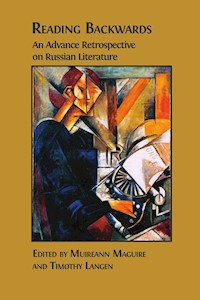
Cover image: Nadezhda Udaltsova, Mashinistka (1910s). Wikimedia, https://commons.wikimedia.org/wiki/File:N._Udaltsova_-_Typewriter_girl,_1910s.jpg, Public Domain.
Cover Design by Anna Gatti.
Contents
Contributor Biographies
vii
Acknowledgements
xi
Introduction: Countersense and Interpretation
xiii
Muireann Maguire and Timothy Langen
I. Gogol
xxvii
1.
Something for Nothing: Imagination and Collapse in O’Brien, Krzhizhanovsky, and Gogol
1
Timothy Langen
2.
Seeing Backwards: Raphael’s Portrait of Nikolai Vasil’evich Gogol
27
Ilya Vinitsky
II. Dostoevsky
51
3.
The Voice of Ivan: Ethical Plagiarism in Dostoevsky and Coetzee
53
Michael Bowden
4.
Foretelling the Past: Fyodor Dostoevsky Follows Guzel’ Yakhina into the Heart of Darkness
79
David Gillespie and Marina Korneeva
5.
Notes from the Other Side of the Chronotope: Dostoevsky Anticipating Petrushevskaia
101
Inna Tigountsova
III. Tolstoy
127
6.
Master and Manxman: Reciprocal Plagiarism in Tolstoy and Hall Caine
129
Muireann Maguire
7.
The Posteriority of the Anterior: Levinas, Tolstoy, and Responsibility for the Other
159
Steven Shankman
8.
From Sky to Sea: When Andrei Bolkonskii Voiced Achilles
189
Svetlana Yefimenko
Afterword: But Seriously, Folks…. (Pierre Bayard and the Russians)
221
Eric Naiman
List of Figures
263
Index
265
Contributor Biographies
Michael Bowden is a postgraduate researcher and teaching assistant at the University of Leeds. His dissertation topic explores Dostoevsky’s influence over novels by J. M. Coetzee, David Foster Wallace and Atiq Rahimi, with a particular focus on the ethical implications of the polyphonic novel form. He received his BA and MA from the University of Manchester.
David Gillespie taught Russian to BA and MA students at the University of Bath, UK, from 1985 to 2016, when he retired as Professor of Russian Studies. He also taught Russian language to UK Ministry of Defence interpreters on a part-time basis at the University of Bristol from 1986 until 2011. He is currently Honorary Professor of Linguistics at Tomsk State University, and Honorary Research Fellow at Queen Mary University of London. He has published ten monographs, including Iurii Trifonov: Unity through Time (1993), and Russian Cinema (2003); over seventy peer-reviewed book chapters and journal articles, and presented over 100 papers at conferences in the UK, USA, Canada, Germany, Belgium, Holland, France, Croatia and Russia. He recently completed editing and updating the fourth edition of Terence Wade’s definitive A Comprehensive Russian Grammar, xxxiii + 601 pp.,published by Wiley-Blackwell (USA and UK) in May 2020. He is currently working on a monograph (A History of Russian Literature on Film),to be published by Bloomsbury in 2023.
Marina Korneeva gained her Candidate of Sciences degree in 2018 and is currently studying for her doctorate in foreign language teaching methodology at Tomsk State University. Since 2017 she has published over twenty peer-reviewed articles. Her monograph, based on her Candidate of Sciences thesis Teaching Foreign Languages to Students of Applied Mechanics through the Case Study Method, will be published by Tomsk University Press in 2021.
Timothy Langen teaches Russian language, literature, and cultural history at the University of Missouri. His research interests include the writings of Nikolai Gogol, Andrey Bely, and Sigizmund Krzhizhanovsky, and the intellectual history of late nineteenth- and early twentieth-century Russia. He is author of The Stony Dance: Unity and Gesture in Andrey Bely’s “Petersburg” (2005) and co-editor and co-translator, with Justin Weir, of Eight Twentieth-Century Russian Plays (2000).
Muireann Maguire lectures in Russian Literature at the University of Exeter, UK. She is the principal researcher on ‘RusTrans, The Dark Side of Translation: 20th and 21st Century Translation from Russian as a Political Phenomenon in the UK, Ireland, and the USA’ (2019–23), an academic project funded by the European Research Council. Her academic specializations include Gothic-fantastic literature, the fictional representation of pregnancy and childbirth, and the nineteenth-century Russian novel. Her book Stalin’s Ghosts: Gothic Themes in Early Soviet Literature was published by Peter Lang in 2012. She has published articles on Russian literature in Modern Language Review, Slavic Review, the Slavonic and East European Review, and other journals.
Eric Naiman teaches Russian and Comparative Literature at the University of California, Berkeley. He is the author of Sex in Public: The Incarnation of Early Soviet Ideology (1997) and Nabokov, Perversely (2010), as well as many articles on nineteenth- and twentieth-century Russian literature.
Steven Shankman holds the UNESCO Chair in Transcultural Studies, Interreligious Dialogue, and Peace at the University of Oregon. His work in the Western classical tradition includes Pope’s Iliad: Homer in the Age of Passion (1983) and In Search of the Classic: Reconsidering the Classical Tradition, Homer to Valéry and Beyond (1994). His Penguin edition of Pope’s Iliad appeared in 1996. Some of his later scholarly work, including The Siren and the Sage: Knowledge and Wisdom in Ancient Greece and China (co-authored with Stephen Durrant, 2000) and Early China/Ancient Greece: Thinking through Comparisons (co-edited by Stephen Durrant, 2002), compares classical traditions. He is a co-editor of The World of Literature (1999), an anthology of world literature from a global perspective, which contains some of his own poetic translations from Chinese, Greek, and Latin. His original poems have appeared in a number of journals including The Sewanee Review, Literary Imagination, Literary Matters, Poetica Magazine, and Tikkun Magazine. Two of his books that explore the work of Emmanuel Levinas are Other Others: Levinas, Literature, Transcultural Studies (2010) and Turned Inside Out: Reading the Russian Novel in Prison (2017).
Inna Tigountsova holds degrees in Romano-Germanic Philology and Translation (Russian/English/German/Polish) from the Federal Baltic State University (Kaliningrad) and in Mediaeval Studies from the Central European University in Budapest. She received her PhD in Slavic Languages and Literatures at the University of Toronto, held a postdoctoral fellowship at Memorial University, and has taught in Canada, the US, and the UK. Her first book The Ugly in Russian Literature: Dostoevsky’s Influence on Iurii Mamleev, Liudmila Petrushevskaia, and Tatiana Tolstaia (2009) was well-reviewed, and her second—Death and Disorder: Dostoevsky in the Context of Petrushevskaia and Goethe—is under contract with Academic Studies Press’ Studies in Comparative Literature and Intellectual History series, edited by Galin Tihanov. She has also published in The Dostoevsky Journal: A Comparative Literature Review; Modern Language Review; Slavic and East European Journal; Canadian Slavonic Papers; Ulbandus: The Slavic Review of Columbia University; Studies in Slavic Cultures; Canadian-American Slavic Studies, and elsewhere. Tigountsova’s translations include works by Dmitrii Prigov, Liudmila Petrushevskaia, and Alexander Piatigorsky.
Ilya Vinitsky is a Professor of Russian literature in the Slavic Department at Princeton University. His main fields of expertise are Russian Romanticism and Realism, the history of emotions, and nineteenth-century intellectual and spiritual history. His books include Vasily Zhukovsky’s Romanticism and the Emotional History of Russia (2015), Ghostly Paradoxes: Modern Spiritualism and Russian Culture in the Age of Realism (2009) and A Cultural History of Russian Literature, co-written with Andrew Baruch Wachtel (2009). His most personal book, The Count of Sardinia: Dmitry Khvostov and Russian Culture (2017; in Russian) investigates the phenomenon of anti-poetry in the Russian literary tradition from the eighteenth through the twenty-first century and focuses on the literary biography and cultural function of the “king” of Russian poetasters, Count Dmitry Khvostov. Vinitsky is currently working on a book about the cultural values of forgers and mystifiers.
Svetlana Yefimenko is a PhD candidate in Russian Studies and Classics at the University of Exeter (United Kingdom), researching Tolstoy’s diachronic reception of Homer. She is founder and editor-in-chief of Xanthos: A Journal of Foreign Literatures and Languages.
Acknowledgements
The editors are indebted to all those who gave moral support or good advice when this volume was still at the planning stage, including Justin Weir and William Mills Todd III. We are grateful to Adam Horsley (University of Exeter) for timely traduction, and to Jacob Emery (Indiana University) for an inspiring critique of our volume which was simultaneously astute and empathetic. The memory of Gennady Barabtarlo’s deep, playful erudition warmed our work and emboldened our search for unexpected patterns and meanings.
We would also like to thank Alessandra Tosi and Melissa Purkiss, of Open Book Publishers, for their exemplary work on behalf of this volume. The University of Missouri Research Council and the University of Exeter’s Institutional Open Access Fund provided invaluable financial support.
We are grateful to our families and colleagues for their forbearance and good humour.
And finally, we thank posterity, for their patience with our plagiarism.
Introduction: Countersense and Interpretation
Muireann Maguire and Timothy Langen
© 2021 Muireann Maguire and Timothy Langen, CC BY 4.0 https://doi.org/10.11647/OBP.0241.10
….[W]ho said that the logic of life is compulsory in art?
— Daniil Kharms and Aleksandr Vvedenskii, ‘The Oberiu Manifesto’
1
In the 1960s, the ‘Oulipo’ group of French writers and philosophers developed, as part of their playful pseudoscience of ‘pataphysics’, a concept they called ‘le plagiat par anticipation’ (plagiarism by anticipation). And while we will have much more to say about anticipatory plagiarism, a few words about this brilliantly inventive and peculiarly disciplined group are necessary to distinguish them from other, notably Russian, twentieth-century literary innovators. The Oulipo (Ouvroir de Littérature Potentielle) movement proved productive and long-lived, publishing manifestos well into the 1980s, surviving the deaths of its founders (Raymond Queneau and François Le Lionnais) and of its most famous member, Georges Perec. Like the Russian avant-garde movements of the early twentieth century, the Oulipo writers proposed a radical reconstruction of literary technique in the pursuit of creative freedom, and an equally sweeping re-evaluation of what constitutes a literary text. But the Oulipo was no second OBERIU; Queneau and Le Lionnais were not plagiarizing Kharms and Vvedensky.2 Like their Russian predecessors, Oulipo favoured artistic experimentation; unlike them, they privileged process over product. The Oulipo writers were not primarily interested in creating literature or performances; instead, they were preoccupied by the development of new contraintes—constraints, or systems of rules—which would force writers to compose within strict limitations. While their results might appear absurd—for example, Le Lionnais wrote poems consisting of a single letter, or of a sequence of numbers and punctuation marks; Perec designed rhyming acrostics—the constraints underpinning these creations were tightly plotted and internally coherent. Their approach to literary production is epitomized by Queneau’s A Hundred Thousand Billion Poems (Cent mille milliards de poèmes, 1961). This set of ten sonnets where each of the lines could be physically cut out and re-inserted in place of any other lines, giving a potential maximum of 1014 unique fourteen-line poems, was in fact structured according to the mathematical operation of permutation.3 We might add that the use of mathematics as a literary trope had been plagiarized well in advance of the Oulipians’ efforts by Dostoevsky’s Underground Man, with his nonconformist insistence that ‘two-times-two-is-five is also sometimes a very lovely little thing’.4
Also unlike the Russian avant-garde and absurdist tradition, the Oulipians did not reject their antecedents. On the contrary, they celebrated their own immersion in literary tradition, especially where Greek classics and French medieval poetry and prose were concerned; and they revelled in identifying past examples of contrainte in literature, particularly if it happened to foreshadow an Oulipian technique or if it had been exercised unwittingly. Hence connection, rather than rupture, was a core tenet of the group’s philosophy. A favourite contrainte was the lipogram, a text missing at least one letter of the alphabet. The most famous example of this is Perec’s 1969 novel The Disappearance (La Disparition), which omits the letter ‘e’; three years later he published Les Revenentes [sic], which omits every vowel except ‘e’. The lipogram is in fact an ancient form; the sixth-century AD Greek poet Tryphiodorus wrote a twenty-four-volume version of the Odyssey, in each successive volume of which he contrived to leave out one letter, following the order of the Greek alphabet.5 Tryphiodorus and other ancient lipogrammatists were much admired by the Oulipians, although the casual reader might be more inclined to sympathize with De Quincey’s opinion that the ancient poets who ‘gloried in dispensing with some one separate consonant, some vowel, or some diphthong’ resembled ‘that pedestrian athlete who wins a race by hopping on one leg, or wins it under the condition of confining both legs in a sack’.6 Extended ad absurdum, as the Oulipo writers often did extend their conceptions, any sentence can be qualified as lipogrammatic: the one you are reading is a lipogram on the letters j, k, v, and z.
Lipograms also open up the Oulipians’ concept of anticipatory plagiarism. Our use of contrainte in the final sentence of the last paragraph was unintentional: we had no plan to embargo those four consonants. But should a future author deliberately compose a sonnet or a novel excluding j, k, v, and z, our essay could be hailed (at least by Oulipian critics) as an example of anticipatory plagiarism of that precise contrainte. Both Perec and Le Lionnais mischievously alleged that writers commonly plagiarize, not their antecedents, but their posterity, by anticipating—and, from a certain perspective, stealing—the subjects, styles, and even the precise words of writers not yet born. This idea turns Harold Bloom’s concept of the ‘anxiety of influence’ on its head: instead of worrying about the originality of their creative ideas, writers should evidently be anxious to ring-fence their copyright from predatory predecessors. A latter-day Oulipian, the writer Jacques Jouet, claimed to have exposed the Romantic poet Alfred de Musset as a proto-Oulipian—in effect, a plagiarist of the group—because Musset allegedly practices an Oulipian contrainte in his 1832 poem, ‘A mon ami Édouard B’. Here the poet enjoins his aspiring poet friend to discover genuine inspiration in his own heart (‘frappe-toi le coeur’) rather than by reading others’ verse (here, Lamartine—the hint of plagiarism may have drawn Jouet to this particular poem by Musset). But, as Jouet points out, Musset’s instructions to his friend are composed in alexandrines, which function as a hidden contrainte.7Musset explicitly instructs his friend to find poetry in his heart; yet, by delivering this advice in a specific metre, he implicitly suggests that metre, not chest-beating, is the key to creativity. Or further still, that the heart itself—manifestly governed as it is by its own metre—demonstrates the inextricability of expression from constraint. The use of concealed constraint like this appealed to the paradox-loving Oulipian mind. Whether or not Musset had plagiarized one of their methods, Jouet and his fellow Oulipians elaborated that any literary or stylistic technique, whether unintentionally deployed (like our lipogram above), or used without formal acknowledgement (like Musset’s alexandrines), can be classified as anticipatory plagiarism if it is later more fully and explicitly expressed in the work of a different author. Instead of suggesting that the successor writer had committed conventional plagiarism of the first, the Oulipo authors read this connection backwards as evidence that the earlier writer had plagiarized his or her descendant—by anticipating them. Like the lipogram, anticipatory plagiarism is of potentially universal application: La Bibliothèque oulipienne reminds us, ‘Tout texte est un plagiat par anticipation d’une contrainte inconnue’ (‘Every text is an anticipatory plagiarism of an unknown constraint’).8
The notion that every text may have multiple, recognized literary offspring suited the provocative Oulipo aesthetic. In a 1979 short story, Perec traded the paradoxical notion of anticipatory plagiarism for the even more radically unbelievable suggestion that the entire cohort of French Symbolist authors had collectively suppressed all traces of a precursor whom they had plagiarized in the conventional manner, by stealing from his published work. The crime comes to light when a young literary historian chances upon an obscure 1864 novel by the unknown Hugo Vernier. After originally accepting the novel’s evocations of Verlaine, Rimbaud, Lautréamont, Huysmans and others, even reading a direct quote from Mallarmé as contemporary pastiche, he suddenly realizes that the novel’s publication pre-dates all of these writers and that they must, therefore, have plagiarized Vernier. But all attempts to research Vernier’s life or even to preserve the last remaining copy of his book fail, forcing the scholar to conclude that most of the print run ‘had been intentionally destroyed by the very people who had been directly inspired by it’.9 Unlikely as it is that France’s leading writers would club together to suppress evidence of a shared crime of plagiarism, even this audaciously paranoid idea may just be more rational than the basic paradox defining anticipatory plagiarism. After all, the notion that every text is a plagiarism of another not yet written (where both employ the same contrainte, implicitly or explicitly) threatens to shift the entire concept of plagiarism towards something like existential guilt. How, then, is it possible to argue meaningfully that specific writers plagiarize their posterity, and how can any such argument hold academic or methodological value?
___
It is our contention in this collection, as our contributors elegantly prove, that anticipatory plagiarism has in fact many insights to offer to scholars, and to readers, and not only in the fields of French—or indeed Russian—literature. We propose that the apparently nonsensical ‘advance retrospective’ approach provides a new way of understanding reception studies, cultural translation, and even our most hallowed classics. It is what we might call countersensical, in that it runs against the patterns of normal experience but reveals new patterns of surprising coherence and scope. It crosses languages, cultures, and genres as readily as it does time. While we do not seriously suggest (nor did the Oulipians) that past authors plagiarized their descendants, the task of thinking about our cultural heritage in this upside-down way forces us to realize that patterns of inspiration are cyclical; that no idea is ever completely original; and that influence flows in many directions (even if not, actually, backwards). In his monograph Anticipatory Plagiarism (Le Plagiat par anticipation, 2009), the contemporary French philosopher Pierre Bayard has modified the radical Oulipo notion to filter out some of its most marked absurdities, and to leave us with arresting new insights into the continuity of technical and aesthetic constraints between generations and literary epochs. He tames the chronological paradox by setting textual parameters for anticipatory plagiarism and thus eliminating the problem of ubiquity. Anticipatory plagiarism is not, according to Bayard, a process; it is a question of perspective, a way of re-evaluating the influences between writers. By assuming that influence is one-directional, we can fail to see the more subtle connections linking the same idea in different generations. When we reverse the direction of influence, we learn more about the overlap between past and present—which is often a valuable lesson for the future. It is just such an inventive, even Borgesian, and intellectually rewarding interplay of ideas that readers of this volume will find in such essays as Shankman’s study of proto-Levinasian ideas in Tolstoy, Langen’s suggestion that Gogol borrowed ideas from both Sigizmund Krzhizhanovsky and the Irish satirist Flann O’Brien, Vinitsky’s deliberately absurdist investigation of the artist Raphael’s plagiarism of Gogol, or Bowden’s re-reading of Dostoevsky through the lens of Coetzee. Beyond this volume, our analyses find an echo (unsurprisingly, in the field of Nabokov studies), in the work of Eric Naiman, a champion of ‘reading preposterously’; in previous articles, he argues for reading Nabokov’s Lolita ‘as if it were as intricate as a Shakespeare sonnet’ and even more counter-intuitively, for Dostoevsky as a pupil or epigone of Nabokov.10Naiman argues forcefully for a rejection of linearity in our approach to literary criticism: ‘Every understanding of a particular work of fiction is somewhat preposterous, coloured by works written after it but which its readers have already read. Why not make aggressive, productive use of our inescapably contaminated sense of temporality? Can’t we read and write history from our own, disciplinary position of strength?’.11In his afterword to the present volume, Naiman explores just what such a position might offer, and look like, from a Bayardian perspective.
The Oulipian approach extends to authors the holiday from linear temporality which Naiman recommends for scholars. ‘On ne cesse d’évoquer l’influence des écrivains et des artistes sur leurs successeurs, sans jamais envisager que l’inverse soit possible et que Sophocle ait plagié Freud, Voltaire Conan Doyle, ou Fra Angelico Jackson Pollock,’ writes Bayard (‘We never stop invoking the influence of writers and artists upon their successors, without ever imagining that the reverse might be possible and that Sophocles might have plagiarized Freud, Voltaire Conan Doyle, or Fra Angelico Jackson Pollock’).12 While one might object that Voltaire did not literally plagiarize Arthur Conan Doyle’s famous Sherlock Holmes, Bayard demonstrates through close reading that the eponymous hero of Voltaire’s Zadig undeniably anticipated (in 1747) the deductive techniques of Doyle’s detective in the short stories ‘The Adventure of Silver Blaze’ (1892) and ‘The Hound of the Baskervilles’ (1901).13Bayard is not alone in connecting Holmes and Zadig; but he may be the first scholar to plot this genealogy in reverse. He makes a similar, textually supported argument that Maupassant plagiarized Proust’s celebrated reminiscent, multi-clause style before Proust had even commenced writing the Remembrance of Things Past (À la recherche du temps perdu, 1913–1927) heptalogy.14 In an effort to make anticipatory plagiarism less arbitrary, Bayard’s book isolates four criteria that must be fulfilled: similarity (the original and the plagiarism must resemble each other), dissimulation (the plagiarist must not acknowledge the theft—a condition presumably easily fulfilled if the plagiarist predeceases the birth of his victim), temporal inversion (the plagiarism must pre-date the original, sometimes by decades or centuries), and dissonance (the plagiarism must appear distinct, in style or content, from the context of the work in which it appears—as, for example, the eponymous Zadig’s deductive episodes clash stylistically with the remainder of Voltaire’s novella).
An Oulipian, countersensical reading can be understood more generally as a kind of play—specifically, the playing of a game with explicitly formalized rules. Apart from whatever pleasurable (or annoying) properties they may have, such games are a valuable and perhaps in some sense unavoidable component of interpretation. A New Critical reading, at least in its archetypical or stereotypical form, proceeds as if the text itself could have an intelligible existence outside its context. A Russian Formalist reading, again in its most extreme form, operates on the manifestly unsustainable assumption that a text’s literary elements could be separated from its non-literary ones. A psychoanalytic reading may adopt the premise that a text or story could itself experience something like desire. While in polemical contexts these games may appear or claim to be self-justifying (structuralism therefore structuralism), they justify themselves to outsiders by the insight—close enough to the intellectual equivalent of ‘fun’—that they yield.
Insight and understanding are of course the aim of the humanistic tradition of interpretation represented by Mikhail Bakhtin and Hans-Georg Gadamer, both of whom argued for a conception of understanding based in some essential way on dialogue. And in this way the hyper-formalism of the Oulipo-game, seemingly so alien in spirit, proves itself to be perfectly suited to the humanistic project. Here the game involves supposing there could be a fully dialogic relation between texts from different eras, such that the earlier and later ones could both read each other. This interpretive game, then, is not only (or even mainly) an exercise in paradox; it is also a game designed to exercise, perhaps to exhaustion, a foundational assumption of dialogical hermeneutics itself, unconstrained by any preemptive commonsensical timekeeper. There is no thought without constraint, any more than there can be vision without perspective: this is the common ground of our thinkers, and it means that interpretation must remain open to the possibility of new perspectives, new constraints, new thought experiments.
Before and after the French theoreticians, there exist alternative and relatively pragmatic ways of conceptualizing anticipatory plagiarism, which this volume will also explore. Perhaps the foundation-stone of anticipatory plagiarism was its use as a defence of true religion by the early Christian philosopher, Justin Martyr. Early Christian thinkers thus attempted to anchor their faith in God to reality by insisting on its miraculous proofs, while struggling to retain the intellectual achievements of their pagan predecessors. When Justin admits in his First Apology (AD 155–57)that the miracles associated with Christ offer ‘nothing new or different’ from Roman mythology, he could do so because he had found an ‘out’ that excused the New Testament’s apparent lack of originality while definitively humbling all previous faiths.15 Elsewhere in the First Apology, Justin appeared to concede:
If we state that He [Christ] was born of a Virgin, this may be comparable to what you admit of Perseus. When we say that He cured the lame, the paralytics, and those blind from birth, and raised the dead to life, we seem to attribute to Him actions similar to those said to have been performed by Aesculapius.
16
Some writers ventured on logistically improbable terrain to resist this charge, proposing that Platonic thought might have developed along proto-Christian lines because Plato visited Egypt, where he read (and plagiarized) the Mosaic Pentateuch.17 Almost two millennia later Lev Tolstoy would, in his letters and in the 1885 biography of Socrates which he co-wrote with Aleksandra Kalmykova, deliberately depict the Greek thinker as a lesser forerunner, although not a plagiarist, of Christ.18
Justin’s solution, in his Dialogue with Trypho (AD 160), is bolder still:
...[W]hen they say that Dionysus was born of Zeus’s union with Semele, and narrate that he was the discoverer of the vine, and that after he was torn to pieces and died, he arose again and ascended into heaven, and when they use wine in his mysteries, is it not evident that the Devil has imitated the previously quoted prophecy of the patriarch Jacob, as recorded by Moses?
19
Here Justin defends the primacy of Christian miracle through a theodicy strangely akin to album or video piracy. According to this view, the Devil exploited his pre-lapsarian VIP access to divine revelation to pre-release a sort of mix-tape of God’s teachings: slightly distorted, pagan copies of Christian figures. Thus Aesculapius pre-empted Christ’s miracles of healing, Hercules his strength, Perseus his virgin birth, because ‘some, namely those previously mentioned demons, foretold through the poets as if already accomplished those things which they invented’.20 By extension, all the pagan sages’ writings were effectively pirate copies of the apologia of future Church fathers; their insights, while not intrinsically sinful, were incomplete or deluded because they were founded on revelations leaked by Satan. Genuine revelation could only come through Christ. This was anticipatory plagiarism by demonic intervention, and it allowed Justin Martyr to argue that the legends of the Christian Church were not, as they might appear to the unenlightened, merely the latest accretion on an intellectual stalagmite of mortal accomplishment: in fact, they were the first correct expression of God’s divine insight; effectively, the director’s cut.
Justin’s method would be followed by a succession of later writers keen to identify their work as the only true expression of an underlying truth or the core aesthetic of a genre; while they acknowledge the existence of predecessors, these are redefined as mere advance plagiarists who try to pre-empt the true word, but get it slightly wrong. In this way, Soviet-era socialist realism might be read (and to a certain degree scripted itself) as the authentic fulfilment of the critical tenets of the radical naturalism first expounded by Belinskii in the early-nineteenth century. Dostoevsky, Belinskii’s first and most significant protegé, was simply a false prophet along this path, misled by bourgeois ambition and naïve psychology. Perhaps even the superfluous man, that archetype so beloved of Russian literature courses on Pushkin’s EvgeniiOnegin (1833) and Lermontov’s A Hero of Our Time (Geroi nashego vremeni, 1840), is superfluous because he is an incomplete and therefore aberrant forerunner of the human ideal fully expressed by Pavel Korchagin in Ostrovskii’s How the Steel Was Tempered (Kak zakalialas’ stal’, 1934).Analogously, in this volume, Inna Tigountsova suggests that Liudmila Petrushevskaia’s female protagonists may be a fuller expression of the Underground Man trope than Dostoevsky’s original disenchanted narrator; the latter is merely an advance plagiarism of the Underground Woman. David Gillespie and Marina Korneeva question whether it is possible to plagiarize an entire genre, examining whether Dostoevsky’s Notes from the House of the Dead (Zapiski iz mertvogo doma, 1862) is merely a foreshadowing of Guzel’ Yakhina’s immensely popular 2015 novel of the Soviet criminal justice system, Zuleikha Opens Her Eyes (Zuleikha otkryvaet glaza). In all these cases, the early Christian philosophers’ argument for the originality of their own faith makes a useful analogy for how contemporary writers have chosen to deny or qualify the influence of certain predecessors. In different ways, they each present their work as the only true fulfilment of their chosen aesthetic, or genre, thus relegating their forerunners to the status of proleptic copycats.
After the Oulipian and Justinian systems, there exists a third kind of anticipatory plagiarism, perhaps the one most readily adaptable for the literature classroom. This system is outlined in David Lodge’s instructive satire about academic ambition, Small World (1984). The naïve protagonist, annoyed that his thesis on Shakespeare’s influence on T. S. Eliot is considered too pedestrian, ad-libs that his real topic is T. S. Eliot’s influence on Shakespeare. ‘“...[W]e can’t avoid reading Shakespeare through the lens of T. S. Eliot’s poetry. I mean, who can read Hamlet today without thinking of Prufrock?”’.21 His reward for ‘thinking in reverse’ is a publisher’s instant invitation to submit his manuscript for review. Lodge may have crafted this anecdote as a satire on the cynicism of publishers, but it confirms the fact that modern writers ineluctably influence our perception of their predecessors; or, to misquote a favourite phrase of Lodge’s, every reading is another re-writing. Hence, when we read Voltaire’s Zadig, we recognize its foreshadowing of nineteenth-century detective fiction; yet instead of reading the Voltairean text by its own standards, we now judge it by our aesthetic reaction to a chronologically later genre. We read Zadig post-Sherlock, as a variant of Doyle, rather than the other way round. Must we accept that Shklovsky wrote War and Peace, or that Nabokov penned The Double (pace Naiman), because we inevitably read Tolstoy and Dostoevsky today through a hermeneutic filter of later critical impositions?
Considered more generally, our reception of the classics is clouded and complicated by the layers of derived texts and subtexts, critical commentaries, and even translations which interpose between their original publication and our reading and reception of them. By ‘reading backwards’, ‘reading upside-down’, or by positing anticipatory plagiarism, we re-start the hermeneutic timer; we consciously strip the original text of its interpretative accretions. This kind of reading may teach us that great minds think alike and that particular ideas (and aesthetic notions) recur cyclically; but even these simple lessons are important today, when the news headlines remind us constantly of the recurrence of dangerous historical trends. If writers can independently develop the same idea at widely separated points in time, so can politicians. The value of a critique based on anticipatory plagiarism is that it teaches us to read these ideas contextually: why did Doyle’s Sherlock become a global cult figure (not least as interpreted on-screen in Soviet Russia), while the detective capabilities of Voltaire’s Zadig remain known to relatively few French literature specialists? In this volume, several essays engage with the cultural hermeneutics of influential texts. Maguire’s chapter re-reads novels by the forgotten Victorian novelist Hall Caine as aspirational Tolstoyan philosophy, while re-evaluating Tolstoy’s Resurrection (Voskresenie, 1899) as a melodrama in the spirit of one of Caine’s bestsellers. Caine’s unrequited admiration for Tolstoy justifies these overlapping values. Yefimenko uses analytic techniques from contemporary critical readings of Tolstoy’s War and Peace (Voina i mir, 1869) to study the moral inadequacy of molodechestvo, or male heroism, in Homer’s Iliad (8th Century BC), and to reveal what Achilles can learn from Tolstoy’s warrior-prince Andrei Bolkonskii.
This anthology focusses on Gogol, Dostoevsky and Tolstoy, three great Russian writers interpreted here—in three discrete sections—as both victims and perpetrators of anticipatory plagiarism. We open with Gogol, who is both sinner (as Timothy Langen’s chapter argues, he steals from the Irish writer Flann O’Brien and the little-known Russian experimentalist Sigizmund Krzhizhanovsky) and sinned against (the distorted physiognomy of Gogol’s nose was illegally scanned by Raphael and other portraitists, as Ilya Vinitsky alleges).
Three chapters are devoted to Dostoevsky, whose well-known moral weakness has evolved from gambling to copyright infringement. Inna Tigountsova argues that Dostoevsky’s notion of the Underground Man was filched from Liudmila Petrushevskaia’s contemporary female embodiment of this narrative archetype in her novel The Time: Night (Vremia: Noch’, 1992). Michael Bowden exploresDostoevsky’s debt to Coetzee and also to Kurt Vonnegut Jr; while David Gillespie and Marina Korneeva return to Dostoevsky’s supposedly least-read book, The House of the Dead, in order to evaluate its thefts from a contemporary novel recently released in English translation and also set in a Siberian prison, Yakhina’s Zuleikha Opens Her Eyes.
The book’s next-to-final section looks at thefts from and by Tolstoy. Muireann Maguire’s chapter studies the paradox of how Tolstoy stole the plot of Resurrection from the bestselling British romance novelist Hall Caine (remembered today, when recalled at all, primarily as the dedicatee of Bram Stoker’s Dracula (1897)). Her essay analyses the critical interactions between Tolstoy and the popular Western writer he famously despised, exploring both Tolstoy’s reception in late nineteenth-century Britain and the reception of socially tendentious bestsellers at the time. Svetlana Yefimenko examines Homer’s debt to Tolstoy—the overlap in style, plot, and characterization between War and Peace and the Iliad—in the context of a detailed study of Tolstoy’s knowledge of the Greek classics. Steven Shankman performs a Levinasian reading of the last sentence of Anna Karenina (1878), interpreting the latter as an anticipation of the radical philosophical speculations of the French Jewish philosopher and also as a means of connecting Anna Karenina conceptually with Resurrection. In his witty and discursive ‘Afterword’ to the present volume, Eric Naiman ranges from Bayard to Bakhtin, Gogol to Freud, Proust to Tolstoy, and, of course, back again, to contend that anticipatory plagiarism not only illuminates past literature for present-day readers, but may amount to an art form in itself.
Our focus on Gogol, Dostoevsky, and Tolstoy provides a much-needed contrainte on the wide-ranging, speculative critical operations with which we are experimenting. An even wider-ranging experiment, from which most of the essays in this volume emerged, occurred in 2018 at the University of Exeter during a conference called ‘Plagiarizing Posterity: Reading the 19th Century Backwards’, organized by Muireann Maguire, one of the present co-editors.22 We therefore want to take this opportunity to renew our thanks to all participants and in particular to acknowledge the stimulating papers read by Roger Cockrell, Anna Ponamareva, Olga Soboleva, Elena Tchougounova-Paulson, and Margarita Vaysman—papers which, though their topics lie outside the constraints of the present volume, helped to shape our understanding of its underlying conception.
This anthology is aimed at scholars and students of literature and culture alike. Our dynamic and challenging system of re-readings and cross-readings of canonical and other texts constitutes a fresh assessment of Russian literary influences, but could be applied to any other national (or indeed global) literature with equally stimulating results. And of course, ‘anticipatory plagiarism’ is entirely our own original notion—albeit, unfortunately for us, already plagiarized by David Lodge, Pierre Bayard, Georges Perec and other ‘ancestors’.
1 Daniil Kharms and Aleksandr Vvedensky, ‘Oberiu Manifesto’ (1928), in The Man with the Black Coat: Russia’s Literature of the Absurd, ed. and trans. by George Gibian (Evanston, IL: Northwestern University Press, 1987), pp. 245–54 (p. 248).
2 The OBERIU were a Leningrad-based group of futurist artists and writers, founded in 1927, whose aesthetic allegiances spanned surrealism, futurism, the Russian notion of zaum (or trans-sense) and other kinds of avant-gardism. Their group name is formed from the initials of the phrase ‘Ob’edinenie real’nogo iskusstva’ (the Association for Real Art). They were known for practising radical artistic experiments in alogism, public pranks, and experimental theatre performances. The OBERIU ceased to exist as a collective in 1930.
3 Raymond Queneau, ‘A Hundred Thousand Billion Poems’, in Oulipo Compendium, ed. by Harry Mathews and Alastair Brotchie (London: Atlas Press, 2005), pp. 14–15.
4 Fyodor Dostoyevsky, Notes from Underground, trans. by Natasha Randall (London: Canongate, 2012), pp. 42–43.
5 Henry Benjamin Wheatley, Of Anagrams: A Monograph Treating of Their History from the Earliest Ages to the Present Time; with an Introduction, Containing Numerous Specimens of Macaronic Poetry, Punning Mottoes, Rhopalic, Shaped, Equivocal, Lyon, and Echo Verses, Alliteration, Acrostics, Lipograms, Chronograms, Logograms, Palindromes, Bouts Rimés (Hertford: Stephen Austin, 1862), p. 21.
6 Cited by Wheatley in Of Anagrams, p. 44.
7Pierre Bayard, Le Plagiat par anticipation (Paris: Les Éditions de Minuit, 2009), pp. 25–26.
8 As cited in Bayard, Le plagiat, p. 26. Note: all translations are our own unless otherwise acknowledged.
9 Georges Perec, ‘The Winter Journey’, trans. by David Bellos, Conjunctions, 12 (1988), 81–86 (p. 85).
10 See Eric Naiman, ‘What If Nabokov Had Written “Dvoinik”? Reading Literature Preposterously’, The Russian Review, 64:4 (2005), 575–89, https://doi.org/10.1111/j.1467-9434.2005.00375.x; and even more counter-intuitively, for Dostoevsky as a pupil or epigone of Nabokov, see Naiman, ‘A Filthy Look at Shakespeare’s “Lolita”’, Comparative Literature, 58:1 (2006), 1–23, https://www.jstor.org/stable/4122338.
11Naiman, ‘What If Nabokov Had Written “Dvoinik”?’, p. 577.
12 From the cover blurb of Bayard’s Le Plagiat.
13Bayard, Le Plagiat,pp. 30–35.
14 Ibid.,pp. 40–48.
15 Justin Martyr, ‘The First Apology’, in Justin Martyr, The First Apology, The Second Apology, Dialogue with Trypho, Exhortation to the Greeks, Discourse to the Greeks, The Monarchy or The Rule of God (Catholic University of America Press, 1948), https://doi.org/10.2307/j.ctt32b2bk.4.
16 Ibid.
17 Henry Chadwick, Early Christian Thought and the Classical Tradition (Oxford: Oxford University Press, 1984),pp. 14–15. https://doi.org/10.1093/acprof:oso/9780198266730.001.0001.
18 See Muireann Maguire, ‘Tolstoy and the Greek Teachers: The Pre-Socratics and Socrates in Tolstoy’s Prose and Educational Writings’, Tolstoy Studies Journal, XXVII (2015), 17–30, esp. p. 24.
19 Justin Martyr, Dialogue with Trypho, trans. by Thomas B. Falls (Washington, DC: Catholic University of America Press, 2003), p. 107.
20 Justin Martyr, ‘The First Apology’.
21 David Lodge, Small World (London: Random House, 2012), p. 52.
22 We thank the University of Exeter, particularly the Open Research Fund, and the British Association for Slavonic and East European Studies for the funding which made this event and, later, this book, possible.
i. Gogol
1. Something for Nothing: Imagination and Collapse in O’Brien, Krzhizhanovsky, and Gogol1
Timothy Langen
© 2021 Timothy Langen, CC BY 4.0 https://doi.org/10.11647/OBP.0241.01
This essay explores several connections among the imaginary worlds of Flann O’Brien (pseudonym of Brian O’Nolan, 1911–1966), Sigizmund Krzhizhanovsky (1887–1950), and Nikolai Gogol (1809–1852). For each writer, the imagination offers the possibility not just of inventing people, things, and events, but also, and more fundamentally, of altering the basic properties of causation, temporality, and proportion that govern existence. This much puts them in the company of a great many other ‘experimental’ writers, such as Borges, Beckett, or, to take an earlier example, Laurence Sterne, but I will try to use Pierre Bayard’s notion of ‘anticipatory plagiarism’ to show some closer, more specific connections. My conceit will be that Krzhizhanovsky interpreted certain key ideas of O’Brien’s, and that Gogol took some of these ideas and adapted them to the concerns of his age. The most important of these ideas is that imaginary worlds can function as a sort of force-multiplier with powerful but destabilizing effects on the real world.
Ibid.
The premise of anticipatory plagiarism is particularly attractive in the case of O’Brien, of whom it has been observed that the sources he could be imagined to have readare more instructive than the sources he is likely to have read. J. C. C. Mays writes that
Brian O’Nolan’s art lives in a literary area of his own invention to the extent that, while he never read more than a fraction of the writers he might be compared to, comparisons to these same writers are more illuminating than to the sources of his writing in his own life […]. The list of parallels and antecedents could be extended, and they would be no less illuminating because Brian O’Nolan was most likely unaware of them.4If ever there were a place to try out the idea of anticipatory plagiarism, this must surely be it: for if O’Brien was unaware of his antecedents, perhaps they were aware of him.5
We might start with O’Brien’s novel The Third Policeman, written in 1939–1940. ‘Not only did he not publish it’, writes Hugh Kenner; ‘he spent the rest of his life going back from it, not forward’.6 It eventually came out in 1967, a year after Brian O’Nolan’s death, seventeen years after Krzhizhanovsky’s, and a hundred and fifteen after Gogol’s. The narrator of The Third Policeman commits murder so he can acquire the funds to publish a definitive treatise on the works of a certain de Selby, and the novel is full of footnotes reporting the latter’s various obscure opinions and attempting to track down their origin and veracity. As M. Keith Booker points out, though, ‘the narrator seems to have spent a great deal more time reading de Selby’s critics than reading de Selby himself’. Further, ‘De Selby’s commentators seem to spend more time commentating on (and generally reviling) each other than on explicating the works of de Selby. And the depths of this cross-examination are as bottomless as those presented by de Selby’s own texts’.7
The meta-commentary extends even further, for the footnotes have proliferated into the world of books aboutFlann O’Brien. One thing O’Brien scholars like to debate is where the name and character of de Selby come from. In Looking for De Selby, Conan Kennedy proposes that the name derives from the De Selby quarries, source of the stones used for roads in Blackrock, County Dublin, around 1912. As for the character de Selby, he may, Kennedy argues, have been based on one Walter Conan, a tailor, inventor, chairman of the De Selby company … and Kennedy’s own great-uncle.8 The weight of scholarly speculation, though, seems to lie neither with the De Selby quarries, nor with Walter Conan, nor, for that matter, with the English town of Selby in North Yorkshire, but rather with the German Selbst, or self. Keith Hopper offers the following in a footnote to his own discussion of de Selby’s name, which he associates with the concept of ‘self’, while scrupulously noting a critique by Rüdiger Imhof, all in response to an idea proposed by Mays.
In more recent correspondence with the present author (8 December 2006), Prof. Imhof elaborated further:‘Selby’ may indeed be derived from the Old High German pronoun ‘selb,’ which seems to have the same root as the English ‘self’ (the exact etymological determination is unclear). The substantive of the pronoun is ‘Selbst,’ which corresponds to the English ‘self.’ So, J. C. C. Mays may have been partly right, after all.Where Mays is wrong is to suggest that ‘de Selby’ is a variation of ‘der Selbe.’ As far as ‘der Selbe’ is concerned, my critical remark still stands: it can only mean ‘the same person.’ It would seem that either Mays or Flann, or indeed both of them made a mistake, namely this: that in order to derive ‘the self’ from a German expression to do with ‘selb,’ ‘Selbe’ or ‘Selbst,’ this expression would have to be ‘das Selbst’ and not ‘der Selbe.’ If Flann meant us to see the connection between ‘de Selby’ and ‘the self,’ he got his German derivation in a twist.I am grateful to Prof. Imhof for his gracious and erudite scholarship (and apologise for co-opting him into such a de Selbian-style commentary).9Here writing itself, nearly unmoored from any particular reference or source because it grazes lightly against so many of them, achieves an almost Nirvanic state of self(Selbst)lessness in the recursive comments and meta-comments of real and fictional scholars. For as Imhof points out, the Selbe that can be inferred from de Selby cannot without lexical violence be made to mean ‘the self’. A name derived from der Selbe must mean not ‘the self’ but rather ‘the same one’, a reference hardly less opaque than the name itself.
As strange as it may seem, though, the reference is in fact perfectly clear; it merely took a Krzhizhanovsky, the equal of Flann O’Brien in both fantasy and pedantry, to point it out. ‘Known for being unknown’, as he said about himself, Krzhizhanovsky remained so for two decades after his death, until his work was tracked down and championed by Vadim Perel’muter. Following a posthumous trajectory familiar to readers of Mikhail Bulgakov or Mikhail Bakhtin, Krzhizhanovsky is among the last of his generation to be “rediscovered” at home and then discovered abroad.10 What has not yet been discovered, though, is that some ten years before O’Brien wrote The Third Policeman, Krzhizhanovsky produced not just a reworking of, but rather the most brilliant commentary on, the later work. The explication came in a story called ‘Materials for a Biography of Gorgis Katafalaki’ (‘Materialy k biografii Gorgisa Katafalaki’, 1929). Like O’Brien’s narrator, Katafalaki is an intellectual searcher, and he pores through bibliographic material hoping to find a universal mind comparable to Aristotle, Descartes, or Leibniz. Before long he comes across a certain Derselbe, who seems to have published major works in every field, and part of the story concerns his misguided attempts to track down this improbably erudite person. The search can never succeed because its object is not a person at all: Derselbe is, after all, ‘the same one’, referring in German footnotes to the most recently cited source. Herr Derselbe is Mr Ibid.
After reading Krzhizhanovsky’s story, it becomes clear that this is the origin of de Selby’s name as well. Derselbe, a verbal shifter in a language foreign to the characters, is mistaken for a name, and thus for a real person to be found or researched, a nothing imaginatively transformed into a something, even a someone. The Katafalaki story, then, is what we could call an ‘anticipatory gloss’ by Krzhizhanovsky, and the most acute commentary on O’Brien’s character of de Selby, but in the form of a story written a decade earlier. It would seem that Krzhizhanovsky read O’Brien’s Third Policeman and, frustrated that no one else got the de Selby joke, retold it with a more explicit backstory. If on the other hand we preclude the possibility of some sort of backwards-reaching action in the universe of literary texts, we will be forced to assume (keeping in mind that Flann O’Brien seems to have had no Russian) that our two authors independently came up with exactly the same trick, to turn a bibliographic term in a different language into a proper name, as a pretext for a wild goose chase. Moreover, they chose the same different language, German. What are the odds of that?11
The covert, backwards-reaching significance of O’Brien’s and Krzhizhanovsky’s de Selby/Derselbe does not stop there. For Gogol too is an artist of linguistic shifters—one thinks here of the ‘words with no particular meaning at all’ that comprise so much of Akaky Akakievich’s speech in Gogol’s story ‘The Overcoat’ (‘Shinel’’, 1842), or of Khlestakov in TheGovernment Inspector (Revizor, 1836), a human cipher onto whom others project their own ambitions, anxieties, and preoccupations. And if O’Brien and Krzhizhanovsky turn a convention of writing into a character, Gogol gives the complementary gesture when the postmaster stands in the pose of a question mark during the famous mute scene at the end of the play, a character transformed into a specimen of punctuation. For all three writers, then, the means of depiction and reference (bibliographic terms, letters, punctuation) become thematized elements within the depicted world.12
Spacetimes of Reading
The premise that earlier texts may borrow or steal from later ones, or—as we might add, somewhat less drastically, that they may interpret them—rests on what Pierre Bayard calls a dual chronology. ‘While full-fledged citizens of their age, creators are equally participants in another temporality, that of literature or art, which obeys its own rhythms’.13 Indeed, literary texts could hardly function without complex rhythmic and temporal interactions. For example, the reader of a text may, more or less at will, arrest forward progress and move back to review earlier material—or even look ahead to find particularly informative or juicy parts, only to circle back once again. Separate from the reader, the text itself can enact retrograde motion relative to any posited unidirectional sequence of events depicted within it. This is part of the work of what Russian Formalists called ‘siuzhet’, the artistic manipulation and distortion of the pre-existing narrative substrate, or ‘fabula’, that can be imagined to proceed evenly from A to B to C and onward. Siuzhet, by contrast, can accelerate, skip ahead, slow down, and even go backwards, before resuming its progress. Even at the most elementary, phenomenological level of reading, then, literature operates in a universe with spatio-temporal properties different from our own ordinary entropic universe.
Texts encode other texts, of course, and if we want to conceptualize the universe of texts, we must do so in a way that accommodates the sort of retrograde motion I have been describing. T. S. Eliot, for example, suggested that each new addition to the canon subtly changes the relations among all the other texts. ‘Events’ in this universe, the universe of what Eliot called ‘tradition’,14 would appear to move not only in the direction Pushkin→Tolstoy→Nabokov, but also the reverse, from Nabokov→Tolstoy→Pushkin. Or, in our case, from the twentieth-century writers Flann O’Brien and Sigizmund Krzhizhanovsky to the nineteenth-century Nikolai Gogol. This is the universe in which Bayard’s ‘anticipatory plagiarism’ may be imagined to operate.
Our authors were all interested in this broader question: the properties of imaginative space-time itself, of which the notion of anticipatory plagiarism describes only a subset. To posit a phenomenon of retrograde influence, interpretation, and even plagiarism means to imagine a world that functions in a way that is radically different from the paradigms and models that (tacitly or explicitly) shape ordinary discourse. A glance at the history of astronomy may be useful here. Retrograde motion (albeit through space rather than time) was first observed by the ancients in the wandering of the planets, which did not follow the steady fabula-like course of stars across the sky but seemed to mark out their own individual siuzhets, moving forwards and then pausing, moving backwards for a bit, and then resuming their forward progress. The eventual solution to this puzzle was to reimagine the underlying geometry: the motion of those planets makes sense if we imagine them to be circling something, and after centuries of mutually refining observation and imagination (contending, of course, with social, political, religious, and other forces), the solar system was eventually conceived to have the shape we now ascribe to it. As new physical problems arose, scientists began to posit new shapes and dimensions, not just for things within the universe, but for the universe itself. If we are to entertain the idea of retrograde action among our three authors, then, we ought to ask what sorts of universe-geometries they construct.
Sausage, Crack, Egg
With O’Brien, the answer is explicit and easy to find. The earth is shaped like a sausage, according to de Selby, who ‘likens the position of a human on earth to that of a man on a tight-wire who must continue walking along the wire or perish, being, however, free in all other respects’.
Movement in this restricted orbit results in the permanent hallucination known conventionally as ‘life’ with its innumerable concomitant limitations, afflictions and anomalies. If a way can be found, says de Selby, of discovering the ‘second direction’, i.e., along the ‘barrel’ of the sausage, a world of entirely new sensation and experience will be open to humanity. New and unimaginable dimensions will supersede the present order and the manifold ‘unnecessaries’ of ‘one-directional’ existence will disappear. (pp. 94–95)‘I would have given much for a glimpse of the signpost showing the way along the “barrel” of the sausage’ (p. 95), the narrator goes on to remark, unaware that he is travelling around the barrel of the sausage that very moment. For The Third Policeman itself is a sausage-shaped imaginary universe, full of what its author called ‘back-chat and funny cracks’.15 The funniest and most horrifying is that the narrator turns out to have been dead all along, the weird disorienting story being his special form or experience of perdition. Thus the strange, looping chronology of this story engulfs the very teller, who continuously tries and fails to chart a rectilinear path out of the perverse curvatures of his sausage-shaped text and universe, a universe where the very atoms of bicycles and their riders intermingle and merge, like sausage ingredients passing through a meat grinder. De Selby seeks a way to the ‘second’ dimension; the narrator finds only death and damnation.
It is tempting to suppose that Krzhizhanovsky, polyglot in abilities and sensibilities, picked up on O’Brien’s ‘back-chat and funny cracks’ and re-interpreted them in his early story ‘The Collector of Cracks’ (‘Sobiratel’ Shchelei’, 1922). The inter-lingual pun would have appealed to both writers: O’Brien’s ‘Chapman and Keats’ series is unimaginable without puns, and Krzhizhanovsky attributed great theoretical significance to wordplay.16Krzhizhanovsky’s main character in ‘The Collector of Cracks’, Lövenix, describes to the narrator how he became interested in the little bits of nothing all around us. He appeals, for example, to the physiology of vision when one watches a film, and through various experiments, manipulating the length of intervals between frames, he trains (in himself and in one other gifted subject) the ability to perceive the interstices through the apparent continuity of motion. Alas, he gets too close to the void, steps on a shadow on his way to meet his beloved, and suffers the loss of his capacity to feel. He believes (referring here to Descartes) that existence itself flickers into and out of being, and he wants to find a way to persist through the blank spots where everything else disappears. Instead the narrator finds Lövenix dead at his desk and throws his manuscript into the fire—negating nothingness, or at least one dangerous way of flirting with it. If in O’Brien’s sausage-verse every path leads to the same place, in Krzhizhanovsky’s crack-verse every instant conceals a trap-door to infinite loss. In both cases a character suspects that his universe contains ubiquitous unperceived domains, and he discovers them, and he experiences not liberation but doom.
Combining O’Brien’s characteristically terse figure of the sausage with Krzhizhanovsky’s characteristically expansive figure of the crack, Gogol arrived at an even richer analogy for the space-time of the imagination. It comes near the end of Dead Souls (Mertvye dushi, 1842), when Gogol is trying to explain how people should read his novel. In the course of his explanations, he invents a certain Kifa Mokiyevich and gives a sort of transcript of the latter’s speculative musings. ‘Well then’, Kifa Mokieyvich thinks, ‘what if an elephant were to be born in an egg, then the shell, I guess, would be so strong and thick that you couldn’t break through it with a cannon-ball; some new firearm would have to be invented’.17 ‘Don’t be like Kifa Mokievich’, seems to be what Gogol may be saying: tend to your responsibilities and use stories like Dead Souls as an instrument to examine yourself critically, rather than as an occasion for idle fantasy about elephant eggs and similar nonsense. Here the ontology of the text is something like that of the mirror, an analogy Gogol had used explicitly in his epigraph to The Government Inspector: don’t blame the mirror if your face is crooked.
Taken another way, though, the imaginary elephant egg is a microcosm of the whole novel. Eggs have come up before—the governor’s daughter’s pretty face that so captivates Chichikov, for example, is compared to an egg—and once we allow that Gogol may have been thinking of O’Brien and Krzhizhanovsky, it becomes apparent that this egg is the shape of space-time in Dead Souls. For hell really is sausage-shaped in The Third Policeman, the narrator given just enough of a hint of linearity that he feels things might be moving somewhere, when really he keeps traversing the same topoi over and over again. And hell really is a collection of cracks for Krzhizhanovsky, each interpersonal or existential void threatening infinite expansion at every instant.18 Likewise, hell in Dead Souls is really an egg that never hatches, promising no progress in any direction either along the surface, or from the inside out, or from the outside in. In Gogol’s world every Kifa Mokievich will beget a Moka Kifevich, every Nozdryov adventure will lead to another Nozdryov adventure, and no one will ever learn anything. The necessity of inventing new firearms to pierce the elephant-egg space-time is, as Gogol suggests, idle fantasy—but in his world it is desperately necessary idle fantasy. Sensible carriages that could get to Moscow but not Kazan’ will never be able to leave this dreary hellish chronotope, and it is dubious whether even the wild Russia-troika at the very end of the novel can reach escape velocity. But the combination of Krzhizhanovsky’s analogy with O’Brien’s allows Gogol to imply a solution: crack the egg, cut the sausage, change the very topology of space and time. And in each case it is the imagination that must lead the way.
Inception19
For all three writers, the creation of spaces by and for the imagination is itself a major and explicit preoccupation, and one that requires effort and risk. Krzhizhanovsky’s short novel TheLetter Killers’ Club (Klub ubiistv bukv




