


109,99 €
Mehr erfahren.
- Herausgeber: John Wiley & Sons
- Kategorie: Wissenschaft und neue Technologien
- Serie: Wiley Series in Quality and Reliability Engineering
- Sprache: Englisch
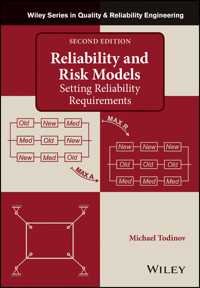
A comprehensively updated and reorganized new edition. The updates include comparative methods for improving reliability; methods for optimal allocation of limited resources to achieve a maximum risk reduction; methods for improving reliability at no extra cost and building reliability networks for engineering systems.
Includes:
- A unique set of 46 generic principles for reducing technical risk
- Monte Carlo simulation algorithms for improving reliability and reducing risk
- Methods for setting reliability requirements based on the cost of failure
- New reliability measures based on a minimal separation of random events on a time interval
- Overstress reliability integral for determining the time to failure caused by overstress failure modes
- A powerful equation for determining the probability of failure controlled by defects in loaded components with complex shape
- Comparative methods for improving reliability which do not require reliability data
- Optimal allocation of limited resources to achieve a maximum risk reduction
- Improving system reliability based solely on a permutation of interchangeable components
Sie lesen das E-Book in den Legimi-Apps auf:
Seitenzahl: 818
Veröffentlichungsjahr: 2015
Ähnliche


















Table of Contents
Cover
Title Page
Series Preface
Preface
1 Failure Modes
1.1 Failure Modes
1.2 Series and Parallel Arrangement of the Components in a Reliability Network
1.3 Building Reliability Networks: Difference between a Physical and Logical Arrangement
1.4 Complex Reliability Networks Which Cannot Be Presented as a Combination of Series and Parallel Arrangements
1.5 Drawbacks of the Traditional Representation of the Reliability Block Diagrams
2 Basic Concepts
2.1 Reliability (Survival) Function, Cumulative Distribution and Probability Density Function of the Times to Failure
2.2 Random Events in Reliability and Risk Modelling
2.3 Statistically Dependent Events and Conditional Probability in Reliability and Risk Modelling
2.4 Total Probability Theorem in Reliability and Risk Modelling. Reliability of Systems with Complex Reliability Networks
2.5 Reliability and Risk Modelling Using Bayesian Transform and Bayesian Updating
3 Common Reliability and Risk Models and Their Applications
3.1 General Framework for Reliability and Risk Analysis Based on Controlling Random Variables
3.2 Binomial Model
3.3 Homogeneous Poisson Process and Poisson Distribution
3.4 Negative Exponential Distribution
3.5 Hazard Rate
3.6 Mean Time to Failure
3.7 Gamma Distribution
3.8 Uncertainty Associated with the MTTF
3.9 Mean Time between Failures
3.10 Problems with the MTTF and MTBF Reliability Measures
3.11 BX% Life
3.12 Minimum Failure-Free Operation Period
3.13 Availability
3.14 Uniform Distribution Model
3.15 Normal (Gaussian) Distribution Model
3.16 Log-Normal Distribution Model
3.17 Weibull Distribution Model of the Time to Failure
3.18 Extreme Value Distribution Model
3.19 Reliability Bathtub Curve
4 Reliability and Risk Models Based on Distribution Mixtures
4.1 Distribution of a Property from Multiple Sources
4.2 Variance of a Property from Multiple Sources
4.3 Variance Upper Bound Theorem
4.4 Applications of the Variance Upper Bound Theorem
5 Building Reliability and Risk Models
5.1 General Rules for Reliability Data Analysis
5.2 Probability Plotting
5.3 Estimating Model Parameters Using the Method of Maximum Likelihood
5.4 Estimating the Parameters of a Three-Parameter Power Law
6 Load–Strength (Demand-Capacity) Models
6.1 A General Reliability Model
6.2 The Load–Strength Interference Model
6.3 Load–Strength (Demand-Capacity) Integrals
6.4 Evaluating the Load–Strength Integral Using Numerical Methods
6.5 Normally Distributed and Statistically Independent Load and Strength
6.6 Reliability and Risk Analysis Based on the Load–Strength Interference Approach
7 Overstress Reliability Integral and Damage Factorisation Law
7.1 Reliability Associated with Overstress Failure Mechanisms
7.2 Damage Factorisation Law
8 Solving Reliability and Risk Models Using a Monte Carlo Simulation
8.1 Monte Carlo Simulation Algorithms
8.2 Simulation of Random Variables
Appendix 8.1
9 Evaluating Reliability and Probability of a Faulty Assembly Using Monte Carlo Simulation
9.1 A General Algorithm for Determining Reliability Controlled by Statistically Independent Random Variables
9.2 Evaluation of the Reliability Controlled by a Load–Strength Interference
9.3 A Virtual Testing Method for Determining the Probability of Faulty Assembly
9.4 Optimal Replacement to Minimise the Probability of a System Failure
10 Evaluating the Reliability of Complex Systems and Virtual Accelerated Life Testing Using Monte Carlo Simulation
10.1 Evaluating the Reliability of Complex Systems
10.2 Virtual Accelerated Life Testing of Complex Systems
11 Generic Principles for Reducing Technical Risk
11.1 Preventive Principles: Reducing Mainly the Likelihood of Failure
11.2 Dual Principles: Reduce Both the Likelihood of Failure and the Magnitude of Consequences
11.3 Protective Principles: Minimise the Consequences of Failure
12 Physics of Failure Models
12.1 Fast Fracture
12.2 Fatigue Fracture
12.3 Early-Life Failures
13 Probability of Failure Initiated by Flaws
13.1 Distribution of the Minimum Fracture Stress and a Mathematical Formulation of the Weakest-Link Concept
13.2 The Stress Hazard Density as an Alternative of the Weibull Distribution
13.3 General Equation Related to the Probability of Failure of a Stressed Component with Complex Shape
13.4 Link between the Stress Hazard Density and the Conditional Individual Probability of Initiating Failure
13.5 Probability of Failure Initiated by Defects in Components with Complex Shape
13.6 Limiting the Vulnerability of Designs to Failure Caused by Flaws
Lesen Sie weiter in der vollständigen Ausgabe!
Lesen Sie weiter in der vollständigen Ausgabe!
Lesen Sie weiter in der vollständigen Ausgabe!
Lesen Sie weiter in der vollständigen Ausgabe!
Lesen Sie weiter in der vollständigen Ausgabe!
Lesen Sie weiter in der vollständigen Ausgabe!
Lesen Sie weiter in der vollständigen Ausgabe!
Lesen Sie weiter in der vollständigen Ausgabe!
Lesen Sie weiter in der vollständigen Ausgabe!
Lesen Sie weiter in der vollständigen Ausgabe!
Lesen Sie weiter in der vollständigen Ausgabe!
Lesen Sie weiter in der vollständigen Ausgabe!
Lesen Sie weiter in der vollständigen Ausgabe!
Lesen Sie weiter in der vollständigen Ausgabe!
Lesen Sie weiter in der vollständigen Ausgabe!
Lesen Sie weiter in der vollständigen Ausgabe!
Lesen Sie weiter in der vollständigen Ausgabe!
Lesen Sie weiter in der vollständigen Ausgabe!
Lesen Sie weiter in der vollständigen Ausgabe!
Lesen Sie weiter in der vollständigen Ausgabe!
Lesen Sie weiter in der vollständigen Ausgabe!
Lesen Sie weiter in der vollständigen Ausgabe!
Lesen Sie weiter in der vollständigen Ausgabe!
Lesen Sie weiter in der vollständigen Ausgabe!
Lesen Sie weiter in der vollständigen Ausgabe!
Lesen Sie weiter in der vollständigen Ausgabe!
Lesen Sie weiter in der vollständigen Ausgabe!
Lesen Sie weiter in der vollständigen Ausgabe!
Lesen Sie weiter in der vollständigen Ausgabe!
Lesen Sie weiter in der vollständigen Ausgabe!
Lesen Sie weiter in der vollständigen Ausgabe!
Lesen Sie weiter in der vollständigen Ausgabe!




