


Erhalten Sie Zugang zu diesem und mehr als 300000 Büchern ab EUR 5,99 monatlich.
- Herausgeber: Verlag Barbara Budrich
- Kategorie: Bildung
- Sprache: Englisch
Die Untersuchung der Kursgestaltung ist eine wichtige empirische Art der Forschung. Allerdings vernachlässigen Kursdesigner*innen oft die akademischen Richtlinien in der Lehrplantheorie und -entwicklung. Diese Studie über Lehrplangestaltung und Kursdesign für Englisch als Fremdsprache (English as a Foreign Language, EFL) verbindet die Theorie mit der Praxis und bietet einen praktischen Leitfaden für Lehrer*innen bei der Planung von Fremdsprachenkursen.
Sie lesen das E-Book in den Legimi-Apps auf:
Seitenzahl: 144
Veröffentlichungsjahr: 2021
Das E-Book (TTS) können Sie hören im Abo „Legimi Premium” in Legimi-Apps auf:
Ähnliche


















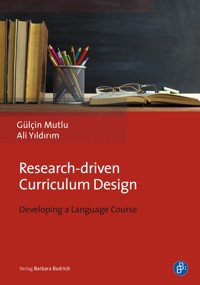
Gülçin MutluAli Yıldırım
Research-drivenCurriculum Design
Developing a Language Course
Verlag Barbara BudrichOpladen • Berlin • Toronto 2021
All rights reserved. No part of this publication may be reproduced, stored in or introduced into a retrieval system, or transmitted, in any form, or by any means (electronic, mechanical, photocopying, recording or otherwise) without the prior written permission of Barbara Budrich Publishers. Any person who does any unauthorized act in relation to this publication may be liable to criminal prosecution and civil claims for damages.
You must not circulate this book in any other binding or cover and you must impose this same condition on any acquirer.
A CIP catalogue record for this book is available from Die Deutsche Bibliothek (The German Library)
© 2021 by Verlag Barbara Budrich GmbH, Opladen, Berlin & Toronto
www.budrich.eu
ISBN 978-3-8474-2426-0
elSBN 978-3-8474-1563-3
DOI 10.3224/84742426
Das Werk einschließlich aller seiner Teile ist urheberrechtlich geschützt. Jede Verwertung außerhalb der engen Grenzen des Urheberrechtsgesetzes ist ohne Zustimmung des Verlages unzulässig und strafbar. Das gilt insbesondere für Vervielfältigungen, Übersetzungen, Mikroverfilmungen und die Einspeicherung und Verarbeitung in elektronischen Systemen.
Die Deutsche Bibliothek – CIP-Einheitsaufnahme
Ein Titeldatensatz für die Publikation ist bei der Deutschen Bibliothek erhältlich.
Verlag Barbara Budrich GmbH
Stauffenbergstr. 7. D-51379 Leverkusen Opladen, Germany
86 Delma Drive. Toronto, ON M8W 4P6 Canadawww.budrich.eu
Jacket illustration by Bettina Lehfeldt, Kleinmachnow, Germany –
www.lehfeldtgraphic.de
Typesetting by Anja Borkam, Jena, Germany – [email protected]
E-Book: CPI books GmbH, Leck
Preface
This book is a study on curriculum design that includes the practices in relation to needs assessment, course development and testing. The aim of the book is to provide the reader with a systematic and research-wise course design primarily in languages and also in other discipline areas. The course design process is a type of research that is to be conducted in several stages by following the academic guidelines in curriculum theory and then reflecting on all this theory during the research-oriented practices. Thus, course design appears to be a process in which curriculum theory is linked to educational research and practice. However, given the currently available books on the market, it appears that there is a need for a source that would include or synthesize theory and practice. That is, there is a lack of available sources that include practical applications of theoratical information on curriculum development in combination with a concrete curriculum and course design process. As most books on course or curriculum design lack a concrete example with all the necessary steps of curriculum design, we believe that this book will fill this gap with its full and detailed explanations as to the necessary steps for course design. Furthermore, this book will meet the above need by emphasizing the course design process as a very important research-driven practice. To serve these ends, we believe that this book will be beneficial for researchers working on educational sciences and foreign languages, as well as for those working as professionals (teachers, lecturers etc.) in the teaching of languages and other discipline areas.
This book is composed of 7 chapters. Chapter 1 serves as an introductory part to the study and to all of the other parts of the book. Chapter 2 provides the literature review for language courses and curriculum design and this part centers around three main dimensions: a) conceptual, b) procedural and c) research-wise background to the language curriculum development. Chapter 3 gives information about the needs assessment, which is the first step in the curriculum design process. Chapter 4 discusses the curriculum design model used in the study and its relevant procedures and more specifically the end product of each particular process determined on the curriculum design model. Chapter 5 provides a unit and a sample lesson plan generated as a result of the curriculum development process told in the previous chapters. Chapter 6 gives information about the field testing of the sample lesson plan provided and mentioned in the previous chapter. Chapter 7 concludes the book with a discussion of final comments on the curriculum development process and with the inclusion of some recommendations for future developmental studies in this area. We believe that the procedures and tactics related to course design and development given in this source will be beneficial for those aiming to design their own courses by utilizing the theoretical and practical information provided in this book.
Dr. Gülçin Mutlu & Dr. Ali Yıldırım
* Preliminary results of the study reported in this book was presented at the European Research Conference (EERA-ECER 2017 Copenhagen: Reforming Education and the Imperative of Constant Change: Ambivalent roles of policy and educational research) in 2017 in Copenhag, Denmark.
Table of Contents
1. Introduction
2. Review of Literature
2.1 Conceptual Background: Theoretical Influence on the Basis of Language Curriculum
2.1.1 Acquisition-learning distinction
2.1.2 Comprehensible input
2.1.3 Affective filter
2.1.4 Competence and performance in language
2.1.5 Nature of linguistic communication
2.2 Design and Procedural Background: Communicative Curriculum in Theory and Practice
2.2.1 Nature of language
2.2.2 Nature of language learning
2.2.3 Nature of educational-cultural philosophy
2.3 Research-wise Background: Studies in relation to English Speaking Skills
2.4 Authentic Materials and Communicative Competence
3. Needs Assessment
3.1 A Snapshot of the Needs Assessment
3.1.1 Who Were Involved in the Needs Assessment?
3.1.2 What Types of Information Was Gathered? (Present Situation Analysis and Target Situation Analyses)
3.1.3 How Was This Information Gathered?
3.2 Needs Assessment Plan for the Further Speaking Course
3.2.1 Data collection procedures
3.2.2 Data analysis procedures
3.2.3 Results of the needs assessment
3.3 Reflections from the Needs Assessment to Use in the Design of the Further Speaking Skills Curriculum
4. Curriculum Design
4.1 Description and Components of the Curriculum Design Model Used
4.2 Application of the Model to the Further Speaking Course
4.2.1 Articulating beliefs
4.2.2 Defining the context and needs assessment
4.2.3 Formulating goals and rationale
4.2.4 Conceptualizing content and course grid
4.2.5 Organizing the course and course syllabus
4.2.6 Refined course goals and intended learning outcomes
4.2.7 Instructional planning and an instructional plan for the FSC
4.2.8 Methods (teaching) strategies
4.2.9 Planning Evaluation and an Evaluation Plan for the FSC
5. Unit and Lesson Plan
5.1 Unit Plan
5.1.1 Rationale
5.1.2 Introduction
5.1.3 Sequence
5.1.4 Instructional foci
5.1.5 ILOs
5.1.6 General teaching strategies
5.1.7 Unintended learning outcomes
5.1.8 Evaluation
5.2 Lesson Plan
6. Field Testing of the Unit Plan
7. Discussion
7.1 Comments on the Process and Design
7.2 Suggestions for Further Course Design Work
References
Appendices
Appendix A
Appendix B
Appendix C
Appendix D
Appendix E
Appendix F
Appendix G
Appendix H
Appendix I
Appendix J
Index
1. Introduction
The purpose of the study reported in this book is to develop an advanced level speaking course that will be offered to the freshman students successfully completing the English preparatory program, which was composed of more than 700 hours of English instruction. This target population of students spends their first year of university at the preparatory English school and they have to successfully complete the preparatory school before they start their main faculties. The students at all preperatory classes usually start with the elementary level of proficiency, and they are expected to move towards an upper level of proficiency level within a whole academic year and finally graduate with an upper intermediate to advanced levels of proficiencies. The students are usually aged between 18 and 20 at the preparatory class, and thus for the year that this speaking course is to be offered, students are expected to be generally aged between 19 and 21. To our experience at several universities in Turkey, these students start university after having been exposed to a highly traditional high school period and school culture. That is, they are accustomed to seeing the teacher as an authority as a figure who always provides them with step-by-step explanations of what they are going to do in class. Given the interactional patterns in the classrooms, based upon their earlier experiences at the high schools, they are not very attentive and willing to work with others for their classroom tasks. However, as they spend a relatively more time in the language classroom, they are observed to change their attitudes to a great extend in comparison to their first weeks and behave in a more relaxed and cooperative manner in the classrooms. Therefore, when they come to the advanced speaking course to be designed for the purposes of this study, they are expected to be already accustomed to a cooperative classroom environment, to teachers behaving like a theater director and guide (not like an authority) and treating the students as active course participants. The course to be designed was named as “Further Speaking Course” (FSC) as the main purpose of this course to make students further their speaking abilities that they have already developed a certain level at the preperatory classes. Hence, this course is built upon the understanding that the target students have a certain level of proficiency in English with regard to language forms, lexical knowledge, use of conversational strategies and registers in communication, and certain level of writing and speaking skills in English.
Given the contextual characteristics, the medium of instruction at the university where we designed this course was Turkish in general. However, the courses are offered with the medium of English on a partial basis in some of the departments and the preperatory class is compulsory for these departments. That is, for some departments, the students study 30 % of the courses in their faculty curriculum in English. The course we attempted to design in this project will be offered to those departments that offer their degree curricula partially in English (i.e. with 30 % of English instruction). This course to be designed in this study will be offered as an elective course for those students who want to further develop their speaking skills. However, in the long run, there may be some departments at the university that will offer all of the degree courses with the medium of English, and in this case, the course to be designed can be offered as a must course. The Further Speaking Skills course will meet for four hours a week in the fall term of an academic year when the students start their degree studies upon the successful completion of the preparatory school. This makes a period of approximately four months for the course.
The English preparatory program is a strict program in which students receive instruction concerning all of the four major skills (listening, writing reading and speaking) and the three sub-skills (grammar, vocabulary, pronunciation) of language. Though we follow a communicative approach to language teaching with a focus upon all four major language skills at the preperatory class from the very beginning of the preperatory semester, it takes time for students to come to a level of production in language for both oral and written purposes. To our experience, their competence (knowledge about the language) precedes their performance (use of the language). However, once they have gained the necessary competence and input in English, they are expected to proceed very well. In this regard, as researchers and teachers we assume that these students develop their competencies to a great extent at the preparatory program; however, they still need more practice for the productive skills of language (for their performance in English). Accordingly, having completed the preparatory class, these students have the ability to produce language on most parts, but there still remain some areas of speaking (e.g. like making speeches before an audience, producing longer stretches of spoken discourse and reflecting on the interlocutors’ opinions) for these students to develop further so that they can be fully competent communicators in English. Hence, the Further Speaking Skills course to be developed for this study will answer to this main need. It is also believed that this course will add to students’ proficiency with other language skills in spite of its preliminary specific focus on speaking skills for it is impossible to isolate the skills of a language as supported by today’s latest and current language teaching methodology.
2. Review of Literature
2.1 Conceptual Background: Theoretical Influence on the Basis of Language Curriculum
According to Yalden (1987), course design is a procedure to merge already present knowledge concerning language teaching and learning with the new opinions, wishes and outlook into the world brought by language students to the language class. In this regard, language course designers are to have a certain degree of theoratical knowledge and awareness concerning language teaching and learning proposed in the available literature on second language learning and acquisition.
Any change seen in theory has automatically influenced the practice about second or foreign language teaching. For instance, a particular interest on structural linguistics in the past has resulted in the formulation of structure-based courses and lessons (Dubin & Olshtain, 1986). However, with the particular surge of interest concerning socio-cultural views about the nature of language, sociolinguistic issues and communication have started to gain more and more attention over the years. Hence, it was seen that linguistic theory was introduced with a new sociolinguistic component or perspective (Yalden, 1987). The courses based upon structures (i.e. knowledge about the language) have lost their popularity over the courses based upon or including socio-linguistic knowledge in terms of classroom practice. Such changes also influenced the way we define language proficiency. The understanding of language proficieny as the extend of mastery of the lexical, grammatical or phonological structures of language seen in the traditional language teaching approaches left its place to such an understanding of language profiency realized basically as the ability to communicate. That is, it was realized that languages are needed for communication and thus should be learned for communication and this condition requires more than the structural knowledge regarding the language.
Based on the changes in theory mentioned above, it can be concluded that the communication with others should form the main basis of a speaking course to be designed for today’s language teaching purposes. Thus, it would be wise to refer to some theoretical issues regarding communicative purposes of language learning. As is also put forth by Yalden (1987), it should be remembered that changes in theoretical issues will in turn bring about some implications for practice and for course design practices, and these changes should be followed and theoratical information should be updated prior to any course design project.
2.1.1 Acquisition-learning distinction
In his theory of second language acquisition, which has been greatly influential upon second language research and teaching for two decades now, Krashen (1981, 1982) talks about the Acquisition-Learning Hypothesis which proposes that there are two distinct and independent ways of second language competence or performance in adults. “The acquired system” and “the learned system” are further defined as these two independent systems of second language performance. The acquired system, or acquisition, is similar to the process children pass through in acquiring their first language. This process is termed as a subconscious process in that acquirers have no conscious awareness of the rules or of the fact that they are learning a language, but they may have a feel for grammaticality (correctness) and they are aware that they are using the language for communication. Meaningful interaction is very important in such a process in which the focus will be on the communicative act and thus on meaning, not on the form. Another perspective to develop competence in a second language is through conscious way of language learning which stands for knowing about a language, that is, its grammar and rules.
Given the links of this hypothesis with the teaching of speaking, Richards (1990) points out that the leaming-acquisition distinction that may underpin one’s choice of a teaching approach, that is, whether one will teach speaking directly (stands for learning) or indirectly (stands for acquisition). The direct approach involves the teaching of specific microskills, strategies and processes of fluent conversation (Richards, 1990). While practicing conversation and speaking is considered important in this approach, there is this presupposition that form-focused instruction might be needed at some point during the lesson (Slade & Thurnbury, 2006). The indirect approach, however, claims that learners gain speaking competence simply through doing it. In other words, conversational competence is arrived at as a result of taking part in a conversational interaction (Richards, 1990). As is also put forth by Bums (1998, p. 103), there is a focus on “tasks mediated through language, negotiation and sharing of information” in the development of conversational competence. This reference to the role of tasks equates indirect approach with the task-based learning which is in fact based on the communicative approach with its claim that language is acquired by means of communication.
Although explicit instruction might be helpful in learning certain formulaic routines and conversational move types (e.g. ways of opening and closing conversations, turn-taking and back-channeling), there is a scarcity of evidence in favor of the direct teaching of conversation (Slade & Thurnbury, 2006). Moreover, some characteristics of conversation are universal in that they might be transferred from learners’ first languages (Brown & Yule, 1983; McCarthy, 1991).




