


29,99 €
Mehr erfahren.
- Herausgeber: John Wiley & Sons
- Kategorie: Wissenschaft und neue Technologien
- Sprache: Englisch
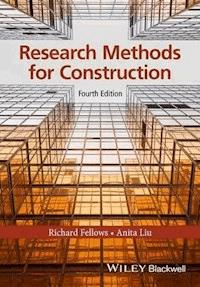
Research Methods for Construction will help you instil rigour into your problem-solving, and into your reports and publications. It will be of value to construction, surveying, architecture and civil engineering students undertaking research, whether for bachelors and masters degree dissertations, or for masters and doctoral research degree theses. Now in its Fourth Edition, this remains one of the few books to provide guidance on research formulation, methodologies, and methods specifically for construction students.
Three main sections – Producing a Proposal, Executing the Research and Reporting the Results discuss the key issues in research and examine the primary approaches, both qualitative and quantitative. The methods adopted for scientific and engineering experiments, model building and simulations are discussed, as well as those employed for research into management, social and economic issues. The authors examine the requirements for data and analysis, including the important statistical considerations and a range of qualitative techniques that enable construction researchers to appreciate what needs to be evaluated in devising how research may be carried out effectively and efficiently.
This new edition has been updated to reflect current debates and concerns, including ethical issues, legislation and codes of practice concerning the collection, processing, storage, use and disposal of data. Pressures of time and funding to carry out the empirical work all too often lead to a lack of attention to how the study should be done and why. The authors address the importance of explaining the philosophical approach adopted (ontology, epistemology) and the consequent methodology. They advocate close scrutiny of the methods available for appropriateness, both academically and practically.
The fundamental theme of the book remains to facilitate a researcher’s informed and justified selection of a philosophical paradigm and of appropriate methods to execute the research.
Sie lesen das E-Book in den Legimi-Apps auf:
Seitenzahl: 621
Veröffentlichungsjahr: 2015
Ähnliche



















Table of Contents
Title Page
Copyright
About the Authors
Professor Richard Fellows, Department of Civil and Building Engineering, Loughborough University
Professor Anita Liu, Department of Real Estate and Construction, University of Hong Kong
Preface
Part I: Producing a Proposal
Chapter 1: Introduction
1.1 The concept of research
1.2 Classifications of research
1.3 Theories and paradigms
1.4 Research styles
1.5 Quantitative and qualitative approaches
1.6 Where to begin
1.7 Summary
References
Chapter 2: Topic for Study
2.1 Selection of a topic
2.2 Writing the proposal
2.3 Summary
References
Part II: Executing the Research
Chapter 3: Initial Research
3.1 The research process
3.2 Initial search
3.3 Literature-based discovery
3.4 Assembling the theoretical framework
3.5 Philosophy and methodology
3.6 Theoretical models and constructs
3.7 Proper referencing
3.8 Summary
References
Chapter 4: Approaches to Empirical Work
4.1 Role of experience
4.2 Research design
4.3 Qualitative approaches
4.4 Quantitative approaches
4.5 Experimental design (including experiments and quasi-experiments)
4.6 Case study research
4.7 Modelling
4.8 Simulation
4.9 Level of research
4.10 Summary
References
Chapter 5: Hypotheses
5.1 Essentials of a valid hypothesis
5.2 Roles of hypotheses
5.3 Objective testing of hypotheses
5.4 Role of sampling
5.5 Common statistical measures
5.6 Null hypotheses
5.7 Validities
5.8 Summary
References
Chapter 6: Data Collection
6.1 Data requirements
6.2 Collecting data from respondents
6.3 Sampling
6.4 Sample size
6.5 Scales of measurement
6.6 Obtaining data
6.7 Response styles
6.8 Summary
References
Chapter 7: Data Analysis
7.1 Analysing data
7.2 Plotting data
7.3 Statistical methods
7.4 Non-parametric tests
7.5 Parametric tests
7.6 Other analytical techniques
7.7 Summary
References
Chapter 8: Ethics in Research
8.1 The concepts of morals and ethics
8.2 Research ethics
8.3 Data analysis, intellectual property and data protection
8.4 Summary
References
Part III: Reporting the Results
Chapter 9: Results, Inferences and Conclusions
9.1 Requirements for valid results
9.2 Potential sources of error
9.3 Results
9.4 Conclusions
9.5 Summary
References
Chapter 10: Reports and Presentations
10.1 Report production
10.2 Communication
10.3 Contents of the report
10.4 Oral presentation
10.5 Summary
Index
End User License Agreement
Pages
iv
xi
xiii
xiv
1
3
4
5
6
7
8
9
10
11
12
13
14
15
16
17
18
19
20
21
22
23
24
25
26
27
28
29
30
31
32
33
34
35
36
37
38
39
40
41
42
43
44
45
46
47
48
49
50
51
52
53
55
56
57
58
59
60
61
62
63
64
65
66
67
68
69
70
71
72
73
74
75
76
77
78
79
80
81
82
83
84
85
86
87
88
89
90
91
92
93
94
95
96
97
98
99
100
101
102
103
104
105
106
107
108
109
110
111
112
113
114
115
116
117
118
119
120
121
122
123
124
125
126
127
128
129
130
131
132
133
134
135
136
137
138
139
140
141
142
143
144
145
146
147
148
149
150
151
152
153
154
155
156
157
158
159
160
161
162
163
164
165
166
167
168
169
170
171
172
173
174
175
176
177
178
179
180
181
182
183
184
185
186
187
188
189
190
191
192
193
194
195
196
197
198
199
200
201
202
203
204
205
206
207
208
209
210
211
212
213
214
215
216
217
218
219
220
221
222
223
224
225
226
227
228
229
230
231
232
233
234
235
236
237
238
239
240
241
242
243
244
245
246
247
248
249
250
251
252
253
254
255
256
257
258
259
261
263
264
265
266
267
268
269
270
271
272
273
274
275
276
277
278
279
280
281
282
283
284
285
286
287
288
289
290
291
292
293
294
295
296
297
298
299
300
301
302
Guide
Cover
Table of Contents
Preface
Part I: Producing a Proposal
Begin Reading
List of Illustrations
Chapter 1: Introduction
Figure 1.1 ‘Causality chain’ between variables (see also Figure 4.1, p. 105).
Figure 1.2 Triangulation of quantitative and qualitative data.
Figure 1.3 Aristotle's inductive–deductive method
Figure 1.4 Depiction of the approach to the advancement of knowledge, as advocated by Galileo
Figure 1.5 Experimental design.
Chapter 2: Topic for Study
Figure 2.1 Pareto distribution applied to the cost of a construction project.
Figure 2.2 The process of refining a topic for research.
Figure 2.3 Development of aim and objectives, and proposition and hypothesis.
Chapter 3: Initial Research
Figure 3.1 The research process (after Bryman and Cramer 1994). It may be advisable to carry out these activities in the reverse sequence to that shown: identify the population and possible ‘sample(s)’ and select and design the survey(s) or experiment(s), then select the ‘sample(s)’ to be used (from theoretical and practical considerations).
Figure 3.2 The research process (after Bryman & Cramer, 1994).
Figure 3.3 The modelling process (developed from Taha 1971; Checkland 1989).
Chapter 4: Approaches to Empirical Work
Figure 4.1 Types of variables and relationships between them. (See also Baron and Kenny 1986; Drenth 1998 for more details.)
Figure 4.2 The modelling process (developed from Mihram 1972).
Chapter 5: Hypotheses
Figure 5.1 Data collection
Figure 5.2 Bias and precision
Figure 5.3 Normal distribution (probability density function).
Chapter 6: Data Collection
Figure 6.1 Simple model of an information system.
Figure 6.2 System boundaries.
Figure 6.3 Types of interview.
Figure 6.4 Breadth versus depth in ‘question-based’ studies.
Figure 6.5 Development of a multi-item scale.
Chapter 7: Data Analysis
Figure 7.1 Frequency distribution ().
Figure 7.2 Bar diagram (relative frequencies may not sum to 1.0 due to rounding).
Figure 7.3 Frequency polygon or
histogram
.
Figure 7.4 ‘More than’ and ‘less than’ ogives.
Figure 7.5 A model of project leadership.
Chapter 8: Ethics in Research
Figure 8.1 Model of organisational ethics (
source:
Liu
et al
. (2004)).
Chapter 9: Results, Inferences and Conclusions
Figure 9.1 Potential sources of error
Chapter 10: Reports and Presentations
Figure 10.1 Communication system.
List of Tables
Chapter 1: Introduction
Table 1.1 Requirements of different research styles/strategies.
Chapter 3: Initial Research
Table 3.1 Polarities and assumptions adopted by researchers.
Table 3.2 Realism and constructivism in organisational contexts (derived from Mir and Watson 2001).
Chapter 4: Approaches to Empirical Work
Table 4.1 Types of research.
Table 4.2 Empirical design.
Chapter 6: Data Collection
Table 6.1 Quasi-experiment models.
Table 6.2 Scales of measurement and data analyses.
Chapter 7: Data Analysis
Table 7.1 Hypothesis testing.
Research Methods for Construction
Fourth Edition
Richard Fellows
School of Civil and Building EngineeringLoughborough UniversityUK
Anita Liu
Department of Real Estate and Construction The University of Hong Kong Hongkong
This edition first published 2015
© 2015 by John Wiley & Sons, Ltd
Registered office:
John Wiley & Sons, Ltd, The Atrium, Southern Gate, Chichester, West Sussex, PO19 8SQ, United Kingdom.
Editorial office:
9600 Garsington Road, Oxford, OX4 2DQ, United Kingdom.
The Atrium, Southern Gate, Chichester, West Sussex, PO19 8SQ, United Kingdom.
For details of our global editorial offices, for customer services and for information about how to apply for permission to reuse the copyright material in this book please see our website at www.wiley.com/wiley-blackwell.
The right of the author to be identified as the author of this work has been asserted in accordance with the UK Copyright, Designs and Patents Act 1988.
All rights reserved. No part of this publication may be reproduced, stored in a retrieval system, or transmitted, in any form or by any means, electronic, mechanical, photocopying, recording or otherwise, except as permitted by the UK Copyright, Designs and Patents Act 1988, without the prior permission of the publisher.
Designations used by companies to distinguish their products are often claimed as trademarks. All brand names and product names used in this book are trade names, service marks, trademarks or registered trademarks of their respective owners. The publisher is not associated with any product or vendor mentioned in this book.
Limit of Liability/Disclaimer of Warranty: While the publisher and author(s) have used their best efforts in preparing this book, they make no representations or warranties with respect to the accuracy or completeness of the contents of this book and specifically disclaim any implied warranties of merchantability or fitness for a particular purpose. It is sold on the understanding that the publisher is not engaged in rendering professional services and neither the publisher nor the author shall be liable for damages arising herefrom. If professional advice or other expert assistance is required, the services of a competent professional should be sought.
Library of Congress Cataloging-in-Publication Data
Fellows, Richard, 1948-
Research methods for construction / Richard Fellows, Department of Real Estate and Construction, The University of Hong Kong, and Anita Liu, Department of Civil and Building Engineering, Loughborough University.–Third edition.
pages cm
Includes bibliographical references and index.
ISBN 978-1-118-91574-5 (pbk.)
1. Building–Research–Methodology. I. Liu, Anita. II. Title.
TH213.5.F45 2015
624.072–dc23
2015008904
A catalogue record for this book is available from the British Library.
Wiley also publishes its books in a variety of electronic formats. Some content that appears in print may not be available in electronic books.
About the Authors
Professor Richard Fellows, Department of Civil and Building Engineering, Loughborough University
Richard Fellows is Professor of Construction Business Management at Loughborough University, United Kingdom; previously, he was a Professor in the Department of Real Estate and Construction, The University of Hong Kong, and Professor of Culture in Construction at Glasgow Caledonian University, United Kingdom. He graduated from the University of Aston and has worked as a quantity surveyor for several major contractors. Richard has a PhD from the University of Reading, has taught at a number of universities in the United Kingdom and other countries and was co-ordinator for research in construction management for the Engineering and Physical Sciences Research Council in the United Kingdom. His research interests concern economics, contracts and law and management of people in construction – especially, cultural issues as drivers of behaviour and performance. He was a founder and, for many years, was joint coordinator of the CIB group, W112 – ‘Culture in Construction’. Richard has published widely in books, journals and international conferences and is qualified as a mediator.
Professor Anita Liu, Department of Real Estate and Construction, University of Hong Kong
Anita Liu graduated from the University of Reading. She returned to Hong Kong to work in a quantity surveying consultancy, for the Hong Kong government, and for a major contractor before moving into academia. She obtained an MSc and a PhD from the University of Hong Kong. She has obtained many research grants from different awarding bodies, including ESRC (UK) and RGC (Hong Kong) projects, and has presented papers at many international research conferences. She publishes widely in a variety of leading journals, is a regular reviewer for international journals and research awarding bodies and is a member of several editorial boards. Anita has been chairperson of the Quantity Surveying Division of the Hong Kong Institute of Surveyors and a member of committees and boards in various professional institutions in China and in the United Kingdom. Anita was chair professor of Commercial Management and Quantity Surveying at Loughborough University. Currently, she is Professor in the Department of Real Estate and Construction at The University of Hong Kong and joint co-coordinator of CIB W112: ‘Culture in Construction’.
Preface
We are very grateful to all our colleagues and researchers who have taken the trouble to provide us with feedback on previous volumes; that feedback has been extremely useful in helping us to amend and improve the content and presentation for this fourth edition of our book. Our own research has continued to inform us and so, the entire book has been scrutinised for scope, rigour and content as well as for ease of comprehension and use.
Research, itself, is a field which is developing and evolving constantly. Philosophical and methodological preferences and debates ebb and flow along the pattern of the dialectic triad. Mixed and multi-method approaches have become popular due to their more inclusive/comprehensive scope. Methods and techniques are developing and new ones are emerging. IT plays an ever greater role in research in a wide variety of ways.
Given the extent and speed of developments, it is hardly surprising that debates and concerns also proliferate. Ethical issues concerning collection, processing, storage, use and disposal of data are addressed in Chapter 8 – which considers the various reports, legislation, codes of practice and requirements of ethical committees and reviews. Pressures of time and funding to ‘do the study’ (the empirical work) all too often lead to a lack of attention to how the study should be done and why. Attention should be given to the philosophical approach adopted (ontology, epistemology) and the consequent methodology – all require rationale/justification. Methods available should be scrutinised for appropriateness, both academically and practically, again, requiring justification for use in context. That is a fundamental theme of this book – to facilitate a researcher's informed and justified selection of a philosophical paradigm and, thence, of appropriate methods to execute the research.
A particular, and vitally important, component is the critical study of theory and literature – usually, a major process to be undertaken early in the research to inform the researcher(s) and, hence, the study. Failure to undertake a thorough review of theory and literature will leave the research poorly informed and with important ‘holes’ and duplications; consequently, the essential discussion of the results and drawing of conclusions will be fundamentally flawed. (In grounded theory, the debate is not whether to study theory and literature but when to do so.)
In a fairly nascent field of research, such as construction, the need for demonstrated rigour is paramount. Methods and techniques from other disciplines and domains are adopted – that requires care and rigour in itself to ensure that suitable methods are selected and employed validly and correctly (e.g. avoiding the ecological fallacy in researching culture topics; appropriate uses of Likert response formats and of Likert scales, and statistical tests which are valid for them – see Chapter 6).
Thus, it could be tempting for us to be prescriptive over how to conduct studies, what methods to use, and so on. We have consciously and strongly resisted that temptation in order to preserve presentation and discussion of the rich array of methodologies and methods available – and appropriate in differing contexts and for different topics. Rather, we have incorporated the main threads of advice and debate, often drawn from the vast body of highly authoritative research papers and books, to succinctly inform researchers of the issues and so, to enable them to make their own, informed selections for achievement of validity and reliability in their particular topics and contexts (which is, itself, a major intellectual component of research).
Finally, our thanks go to the many colleagues and friends who have helped and supported us. In particular, Madeleine Metcalfe and Harriet Konishi at Wiley-Blackwell, and all the production staff, who have been so kind, helpful and understanding in our endeavours to complete this fourth edition.
Anita LiuRichard FellowsHong Kong, July 2014
Part IProducing a Proposal
Chapter 1Introduction
Learning Objective
The objectives of this chapter are to:
introduce the
concept of research
;
provide awareness of different
classifications of research
;
outline the essentials of
theories and paradigms
;
discuss the various
research styles
;
introduce
quantitative and qualitative approaches
;
consider
where
,
and how
,
to begin
.
1.1 The concept of research
Chambers English Dictionary defines research as:
a careful search
investigation
systematic investigation towards increasing the sum of knowledge.
For many people, the prospect of embarking on a research project is a daunting one. However, especially for people who are associated with a project-oriented industry, such as property development, building design, construction or facilities management, familiarity with the nature of projects and their management is a significant advantage. Dr Martin Barnes, an ex-chairperson of the Association of Project Managers (APM), has described a project as a task or an activity which has a beginning (start), a middle and an end that involves a process which leads to an output (product/solution). Despite the situation that much research is carried out as part of a long-term ‘rolling’ programme, each individual package of research is an entity which is complete in itself, while contributing to the overall programme.
Indeed, any work which assists in the advancement of knowledge, whether of society, a group or an individual, involves research; it will involve enquiry and learning also.
1.1.1 Research: a careful search/investigation
Research can be considered to be a ‘voyage of discovery’, whether anything is discovered or not. In fact, it is highly likely that some discovery will result because discovery can concern the process of investigation as well as the ‘technical subject’ (the topic of investigation). Even if no new knowledge is apparent, the investigation may lend further support for existing theory. What is discovered depends on the question(s) which the research addresses, the patterns and techniques of searching, the location and subject material investigated, the analyses carried out and, importantly, reflection by the researcher on the results of the analyses in the context of the theory and literature and methodology/methods employed. The knowledge and abilities of researchers and their associates are important in executing the investigative work and, perhaps more especially, in the production of results, discussion of them and the drawing of conclusions. Being open-minded and as objective as possible is vital for good research.
1.1.2 Research: contribution to knowledge
The Economic and Social Research Council (ESRC) defines research as ‘…any form of disciplined inquiry that aims to contribute to a body of knowledge or theory’ (ESRC, 2007). That definition demonstrates that the inquiry must be designed and structured appropriately and that it is the intent of the inquiry which is important (to distinguish from casual inquiries) rather than the outcome per se.
The Concise Oxford Dictionary (1995) provides a more extensive definition of research as ‘the systematic investigation into and study of materials, sources and so on in order to establish facts and reach new conclusions’. Here the emphasis lies on determining facts in order to reach new conclusions – hence, new knowledge. The issue of ‘facts’ is not as clear, philosophically speaking, as is commonly assumed, and will be considered later.
The dictionary continues: ‘an endeavour to discover new or collate old facts and so on by the scientific study of a subject or by a course of critical investigation’. Here there is added emphasis on the method(s) of study; the importance of being scientific and critical is reinforced.
Therefore, research comprises what (facts and conclusions) and how (scientific; critical) components. Being critical, even sceptical, rather than merely accepting, is vital; evidence to support assertions, use of methods, production of findings and so on is essential. ‘…critical analysis questions the authority and objective necessity of the normative framework that is taken for granted…also challenges the adequacy of…accounts…’ (Willmott 1993: p. 522). Further, it is concerned to ‘…situate the development and popularity of ideas and practices…in the material and historical contexts of their emergence and application…’ (: p. 521).
Lesen Sie weiter in der vollständigen Ausgabe!
Lesen Sie weiter in der vollständigen Ausgabe!
Lesen Sie weiter in der vollständigen Ausgabe!
Lesen Sie weiter in der vollständigen Ausgabe!
Lesen Sie weiter in der vollständigen Ausgabe!
Lesen Sie weiter in der vollständigen Ausgabe!
Lesen Sie weiter in der vollständigen Ausgabe!
Lesen Sie weiter in der vollständigen Ausgabe!
Lesen Sie weiter in der vollständigen Ausgabe!
Lesen Sie weiter in der vollständigen Ausgabe!
Lesen Sie weiter in der vollständigen Ausgabe!
Lesen Sie weiter in der vollständigen Ausgabe!
Lesen Sie weiter in der vollständigen Ausgabe!




