


Erhalten Sie Zugang zu diesem und mehr als 300000 Büchern ab EUR 5,99 monatlich.
- Herausgeber: Carcanet Classics
- Kategorie: Poesie und Drama
- Sprache: Englisch
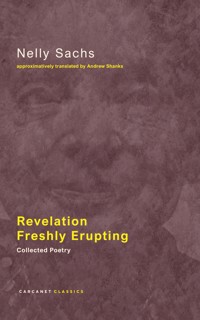
Winner of the Warwick Prize for Women in Translation 2024 Winner of the Schlegel-Tieck Prize 2024 The Jewish poet Nelly Sachs (1891–1970) writes in direct response to the Holocaust. She is uniquely a 'prophetic' poet, one of the greatest of that species in the twentieth century. Her first book appeared in the immediate wake of the Second World War, in 1946. Since that time, Hans Magnus Enzensberger declared, 'she has been writing fundamentally a single book'. That book is represented in this volume which reveals her whole progression rendered into English. Unlike earlier translators, Andrew Shanks calls his versions 'translations/imitations', moving away from the doggedly literal to render more faithfully the sense and intention of the originals. Sachs escaped Berlin in May 1940. She found refuge in Sweden. Her major work is an evolving response to the trauma of the Holocaust. In 1966 she received the Nobel Prize for Literature. This book includes all the lyric poetry Sachs published in her lifetime and adds the posthumous collection Teile dich Nacht, an introductory essay, and notes. Her poetry begins as a monumental lament for the victims of the Holocaust. Other themes develop: biblical, Kabbalist and religious allusions, personal bereavement, mental breakdown. And there are reflections on poetic vocation in the darkness of recent history.
Sie lesen das E-Book in den Legimi-Apps auf:
Seitenzahl: 301
Veröffentlichungsjahr: 2023
Das E-Book (TTS) können Sie hören im Abo „Legimi Premium” in Legimi-Apps auf:
Ähnliche










123
Nelly Sachs
Revelation Freshly Erupting
collected poetry
Approximatively translated byAndrew Shanks
CARCANET POETRY
Contents
Since the appearance… of her first collection of poetry… [Sachs] has been writing fundamentally a single book.
Hans Magnus Enzensberger
revelation freshly erupting
Introduction: Revelation Freshly Erupting
Early in May 1940, as the armies of the Third Reich swept through France, Belgium and the Netherlands, Nelly Sachs and her mother were still stuck in Berlin, when they received, through the post, the mobilisation order announcing their prospective internment, as Jews, in a labour camp.
This was the official next step in the process of genocide. The previous year their spacious flat on the Lessingstraße, with its lovely garden bordering on the Spree Canal, had been confiscated. Before the antique furnishings could be cheaply auctioned off, a gang of local SS and SA men, accompanied by their wives, had simply burst in and plundered all the best items. Step by bureaucratic step, the state had then appropriated the Sachs family’s remaining assets. Three times they had found themselves compelled to move, downsizing their accommodation each time. And now they were sharing a bleak little room in a pension.
Meanwhile, however Sachs’s gentile friend Gudrun Harlan had travelled to Sweden. The Swedish government was no longer issuing entry visas, other than in exceptional cases. Nevertheless, Harlan lobbied the now frail and elderly grande dame of Swedish literature, Selma Lagerlöf, on Sachs’s behalf, and also managed to gain access to the king’s brother, Prince Eugen. Lagerlöf, at first, had perhaps only quite a faint memory of Sachs having once corresponded with her, as a fan. But she did eventually write a note to the appropriate authorities. And the prince also promised to give his support. Next, financial sponsors had to be found. After which, there had ensued a lengthy official process, lasting the greater part of a year.
The labour camp summons arrived, and still no news of the prospective Swedish visa. Another gentile friend, Anneliese Neff, went to enquire at the Embassy – and it turned out that the necessary paperwork had in fact arrived a fortnight before, without their being notified.
Some months earlier, Sachs had been obliged to register with the Gestapo, and had sweated so much with fear as to make the dye flow from her gloves, spoiling the form. A kindly Gestapo officer, seeing this, had taken pity on her and given her his telephone number, promising to give her advice if ever she needed it. Now she rang this man. He told her to 12tear up the labour camp summons. And, when she mentioned that she had already bought train tickets, through Denmark, he said ‘No, no. Don’t take the train. Even with all your paperwork in order, the chances are, they won’t let you through that way. Go by plane, instead.’
The two women embarked on one of the last Berlin to Stockholm flights before the service was discontinued for the duration of the war. With one small suitcase, and a thermos flask of fennel tea for her ailing mother, Nelly Sachs arrived in Sweden.1
§
She was forty-eight. Hitherto she had, as she herself subsequently saw it, little more than dabbled in literature. Lagerlöf, dredging up memories from some eighteen years earlier, had the impression that, as she put it in a letter, Sachs was essentially ‘a nice writer of verse for children and little children’s fairy stories’.2 Now however, in response to the trauma of exile, something else began to brew.
Three years after that flight to Sweden – whilst, over on the other side of the Baltic, the slaughter proceeded – she started work on what was to become her first major work: the collection In the Habitations of Death.
‘To write poetry after Auschwitz is barbaric’: Theodor Adorno’s famous (anti-Heideggerian) provocation actually first appeared in an essay of 1949.3 But the real storm of debate in Germany, over the challenge here, did not begin until some ten years later. It was prompted by a response to Adorno written by Hans Magnus Enzensberger, who, although he was largely an ally of Adorno’s, nevertheless cited against him the 13counter-example of Sachs’s work.4 Adorno’s allergy to anything at all religious kept him from ever really engaging with her. Nevertheless, as he put it in a 1962 radio lecture,
[Whilst] I do not want to soften my statement that it is barbaric to write poetry after Auschwitz… Hans Magnus Enzensberger’s rejoinder also remains true, namely that literature must resist precisely this verdict, that is, be such that it does not surrender to cynicism merely by existing after Auschwitz… The abundance of real suffering permits no forgetting; Pascal’s theological ‘On ne doit plus dormir’ should be secularized. But the suffering – what Hegel called the awareness of affliction – also demands the continuance of the very art it forbids.5
No ‘cynicism’ of distractive art-as-anaesthetic; nor any easeful mere forgetting, either. The ‘barbarism’ of Sachs’s poetry, written in the shadow of Auschwitz, simply originates from that double imperative.
She felt herself called to bear poetic witness. Those many other traumatised escapees who chose, rather, just to turn their backs on the past, and never to speak of it, may well have chosen more wisely, at any rate for the purposes of preserving their own mental health. But Sachs quite ruthlessly put herself in psychological harm’s way. Her work only began to gain widespread public recognition from the later 1950s onwards. Then indeed it started to fit the emergent need of the German intellectual public to try and come to some sort of terms with the trauma of the Holocaust. Sachs was awarded a series of literary prizes, culminating in the 1966 Nobel Prize for Literature. And the concomitant stress brought her to a major crisis.
14She had long been psychologically fragile. This was already apparent when she was seventeen. On holiday – a solitary, hyper-sensitive only child – she had fallen in love with an older man. We do not know his identity; she kept it strictly secret to the end of her days. All we know is that it was hopeless from the start; and that the ensuing grief nearly killed her, as she lapsed into anorexia. (It seems, in fact, that she encountered the man again in the 1930s, and that he was one of the early victims of Nazi murder, commemorated as such most notably in the section of In the Habitations of Death, ‘Prayers for the Dead Bridegroom’.)6
Following her recovery from that initial calamity, the years of her early adulthood were, to a large extent, dedicated to caring for her parents. Her father, who had been a businessman, died in 1930. Her mother lived on until 1950. Then, following her mother’s death, Sachs suffered a reactive breakdown.
And in 1960, after she had started to receive literary prizes, she collapsed again: afflicted now with an agony of paranoid delusions. She was hospitalised, sank into a catatonic state, and was treated with electric shock therapy. In 1960 she spent (nearly) five months as a psychiatric hospital patient; in 1961, six months; in 1962, eleven months; in 1963, three months; and again in 1968, another month.
Her writing remains, in itself, a work of resilience, defiantly unsubdued. Yet it is energised by pressures that, otherwise, overwhelmed her.
15
§
The trajectory of Sachs’s work begins with her direct response to the shock of the Holocaust: in poetry which is monumental, yet at the same time strikingly tender and therefore raw. Later, other themes emerge. Notably: celebration, first of biblical, then also of kabbalist tradition; mourning for her mother, after the latter’s death; and her own experience of mental illness. Her later poetry grows more and more compacted, more and more mysterious, as she seeks to evoke the deep mystery, as she sees it, of the divine. This sense of mystery is grounded in radical anti-theodicy. That is to say: faith which has nothing whatsoever to do with consolation, but which is, instead, exclusively a matter of intensified poetic openness, exposure to ethical reality. Mystery here derives from a systematic going against the grain of wish-fulfilment fantasy, as such.
I regard Sachs not least as being, in her way, a remarkable witness to sacred truth. – But how can such a claim be sustained, in view of her proneness to paranoia? Well, the first thing to be remarked in this regard is that hers really was the exact opposite species of paranoia to that which for instance drove, or was cynically deployed, by the Nazi persecutors. For it was a paranoia of excessive, crippling fear, as opposed to gratuitous hatred. Sachs was not intent, as they were, on fabricating fantastical pretexts for hatred.
On the contrary: one of her Swedish neighbours once described Sachs as ‘egocentric, but not egoistic’.7 Indeed, she embodied that distinction in an exceptionally vivid way. Her paranoia and her sense of God-given calling, as a representative bearer of poetic witness, are surely two sides of the same coin: egocentricity as destructive affliction, egocentricity as creative inspiration. But her poetry also reflects a conscientious, radical erasure of egoism, whether individual or corporate. No cynicism of distractive art-as-anaesthetic, no easeful forgetting – and no egoism; that is, no lingering rancour, either, in remembrance. She sets out, in systematic fashion, not least to purge away rancour.
16To this end, she deploys two primary strategies.
One strategy involves a vast extending of imaginative horizons. Sachs’s work, as a whole, springs from an unflinching commemoration of horrors. Yet these horrors are viewed, so far as possible, from the perspective of eternity. Her poetry represents a fundamental will to non-rancorous contemplative detachment. Thus, the commemoration is placed in the context of vast spans of time, vast spaces; the constellations of the night sky are a recurrent presence. This has a two-fold effect: as stimuli to slow, prayerful attentiveness, the horrors are brought, symbolically, to the cosmic fore; yet as immediate provocation, in themselves, to crude despairing rage, they’re defiantly shrunk.
The other strategy involves a systematic distillation of the universally human, out of particular autobiographical or historic experience. The potential for rancour, after all, lies in the particularity of ‘my’ or ‘our’ distinctive grievances, as such. More and more, therefore, as her work develops, Sachs lets that whole element of particularity, so to speak, evaporate away. So it is that her later poetry tends to become a series of ‘riddles’. Each ‘riddle’-poem contains a little shot of anguish or of ecstasy – or some mix of the two – largely, however, without indication of the specific original occasion giving rise to it; they are enigmatic in that sense. These ‘riddles’ do not primarily demand any solution. Rather, they are a reaching out towards what is most profoundly universal: the very deepest sources of a purely humane morality.
Take, for example, the opening poem of the collection Flight and Metamorphosis.8 It begins with a retrospect from the very end of human history – ‘The night will thunder’. This poetry anticipates the thunder of the Last Judgement: it seeks to evoke the very deepest moral realities, concealed by everyday banality. The thunder of the Last Judgement swiftly mutates: first, into what seems to be the thunder in the story of the crucifixion (Sachs’s religious imagination is, from the outset, of mixed Judaeo-Christian character); then (implicitly) into the thunder in the story 17of Noah, as the rain falls. And next we find ourselves hurtling through the constellations of the night sky. Vast expanses of time, vast expanses of space: the first strategy. At the same time, however, we are also shown a universally representative figure, the Kabbalist conception of Adam Kadmon, embodying the whole of human suffering: the second strategy. The focus abruptly narrows, cartoon film fashion, to a pair of shoes. Are they pilgrim shoes? At all events – look! – they are full of water, a dizzying reduction of Noah’s Flood:
and through that little flood a little fish
with dorsal fin as taut as any homesick sail
will tug the rotten age
to everlasting rest.
The fish, as always in Sachs’s work, is a symbol of mute suffering. Here this mute suffering is paired with homesick longing: the ‘little fish’ represents the whole of human history, at its morally most significant. And it is shrunk, to fit the span of a shoe: once again, suggesting vast expanses beyond.
§
Sachs’s mature poetry is shaped solely by the substantive unfolding of its metaphors, without any more formal rules, of verse length, metre or rhyme. This certainly helps render it translatable. She aims at maximum compression compatible with just sufficient guidance for the potential reader, and the desired intensity of emotional charge.
I first discovered Sachs’s work during a year I spent on a postgraduate scholarship from the World Council of Churches at the University of Marburg, 1983-4, researching the engagement of the West German churches in the anti-nuclear peace movement of those years. Browsing at random in a Marburg bookshop I came across a volume of her work, and, never previously having heard of it, was immediately intrigued enough to buy the book. I am not a brilliant linguist and, if I want to appreciate poetry in a foreign language, I really have to work at it. And so I started 18making these translations. At first this was quite without any thought of publication. It was simply something that I did whilst on holiday, for my own pleasure.
Sachs’s Werke have been published in four volumes.9 The first two largely consist of the texts translated below, plus commentary.10 Then there is a volume of her ‘Szenische Dichtungen’, ‘Theatrical Poetry’, texts written for dramatic performance, often in experimental format, with musical, mime and dance accompaniment. And finally: a volume of prose writings, along with her translations from Swedish to German.
Two volumes of previous translations into English, also covering the first two volumes of the Werke, appeared in the immediate aftermath of the Nobel Prize award.11 These are bilingual editions. They are, I’ll admit, a great help for people like me, who struggle to get to grips with the original German: the overriding priority for these first translators was clearly to keep as close as possible to the originals. But here, by contrast, I have been more concerned with trying to produce versions that, to my ear, work as poems in English. In Edward FitzGerald’s famous formula: as far as I am concerned, ‘Better a live sparrow than a stuffed eagle’!
So, I present this as a volume of ‘approximative’ translations. The later poems tend to demand a more ‘approximative’ approach; the earlier ones are more straightforward. Suppose that (like Vladimir Nabokov) one tends towards the view that translated poetry ought, in principle, to be readily 19rückübersetzbar, back-translatable – that if a native speaker of the language in which the poems were first written, who does not know them, is presented with the translations, and knows that other language also, they may easily translate them back and arrive at something quite close to the originals. Then, in accordance with this view, one will prefer the older versions.12
But the basic problem with those older versions is – very simply – that they have never, to any serious degree, caught on. Sachs has in my experience been pretty well forgotten in the English-speaking world. This seems to me a shame. I want to try and help revive her reputation.13
§
Why does her work matter?
More than in any other literature that I know of from my own lifetime, I find here a sublime quality that I am inclined to call ‘revelatory’.
It is natural to compare Sachs to Paul Celan. They became close friends: two great post-Holocaust Jewish poets in German, seismologists, or vulcanologists, of the Spirit. And yet, their respective orientations towards religious faith were antithetical. Celan, brought up in a devoutly Hasidic environment, rejected the faith of his childhood community in Romania, mistrustful of its traditional consolations in the face of the horror. Sachs, brought up in a thoroughly secular environment, turned to faith as an adult, precisely I think because of the way in which she saw it, on the contrary, as showcasing the full truth of the horror: that is, the blasphemy involved. Again: for her, faith had never been a source of consolation, only ever an intensifier of tragic insight.
Following a two-and-a-half-year correspondence, Sachs and Celan first arranged to meet face to face in Zürich in 1960, on the occasion of 20her travelling there to receive a literary prize. Celan recorded the event in a little poem, named after the hotel where they sat and talked, ‘Zürich zum Storchen’.14
He remembers the two of them talking, above all, about religious faith. And the poem ends, as it were, with a conversational shrug of the shoulders, Celan apparently quoting something Sachs had said to him, or the gist of what she had said:
We
don’t know, you know,
we
don’t know, do we?,
what
counts.
But now, let us reconsider the question of what might after all ‘count’. That is: what might, in principle, ‘count’ as authentic divine revelation?
It seems to me that one can distinguish three different layers to revelation as a whole. First there is, so to speak, ‘primary revelation’: a sheer earthquake, or volcano event, in the mind, as one is brought face to face with the utter inadequacy of all our conventionally given notions of God, the radical otherness, always, of actual divine reality. Primary revelation simply means, in the most vivid fashion, being exposed to the infinite imperatives inherent in God’s love.
Such negativity towards convention alone, however, would generate mere chaos. There is indeed always a certain tendency to insanity in primary revelation at its most intense – inasmuch as sanity is bounded by adherence to consensual norms, and primary revelation is by definition excessive. So ‘secondary revelation’ appears alongside it, seeking to contain it: a 21systematic attempt to reconstruct effective bonds of solidarity. Accordingly, secondary revelation serves to establish a whole body of sacred law, religious community organisation and liturgical practice. It is negation of negation, so far as possible however incorporating, and helping to transmit, the insights delivered by the original eruptive process of primary revelation. Secondary revelation establishes a fresh matrix for sanity – in principle, a more sensitive and generous one than that which primary revelation has negated.
Yet then in turn, of course, this supplementary work of solidarity-building also runs into further trouble of its own. Secondary revelation immediately tends to lapse into ambiguity – a spirit of cliché starts to infect it – ideological power-interests, completely alien to primary revelation, tend to exploit, and so distort, the sacred order which secondary revelation has re-established. Therefore, yet another remedial layer comes to be required. Critically identifying and analysing what has gone wrong, ‘tertiary revelation’ is above all a matter of re-connecting the legacies of primary and secondary revelation, wherever they have in actual practice been torn apart. I means working within an already well-rooted tradition, to try and mend it.
I am by trade a Christian philosophic theologian – a devotee, in the first instance, of tertiary revelation in this sense, intent on articulating the unity of all three layers. Yet what I see in the work of Nelly Sachs is an exceptionally bold poetic renewal of pure primary revelation. She actually sits quite loose to any specific forms of secondary or tertiary revelation: making free use of both Rabbinic-Jewish and Christian motifs alike. Alluding to, but nevertheless essentially in itself eclipsing any work of law, or communal strategy – and so transcending the prose of theology – this oeuvre demonstrates the revelatory potential of pure poetry at its most ambitious. Therefore, as a theologian I would argue that it embodies just that initial, anarchic spirit which theology forever has to discern, more or less concealed within the otherwise more orderly heritage of organised religion, and which theology is then called upon to try and rescue.
What exactly is it about her writing that qualifies it for this role? Basically, there are three aspects: 22
the sheer dire extremity of the context, which it tenderly registers;
the moral purity of her response; and then
its aesthetic quality, namely the often quite extravagant wildness, the wit, the sheer ultra-compacted relentless intensity of the metaphors she deploys.
As Sachs writes free verse, with a minimum of decorative formal constraints, this is in fact her work’s prime governing aesthetic principle. Here urgency is everything.
When Sachs was awarded the Nobel Prize, the citation referred to her ‘outstanding lyrical and dramatic writing, which interprets Israel’s destiny with touching strength’. And yes, of course, that is a core aspect of it. But still, I think there is something more here. In and through her ‘interpretation of Israel’s destiny’, we surely do need to recognise her as a great poet of primordial, and therefore universal, divine revelation.
Here is a latter-day mystic – or, more exactly, a prophet – a celebrant of the universally human, who, although broken by her vocation, nevertheless pursued it, with splendid determination, to the end.15
Andrew Shanks
1 For an excellent, and beautifully illustrated, biography, see Fioretos, 2012. And compare also Dinesen, 1992.
2 Fioretos, 2012, p. 108. (See, on the other hand, Hoyer, 2014, Chapters 2–3. Hoyer wants to take Sachs’s early work altogether more seriously.)
3 Adorno, 1967, ‘An Essay on Cultural Criticism and Society’, p. 34.
4 Enzensberger, ‘Die Steine der Freiheit’, Merkur 13, pp. 770–5; in Kiedaisch, 1995, pp. 73–6. For a good commentary, in English, on Sachs, placing her in the context of this whole debate: see Martin, 2011.
5 Adorno, 1992, ‘Commitment’, pp. 87–8.
6 She told the literary critic Walter Berendsohn, a fellow-exile in Sweden, that this man had been a ‘non-Jewish man of good family’, who had gone on to become an anti-Nazi activist in the Third Reich. See Berendsohn 1965. But cf. also Fioretos, 2012, pp. 55–74. Fioretos raises the question whether the beloved of the 1930s was indeed identical with the beloved of 1908 (although the answer is probably yes, not even this is altogether certain); he speculates a little as to the beloved’s identity, the various possible reasons rendering Sachs’s passion hopeless, and the circumstances of the beloved’s ‘martyrdom’; and he traces the echoes of the trauma throughout her writing.
7 Fioretos, 2012, p. 321.
8 See below: p. 209
9 Sachs, 2010.
10 Those that Sachs herself selected for publication in her main collections; and the selection of her late poems published posthumously, with Margaretha and Bengt Holmqvist as editors.
11 Sachs, 1967, 1970. Each of these two volumes contains a selection from her various books; other than the posthumously published collection Teile Dich Nacht (O Night, Divide) which had not yet appeared. There are also a few other omissions. Sachs, 2011, 2013 are reissues of some of the earlier translations. And Joshua Weiner has recently translated, afresh, her 1959 collection Flucht und Verwandlung: Sachs, 2022.
12




