


3,49 €
Mehr erfahren.
- Herausgeber: Editora Jaguatirica
- Kategorie: Fantasy und Science-Fiction
- Sprache: Englisch
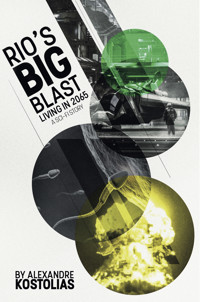
The year is 2065. Rio de Janeiro, Brazil, is getting ready to celebrate its 500th anniversary. Ten million people will attend the event at the giant Copacabana Beach Park. Billions will watch on colossal screens spread throughout the Solar System. However, at midnight, something unprecedented and bombastic will, and is about to happen. Bruna is perhaps the last human female of her species who wants to be loved, wants to be a mother, and who wants to love and nurture her own children. Her civil cohabitant Maxim is too busy piloting spaceships to and from Planet Mars to offer her any attention. Bruna fears he's, at least in part, an android. An immersion into what things will be like living in Rio, living in Brazil, living on planet Earth, living on the Moon, and living on other planets in the Solar System. More significantly, this is an essay that seeks to address the overwhelming, startling, and unavoidable issue of whom and what we human beings will have become by 2065.
Sie lesen das E-Book in den Legimi-Apps auf:
Seitenzahl: 94
Veröffentlichungsjahr: 2017
Ähnliche


















Rio’s Big Blast – Living in 2065
The year is 2065. Rio de Janeiro, Brazil, is getting ready to celebrate its 500th anniversary. Ten million people will attend the event at the giant Copacabana Beach Park. Billions will watch on colossal screens spread throughout the Solar System. However, at midnight, something unprecedented and bombastic will, and is about to happen.
Bruna is perhaps the last human female of her species who wants to be loved, wants to be a mother, and who wants to love and nurture her own children. Her civil cohabitant Maxim is too busy piloting spaceships to and from Planet Mars to offer her any attention. Bruna fears he’s, at least in part, an android.
An immersion into what things will be like living in Rio, living in Brazil, living on planet Earth, living on the Moon, and living on other planets in the Solar System.
More significantly, this is an essay that seeks to address the overwhelming, startling, and unavoidable issue of whom and what we human beings will have become by 2065.
About the Author
Alexandre Kostolias was born in Rio de Janeiro, Brazil, in 1949. He lived his early years and part of his adult life in the United States, mostly in San Francisco, California. He travelled to over forty countries in the Americas, Europe, North Africa and Asia. He graduated in International Relations (Magna cum Laude, 1985) from San Francisco State University and attended the University of California, Berkeley. Later, back to Rio, he published four books in Portuguese, including two novels.
Alexandre Kostolias sees himself as a Brazilian writer who aspires to become a citizen of the world and believes that “there is no road map to peace, that peace is the road map”, a habit, a culture, a way of coexisting.
We just belong to a small planet lost in the universe.
Credits
© Jaguatirica, 2017 All rights reserved.
Library of Congress – United States Copyright Office
Registration Number: TXu 2- 050-206, April 04, 2017
Title: Rio’s Big Blast – Living in 2065
Author: Alexandre Kostolias
Adapted, expanded and freely translated by the author from the original Portuguese language edition of the sci-fi story entitled “o quinto centenário” (“the fifth centennial”), in “Rio em seis tempos”, by Alexandre Kostolias, editora Jaguatirica, Rio de Janeiro, 2015 conceived, expanded and adapted by Alexandre Kostolias this edition published in 2017 by Editora Jaguatirica, Rio de Janeiro, Brazil. Planet Earth version
publisher Paula Cajaty
digital publishing 54 Design
cover design Rodrigo Herzog
revised Robert Bozina and Alexandre Kostolias
Issued in electronic format.
isbn 978-85-5662-101-6
Jaguatirica
rua da Quitanda, 86, 2º andar, Centro
20091-902 Rio de Janeiro rj
tel. [21] 4141-5145, [21] 3500-1390
editorajaguatirica.com.br
***
This is a work of fiction. Names, characters, places, events, and incidents past, present or future, are the product of the author’s imagination or are used fictitiously. Any resemblance to actual persons, living or dead, events, corporations (and their products), institutions, organizations or locales is entirely coincidental.
Futuristic neologisms in italics
***
Rio’s big blast – living in 2065 , a sci-fi story, is the author’s first book (e-book version) published in English and is an adaptation and enlargement of his futuristic short story “O quinto centenário” (translates as “The fifth centennial”), included in the book “Rio em seis tempos”, published by editora Jaguatirica, Rio de Janeiro, 2015.
Contents
Rio’s Big Blast – Living in 2065
ONE
TWO
THREE
FOUR
FIVE
SIX
SEVEN
EIGHT
to Alessandra
ONE
Emerging from the depths of the Lagoon1 in her Speedam LX Chameleon, Bruna1431KL was glamorous and smartly dressed. The Speedam, a third generation electrically powered air, surface and submarine transport vehicle displayed black and yellow stripes on its panels. Black and yellow were the perfect colors for heavy traffic. Speedily moving into the RB2 (#2) III Tunnel, Bruna1431KL heard the double beep generated by the toll machine indicating it had charged her Monthly Transit Account. She knew the charge was to be 200 New Reais (about 100 US$).
Heading toward Tom Jobim Spaceport (TJSP) at 250 km (160 mph) an hour, the vehicle levitated magnetically and nearly touched the titanium rails of the RBIII Tunnel. Like all vehicles transiting the tunnel, the Speedam was self-driving and interacted with the immediate environment. As long as systems didn’t malfunction, the tunnel was free from vehicle crashes. Regrettably, at times systems did malfunction. But according to Bruna’s Sphynx on-board oracle this wouldn’t happen today; a smooth ride was forecasted. Also according to Sphynx, she would overfly the spaceport’s vicinity in 3 minutes and 37 seconds. However, also according to her oracle, as soon as she reached massive TJSP, her self-driving (and self-parking) car would waste 54 minutes trying to find parking space before it docked itself in the 20-story underground parking lot.
– Sh%$##!, she moaned in anticipated frustration, while retouching her Perenial27 make up, prepared with Rejuvenium, a skin-regenerating substance. It was brought in from planet Mars by Bruna’s civilcohabitant, Maxim3131ZX.
Maxim was a spaceship pilot in the recently opened Riosp-Mars space shuttle. TJSP was one of the 12 locations in the planet, the only one in the ULATAM (União Latino Americana, a Latin American Confederation) from where space voyages departed. Other spaceports were located in New York, Las Vegas, Singapore, Shanghai, Okinawa, Moscow, Nice, London, Mumbai, Dubai and Johannesburg. A few more were under construction.
Score one for Riosp, an immense conurbation of 40 million people that included the former metropolitan areas of Rio de Janeiro and São Paulo (Sampario had been another name option for the megalopolis, but it was decided that Riosp had more touristic appeal).
Both ends of Riosp were now completely integrated by 18 main lines of High-Speed Metro plus a number of branch lines. Therefore, passengers who boarded the Central Subway Station in São Paulo, built uphill and far away from the coast, could reach Ipanema Beach Station, in Rio, in exactly 34 minutes. The paulistas’ (São Paulo dwellers) long-awaited dream of a quick ride to the beach did finally come true.
Meanwhile, a Magway composed of 22 magnetic levitation lanes for all sorts of vehicles, gave access to a mega touristic region along the Green Coast, featuring about 600 resorts and 6000 inns.
Trips to Mars were the planetary buzz of 2065. Package tours to the Moon, less exclusive and much less expensive, were still popular in people’s imagination. But truly sophisticated couples were no longer impressed by those “Honeymoon on the Moon!” travel industry sleazy ads which had been the planetary craze only 20 years before.
The Moon had become nothing but a frantic nightmare, with its colossal casinos entertaining innumerable amounts of customers in every imaginable way. Many gamblers systematically won millions of astrodollars (the currency used on the Moon and some planets of the Solar System) at late night just to lose every astropenny before breakfast. Many enjoyed the excitement of having become fake millionaires for a few hours. Others found the frustration of having lost all their “fortunes” too hard to bear and would commit suicide in front of an applauding crowd by shooting themselves. With fake bullets, of course, so nobody got hurt. That was regarded as top entertainment. The whole idea was to provide high-adrenalin amusement to masses that lived their daily lives in a permanent state of boredom.
In addition, there was a wide choice of lunar extravaganza options, from 5 star, highly luxurious shopping malls catering to pampered, narcissistic consumers, to honeymooners’ love nests of all kinds. There were even sexual fantasies’ theme parks.
Lunar entertainment developers had built not only gigantic casinos, but also many non-gambling businesses such as no-drugs-banned convenience stores, intelligent drugs’ spas, destination-wedding facilities, vintage rock shows in 4 dimensions, and demented rapture concerts, for those who chose to go irreversibly insane.
In strictly technical terms, a trip to the Moon was a very simple matter, it’s so nearby. On the other hand, an all-inclusive package tour to Mars had to wait a few more years. Now, it had become yet another product offered by the travel industry.
It was only after nuclear fusion was mastered and safely employed in space crafts that trips to Mars became commercially feasible. Combined with the development of magnetic technology and the use of gravitational forces, the new technology was a game changer, an outstanding breakthrough in interplanetary navigation. It freed humankind from remaining restricted to the Solar System; it emancipated humans from the isolation of Solar System confinement.
In 2065 travel time between planet Earth and either to Liberty Mars Spaceport, leased by NASA to a multinational corporation, or to the Russian-Chinese Gagarin New Beijing Cosmodrome, an inter-governmental joint venture, had been reduced to a mere 12 Earth hours. It was even possible to diminish the actual cruising time of the journey between the Blue Planet and the Red Planet in case of emergency. But it wasn´t advisable: 12 hours was the bare minimum time in commercial flights for interplanetary acclimatization. It was essential to adapt visitors to the specific conditions of planet Mars, and it was prudent not to aggravate the disturbing consequences of space lag.
1 Lagoa is a natural lagoon located in the middle of Rio de Janeiro’s prestigious South Zone, a coastal area, and is surrounded by residential neighborhoods.
2 RB stands for Rebouças, the name of the tunnel that connects Rio’s South Zone with the North Zone
TWO
When Bruna was just about to get off the city tunnel, she took a quick look at the cabin’s display panel, a miracle (or perhaps a nightmare) of digital technology. With a quick facial contraction, she moved her left ear lobe slightly downward turning off her implanted wise phone. Bruna couldn’t stand any longerthe uninterrupted flow of incoming calls, either commercial or personal, that she got 24 by 7. No wonder, Bruna had about 7 million virtual friends spread over hundreds of social network groups from different planets. Paradoxically, in her everyday life, Bruna wasn’t sure she could count seven real friends.
She also became fidgety for having to sit pretty on the driver´s seat and do absolutely nothing but retouch her make up. Self-driving cars were sooo boring.
As she was finally getting off the tunnel and her vehicle was gaining momentum on the take-off ramp, Bruna switched the car’s operational mode back to manual driving and felt a sensation of immediate relief. Following instructions she had received from the Urban Traffic controllers, she made the vehicle ascend to the 1900 feet level sky lane and through a voice command she accelerated it to 480 km (300 miles) an hour. She felt mighty, she felt empowered. Wow, what a feeling!
Bruna1431KL was a licensed real estate broker dealing with housing projects on the Moon. She was a typical carioca (people born in Rio de Janeiro) in many ways. Fun-loving, impatient and, at times, temperamental, Bruna was passionate about everything she did.
She reset the Chameleon photosensitive vehicle’s outer body panel to display the recently-adopted Brazilian flag; Maxim disapproved the new version. While keeping the green field and the yellow quadrangular rhombus, the rather old-fashioned national motto “Order and Progress” had to go in these neo politically-correct




