


65,99 €
Mehr erfahren.
- Herausgeber: John Wiley & Sons
- Kategorie: Wissenschaft und neue Technologien
- Sprache: Englisch
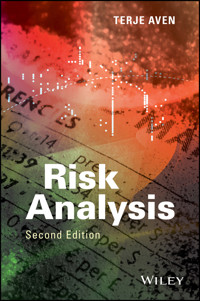
A practical guide to the varied challenges presented in the ever-growing field of risk analysis.
Risk Analysis presents an accessible and concise guide to performing risk analysis, in a wide variety of field, with minimal prior knowledge required. Forming an ideal companion volume to Aven's previous Wiley text Foundations of Risk Analysis, it provides clear recommendations and guidance in the planning, execution anduse of risk analysis.
This new edition presents recent developments related to risk conceptualization, focusing on related issues on risk assessment and their application. New examples are also featured to clarify the reader's understanding in the application of risk analysis and the risk analysis process.
Key features:
- Fully updated to include recent developments related to risk conceptualization and related issues on risk assessments and their applications.
- Emphasizes the decision making context of risk analysis rather than just computing probabilities
- Demonstrates how to carry out predictive risk analysis using a variety of case studies and examples.
- Written by an experienced expert in the field, in a style suitable for both industrial and academic audiences.
This book is ideal for advanced undergraduates, graduates, analysts and researchers from statistics, engineering, finance, medicine and physical sciences. Managers facing decision making problems involving risk and uncertainty will also benefit from this book.
Sie lesen das E-Book in den Legimi-Apps auf:
Seitenzahl: 353
Veröffentlichungsjahr: 2015
Ähnliche















Table of Contents
Cover
Title Page
Copyright
Preface
Chapter 1: What is a risk analysis?
1.1 Why risk analysis?
1.2 Risk management
1.3 Examples: decision situations
chapter 2: What is risk?
2.1 The risk concept and its description
2.2 Vulnerability
2.3 How to describe risk quantitatively
2.4 Qualitative judgements
Chapter 3: The risk analysis process: planning
3.1 Problem definition
3.2 Selection of analysis method
Chapter 4: The risk analysis process: risk assessment
4.1 Identification of initiating events
4.2 Cause analysis
4.3 Consequence analysis
4.4 Probabilities and uncertainties
4.5 Risk picture: risk presentation
Chapter 5: The risk analysis process: risk treatment
5.1 Comparisons of alternatives
5.2 Management review and judgement
Chapter 6: Risk analysis methods
6.1 Coarse risk analysis
6.2 Job safety analysis
6.3 Failure modes and effects analysis
6.4 Hazard and operability studies
6.5 SWIFT
6.6 Fault tree analysis
6.7 Event tree analysis
6.8 Bayesian networks
6.9 Monte Carlo simulation
Chapter 7: Safety measures for a road tunnel
7.1 Planning
7.2 Risk assessment
7.3 Risk treatment
Chapter 8: Risk analysis process for an offshore installation
8.1 Planning
8.2 Risk analysis
8.3 Risk picture and comparison of alternatives
8.4 Management review and judgement
Chapter 9: Production assurance
9.1 Planning
9.2 Risk analysis
9.3 Risk picture and comparison of alternatives
9.4 Management review and judgement. Decision
Chapter 10: Risk analysis process for a cash depot
10.1 Planning
10.2 Risk analysis
10.3 Risk picture
10.4 Risk-reducing measures
10.5 Management review and judgement. Decision
10.6 Discussion
Chapter 11: Risk analysis process for municipalities
11.1 Planning
11.2 Risk assessment
11.3 Risk treatment
Chapter 12: Risk analysis process for the entire enterprise
12.1 Planning
12.2 Risk analysis
12.3 Overall risk picture
12.4 Risk treatment
Chapter 13: Discussion
13.1 Risk analysis as a decision support tool
13.2 Risk is more than the calculated probabilities and expected values
13.3 Risk analysis has both strengths and weaknesses
13.4 Reflection on approaches, methods and results
13.5 Limitations of the causal chain approach
13.6 Risk perspectives
13.7 Scientific basis
13.8 The implications of the limitations of risk assessment
13.9 Critical systems and activities
13.10 On the difference between risk as seen from the perspectives of the analysts and management
13.11 Conclusions
Appendix A: Probability calculus and statistics
A.1 The meaning of a probability
A.2 Probability calculus
A.3 Probability distributions: expected value
A.4 Statistics (Bayesian statistics)
Appendix B: Introduction to reliability analysis
B.1 Reliability of systems composed of components
B.2 Production system
B.3 Safety system
Appendix C: Approach for selecting risk analysis methods
C.1 Expected consequences
C.2 Uncertainty factors
C.3 Frame conditions
C.4 Selection of a specific method
Appendix D: Terminology
D.1 Risk management: Relationships between key terms
Bibliography
Index
End User License Agreement
Pages
ix
x
xi
1
2
3
4
5
6
7
8
9
10
11
12
13
14
15
16
17
18
19
20
21
22
23
24
25
26
27
28
29
30
31
32
33
34
35
36
37
38
39
40
41
42
43
44
45
46
47
48
49
50
51
52
53
54
55
56
57
58
59
60
61
62
63
64
65
66
67
68
69
70
71
72
73
74
75
76
77
78
79
80
81
82
83
84
85
86
87
88
89
90
91
92
93
94
95
96
97
98
99
100
101
102
103
104
105
106
107
108
109
110
111
112
113
114
115
116
117
118
119
120
121
122
123
124
125
126
127
128
129
130
131
132
133
134
135
136
137
138
139
140
141
142
143
144
145
146
147
148
149
150
151
152
153
154
155
156
157
158
159
160
161
162
163
164
165
166
167
168
169
170
171
172
173
174
175
176
177
178
179
180
181
182
183
184
185
186
187
188
189
190
191
192
193
194
195
196
197
Guide
Cover
Table of Contents
Preface
Begin Reading
List of Illustrations
Chapter 1: What is a risk analysis?
Figure 1.1 Example of a bow-tie.
Figure 1.2 The main steps of the risk analysis process.
Figure 1.3 A model for decision-making under uncertainty (Aven 2012d).
chapter 2: What is risk?
Figure 2.1 Risk description for two events and , with associated expectations and .
Figure 2.2 Risk description based on four consequence categories.
Figure 2.3 Example of a risk matri2. The in column shows that there is a probability greater than 0.5 for consequence . The numbers are conditional that the person is ill.
Figure 2.4 Example of a risk matri2. The category ‘Unlikely’ corresponds to a prediction of one event in 50 years or more, ‘Low probability’ corresponds to a prediction of one event in 10–50 years and so on.
Figure 2.5 Example of an F–N curve (Frequency–Number of fatalities).
Figure 2.6 Example of a risk matrix, where the assignments are supported by strong, medium and weak background knowledge. Strong knowledge: •, medium strong knowledge: : and weak knowledge: .
Chapter 4: The risk analysis process: risk assessment
Figure 4.1 Hazard identification.
Figure 4.2 Use of fault trees.
Figure 4.3 Cause analysis for disconnection from server (shutdown).
Figure 4.4 Probability of various consequences should the undesirable event occur.
Figure 4.5 Example of a risk matri4.
Figure 4.6 Example of sensitivity analysis.
Chapter 6: Risk analysis methods
Figure 6.1 Probability (frequency)–consequence diagram.
Figure 6.2 Storage tank example.
Figure 6.3 Fault tree symbols.
Figure 6.4 Functional element in a reliability block diagram.
Figure 6.5 Correspondence between reliability block diagrams and fault trees.
Figure 6.6 Fault tree for the top event ‘overfilling of the tank’.
Figure 6.7 Reliability block diagram for the fault tree in Figure 6.6.
Figure 6.8 The minimal cut set representation of the system in Figure 6.7.
Figure 6.9 Event tree example. Here means ‘not ’ and so on.
Figure 6.10 Example of a Bayesian network.
Chapter 7: Safety measures for a road tunnel
Figure 7.1 Categorisation of people in the tunnel.
Chapter 8: Risk analysis process for an offshore installation
Figure 8.1 Barrier block diagram.
Figure 8.2 Fault tree for failure of a barrier.
Figure 8.3 Example of influence diagram. HMI: Human Machine Interface.
Figure 8.4 Accident development modelled using an event tree.
Figure 8.5 Risk description showing the probability of occurrence of two scenarios and the associated expected number of fatalities.
Chapter 9: Production assurance
Figure 9.1 Flow network models for alternatives and .
Chapter 10: Risk analysis process for a cash depot
Figure 10.1 Event tree for the threat attack.
Chapter 11: Risk analysis process for municipalities
Figure 11.1 Probability distribution associated with the consequences of a bus accident.
Figure 11.2 Risk matrix based on expected loss. Events with large uncertainty with respect to outcome are highlighted (grey).
Chapter 12: Risk analysis process for the entire enterprise
Figure 12.1 Prices for two products per month.
Figure 12.2 A standard risk description with components and . Here the 's represent specified values for two different events.
Figure 12.3 Risk description based on the components, expected consequence and uncertainty in the underlying phenomena and processes. The 's represent risk determined for two different events.
Chapter 13: Discussion
Figure 13.1 Improper use of the risk matrix, with scores based on categories 1–5.
Figure 13.2 Risk matrix, with scores based on the expected number of fatalities.
Appendix B: Introduction to reliability analysis
Figure B.1 Parallel system.
Figure B.2 Series system.
Figure B.3 System comprising three components.
Appendix C: Approach for selecting risk analysis methods
Figure C.1 Risk matrix 1 for water supply example. Expected consequences given the occurrence of a failure.
Figure C.2 Risk matrix 2 for water supply example.
List of Tables
Chapter 1: What is a risk analysis?
Table 1.1 Main categories of risk analysis methods
Chapter 3: The risk analysis process: planning
Table 3.1 Example of a checklist for selection of analysis method—road tunnels
Chapter 6: Risk analysis methods
Table 6.1 Example of an analysis form for a coarse risk analysis of a road tunnel
Table 6.2 Summary of identified hazards
Table 6.3 Completed FMEA form for storage tank example components LSH, LSHH and V1
Table 6.4 Completed FMEA form for storage tank example components V2 and V3
Table 6.5 Example of a checklist for use in SWIFT analyses
Table 6.6 Conditional probabilities
Chapter 7: Safety measures for a road tunnel
Table 7.1 List of typical undesirable events at different specification levels
Table 7.2 Examples of assumptions made in the risk analysis
Table 7.3 Results from the risk analysis
Chapter 8: Risk analysis process for an offshore installation
Table 8.1 Result summary for the risk analysis. Overall assessments of modification and measures
Table 8.2 Result summary for the risk analysis. Uncertainty factors
Chapter 9: Production assurance
Table 9.1 Capacity of the equipment units, alternative
Table 9.2 Capacity of the equipment units, alternative
Table 9.3 Unavailabilities for the equipment
Table 9.4 Expected production for alternatives and
Chapter 11: Risk analysis process for municipalities
Table 11.1 Consequence categories
Table 11.2 Categories of frequency/probability
Table 11.3 Main categories of events
Table 11.4 Selected events
Chapter 12: Risk analysis process for the entire enterprise
Table 12.1 Prices for Two Products Per Month
Table 12.2 Means and Empirical Standard Deviations
Table 12.3 The Number of Persons Who Develop Serious Health Problems Over a Given Period of Time
Table 12.4 Simplified Risk Picture
Appendix C: Approach for selecting risk analysis methods
Table C.1 Classification based on expected consequences—example from a water supply operation (Wiencke et al. 2006)
Table C.2 Factors that can produce a significant deviation between the expected value and the actual consequences—an example from water supply operations
Table C.3 Frame conditions (example from a water supply operation)
Risk Analysis
Second Edition
Terje Aven
University of Stavanger, Norway
This edition first published 2015
© 2015 John Wiley & Sons, Ltd
Registered office
John Wiley & Sons Ltd, The Atrium, Southern Gate, Chichester, West Sussex, PO19 8SQ, United Kingdom
For details of our global editorial offices, for customer services and for information about how to apply for permission to reuse the copyright material in this book please see our website at www.wiley.com.
The right of the author to be identified as the author of this work has been asserted in accordance with the UK Copyright, Designs and Patents Act 1988.
All rights reserved. No part of this publication may be reproduced, stored in a retrieval system, or transmitted, in any form or by any means, electronic, mechanical, photocopying, recording or otherwise, except as permitted by the UK Copyright, Designs and Patents Act 1988, without the prior permission of the publisher.
Wiley also publishes its books in a variety of electronic formats. Some content that appears in print may not be available in electronic books.
Designations used by companies to distinguish their products are often claimed as trademarks. All brand names and product names used in this book are trade names, service marks, trademarks or registered trademarks of their respective owners. The publisher is not associated with any product or vendor mentioned in this book.
Limit of Liability/Disclaimer of Warranty: While the publisher and author(s) have used their best efforts in preparing this book, they make no representations or warranties with respect to the accuracy or completeness of the contents of this book and specifically disclaim any implied warranties of merchantability or fitness for a particular purpose. It is sold on the understanding that the publisher is not engaged in rendering professional services and neither the publisher nor the author shall be liable for damages arising herefrom. If professional advice or other expert assistance is required, the services of a competent professional should be sought.
Library of Congress Cataloging-in-Publication Data
Aven, Terje.
Risk analysis / Terje Aven. – Second edition.
pages cm
Previous edition: 2008.
Includes bibliographical references and index.
ISBN 978-1-119-05779-6 (cloth)
1. Risk assessment–Mathematical models. 2. Risk–Mathematical models.
3. Uncertainty–Mathematical models. I. Title.
HD61.A938 2015
338.5–dc23
2015018045
A catalogue record for this book is available from the British Library.
ISBN: 9781119057796
Preface
This book is about risk analysis—basic ideas, principles and methods. Both theory and practice are covered. A number of books exist presenting the many risk analysis methods and tools, such as fault tree analysis, event tree analysis and Bayesian networks. In this book we go one step back and discuss the role of the analyses in risk management. How such analyses should be planned, executed and used, such that they meet the professional standards for risk analyses and at the same time are useful in a practical decision-making context. In the book we review the common risk analysis methods, but the emphasis is placed on the context and applications. By using examples from different areas, we highlight the various elements that are part of the planning, execution and use of the risk analysis method. What are the main challenges we face? What type of methods should we choose? How can we avoid scientific mistakes? The examples used are taken from, among others, the transport sector, the petroleum industry and ICT (Information and Communication Technology). For each example we define a decision-making problem, and show how the analyses can be used to provide adequate decision support. The book covers both safety (accidental events) and security (intentional acts).
This book is based on the recommended approach to risk analysis described and discussed in Aven (2012a,d). The basic idea is that risk analysis should produce a broad risk picture, highlighting uncertainties beyond expected values and probabilities. The aim of the risk analysis is to predict unknown physical quantities, such as the explosion pressure, the number of fatalities, costs and so on, and assess uncertainties. A probability is not a perfect tool for expressing the uncertainties we have to acknowledge that the assigned probabilities are subjective probabilities conditional on a specific background knowledge. The assigned probabilities could produce poor predictions. The main component of risk is uncertainty, not probability. Surprises relative to the assigned probabilities may occur and by just addressing probabilities such surprises may be overlooked.
It has been a goal to provide a simplified presentation of the material, without diminishing the requirement for precision and accuracy. In this book, technicalities are reduced to a minimum, instead ideas and principles are highlighted. Reading the book requires no special background, but for certain parts it would be beneficial to have a knowledge of basic probability theory and statistics. It has, however, been a goal to reduce the dependency on extensive prior knowledge of probability theory and statistics. The key statistical concepts are introduced and discussed thoroughly in the book. Appendix A summarises some basic probability theory and statistical analysis. This makes the book more self-contained, and it gives the book the required sharpness with respect to relevant concepts and tools.
We have also included a brief appendix covering basic reliability analysis, so that the reader can obtain the necessary background for calculating the reliability of a safety system.
This book is primarily about planning, execution and use of risk analyses, and it provides clear recommendations and guidance in this context. However, it is not a recipe-book, telling you which risk analysis methods should be used in different situations. What is covered, is the general thinking process related to the planning, execution and use of risk analyses. Examples are provided to illustrate this process.
This book is based on and relates to the research literature in the field of risk, risk analysis and risk management.
Some of the premises for the approach taken in the book as well as some areas of scientific dispute are looked into in a special ‘Discussion’ chapter (Chapter 13). The issues addressed include the risk concept, the use of risk acceptance criteria and the definition of safety critical systems.
The target audience for the book is primarily professionals within the risk analysis and risk management fields, but others, in particular managers and decision-makers, can also benefit from the book. All those working with risk-related problems need to understand the fundamental principles of risk analysis.
This book is based on a Norwegian book on risk analysis (Aven et al. 2008), with co-authors Willy Røed and Hermann S. Wiencke. The present version is, however, more advanced and includes topics that are not included in Aven et al. (2008).
The terminology used in the book is summarised in Appendix D.
Our approach means a humble attitude to risk and the possession of the truth, and hopefully it will be more attractive also to social scientists and others, who have strongly criticised the prevalent thinking of risk analysis and evaluation in the engineering environment. Our way of thinking, to a large extent, integrates technical and economic risk analyses and the social scientist perspectives on risk. As a main component of risk is uncertainty about the world, risk perception has a role to play to guide decision-makers. Professional risk analysts do not have the exclusive right to describe risk.
Acknowledgements
A number of individuals have provided helpful comments and suggestions to this book. In particular, I would like to acknowledge my co-authors of Aven et al. (2008), Willy Røed and Hermann S. Wiencke. Chapters 7 and 11 are mainly due to Willy and Hermann; thanks to both. I am also grateful to Eirik B. Abrahamsen and Roger Flage for the great deal of time and effort they spent reading and preparing comments.
For financial support, thanks to the University of Stavanger, and the Research Council of Norway.
I also acknowledge the editing and production staff at Wiley for their careful work.
January 2009, Terje Aven
Preface Second Edition
In this second edition I have updated the book with the most recent developments related to risk conceptualization and related issues on risk assessments and their use. Chapter 2 is to large extent rewritten, and some adjustments have also been made in the other chapters to be in line with the new Chapter 2. In the discussion Chapter 13, a new section on the difference between risk as seen from the perspectives of the analysts and management, is included. Also a number of misprints have been corrected.
Terje Aven
Chapter 1What is a risk analysis?
A main objective of a risk analysis is to describe risk, that is, to present an informative risk picture. Figure 1.1 illustrates important building blocks of such a risk picture. Located at the centre of the figure is the initiating event (the hazard, the threat, the opportunity), which we denote by . In the example, the event is that a person (John) contracts a specific disease. An important task in the risk analysis is to identify such initiating events. In our example, we may be concerned about various diseases that could affect the person. The left side of the figure illustrates the causal picture that may lead to the event . The right side describes the possible consequences of .
Figure 1.1 Example of a bow-tie.
On the left side are barriers that are introduced to prevent the event from occurring; these are the probability reducing or preventive barriers. Examples of such barriers are medical check-ups/examinations, vaccinations and limiting the exposure to contamination sources. On the right side are barriers to prevent the disease (event A) from bringing about serious consequences, the consequence-reducing barriers. Examples of such barriers are medication and surgery. The occurrence of and performance of the various barriers are influenced by a number of factors—the so-called risk-influencing or performance-influencing factors. Examples are the quality of the medical check-ups; the effectiveness of the vaccine, drug or surgery; what is known about the disease and what causes it; lifestyle, nutrition and inheritance and genes.
Lesen Sie weiter in der vollständigen Ausgabe!
Lesen Sie weiter in der vollständigen Ausgabe!
Lesen Sie weiter in der vollständigen Ausgabe!
Lesen Sie weiter in der vollständigen Ausgabe!
Lesen Sie weiter in der vollständigen Ausgabe!
Lesen Sie weiter in der vollständigen Ausgabe!
Lesen Sie weiter in der vollständigen Ausgabe!
Lesen Sie weiter in der vollständigen Ausgabe!
Lesen Sie weiter in der vollständigen Ausgabe!
Lesen Sie weiter in der vollständigen Ausgabe!
Lesen Sie weiter in der vollständigen Ausgabe!
Lesen Sie weiter in der vollständigen Ausgabe!
Lesen Sie weiter in der vollständigen Ausgabe!
Lesen Sie weiter in der vollständigen Ausgabe!
Lesen Sie weiter in der vollständigen Ausgabe!
Lesen Sie weiter in der vollständigen Ausgabe!
Lesen Sie weiter in der vollständigen Ausgabe!
Lesen Sie weiter in der vollständigen Ausgabe!
Lesen Sie weiter in der vollständigen Ausgabe!




