


69,99 €
Mehr erfahren.
- Herausgeber: John Wiley & Sons
- Kategorie: Wissenschaft und neue Technologien
- Sprache: Englisch
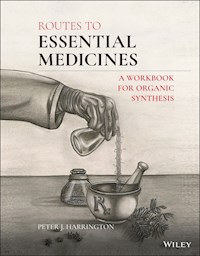
This comprehensive workbook helps readers become familiar with the structures and synthetic challenges associated with nearly 300 essential medicines and gain the skills needed for pharmaceutical development.
- Highlights nearly three hundred medicines on the latest World Health Organization (WHO) Model List of Essential Medicines and their manufacturing routes
- Features exercises that equip students with the skills necessary to solve similar real-world problems
- Includes a retrosynthetic analysis for each commodity chemical and supplies an extensive list of key journal and information sites and a library of reagents, solvents, and conditions for many common organic reactions
Sie lesen das E-Book in den Legimi-Apps auf:
Seitenzahl: 355
Veröffentlichungsjahr: 2021
Ähnliche


















Table of Contents
Cover
Title Page
Copyright Page
Dedication Page
About the Companion Website
Introduction
A
Abacavir
Acetazolamide
Acetylcysteine
Acetylsalicylic Acid
Acyclovir
Albendazole
Allopurinol
Amidotriazoate
Amikacin
Amiloride
4‐Aminosalicylic Acid
Amiodarone
Amitriptyline
Amlodipine
Amodiaquine
Amoxicillin
Ampicillin
Anastrozole
Artemether
Artesunate
Ascorbic Acid
Atazanavir
Atracurium Besylate
Atropine
Azathioprine
Azithromycin
Aztreonam
B
Beclomethasone Dipropionate
Bedaquiline
Bendamustine
Benznidazole
Benzoyl Peroxide
Benzyl Benzoate
Betamethasone
Bicalutamide
Biperiden
Bisoprolol
Budesonide
Bupivacaine
C
Caffeine
Calcium Folinate/Folinic Acid
Capecitabine
Carbamazepine
Cefalexin
Cefazolin
Cefepime
Cefixime
Cefotaxime
Ceftaroline
Ceftazidime
Ceftriaxone
Chlorambucil
Chloramphenicol
Chlorhexidine
Chloroquine
Chloroxylenol
Chlorpromazine
Ciprofloxacin
Cisplatin, Carboplatin, Oxaliplatin
Clarithromycin
Clindamycin
Clofazimine
Clomifene
Clomipramine
Clopidogrel
Cloxacillin
Clotrimazole
Clozapine
Codeine
Colecalciferol
Cyclizine
Cyclophosphamide
Cycloserine
Cytarabine
D
Dacarbazine
Daclatasvir
Dapsone
Darunavir
Dasabuvir
Dasatinib
Delamanid
Desmopressin
Dexamethasone
Diazepam
Diethylcarbamazine
Dihydroartemisinin
Diloxanide Furoate
Dimercaprol
Docetaxel
Docusate Sodium
Dolutegravir
Dopamine
Doxycycline
E
Efavirenz
Eflornithine
Emtricitabine
Enalapril
Entecavir
Ephedrine
Epinephrine
Ergocalciferol
Ergometrine
Estradiol Cypionate
Ethambutol
Ethinylestradiol
Ethionamide
Ethosuximide
Etonogestrel
Etoposide
F
Fentanyl
Fluconazole
Flucytosine
Fludarabine Phosphate
Fludrocortisone Acetate
Fluorouracil
Fluoxetine
Fluphenazine
Folic Acid
Fomepizole
Formoterol
Fosfomycin
Furosemide
G
Gemcitabine
Gliclazide
Glutaral
Glyceryl Trinitrate
H
Haloperidol
Halothane
Hydralazine
Hydrochlorothiazide
Hydrocortisone
Hydroxycarbamide
Hydroxychloroquine
Hyoscine Butylbromide
I
Ibuprofen
Ifosfamide
Imatinib
Iohexol
Ipratropium Bromide
Irinotecan
Isoflurane
Isoniazid
Isosorbide Dinitrate
Itraconazole
Ivermectin
K
Ketamine
L
Lactulose
Lamivudine
Lamotrigine
Latanoprost
Ledipasvir
Leuprorelin
Levamisole
Levofloxacin
Levonorgestrel
Levothyroxine
Lidocaine
Linezolid
Loperamide
Lopinavir
Loratidine
Lorazepam
Losartan Potassium
Lumefantrine
M
Mannitol
Mebendazole
Medroxyprogesterone Acetate
Mefloquine
Meglumine Iotroxate
Melarsoprol
Mercaptopurine
Meropenem
Mesna
Metformin
Methadone
Methotrexate
Methyldopa
Methylprednisolone
Methylthioninium Chloride
Metoclopramide
Metronidazole
Miconazole
Midazolam
Mifepristone
Miltefosine
Misoprostol
Moxifloxacin
N
Naloxone
Neostigmine Methylsulfate
Nevirapine
Niclosamide
Nicotinamide
Nifedipine
Nifurtimox
Nilotinib
Nitrofurantoin
Norethisterone and Norethisterone Enanate
O
Ofloxacin
Ombitasvir
Omeprazole
Ondansetron
Oseltamivir
Oxamniquine
Oxytocin
P
Paclitaxel
Paracetamol
Paritaprevir
Penicillamine
Pentamidine
Permethrin
Phenobarbital
Phenytoin
Piperacillin
Piperaquine
Praziquantel
Prednisolone
Primaquine
Procarbazine
Progesterone
Proguanil
Propofol
Propranolol
Propylthiouracil
Prostaglandin E
1
Prostaglandin E
2
Pyrantel
Pyrazinamide
Pyridoxine
Pyridostigmine Bromide
Pyrimethamine
Pyronaridine
R
Raltegravir
Ranitidine
Retinoic Acid (All‐
trans
)
Retinol (Vitamin A
1
)
Ribavirin
Rifabutin
Rifampicin
Rifapentine
Risperidone
Ritonavir
S
Salbutamol
Simeprevir
Simvastatin
Sodium Calcium Edetate
Sofosbuvir
Spironolactone
Succimer
Sulfadiazine and Silver Sulfadiazine
Sulfadoxine
Sulfamethoxazole
Sulfasalazine
Suramin
Suxamethonium Chloride
T
Tamoxifen
Tazobactam
Tenofovir Disoproxil
Terbinafine
Testosterone
Tetracaine
Tetracycline
Thiamine
Tigecycline
Timolol
Tranexamic Acid
Triclabendazole
Trimethoprim
Tropicamide
U
Ulipristal Acetate
V
Valganciclovir
Valproic Acid
Vecuronium Bromide
Velpatasvir
Verapamil
Vincristine
Vinorelbine
Voriconazole
W
Warfarin
X
Xylometazoline
Z
Zidovudine
Zoledronic Acid
A Demonstration: Amiodarone
References
Index
End User License Agreement
Guide
Cover Page
Title Page
Copyright Page
Dedication Page
About the Companion Website
Introduction
Table of Contents
Begin Reading
A Demonstration: Amiodarone
Index
Wiley End User License Agreement
Pages
iii
iv
v
vi
xiv
xv
xvi
1
2
3
4
5
6
7
8
9
10
11
12
13
14
15
16
17
18
19
20
21
22
23
24
25
26
27
28
29
30
31
32
33
34
35
36
37
38
39
40
41
42
43
44
45
46
47
48
49
50
51
52
53
54
55
56
57
58
59
60
61
62
63
64
65
66
67
68
69
70
71
72
73
74
75
76
77
78
79
80
81
82
83
84
85
86
87
88
89
90
91
92
93
94
95
96
97
98
99
100
101
102
103
104
105
106
107
108
109
110
111
112
113
114
115
116
117
118
119
120
121
122
123
124
125
126
127
128
129
130
131
132
133
134
135
136
137
138
139
140
141
142
143
144
145
146
147
148
149
150
151
152
153
154
155
156
157
158
159
160
161
162
163
164
165
166
167
168
169
170
171
172
173
174
175
176
177
178
179
180
181
182
183
184
185
186
187
188
189
190
191
192
193
194
195
196
197
198
199
200
201
202
203
204
205
206
207
208
209
210
211
212
213
214
215
216
217
218
219
220
221
222
223
224
225
226
227
228
229
230
231
232
233
234
235
236
237
238
239
240
241
242
243
244
245
246
247
248
249
250
251
252
253
254
255
256
257
258
259
260
261
262
263
264
265
266
267
268
269
270
271
272
273
274
275
276
277
278
279
280
281
282
283
284
285
286
287
288
289
290
291
292
293
294
295
296
297
298
299
300
301
302
303
304
305
306
307
308
309
310
311
312
313
314
315
316
317
318
319
320
321
322
323
324
325
326
327
328
329
330
331
332
333
334
335
336
337
338
339
340
341
342
343
344
345
346
347
348
349
350
351
352
353
354
355
356
357
358
359
360
361
362
363
364
365
366
367
368
369
370
371
372
373
374
375
376
377
378
379
380
381
382
383
384
385
386
387
388
389
390
391
392
393
394
395
396
397
398
399
400
401
402
403
404
405
406
407
408
409
410
411
412
413
414
415
416
417
418
419
420
421
422
423
424
425
426
427
428
429
430
431
432
433
434
435
436
437
438
439
440
441
442
443
444
445
446
447
448
449
450
451
452
453
454
455
456
457
458
459
460
461
462
463
464
465
466
467
468
469
470
471
472
473
474
475
476
477
217
478
479
480
481
482
483
484
485
486
487
488
489
490
491
492
493
494
Routes to Essential Medicines
A Workbook for Organic Synthesis
Peter J. Harrington
Better Pharma Processes, LLC
Louisville, CO, USA
This edition first published 2022© 2022 John Wiley & Sons, Inc.
All rights reserved. No part of this publication may be reproduced, stored in a retrieval system, or transmitted, in any form or by any means, electronic, mechanical, photocopying, recording or otherwise, except as permitted by law. Advice on how to obtain permission to reuse material from this title is available at http://www.wiley.com/go/permissions.
The right of Peter J Harrington to be identified as the author of this work has been asserted in accordance with law.
Registered OfficeJohn Wiley & Sons, Inc., 111 River Street, Hoboken, NJ 07030, USA
Editorial Office111 River Street, Hoboken, NJ 07030, USA
For details of our global editorial offices, customer services, and more information about Wiley products visit us at www.wiley.com.
Wiley also publishes its books in a variety of electronic formats and by print‐on‐demand. Some content that appears in standard print versions of this book may not be available in other formats.
Limit of Liability/Disclaimer of WarrantyIn view of ongoing research, equipment modifications, changes in governmental regulations, and the constant flow of information relating to the use of experimental reagents, equipment, and devices, the reader is urged to review and evaluate the information provided in the package insert or instructions for each chemical, piece of equipment, reagent, or device for, among other things, any changes in the instructions or indication of usage and for added warnings and precautions. While the publisher and authors have used their best efforts in preparing this work, they make no representations or warranties with respect to the accuracy or completeness of the contents of this work and specifically disclaim all warranties, including without limitation any implied warranties of merchantability or fitness for a particular purpose. No warranty may be created or extended by sales representatives, written sales materials or promotional statements for this work. The fact that an organization, website, or product is referred to in this work as a citation and/or potential source of further information does not mean that the publisher and authors endorse the information or services the organization, website, or product may provide or recommendations it may make. This work is sold with the understanding that the publisher is not engaged in rendering professional services. The advice and strategies contained herein may not be suitable for your situation. You should consult with a specialist where appropriate. Further, readers should be aware that websites listed in this work may have changed or disappeared between when this work was written and when it is read. Neither the publisher nor authors shall be liable for any loss of profit or any other commercial damages, including but not limited to special, incidental, consequential, or other damages.
Library of Congress Cataloging‐in‐Publication Data applied for:
ISBN: 9781119722861
Cover image: [Production Editor to insert]Cover design by [Production Editor to insert]
This workbook is dedicated to everyone who made it their mission in life to discover and manufacture Essential Medicines and to:Professor Louis S. Hegedus
Who inspired this workbook project with a lesson learned at Colorado State University:An hour in the library will save you from two weeks of floundering around in the laboratory.
About the Companion Website
www.wiley.com/go/Harrington/routes_essential_medicine
Introduction
While teaching undergraduate Organic Chemistry at University of Colorado, I was asked if I could teach a course in organic synthesis. I have worked as synthetic organic chemist and educator for my entire career (Princeton University, Colorado State University, SUNY Binghamton, Syntex, Roche, University of Denver, University of Colorado, and Better Pharma Processes, LLC) but I realized I was not prepared to teach the course. This workbook project began with that missed opportunity.
In my first Organic Chemistry class at Canisius College more than forty years ago, I recognized the power synthetic organic chemists have to create new medicines to improve human healthcare. With great power comes great responsibility. The synthetic organic chemistry community accepted this responsibility: the result is our World Health Organization (WHO) Model List of Essential Medicines.
Routes to Essential Medicines: A Workbook for Organic Synthesis highlights the synthetic organic chemistry in the manufacturing routes of nearly three hundred medicines on the World Health Organization (WHO) Model List of Essential Medicines (20th List from March 2017). The workbook includes all the medicines on the list for which synthetic organic chemistry plays an important role in the manufacturing process.
Routes to Essential Medicines: A Workbook for Organic Synthesis is intended for use by upper‐level undergraduate students and graduate students participating in a course in organic synthesis or medicinal chemistry. Students using this workbook will become familiar with the structures and synthetic challenges associated with nearly three hundred essential medicines and gain an appreciation for the manufacture of specialty chemical starting materials. Students who use this workbook will develop a solid foundation for their academic and postacademic research: an extensive favorites list of key journal and information sites and a personal library of reagents, solvents, and conditions for many workhorse organic reactions. Classroom discussion and extended discussion time will provide valuable experience presenting route and reagent options and mechanisms.
For many students, this workbook will be a first encounter with the Essential Medicines on the WHO List. These medicines are the milestones in our progress in improving human healthcare in the last 100 years. The structural features of these medicines and the synthetic strategies used to create these medicines are the current state of the art and the foundation we will build upon to move human healthcare ahead for the next 100 years. How important are the Essential Medicines? In 2020 they are critically important. They are life‐and‐death important. I look out my office window on a world practicing social distancing to slow the spread of covid19. We wait for “the answer,” a drug to speed recovery from the infection, better yet, a drug to stop the spread of the virus. An optimal drug would be a drug with known and tolerable side effects, a drug which can be produced and distributed quickly, an inexpensive drug. This description fits many of the Essential Medicines on the WHO List so it comes as no surprise that many of the medicines in this workbook are being evaluated as an answer for covid19.
Workbook Organization
The workbook is organized by INN (International Non‐Proprietary Name) of the essential medicines in alphabetical order. The presentation for each target molecule begins with the structure of the target and the indications for the drug taken from the Model List. For example, for amiodarone:
From the List:
12. Cardiovascular Medicines
12.3 Antihypertensive Medicines
In the workbook:
Cardiovascular Medicines/Antihypertensive Medicines
In a group setting, each target presentation could begin with some discussion of indications, old and new. The breadth and depth of that discussion is tailored to match the time allotted and the talents and interests of the group. In many cases the discussion could be extended to include new analogs of an old drug.
One route is presented for each target molecule in most cases. The route usually has the shortest sequence from starting materials to target molecule, is adequately described in the literature, and is likely to be close to a manufacturing route still in use today.
At first glance at the target structure, previous knowledge and experience are used to create “back of the envelope” ideas for synthesis of the target. A text box highlights one idea from the list which was most influential in guiding the decision‐making leading to the presented route. Students should add ideas to create their own list as they work through the synthesis.
The route is presented as a retrosynthetic analysis accompanied by a brief text Discussion. Experimental details, references and mechanisms are not provided so that students will first focus on the structures and key disconnections. Students are then tasked to search for, evaluate, and present the procedure details (reagent(s), solvent(s), temperature, reaction time, workup, percent yield) which are the keys to the success of each reaction and the overall route. A discussion of mechanisms could accompany or follow the discussion of procedure details.
The simple sentence structure and limited vocabulary used in the text Discussion are intended to facilitate understanding by non‐English‐speaking readers. The Discussion includes tested online search terms (names for reactions, intermediates, and starting materials). The name used for an intermediate or starting material is the name commonly encountered in an online search. Name reactions are highlighted in bold. Some questions or tasks are (embedded) in the Discussion to draw attention to multiple options for reagent(s) for a reaction, selectivity data, or critical separation procedures.
The schemes are usually presented left‐to‐right without the use of retrosynthetic arrows. Retrosynthetic arrows are used to avoid confusion in some schemes. Only carbon‐containing reagents, intermediates, and products are shown. One structure in a scheme often has the positions relevant to the text Discussion numbered.
The discussion is often written so that each sentence describes one reaction. This allows the discussion to be read as a description of the retrosynthesis or the synthesis. To illustrate, for amiodarone:
Retrosynthesis: The phenol is iodinated in both ortho positions. The phenol is formed by demethylation of the ether. The ketone is formed by acylation of 2‐butyl‐2,3‐benzofuran with 4‐methoxybenzoyl chloride (Friedel–Crafts Acylation). 4‐Methoxybenzoyl chloride is formed from para‐anisic acid.
Synthesis: 4‐Methoxybenzoyl chloride is formed from para‐anisic acid. The ketone is formed by acylation of 2‐butyl‐2,3‐benzofuran with 4‐methoxybenzoyl chloride (Friedel–Crafts Acylation). The phenol is formed by demethylation of the ether. The phenol is iodinated in both ortho positions.
The retrosynthetic analysis ends with specialty chemical(s), petrochemical(s), or biochemical(s) starting materials. Specialty chemical and petrochemical starting materials are highlighted with a box to direct the reader to an Appendix. Appendix A contains the specialty chemicals used in this workbook. One retrosynthetic analysis is provided for each specialty chemical. It is important to emphasize that specialty chemicals are often manufactured by more than one route. The preferred route often changes with the implementation of new manufacturing technologies and with changes in availability and cost of petrochemical and biochemical raw materials. Each specialty chemical retrosynthetic analysis ends with petrochemical(s) or biochemical(s) available in bulk from many suppliers. Appendix B lists the petrochemicals extracted or produced from coal, crude oil, or natural gas that are used in this workbook. Appendix C lists the biochemicals that are used in this workbook.
In the optional Extended Discussion, students are tasked to propose and evaluate alternative routes, reactions, or reagents encountered in their online search work.
A course based on this workbook could be organized in many ways: medicines for pain, medicines containing fluorine, medicines made using a Diels–Alder Reaction, etc. Course development will be facilitated by the provided Indices (name reactions, starting materials from the chiral pool, diazonium salt reactions, epoxide ring‐opening reactions, fluorine‐containing target molecules, furans, imidazoles, nucleophilic aromatic substitution reactions, oxidations, peptides, photochemistry, purines, pyrazines, pyridines, pyrimidines, quinolines, symmetrical molecules, thiazoles, thioethers, triazoles.)
Appendices A, B, and C and a complete list of the References used in preparation of the workbook are available on the companion website.
www.wiley.com/go/Harrington/routes_essential_medicine
A
Abacavir
Antiviral Medicines/Antiretrovirals/Nucleoside or Nucleotide Reverse Transcriptase Inhibitors
When two chiral carbons are separated by one or more atoms, disconnections often lead back to an intermediate with the two chiral carbons next to each other and formed in the same reaction.
Discussion. Cyclopropanamine is introduced by chloride displacement in the final step (the chloropurine partner is also used to make the AIDS drug carbovir.) The imidazole ring of the purine is formed from the formamide (Traube Purine Synthesis). A C─N bond is formed by displacement of chloride from the symmetrical dichloropyrimidine by the amine of (1S,4R)‐4‐amino‐2‐cyclopentene‐1‐methanol.
The 2,5‐diaminopyrimidine 5‐formamide is formed from the 2,5‐diaminopyrimidine and formic acid. 2,5‐Diamino‐4,6‐dichloropyrimidine is formed from 2,5‐diamino‐4,6‐dihydroxypyrimidine. 2,5‐Diamino‐4,6‐dihydroxypyrimidine is formed by hydrolysis of the 5‐acetamide. 5‐Acetamido‐2‐amino‐4,6‐dihydroxypyrimidine ring is formed from guanidine and diethyl acetamidomalonate (Pinner Pyrimidine Synthesis).
(1S,4R)‐4‐Amino‐2‐cyclopentene‐1‐methanol and the (1R,4S)‐enantiomer are separated by resolution. The amino alcohols are formed by reduction of the amides (Vince Lactam). The amides are formed by displacement of methanesulfinate by hydroxide.
The 2‐azabicyclo[2.2.1]hepta‐2,5‐dienes are formed by [4 + 2]‐cycloaddition of cyclopentadiene with methanesulfonyl cyanide (Diels–Alder Cycloaddition). Methanesulfonyl cyanide is formed from sodium methanesulfinate and cyanogen chloride. Sodium methanesulfinate is formed by reduction of methanesulfonyl chloride.
Extended Discussion
Draw the structures of the retrosynthetic analysis of one alternative route to abacavir using a disconnection of the C─N bond joining the purine ring to the cyclopentene ring. Include the structures of the retrosynthetic analysis of any organic starting material(s) from petrochemical or biochemical raw materials.
Acetazolamide
Ophthalmological Preparations/Miotics and Antiglaucoma Medicines
A sulfonyl chloride attached to an aromatic ring may be formed by oxidation of the thiol.
Discussion. Acetazolamide is formed in just three steps from 5‐amino‐1,3,4‐thiadiazole‐2‐thiol. The sulfonamide is formed from the sulfonyl chloride in the final step. The sulfonyl chloride is formed by oxidation of the thiol. The amide is formed by acetylation of the amine using acetic anhydride.
Extended Discussion
Draw the structures of the retrosynthetic analysis of one alternative route to the starting material 5‐amino‐1,3,4‐thiadiazole‐2‐thiol. List the pros for the route presented and the alternative route and select one route as the preferred route.
Acetylcysteine
Antidotes/Specific
A chiral carbon in a single‐enantiomer molecule is often delivered in a starting material.
Discussion.N‐Acetyl‐L‐cysteine is formed by acetylation of L‐cysteine with acetic anhydride. L‐Cysteine is produced by fermentation.
Acetylsalicylic Acid
Medicines for Pain and Palliative Care/Non‐Opioids and Non‐Steroidal Anti‐Inflammatory Medicines
Antimigraine Medicines/For Treatment of Acute Attack
Cardiovascular Medicines/Antithrombotic Medicines/Anti‐Platelet Medicines
Medicines for Diseases of Joints/Juvenile Joint Diseases
salicylic acid
Dermatological Medicines/Medicines Affecting Skin Differentiation and Proliferation
Discussion. Acetylsalicylic acid (aspirin) is formed from another essential medicine, salicylic acid, and acetic anhydride. Salicylic acid is formed from phenol and carbon dioxide (Kolbe–Schmitt Reaction).
Acyclovir
Anti‐Infective Medicines/Antiviral Medicines/Antiherpes Medicines
Ophthalmological Preparations/Anti‐Infective Agents
Guanine is often converted to an acylated or silylated derivative to increase solubility in organic solvents. These derivatives react with alkylating agents to form a mixture of N7‐alkylated (kinetic) product and N9‐alkylated (thermodynamic) product.
Discussion. The concepts and challenges common to the many routes to acyclovir are featured in a comparison of two preferred routes. In route A, the alcohol is released by O‐desilylation in the final step. Acyclovir O‐trimethylsilyl ether is formed by desilylation of persilyl acyclovir. A mixture of the N9‐alkylated persilyl acyclovir and the N7‐alkylated regioisomer is formed in situ by in the reaction of persilyl guanine with 1,3‐dioxolane (What is the highest ratio of persilyl acyclovir to the N7‐alkylated regioisomer? What reaction conditions are associated with the highest ratio? How is the N7‐alkylated side product separated from the N9‐alkylated product?). Persilyl guanine is a mixture of N7‐TMS and N9‐TMS regioisomers formed in situ by the reaction of guanine with excess hexamethyldisilazane (HMDS).
In route B, the alcohol and amino group are released by hydrolysis of the ester and amide in the final step. The alkylation of N2,9‐diacetylguanine with 2‐(acetoxyethoxy)methyl acetate affords a mixture of the N7‐ and N9‐regioisomers. (Draw the structure of the N7‐regioisomer. What is the highest N9:N7 ratio? What reaction conditions are associated with the highest ratio? How is the N7‐alkylated side product separated from N9‐alkylated product?) N2,9‐Diacetylguanine is formed by reaction of guanine with acetic anhydride.
2‐(Acetoxyethoxy)methyl acetate is formed from 1,3‐dioxolane, acetic acid, and acetic anhydride.
Extended Discussion
List the pros and cons for routes A and B and select one route as the preferred route.
Albendazole
Anti‐Infective Medicines/Anthelmintics/Antifilarials
A benzimidazole is often formed from a 1,2‐phenylenediamine.
Discussion. The benzimidazole is formed in the final step from the benzene‐1,2‐diamine and N‐methoxycarbonylcyanamide. N‐Methoxycarbonylcyanamide is formed from cyanamide and methyl chloroformate. 4‐(Propylthio)benzene‐1,2‐diamine is formed by reduction of 2‐nitro‐4‐propylthioaniline. A C─S bond is formed by displacement of chloride from 4‐chloro‐2‐nitroacetanilide by sodium propanethiolate. The acetanilide is also hydrolyzed under the chloride displacement reaction conditions. 4‐Chloro‐2‐nitroacetanilide is formed from 4‐chloro‐2‐nitroaniline and acetic anhydride.
Extended Discussion
2‐Nitro‐4‐propylthioaniline can also be manufactured from 1‐chloro‐2‐nitrobenzene. Draw the structures of the retrosynthetic analysis of this route. List the pros and cons for both routes. Which route is preferred?
Allopurinol
Antineoplastics and Immunosuppressives/Cytotoxic and Adjuvant Medicines
Medicines for Diseases of Joints/Medicines Used to Treat Gout
Hydrazine is often the source of the two nitrogen atoms in a pyrazole ring.
Discussion. The pyrimidine ring of the pyrazolo[3,4‐d]pyrimidine is formed in the final step by reaction of 3‐aminopyrazole‐4‐carboxamide with formamide. The pyrazole ring is formed from 2‐cyano‐3‐morpholinoacrylamide and hydrazine. The enamine of 2‐cyano‐3‐morpholinoacrylamide is formed from the enol ether by the displacement of ethanol by morpholine. The enol ether of 2‐cyano‐3‐ethoxyacrylamide is formed by the reaction of 2‐cyanoacetamide with triethyl orthoformate.
Extended Discussion
The pyrimidine ring is also formed by reaction of ethyl 3‐aminopyrazole‐4‐carboxylate with formamide. Draw the structures of the retrosynthetic analysis of ethyl 3‐aminopyrazole‐4‐carboxylate. List the pros and cons for both routes and select one route as the preferred route.
Amidotriazoate
Diagnostic Agents/Radiocontrast Media
For a symmetrical molecule, symmetrical disconnections lead back to symmetrical intermediates and are likely associated with the shortest route.
Discussion. Since some amide hydrolysis is likely under iodination conditions, the diamide is formed in the final step by reaction of the diamine with acetic anhydride. The triiodide is formed by iodination of 3,5‐diaminobenzoic acid.
Extended Discussion
List reagents or reagent combinations used for direct iodination of an aromatic ring.
Amikacin
Anti‐Infective Medicines/Antibacterials/Other Antibacterials
Anti‐Infective Medicines/Antibacterials/Antituberculosis Medicines
A single‐enantiomer molecule with multiple chiral carbons is often made by modification of a natural product which has most or all of the chiral carbons already in place.
Discussion. Amikacin is semisynthetic. Amikacin is formed by acylation of the amino group at C1 of kanamycin A. This selective acylation requires a protection–deprotection strategy since kanamycin A has four amino groups and the amino group at C1 is not the most reactive.
Three of the amino groups of amikacin are released in the final step by benzyl carbamate hydrogenolysis. The amide at C1 is formed by reaction of the amino group with an N‐hydroxysuccinimide ester. Amino groups at C3 and C6′ of kanamycin A are protected as benzyl carbamates (Cbz). Kanamycin A is produced by fermentation.
The N‐hydroxysuccinimide ester is formed from the carboxylic acid. The amino group of the 4‐amino‐2‐hydroxybutanoic acid is protected as the benzyl carbamate. (S)‐4‐Amino‐2‐hydroxybutanoic acid is formed from (S)‐2‐hydroxyglutaramic acid (Hofmann Rearrangement). The amide is formed from the lactone. (S)‐5‐Oxotetrahydrofuran‐2‐carboxylic acid lactone is formed by diazotization of L‐glutamic acid. L‐Glutamic acid is produced by fermentation.
Extended Discussion
Draw the structures of three side products which are likely to be formed in the reaction of kanamycin A with two equivalents of benzyl chloroformate. Draw the structure(s) of likely impurities in amikacin as each side product is carried through the amide formation and carbamate hydrogenolysis.
or
Draw the structures of the retrosynthetic analysis of the alternative route to (S)‐4‐amino‐2‐hydroxybutanoic acid from L‐asparagine. List the pros and cons for both routes and select one route as the preferred route.
Amiloride
Diuretic
A nitrogen substituent on a pyrazine ring carbon is often introduced by displacement of chloride. The substitution is facilitated by the adjacent ring nitrogen and can be further facilitated by an electron‐withdrawing group (NO2, SO2R, COOR, CN) on a para ring carbon.
Discussion. The guanidine group is introduced in the final step by reaction of guanidine with the methyl ester. Chloride at the 5‐position of the 5,6‐dichloropyrazine is displaced by ammonia. The 5,6‐dichloropyrazine is formed by chlorination of methyl 3‐aminopyrazine‐2‐carboxylate. The methyl ester is formed from the carboxylic acid (Fischer Esterification).
3‐Aminopyrazine‐2‐carboxylic acid is formed by hydrolysis of the pyrimidine ring of lumazine (1H‐pteridine‐2,4‐dione). The pyrazine ring of lumazine is formed by reaction of 5,6‐diaminouracil with glyoxal. The amino group at the 5‐position of 5,6‐diaminouracil is formed by reduction of a nitroso group. The nitroso group is introduced by nitrosation of 6‐aminouracil. 6‐Aminouracil is formed from ethyl cyanoacetate and urea.
Extended Discussion
Draw the structures of the retrosynthetic analysis of one alternative route to 3‐aminopyrazine‐2‐carboxylic acid. Include the structures of the retrosynthetic analysis of any organic starting material(s) from petrochemical or biochemical raw materials. List the pros and cons for both routes and select one route as the preferred route.
4‐Aminosalicylic Acid
Anti‐Infective Medicines/Antibacterials/Antituberculosis Medicines
A 2‐hydroxybenzoic acid is often formed by carboxylation of the phenol (Kolbe–Schmitt Reaction).
Discussion. 4‐Aminosalicylic acid is formed from 3‐aminophenol and carbon dioxide (Kolbe–Schmitt Reaction) (Draw the structure of one side product formed in this reaction. How is pure 4‐aminosalicylic acid isolated from the product mixture?).
Extended Discussion
A preferred route to 3‐aminophenol is from benzene via resorcinol. Draw the structures of a retrosynthetic analysis of one alternative route to 3‐aminophenol. Include the structures of the retrosynthetic analysis of any organic starting material(s) from petrochemical or biochemical raw materials. List pros and cons for the two routes and select one route as the preferred route.
Amiodarone
Cardiovascular Medicines/Antihypertensive Medicines
An aromatic ketone is often formed by Friedel–Crafts Acylation.
Discussion. The ether is formed in the final step by displacement of the chloride of 2‐chloro‐N,N‐diethylethanamine by the phenol (Williamson Ether Synthesis).
The phenol is iodinated in both ortho positions. The phenol is formed by demethylation of the ether. The ketone is formed by acylation of 2‐butyl‐2,3‐benzofuran with 4‐methoxybenzoyl chloride (Friedel–Crafts Acylation). 4‐Methoxybenzoyl chloride is formed from para‐anisic acid.
2‐Butylbenzofuran is formed by rearrangement of the chlorohydrin. The tertiary alcohol of the chlorohydrin is formed by addition of butylmagnesium chloride to the ketone (Grignard Reaction). Butylmagnesium chloride is formed from 1‐chlorobutane. 2‐Chloro‐2′‐hydroxyacetophenone is formed from phenol and chloroacetonitrile (Sugasawa Reaction).
Extended Discussion
Draw the structures of the retrosynthetic analysis of one alternative route to 2‐butylbenzofuran. Include the structures of the retrosynthetic analysis of any organic starting material(s) from petrochemical or biochemical raw materials. List the pros and cons for both routes and select one route as the preferred route.
Amitriptyline
Medicines for Pain and Palliative Care/Medicines for Other Common Symptoms in Palliative Care
Medicines for Mental and Behavioral Disorders/Medicines Used in Mood Disorders/Medicines Used in Depressive Disorders
An alkene conjugated to two aromatic rings is often formed by dehydration of an alcohol.
Discussion. The alkene is formed in the final step by dehydration of the tertiary alcohol. The tertiary alcohol is formed by addition of the alkylmagnesium chloride to dibenzosuberone (Grignard Reaction). The alkylmagnesium chloride is formed from 3‐chloro‐N,N‐dimethylpropan‐1‐amine. Dibenzosuberone is formed by cyclization of 2‐phenethylbenzoic acid (Friedel–Crafts Acylation). 2‐Phenethylbenzoic acid is formed by reduction of benzalphthalide. Benzalphthalide is formed from phthalic anhydride and phenylacetic acid.
Extended Discussion
Dibenzosuberone is also formed from 2‐bromobenzyl bromide and carbon dioxide (Parham Cyclization). List the pros and cons for the two dibenzosuberone routes and select one route as the preferred route.
Amlodipine
Cardiovascular Medicines/Antihypertensive Medicines
A dihydropyridine is often formed by Hantzsch Synthesis. The key step in the Hantzsch Synthesis is formation of a C3─C4 bond of the ring by Michael Addition of an enamine to an α,β‐unsaturated ketone or ester.
Discussion. While the (S)‐enantiomer is a thousand times more active than the (R)‐enantiomer, amlodipine is sold as the racemate. Racemic amlodipine is constructed in just four steps! The primary amine is formed using a Gabriel Synthesis. The final step is release of the primary amine from the phthalimide. The 1,4‐dihydropyridine is formed from methyl 3‐aminocrotonate and an enone by C─C bond formation (Michael Addition) followed by C─N bond formation to close the ring (Hantzsch Dihydropyridine Synthesis). The enone is formed by condensation of a β‐ketoester with 2‐chlorobenzaldehyde (Knoevenagel Condensation). The ether on C4 of the β‐ketoester is formed by chloride displacement from ethyl 4‐chloro‐3‐oxobutanoate by the alcohol of N‐(2‐hydroxyethyl)phthalimide (Williamson Ether Synthesis).
Extended Discussion
List the amine protecting groups that have been used in alternative syntheses of amlodipine. List the conditions used and amlodipine yields obtained in deprotection of each group in the final step. Why is the phthalimide group preferred?
Amodiaquine
Anti‐Infective Medicines/Antiprotozoal Medicines/Antimalarial Medicines/For Curative Treatment
A nitrogen substituent at C2 or C4 on a quinoline ring is often introduced by displacement of chloride. The substitution is facilitated by the quinoline ring nitrogen and can be further facilitated by an electron‐withdrawing group (NO2, SO2R, COOR, CN) on C3.
Discussion. A C─N bond is formed by displacement of a chloride at the quinoline 4‐position by nitrogen of the 4‐aminophenol.
4,7‐Dichloroquinoline is formed from 7‐chloro‐ 4‐hydroxyquinoline (7‐chloroquinolin‐4‐one). 7‐Chloro‐ 4‐hydroxyquinoline is formed by thermolysis/decarboxylation of the 4‐hydroxyquinoline‐3‐carboxylic acid. The carboxylic acid is formed by ester hydrolysis. The quinoline ring is formed by an intramolecular acylation at C6 of the 3‐chloroaniline. An enamine is formed by reaction of the enol ether of ethyl ethoxymethylenemalonate with 3‐chloroaniline (The four‐step sequence from 3‐chloroaniline to 7‐chloro‐4‐hydroxyquinoline is an example of the Gould–Jacobs Reaction).
The 4‐aminophenol is formed by hydrolysis of the acetanilide. Another essential medicine, 4‐acetamidophenol (para‐acetamol or acetaminophen) is alkylated by reaction with formaldehyde and N,N‐diethylamine (Betti Reaction).
Extended Discussion
Draw the structures of the retrosynthetic analysis of an alternative route from 3‐chloroaniline to 7‐chloro‐4‐hydroxyquinoline utilizing a Conrad–Limpach Reaction. Include the structures of the retrosynthetic analysis of any organic starting material(s) from petrochemical or biochemical raw materials. List pros and cons for the two routes and select one route as the preferred route.
Amoxicillin
Anti‐Infective Medicines/Antibacterials/Beta‐Lactam Medicines
Penicillins are produced by fermentation or are semisynthetic. A semisynthetic penicillin is often formed by acylation of the amine of 6‐aminopenicillanic acid (6‐APA). 6‐APA is produced from penicillin G (benzylpenicillin) by enzyme‐mediated hydrolysis of the side‐chain amide.
Discussion. Amoxicillin is a semisynthetic penicillin. The final step is enzyme‐mediated formation of the side‐chain amide by reaction of an amine with an ester. The amine, 6‐aminopenicillanic acid (6‐APA), is formed by enzyme‐mediated hydrolysis of the side‐chain amide of penicillin G. Penicillin G (benzylpenicillin) is produced by the fungus Penicillium chrysogenum.
The ester is formed from the carboxylic acid (Fischer Esterification). The α‐amino acid, (R)‐α‐(4‐hydroxyphenyl)glycine, is formed by enzyme‐mediated hydrolysis of the N‐carbamoyl α‐amino acid. The (R)‐N‐carbamoyl α‐amino acid is formed by enzyme‐mediated hydrolysis of the (R)‐hydantoin in a mixture of the (R)‐ and (S)‐hydantoins. Since the (R)‐ and (S)‐hydantoins interconvert under the hydrolysis conditions, the (S)‐hydantoin is also converted to the (R)‐N‐carbamoyl α‐amino acid. The mixture of (R)‐ and (S)‐hydantoins is formed from phenol, glyoxylic acid, and urea.
Extended Discussion
Draw the structures of the retrosynthetic analysis of an alternative route to amoxicillin from (R)‐α‐(4‐hydroxyphenyl)glycine and 6‐APA which does not utilize an enzyme to mediate the formation of the side‐chain amide bond.
Ampicillin
Anti‐Infective Medicines/Antibacterials/Beta‐Lactam Medicines
Penicillins are produced by fermentation or are semisynthetic. A semisynthetic penicillin is often formed by acylation of the amine of 6‐aminopenicillanic acid (6‐APA). 6‐APA is produced from penicillin G (benzylpenicillin) by enzyme‐mediated hydrolysis of the side‐chain amide.
Discussion. Ampicillin is a semisynthetic penicillin. The final step is release of the amine by hydrolysis of an enamine. The side‐chain amide is formed by enzyme‐mediated formation of the reaction of 6‐aminopenicillanic acid (6‐APA) with a mixed anhydride. 6‐Aminopenicillanic acid is formed by enzyme‐mediated hydrolysis of the side‐chain amide of penicillin G. Penicillin G (benzylpenicillin) is produced by the fungus P. chrysogenum.
The mixed anhydride is formed from the potassium carboxylate salt and pivaloyl chloride. The N‐protected potassium carboxylate salt of the amino acid (known as a Dane Salt) is formed from (R)‐α‐phenylglycine and ethyl acetoacetate.
Extended Discussion
Ampicillin is also manufactured from 6‐APA and the acid chloride, (R)‐α‐phenylglycine chloride hydrochloride. List the pros and cons for both routes and select one route as the preferred route.
Anastrozole
Antineoplastics and Immunosuppressives/Hormones and Antihormones
A phenylacetonitrile is often formed by displacement of a benzyl chloride or bromide by cyanide.
Discussion. Each substituent on the central ring of anastrozole has a functional group (cyanide or 1,2,4‐triazole) which is likely introduced as a nucleophile. These features suggest disconnection strategies which have statistical product distribution problems. In a preferred strategy, the most significant problem is addressed in the preparation of the starting material.
Bromide is displaced by 1,2,4‐triazole in the final step. The bromomethyl group is formed by bromination of the methyl group.
Four methyl groups are added by α‐alkylation of the nitriles with iodomethane. The nitriles are formed by bromide displacement by sodium cyanide. The dibromide is formed by bromination of mesitylene.
Extended Discussion
Final product purity is critical when manufacturing a drug substance. To ensure high purity of the product, no side products which are difficult to separate from the product should form in the final step. This is not the case for the anastrozole process. Explain. List the process details which ensure that anastrozole meets high purity specifications.
Artemether
Anti‐Infective Medicines/Antiprotozoal Medicines/Antimalarial Medicines/For Curative Treatment
A single‐enantiomer molecule with multiple chiral carbons is often formed by modification of a natural product which has most or all of the chiral carbons already in place.
Discussion. Artemether (β‐artemether) is semisynthetic, it is manufactured in two steps from artemisinin. The methyl acetal of β‐artemether is formed by the acid‐catalyzed reaction of the hemiacetal (dihydroartemisinin) with methanol. The hemiacetal of dihydroartemisinin is formed by reduction of the ester of artemisinin. Artemisinin is a natural product isolated from the plant Artemisia annua or sweet wormwood.
Artemisinin can also be manufactured in four steps from artemisinic acid. In the last step, a hydroperoxide is formed by α‐oxidation of an aldehyde with triplet oxygen. The aldehyde, hydroperoxide, ketone, and carboxylic acid then assemble to form artemisinin. The aldehyde and ketone are formed by cleavage of an allylic hydroperoxide (Hock Rearrangement). The allylic hydroperoxide is formed from dihydroartemisinic acid (Ene Reaction). Dihydroartemisinic acid is formed by reduction of artemisinic acid. Artemisinic acid is a natural product also isolated from the plant A. annua or sweet wormwood. Artemisinic acid is also produced by fermentation.
Extended Discussion
Draw the structures of four impurities which are likely to form in the conversion of dihydroartemisinin to artemether.
Artesunate
Anti‐Infective Medicines/Antiprotozoal Medicines/Antimalarial Medicines/For Curative Treatment
A single‐enantiomer molecule with multiple chiral carbons is often formed by modification of a natural product which has most or all of the chiral carbons already in place.
Discussion. Artesunate is semisynthetic, and it is manufactured in two steps from artemisinin. The ester is formed by reaction of the hemiacetal (dihydroartemisinin) with succinic anhydride. The hemiacetal of dihydroartemisinin is formed by reduction of the ester of artemisinin. Artemisinin is a natural product isolated from the plant A. annua or sweet wormwood.
Artemisinin is also manufactured in four steps from artemisinic acid. In the last step, a hydroperoxide is formed by α‐oxidation of an aldehyde with triplet oxygen. The aldehyde, hydroperoxide, ketone, and carboxylic acid then assemble to form artemisinin. The aldehyde and ketone are formed by cleavage of an allylic hydroperoxide (Hock Rearrangement). The allylic hydroperoxide is formed from the alkene (Ene Reaction). The alkene, dihydroartemisinic acid, is formed by reduction of artemisinic acid. Artemisinic acid is a natural product also isolated from the plant A. annua or sweet wormwood. Artemisinic acid is also produced by fermentation.
Extended Discussion
β‐Artemether and α‐artesunate are both formed from dihydroartemisinin. Draw the structures of a retrosynthetic analysis of β‐artesunate.
Ascorbic Acid
Vitamins and Minerals
A single‐enantiomer molecule with multiple chiral carbons is often formed by modification of a natural product which has most or all of the chiral carbons already in place.
Discussion. Ascorbic acid (vitamin C) is semisynthetic. Ascorbic acid is formed from 2‐keto‐L‐gulonic acid. 2‐Keto‐L‐gulonic acid is produced by fermentation from L‐sorbose. L‐Sorbose is produced by fermentation from D‐sorbitol.
Extended Discussion
Draw the structures of the retrosynthetic analysis of an alternative non‐fermentation route to 2‐keto‐L‐gulonic acid from L‐sorbose.
Atazanavir
Anti‐Infective Medicines/Antiviral Medicines/Antiretrovirals/Protease Inhibitors
A β‐amino alcohol with a primary β‐C is often formed by ring‐opening of an epoxide by an amine.
Discussion. Two amides are formed with expensive N‐(methoxycarbonyl)‐L‐tertleucine (Moc‐L‐tertleucine) in the final step. The amine and hydrazine needed to form the amides are released by hydrolysis of tert‐butoxycarbonyl (Boc) protecting groups. A key C─N bond near the center of the molecule is formed by ring‐opening of an epoxide with a Boc‐protected hydrazine.
Moc‐L‐Tertleucine is formed from L‐tertleucine and methyl chloroformate. L‐Tertleucine is formed by an enzyme‐mediated reductive amination of trimethylpyruvic acid. The pyruvic acid is formed by oxidation of the α‐hydroxyacid. The α‐hydroxyacid is formed from 1,1‐dichloropinacolone by rearrangement and hydrolysis. 1,1‐Dichloropinacolone is formed by α–chlorination of pinacolone.
The epoxide is formed from the chlorohydrin by nucleophilic displacement of chloride by oxygen. The chlorohydrin is formed by reduction of the α‐chloroketone, N‐(tert‐butoxycarbonyl)‐3(S)‐amino‐1‐chloro‐4‐phenyl‐2‐butanone. The α‐chloroketone is formed by reduction of the α,α‐dichloroketone. The α,α‐dichloroketone is formed from N




