


10,49 €
Mehr erfahren.
- Herausgeber: John Wiley & Sons
- Kategorie: Geisteswissenschaft
- Sprache: Englisch
This is an ode to the lost golden age of the pinball machine. These vivid, flashing portals of entertainment were mainstays of nearly every bar, pub, and amusement arcade from the 1960s to the 1990s, but today they have all but disappeared. Andreas Bernard, looking back on his coming of age as an avid pinballer, reflects on what the disappearance of pinball machines tells us about the modern transformation of leisure time and public spaces.
The demise of pinballing at the end of the 1990s converged with huge social shifts which eroded the distinction between work and leisure. Now we use the same screen to organize both work and leisure, and games have been absorbed by a professionalization of daily life that is impossible to escape. Is our free time, as we know it, really free? Bernard also shows how the replacement of pinball machines by pocket-sized vessels of distraction was accompanied by the ebbing away of social critique.
At times nostalgic and lighthearted and at others bitingly astute, this book will appeal to all pinballers, past and present, and to anyone interested in the changing world of culture, gaming, and entertainment.
Sie lesen das E-Book in den Legimi-Apps auf:
Seitenzahl: 136
Veröffentlichungsjahr: 2026
Ähnliche















CONTENTS
Cover
Table of Contents
Title Page
Copyright
1 Time Warp
2 Monaco
3 Harlem Globetrotters
4 Pinball Champ ’82
5 Paragon
6 Earthshaker
7 Taxi
8 Star Trek: The Next Generation
9 Tilt
10 Same Player Shoots Again
End User License Agreement
Guide
Cover
Table of Contents
Title Page
Copyright
Begin Reading
End User License Agreement
Pages
iii
iv
1
2
3
4
5
6
7
8
9
10
11
12
13
14
15
16
17
18
19
20
21
22
23
24
25
26
27
28
29
30
31
32
33
34
35
36
37
38
39
40
41
42
43
44
45
46
47
48
49
50
51
52
53
54
55
56
57
58
59
60
61
62
63
64
65
66
67
68
69
70
71
72
73
74
75
76
77
78
79
80
81
82
83
84
85
86
87
88
89
90
91
92
93
94
95
96
97
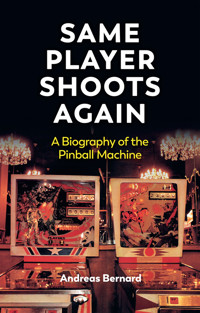
Same Player Shoots Again
A Biography of the Pinball Machine
Andreas Bernard
Translated by Valentine A. Pakis
polity
Originally published in German as Der Trost der Flipper © 2024 Klett-Cotta – J. G. Cotta’sche Buchhandlung Nachfolger GmbH, gegr. 1659, Stuttgart.
This English translation © Polity Press, 2026.
Polity Press65 Bridge StreetCambridge CB2 1UR, UK
Polity Press111 River StreetHoboken, NJ 07030, USA
All rights reserved. Except for the quotation of short passages for the purpose of criticism and review, no part of this publication may be reproduced, stored in a retrieval system, or transmitted, in any form or by any means, electronic, mechanical, photocopying, recording, or otherwise, without the prior permission of the publisher.
ISBN-13: 978-1-5095-6945-8
A catalogue record for this book is available from the British Library.
Library of Congress Control Number: 2025938360
The publisher has used its best endeavors to ensure that the URLs for external websites referred to in this book are correct and active at the time of going to press. However, the publisher has no responsibility for the websites and can make no guarantee that a site will remain live or that the content is or will remain appropriate.
Every effort has been made to trace all copyright holders, but if any have been overlooked the publisher will be pleased to include any necessary credits in any subsequent reprint or edition.
For further information on Polity, visit our website:politybooks.com
1Time Warp
Since the disappearance of pinball machines, cities have changed. They’ve become glassier, more transparent. Their centers and main streets are now lined with bright store fronts, nail salons, coffee shops, hookah lounges, Asian bistros, start-up offices – places that were all but unknown during the heyday of pinball. Perhaps my memory deceives me, but I can’t recall a single transparent place on the streets of my childhood, with their rows of apartment buildings, stores, and pubs. My neighborhood’s many bars, bakeries, and restaurants serving Yugoslavian or “home-style” cuisine (this type of food was never called “German,” oddly enough) all had wooden doors with yellowish curtains, and large posters advertising special offers covered the windows of the supermarkets, convenience stores, and stationery stores. The only places that seemed to offer a full view of the interior were the butcher shops.
With today’s cafés and pubs, it would be possible to identify immediately from the outside whether or not there was a pinball machine inside. Sometimes, while I’m walking by, I’ll see a spot behind a large window that would be perfect for a machine – typical locations for pinball machines in the past were by the toilet doors or in a corner at the end of the bar. Once, when looking into a Turkish restaurant, the open space between the counter, the wall, and the window seemed to have been created so precisely – a gap in the very shape of a pinball machine – that for a moment a flashing game stood before my eyes like a mirage.
When there were still pinball machines, very few of them revealed themselves at first glance. They had to be discovered inside bars and restaurants, often in out-of-the-way places: in a narrow hallway at the back, where the restrooms and the cigarette machine were located; in a side room with a pool table, which a few steps led up to; or even in the basement or in the entryway of a bowling alley. The advantage of this situation was that I was able to spend half an afternoon playing pinball at an age when I wouldn’t have been allowed to go to one of these narrow pubs on my own. I would ask at the bar whether I could use the toilet, rush full of excitement to the back of the place, and play the machines without being noticed. (The more often I got to play a given game, the more familiar it would become to me, and thus the longer my budget of 2 or 3 Deutschmarks would last.) The bartender had long forgotten about me; occasionally, one of the drinkers would come back for a pack of cigarettes and give me a conspiratorial look as he left.
Among these dim, almost hidden pinball spots, there was one exception, a venue where the machines were openly on display – the brightly lit arcades, which were mostly located near the train station. Adorned with neon lettering, their large window could be seen from afar, and it’s been quite a sharp reversal in the appearance of cities that today’s remaining arcades are now the hidden blind spots among so many bright rows of shops. Arcades today are hermetic places with blackened windows whose façades, according to a German law passed in 2012, “must be designed in such a way that it is impossible to see inside the premises from the outside.” In the days of pinball machines, arcades were promising, permeable places whose sounds – the amplified rattling and whirring of dozens of machines – could be heard from afar by people on the street, as though they were approaching a nearby fairground. Today, those who overcome their fear of blacked-out windows and open the door to an arcade will enter instead a sealed and almost sterile space. The arcade games stand on clean carpeting (there are no longer any pinball machines or other devices “for amusement only”), and a few players sit in front of them on barstools with backrests and stoically push their buttons. Much like the smoking areas in airports and train stations, these are ghettos – intentionally displaced from the world at large – for a left-over group of addicts.
My orientation in my home town, and especially in its southern districts, is still defined by the former locations of pinball machines; the pubs and their machines – around the Slaughterhouse District and the Wholesale Market, along the river toward the zoo – form in my mind a reliable map of the city. According to the moving blue dot on my iPhone, I may head south along Thalkirchnerstraße from the roundabout at the Wholesale Market and go left onto Brudermühlstraße before turning, just before the main highway, onto the narrow Bruderhofstraße, which eventually leads to Schäftlarnstraße along the Isar river. Even after 40 years, however, my internal topography sees this same route as a trip from one pinball machine to another. From the game Pharaoh in a pub by the roundabout whose name I’ve forgotten, the path leads to Medusa, which we played in a seedy drinking hole called Dudlhofer, to Time Warp with its banana flippers in the Herzog Siegfried pub (or was it called Herzog Anton?), and on from there to Gorgar in the Wasserturm, and finally to the Panthera game, which was in the very back of a Western-themed bar called Oklahoma. Not one of these places still exists today. At some point, the Herzog Siegfried pub was replaced by a Greek restaurant and then by a tapas bar (the inevitable fate of nearly all Greek restaurants toward the end of the 1990s). The place by the roundabout, the Wasserturm, and Oklahoma are no longer restaurants or pubs at all. They were eventually converted into ground-floor apartments or office spaces, and only the newer brickwork around their entrances (wider doors were replaced with narrower doors) provides a clue that they were once drinking establishments.
During the early 1980s, in a West German city such as Munich, flashing pinball machines and their glamorous themes represented to me, perhaps more than anything else, the promises of American culture. The three main producers of these games – Bally, Williams, and Gottlieb – were all based in Chicago, and after the Second World War their machines found their way into the remotest provinces of Germany, France, and Italy. Pier Paolo Pasolini once expressly described the increasing “Americanism” of Europe in the second half of the twentieth century as an “era of pinball and television.” And, in fact, as an 11- or 12-year-old playing the games Kiss, Charlie’s Angels, or Six Million Dollar Man in the back of a pub, I felt more closely connected with American pop culture than I would have if I’d only listened to the records or watched the TV shows of the same name. Throughout the duration of a game, operating a pinball machine and lighting up its targets allowed me to participate somewhat in the distant homeland of glitter and glam. Looking back now, I tend to think that these machines were perhaps even more meaningful for us Europeans than they were for players in the United States because their themes and motifs were not self-explanatory to us. In the gray concrete dreariness of West Germany, I probably took American culture more seriously than the Americans themselves.
The bygone world of pinball is now only preserved in old movies and television shows. Especially during the period of their greatest popularity (the five or six golden years ending in 1982, which luckily coincided with my own discovery of pinball machines), they regularly appear in bar scenes, whether as part of the action or, more often, as mere background scenery. Pinball machines will show up on screen briefly without any function and perhaps unintentionally – as an incidental sign of the times like an advertisement, or a plastic bag with the logo of a certain department store. In films and television series from the early 1980s, such beautiful moments can occur at any given time: at the Parisian shopping center in the film La Boum, where Vic and her friends from school hang out and where a Supersonic game can be seen in the background; in Helmut Dietl’s television series Monaco Franze, in which the hero waits late at night in a gambling parlor for his young girlfriend to finish work and walks past a Flash Gordonmachine; or in the show Manni, der Libero, where a bunch of young soccer players are shown playing the game Strikes and Spares in the clubhouse after practice.
Nostalgic for the devices I’d learned to play on – the first electronic pinball machines made by Bally and Williams, with red computer digits instead of the obligatory mechanical display – I’ve been systematically searching through movie and television clips for a long time. In doing so, I chose to ignore the growing number of YouTube videos in which fully restored machines are shown off in the basements or garages of hobbyists. I had no interest in these machines as collector items with keys in their coin boxes and perpetual free play. I only took into account movie or television scenes that showed pinball machines in their original surroundings, as public games on which anyone with a coin could test their skill.
The most productive source for such scenes seemed to be crime series, for the simple reason that detectives and inspectors always seem to end up at places where pinball machines might be. I searched through numerous episodes of German crime shows such as Derrick or Tatort (Crime Scene) from the late 1970s and early 1980s. My expectations were especially high for Derrick, because the show is set in Munich and I hoped that one episode or another would bring the inspector to the train station or the Slaughterhouse District and feature a pub in which I myself had once discovered a pinball machine as a child. The results, however, were disappointing. The crimes committed in Derrick, as I must have vaguely remembered, usually take place in the wealthy districts of Grünwald or around Lake Starnberg; and even when they do occur in the city center, they tend to affect prosperous areas such as Nymphenburg or Bogenhausen. Only rarely are Derrick and his assistant Harry Klein summoned to pubs, bars, or arcades. In all the episodes broadcast between 1978 and 1984, I came across just two scenes in which a pinball machine appears. In an episode titled “Ute und Manuela,” the young suspect, with a leather jacket and stringy hair, is seen playing an electro-mechanical machine in a bowling alley; at the beginning of “Das Mädchen in Jeans” (The Girl in Jeans), a barmaid standing by Pinball Champ ’82 is suddenly threatened with a knife by a patron.
In the case of Derrick and in the earlier episodes of Tatort, pinball machines hardly ever show up at all, and whenever anyone does appear on screen playing pinball, this person is always a delinquent. In 1981, however, a Tatort investigator from the industrial city of Duisburg is given the job, and he himself is seen standing in front of a machine as early as his first case. Along with his colleague Thanner, the character Horst Schimanski plays Bally’s Star Trek pinball game; here, the detective’s love of pinball is used to underscore his casual nature (unthinkable in previous seasons of Tatort) and to indicate that he is more at home in the criminal world under investigation than he is at the police station. In the 29 Schimanski episodes that aired between 1981 and 1991, pinball machines appear regularly, especially in the earlier seasons. In the first episode, “Duisburg-Ruhrort,” we encounter not only Star Trek but also Flash (in a rocker bar) and Harlem Globetrotters (in a Turkish restaurant); in the second, “Grenzgänger” (Border Crossers), the game Hot Tip appears; in the fourth, “Das Mädchen auf der Treppe” (The Girl on the Stairs), we see a Firepower pinball machine, which shows up in one of the first German franchises of Burger King (“Do you know the guy at the pinball machine? I think he’s been following us the entire time,” Thanner says to a young woman who’s trying to find her mother’s killer). In the fifth episode, “Kuscheltiere” (Stuffed Animals), the game Black Knight appears twice; in the eighth, “Zweierlei Blut” (Blood Twofold), Schimanski plays Pinball Champ ’82 during an undercover investigation in a sports bar after the murder of a fan of the soccer team MSV Duisburg. At one point, a regular at the bar respectfully calls him “the pinball king.”
In the Tatort episodes with Inspector Schimanski, the frequency of pinball scenes is so high as to seem almost programmatic. And, in fact, there is some evidence in the biography of Hajo Gies, the director of the earliest episodes and the creator of the character, that confirms this suspicion. In 1967, Gies was a member of the inaugural class of the newly founded film school in Munich, along with Wim Wenders and Werner Schroeter. The significance of pinball for these young Munich directors is well documented, both in interviews and in memoirs about their late-night competitions at the Kleiner Bungalow (a pub in the Schwabing district), which had three machines, as well as in their early work, such as Klaus Lemke’s Strategen from 1966; Wenders’s short film Same Player Shoots Again from 1966, in which the actor Hanns Zischler relives the same scene five times (at that time, pinball machines still had five balls); or Fassbinder’s Liebe ist kälter als Tod




