


Erhalten Sie Zugang zu diesem und mehr als 300000 Büchern ab EUR 5,99 monatlich.
Scottish Gaelic in Twelve Weeks has been written both as a self-tuition course for beginners and also for use within the classroom. You may want to learn Gaelic because of a general interest in Celtic or Scottish history and culture, or because it was the everyday language of your ancestors. The cynical observer may wonder if the exercise is worthwhile, when only 1.5 per cent of Scotland's population speak the language. However, Gaelic is far from dead; in some parts of the Highlands and Western Isles it is the everyday language and it represents an important part of the United Kingdom's cultural mix. There are Gaelic-learning classes in almost every area of Scotland. Each lesson in the book contains some essential points of grammar explained and illustrated, exercises, a list of new vocabulary (with a guide to pronunciation, using the International Phonetics Alphabet), and an item of conversation. This new edition includes an audio download link.
Sie lesen das E-Book in den Legimi-Apps auf:
Seitenzahl: 394
Veröffentlichungsjahr: 2023
Das E-Book (TTS) können Sie hören im Abo „Legimi Premium” in Legimi-Apps auf:
Ähnliche







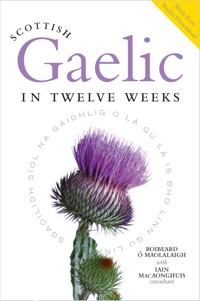
Scottish Gaelic in Twelve Weeks
Roibeard Ó Maolalaigh
with Iain MacAonghuis(Consultant)
FREE AUDIOBOOK
To access the audio download, click here and follow the instructions.
First published in 2008 by
Birlinn Limited
West Newington House
10 Newington Road
Edinburgh
EH9 1QS
www.birlinn.co.uk
Reprinted 2011, 2022
Copyright © Roibeard Ó Maolalaigh 1996, 1998, 2008
First published in 1996 as Scottish Gaelic in Three Months by Dorling
Kindersley Ltd, London
The moral right of Roibeard Ó Maolalaigh to be identified as the author of this work has been asserted by him in accordance with the Copyright, Designs and Patents Act 1988
All rights reserved. No part of this publication may be reproduced, stored or transmitted in any form without the express written permission of the publisher.
ISBN 978 1 78027 815 5
British Library Cataloguing-in-Publication Data
A catalogue record for this book is available from the British Library
Designed and typeset by Sharon McTeir
Printed and bound by Ashford Colour Press Ltd, Gosport
Contents
Abbreviations used in this book
Preface
Glossary of grammatical terms
Pronunciation and Spelling
Stress
Spelling, Alphabet
Vowels
Accents
Pronunciation of Vowels
Diphthongs
Nasalised Vowels
Helping (Epenthetic) Vowels
Elision
Consonants
Broad Consonants
Slender Consonants
Preaspiration
Consonants Groups: rt, rd; chd; sr
Hiatus
More Consonants: Fricatives, Broad and Slender
Initial Mutations
Lenition
Slenderisation/Palatalisation
Lenition and Slenderisation
Lesson 1
1 Pronouns
2 The verb ‘tha’ (‘to be’)
3 Indefinite nouns
3a ‘There is/are’
4 ‘To have’
4a Prepositional pronouns (agam, agad, etc.)
Exercise 1.1
4b ‘To know’
5 Negative and interrogative forms of ‘tha’
6 Answering questions
7 ‘I have only’
Exercise 1.2
8 Adverbs
8a ‘How are you?’
Vocabulary and Conversation: Iain agus Anna (John and Ann)
Lesson 2
9 Emphatic pronouns
9a ‘Who are you?’
10 The verb ‘is’ (‘to be’)
10a ‘A note on the difference between ‘tha’ and ‘is’
10b Negative and interrogative forms of ‘is’
Exercise 2.1
11 Gender
12 The pronouns ‘fear’ and ‘tè’ (one)
13 Case in Gaelic
14 Definite article (‘the’)
14a Use of article
Exercise 2.2
15 Possessive constructions
Exercise 2.3
16 Position and status of adjectives
Exercise 2.4
Vocabulary and Conversation: Balach òg, Iain, aig an ospadal (A young boy, John, at the hospital)
Lesson 3
17 Verbal nouns
18 Present tense
19 ‘What do you want?’ etc.
Exercise 3.1
20 Definite nouns: definition
21 More on the verb ‘is’ (‘to be’)
Exercise 3.2
22 Demonstratives: adjectives, pronouns, adverbs
22a ‘Càite a bheil …?’ (‘Where is …?’)
Exercise 3.3
23 Numerals 0–19
Exercise 3.4
24 Adverbs of direction
25 Days, months and seasons
26 Emphatic suffixes
Vocabulary and Conversation: Anna ann am bùth (Ann in a shop)
Lesson 4
27 Past tense of ‘tha’
27a Independent and dependent verbal forms
27b Past tense of ‘tha’ with verbal noun
28 Irregular verbs: simple past tense
Exercise 4.1
Exercise 4.2
29 Answering questions (past tense)
30 Imperative
30a Negative imperative
30b Other imperative forms
Exercise 4.3
31 Past tense of ‘is’
31a Idioms with ‘is’
32 Prepositional pronouns: ‘do’ (‘to, for’)
32a Idioms involving ‘do’
33 Vocative (or address form)
Exercise 4.4
34 Reflexive pronoun ‘fhèin’ (‘self’)
34a Adverbial use of ‘fhèin’ (‘self’)
Vocabulary and Conversation: Oileanaich a’ coinneachadh ann an taigh-òsta (Students meeting in a pub)
Lesson 5
35 Preposition ‘ann an’ (‘in’)
35a Idiomatic use of ‘ann an’ (‘in’)
Exercise 5.1
36 More on use the of ‘is’
Exercise 5.2
36a Negative and question forms (interrogative) of ‘is e’
36b Alternative construction: using ‘tha’ instead of ‘is’
36c ‘It is …’
37 Past tense of ‘is e tidsear a tha ann an Iain’ (‘John is a teacher’)
38 ‘This is’, ‘That is’
39 Asking ‘What is …?’
40 Word order: fronting
Exercise 5.3
41 Answering questions beginning with ‘an e?’, ‘nach e?’, ‘an ann?’, ‘nach ann?’
42 Ownership
42a ‘Who owns?’
42b Prepositional pronouns ‘le’ (‘with’)
42c Idioms with ‘le’ (‘with’)
Exercise 5.4
43 The weather
44 Prepositions
Exercise 5.5
45 More prepositional pronouns
Vocabulary and Conversation: Aig port-adhair (At an airport)
Lesson 6
46 The prepositional (P) case
46a Irregular nouns
Exercise 6.1
46b Prepositions and possessive pronouns
47 Prepositions followed by the nominative
48 The past tense of regular verbs: independent forms
Exercise 6.2
49 Some more prepositional pronouns: ‘ri’ (‘to,’ etc.), ‘do’ (‘to, for’)
50 Verbs and prepositions
51 More on the regular past tense: dependent forms
51a ‘Never’, ‘ever’
51b ‘Only’
52 Independent and dependent verbal particles
52a How to recognise an independent verbal particle
53 ‘Who?’ v. ‘who’, ‘when?’ v. ‘when’, ‘where?’ v. ‘where’, ‘what?’ v. ‘what’, ‘how?’ v. ‘how’
Exercise 6.3
54 Time
54a Other times of the year
54b ‘Last’, ‘next’
55 ‘Some’
55a ‘Feadhainn’ (‘some people/things’)
56 ‘Every’
Vocabulary and Conversation: A bheil dad às ùr? (Anything new?)
Lesson 7
57 The genitive case
57a Forming the genitive case
57b The article in the genitive case
58 Double definite article
58a Genitive of irregular nouns
Exercise 7.1
59 Surnames
60 Adverbs of quantity
61 The verbal noun and the genitive case
Exercise 7.2
62 Composite prepositions
62a Prepositions followed by the genitive
Exercise 7.3
63 More on time
Vocabulary and Conversation: Lathaichean saora faisg air Beinn na h-Iolaire (Holidays near Beinn na h-Iolaire)
Lesson 8
64 ‘Tha’: future
64a Regular verbs: future
64b Pronouns
64c Present habitual use of future tense
65 Ability
Exercise 8.1
66 Answering questions (future)
67 Conjunctions
67a ‘Because’, ‘since’
67b ‘Never’, ‘ever’
68 The nominative plural
68a The genitive plural
68b The plural article
68c The indefinite genitive plural
69 Prepositions before the article
Exercise 8.2
70 Irregular nouns: plural
70a Other plural forms (prepositional and vocative)
71 Numerals with nouns
71a Dual number
Exercise 8.3
72 Verbal nouns with pronoun objects
Exercise 8.4
73 ‘Duine’ (‘man, husband, person’)
Vocabulary and Conversation: Co-làbreith Anna (Ann’s birthday)
Lesson 9
74 Irregular verbs: future
Exercise 9.1
75 Answering questions
76 Present habitual use of the future tense
77 The relative
77a Relative ‘whose’
77b Relative ‘in which’, ‘with whom’, etc.
77c Relative ‘in which’, ‘with whom’: alternative construction
78 Negative relative clauses
Exercise 9.2
79 Interrogatives involving prepositions
80 Relative form of ‘is’
80a Negative relative form of ‘is’
81 Adjectives: singular (nominative, prepositional, genitive)
Exercise 9.3
82 More on mumerals: 20–99
82a Numerals with nouns
82b Age; ‘How old are you?’
Exercise 9.4
83 Use of ‘de’ (‘of’)
84 Countries
Vocabulary and Conversation: Anns an stèisean (In the station)
Lesson 10
85 Regular verbs: conditional/past habitual: independent forms
85a Regular verbs: conditional/past habitual: dependent forms
85b ‘Tha’: conditional/past habitual
85c Answering questions
86 ‘If’
86a ‘Ma’ (‘if’)
86b ‘Nan’ (‘if’)
86c ‘Robh’ and conditional use of past tense
87 ‘Mura’ (if not)
87a ‘If it were not for . . .’
88 ‘If’ meaning ‘whether’
Exercise 10.1
89 Adjectives: equitive, comparative and superlative
90 Irregular adjectives: comparative and superlative
Exercise 10.2
91 ‘That’: linking clauses and reported speech
91a ‘Gun’, ‘gur’: linking ‘is’ sentences
91b Linking ‘is ann’ sentences
Exercise 10.3
92 Adjectives: plural
Exercise 10.4
93 Personal numerals
Vocabulary and Conversation: Iain a’ dèanamh agallamh airson obair mar oifigear cànain le Comann Luchd Ionnsachaidh(John doing an interview for a job as language officer with Comann Luchd Ionnsachaidh (Learners’ Society))
Lesson 11
94 Modal verbs ‘feum’ and ‘faod’
95 Infinitives
95a Indirect objects of infinitives
Exercise 11.1
95b Direct objects of infinitives: nouns
95c Inversion
Exercise 11.2
96 Direct objects of infinitives: pronouns
96a Demonstrative pronouns as objects of infinitives
97 ‘A bhith’ (‘to be’)
Exercise 11.3
98 The perfect
98a The pluferfect
98b The future perfect
98c The conditional perfect
98d The immediate perfect
Exercise 11.4
99 ‘Ri’ + noun
100 ‘Gu’ + verbal noun/infinitive
100a Colours
101 Ordinal numbers (first, second …)
Vocabulary and Conversation: Oidhche na Bliadhna Ùire (Hogmanay)
Lesson 12
102 Irregular verbs: conditional/past habitual
102a Answering questions
Exercise 12.1
103 ‘Usually’ (‘is àbhaist do’)
104 ‘Used to’ (‘b’ àbhaist do’)
105 Past participles and the perfective
106 The passive
107 Impersonal verbal forms
108 Independent and dependent impersonal forms
109 Another passive construction: ‘tha . . . ag . . .’ (‘is being’)
Exercise 12.2
110 The subjunctive
111 Defective verbs ‘ars(a)’ (‘says/said’), ‘theab’ (‘almost’), ‘dh’fhidir’ (‘know’), ‘trobhad’ (‘come’)
112 Interjections
113 Remaining prepositional pronouns
Vocabulary and Conversation: Bàrd ainmeil a’ bruidhinn air prògram rèidio(A famous poet speaking on a radio programme)
Appendices
Appendix 1: Vowel changes with slenderisation
Appendix 2: Prepositions and prepositional pronouns
Appendix 3: Forms of the article
Appendix 4: Nasalisation (eclipsis)
Appendix 5: Paradigm of the regular verb ‘mol’ (‘praise’)
Appendix 6: Grave and acute accents
Appendix 7: The dental rule
Reading Practice
1 Iolaire Loch Trèig (The Eagle of Loch Trèig)
2 Alasdair Mac Mhaighstir Alasdair agus Donnchadh Bàn Mac an t-Saoir: dithis(t) bhàrd ainmeil (Alexander MacDonald (c 1695–1770) and Duncan Bàn MacIntyre (c 1724–1812): two famous bards)
3 Donnchadh Bàn agus ‘Moladh Beinn Dòbhrain’ (Duncan Bàn and ‘The Praise of Ben Doran’)
4 Foghlam anns a’ Ghàidhlig (Education in Gaelic)
Key to exercises
Mini-dictionary
Index
Abbreviations used in this book
Mini-dictionary
adj
adjective
adv
adverb
attr
attributive
art
article
cjn
conjunction
cmp prp
composite preposition
coll
collective
def
defective
f
feminine
G, gen
genitive
inf
infinitive
interj
interjection
interr
interrogative
IPA
International Phonetic Alphabet
irreg
irregular
lit
literally
m
masculine
neg
negative
num
numeral
obj
object
P
prepositional
pl
plural
pron
pronoun
pos
positive
ppn
possessive pronoun
pred
predicate
prp
preposition
prt
particle
rel
relative
sing
singular
subj
subject
v
vide, see
vb
verb
vn
verbal noun
*
lenites following word
Preface
Scottish Gaelic in Twelve Weeks, which represents a revised edition of Scottish Gaelic in Three Months, has been written both as a self-tuition book for beginners and also for use within the classroom. You may want to learn Gaelic because of a general interest in Celtic or Scottish history and culture, or because it was the everyday language of your ancestors before they emigrated – perhaps to Nova Scotia, where, on Cape Breton Island, Gaelic speakers may still be found. The cynical observer may wonder if the exercise is worthwhile, when only less than one and a half per cent of Scotland’s population speak the language. However, Gaelic is far from being dead; in some parts of the Highlands and Western Isles it is the everyday language, and it represents an important part of the United Kingdom’s cultural ‘mix’; there are significant numbers of Gaelic speakers in urban centres, including but not limited to Glasgow and Edinburgh. There are Gaelic-learning classes in almost every area of Scotland.
Roibeard Ó Maolalaigh, from Dublin, former lecturer at the University of Edinburgh and assistant professor at the School of Celtic Studies, Dublin Institute for Advanced Studies, now lectures in the Department of Celtic at the University of Glasgow, where he is Professor of Gaelic. His consultant Iain MacAonghuis is a native speaker of Scottish Gaelic who was born and brought up in the Isles. He lectured for many years at the School of Scottish Studies, University of Edinburgh (where he was also an Endowment Fellow), and has written and broadcast on a range of Gaelic subjects. The author is grateful to Morag MacLeod, formerly of the School of Scottish Studies, for helpful comments on the first edition of this book.
Each lesson in Scottish Gaelic in Twelve Weeks contains some essential points of grammar explained and illustrated, exercises, a list of new vocabulary (with a guide to pronunciation, in International Phonetics notation), and an item of conversation. Ideally, you should spend about an hour a day on the book, although this is by no means a firm rule. Do as much as you feel capable of doing at a particular time; it is much better to learn a little at a time, and to learn that thoroughly, than to force yourself beyond your daily capacity to absorb new material. Spend the first ten minutes of a daily session revising what you learned the day before.
When you have completed this book on modern, everyday Gaelic, you should have a good understanding of this wonderful language.
Gaelic: an introductory note
Scottish Gaelic has a standard orthography but otherwise tolerates quite a wide diversity. Local pronunciation and inflection are perfectly acceptable though often with the qualification that the native speaker tends to regard the speech of his or her own area as the most pleasing. Syntactical variation is minimal among the dialects of the language with phonological variation showing the greatest divergence. The present book, while adhering to a core standard, occasionally provides information on the different types of dialect variation which exist in the language.
Learners sometimes find this flexibility confusing at the start but soon realise it is essentially no different from the acceptance, say, of American, Australian or West Indian varieties of English as having equal status in pronunciation, syntax and idiom. The recently revised Gaelic Orthographic Conventions, published by the Scottish Qualification Authority (SQA) in 2005, has provided the basis for the standard spelling system which is utlised in this revised edition.
Gaelic had no official status in the United Kingdom until relatively recently. This situation reflects the history of the language first within Scotland and later in the United Kingdom. In particular throughout the last few centuries, when western European languages in general achieved their standard form, Gaelic has lacked the social institutions – centrally either a state-based or an independent educational system – which shape a register of the language common to all educated speakers. It is true that the Presbyterian churches and their associated schools made a signal contribution in this respect, but even that fell far short of what is normally provided by a system of secular education. Gaelic has had simply no place in the centres of political power since the high Middle Ages.
The tide has begun to change slowly in very recent years. The Gaelic Language (Scotland) Act / Achd na Gàidhlig (Alba) received Royal assent on 1 June 2005 and was commenced on 13 January 2006. As a result Bòrd na Gàidhlig (‘The Gaelic Language Board’) was established as a statutory Non-departmental Public Body with government funding to promote and develop the use and understanding of Gaelic. The Bòrd published in 2007 Plana Nàiseanta na Gàidhlig 2007–12 / The National Plan for Gaelic 2007–12, which sets out the road-map for Gaelic language development over the next 5 years. The Bòrd has the power to request public bodies in Scotland to produce Gaelic language plans.
To understand the past fortunes of Gaelic, it is necessary to see the language in an historical perspective. Gaelic was brought to Scotland by colonists from Ireland towards the end of the Roman Empire in Britain. By AD 500 these Gaels had established their Kingdom of Dàl Riada, centred on what is now Argyll in south-west Scotland; in Gaelic, Earra-Ghàidheal, ‘the coastland of the Gael’. To Roman writers they were Scotti – Scotia at this time denoted Ireland – although these names cannot be traced with certainty to an origin in Gaelic itself. But from these Latin forms came the name Scotland. In Gaelic, however, the country is Alba, as in Irish Gaelic and Alban in Welsh.
By the eleventh century, Gaelic was at its highest point in Scotland and known to some degree virtually throughout the country. A Gaelic-speaking court, supported by the Columban church, gave patronage to makers of literature at the highest levels of society. With the Anglicisation of the dynasty late in that century, what has been described as a shift to an English way of life was deliberately planned and, as far as possible, implemented. The court itself became English and Norman-French in speech and the northern English dialect (Inglis) was fostered as the official language. The loss of status that these changes entailed for Gaelic had a profound and permanent effect.
In the mid-twelfth century the Lordship of the Isles, founded in part on the Norse kingdom of the Western and Southern Isles, but drawing also on the traditions of a former, wider Gaelic territory, emerged as a quasi-independent state. Until the Lordship was destroyed by the central authorities of Scotland in the late fifteenth century, Gaelic culture and learning continued to flourish. In the same twelfth century a reorganised literary order, whose main centres were in Ireland, was codifying Gaelic to produce an elegant formal register of the language, which we call Classical Gaelic. It was common to the learned classes of Ireland and Scotland and taught to the children of the aristocracy. It lasted in Scotland until the eighteenth century.
We can see this in religious prose (Bishop John Carswell’s translation of the Book of Common Order in 1567 was the first Gaelic printed book and the first in any Celtic language), culminating in the translation of the scriptures in various phases until 1801. These literary activities involve a remarkably skilful transition from classical to vernacular Gaelic writing. On that basis, but drawing also on colloquial speech, Gaelic prose-writers developed a formal standard register whose strength is most evident in expository writings. Only in the twentieth century, however, and particularly with the founding of the periodical Gairm (1952–2002), and with new opportunities afforded by radio for short-story and other creative writing, was Gaelic freed from the rigidities of its older conventions. Verse too displays similar modulations from classical to vernacular Gaelic, although a tradition of oral vernacular song-poetry predominates. The renaissance of poetry in the twentieth century draws, with a variety of personal combinations, upon these resources.
Modern Gaelic offers the learner a wide spectrum of styles, ranging from formal registers, still in some degree associated with the church, to rich vivid idiomatic speech. Gaelic as a living language is now largely confined to north-western and island communities. But Gaelic speakers of local dialects are still to be found here and there throughout the Highlands. There are, besides, sizeable communities in the cities, particularly in Glasgow. A number of organisations are active in promoting the language. The oldest is An Comann Gàidhealach, founded at the end of the nineteenth century. In the last few years, the Gaelic College in Skye (at Sabhal Mòr Ostaig), Comunn na Gàidhlig (CNAG), Comann Luchd Ionnsachaidh (CLI) and Bòrd na Gàidhlig have all been established with the purpose of reviving the fortunes of the language.
While it is true that the history of the language is largely one of resistance to ethnocidal policies that sought to exclude the Gaels from the world of post-Renaissance Europe, contemporary developments in education, radio and television, and in literature generally, aim to redress the balance. And it should be noted that some of the most interesting writers now active on the literary scene are not native speakers but learners of Gaelic.
Glossary of grammatical terms
Fronting
This occurs when a word is moved from its usual position in a sentence to nearer the beginning of the sentence, for special emphasis.
Helping (Epenthetic) vowels
A vowel inserted between two consonants in certain words (usually containing l, r or n, e.g. Alba ‘Scotland’ is pronounced as if it were ‘Alaba’).
Lenition
Lenition (softening) is a process whereby certain consonants at the beginning of words are made ‘softer’. This is indicated in writing by adding an ‘h’ to the consonant. Lenition changes beag (‘small’) to bheag, pronounced ‘veg’.
Slenderisation/palatalisation
A process which makes consonants at the end of words sound slender (i.e. palatalised). A sound is made slender by adding a ‘y’ sound, as in English ‘yes’ to its pronunciation. A ‘g’ sound, for example, is slenderised by pronouncing it like the ‘g’ in ‘argue’.
Pronunciation and Spelling
The pronunciation of Scottish Gaelic is somewhat different to English in certain respects; not all letters have an equivalent sound in English, and some consonants change their sound according to their position in the word. This being so, please bear in mind that some of the following guidelines can only be approximate. The vocabulary lists in each lesson show the pronunciation of every word in International Phonetics Alphabet (IPA); the fact that you might not have a ‘standard English’ accent renders the customary form of imitated pronunciation untrustworthy.
Naturally, if you wish to hear and acquire perfect pronunciation, you should use the CD recordings which we have produced as an optional ‘extra’ to this book. The CDs will allow you to hear the Gaelic words and phrases as you follow them in the book.
Whether you use the recordings or not, you should nevertheless read through the following notes on Scottish Gaelic pronunciation. There is no need to learn the rules by heart at this point. They should be referred to at frequent intervals, and soon you will become familiar with them. The same applies to the paragraphs dealing with lenition (a form of mutation, or change of consonant at the beginning of a word); this is a feature of the language which you cannot ignore but shouldn’t get stuck on during the early stages of learning. In the meantime, you can start at Lesson 1.
Stress
Unlike English, the stress in Scottish Gaelic almost always falls on the first syllable of a word. Compare the word for ‘police(man)’ in English and Gaelic, where capital letters indicate the main stress:
English:
poLICE
/pə lis/
Scottish Gaelic:
POILeas
/pɔləs/
There are some exceptions, however, which are stressed on the second syllable. This is generally indicated by means of a hyphen in written and printed Gaelic, e.g. a-rithist, a-staigh, a-mach, etc.
Spelling, Alphabet
Although Scottish Gaelic spelling may seem complicated at first sight, it is in many ways more regular than English, so that you can generally tell from the written form of a word how it is to be pronounced once you have become familiar with the spelling system.
There are eighteen letters in the Gaelic alphabet; the letters j, k, q, v, w, x, y, z are not used, except in some recent loan-words. Despite having a slightly smaller alphabet, Scottish Gaelic has far more individual sounds than English. These are represented by various combinations of the eighteen letters, as we shall see below.
Vowels
Accents
In Gaelic there are both short and long vowels. Long vowels are indicated by means of a grave accent. The traditional use of both grave and acute accents to indicate different long vowel qualities was largely, but by no means universally, abandoned with the publication of orthographic conventions for use in schools in the year 1981. The revised Gaelic Orthographic Conventions (2005), which continue to advocate the use only of the grave accent, are followed in this edition. Readers may, however, come across publications in which both grave and acute accents are used, the latter used only with the letters e and o (and rarely with a).
The difference in pronunciation between a, o, u, i, e and à, ò, ù, ì, è respectively is one of pure length. The difference on the other hand between è, ò and é, ó respectively is one of quality: no such distinction in orthography will be made in this book. The grave è sounds like the ‘ai’ in ‘fair’; the ‘older’ acute é sounds like the ‘ay’ in ‘say’. Compare the French ‘è’ and ‘é’. See Appendix 6 for more information.
A grave accent is occasionally also used to differentiate between ’clear’ and ‘unclear’ vowels, e.g.
as /əs/ (unclear)
às /as/ (clear)
Pronunciation of Vowels
GAELICLETTER
IPASYMBOL
a
/a/
like ‘a’ in ‘hat’
à
/aː/
like ‘a’ in ‘halve’
o
/o,ɔ,ɤ/
like ‘o’ in ‘coat’, like ‘o’ in ‘cot’ and like ‘u’ in ‘cut’
ò
/ɔː/, /oː/
like ‘au’ in ‘caught’, like ‘o’ in ‘owe’ (with lips more rounded than for ‘au’ in caught’); the vowel sound in ‘owe’ (IPA [o:]) corresponds to the older acute ó
u
/u,ɯ/
like ‘oo’ in ‘took’
ù
/uː/
like ‘oo’ in ‘cool’
i
/i/
like ‘ee’ in ‘deep’
ì
/iː/
like ‘ea’ in ‘bean’
e
/e,ε/
like ‘a’ in ‘gate’ and ‘e’ in ‘get’
è
/εː/, /eː/
like ‘ai’ in ‘fair’, like ‘ay’ in ‘say’ (IPA [e:]), the latter representing older acute é
When i is added to a vowel, there is often no change in pronunciation; however, there is much variation with the pronunciation of oi. The vowels appearing in the following rows are pronounced similarly:
SPELLING
ADD i
IPA
OTHER VOWELS AND THEIR ALTERNATIVE PRONUNCIATIONS
a
ai
/a/
ea (pronounced also like /ε/)
à
ài
/a:/
o
oi
/ɔ,o,ɤ/
eo (usually ɔl)
ò
òi
/ɔ:/
eò, eòi
u
ui
/u,ɯ/
iu, iui
i
/i/
io (pronounced also as /u/)
ì
/i:/
ìo (pronounced also like /iə/)
e
ei
/ε,e/
ea (pronounced also like /ε/)
è
èi
/e:,ε:/
Some digraphs can represent different vowel sounds, the most important of which are:
SPELLING
IPA
PRONUNCIATION
EXAMPLE
ea
/ε /
like ‘e’ in ‘get’
each ‘horse’
ea
/a/
like ‘a’ in ‘hat’
each ‘horse’ (some dialects)
io
/i/
like ‘ee’ in ‘deep’
fios ‘knowledge’
io
/u/
like ‘oo’ in ‘took’
rionnag ‘star’
oi
/ɔ/
like ‘o’ in ‘cot’
coire ‘kettle’
oi
/ɤ/
like ‘u’ in ‘cut’
coireach ‘faulty, guilty’
ài
/a:/
like ‘a’ in ‘halve’
càite? ‘where?’
ài
/ε:/
like ‘ai’ in ‘fair’
Gàidheal ‘Gael’
The following vowel sounds should also be noted:
SPELLING
IPA
PRONUNCIATION
EXAMPLE
ao
/ɯ:/
has no equivalent in English. It is similar to ‘oo’ in ‘cool’ but with unrounded lips
gaol ‘love’
aoi
/ɯ:/
has no equivalent in English; as ao above (we will see below that aoi can be pronounced as a diphthong in some words)
daoine ‘people’
In stressed syllables the sequence (e)adh/gh is usually pronounced like ‘u’ in ‘cut’, e.g. feadh /fjəɣ/ ‘during’, laghach /ɫ̪ɤ-əx/ ‘kind’, but note the long vowel when the sequence occurs before a consonant in adhbhar /ɤ:vər/ ‘reason’, Raghnall /r̴ɤ̃:-əɫ̪/ ‘Ronald’.
Diphthongs
Scottish Gaelic has a number of diphthongs, i.e. two different vowel sounds pronounced in succession within the same syllable. Diphthongs can be represented in spelling by a sequence of vowels, e.g. ia, ua, and in some words aoi, eu/èa, ìo (see below). Diphthongs are also representing in spelling by a combination of a vowel plus any of the following consonants, ll, nn, m (when not followed by a vowel) and bh, mh, dh, gh.
Sequence of Vowels
SPELLING
IPA
PRONUNCIATION
EXAMPLE
ia(i)
/iə/
like ‘ea’ in ‘ear’
biadh ‘food’
ua(i)
/uə/
like ‘oo’ in ‘poor’
fuar ‘cold’
eu, èa
/ia/
like ‘ia’ in ‘Maria’
beul ‘mouth’, dèan ‘do’
ìo
/iə/
like ‘ea’ in ‘ear’
sìos ‘down’
aoi
/ɤi/
has no equivalent in English; similar to ‘oy’ in ‘boy’ but with unrounded ‘o’
naoi /ɤ̃ĩ/ ‘nine’
It is important to note that eu and ìo can be pronounced as diphthongs or as long vowels, depending on the word (and dialect) in question:
eu, èa
/ia/
like ‘ia’ in ‘Maria’
beul ‘mouth’, dèan ‘do’
eu
/eː/
like ‘ay’ in ‘say’
ceum ‘step, degree’
ìo
/iə/
like ‘ea’ in ‘ear’
sìos ‘down’
ìo
/iː/
like ‘ee’ in ‘feet’
pìob ‘pipe’
Vowel + ll, nn, m or bh, mh, dh, gh
all, ann, am
/au/
like ‘ow’ in ‘how’
call ‘loss’
oll, onn, om
/ou/
like ‘o’ in standard English ‘no’
trom ‘heavy’
aill, ainn, aim, aibh, aimh
/ai/
like ‘y’ in ‘my’
caill ‘lose’
einn, eim
/ei/
like ‘ay’ in ‘say’
seinn ‘singing’
oill, oinn, oim, aidh, aigh, oidh, oigh
/ɤi/
has no equivalent in English; it is similar to ‘y’ in ‘my’ but the first part of the diphthong is like the ‘u’ in ‘cut’.
taigh ‘house’
uill, uinn, uim
/ui, ɤi/
has no equivalent in English; it is similar to the previous diphthong, but the first part of the diphthong is like an unrounded form of ‘oo’ in ‘cool’
tuill ‘holes’
The above rules only hold when the consonants ll, nn, m are not followed by vowels, in which case the vowels are pronounced as normal. Compare:
ann /aun̴̪/
Anna/an̴̪ə/
donn/d̪oun̴̪
donna /d̪on̴̪ə
Nasalised Vowels
Some vowels and diphthongs can occur nasalised, e.g. faic /fɛ̃çgj/ ‘see’, mac /mãxg/ ‘son’. However, the rules for its occurrence are far too complicated to be described in an introductory book of this nature.
Helping (Epenthetic) Vowels
A vowel is inserted between two consonants in certain words (usually containing l, r or n). This vowel is called a helping or epenthetic vowel; it is present in sound only, and is usually an exact copy of the preceding stressed vowel. (Think of someone with a good Scots accent saying ‘harm’ or ‘film’; the ‘r’ and the ‘l’ are rolled, and a vowel is inserted after them – ‘harram’, ‘fillim’.) Here are some examples – the square brackets in the IPA transcription show that an epenthetic syllable is pronounced differently to ordinary disyllables:
Alba
/[ala]bə/
Scotland
marbh
/m[ara]v/
dead
arm
/[ara]m/
army
The realisation of these ‘helping’ syllables varies a great deal in Gaelic dialects; don’t worry too much about them at this stage.
Elision
Unstressed vowels are frequently elided in the vicinity of other vowels, e.g. a òran ‘his song’ is pronounced as òran. Similarly, duine àrd ‘a tall man’ (lit ‘man tall’) is pronounced duin’ àrd. Such elision is often represented in spelling. However, in this book elision for the most part will not be represented in spellings so that learners can ‘see’ all of the elements that are present.
Consonants
In Gaelic the consonants may be divided into two groups, the ‘broad’ consonants and the ‘slender’ consonants. For most broad consonants, there is a corresponding slender consonant; so we may speak of a broad and slender k or g or d and so on.
A consonant is broad if it is preceded or followed by any of the broad vowels a, o, u; it is slender if preceded or followed by any of the slender vowels i, e: the i and e indicate that the tongue is raised in the mouth when the adjoining consonant is pronounced. Since a consonant cannot be both broad and slender, vowels on both sides of a consonant must agree according to ‘colour’ (broad or slender). This is sometimes stated as a rule:
caol ri caol is leathann ri leathann
i.e. slender with slender and broad with broad
Consider the following examples:
caileag, balla, gille, daoine, baga, pàipear, Seumas, Màiri, brògan.
As is the case with most rules, there are some exceptions, e.g. dèante, esan, etc.
Broad Consonants
The pronunciation of the broad consonants is in most cases similar to their English counterparts. But some essential differences will be observed.
GAELIC LETTER
IPA
PRONUNCIATION
b
/b, p/
like ‘p’ in ‘spot’; sounds like like ‘p’ in ‘cap’ especially after vowels
p
/p/
like ‘p’ in ‘pad’
g
/g, k/
like ‘c’ in ‘Scot’; sounds like ‘k’ in ‘cook’ especially after vowels
c
/k/
like ‘c’ in ‘cat’
d
/d̪, t̪/
like ‘t’ in ‘stop’; sounds like ‘t’ in ‘cat’ especially after vowels. Tongue touches upper teeth
t
/t̪/
like ‘t’ in tap. Tongue touches upper teeth.
l, ll
/ɫ̪/
like a hollow ‘l’ as in ‘full’ with the tongue touching the upper teeth
n
/n̴̪, n/
is pronounced in a similar fashion to the hollow ‘l’ described above when it appears initially; otherwise broad ‘n’ is pronounced as in English
nn
/n̴̪/
is pronounced in a similar fashion to the hollow ‘l’ described above
r
/r̃, r/
has no equivalent in English but is similar to a rolled ‘r’; this sound appears for ‘r’ initially; otherwise broad ‘r’ is pronounced like ‘r’ in ‘read’
rr
/r̃/
has no equivalent in English but is similar to a rolled ‘r’
ng
/ŋ/
like ‘ng’ in ‘kong’
Broad f, h, m, s are pronounced like their English counterparts.
Slender Consonants
For the most part the pronunciation of the slender consonants involves raising the tongue towards the roof of the mouth to the position where the i-vowel is pronounced; linguists refer to slender consonants as palatalised consonants.
GAELIC LETTER
IPA
PRONUNCIATION
b
/b(j), p(j)/
like ‘p’ in ‘dispute’; sounds like ‘p’ in ‘type’
p
/p(j)/
like ‘p’ in ‘pea’ or like ‘p’ in ‘pew’
g
/gj, kj/
like ‘k’ in ‘skew’; sounds like ‘k’ in ‘hike’
c
/kj/
like ‘c’ in ‘cue’
d
/dj, tj/
like ‘t’ in ‘stupid’ or the ‘ch’ in ‘cheers’; sounds like ‘tch’ in ‘match’
t
/tj/
like ‘ch’ in ‘chew’
l
/ʎ, l/
like ‘ll’ in ‘million’ when it appears initially; otherwise slender ‘l’ is pronounced like ‘l’ in ‘silly’
ll
/ʎ/
like ‘ll’ in ‘million’ or ‘gli’ in Italian
n
/ɲ, n/
like the first ‘n’ in ‘onion’ when it appears initially; otherwise slender ‘n’ is pronounced like ‘n’ in ‘neat’ and in some instances like the first ‘n’ in ‘onion’
nn
/ɲ/
like the first ‘n’ in ‘onion’ or ‘canyon’
r
/rj/
has no equivalent in English and varies considerably from dialect to dialect; it is in some dialects similar to ‘r’ in ‘tree’
ng
/ŋj/
like ‘ng’ in ‘king’
f
/fj/
like ‘f’ in ‘few’
h
/h, ç/
like ‘h’ in ‘happy’ and ‘h’ in ‘hue’
m
/m, m(j)/
is pronounced like ‘m’ in ‘meal’ or like ‘m’ in ‘mule’
s
/∫/
is pronounced like ‘sh’ in ‘shoe’
Recent loan-words with ‘t’ or ‘d’ from English are pronounced as in English, e.g:
tì
/tiː/
tea
dola
/dɔlə/
doll
Preaspiration
‘Preaspiration’ means the placing of an h-like sound before certain consonants (t, c, p).
The voiceless consonants t, c, p following a stressed vowel are usually preaspirated in Gaelic. The preaspiration takes the form of voiceless breathing /h/ before each of the consonants. The preaspiration may be realised as a ‘ch’ sound especially before c. Preaspiration is not so noticeable in some dialects, particularly in some north-western dialects. Here are some examples:
GAELIC SPELLING
IPA
cat
cat
/kaht̪/
cait
cats
/kahtj/
mac
son
/mãhk/, /mãxk/
mic
sons
/mĩhkj/, /mĩçkj/
map
map
/mahp/
Consonant Groups
The Clusters rt and rd
Related to preaspiration is the insertion of ‘s’ between r and a following t and d, e.g:
ceart
/kjar̴st̪/
right
sagart
/sagər̴(s)t̪/
priest
àrd
/a:r̴(s)t̪/
high
All modern varieties of Scottish Gaelic insert ‘s’ in rt clusters in monosyllables. However, not all dialects insert ‘s’ in the rd clusters or in rt in unstressed (i.e. second) syllables.
The chd Cluster
The cluster chd in Scottish Gaelic is pronounced as if chc, e.g. seachd ‘seven’, ochd ‘eight’, bochd ‘poor’. The word eachdraidh ‘history’ is an exception where the cluster chd is pronounced as ch+d.
The Initial sr Cluster
Initial sr is pronounced as if str in most dialects. However, the older pronunciation, sr, is retained in some southern dialects. Examples: sràid ‘street’, sreap ‘climb(ing)’, sròn ‘nose’.
Hiatus
When two adjacent vowels within the same word belong to different syllables, we say that there is hiatus (a gap) between them. In many words bh, mh, dh, gh are mute when they appear between vowels. The preceding and following syllables are generally not coalesced (i.e. joined together); there is a gap or hiatus between such syllables. This hiatus is denoted by a hyphen (the symbol /-/) in the IPA transcription. Here are some examples:
laghach
/ɫ̪ɤ-əx/
kind
saoghal
/smː-əɫ̪/
world
cladhach
/kɫ̪ɤ-əx/
digging
abhainn
/ã-iɲ/
river
-th-, which is usually pronounced as /h/, is used in a small number of words to indicate hiatus, e.g.
latha
/ɫ̪a-ə/
day
fhathast
/ha-əst̪/
yet
rathad
/r̴a-əd̪/
road
More Consonants: Fricatives
In English when we write ‘h’ after ‘t’, ‘d’, ‘c’, ‘g’, ‘p’, ‘s’, ‘w’, we form new sounds ‘th’, ‘dh’, ‘ch’, ‘gh’, ‘ph’, ‘sh’, ‘wh’. The letter h is used far more frequently in this way in Scottish Gaelic than in English. It is important to note that when h is added to a consonant in Scottish Gaelic, the resulting consonant is never pronounced as in English; except in the case of fh, which is silent, all other resulting consonants are referred to as fricatives. Once again we must distinguish between broad and slender fricative consonants. Here is a list of the consonants which may be written with h to form new sounds:
Broad
GAELIC LETTER
IPA
PRONUNCIATION
ph
/f/
like ‘f’ in ‘fish’
bh
/v/
like ‘v’ in ‘very’
ch
/x/
like ‘ch’ in Scottish ‘loch’ and German ‘ch’ in ‘Bach’
gh
/ɣ/
the voiced version of ‘ch’; like ‘r’ in French ‘rire’
th
/h/
like ‘h’ in ‘hat’; it is never pronounced like ‘th’ in ‘think’ or ‘then’
dh
/ɣ/
like broad ‘gh’ (i.e. like ‘r’ in French ‘rire’)
mh
/v/
like broad ‘bh’ (i.e. like ‘v’ in ‘very’)
sh
/h/
like broad ‘th’ (i.e. like ‘h’ in ‘hat’)
fh
–
is not pronounced (except in fhathast ‘yet’, fhuair ‘got’ and fhalbh ‘go’, in which case it is pronounced as h).
Slender
GAELIC LETTER
IPA
PRONUNCIATION
ph
/f, f(j)/
like ‘f’ in ‘fast’ and ‘f’ in ‘few’
bh
/v, v(j)/
like ‘v’ in ‘very’ and ‘v’ in ‘view’
ch
/ç/
like ‘h’ in ‘hue’ or ‘ch’ in German ‘ich’
gh
/j/
like ‘y’ in ‘yes’
th
/h, ç/
like broad th or slender ch
dh
/j/
like slender gh
mh
/v, v(j)/
like slender bh
sh
/h, ç/
like broad sh or like slender ch
fh
–
is not pronounced except in fhèin ‘self’, in which case it is pronounced as h
Initial Mutations
A characteristic which is common to all Celtic languages, including Irish, Manx, Welsh, Cornish and Breton, is the change of certain consonants at the beginning of words. These changes, sometimes called mutations, appear according to grammatical context. In Scottish Gaelic, there are two initial mutations, lenition and nasalisation (sometimes referred to as eclipsis). Lenition is very important and will be dealt with presently. Nasalisation, which varies according to dialect, is perhaps not as important for learners as lenition and is discussed in Appendix 4.
Lenition
Lenition (softening) is a process whereby certain consonants which appear at the beginning of words are made ‘softer’. This is indicated in writing by adding an h to the consonant. For example lenition changes p to an ‘f’ sound which is spelled ph. Lenition changes an initial b to bh, g to gh, c to ch, d to dh, t to th, m to mh, s to sh, f to fh. See above for the pronunciation of these lenitions. Note that s can be lenited in the clusters sl, sn, sr but never in the clusters sg, sp, st, sm. (Note: although sr is in most dialects pronounced as str, sr can be lenited: it becomes shr, pronounced hr.)
The -h form of a consonant, when it appears at the beginning of words, is referred to as the lenited form of the consonant. Those consonants which can ‘add’ h are called lenitable consonants; there are nine of them. Lenition is usually but not always caused by a preceding word. Consider the following example:
a cat
her cat
a chat
his cat
You will see that the word for ‘her’ and ‘his’ is a, the only difference between them being that the word for ‘his’ lenites a following (lenitable) consonant whereas the word for ‘her’ does not. We say that a ‘his’ is a leniting word and that it lenites a following word. We will distinguish between leniting and non-leniting words by placing the symbol * after those words which cause lenition. Lenition is extremely common in Scottish Gaelic and we will meet many more leniting words and particles in the lessons below. Here are some more examples of the words for ‘his’ and ‘her’:
bàta
boat
a bàta
her boat
a bhàta
his boat
piuthar
sister
a piuthar
her sister
a phiuthar
his sister
geansaidh
jumper
a geansaidh
her jumper
a gheansaidh
his jumper
cù
dog
a cù
her dog
a chù
his dog
dealbh
picture
a dealbh
her picture
a dhealbh
his picture
taigh
house
a taigh
her house
a thaigh
his house
mac
son
a mac
her son
a mhac
his son
sùil
eye
a sùil
her eye
a shùil
his eye
falt
hair
a falt
her hair
a fhalt
his hair
Note: We never write h after l n r although some dialects lenite certain varieties of l n r sounds, e.g. leabaidh /ʎεbi/ ‘bed’ but mo leabaidh /mə lεbi/ ‘my bed’; nigh /ɲi/ ‘wash’ (imperative) but nigh /ni/ ‘washed’ (past tense); Rob /r̴ɔb/ ‘Rob’ (nominative) but a Rob /ə rɔb/ or /ə ɾɔb/ ‘Rob’ (address / vocative form: see below and Section 33). However, the subtle differences involved are beyond the scope of this book.
Slenderisation/Palatalisation
We have seen above that for most consonants, there is a broad and a slender (palatalised) form, each one representing a separate sound in the language. For any consonant, broad and slender forms frequently alternate at the end of words, e.g. cat ‘a cat’ and cait ‘cats’. We say that cait is the slenderised form of cat. A word is slenderised by inserting an ‘i’ before the last consonant or group of consonants. The i before a final consonant tells us that the letter is to be pronounced differently, i.e. as a slender consonant. The change of broad t to slender t is called slenderisation or palatalisation. It is important to note that slenderisation occurs only at the end of words. Slenderisation is used to form the plural form of some nouns. Here are some examples:
cat
cat
cait
cats
dùn
fort
dùin
forts
balach
boy
balaich
boys
boireannach
woman
boireannaich
women
òran
song
òrain
songs
Slenderisation of a final consonant can in some cases cause the preceding vowel to change form. A list of the common changes can be found in Appendix 1. Here are a few examples where the preceding vowel is affected by the process of slenderisation:
mac
son
mic
sons
fear
man
fir
men
cnoc
hill
cnuic
hills
bòrd
table
bùird
tables
fiadh
deer
fèidh
deer (plural)
Slenderisation is very important in Scottish Gaelic and we will meet many further instances of it in the lessons which follow.
Lenition and Slenderisation
Lenition and slenderisation can operate simultaneously on a word. When we address a person in Gaelic, the name is preceded by a, which lenites the initial consonant, e.g.
NORMAL FORM
ADDRESS FORM
Mòrag
a Mhòrag
Morag
Màiri
a Mhàiri
Mary
Catrìona
a Chatrìona
Catherine
However, when we address a male, the name is also slenderised, e.g.
NORMAL FORM
ADDRESS FORM
Seumas
a Sheumais
James
Dòmhnall
a Dhòmhnaill
Donald
Tormod
a Thormoid
Norman
The address form is referred to as the vocative. See Section 33.
Lesson 1
1 Pronouns
mi
I
thu
you
e
he/it
i
she/it
sinn
we
sibh
you (pl)
iad
they
In Gaelic there are two words used for ‘you’, thu and sibh. Sibh is used to refer to (a) ‘you’ plural and (b) ‘you’ in formal or polite contexts, usually when addressing one’s elders or superiors. Thu is used otherwise, generally in familiar contexts.
2 The verb ‘tha’ (‘to be’)
In sentences like ‘John is young’, ‘Ann is small’, ‘James is tired’ we use the verb tha. In Gaelic the order of words in such sentences is the same as English except that the verb comes first in the sentence. Consider the following examples:
Tha Iain òg.
John is young.
Tha Anna beag.
Ann is small.
Tha Seumas sgìth.
James is tired.
Tha Màiri toilichte.
Mary is happy.
Tha Dòmhnall an seo.
Donald is here.
Tha Uilleam an sin.
William is there.
Tha Raghnall an siud.
Ronald is yonder.
Tha Iain math.
John is good.
Tha Anna gu math.
Ann is well.
Tha mi sgìth.
I am tired.
Tha thu làidir.
You are strong.
Tha e fuar.
He/it is cold.
Tha sinn blàth.
We are warm.




