


17,99 €
Mehr erfahren.
- Herausgeber: Independent Thinking Press
- Kategorie: Bildung
- Sprache: Englisch
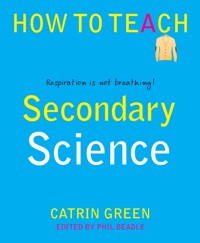
Part of Phil Beadle's How to Teach Series So, you have passion for your subject and you get to work with some of the funniest, most surprising and exceptional students. But teaching science isn't always a walk in the park. How do you get students to think scientifically, remember all of those key words and not get acid in their eyes? Secondary Science is chockfull of workable ideas for the secondary science classroom. Ditch the stereotypical view of a science teacher: white coat, slides, teaching the limewater test to the same class for the fifth year in a row, and discover new and creative ways to inspire the next generation to use science. Areas covered include: the big ideas in science, scientific skills and knowledge, curriculum, practical work, difficult topics, differentiation, assessment, feedback and the science of memory and learning, including the spacing effect and interleaving. The book is packed with: advice about teacher talk, fun science games, ideas for developing scientific literacy, ideas for embedding mathematical skill in science, advice for extended writing in science, advice to make practical work safe, meaningful and worthwhile, and top tips for teaching the difficult topics that students tend to dislike! Catrin offers tips for teaching areas of the science curriculum including electricity, evolution and balancing equations. Suitable for all teachers, including NQTs and experienced teachers who are looking for new ideas. If you are looking for quick and easy ideas to make science fun and relevant, while ensuring that all students are successful and confident in your lessons, and not overloaded with facts, then this book is for you.
Das E-Book können Sie in Legimi-Apps oder einer beliebigen App lesen, die das folgende Format unterstützen:
Veröffentlichungsjahr: 2016
Ähnliche















ACKNOWLEDGEMENTS
When I first started teaching I was very lucky to meet Phil Beadle, who both inspired me and challenged me to become a better teacher. I am very glad and thankful to have worked alongside him again with this book. My thanks must also go to all of the staff at Crown House Publishing, particularly to Emma Tuck and Caroline Lenton for their help throughout the writing of this book.
Thank you to all of my family, in particular Jon, for always encouraging me to get outside of my comfort zone. This book is dedicated to my son Ioan, who was with me throughout its writing.
FOREWORD BY PHIL BEADLE
‘Open your books at page 34. Do exercises 1 through to 17 and shut up while you’re doing them!’
I’ve sat in on some quite poor science lessons in my time (two in a row, in fact, where one of the key words was ‘bucket’). The ‘not really trying very hard’ version of these lessons always seemed to be orientated around a stained textbook. The kids were guided through a reasonable enough practical activity but were always forced to follow this up with a series of drab comprehension questions that the students answered entirely perfunctorily, all the time studiously ignoring the teacher’s vain and frustrated wish that they write in full sentences. We didn’t learn much. But the time passed. And we were, all of us, one day nearer the day we got out of this dump.
It was a shame that this brilliant subject was marginalised as the blind, impotent witch in the triumvirate of important things to know (maths, English and the other one). I remember thinking a decade ago that it could be so much more than it was at that time.
Enter Teach First. Enter Catrin Green.
The first time I sat in a science lesson and thought, ‘Oh, this is how it should be done,’ was in a knackered lab in an academy in the outer reaches of Croydon. Here, a young woman, the author of this book, was taking risks, expecting the kids to understand difficult things, playing with the form. It was relatively early on in her first term as a teacher and she was already really, really good. So good, in fact, that they offered her the head of science post before the end of the second term. (I believe she said no as she wanted to focus on being as good a teacher as she could be.)
But it was not just the lesson, profoundly impressive as it was, or the kids’ achievement and enjoyment, which was tangible, that impressed. It was in the feedback afterwards, in which Catrin, fizzing with intelligence, started questioning some of the Ofsted tropes and some of the thoughtless givens of ‘fashionable’ pedagogy at the time. I recall thinking that if Catrin Green was in any way representative of the kind of teacher Teach First were bringing into the profession, then I would have to put my cynicism about it away.
Science teaching has, I feel, improved a lot since I spent much of my life sitting at the back of other people’s lessons ticking and crossing silly boxes. Things move on. And Catrin is no longer a talented ingénue sparking with potential. The book you have in your hands is written by a seasoned and talented teacher with nearly 10 years’ experience of getting kids in Croydon to learn science, to love science and to love learning science. There will be bits that you disagree with, and there might be points at which you throw the book across the room (Catrin’s approach is – dare I say – quite ‘progressive’ at points); but what you have here are the thoughts and ideas of an excellent practitioner who always finds a better way of doing things than, ‘Open your books at page 34. Do exercises 1 through to 17 and …’
CONTENTS
INTRODUCTION
In some ways, science teaching hasn’t moved on that much since you were at school. The formation of ionic bonds, identifying the organelles of the cell and the difference between voltage and current are still mainstays in the vast catalogue of content we have to teach. However, just as scientific understanding itself has moved on, so has the way we teach it.
Nowadays, science labs are rarely rows of benched students working through questions from a textbook or copying notes from the board. Science teachers have moved on from the ‘This is the truth – now get on with it’ mentality I remember from the lessons I was subjected to at school towards a focus on lively and engaging ways of teaching the key concepts. This shift, though, can pose a challenge to teachers as exciting student-centric lessons can be time consuming to plan and, if this planning hasn’t been properly undertaken, they can result in students learning little or nothing. This book aims to show you how you might plan memorable (and, yes, even fun) lessons in a time efficient way that, most importantly, has learning at the centre.
Science is more important and more high profile than ever before: 92% of firms across all sectors require staff with science, technology, engineering and mathematics (STEM) backgrounds and most struggle to recruit the right people.1 If we are going to plug the gap in numbers, science teachers need to teach cutting edge content and provide new experiences for our students in order to pass on our passion. Many adults have gone on to be totally enthralled by popular science after they’ve left school, but if you asked them what their memory of school science was, they would have reported ambivalence to the lessons at best and active dislike at worst. It is incumbent on practitioners to ask why this is, what we might do about it and how we might change things so the science curriculum comes alive.
Additionally, people can so often be easy victims to the dupery of ‘bad science’ because they don’t have a good enough grasp of scientific knowledge to see through the guff. A student in your classroom could go on to work in the media or in the next area of pseudo-science (we will not be giving any time here to homeopathy etc.). As such, it is our duty as science teachers to ensure that young people are able to make informed decisions in the future – and we do not end up producing the next Gillian McKeith or ‘science’ correspondent for the Daily Mail.
Most science teachers have a degree in the subject and ought to be pioneers in using techniques founded in the theory of science. Ongoing research from cognitive psychology should be used to inform how we teach, so this book draws on a number of ideas sourced from Hattie’s well-known metaanalysis.2 Whilst teaching is never going to be a physical science, and whilst acknowledging that what works in an inner city school may not work in a rural grammar, research can show us new ways to think about our practice and look for ways to become better teachers. What unifies all the ideas in this book are that they are designed to engage your students and to make sure they learn; you should be able to use them to support students regardless of your school setting.
I have always had an active classroom – we regularly sing, dance and play games to learn new content – but we also believe in challenge. These two ideas are mutually exclusive only to the myopic or the bigoted. It is possible that some of these ideas, at first attempt, may result in a perceived failure, but this can often be merely an ‘implementation dip’ and it is important that you keep trying with them. We can’t teach our students to learn from and embrace their mistakes if we are not happy to do the same.
Successful science teaching is all in the balance: the balance between knowledge and skills; the balance between student engagement and hard work; the balance between teaching incredible lessons all day, every day, and managing to maintain any semblance of sanity. This book is a guide to finding the middle ground on all these issues. It will give you plenty of hands-on ideas about how to make the teaching of scientific ideas memorable, without you planning lessons until midnight and arriving at your class with bags under your eyes and a look of horror on your face, rather than the big smile that is a teacher essential.
Danielle McNamara observes: ‘There is an overwhelming assumption in our educational system that the most important thing to deliver to our students is content. Teachers assume that when they have covered something in a course that it should be absorbed by the student.’3 Science teachers do have to deliver a lot of information to students, and we need to find interesting ways of making that knowledge mean something to young people so they can remember it and create their own understandings. The number one issue all science teachers talk about is how difficult it is to pass on all the knowledge in the curriculum whilst also extending and developing scientific skill. Any glimpse at a GCSE science specification will see the word ‘recall’ littered over every page, but if all we do is share information then our students won’t develop real understanding of it. And just because we have lots of knowledge to communicate, this doesn’t mean that we should always fall back on resorting to chalk and talk as a default setting. This has its place, of course, as there are times when explicit instruction is necessary for clear understanding (such as when introducing the concepts of reacting masses or half-life). However, I find that using a variety of teaching tools is the best way to achieve the balance we are after.
Even if you are able to give your students the most memorable experiences possible, this may well not be enough to ensure that they will be able to commit such information to long term memory. You will also need to establish that they are not labouring under misconceptions, you will have to give them chances to really think and you will need to provide opportunity after opportunity for them to practise what they have learnt. The following chapters outline how to achieve good learning in science classrooms.
1 See http://www.policyexchange.org.uk/publications/ category/item/science-fiction-uncovering-the-real- level-of-science-skills-at-school-and-university.
2 J. Hattie, Visible Learning: A Synthesis of Over 800 Meta-Analyses in Education (Abingdon: Routledge, 2008).
3 D. S. McNamara, ‘Strategies to Learn and Learn: Overcoming Learning by Consumption’, Medical Education 44(4) (2010): 340–346.
Chapter 1
THE IMPORTANCE OF THE BIG PICTURE
‘BUT WHAT HAVE PARTICLES GOT TO DO WITH REAL LIFE?!’
The science curriculum can appear as a ‘catalogue’ of discrete ideas, lacking coherence or relevance. There is an over-emphasis on content which is often taught in isolation from the kinds of contexts which would provide essential relevance and meaning.
Robin Millar and Jonathan Osborne1
To engage students in learning we provide them with a peg on which to hook their new learning – usually background knowledge from day-to-day life, from the previous lesson or from a prior topic. What a student already knows about a subject has a much greater impact on achievement than both the interests of the student and the skill of the teacher,2 and whilst it is not possible for a teacher to fully influence a student’s background knowledge, one of the most important factors in its acquisition in the first place is the number of opportunities that we provide students with to understand the content and how we find ways of linking the science to real life.
Lesen Sie weiter in der vollständigen Ausgabe!
Lesen Sie weiter in der vollständigen Ausgabe!
Lesen Sie weiter in der vollständigen Ausgabe!
Lesen Sie weiter in der vollständigen Ausgabe!
Lesen Sie weiter in der vollständigen Ausgabe!
Lesen Sie weiter in der vollständigen Ausgabe!
Lesen Sie weiter in der vollständigen Ausgabe!
Lesen Sie weiter in der vollständigen Ausgabe!
Lesen Sie weiter in der vollständigen Ausgabe!
Lesen Sie weiter in der vollständigen Ausgabe!
Lesen Sie weiter in der vollständigen Ausgabe!




