


9,59 €
Mehr erfahren.
- Herausgeber: Carcanet Classics
- Kategorie: Poesie und Drama
- Sprache: Englisch
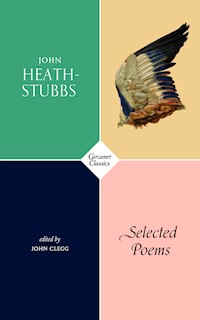
C.H. Sisson called John Heath-Stubbs 'a Johnsonian presence with a Miltonic disability' – a reference to the poet's blindness. This selection of an abundant poet restores him to a new readership with the work on which his popularity was based. His ground-breaking early poetry is given its due, especially the major long poem Wounded Thammuz, printed here in its entirety. Heath-Stubbs was at the centre of the New Romantic school. The Second World War left him as almost the sole representative of one stream of English poetry. He remains crucial to the 1940s and '50s, and was a popular presence into the 1980s, composing his later poems in his head and reciting from memory. Too long he has been sidelined by shifts of critical fashion. Selected Poems includes a critical preface by John Clegg who essentialises and celebrates the work. Three of Heath-Stubbs' translations of Leopardi – revered by subsequent translators, and long out of print – are included.
Das E-Book können Sie in Legimi-Apps oder einer beliebigen App lesen, die das folgende Format unterstützen:
Veröffentlichungsjahr: 2018
Ähnliche








Selected Poems
JOHN HEATH-STUBBS
edited by John Clegg
Dedicatory Poem
to Guthrie McKie
These poems are objects not subjects, made
From a twist of words, a moment of the mind’s freedom.
Like midges, they hum and dance
In the warm air, whose larvae
Were bred for long in the damp soil.
That soil is my black moods, my weeks of silence:
You have had to deal with those, it is only just
You get the poems as well.
Here I deliver them, along with –
Oh, I almost forgot to add – my love.
(from Naming the Beasts, 1982)
Contents
Preface
This is a short selection from a very large body of work. The pre-1965 poetry, which I have selected from freely, was later half-repudiated by the author, I think for bad reasons. Heath-Stubbs’s early poems include some of his strongest and most characteristic: ‘An Heroic Epistle’, ‘Mozart’ (praised by Hugh Kenner), ‘The Divided Ways’ and ‘Epitaph’ belong in any anthology of twentieth-century poetry. The change in style after ‘Epitaph’ is barely noticeable, and amounts not so much to a rejection of romanticism as a rejection of the dramatic monologue – a shame, as in that mode and a characteristic ‘narrated’ psychological monologue (the form of ‘Leporello’, for example), Heath-Stubbs had achieved some of his greatest successes.
I have given one long poem in its entirety – his debut, Wounded Thammuz. It deserves a much larger audience than it has so far found; for me it is one of the most important poems of the Second World War, capturing the mood of the autumn, winter and spring of 1940–41, the point at which the war seriously began to turn, where the genuine threat of a Nazi invasion of Britain became less pressing. After a long tiring slog, the poem insinuates, we will probably come through, and can begin the process of renewal and regrowth, but the dead will still be dead – their only hope is in the other, Christian myth cycle, of which Adonis and Thammuz (or Tammuz, a Sumerian counterpart of Adonis) are echoes. The context is plainest in the best lines of the poem, from section II of ‘Spring Pastoral’:
So gaunt and sallow-visaged Spring came forth
Across polluted Europe; uncouth paths
Stalked he in green and firey slippers, spread
His Eastern carpets over rubble-heaps,
Pranked with the naked snowdrop, saffron-flower
Of Colchis, Muslim tulip, mortuary
Daffodil.
Wounded Thammuz is unmistakably a young man’s poem. Its weaknesses are obvious: the archaisms, unevenness, detours into erudition, influences not quite digested. They are weaknesses we can afford to indulge. To call the poem charming would be to sell its ambition short, and yet it is charming, in a way that comparable early poems by Heath-Stubbs’s contemporaries are not. Such lines as ‘The moon’s green blood in the mid-rib, and the rich red / Blood that is shed in the sunlight’, are laughing off the risk of being laughed at, and display the kind of seriousness which puts at stake the possibility of silliness.
Many of the themes and images in Wounded Thammuz will reappear throughout Heath-Stubbs’s work: the Christianity, the reworked mythology (my favourite in this vein is one of Heath-Stubbs’s funniest poems, ‘Not Being Oedipus’), the turn of the seasons. The unforgettable diving seabird, ‘forked and arrowy’, in Wounded Thammuz, is just the first of countless vivid birds (I have included the late collection Birds Reconvened almost in its entirety); and the poem as a whole is a kind of elegy, a form which he would, regrettably, have much recourse to. Two elegies for his undergraduate friends, ‘The Divided Ways’ for Sidney Keyes and ‘Elegiac Stanzas’ for William Bell, are among his most memorable work. The cosmology and angelology of Wounded Thammuz, deftly and enthusiastically handled, are medieval, borrowed from the lectures of C.S. Lewis, which he attended as an undergraduate in the early 40s. (Reading Lewis’s The Discarded Image might be the best preparation for immersing oneself in Heath-Stubbs.) Oxford is itself a presence throughout Heath-Stubbs’s poetry, as much as his beloved Soho and Fitzrovia; in the ‘Elegiac Stanzas’ the city itself participates in the working-out of grief, and in the long sonnet sequence ‘The Heart’s Forest’, it forms a shadowy fourth partner in the bitter three-way relationship being described.
‘What is ours of him,’ he wrote of Keyes, ‘must speak impartially for all the world.’ I have taken this as an editorial maxim, going against his wishes in giving the poems as originally published (discarding changes made in the Selected and Collected), and in the order in which he published them. Furthermore I have included ‘Epitaph’, which he considered too anthologised, thereby running the risk of his curse against future reproducers. One decision gave me a lot of pause. I have not included anything from Artorius (1972). It is an astonishing long poem retelling the Arthurian legend, set up deliberately as a counterbalance to Charles Williams’ Taliessin through Logres. It would be hard to call it a complete success; it changes tone too sharply, the satires on F.R. Leavis and contemporary feminism are out of place, when it describes boredom (as, again, in the satire on Leavis) it is itself boring. But without doubt it runs those risks of embarrassment that Heath-Stubbs had forbidden himself aged thirty (‘a year in which, not I trust without irony, I composed my own epitaph, and proceeded to the formation of what I hope is a more mature and more intellectually disciplined style’). It was too long to include entire, and impossible to excerpt without misrepresenting.
THE TEXT
The poems are given in the text of their first book publication. Most of the changes between these texts and those in the Selected and Collected are minor. In the 1965 Selected, the poems printed in 1945, 1946 and 1954 as ‘Leporello’, ‘Don Juan Muses’ and ‘Donna Elvira’ were gathered into a single poem called ‘The Don Juan Triptych’, and ‘Valse Oubliée’ was retitled ‘Tschaikowskian Poem’.
Conventions for quotation marks varied among Heath-Stubbs’s publishers. I have used single quotation marks throughout.
Something has gone wrong with the text of Wounded Thammuz: ‘Spring Pastoral’, section VI, lines 4–6, seem to have been garbled. Possibly a whole line is missing; omitting ‘are’ (or adding ‘that’) to line 6 makes some sense but warps the metre. I have let the garbled sentence stand. The manuscript of Wounded Thammuz, which might have provided an authoritative correction, is regrettably not among the collections of Heath-Stubbs’s papers at the University of Leeds or the John Rylands University of Manchester Library.
ACKNOWLEDGEMENTS
Thank you to Bernard Saint, Henry King and James Keery, for their helpful suggestions; to the staff at Peter Ellis Bookshop, the Poetry Library, and the John Rylands Library in Manchester, for tracking down fugitive volumes; to my mother, for all her help with the text; and to my grandfather, Donald Rooum, for introducing me to Heath-Stubbs’ poetry.
John Clegg
Selected Poems
From Eight Oxford Poets (1941)
Leporello
Do you see that old man over there? – He was once a gentleman’s gentleman;
His skull is bald and wrinkled like a leathery snake’s egg;
His forehead is not high, but his eyes, though horny, are cunning,
Like an old jackdaw’s beginning to moult a few grey feathers;
His nose is sharp like a weasel’s, and his lips always a little smiling,
His narrow shoulders crouched forward, hinting a half-finished bow.
Did you notice how beautifully white and smooth and soft his hands were?
His coat is dowdy as the dusty shards of a house-haunting beetle,
His cuffs and collar not quite white, like foam on a fouled mill-race.
But Fear flickers over his face – now settling like a fly
On his sunken cheeks, now haunting his blurred eyes;
And his pale mouth is always ready to fall open and gasp and shriek….
Night after night he’s here, in all weathers,
Drinking. They say his wife is a shrew and holds her head high
For all that once…. Night after night, under the yellow lantern-light,
Always the same old chair in the corner, night after night.
But he likes to talk to a stranger – it makes a nice change.
Why don’t you buy him a drink and get him talking?
He can remember his master well – those were the days! –
Feast days, Carnival days – fans and flowers and bright silk shawls
Tossing like a poppy-patched cornfield the wind dishevels,
And then milky moonlight flowing over close-kept courtyards;
And while his master climbed the balcony, he would keep watch,
Whistle and rub his hands and gaze at the stars –
His co-panders; or there were mandolins murmuring
Lies under windows that winked and slyly slid open;
Or the hand’s clutch and half-humorous gasp of the escapade,
And after a doubling hare’s turn, choked laughter at fooled footsteps
Trotting away down wrong turnings; or when cornered
The sardonic, simple, decided flash of a sword – his master’s sword.
And he can remember that night when he stood on the terrace
Sunning himself in black beams of vicarious sin,
While the waltz whispered within,
And three unaccountable late-comers came,
And gave no name –
(But she in the blue brocade is Anna:
And she has forged her outraged chastity into a blade
Of thin sharp ice-coloured steel; her hair is brown
And her eyebrows arched and black like two leaping salmon
Seen against the sun-flecked foam of a weir down-rushing;
And like a slim white hound unleashed she snuffs for the blood
Of a father’s killer. And not far away is Elvira:
She wears silver and black and is heavily veiled
And has laid a huge jewelled crucifix over her hungry heart
In vain; for she is like an old frosty-feathered gyrfalcon,
With chrysolite eyes, mewed-up now, whose inactive perch
Frets her hooked feet; who cannot bear to gaze out
At the blue sky-paths slashed by young curving wings;
Her heart is a ruined tower from which snake-ivy
Creeps, fit to drag down an oak and smother him in dark green leaves.)
But the windows were all golden-spotted with candles,
Shadowed by dancing shapes; till above the silken strings
Flute and violin had trailed across the evening – a cry:
Zerlina, like a wounded hare tangled in that black net.
It is very quiet in the graveyard – a strange place to be waiting for him;
The moonlight hints queer perjuries – for all the Dead
Are tucked up snug in mud; we have heaped vast lumps of masonry
Over their head and feet, fenced them round with crosses
And stones scrawled over with white lies; we have given them flowers
Against the stench, and stopped their nostrils with mud;
We have lighted candles for hollow sockets; they will not trouble us;
They cannot see to climb the slippery stairs of their vault;
They are blind spectators who have long dropped out of the game –
But what if they didn’t play fair? What if cold stone
Should speak, and offer unwanted advice? What if quite suddenly
This polished transparently reasonable world were shattered?
When the soft curtain of the night is ripped up by the bray of trombones,
And a dumb stone abstraction can speak, and the madman invites it to supper –
That is no laughing matter. If you are young and well-born
And have no heart, it seems you can go home and laugh,
Drink wine and do yourself well; but he, Leporello,
A poor man, sir, always attentive to business, no great scholar,
Had never thought of these things, didn’t know how to deal with the dead gentleman,
Or Hell stretching out a flaming hungry arm
To snatch the ripe fruit of sin from the lighted banqueting hall.
So that is why he has always a startled look, that old man;
For he feels he is being watched by dead eyes from behind the curtains,
And is still expecting a knock at the door, and the stone foot’s tramp on the stairs.




