


69,99 €
Mehr erfahren.
- Herausgeber: John Wiley & Sons
- Kategorie: Wissenschaft und neue Technologien
- Sprache: Englisch
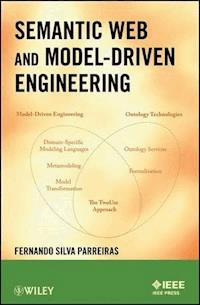
The next enterprise computing era will rely on the synergy between both technologies: semantic web and model-driven software development (MDSD). The semantic web organizes system knowledge in conceptual domains according to its meaning. It addresses various enterprise computing needs by identifying, abstracting and rationalizing commonalities, and checking for inconsistencies across system specifications. On the other side, model-driven software development is closing the gap among business requirements, designs and executables by using domain-specific languages with custom-built syntax and semantics. It focuses on using modeling languages as programming languages. Among many areas of application, we highlight the area of configuration management. Consider the example of a telecommunication company, where managing the multiple configurations of network devices (routers, hubs, modems, etc.) is crucial. Enterprise systems identify and document the functional and physical characteristics of network devices, and control changes to those characteristics. Applying the integration of semantic web and model-driven software development allows for (1) explicitly specifying configurations of network devices with tailor-made languages, (2) for checking the consistency of these specifications (3) for defining a vocabulary to share device specifications across enterprise systems. By managing configurations with consistent and explicit concepts, we reduce cost and risk, and enhance agility in response to new requirements in the telecommunication area. This book examines the synergy between semantic web and model-driven software development. It brings together advances from disciplines like ontologies, description logics, domain-specific modeling, model transformation and ontology engineering to take enterprise computing to the next level.
Sie lesen das E-Book in den Legimi-Apps auf:
Seitenzahl: 327
Veröffentlichungsjahr: 2012
Ähnliche



















Table of Contents
Cover
IEEE Press
Title page
Copyright page
Dedication
LIST OF FIGURES
LIST OF TABLES
FOREWORD
PREFACE
HOW TO READ THIS BOOK
COMMUNICATIONS OF THIS BOOK
ACKNOWLEDGMENTS
ACRONYMS
PART I: FUNDAMENTALS
CHAPTER 1 INTRODUCTION
1.1 MOTIVATION
1.2 RESEARCH QUESTIONS
CHAPTER 2 MODEL-DRIVEN ENGINEERING FOUNDATIONS
2.1 INTRODUCTION
2.2 MODEL-DRIVEN ENGINEERING STRUCTURE
2.3 TECHNICAL SPACES
2.4 CONCLUSION
CHAPTER 3 ONTOLOGY FOUNDATIONS
3.1 INTRODUCTION
3.2 ONTOLOGY
3.3 THE ONTOLOGY WEB LANGUAGE
3.4 ONTOLOGY SERVICES
3.5 ONTOLOGY ENGINEERING SERVICES
3.6 RULES
3.7 METAMODELS FOR ONTOLOGY TECHNOLOGIES
3.8 ONTOLOGICAL TECHNICAL SPACES
3.9 CONCLUSION
CHAPTER 4 MARRYING ONTOLOGY AND MODEL-DRIVEN ENGINEERING
4.1 INTRODUCTION
4.2 SIMILARITIES BETWEEN OWL MODELING AND UML CLASS-BASED MODELING
4.3 COMMONALITIES AND VARIATIONS
4.4 THE STATE OF THE ART OF INTEGRATED APPROACHES
4.5 EXISTING WORK ON CLASSIFYING INTEGRATED APPROACHES
4.6 CONCLUSION
CONCLUSION OF PART I
PART II: THE TWOUSE APPROACH
CHAPTER 5 THE TWOUSE CONCEPTUAL ARCHITECTURE
5.1 INTRODUCTION
5.2 REQUIREMENTS FOR INTEGRATING ONTOLOGY TECHNOLOGIES AND MODEL-DRIVEN ENGINEERING
5.3 ADDRESSING THE REQUIREMENTS WITH THE TWOUSE APPROACH
5.4 METAMODELING ARCHITECTURE
5.5 SYNTAX
5.6 CONCLUSION
CHAPTER 6 QUERY LANGUAGES FOR INTEGRATED MODELS
6.1 INTRODUCTION
6.2 COMBINING EXISTING APPROACHES
6.3 QUERYING ONTOLOGIES USING OWL SYNTAX: SPARQLAS
6.4 QUERYING INTEGRATED MODELS: SPARQLAS4TWOUSE
6.5 CONCLUSION
CHAPTER 7 THE TWOUSE TOOLKIT
7.1 INTRODUCTION
7.2 USE CASE DESCRIPTIONS
7.3 A GENERIC ARCHITECTURE FOR MDE AND ONTOLOGY ENGINEERING
7.4 INSTANTIATING THE GENERIC MODEL-DRIVEN ARCHITECTURE: THE TWOUSE TOOLKIT
7.5 CONCLUSION
CONCLUSION OF PART II
PART III: APPLICATIONS IN MODEL-DRIVEN ENGINEERING
CHAPTER 8 IMPROVING SOFTWARE DESIGN PATTERNS WITH OWL
8.1 INTRODUCTION
8.2 CASE STUDY
8.3 APPLICATION OF THE TWOUSE APPROACH
8.4 VALIDATION
8.5 RELATED WORK
8.6 CONCLUSION
CHAPTER 9 MODELING ONTOLOGY-BASED INFORMATION SYSTEMS
9.1 INTRODUCTION
9.2 CASE STUDY
9.3 APPLICATION OF THE TWOUSE APPROACH
9.4 VALIDATION
9.5 CONCLUSION
CHAPTER 10 ENABLING LINKED DATA CAPABILITIES TO MOF COMPLIANT MODELS
10.1 INTRODUCTION
10.2 CASE STUDY
10.3 APPLICATION OF THE TWOUSE APPROACH
10.4 VALIDATION
10.5 RELATED WORK
10.6 CONCLUSION
CONCLUSION OF PART III
PART IV: APPLICATIONS IN THE SEMANTIC WEB
CHAPTER 11 MODEL-DRIVEN SPECIFICATION OF ONTOLOGY TRANSLATIONS
11.1 INTRODUCTION
11.2 CASE STUDY
11.3 APPLICATION OF THE TWOUSE APPROACH
11.4 EXAMPLES
11.5 ANALYSIS
11.6 RELATED WORK
11.7 CONCLUSION
CHAPTER 12 AUTOMATIC GENERATION OF ONTOLOGY APIS
12.1 INTRODUCTION
12.2 CASE STUDY
12.3 APPLICATION OF THE TWOUSE APPROACH
12.4 ANALYSIS
12.5 RELATED WORK
12.6 CONCLUSION
CHAPTER 13 USING TEMPLATES IN OWL ONTOLOGIES
13.1 INTRODUCTION
13.2 CASE STUDY
13.3 APPLICATION OF THE TWOUSE APPROACH
13.4 ANALYSIS
13.5 RELATED WORK
13.6 CONCLUSION
CONCLUSION OF PART IV
CHAPTER 14 CONCLUSION
14.1 CONTRIBUTIONS
14.2 OUTLOOK
APPENDIX A
A.1 EBNF DEFINITION OF THE CONCRETE TEXTUAL SYNTAX FOR TWOUSE
A.2 EBNF GRAMMAR OF SPARQLAS FUNCTIONAL SYNTAX
A.3 EBNF GRAMMAR OF SPARQLAS MANCHESTER SYNTAX
A.4 SPARQLAS METAMODEL
A.5 ECORE TO OWL: TRANSLATION RULES
APPENDIX B
B.1 USE CASES
B.2 CONNECTING USE CASES WITH REQUIREMENTS
REFERENCES
Index
IEEE Press
445 Hoes Lane
Piscataway, NJ 08854
IEEE Press Editorial Board
Lajos Hanzo, Editor in Chief
R. Abhari
M. El-Hawary
O. P. Malik
J. Anderson
B-M. Haemmerli
S. Nahavandi
G. W. Arnold
M. Lanzerotti
T. Samad
F. Canavero
D. Jacobson
G. Zobrist
Kenneth Moore, Director of IEEE Book and Information Services (BIS)
Copyright © 2012 by Institute of Electrical and Electronics Engineers. All rights reserved.
Published by John Wiley & Sons, Inc., Hoboken, New Jersey.
Published simultaneously in Canada.
No part of this publication may be reproduced, stored in a retrieval system, or transmitted in any form or by any means, electronic, mechanical, photocopying, recording, scanning, or otherwise, except as permitted under Section 107 or 108 of the 1976 United States Copyright Act, without either the prior written permission of the Publisher, or authorization through payment of the appropriate per-copy fee to the Copyright Clearance Center, Inc., 222 Rosewood Drive, Danvers, MA 01923, (978) 750-8400, fax (978) 750-4470, or on the web at www.copyright.com. Requests to the Publisher for permission should be addressed to the Permissions Department, John Wiley & Sons, Inc., 111 River Street, Hoboken, NJ 07030, (201) 748-6011, fax (201) 748-6008, or online at http://www.wiley.com/go/permissions.
Limit of Liability/Disclaimer of Warranty: While the publisher and author have used their best efforts in preparing this book, they make no representations or warranties with respect to the accuracy or completeness of the contents of this book and specifically disclaim any implied warranties of merchantability or fitness for a particular purpose. No warranty may be created or extended by sales representatives or written sales materials. The advice and strategies contained herein may not be suitable for your situation. You should consult with a professional where appropriate. Neither the publisher nor author shall be liable for any loss of profit or any other commercial damages, including but not limited to special, incidental, consequential, or other damages.
For general information on our other products and services or for technical support, please contact our Customer Care Department within the United States at (800) 762-2974, outside the United States at (317) 572-3993 or fax (317) 572-4002.
Wiley also publishes its books in a variety of electronic formats. Some content that appears in print may not be available in electronic formats. For more information about Wiley products, visit our web site at www.wiley.com.
Library of Congress Cataloging-in-Publication Data is available.
ISBN: 978-1-118-00417-3
To my family
LIST OF FIGURES
1.1
Context of the Book.
2.1
Main Concepts of Megamodel.
2.2
Notion of RepresentationOf in Megamodel.
2.3
Notion of ConformsTo in Megamodel.
2.4
Layered Architecture.
2.5
EMOF Classes.
2.6
Ecore Structure.
2.7
Structure, Semantics, and Syntax of the UML Language.
2.8
UML Class Diagram of an E-Shop System.
2.9
MOF Technical Space.
3.1
Semantic Web Stack Covered in This Chapter.
3.2
E-Shop Example with Description Logic Syntax.
3.3
Closing the Domain of E-Shop with OWL Axioms.
3.4
OWL Class Descriptions of the OMG OWL Metamodel [114].
3.5
OWL Properties of the OMG OWL Metamodel [114].
3.6
RDFS Properties of the OMG OWL Metamodel [114].
3.7
OWL Class Descriptions of the NeOn Metamodel.
3.8
OWL Properties of the NeOn Metamodel.
3.9
OWL Class Descriptions of the OWL 2 Metamodel.
3.10
OWL Properties of the OWL 2 Metamodel.
3.11
Snippets of the SWRL Metamodel and the Connections with the OWL Metamodel.
3.12
Snippets of the SPARQL Metamodel.
3.13
The Description Logics Technical Space.
3.14
Relation between the EBNF Technical Space and the Description Logics Technical Space.
3.15
Model-Driven Viewpoint of Ontology Technologies.
4.1
Marrying MMTS and OTS.
4.2
Comparing UML Class Diagrams, OWL-DL, OWL 2, and DL-Lite.
4.3
Snippet of the Feature Model of Bridging OTS and MMTS.
4.4
Organization of Features According to Technical Space.
4.5
Checking Consistency of UML Models.
4.6
Feature Model Configuration for Model Checking.
4.7
Mapping between Two Models Ma and Mb.
4.8
Feature Model Configuration for Model Enrichment.
4.9
Ontology Modeling with UML Profile.
4.10
Feature Model Configuration for Ontology Modeling.
5.1
The TwoUse Conceptual Architecture.
5.2
Adapting the OWL Class for UML Class-Based Modeling.
5.3
The OWL 2 Metamodel Adapted for the UML Class-Based Metamodel — the TwoUse Metamodel.
5.4
UML Class Diagram Profiled with UML Profile for OWL and TwoUse Profile.
6.1
Existing Approaches for Querying Models.
6.2
Variables in the SPARQLAS Metamodel.
6.3
Composing the SPARQLAS Metamodel and the TwoUse Metamodel.
6.4
Snapshot of the Running Example.
6.5
Positioning SPARQLAS4TwoUse among Existing Approaches.
7.1
Use Case for a Generic Architecture for MDE and Ontology Engineering.
7.2
A Generic Architecture for MDE and Ontology Engineering.
7.3
The TwoUse Toolkit.
7.4
TwoUse Toolkit Snapshot: Explanation Service.
7.5
TwoUse Toolkit Snapshot: View Inferred Class Hierarchy.
7.6
Instantiation of the Generic Architecture: The TwoUse Toolkit.
8.1
Application of the Strategy Pattern in the Running Example.
8.2
Drawbacks of the Strategy Pattern.
8.3
Strategy and Abstract Factory Patterns with Configuration Object.
8.4
UML Sequence Diagram of Strategy and Abstract Factory Patterns with Configuration Object.
8.5
Domain Design by a UML Class Diagram Using a UML Profile for OWL.
8.6
Profiled UML Class Diagram of an Ontology-Based Solution.
8.7
Profiled UML Class Diagram with the Strategy Pattern.
8.8
Sequence Diagram of an OWL-Based Solution.
8.9
Structure, Participants, and Collaborations in the Selector Pattern.
9.1
UML Class Diagram and Sequence Diagram of KAT Algorithms.
9.2
UML Class Diagram of KAT.
9.3
Excerpt of a KAT model (M1).
9.4
Snapshot of KAT (M0).
10.1
Development Life Cycle of the TwoUse Toolkit.
10.2
Snippets of Use Case Diagram from TwoUse Toolkit.
10.3
Snippets of BPMN Diagram from TwoUse Toolkit.
10.4
Snippets of Component Diagram from TwoUse Toolkit.
10.5
Snippet of BPMN metamodel and UML metamodel for Use Cases.
10.6
Mapping Ecore and OWL.
11.1
Ontology Mapping Challenge for the Running Example.
11.2
Abstraction vs. Expressiveness.
11.3
Example of a Translation Rule.
11.4
Fragment of the ATL Metamodel.
11.5
Snippet of the Package Type and Package Expressions of the OCL Metamodel.
11.6
Ontology Translation Process.
11.7
Screenshot of MBOTL.
12.1
Limitations of Current Approaches.
12.2
Ontology and API for the Semantic Annotation Pattern.
12.3
Snippet of the
agogo
Metamodel.
12.4
Architecture of the
agogo
Approach.
12.5
Screenshot of
agogo
Implementation.
13.1
Modeling the Running Example with OMG UML Profile for OWL and UML Profile for SWRL.
13.2
Metamodel for Ontology Templates.
13.3
The Template Binding Realization Algorithm.
13.4
Modeling the Running Example with OWL 2 Graphical Syntax.
13.5
Ontology Development with Templates.
A.1
SPARQLAS Metamodel
LIST OF TABLES
3.1
Syntax of Class Expression Axioms.
3.2
Syntax of Object Property Axioms.
3.3
Syntax of Data Property Axioms.
3.4
Syntax of Assertions.
3.5
Syntax of Class Expressions.
3.6
Syntax of Data Ranges.
3.7
Semantics of Class Expression Axioms.
3.8
Semantics of Object Property Axioms.
3.9
Semantics of Data Property Axioms.
3.10
Semantics of Assertions.
3.11
Semantics of Class Expression.
4.1
OTS and MMTS: Comparable Features.
5.1
Correlating Building Blocks with Requirements.
5.2
Mapping between the UML Profile for OWL (Hybrid Diagram) and the TwoUse Metamodel.
6.1
Evaluation of SPARQLAS Expressions According to the Running Example Snapshot.
9.1
Specifying KAT with Description Logic Syntax.
9.2
Evaluation of SPARQLAS Expressions According to the KAT Snapshot.
10.1
TwoUse Measurement.
11.1
Satisfying Ontology Translation Requirements.
12.1
Comparison of Size between
agogo
and the Current COMM API in Two Cases.
12.2
Correlating
agogo
Requirements with Quality Attributes.
B.1
Mapping Use Cases and Requirements.
FOREWORD
Software modeling is in a schizophrenic situation. On the one hand, it is targeted towards the development of completely formal systems, i.e., executable code. On the other hand, the tools dominating in software modeling are typically drawing tools prepared with specific graphical icons. This dichotomy implies that the targeted meaning of a software model is limited in its use towards human understanding and communication only.
This dichotomy is reconciled when software is enriched with formulae specifying the functionality of the code. This is an exciting branch in software engineering, however, for the time being, this is a very labor-intensive exercise that can only be applied for smaller scale systems with particular value, e.g., strong safety requirements.
The above-explained dichotomy is also reduced when software models are exploited in model-driven development for the semi-automatic derivation of more formal models, e.g., executable code (stubs). In such model-driven development the meaning of a model is implicitly defined by mapping it into a (more), formal model. This (more) formal model, however, is exclusively oriented towards operational semantics, it does not bear any semantic meaning for issues like organization and modularization of software models.
Hence, what is obviously missing is a stronger notion of meaning for software models themselves. A meaning that is not only accessible to human interpretation, but that can be operationalized on the software model alone and not only on one view of a software model but on different sublanguages that together constitute a software modeling framework.
In this book, Fernando Silva Parreiras makes a major step towards realizing such meaning for software models. With his methodology TwoUSE—Transforming and Weaving Ontologies and UML for Software Engineering—he combines the established routines of current-day software modelers with the most recent technology for reasoning over large and complex models, i.e., ontology technology.
Ontology technology, based on the family of description logics dialects, has thrived over the last 15 years, coming from small formal systems where it was hardly possible to manage 102 entities in one model to systems that reason over 105 entities—and growing. It is the core target of ontology technologies to model classes, their relationships, and their instances in a versatile manner that still leads to a decidable logical language, which can (mostly) be reasoned about for models that do not appear in the worst case, but in practice. Hence, ontology technology is ideally suited to be carried over to the world of software models.
Such a step seems to be incremental at first sight. This, however, is not the case. The reason is that it is not sufficient to come up with a single mapping, e.g., from UML class diagrams to an ontology language, because the range of software models is ranging much farther and what is needed is a methodology with example cases and best practices rather than an ad hoc development.
Fernando Silva Parreiras has accomplished such a methodology with TwoUse. And this methodology has become influential even before this book could be published. First, the EU project MOST—Marrying Ontology and Software Technologies—running from Februrary 2008 to April 2011 has relied heavily on Fernando’s TwoUse methodology and has taken it as a major source of inspiration for further developing best practices for using ontology technologies in software development. Second, his work has become pivotal for other researchers in our lab—and beyond-who have been building on the integration of software models and ontologies and have further refined it, most notably Tobias Walter and Gerd Gröner.
Finally, the development of TwoUse has been a major accomplishment, because its development has been off the beaten path between the software modeling and the ontology technology communities and staying within neither. At the same time, advising Fernando and charting unexplored research terrain with him has become one of my most beloved research experiences of the last years—intellectually and personally—one that I would not want to miss by any means.
Steffen StaabKoblenz, GermanyApril 2012
PREFACE
The audience for this book embraces computer science graduate students, researchers, advanced professionals, practitioners, and implementers in the areas of software engineering, knowledge engineering, and artificial intelligence, interested in knowing the possibilities of using semantic web technologies in the context of model-driven software development or in enhancing knowledge engineering process with model-driven software development.
For the knowledge engineering community, the advent of ontology engineering required adapting methodologies and technologies inherited from software engineering to an open and networked environment. With the advances provided by model-driven software development, the semantic web community is keen on learning what the benefits are of disciplines like metamodeling, domain-specific modeling, and model transformation for the semantic web field.
For software engineering, declarative specification is one of the major facets of enterprise computing. Because the Ontology Web Language (OWL) is designed for sharing terminologies, interoperability, and inconsistency detection, software engineers will welcome a technique that improves productivity and quality of software models. This book is relevant for researchers who work in the field of complex software systems using model-driven technology and for companies that build large-scale software like enterprise software offerings, data-warehousing products, and software product lines.
HOW TO READ THIS BOOK
In Part I, we present the fundamental concepts and analyze state-of-the-art approaches. Chapters 2 and 3 describe the concepts and technologies around MDE and ontologies, respectively. In Chapter 4, we present the commonalities and variations of both paradigms, analyze existing work in this area, and elicit the requirements for an integrated solution.
Part II describes the role of MDE techniques (DSL, model transformation, and metamodeling) and ontology technologies (reasoning services, query answering) in an integrated approach. In Chapters 5 and 6, we describe the conceptual architecture of our approach. Chapter 7 presents the TwoUse Toolkit—the implementation of the conceptual architecture.
We use the TwoUse Toolkit to realize case studies from the model-driven engineering and ontology engineering domains. Part III assembles case studies that use our approach at the modeling level and at the language level. Chapter 8 analyzes the application of TwoUse in software design patterns, and in Chapter 9 we present the application of TwoUse in ontology-based information systems. Chapter 10 describes the usage of TwoUse to support software developers in integrating software languages.
Part IV presents an analysis of employing our approach in ontology engineering services. We address the need for multiple languages for ontology mapping in Chapter 11. Chapter 12 presents a domain-specific language for specifying ontology APIs. Chapter 13 uses templates for encapsulating complexity of ontology design patterns.
COMMUNICATIONS OF THIS BOOK
We have communicated the research presented in this book through conference papers, a journal paper, conference tutorials, conference demonstrations, and bachelor/master theses. In the following, we list the publications according to the chapters covering the respective contributions.
We presented parts of this work in the following tutorials:
Silva Parreiras, F., Walter, T., Wende, C., Thomas, E.: Model-Driven Software Development with Semantic Web Technologies. In: Tutorial at the 6th European Conference on Modelling Foundations and Applications, ECMFA 2010, Paris, France, June 15–18, 2010. (2010)
Silva Parreiras, F., Walter, T., Wende, C., Thomas, E.: Bridging Software Languages and Ontology Technologies. In: SPLASH ’10: Proceedings of the ACM international conference companion on Object oriented programming systems languages and applications companion, October 17, 2010, Reno/Tahoe, NV, USA., ACM (2010) 311–315
Gasevic, D., Silva Parreiras, F., Walter, T.: Ontologies and Software Language Engineering. In: Tutorial at Generative Programming and Component Engineering (GPCE’10) co-located with Software Language Engineering (SLE 2010), October 10, 2010, Eindhoven, The Netherlands. (2010)
Staab, S., Walter, T., Gröner, G., Silva Parreiras, F.: Model Driven Engineering with Ontology Technologies. In: Reasoning Web. Semantic Technologies for Software Engineering, 6th International Summer School 2010, Dresden, Germany, August 30 – September 3, 2010. Tutorial Lectures. LNCS 6325 Springer (2010) 62–98
The implementation of the approach described in this book served as basis for the following bachelor’s thesis, Studienarbeiten or Diplomarbeiten:
Saile, David: Integrating TwoUse and OCL-DL.
Studienarbeit
.
Schneider, Mark: SPARQLAS—Implementing SPARQL Queries with OWL Syntax.
Studienarbeit
. [In German]
Fichtner, Vitali: Developing a Semantic Environment for Analyzing Software Artifacts. Bachelor’s Thesis. [In German]
Schneider, Carsten: Towards an Eclipse Ontology Framework: Integrating OWL and the Eclipse Modeling Framework.
Diplomarbeit
. [In German]
Moreover, the implementation of the approach led to the development of a free open-source set of tools for designing models combining model-driven engineering and OWL—the TwoUse Toolkit.1
ACKNOWLEDGMENTS
I thank God and the Holy Mary, Mother of God, for all the blessings on my way and for giving me strength to carry on through the hard times.
I would like to thank Prof. Steffen Staab for helping in my development as a researcher. I am also indebted to Prof. Andreas Winter and Prof. Jürgen Ebert for their valuable advice and the constructive meetings through the last years.
I am grateful to Prof. Dr. Uwe Assmann and Prof. Dr. Daniel Schwabe for their time invested in reading and reviewing this book.
I am happy and thankful to have worked with Thomas Franz, Carsten Saathoff, and Simon Schenk on the applications of the work described in this book. I am also thankful to my colleagues Gerd Gröner and Tobias Walter, with whom I shared an office, for the many brainstorming hours.
I would like to thank the current and former students for their indispensable work on implementing the approach presented in this book: David Saile, Johannes Knopp, Sven Kühner, Henning Selt, Mark Schneider, Marko Scheller, and Carsten Schneider.
I am extremely grateful to my mother and father for shaping my character.
Finally, from the bottom of my heart, I thank my wife for her support and donating that time I was supposed to spend with her and my son toward writing this book.
Fernando Silva Parreiras
Note
1http://twouse.googlecode.com/.
ACRONYMS
ABOX
Assertional Box
API
Application Program Interface
ATL
Atlas Transformation Language
BPMN
Business Process Modeling Notation
COMM
Core Ontology on Multimedia
CS
Concrete Syntax
CWA
Closed World Assumption
DL
Description Logic
DSL
Domain-Specific Language
EBNF
Extended BackusNaur Form
EMOF
Essential MOF
EU
European Union
FOL
First-Order Logic
GPML
General Purpose Modeling Language
GReTL
Graph Repository Transformation Language
HTTP
Hypertext Transfer Protocol
KAT
K-Space Annotation Tool
MDA
Model-Driven Architecture
MDE
Model-Driven Engineering
MMTS
MOF Technical Space
MOF
Meta Object Facility
NAF
Negation As Failure
OCL
Object Constraint Language
ODP
Ontology Design Pattern
OIS
Ontology-Based Information System
OMG
Object Management Group
OTS
Ontological Technical Space
OWA
Open World Assumption
OWL
Web Ontology Language
PIM
Platform Independent Model
PSM
Platform Specific Model
QVT
Query/View/Transformation Language
RDF
Resource Description Framework
RDFS
RDF Schema
SAIQL
Schema And Instance Query Language
SPARQL
SPARQL Protocol And RDF Query Language
SWRL
Semantic Web Rule Language
TBOX
Terminological Box
TS
Technical Space
UML
Unified Modeling Language
URI
Unified Resource Identifier
W3C
World Wide Web Consortium
XML
Extensible Markup Language
Lesen Sie weiter in der vollständigen Ausgabe!
Lesen Sie weiter in der vollständigen Ausgabe!
Lesen Sie weiter in der vollständigen Ausgabe!
Lesen Sie weiter in der vollständigen Ausgabe!
Lesen Sie weiter in der vollständigen Ausgabe!
Lesen Sie weiter in der vollständigen Ausgabe!
Lesen Sie weiter in der vollständigen Ausgabe!
Lesen Sie weiter in der vollständigen Ausgabe!
Lesen Sie weiter in der vollständigen Ausgabe!
Lesen Sie weiter in der vollständigen Ausgabe!
Lesen Sie weiter in der vollständigen Ausgabe!
Lesen Sie weiter in der vollständigen Ausgabe!
Lesen Sie weiter in der vollständigen Ausgabe!
Lesen Sie weiter in der vollständigen Ausgabe!
Lesen Sie weiter in der vollständigen Ausgabe!
Lesen Sie weiter in der vollständigen Ausgabe!
Lesen Sie weiter in der vollständigen Ausgabe!
Lesen Sie weiter in der vollständigen Ausgabe!
Lesen Sie weiter in der vollständigen Ausgabe!
Lesen Sie weiter in der vollständigen Ausgabe!
Lesen Sie weiter in der vollständigen Ausgabe!
Lesen Sie weiter in der vollständigen Ausgabe!
Lesen Sie weiter in der vollständigen Ausgabe!
Lesen Sie weiter in der vollständigen Ausgabe!
Lesen Sie weiter in der vollständigen Ausgabe!
Lesen Sie weiter in der vollständigen Ausgabe!




