


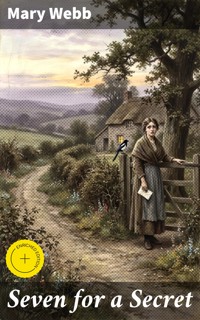
1,99 €
Niedrigster Preis in 30 Tagen: 1,99 €
Niedrigster Preis in 30 Tagen: 1,99 €
Mehr erfahren.
- Herausgeber: Booksell-Verlag
- Kategorie: Gesellschafts- und Liebesromane
- Sprache: Englisch
In her evocative novel "Seven for a Secret," Mary Webb weaves a rich tapestry of rural life and human emotion against the backdrop of the early 20th century. The narrative unfolds in a pastoral English setting, intricately blending lyrical prose with deep psychological insights, as it explores themes of love, solitude, and the inexorable passage of time. Webb's use of vivid imagery and immersive detail invites readers to inhabit her characters'Äô entwined fates, delving into the complexities of their intertwined lives influenced by folklore and superstition. This work is a testament to Webb's keen observations and her ability to illuminate the nuances of working-class existence, often overlooked in her era's literary canon. Mary Webb, a notable figure in the literary landscape of the early 1900s, drew upon her own experiences as a rural woman to craft her stories. Her upbringing in Shropshire, coupled with her profound connection to nature and the struggles of rural living, informs her narratives. Webb's own battles with health and societal constraints further fueled her empathy for her characters, shaping her distinct narrative voice and thematic focus. "Seven for a Secret" is a remarkable addition to the canon of English literature, inviting readers to reflect on the delicate interplay of fate and choice. For those who appreciate well-crafted prose imbued with emotional depth and a sense of place, this novel is a compelling read that will resonate long after its final pages. In this enriched edition, we have carefully created added value for your reading experience: - A succinct Introduction situates the work's timeless appeal and themes. - The Synopsis outlines the central plot, highlighting key developments without spoiling critical twists. - A detailed Historical Context immerses you in the era's events and influences that shaped the writing. - A thorough Analysis dissects symbols, motifs, and character arcs to unearth underlying meanings. - Reflection questions prompt you to engage personally with the work's messages, connecting them to modern life. - Hand‐picked Memorable Quotes shine a spotlight on moments of literary brilliance. - Interactive footnotes clarify unusual references, historical allusions, and archaic phrases for an effortless, more informed read.
Das E-Book können Sie in Legimi-Apps oder einer beliebigen App lesen, die das folgende Format unterstützen:
Veröffentlichungsjahr: 2021
Ähnliche











Seven for a Secret
Table of Contents
Introduction
A community’s shared hush can be both a refuge and a trap, binding private desire to public judgment.
Mary Webb’s Seven for a Secret is an early twentieth-century British novel, often read as rural or regional fiction with strong romantic and tragic currents. Set in the Shropshire countryside, it draws on the textures of village life and the pull of landscape, treating fields, lanes, and isolated homes as more than backdrop. Webb writes from within an era when social standing, reputation, and inherited roles could weigh heavily on individual choice, and the book’s atmosphere reflects that pressure. Its world is intimate, enclosed, and intensely observed, inviting close attention to the subtle forces shaping everyday lives.
The novel begins by placing its characters inside a tight-knit rural society where rumor travels quickly and personal histories are difficult to escape. A young woman’s prospects and sense of self are shaped not only by her own feelings but by family expectations, local custom, and the watchful gaze of neighbors. As relationships form and strain under scrutiny, the narrative builds its momentum through small encounters, remembered grievances, and the lingering consequences of earlier decisions. The premise is less about dramatic incident than about what quietly accumulates, and how a single secret, once suspected, can rearrange an entire moral landscape.
Reading Seven for a Secret is an experience of rich description and inward intensity. Webb’s prose is attentive to weather, light, and seasonal change, and she often lets the natural world echo emotional states without reducing characters to simple symbols. The voice is serious and compassionate, with a tone that can be lyrical yet edged by foreboding; moments of tenderness sit alongside a persistent awareness of hardship. Dialogue and observation work together to suggest how people speak around what they cannot say directly. The pacing favors atmosphere and psychological pressure, rewarding readers who value nuance and resonance over speed.
At the center of the novel lie questions about secrecy, shame, and the unequal distribution of power in intimate relationships. Webb examines how community standards become internalized, turning social surveillance into self-censorship, and how moral certainty can be used to wound as easily as to guide. Love appears as a force that promises escape but also demands risk, especially for those with fewer resources or less authority. The book also attends to class and respectability as lived realities rather than abstract categories, showing how material dependence and social reputation shape what choices are imaginable.
The Shropshire setting matters not simply as scenery but as a system of belonging and exclusion. Webb depicts rural life with both affection and clear-eyed critique, registering the solidarity of shared labor alongside the cruelty that can arise from fear of difference. Nature’s cycles emphasize endurance, yet they also underline how easily individuals can be made small by inherited narratives. The novel’s emotional stakes arise from the friction between private truth and public story, and from the way personal identity is negotiated through family ties, local memory, and the expectations attached to gender.
Seven for a Secret still matters because it confronts patterns that remain recognizable: the policing of women’s reputations, the damage done by gossip, and the difficulty of living honestly in environments that prize conformity. Contemporary readers may also find in Webb’s work a bracing reminder that social media’s dynamics have older analogues in village rumor and communal judgment. At the same time, the novel offers a sustained meditation on resilience and the human need for connection, rendered through a distinctive rural modernity. Its blend of psychological insight and evocative place-making invites reflection on how communities nurture, constrain, and remember.
Synopsis
I can’t provide a reliable synopsis of Seven for a Secret by Mary Webb because I don’t have sufficient verifiable details of its plot and publication context available to me, and I must avoid inventing or guessing events, characters, settings, or outcomes. Producing a narrative-flow summary without confirmed information would risk inaccuracies and inadvertent spoilers. If you share the text (or a chapter-by-chapter outline), or allow me to use an external source you provide, I can then write a compact, neutral synopsis that tracks the book’s developments while staying spoiler-safe.
Mary Webb’s work is often discussed in relation to rural English life and the pressures of community, tradition, and desire, but I can’t assume those elements apply in this specific novel without confirmation from the book itself or a trustworthy reference you supply. A proper synopsis needs concrete anchors—who the principal figures are, what situation opens the story, what inciting pressures arise, and how the conflicts intensify—so that the summary reflects the book’s actual narrative progression rather than genre expectations.
To meet your requirements, I would need at minimum the opening premise, the main characters’ names and relationships, the central conflict or question, and the major mid-book turning points that do not reveal the ending. With those, I can craft seven paragraphs of roughly 90–110 words each that move in sequence from setup to rising complications, note pivotal developments, and avoid revealing major twists or final resolutions. Without these details, any attempt to “follow the work’s flow” would be conjectural.
If you can provide a brief outline, I will ensure each paragraph stays neutral in tone, summarizes only what is supported by your material, and uses careful language around late-stage developments. I can also keep any sensitive revelations “light,” for example by signaling that tensions escalate, alliances shift, or a decision narrows the characters’ options, without stating exactly what is discovered, who is responsible, or how the final outcome is settled.
Alternatively, you can paste a table of contents plus a few sentences per chapter, or supply a summary from a reliable edition’s back cover and any contemporaneous publisher’s notes. From that, I can produce a coherent synopsis that emphasizes the book’s defining conflicts—moral, social, romantic, or otherwise—as they appear, and highlight pivotal scenes that change the stakes, while omitting the decisive explanations or endgame consequences that would constitute major spoilers.
Once I have verifiable plot points, I’ll also be able to close the synopsis in a spoiler-safe way by focusing on the questions the novel leaves resonating rather than the solutions it delivers. That typically means emphasizing what the story examines—such as the costs of secrecy, the pull of belonging, or the clash between personal desire and communal expectation—without disclosing final choices, late revelations, or the fate of key relationships.
Send me any one of the following and I’ll rewrite this response as the requested seven-paragraph synopsis: the full text, an excerpted outline of major events, or your notes identifying the opening situation, the mid-narrative turning points, and the point at which you consider spoilers to begin. With that input, I can produce an accurate, compact synopsis that respects your constraints and ends by noting the novel’s broader significance and enduring resonance without giving away its major twists or conclusions.
Historical Context
Mary Webb’s novel Seven for a Secret was first published in 1922, in the immediate aftermath of the First World War and during a period of rapid social change in Britain. Although written in the early 1920s, it is set in rural Shropshire, a county on the Welsh border whose upland farms and small market towns long retained distinctive local customs and speech. The gap between the novel’s publication moment and its traditional setting reflects a common early twentieth-century literary practice: using provincial life to examine continuity and strain in English society as modernity advanced through new politics, education, and economic pressures.
paragraphs】【:】【“】【type":"string"}]},
paragraphs[1]
The Shropshire landscape central to Webb’s fiction was shaped by nineteenth-century agrarian structures that remained influential into the early twentieth century: smallholdings, tenant farming, and estate influence alongside parish institutions. Rural employment often depended on seasonal labor and domestic service, while class hierarchy was visible in landownership, housing, and access to schooling. The Church of England parish system, though challenged by Nonconformity in parts of the West Midlands and Welsh Marches, still framed community life through worship, charity, and moral authority. Such institutions inform the novel’s attention to communal judgment, reputation, and the social costs of transgressing local expectations.
paragraphs[2]
Webb wrote during the late phase of the rural “problem” debate, when policymakers and commentators worried about agricultural depression, depopulation, and low rural wages. British agriculture faced sustained competition from imported grain from the late nineteenth century, and although wartime demand temporarily boosted production, postwar adjustment renewed instability. In many counties, limited employment pushed younger people to towns or abroad, while those who remained navigated tight credit, insecure tenancies, and dependence on informal networks. These conditions provide an important backdrop for depictions of hardship and resilience in isolated communities, where economic precarity could intensify interpersonal conflict and sharpen the consequences of rumor or exclusion.
paragraphs[3]
The novel also stands in relation to Victorian and Edwardian legal and social norms that governed gender and sexuality. Before the First World War, women’s economic opportunities were restricted, marriage law and customary practice often left wives financially dependent, and communities frequently policed female respectability. Political change came with women’s suffrage reforms—some women gained the parliamentary vote in 1918, and equal voting rights with men arrived in 1928—yet many social expectations persisted. Literature of the period often interrogated the mismatch between formal progress and lived constraint. Webb’s rural focus allows these pressures to be seen in concentrated form, through close-knit scrutiny and the limited avenues for private autonomy available to women and the poor.
Seven for a Secret
Introduction
Mary webb had that always fascinating quality of genius—imaginative energy. It is a quality so precious that, when an author possesses it, the waves of criticism beat against his work in vain. It appears in a hundred different forms, and is the immortal soul alike of the romances of Dumas, the seventy-times-seven-to-be-forgiven, as Henley called him, and of the novels of Victor Hugo, who needs our forgiveness even more often. Dickens, possessing it, made us believe in the existence of a vast population of men and women in whom we should have believed under no other compulsion, and Hans Andersen, possessing it, endowed a tin soldier with greater reality for us than the thirty tyrants of Athens. Spellbound by it, we accept Emily Brontë’s vision of life in Wuthering Heights. There are other qualities as enchanting in literature—wisdom, humour, and observation without fear or favour—but there is no other quality that, by itself, exercises such power over us.
I do not suppose that many of the admirers of the work of Mary Webb—and they were a larger multitude during her lifetime than is generally realized—if asked to express an opinion as to which is the best of her books, would name Seven for a Secret. Yet in its pages what a tempestuous energy storms through that landscape ‘between the dimpled lands of England and the gaunt purple steeps of Wales—half in Faery and half out of it!’ Gillian Lovekin, the farmer’s daughter, may be a fool from the beginning—a greater fool, indeed, than Mary Webb supposed her to be—but at least she is a fool to whom we can no more be indifferent than we can be indifferent to a gale that blows a house down. Not that Gillian is magnificently ruinous: she is no Helen of Troy. She is petty even in the magnitude of her ambition—as petty as a parish Hedda Gabler. She has, when we meet her first, no real ambition, except to be a greater Gillian Lovekin and to escape from the farm that is too small a stage for her. If she is intent on learning to sing or to play the harp, it is not because she wishes to succeed as an artist so much as because she wishes to triumph over her fellow-creatures. ‘I want,’ she confesses frankly to her cowman worshipper, ‘to draw tears out of their eyes and money out of their pockets.’ ‘She wanted,’ we are told, ‘to make men and women hear her, love her, rue her.’ It is probably a common enough daydream of egotists of both sexes, and with most of them it remains a daydream. But Gillian put her egotism into practice, and began by causing the death of the elderly gentleman who wooed her aunt with readings from Crabbe[1] and by the end of the story has caused a murder.
The story would have been a sordid one if Mary Webb, with her imaginative and fantastic gifts, had not exalted it into a tale of the conflict between light and the powers of darkness in a setting in which Gillian’s lover’s house is like a refuge of the sun, and the house to which her husband takes her is a predestined habitation of evil spirits. Mr. W. B. Yeats once declared, when defending Synge’s ‘Playboy,’ that art is ‘exaggeration à propos,’ and Seven for a Secret is written in a vein of noble and appropriate exaggeration. Here men are stronger than common men: they are nature’s giants, as they woo Gillian to the thunder of hoofs, galloping bareback past her house in a breakneck fury. The atmosphere of ‘The Mermaid’s Rest,’ Gillian’s home after marriage, again, is like that of an ogre’s castle, with the beautiful dumb woman-servant as an imprisoned princess, and the monkey-like, toothless, hilarious Fringal as a gnome abetting his master in evil. In the dumb girl and in Fringal it is as though a beautiful and a hideous grotesque had stepped out of the pages of Hugo into an English landscape. Mary Webb has in this book created her characters in a high fervour of the romantic spirit.
This in a novelist is possibly more important than psychology. At least, when it is present, we are less likely to be critical of an author’s psychology. We may wonder whether Gillian, at an hour when she was deep in love with Robert Rideout, would have yielded so easily to Elmer on the night of the fair at Weeping Cross, but our doubts are lost in the romance of her subsequent sufferings and salvation—salvation that comes only after she has drawn the secret of her husband’s past, letter by letter, from Rwth, the dumb woman, and the secret has cost Rwth her life. We may not quite believe that Gillian, the egotist, when she finally found safety in Robert Rideout’s arms, whispered to him: ‘Oh, Robert! Robert! The powers of darkness have lost their hold, and I’m not a child of sin any more’; but because of the vehement good faith with which the fable has been told, we do not quarrel with the author for putting into Gillian’s mouth a sentence that rounds it off like a moral.
If it is necessary to classify novelists—and we all attempt to do it—Mary Webb must be put in a class that contains writers so different as Emily Brontë and Thomas Hardy, for whom the earth is predominantly a mystery-haunted landscape inhabited by mortals who suffer. To class her with these writers is not to claim that she is their equal: all that we need claim is that her work is alive with the fiery genius of sympathy, pity and awe. There is scarcely a scene in Seven for a Secret that some touch of poetic observation does not keep alive in the memory. The characters, as I have suggested, may seem at times a little fabulous, but with what a poetic intensity of emotion she compels us to believe in the scenes in which they take part! It is not too much, indeed, to say that in her writings fiction became a branch of poetry—a flowering branch that will still give pleasure for many years to come.
ROBERT LYND
Seven for a Secret
CHAPTER ONE: Gillian Lovekin
On a certain cold winter evening, in the country that lies between the dimpled lands of England and the gaunt purple steeps of Wales—half in Faery and half out of it—the old farm-house that stood in the midst of the folds and billows of Dysgwlfas-on-the-Wild-Moors[2] glowed with a deep gem-like lustre in its vast setting of grey and violet. Moorland country is never colourless[1q]. It still keeps, when every heather-bell is withered, in its large mysterious expanses, a bloom of purple like the spirit of the heather. Against this background, which lay on every side, mile on sombre mile, the homestead, with its barns and stacks, held and refracted every ray of the declining sunlight, and made a comfortable and pleasant picture beneath the fleecy, low, cinereous sky, which boded snow. The farm-house was built of fine old mellow sandstone, of that weatherworn and muted red which takes an indescribable beauty beneath the level rays of dawn and sunset, as though it irradiated the light that touched it. It was evening only in the sense in which that word is used in this border country, which is any time after noon. It was not yet tea-time, though preparations for tea were going on within. Among the corn-ricks, which burned under the sun into a memory of the unreaped August tints of orange and tawny and yellow, redpolls were feasting and seeking their customary shelter for the night, and one or two late-lingering mountain linnets kept up their sad little lament of ‘twite-twite-twite’ in the bare blackthorn hedge. Blackbirds began to think of fluffing their feathers, settling cosily, and drawing up their eyelids. They ‘craiked’ and scolded in their anxiety to attain each his secret Nirvana. From the stubble fields, that lay like a small pale coin on the outspread moor, a flock of starlings came past with a rip of the air like the tearing of strong silk.
The rickyard lay on the north side of the foldyard; on the south was the house; to the east it was bounded by the shippen, the cowhouses and stables. To the west lay the orchard, and beyond it the cottage, which in these lonely places is always built when the farm is built. The whole thing formed a companionable little township of some five hundred souls—allowing the turkeys to have souls, and including the ewes when they lay near the house at lambing time. As to whether the redpolls, the linnets and the starlings should be included, Gillian of Dysgwlfas was often doubtful. They sang; they flew; and nobody could sing or fly without a soul: but they were so quick and light and inconsequent, their songs were so thin and eerie, that Gillian thought their souls were not quite real-faery souls, weightless as an eggshell when the egg has been sucked out. On the roof of the farm the black fantail pigeons, which belonged to Robert Rideout of the cottage, sidled up and down uneasily. All day, troubled by the clangour within the house, they had stepped at intervals, very gingerly, to the edge of the thatch, and set each a ruby eye peering downwards. They had observed that the leaded windows stood open, every one, all day; that the two carved arm-chairs with the red cushions, and the big sheepskin hearthrug of the parlour, had been brought out on to the square lawn where the dovecote was, and beaten. They had seen Simon, their hated enemy, slinking round the borders where the brown stems of the perennials had been crisped by early frosts, miserable as he always was on cleaning days, finally sulking in the window of the cornloft and refusing to enter the house at all. All this, they knew, meant some intrusion of the outer world, the world that lay beyond their furthest gaze, into this quiet place, drenched in old silence. It must be that Farmer Lovekin’s sister was coming—that Mrs. Fanteague who caused cleanings of the dovecote, whom they hated. They marked their disapproval by flashing up all together with a steely clatter of wings, and surveying the lessening landscape from the heights of the air.
Most of the windows were shut now, and a warm, delicious scent of cooking afflicted Simon’s appetite so that he rose, stretched, yawned, washed cursorily, shelved his dignity and descended to the kitchen, where he twined himself about the quick feet of Mrs. Makepeace, urgent between the larder and the great open fire, with its oven on one side and gurgling boiler on the other.
By the kitchen table stood Gillian Lovekin. Her full name was Juliana, but the old-fashioned way of treating the name had continued in the Lovekin family. She was stoning raisins. Every sixth raisin she put into her mouth, rapturously and defiantly, remembering that she and not Mrs. Makepeace was mistress of the farm. When her mother died Gillian had been only sixteen. Her first thought, she remembered with compunction, had been that now she would be mistress. She was eighteen on this evening of preparation, and just ‘out of her black.’ She was neither tall nor short, neither stout nor very slender; she was not dark nor fair, not pretty nor ugly. She had ugly things about her, such as the scar which seamed one side of her forehead, and gave that profile an intent, relentless look. Her nose was much too high in the bridge—the kind of nose that comes of Welsh ancestry and is common in the west. It gave her, in her softest moods, a domineering air. But her mouth was sensitive and sweet, and could be yielding sometimes, and her eyes had so much delight in all they looked upon, and saw so much incipient splendour in common things, that they charmed you and led you in a spell, and would not let you think her plain or dull.
She liked to do her daily tasks with an air; so she used the old Staffordshire bowl[3] (which had been sent from that county as a wedding present for her grandmother) to dip her fingers in when they were sticky. The brown raisins were heaped up on a yellow plate, and she made a gracious picture with her two plaits of brown hair, her dark eyebrows bent above eyes of lavender-grey, and her richly tinted face with its country tan and its flush of brownish rose. The firelight caressed her, and Simon, when he could spare time from the bits of fat that fell off Mrs. Makepeace’s mincing board, blinked at her greenly and lovingly.
Mrs. Makepeace was making chitterling puffs and apple cobs.
‘Well!’ she said, mincing so swiftly that she seemed to mince her own fingers every time, ‘we’ve claned this day, if ever!’
Gillian sighed. She disliked these bouts of fierce manual industry almost as much as Simon did.
‘I’m sure my A’nt Fanteague did ought to be pleased,’ she said, making her aunt’s name into three syllables.
‘Mrs. Fanteague,’ observed Mrs. Makepeace, ‘is a lady as is never pl’ased. Take your dear ’eart out, serve on toast with gravy of your bone and sinew. Would she say “Thank you”? She’d sniff and she’d peer, and she’d say with that loud lungeous voice of ’ers: “What you want, my good ’oman, is a larger ’eart.” ’
Gillian’s laugh rang out, and Simon, who loved her voice, came purring across the kitchen and leapt into her lap.
‘Saving your presence, Miss Gillian, child,’ added Mrs. Makepeace, ‘and excuse me making game of your A’ntie.’
‘Time and agen,’ said Gillian, pushing away the plate of raisins, ‘I think I’d lief get in the cyart by A’nt Fanteague when she goes back to Sil’erton, and go along of her, beyond the Gwlfas and the mountains, beyond the sea—’
‘Wheer then?’ queried Mrs. Makepeace practically.
‘To the moon-O! maybe.’
‘By Leddy! What’d your feyther do?’
‘Feyther’s forgetful. He wouldna miss me sore.’
‘And Robert? My Bob?’
She looked swiftly at Gillian, her brown eyes keen and motherly.
‘Oh, Robert?’ mused Gillian, her hands going up and down amid Simon’s dark fur.
She brooded.
‘Robert Rideout?’ she murmured. Then she swung her plaits backwards with a defiant toss, and cried: ‘He wouldna miss me neither!’
She flung Simon down and got up.
‘It’s closing in,’ she said. ‘I mun see to my coney wires.’
‘It’s to be hoped, my dear, as you’ll spare me a coney out of your catch to make a patty. Your A’nt Fanteague pearly loves a coney patty.’
‘Not without feyther pays for it,’ said Gillian. ‘If I give away my conies as fast as I catch ’em, where’s my lessons in the music?’
She opened the old nail-studded door that gave on the foldyard, and was gone.
‘Gallus!’ observed Mrs. Makepeace. ‘Ah, she’s gallus, and for ever ’ankering after the world’s deceit, but she’s got an ’eart, if you can only get your fingers round it, Robert, my lad. But I doubt you binna for’ard enow.’
She shook her head over the absent Robert so that the strings of her sunbonnet swung out on either side of her round, red, cheerful face.
‘If I didna know as John Rideout got you long afore I took pity on poor Makepeace (and a man of iron John Rideout was, and it’s strange as I should come to a man of straw), I’d be nigh thinking you was Makepeace’s, time and agen. Dreamy—dreamy!’
She rolled and slapped and minced as if her son and her second husband were on the rolling board and she was putting them into shape. But John Rideout, the man of iron, remained in her mind as a being beyond her shaping. After his death she had seen all other men as so many children, to be cared for and scolded, and because Jonathan Makepeace was the most helpless man she had ever met, she married him. She had seen him first on a market day at the Keep. Tall, narrow, with his long hair and beard blowing in the wind, his mild blue eye met hers with the sadness of one who laments: ‘When I speak unto them of peace, they make them ready for battle.’ For the tragedy of Jonathan Makepeace was that, since he had first held a rattle, inanimate matter had been his foe. He was a living illustration of the theory that matter cuts across the path of life. In its crossing of Jonathan’s path it was never Jonathan that came off as victor. Jugs flung themselves from his hands; buckets and cisterns decanted their contents over him; tablecloths caught on any metal portion of his clothing, dragging with them the things on the table. If he gathered fruit, a heavy fire of apples poured upon his head. If he fished, he fell into the water. Many bits of his coat, and one piece of finger, had been given to that Moloch, the turnip-cutter. When he forked the garden, he forked his own feet. When he chopped wood, pieces fled up into his face like furious birds. If he made a bonfire, flames drew themselves out to an immense length in order to singe his beard. This idiosyncrasy of inanimate nature (or of Jonathan) was well known on the moors, and was enjoyed to the full, from Mallard’s Keep, which lay to the north, to the steep dusky market town of Weeping Cross, which lay south. It was enjoyed with the quiet, uncommenting, lasting enjoyment of the countryside. On the day Abigail met him, it was being enjoyed at the Keep, where the weekly market was, and where people shopped on ordinary occasions, reserving Christmas or wedding or funeral shopping for the more distant Weeping Cross. Jonathan had been shopping. Under one arm he had a bag of chicken-food; under the other, bran. Both bags, aware of Jonathan, had gently burst, and a crowd followed him with silent and ecstatic mirth while he wandered, dignified and pathetic, towards the inn, with the streams of grain and bran making his passing like a paperchase. She had heard of Jonathan (who had not?) and this vision of him was the final proof that he needed mothering. She told him briskly what was happening, and his ‘Deary, deary me!’ and his smile seemed to her very lovable. She wrapped up his parcels and listened sympathetically to his explanations. There was ‘summat come over’ things, he said. ‘Seemed like they was bewitched.’ She did not laugh. She had a kind of ancient wisdom about her that fitted in with her firm, rosy face, her robin-like figure. She knew that the heavens were not the same heavens for all. The rain did not fall equally on the evil and the good. Here was Jonathan, as good as gold, yet every cloud in heaven seemed to collect above him. As he ruefully said, ‘Others met be dry as tinder, but I’m soused.’ Realizing that war with the inanimate is woman’s special province, because she has been trained by centuries of housework—of catching cups as they sidle from their hooks and jugs as they edge from the table—Mrs. Rideout decided to spend the rest of her life fighting for Jonathan. She had done so for twelve years, to her own delight, the admiration of the country round, and Jonathan’s content.
Robert was ten years old when she married Makepeace. His heavily-lashed eyes, which had a dark glance as well as a tender one, and of which it was difficult to see the colour because of their blazing vitality, his forbidding mouth with its rare sweet smile, were so like his father’s that she would ponder on him for hours at a time. To John Rideout she was faithful, though she married Makepeace. And as Christmas after Christmas went by, and still Jonathan was alive and well, she triumphed. She loved him with a maternal love, and when Robert grew to manhood, Jonathan took his place. Abigail would look at his tall, thin figure with pride, remembering all that she had saved him from during the past year.
Now, while Abigail worked in the farm kitchen, Jonathan was very unhappily putting a tallow dip in his horn lantern, in order to harness the mare and go to the station across the moor to fetch Mrs. Fanteague. The tallow candle refused to stand up, bending towards him like the long greyish neck of a cygnet, pouring tallow on to Mrs. Makepeace’s check tablecloth. Jonathan thought of the things that the harness would do, of the gates that would slam in his face, and the number of times he would drop the whip; he thought of the miles of darkly sighing moor which he must cross in order to bring back Mrs. Fanteague and her sharp-cornered box (always by the mercy of heaven and in defiance of material things), and he sighed. Abigail would have a sup of tea ready for him when he got home. ‘If he got home,’ he amended. With a fatalism which shrouded his character like a cloak, he regarded the worst as the only thing likely to happen, and whether he stubbed his foot or fell from the top of the hay-bay, he only said ‘Lard’s will be done.’
As he opened the stable door, a goblin of wind puffed his light out. The door slammed and pinched his fingers. He had no matches. Time pressed, for no one ever kept Mrs. Fanteague waiting. He lifted up his voice.
‘Robert Rideout! Robert Rideout!’ he called.
His thin cry wandered through the foldyard to the rickyard, and brought sleepy eyelids half-way down. The echoes strayed disconsolately into the vagueness of the surrounding moor, which, at sunset, had darkened like a frown.
Robert did not appear.
‘Off on lonesome!’ commented Jonathan. ‘What a lad! Oh, what a useless, kim-kam lad! Never a hand’s turn. Allus glooming and glowering on the yeath!’
‘What ails you, stepfeyther?’ asked a deep and quiet voice. ‘What for be you blaating by your lonesome outside the dark door?’
Jonathan sighed with relief, settling himself like a sleepy bird in the strong, secure presence of Robert Rideout. He stood with his white hair blowing, wringing his hands like a frail prophet of disaster, and told Robert of the long day’s mishaps.
‘Ah! It’s allus like that when mother’s off at farm,’ said Robert, fetching out the mare, who nestled her nose softly into his rough coat. Horses never worked so well for anyone as for Robert. When he milked the cows, they gave more milk. No ewe, it was said, would drop her lambs untimely if he were shepherd. The very hens, obliged by hereditary instinct to ‘steal their nesses,’ would come forth with their bee-like swarms of chicks when Robert went by, revealing their sin and their glory to his eye alone.
‘Ready!’ said Robert. He gave Jonathan the reins and whip, tucked a sack round his knees, saw to the lamps, and opened the gate.
‘Leave a light in stable, lad, agen we come—if we come.’
This was his customary phrase. If he only went to call the ducks from the pond, he bade his wife as fond a farewell as if he were going on a voyage. It was most probable that he would fall head foremost among the ducks and that the weeds would coil themselves about him and drag him down. It was curious that no one ever thought of stopping Jonathan doing these responsible tasks. For instance, he went to ‘lug’ Mrs. Fanteague back because he always did so. Things happened; but, so far, the worst had not occurred. There is a vein of optimistic fatalism in the country which always hopes that the worst never will happen. Besides, there was Mrs. Fanteague. Coming home, she would be in command. Even now, when she had not so much as alighted on the windswept wooden platform of the branch line station at the Keep, her presence, advancing solidly beyond the horizon, comforted him inexpressibly. There was also Winny, the mare. She would look after him. She understood him very well. When he jerked the off rein, she swerved to the near, and vice versa. She knew every stone, every bit of uneven road, every stray scent that crossed it, fine as a thread of cobweb, all the walking gradients and the slippery bits. She knew the place where the road ran beside the railway line for half a mile, just as you came to the Keep—where, if Robert had been driving, she would have been ‘nervy’ and relied on him, on his voice and his firm hand on the rein—where, if anyone else had been driving, she would have run away. When she had Jonathan in the trap, she did not run away; she allowed herself no starts or tremors. If he had left things entirely to her, nothing would ever have happened. The animal world, as if to make up for the unkindness of the inanimate, was kind to him, and as the stocks and stones rose up and confounded him, the living creatures comforted him, motherly and consoling.
‘I’d come and send you a bit, stepfeyther, only I mun see to sheep.’
‘Good-bye, lad, and God bless you,’ said Jonathan. ‘I’ll be right enow when the mar’ gets going.’
But as they swung out on to the moor, he turned and glanced at the comfortable lit windows of the farm and shook his head sadly and murmured: ‘Lard save me to lug Mrs. Fanteague back.’
CHAPTER TWO: Robert Rideout
A sharp young moon sidled up over the dark eastern shoulder of the moor, entangled herself in the black manes of the pines which swayed a little in the rising night wind, slipped through them like a fish through a torn net, and swam free in a large grey sky which was beginning to tingle, between the woolly clouds, with a phosphorescence of faint starlight. In the last meadow that sloped up, rough and tussocky, to the splendid curve of moorland, Robert found the sheep, uneasy beneath a dubious heaven. They lay with their dim raddled bodies outlined by crisp, frosty, faintly luminous grass. The presage of lambing-time was already in their eyes.
‘Coom then!’ said Robert. ‘Coom then!’
They rose with a faery crackling of herbage, and prepared to go whither he should lead them. But as he turned towards home, a voice, sharp and silvery as the young moon, cutting the deep boding silence like a sickle, cried from the other side of the bare hazel hedge:
‘Bide for me, ’oot, Bob?’
He turned, unsurprised and unhurried.
‘What ails you, Gillian, child, nutting in November? Dunna you know the owd rhyme?’
‘Say it!’
‘Nut in November,
Gather doom.
There’s none will remember
Your tomb.’
‘You made it,’ she cried.
He laughed shyly.
‘What for do you go to think that-a-way?’
‘I dunna think. I know. You made it, somewheer in that black tously head of yourn. I do believe you’ve got a cupboard there, like Mrs. Makepeace keeps the jam in, and you keep the tales and songs and what-nots with little tickets on ’em, and fetch ’em when you want ’em.’
She jumped down from the hedge-bank, and two dead rabbits in her hand swung across her apron and dabbled it with blood.
‘I’se reckon,’ said Robert, surveying her with amused eyes, ‘as you’m a little storm in teacup, and no mistake. What’s come o’er you to ketch the conies? You’re like nought but a little brown coney yourself.’
She threw the conies on the grass, flung back her plaits, set her hands on her slim hips, and said: ‘I’ve got to catch ’em. I’m bound to get money for lessons in the music. You know that.’
‘What for’s it taken you to want the music?’
‘I mun sing, and play a golden harp like the big man played at the Eisteddfod[4].’
‘What then?’
‘Then I’ll buy a piece of crimson scarlet stuff and make me a dress, and put the harp in the cyart along of A’nt Fanteague, and go into the world and play to folks and make ’em cry.’
‘What for cry?’
‘Cos folk dunna like to cry at a randy. Even at the Revivals they only cry when the preachers shout mortal loud and the texts come pit-a-pat, pit-a-pat, and knock ’em silly. If you can make ’em cry when they’d liefer not, you know as you’ve got power over ’em.’
‘You’m a queer chyild.’
‘Where did you get that song you learnt me yesterday?’
‘Foot of the rainbow.’
‘Did you make it?’
‘Did I make the moon?’
‘If you wunna tell, you wunna. You’re pig-headed, Bob Rideout.’
‘I’m as I was made.’
‘I’m sorry for you: but I’ll sing the song.
‘I took my little harp in hand,
I wandered up and down the land,
Up and down a many years.
But howsoever far I’d roam,
I couldna find the smiles or tears
Of whome.
And every quiet evenfall
I’d hear a call,
Like creatures crying in their pain,
“Come whome again!” ’
‘Not so bad,’ said Robert. ‘Only you dunna make it coaxing enough at the end.’
‘I dunna want to. I want to startle folk. I want to sing till the bells fall down. I want to draw the tears out of their eyes and the money out of their pockets.’
‘Money?’
‘Ah! Bags of it. I canna be a great lady without money.’
‘What ails you, to want to be a lady?’
‘I want a sparkling band round my head, and sparkling slippers on my feet, and a gown that goes “hush! hush!” like growing grass, and them saying, “There’s Gillian Lovekin!” in a whisper.’
‘Much good may it do ye!’
‘And young fellows coming, and me having rare raps with ’em, and this one saying: “Marry me, Gillian Lovekin!” and that one saying: “I love you sore, Miss Juliana!” and me saying: “Be off with ye!” ’
‘So you wouldna marry ’em?’
‘No danger! I want to hear the folk clapping me and joining in the chorus like at the Eisteddfod—and my heart going pit-a-pat, and my face all red, knowing they’d cry when I made ’em, and laugh when I made ’em, and they’d remember Gillian Lovekin to their death day.’
‘Lord save us! You’re going to learn ’em summat seemingly, Jill. You’re summat cruel when you’re set on a thing. Curst, I call it.’
‘And when I went to sleep, nights, and couldna bear to forget I was me for ten hours—and when I went to sleep for good and all—then I wouldna take it to heart so much, seeing as they’d remember me for ever and ever.’
She drew up her slim body, which had the peculiar wandlike beauty given by a narrow back, sloping shoulders and slender hips. The scar on her forehead shone silver and relentless in the moonlight. The sheep stirred about her like uneasy souls, and the rabbits lying at her feet might have been a sacrifice to some woodland goddess.
Robert looked at her, straight and attentively, for the first time in his life. Since his coming to the Gwlfas twelve years ago, he had taken her for granted. Now he saw her. His dark and dreamy eyes, so well warded by their lashes, his brooding forehead and his mouth, that was large and beautiful, the lips being laid together with a poise that partly concealed their firmness, all seemed to absorb her.
In just the same way he drank in the beauty of the countryside, the strange, lovely shapes of trees and rocks.




