


9,99 €
Mehr erfahren.
- Herausgeber: Glagoslav Publications B.V.
- Kategorie: Poesie und Drama
- Sprache: Englisch
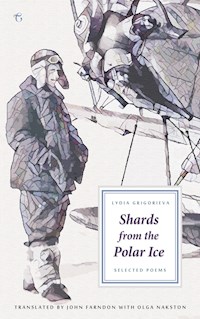
“It would be hard to imagine Russian poetry in the last half century without Lydia Grigorieva,” writes eminent Russian poet and critic Konstantin Kedrov. Grigorieva is a uniquely individual voice, bucking the trends of modernist poetry to create her own distinctive and beguiling body of poetry.
Her work draws on her own remarkable life to create startlingly arresting images and metaphors, full of beauty and power, from her series that emerged from her Arctic childhood, to the troubles that beset Ukraine. Her range of influences is wide, and Beethoven, Freud, Sylvia Plath and Byron all appear in her poems as well as more familiar Russian images.
At the heart of Grigorieva’s poetry is what she calls its ‘musicality’ – her firm belief in the power of rhyme and rhythm in creating a poetic experience. In this first major collection of her work in English, English poet John Farndon, working with Grigorieva and co-translator Olga Nakston, has recreated this musicality in English so that English readers might experience for the first time what makes her work so revered in her Russian homeland.
Translated by John Farndon with Olga Nakston. Maxim Hodak - Максим Ходак (Publisher),
Max Mendor - Макс Мендор (Director),
Ksenia Papazova (Managing Editor).
Das E-Book können Sie in Legimi-Apps oder einer beliebigen App lesen, die das folgende Format unterstützen:
Seitenzahl: 76
Veröffentlichungsjahr: 2018
Ähnliche














Shards from the Polar Ice
Selected Poems
Lydia Grigorieva
Contents
Copyright
Introduction
A note on the Translation
Commentary by Konstantin Kedrov
Selected Poems
Pity Beethoven
A Dream in the Garden
The Polar Day
The Polac Night
A life among the stones I took…
The Crazy Gardener
How we danced…
Vivaldi in Venice
Cedar is my brother. The grass is my sister…
Wet...
Will it be our children…
These are difficult times…
In the Garden of a Communist
I’ll suit my life, I’ll make it trim…
I flung the door wide…
White Horse
My garden…
Verde que te queiro verde...
Smash the window…
Shostakovich
Rose Petals
Arctic Ocean
Arctic Circle
Byron in Venice
Oh poor Abyss!
The neglected Garden
The Age of Silver
Kantemir in London
Once more I had to…
Flight Analysis
Words displayed…
Monument
Passion for Colours
I’m stepping through anguish…
Eternal Subjecte
All’s long been wrong…
Poet and Muse
Dreaming
The lilac by the home of Pasternak…
The Mad Photographer
I thank you now…
Oh, how can we, can we be so daring?…
‘God save me from losing my mind, I’d rather walk off with a staff and a bag.’
Oh God in your heaven…
Michelangelo went to Carrara to choose…
Raising a Garden
An Angel Coming
The Red Sea
Hexameter
Waiting Hall
Sleep in the Sinai Desert
Sinai
In the Scriabin Museum
Gare de Lyon
Waterloo Bridge
A Fright
The white air of the Vatican
I cannot really say…
When these lines no longer move…
What do the two of us need?…
Here I am! Now you have me…
It hurts them to stand…
City on the Camel Rug
Evening Cats
The Starry Garden
Smoke of the Fatherland
“From above, Paris looks like our aul from Charmoi-lam mountain…”
A respectable idea entered…
Weeping for the Empire
The Palace of Winds
Well, my friend…
A Dream
Welsh Carols
Freud in London
Melody
In memory of Sylvia Plath and Ted Hughes
The world is destroyed…
The Gardens by the Palace
Lydia Grigorieva: biography
Shards from the Polar Ice Selected Poems
by Lydia Grigorieva
Translated by John Farndon with Olga Nakston
Publishers Maxim Hodak & Max Mendor
Published with the support of the Institute for Literary Translation, Russia
© 2015, Lydia Grigorieva
© 2016, Glagoslav Publications, United Kingdom
Glagoslav Publications Ltd
88-90 Hatton Garden
EC1N 8PN London
United Kingdom
www.glagoslav.com
ISBN: 9781784379797 (Ebook)
This book is in copyright. No part of this publication may be reproduced, stored in a retrieval system or transmitted in any form or by any means without the prior permission in writing of the publisher, nor be otherwise circulated in any form of binding or cover other than that in which it is published without a similar condition, including this condition, being imposed on the subsequent purchaser.
Introduction
I first came across Lydia Grigorieva’s poetry in 2012 when I was working on a translation of her late husband Ravil Bukharaev’s beautiful novel memoir Letters to Another Room. Ravil was a great poet himself, and it was quite clear from the book that he adored Lydia’s poetry, too. He includes four full poems of hers within the text of the book and, of course, I had to translate these into English, so I came to see the power of her poetry at first hand.
One of the poems in particular stood out. It’s called Pity Beethoven and is a short but highly charged tour de force that captures the romantic image of the genius raging against the world with tremendous power and theatricality. It’s a piece that when read aloud to an audience thrills with its image of Beethoven striding through a storm. It makes poetry exciting, which is a rare quality.
“Cold rain rams his massive brow.
Balls of lightning hunt him now.
Sharp whips of wind about him lay.
Fate drives him on; he must obey.”
The short, sharp, strongly rhythmic lines and vivid imagery are typical of Lydia’s work, as I came to discover.
The poem was inspired, like so many of Lydia’s poems, by an image she has seen on her travels around the world and responded to with characteristic intensity. Karlovy-Vary in the Czech republic was once known as Carlsbad. In the early 1800s, this elegant spa town in a deep wooded Bohemian cleft was the place to be, and Beethoven was just one of the famous visitors. Goethe, Chopin, Turgenev and many others came here to take the waters.
On the outskirts of the town there is a dynamic, wild looking statue of Beethoven, green with verdi-gris, his face turned as if in defiance of all that nature and the ages can throw at him. Inspired by the statue, Lydia creates an imaginary picture of the night when Beethoven walked through a storm here in the town to meet his ‘Immortal Beloved’ – and she creates it so vividly it’s like a painting by Caspar David Friedrich come to life. And one can almost hear the crashing and defiant and desperate chords of Beethoven’s music.
With that poem, I was intrigued, and then Lydia asked me to translate another of her poems, A Dream in the Garden – and I was hooked. The contrast with the Beethoven poem could not be starker. A Dream in the Garden is an intense, almost psychedelic vision of sensual love as a dream in a perfumed garden. It is utterly intoxicating with its flowers that drown the drunken young lovers with their heady scent. It’s excessive, yes, but that’s its power.
“And on your damp chest, it’s not moths that are quivering
But soft blushing petals, fallen and shivering.”
Whoever thought fallen petals could be so erotic?
I gradually learned of the high esteem which with Lydia’s poems are held in Russia. Her poetry collections have been awarded numerous prizes. Her book of poems Celestial was shortlisted for the Buninskaya Prize and her Eternal Theme was finalist for Russian ‘Book of the Year’ in 2013. She won the Special Prize from the Russian Writers’ Union (2010) for the best poetry book of the year for the collection featuring A Dream in the Garden and also the im. A. Delviga Prize (2012).
“It would be hard to imagine Russian poetry in the last half century without Lydia Grigorieva,” writes eminent Russian poet and critic Konstantin Kedrov. But she is by no means an avant garde poet. Her poems are firmly traditional in their use of familiar rhythms and rhyme schemes. But that is her strength. Grigorieva is a uniquely individual voice, bucking trends of modernist poetry to create her own distinctive and beguiling body of poetry.
Her work draws on her own nomadic life to create arresting images and metaphors, full of beauty and power, vivid and arresting – whether it is white owls lost in the polar snow (Arctic Ocean) or tropic winds blowing through the pink palace of Jaipur (The Palace of Winds)
Sometimes her poems have the direct simplicity of a nursery rhyme or a traditional ballad.
“I’ll sew a garden neatly
Stitch flowers in the waste
And the pollen floating sweetly
Will add a homely taste.”
Sometimes the images are familiar:
“A white horse slowly, slowly trudging
Frail as mica, weakly panting
Enveloped by the winter steam.”
Just as often they are enigmatic:
“And my green dog has lost its mind...”
But the imagery is always intriguing, often haunting.
Like the towering figure of Russian poetry, Alexander Pushkin, Lydia draws inspiration from the English romantics Byron and Coleridge. What is remarkable is how she uses these influences to tap deep into the heart of the terrible Russian experience under the Soviet Union, and the ravages wrought upon her beloved Ukraine, the place of her birth and an idyllic childhood.
In her haunting poem, The Crazy Gardener, the allusion to Coleridge’s Rhyme of the Ancient Mariner is unmistakable:
“All the day long, the crazy old gardener
Worked on erecting an arbour of rose.
But the next day, as he walked out to water it,
Fear seized his soul and he instantly froze.”
Yet this poem is a powerful image of the damage to the Russian soul of Communism – a soul endangered just as powerfully as Coleridge’s mariner.
“There he was in the garden, candle in hand
Aglow in the day, with the sun shining bright
Illuminating the illogical landscape of Russia
And casting light on its dark soul’s blight.”
In the poemByron in Venice, Pushkin and Byron actually both appear. They are linked in exile, and exile is a recurrent theme in Lydia’s work, as it is in her life. Right now she lives in London as she has for decades since she came with her husband Ravil as he took up a job with the BBC World Service. It is the longest she has lived anywhere, but she is in exile from her homeland, from Russian Ukraine, the place of her birth, and the pain of those separations throbs like a vein through her poetry.
More than half her life, she spent under the Soviet regime, and like many poets came up against the constraints of the KGB, who, for instance, forbade any reference to God in poems. It’s no wonder Russian poets became adept at speaking in riddles, and there are times when I am sure I have missed allusions when translating Lydia’s poetry.




