


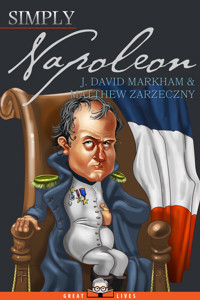
7,60 €
Mehr erfahren.
- Herausgeber: Simply Charly
- Kategorie: Religion und Spiritualität
- Serie: Great Lives
- Sprache: Englisch
“What a little gem! If you are looking for a quick biography of Napoleon, look no further. With lively narrative and good mastery of facts, Simply Napoleon will take you on a thrilling journey recounting Napoleon's rise to power from his humble beginnings on the island of Corsica to the emperor of much of Europe. Highly recommended for those wanting a brief refresher on one of the greatest European statesmen. This is both an entertaining and an enlightening read!”
—Alexander Mikaberidze, Sybil T. and J. Frederick Patten Professor of History Department of History and Social Sciences at Louisiana State University in Shreveport
The first emperor of France and one of the shrewdest military leaders of all time, Napoleon Bonaparte(1769–1821) eventually came to control much of Europe. In Simply Napoleon, authors J. David Markham and Matthew Zarzeczny tell Napoleon’s story, from his birth on the island of Corsica to his eventual imprisonment and death on the island of Saint Helena.
They explain how the famed military commander’s unique combination of determination, intellect, and personal charisma allowed him to rise from a provincial village to become a powerful and authoritative ruler. While taking an overall positive view of Napoleon, Markham and Zarzeczny also make it a point to draw attention to his mistakes and their consequences, providing a balanced picture of this complicated figure who was both a product of his times and a man pointing the way to the future.
Marked by first-rate scholarship, as well as a highly readable and accessible style, Simply Napoleon is an exceptional introduction to Napoleon and his times—a study that not only illuminates a key personality and period in modern history, but also helps us understand how modern Europe took shape.
Das E-Book können Sie in Legimi-Apps oder einer beliebigen App lesen, die das folgende Format unterstützen:
Seitenzahl: 204
Veröffentlichungsjahr: 2017
Ähnliche















Simply Napoleon
J. David Markham and Matthew Zarzeczny
Simply Charly
New York
Copyright © 2017 by J. David Markham & Matthew Zarzeczny
Cover Illustration by José RamosCover Design by Scarlett Rugers
All rights reserved. No part of this publication may be reproduced, distributed, or transmitted in any form or by any means, including photocopying, recording, or other electronic or mechanical methods, without the prior written permission of the publisher, except in the case of brief quotations embodied in critical reviews and certain other noncommercial uses permitted by copyright law. For permission requests, write to the publisher at the address below.
ISBN: 978-1-943657-30-8
Brought to you by http://simplycharly.com
1
To our mothers, with love, Myrtle Sturgis Markham and Sharon Marie Zarzeczny
Contents
DedicationPraise for Simply NapoleonOther Great LivesSeries Editor's ForewordPrefaceAcknowledgements 1. The Little Corsican: Napoleon’s Childhood (1769-1789) 2. Napoleon and the French Revolution (1789-1798) 3. Napoleon as Alexander (1798-1799) 4. Napoleon as Caesar (1799-1804) 5. Napoleon as Charlemagne (1804-1807) 6. Imperial Glory (1807-1812) 7. Imperial Decline (1812-1814) 8. Napoleon’s Return and Last Stand (1814-1815) 9. A Murder on St. Helena? — The Final Exile and Death of Napoleon (1815-1821) 10. Napoleon’s LegacySourcesSuggested ReadingAbout the AuthorsA Word from the Publisher2
Praise for Simply Napoleon
“From being the enfant terrible of the Bonaparte clan, to his torrid letters to Josephine, to his conquest and reorganization of Europe, Napoleon Bonaparte is portrayed as both man of the flesh and man of destiny in Simply Napoleon. There is nothing simple about Simply Napoleon; it is a carefully researched, well-written, condensed version of the Napoleonic era. Here the reader will find the ogre and brigand (according to his detractors), masterful general, reforming emperor, imperial majesty, and ultimately prisoner. Napoleon was both despondent and jubilant, and readers of this book will find themselves in the same conundrum.”
—Susan P. Conner, Professor of History Emerita and retired Provost, Albion College, Michigan
“What a little gem! If you are looking for a quick biography of Napoleon, look no further. With lively narrative and good mastery of facts, Simply Napoleon will take you on a thrilling journey recounting Napoleon’s rise to power from his humble beginnings on the island of Corsica to the emperor of much of Europe. Highly recommended for those wanting a brief refresher on one of the greatest European statesmen. This is both an entertaining and an enlightening read!”
—Alexander Mikaberidze, Sybil T. and J. Frederick Patten Professor of History and Social Sciences at Louisiana State University in Shreveport
“Well-researched and plainly written, Simply Napoleon is a good, readily accessible introduction to Napoleon and his military leadership, providing essential geopolitical context and psychological motivations for his campaigns. For those interested in learning more, the authors provide an excellent list of suggested works.”
—Wayne Hanley, author of The Genesis of Napoleonic Propaganda, 1796-1799 and Professor of History at West Chester University
“On a subject as vast as Napoleon, perhaps the greatest challenge is not to include everything, but rather to cull the information down to a digestible form. In this, both authors have achieved the Herculean task of presenting the key information needed to begin to come to grips with perhaps the most influential and fascinating man in history. If you have not yet approached the history of Napoleon and his era, then run out and get this book so that you may begin to appreciate all that is offered.”
—Todd Fisher, Executive Director of the Napoleonic Historical Society
“Simply Napoleon provides a clear, quick, and readable work that can be absorbed by anyone desiring a brief look at Napoleon Bonaparte’s life and accomplishments. The annotated suggested reading list provides the tools necessary for readers who are intrigued and tantalized by this man to dig deeper into the great Napoleon’s life and lasting legacy. Simply Napoleon provides an uncluttered starting point from which to embark upon an investigative journey into the life of this very complicated man.”
—George N. Vourlojianis, Professor Emeritus of History at John Carroll University
“If I were to recommend a book on Napoleon that would turn mild interest into full-blown obsession, Simply Napoleon would be among my top two choices. The authors’ ability to weave such a comprehensive narrative of the most salient facts without losing some of the details in the grand story of Napoleon is unparalleled. In style, both academics and casual readers will enjoy the almost conversational approach to the history of the Napoleonic Era. This book is a must-have for both nascent and well established Napoleonic libraries.”
—Kevin F. Rodriguez, Fellow of the International Napoleonic Society, Social Media Director, Napoleonic Historical Society
“An enjoyable read, Simply Napoleon serves as an excellent introduction to Napoleon Bonaparte, his times, and his legacy. While written for those new to Napoleon and Napoleonic history, Simply Napoleon will also prove useful to scholars with its enlightening anecdotes that illustrate the views of Napoleon and his contemporaries. Even those familiar with Napoleonic history are likely to discover new information while reading Simply Napoleon. Recommended for both newcomers and experts alike.”
—Nathan D. Jensen, Fellow of the International Napoleonic Society, owner/writer of www.frenchempire.net
“If you have ever wondered why Napoleon inspires interest not just in France but around the world even to this day, Simply Napoleon provides the quick and easy introduction regardless of background. This blitz through the storied life of the man himself nevertheless still finds time to connect larger international currents from the Society of United Irishmen to the Haitian Revolution. While the authors admire Napoleon, their subject remains human, and great efforts are made to present a rounded figure for the reader to judge, including a useful annotated guide for further reading. However one views the French general and emperor, the book’s central point is achieved with abundant clarity: an understanding of the modern world is incomplete without Napoleon.”
—Nicholas Stark, Adjunct Instructor of History at Union County College
“Packed with facts and interwoven with extensive excerpts from Napoleon’s correspondence and speeches, this is a popular yet painstaking biography that does not take sides or grind critical axes. Instead, it aims to provide interested readers with an entertaining and sympathetic portrait of one of history’s most astonishing leaders. The authors are noted experts on their subject, providing sure guidance through the thicket of facts, theories, and speculation that surrounds Bonaparte and ably curating additional research for readers who are enticed to learn more.”
—Yvonne Bruce, Lecturer in English at John Carroll University
3
Other Great Lives
Simply Austenby Joan Klingel RaySimply Beckettby Katherine WeissSimply Beethoven by Leon PlantingaSimply Chekhov by Carol ApollonioSimply Chomskyby Raphael SalkieSimply Chopinby William SmialekSimply Darwinby Michael RuseSimply Descartesby Kurt SmithSimply Dickensby Paul SchlickeSimply Diracby Helge KraghSimply Einsteinby Jimena CanalesSimply Eliot by Joseph MaddreySimply Euler by Robert E. BradleySimply Faulkner by Philip WeinsteinSimply Fitzgerald by Kim MorelandSimply Freud by Stephen FroshSimply Gödel by Richard TieszenSimply Hegel by Robert L. WicksSimply Hitchcock by David SterrittSimply Joyce by Margot NorrisSimply Machiavelli by Robert FredonaSimply Nietzsche by Peter KailSimply Proust by Jack JordanSimply Riemann by Jeremy GraySimply Sartre by David DetmerSimply Tolstoy by Donna Tussing OrwinSimply Stravinsky by Pieter van den ToornSimply Turing by Michael OlinickSimply Wagner by Thomas S. GreySimply Wittgenstein by James C. Klagge
4
Series Editor's Foreword
Simply Charly’s “Great Lives” series offers brief but authoritative introductions to the world’s most influential people—scientists, artists, writers, economists, and other historical figures whose contributions have had a meaningful and enduring impact on our society.
Each book provides an illuminating look at the works, ideas, personal lives, and the legacies these individuals left behind, also shedding light on the thought processes, specific events, and experiences that led these remarkable people to their groundbreaking discoveries or other achievements. Additionally, every volume explores various challenges they had to face and overcome to make history in their respective fields, as well as the little-known character traits, quirks, strengths, and frailties, myths, and controversies that sometimes surrounded these personalities.
Our authors are prominent scholars and other top experts who have dedicated their careers to exploring each facet of their subjects’ work and personal lives.
Unlike many other works that are merely descriptions of the major milestones in a person’s life, the “Great Lives” series goes above and beyond the standard format and content. It brings substance, depth, and clarity to the sometimes-complex lives and works of history’s most powerful and influential people.
We hope that by exploring this series, readers will not only gain new knowledge and understanding of what drove these geniuses, but also find inspiration for their own lives. Isn’t this what a great book is supposed to do?
Charles Carlini, Simply Charly New York City
5
Preface
“Napoleon is the greatest man that has ever lived … Since the world has existed there has never appeared a general, a conqueror, or a king, who can be compared to him.” With these words, Louis Bonaparte, a relatively short-reigning ruler of Holland in the early 19th century, lauded his more illustrious brother. While this praise may seem like a fraternal hyperbole, Louis was hardly alone in this grandiose assessment, although we disagree that Napoleon cannot be compared to anyone else in history. Still, we, like many historians before us, would only offer a handful of names for such a comparison.
Napoleon Bonaparte, or Emperor Napoleon I, was without any doubt one of the most influential and remarkable people who has ever lived. Only an elite group of individuals are reasonably categorized in the same class as Napoleon: Alexander the Great, Julius Caesar, and Charlemagne—all of whom Napoleon admired and compared himself to—can justifiably be placed alongside Napoleon as the truly “greatest men” of human history. The importance of these leaders as military innovators, empire builders, and so much more is difficult to quantify.
To that end, Simply Napoleon should bring a well-researched look at France’s legendary emperor and military commander to a wide general audience, including those who have heard of Napoleon (yes, there is even a Pizza Hut commercial in which the current United States President Donald Trump compares himself to Napoleon) and yet do not really know the history of this iconic figure. This book is written in an easily readable manner without the technical jargon often found in biographies and studies directed at a primarily academic audience of our fellow professors. Moreover, it is intended as a fairly concise overview of Napoleon’s life and times, and serves as a sort of introduction and study guide of the great man and his many groundbreaking accomplishments.
Although he is the central figure of this volume, Napoleon is joined by a veritable cast of fascinating people who played their own roles in influencing Bonaparte’s life, as well as his successes and failures. In the coming pages, you will learn about Napoleon’s tumultuous love life (he was married twice and had many mistresses), as well as his large family with ambitious brothers and sisters who would join Napoleon in ruling various kingdoms and principalities in Europe. Napoleon also had to contend with members of Europe’s traditional ruling dynasties—the Bourbons, Habsburgs, Hohenzollerns, and Romanovs, who were sometimes allied with the Bonapartes and at other times, their bitter enemies. The story of Napoleon goes beyond the lives of monarchs and their spouses to include diplomats, lawyers, politicians, priests, rebels, scientists, and soldiers—all of whom had in some way shaped the emperor’s private, public, and military life. Statesmen helped negotiate the treaties that redrew the world’s maps. Lawyers and politicians enacted laws under Napoleon’s guidance that would be adapted by countries across the world from Asia to North America. Bishops, priests, and even rabbis all worked with Napoleon in the undertaking of numerous religious reforms, including a Concordat between Napoleonic France and the Holy See that lasted for over 100 years, from 1801 to 1905, foreshadowing agreements made between Fascist Italy (in 1929) and Nazi Germany (in 1933) with the Holy See in the 20th century. Thus, because the Napoleonic Code, the French civil code established in 1804, and the Concordat of 1801 are accepted as two of the most important and influential documents in all of modern world history, their authors are worthy of remembering. So too are the rebels in Haiti and Spain who unleashed horrors on Napoleon’s forces; while we do address these atrocities, we only scratch the surface of the darkest moments of the era. Far less disturbing were the architects, artists, scholars, and scientists of that era. Working on Napoleon’s behalf, they advanced our understanding of Ancient Egypt, while also producing some of the finest paintings and monuments that are still visited and admired every day by millions of people from around the world. Finally, we also mention the many soldiers who fought, bled, and in many cases even died, in the numerous battles and campaigns fought by Napoleon and his subordinates in battlefields around the world.
This book will enlighten our readers about the life of a military genius who led armies to Egypt, the Holy Land, and across Europe. Napoleon sent his forces to battle Haitians in the Caribbean and doubled the size of the United States with one of history’s most celebrated real estate deals—the Louisiana Purchase. But he was more than just a conqueror and gifted general. He was also an activist of sorts, bringing reforms to France’s education and legal system, the positive changes that far outlasted Napoleon’s conquests and influenced—in some cases to this day—reforms in many other countries as well. Having achieved so much in one of history’s most turbulent eras, that of the French Revolution, Napoleon has been the subject of countless works of art, literature, and cinema. Everything from restaurants (Napoleon’s Pizza) to psychological conditions (Napoleon complex) have been named after him. Once again, few men or women have had such an enduring influence on the world’s military, education systems, laws, and popular culture.
His accomplishments during his life were significant, and so too were his failures. Not everyone who acknowledges Napoleon as an important or influential figure necessarily sees him as a “great” man in a positive sense. Both during and after his life, he has had his share of venomous detractors who pointed to the death toll of his many wars as his truest legacy. Although such luminous men as Britain’s erstwhile Prime Minister Winston Churchill disagreed with comparisons of Napoleon with Adolf Hitler, others, including our fellow contemporary historian Claude Ribbe, embrace parallels between the French emperor and the German dictator. In his 2005 book Le Crime de Napoleon (Napoleon’s Crime), Ribbe alleged that Napoleon’s forces used Sulphur Dioxide gas to mass execute over 100,000 rebellious blacks on Saint-Domingue (now Haiti) and Guadeloupe, an action that Ribbe saw as a model for Hitler’s Holocaust in the 20th century. Ribbe is hardly the only scholar to present Napoleon in such a negative light. American historian Alan Schom wrote a lengthy and maligned biography of Napoleon published in 1997 that is anything but flattering. In a review of this book on the website The Napoleon Series (https://www.napoleon-series.org), Kevin Kiley, author of the much more positively reviewed Artillery of the Napoleonic Wars (2004), denounced Schom for, among other things, doing “his prejudiced best to blacken Napoleon’s reputation.” Ribbe and Schom may represent some of the most notable recent historians to criticize Napoleon sharply, but they are preceded by numerous people of diverse backgrounds from as far back as Napoleon’s life. To see negative perceptions of Bonaparte dating back to his lifetime, one need only look at the many cartoons by such artists as Britain’s James Gillray that present mocking caricatures of Napoleon akin to what we see in newspapers today of our present politicians. Over the course of Napoleon’s career and after, cartoonists, pamphleteers, and some of Europe’s propagandists continued to ridicule Napoleon and even portray him as an antichrist. As you will learn in the following pages, alongside the positive descriptions of Bonaparte as a hero and humanitarian, a number of his contemporaries and some modern scholars have denounced him as “bad” and even “evil.”
How can one and the same person be revered as “the greatest man who ever lived” by some, and denounced as a warmongering and even genocidal tyrant by others? Why has he been so polarizing and controversial? Or was Napoleon, as we would argue, more complicated than to be classified as either “good” or “evil?” Is he as British historian David Chandler asserted “a great bad man” or is another description more accurate? By reading this volume, you will perhaps develop your own opinion of this much-debated and perhaps even misunderstood man.
In the pages that follow, we seek to explore many facets of Napoleon and his policies in chapters organized chronologically by key phases of his life. We start with his childhood, which had an unquestionable formative influence upon him, especially his upbringing by his mother, and then explore his education and early military schooling before moving on to his career as an officer in the French army amid the tumult of the French Revolution. From there, we see how Napoleon rose through the ranks to lead French forces in their conquests of Italy and then Egypt in a manner sometimes compared (even by Napoleon himself) to the exploits of Alexander the Great. Our next chapter sees Napoleon lead France as a reform-minded “Consul” reminiscent of the flurry of activity undertaken by ancient Roman Consul and Dictator Julius Caesar nearly two millennia earlier. Afterward, Napoleon traded the trappings of republicanism for something more akin to establishing a Charlemagne-esque imperial system that dominated Western Europe. Afterward, we focus first on the period of imperial glory, followed by Napoleon’s precipitous fall and eventual final defeat. We continue with his life and death in exile before concluding with an examination of the aftermath—Napoleon’s legacy that endures to the present, as is evident by even your reading this volume today.
Our coverage within these ten chapters includes some topics that go beyond just a narrative of Napoleon’s life to place him in his historical context and to show how extensive his influence was on world history. As you can tell already from the preceding paragraphs, his significance was and still is widespread. Indeed, modern historians from Paul Fregosi to J. P. Riley have written books with titles that explicitly refer to the Napoleonic Wars as a “world war.” Yet, as we mentioned above, Bonaparte was more than merely a military figure. His varied accomplishments have helped shape the world we live in today and, for better or worse, without Napoleon’s influence on so many aspects of our history, the world today would likely be a quite different place. It is hardly surprising then that numerous articles, essays, and books addressing various counterfactuals or “what ifs” of the Napoleonic Age continue to speculate how even seemingly minor changes in Napoleon’s life could have had far-reaching consequences. We continue to ask questions and search for answers about this beguiling man who has arguably influenced all of us in a variety of ways. Was he really the greatest man who ever lived? Read on and reach your own conclusion!
As for Napoleon, his journey (well, as is the case with all of us, really) began when he first entered our world. Nearly 10 years before the birth of Louis Bonaparte and many decades before Louis’s designation of his older brother as history’s greatest man, the birth of Napoleon Bonaparte to his mother, Letizia, would commence a life only paralleled by a handful of individuals. So, let us start with the story of a boy and his mother, and how this relationship changed the course of world history.
J. David Markham Toronto, ON
Matthew Zarzeczny Ashland, OH
6
Acknowledgements
To acknowledge all those who have helped David in his career would take an entire book! Napoleonic history luminaries like Don Horward, Jerry Gallaher, Rafe Blaufarb, and others certainly have made a huge difference. Other friends in the International Napoleonic Society, the Napoleonic Historical Society, the Consortium on the Revolutionary Era, and the Massena Society have always been there to offer support and help. The late Proctor Patterson Jones and, of course, his friend and the founder of the INS, the late Ben Weider, were very important in his development. He is also grateful for his friend Matthew’s willingness to join in this project.
Closer to home, David’s parents always encouraged his interests, though when his dad, James, introduced him to Napoleon, no one probably suspected where that would lead! David’s sister, Sara, her husband, Ron, and their son, Adam, have always been supportive as well, even if they are not Napoleon’s biggest fans. David’s ex-wife and now close friend, Barbara Munson, was instrumental in his success for many years, serving as his editor for all of his books and articles. And finally, he wants to give special tribute to his wife, Edna. Her support in the past few years has motivated him to continue moving forward. But then again, Edna’s ancestors were from Prussia, home of Marshal Blücher, a.k.a. “Marshal Forwards!”
In addition to Matthew’s parents, Daniel and Sharon Zarzeczny, brother- and sister-in-law David and Regina Zarzeczny (as well as his niece and nephews Alexis, Elias, and James), and miniature dachshund (appropriately named Marie Louise Zarzeczny), Matthew would like to thank Dr. David Foster at Ashland University; Drs. Matthew Berg, Yvonne Bruce, Rodney Hessinger, Daniel Kilbride, Anne Kugler, Maria Marsilli, and George Vourlojianis at John Carroll University; Drs. Leslie Heaphy, Ralph Menning, James Seelye, Shawn Selby, Thomas Sosnowski, and Lindsay Starkey as well as adjuncts Christine Bowman and Angela Saunders at Kent State University at Stark; and Drs. Alice Conklin, Nathan Rosenstein, Richard Ugland, and Dale Van Kley at The Ohio State University, as well as Shell Harris at TopTenz.net and Beth Murina Michaels of Unique Interpretations, for their continued support and encouragement in his academic and professional careers. Matthew also wishes to thank his many students for their enthusiasm and diligence, which makes sharing his love of history that much more rewarding an experience. To that end, he especially recognizes the inspiring achievements of his students Eugene Claridge, Bryan Mersol, and Amber Hanophy, who have excelled both in and outside of the classroom. Lastly, Matthew wishes to recognize the many members of John Carroll University’s Paranormal Research Group, the award-winning student organization that he advises, for making his academic career that much more unique and interesting.
Thank you from both of us to our editors, Helena Bachmann and John Meyer, for their careful examination of our manuscript. We greatly appreciate their hard work in helping us produce a more smoothly worded contribution to the Simply Charly series. Finally, we must also thank Charles Carlini for the opportunity to participate in this wonderful series of biographies.
Nearly all images used in this book, excluding the cover and a few images in the Public Domain reproduced here from Wikipedia, are from the David Markham Collection.
1
The Little Corsican: Napoleon’s Childhood (1769-1789)
As a youth growing up on his island home of Corsica, the future emperor of the French and one of history’s greatest conquerors, Napoleon Bonaparte, already wore a military uniform. On a particularly painful occasion, the young Napoleon’s mother, Letizia, dealt him a sharp punishment. She tricked her son into believing that he had been invited to dine by the island’s governor. Then, as Napoleon changed his clothes, she seized him, laid him across her knee, and proceeded to spank him. Why? He and his sister, Pauline had earlier mocked their hobbling grandmother, Letizia’s mother. Whereas her mother spanked Pauline immediately when Letizia learned of her children’s misbehavior, Napoleon could not justly be punished while wearing his sacred uniform.




