


Erhalten Sie Zugang zu diesem und mehr als 300000 Büchern ab EUR 5,99 monatlich.
- Herausgeber: Pushkin Press
- Kategorie: Gesellschafts- und Liebesromane
- Sprache: Englisch
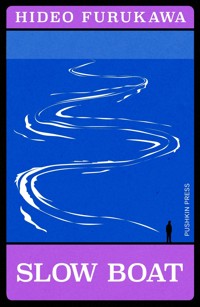
A startling novella from the heir to Haruki Murakami and Gabriel García Márquez 'I've never made it out of Tokyo. I can't tell you how many times I've asked myself if the boundary is real. Of course it's real. And if you think I'm lying, you can come and see for yourself.' Trapped in Tokyo, left behind by a series of girlfriends, the narrator of Slow Boat sizes up his situation. His missteps, his violent rebellions, his tiny victories. But he is not a passive loser, content to accept all that fate hands him. He attempts one last escape to the edges of the city, holding the only safety net he has known - his dreams. Filled with lyrical longing and humour, Slow Boat captures perfectly the urge to get away and the necessity of finding yourself in a world which might never even be looking for you. Hideo Furukawa, born in 1966, is an acclaimed and prize-winning writer, hailed by many in Japan's literary world as a prodigy worthy of inheriting the mantle of Haruki Murakami. He was awarded the Mishima Prize in 2006 for Love. His best-known novel is the 2008 Holy Family, an epic work of alternate history set in north-eastern Japan, where he was born.
Sie lesen das E-Book in den Legimi-Apps auf:
Seitenzahl: 132
Veröffentlichungsjahr: 2017
Das E-Book (TTS) können Sie hören im Abo „Legimi Premium” in Legimi-Apps auf:
Ähnliche




















123
HIDEO FURUKAWA
SLOW BOAT
A SLOW BOAT TO CHINA RMX
translated by DAVID BOYD
PUSHKIN PRESS
CONTENTS
BOAT ONE
THE DIG
I’ve never made it out of Tokyo.
I can’t tell you how many times I’ve asked myself if the boundary is real. Of course it’s real. And if you think I’m lying, you can come and see for yourself.
I’m working on the final plan today. For the last time.
The boundary isn’t a border. But just because you don’t need a passport doesn’t mean you can up and leave whenever you like. This is where I was born, and it’s where I’m going to die.
This is my botched Tokyo Exodus, the chronicle of my failures.
Three failures, to be exact. The Japanese language is nothing but lies. Or maybe just chaos. “What happens twice will happen again.” OK, I buy that. But how can that idea coexist with “Third time’s the charm”?
Farewell, mother tongue.
Still, I’m writing this in Japanese. It’s the best language I have for writing down my experiences (or the contents of my brain). No question. Language has its limits, but it’s all we’ve got. For understanding each other or misunderstanding each other or whatever. Besides, isn’t life all about limits?
At the end of the day, we’ve all got our limits. As living things, we’re bound to die. 8
Death.
Let me tell you about the Big Limit.
Tokyo, 2002 a.d.
Winter. K-1 kick-boxer Ernesto Hoost shouts: “I’m the three-time champion!” Good for you. I’ve failed to make it out of Tokyo three times. The first time, I guess I was ten or eleven. Not sure which. How old are you in the fifth grade? That old. My most recent fail was a little under two years ago.
Three tries, three girlfriends.
The losses don’t stop. The odds were always stacked against me. Sneaking onto some ship is probably my best hope to get out now.
Maybe you figured this out already—I don’t do well with people. Believe me, I tried. But we need to keep on fighting, right? Even if we’re just marching towards death.
No—that’s exactly why we need to stay in the ring.
It’s morning, 24th December. I’m at Hamarikyu Gardens, making a fist.
This is the last time. My final plan, ergo my ultimate plan. So I need to get a good read on things. I tell myself: dig, dig, dig. Think archaeologically.
Hamarikyu is between the Tsukiji Fish Market, Takeshiba Pier and Shiodome (where the Shiosite skyscrapers are going up as we speak). I’m looking at the moment that Tokyo Bay becomes the Sumida River. Wait. More like I’m watching the Sumida lose its name.
Time—so much time—flows by in a liquid state. 9
Thick, leaden liquid.
The water buses aren’t running.
Of course they aren’t. It’s 9.20 in the morning. First day after a long weekend. Christmas festivities will bring crowds later on, but there’s nobody here now. Just me and the dark clouds. Wait, was it supposed to rain today? Did I miss the forecast? The whole place is empty, but this bus terminal feels like a mortuary.
Thick, leaden sky.
I open the pamphlet I got at the ticket gate. Hamarikyu once belonged to the Tokugawa family. Property of the Shogunate. After the Meiji Restoration, it was an imperial villa. During the American Occupation, it lost its imperial standing. Just makes you wonder… who really owns Tokyo? I walk around. There are a couple of spots for duck-hunting, used even in the middle of the Pacific War. There’s a peony garden—not that peonies are in season. There’s Shiori Pond, the only saltwater pond in Tokyo. I see a lot of birds. Taking another look at the pamphlet, I can see that this place gets all sorts of avian visitors. Resident birds: wagtail, spot-billed duck, night heron, little grebe… Then the migratory birds: common pochard, northern shoveler, northern pintail, etc. But the bird you see the most makes no appearance in the garden’s official literature: the crow.
The jungle crow, to be specific. A very intelligent (and impudent) scavenger.
At this hour, the garden belongs to the crows. They fly around, hang upside-down from the pines, hop across the grass. There’s a party of crows by Shiori Pond, cawing and 10cawing. They’re making a racket, so I walk over to see what all the fuss is about.
They’re going at a carcass. Maybe it was a seagull.
And I was under the impression that eating in the garden was strictly prohibited.
Not that you’d know it from the pamphlet, but the crows make their nests high up in the trees. They swoop down and attack lesser birds. They take total advantage of all the nature Hamarikyu has to offer. They do what they want.
I feel a kind of love for this place, where crows can be crows.
But that fantasy doesn’t last long.
I hear something like screams. I follow my ears, off the path—off-limits. I walk up a low grassy hill, and there it is. A huge enclosure, boarded up to look like something legit. Clearly, they don’t want anyone to know what’s going on.
I peek between the cracks. About ten crows inside, alive, but very unhappy. What the hell is this?
There’s a sign on the boards: wild crow regulation installation—property of metropolitan tokyo.
Meaning: Hands off.
For the peace of the citizens of Tokyo.
The captive crows thrash around. They’re frantic.
The screaming doesn’t stop:
Let us outta here! Let us outta here!
But this is necessary, to make Tokyo a better place for us to live.
Crows have no value to people, so we exterminate them. 11
Hands off.
If you can’t comply, then Tokyo has no need for you, either.
In that instant, I slip into a daydream. A fury. I fantasize about prying off the boards and busting the bars, freeing the crows. I want to find the other cages (this can’t be the only one) and destroy them, too. But my legs don’t move. And I know why. I’m not afraid of being caught by some cop or security guard with a nightstick. Like I could care. Here’s my problem: If a cop comes after me, do I have what it takes to fight back? Like, call him a STUPID DICKHEAD and lunge right at him? I don’t think so. And there’s only one reason for that. I’m not naïve enough to think I can free the crows. Not really. If someone like me breaks into the cage and lets the birds out, they’ll just step up security. They’ll have ten new crows in there, like, right away. And they’ll keep a closer watch on them. The incident would end up on the news, too, giving the citizens of Tokyo more reason to hate crows. And the cop trying to stop me, he doesn’t give a shit about the crows. He’s just doing his job. He doesn’t care about me or anything I have to say. Justice isn’t in the picture.
If the law forbids it, you can’t do it. That’s it. End of story.
The Holocaust was OK under Nazi German law.
That’s why my legs won’t move. Why I feel empty. Alone.
Dark clouds.
Christmas Eve in Hamarikyu, and no one is around.
Where’s the rain? 12
I wasn’t so weak when I was young. But I got old. Now I always think about consequences. Through my early twenties, when I was sure justice was on my side, justice was on my side.
Now I can barely utter the word “justice”.
There were times when I stood up and fought back. And I lost. Three times.
Days of failed escapes. When I was younger, and tougher.
When I was sure there was a way out.
BOAT TWO
KEEP BOTH HANDS FLAT ON YOUR LAP
I stopped going to school when I was in the fifth grade—in early May, right after Golden Week. Everyone always wants to know why. I had my reasons, trust me. My mom was getting hysterical, for starters. And my teacher was always coming to my house and getting me in trouble… Talk about no boundaries. But I bet they saw things differently. I bet, the way they saw it, it wasn’t me who was giving up on school. School was giving up on me.
Whatever, not even close.
I know what happened. But it’s hard for me to explain, even now. Way harder for a kid ten or eleven years old to put into words—into Japanese.
Anyway… I guess what really triggered it was Children’s Day. “When you write ‘Children’s Day’, don’t do it in kanji,” my teacher said. “Spell it out in kana. If you can read the kanji for ‘children’ then you’re not a child any more.” Ha ha ha. Hilarious.
The whole world was comfortably dumb.
Children’s Day: A day for the children, for their happiness and for their mothers.
Give me a break. As soon as I saw all the carp floating over the city, that was it for me. What the hell is this farce? 14Tokyo’s full of carp (or streamers acting like carp). What are all these fish-mouths trying to say? It’s a giant farce. True, “farce” wasn’t in my vocabulary back then. But that’s what I felt, in my bones. I had to get the hell out.
Which is what I did, in dreams.
Not ambitions. Real dreams, if dreams can be real.
I said it before and I’ll say it again. This record of mine is nothing without my Japanese and all of its limits. When you talk about life, you have to talk about the Big Limit. Death. It’s a part of life. No escaping it.
OK. Let’s start at the beginning.
Pretty sure it was the end of the fourth grade. February probably. February 1985. I went to sleep. Except I didn’t. After a few minutes in bed, not sleeping, I had this revelation. It just came to me. I might’ve been a stupid kid, but this fact hadn’t hit me until that night. Suddenly I understood: I’m going to die at some point. My life won’t last forever.
I curl up.
That night, alone in bed, I started seeing time differently. History. Followed by a full stop. Try to imagine what it’s like for a fourth-grader to be terrified of death. I had to find a way out. Sleep was definitely scary—a whole lot like death. But that didn’t keep me from getting sucked in.
Into the world of dreams.
The boy who is afraid of death lives for dreams.
I started my dream diary before entering the fifth grade. But writing down your dreams isn’t as easy as you think, so I went looking for help. A guide. Something to point 15the way. What I found was a how-to book. Dream analysis stuff. Like Freud (yeah, Sigmund Freud). “Snakes represent penises, caves represent vaginas.” That sort of thing. But the real Freud is too complicated for a total beginner. Hell, I still haven’t read Introduction to Psychoanalysis. The book I bought wasn’t the real Freud. It was Freudian. Written by a so-called “expert”, published by a so-called “publisher”. But this book became my bible. It was easy to read. The chapters were short, and there were tons of illustrations. It almost felt like a strategy guide for some video game. Cheat codes for the libido or something.
But what’s a vagina to a prepubescent boy anyway?
Sure. I’d had some sex dreams. But I never saw the female anatomy as the be-all and end-all. Well, I never saw the female anatomy at all. In my dreams, there was nothing but skin down there. Smooth, like a doll’s. You can’t dream about something you’ve never seen in the real world. I hadn’t come yet, either, so all the references to “ejaculation” meant jack to me.
Reading dreams is hard.
I tried my best. I was a big fan of free association. The moment I woke up, I would write down how my dreams felt, using a few clues picked up from my bible. You have to start somewhere. Can’t write about your dreams without the language of dreams.
The problem wasn’t me—not necessarily. The Japanese language has its own shortcomings. But that’s a story for another time.
This is the story of a fifth-grade boy hell-bent on making 16sense of his dreams. Cracking the code. And that means staring death in the face. Which takes, you know, courage. In the words of Henry Miller, “Sleep is an even greater danger than insomnia.” Or did he mean something else? Maybe I’ve got it wrong.
Story of my life.
Back in the world of the living: Children’s Day. 5th May 1985. Flying fish invade Tokyo airspace. But I’m not there. I’m in bed.
I was so devoted to figuring out my dreams that I never left my bed. I kept on sleeping. Didn’t go to school.
That’s how I became a “dropout”.
What happened then?
By the end of June, I was no longer a resident of Suginami ward. The guidance counsellor at school recommended “a change of environment”. For me. Not my family. They stayed put. I was sent away, on my own, to an alternative school for dropouts. A place for kids who are for some reason unable to go to regular school. There were grade-schoolers—like me—and middle-schoolers. We lived together under one roof, in a dorm. And, following our marching orders, we walked to and from the local school each day. Together.
Out there in the mountains. It kind of felt like summer camp.
But we were still in Tokyo.
Japan Railways, JR, by that name, didn’t exist yet. It was National Railways. Well after the NR Chuo Line stops to the 17west, Tokyo keeps on going. I never thought about it until then. After Takao? Another prefecture, right? Saitama or Yamanashi or something. Beyond my ken. Hell, I was oblivious to the fact that Tokyo has eight “villages”. Did you know that? Tokyo’s eastern limit: Minamitori Island. Formerly known as Marcus Island. Part of the Ogasawara Islands. Co-ordinates: 153° 58' 50" E. To the south: the Okinotori Islands. An atoll, actually, almost completely underwater at high tide. 20° 25' N. Uninhabited, obviously, and far and away Tokyo’s southernmost point.
Tokyo.
How far does Tokyo go?
There I was. A ten- or eleven-year-old dropout with no interest in speaking to others. Sent away—to the only Tokyo “village” on the main island. Damn close to Tokyo’s western edge.
I was shocked to find Tokyo went that far. It took me two trains (the Chuo and Ome Lines) and one bus (called the West Tokyo Line for a reason) to get there. A solid two hours from home—and I’m still in Tokyo? Are you kidding? For one thing, this place is deep in the mountains. For another, the news-stand at the station is selling wasabi… The news-stand.
It felt like Chichibu Tama National Park.
Nothing around, unless you’re itching for a killer hike. And the dorm was apparently built on land that used to be a village for fugitive warriors.
“Fugitive warriors”?
*
18The village school had opened its doors to us dropouts. Due to a dwindling student body, it had to shut down or agree to educate a wild bunch of losers from all over Japan. It chose door number two and stayed open. That was what everyone wanted—the teachers, the village, everyone. And in my own (unasked-for) opinion, it was the right move. Right?
That’s how I see it at present.




