


10,79 €
Mehr erfahren.
- Herausgeber: David Fickling Books
- Kategorie: Für Kinder und Jugendliche
- Serie: Stuart
- Sprache: Englisch
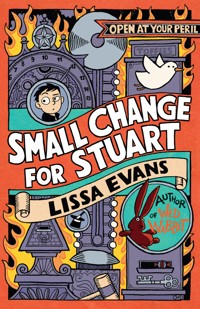
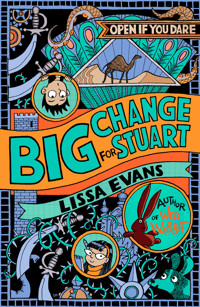
Stuart Horten, ten years old and small for his age, is about to have the strangest ADVENTURE of his life. After moving to the boring town of Beeton, he finds himself swept up in an INCREDIBLE QUEST to find his great-uncle's lost legacy: a magician's workshop stuffed with trickery and MAGIC. There are clues to follow, unbearable neighbours to avoid and PUZZLES to solve, but what starts as FUN ends up as DANGER, and Stuart begins to realise that he can't finish the task on his own . . .
Das E-Book können Sie in Legimi-Apps oder einer beliebigen App lesen, die das folgende Format unterstützen:
Seitenzahl: 215
Veröffentlichungsjahr: 2019
Ähnliche














![Tintenherz [Tintenwelt-Reihe, Band 1 (Ungekürzt)] - Cornelia Funke - Hörbuch](https://legimifiles.blob.core.windows.net/images/2830629ec0fd3fd8c1f122134ba4a884/w200_u90.jpg)
www.davidficklingbooks.com
For my girls
Contents
Chapter 1
Stuart Horten was small for his age – the smallest boy in his year at school – and both his parents were very tall, which meant that when he stood next to them he looked about the size of an ant.
As well as being tall, and quite old (especially his father), his parents were extremely clever people. But clever people aren’t always sensible. A sensible person would never give a child a name that could be written down as S. Horten. A sensible person would realize that anyone called S. Horten would instantly be nicknamed ‘Shorten’, even by their friends. And Stuart had quite a lot of friends. He also had a bike with eight gears, a garden with a tree house and a large and muddy pond. Life was pretty good.
* * *
Anyway, this whole story – this unexpected, strange, dangerous story of Great-Uncle Tony’s lost legacy – began when Stuart’s mother was offered a new job. She was a doctor (not the sort who stitches up bleeding wounds, but the sort who peers down a microscope) and the new job was in a hospital a hundred miles from home, which was too far for her to travel to every day.
‘I suppose I could live away during the week,’ she said, ‘but I’d hate it. I’d miss you both too much.’
So that was that, thought Stuart.
Life went on as normal for a day or two, and then Stuart’s father, who was a writer (not of films or of best-selling books, but of difficult crosswords), came up with an awful suggestion. ‘We could rent this house out for a year,’ he said quite casually to Stuart’s mother, as if leaving the village in which Stuart had lived for his whole life was something quite minor. ‘We could move closer to your new hospital, and see if we like it.’
‘I won’t like it,’ said Stuart.
His father took out a road map of England and began to trace his finger northward. ‘Well I never,’ he said, his finger halting at a black smudge. He shook his head wonderingly. ‘I hadn’t realized that the hospital was so close to Beeton. That’s the town where I was born – I haven’t been back in well over forty years. We could go and live there. It’s quite pleasant.’
‘Oh, now that would be interesting for Stuart,’ said his mother.
‘No it wouldn’t,’ said Stuart.
They didn’t listen to him. At the end of the school year, they packed up and moved to Beeton, taking Stuart with them, and though they were clever people, being clever isn’t the same as being sensible. A sensible person would know that if you had to move house, then the worst possible time to move would be at the start of the summer holidays. Because when you arrived at the new house you wouldn’t know any other children, and you’d have no chance to meet any until school started again in the autumn.
And – to make it worse – the new house (20 Beech Road) was small and boring and looked just like all the other houses in the road, and in the next road, and in the road after that. It was nowhere near an adventure playground or a swimming pool. There was no front garden, and the back garden consisted of a square of grass surrounded by a fence that was slightly too high for Stuart to see over.
On the first day after the move, Stuart shoved his clothes and games into cupboards, and flattened out the giant cardboard boxes into which they’d been packed.
On the second day, there was nothing to do. Nothing, nothing, nothing.
Which is why, when his father said, ‘Ah, there you are. I was just thinking of going for a brief perambulation. Would you like to come too?’ Stuart answered, ‘Oh all right, then.’
By ‘brief perambulation’, his father meant a short walk. That was the way he talked all the time, and he always spoke in a loud, clear voice, so that people in the street turned and stared at him.
Normally Stuart would rather have poured cold gravy over himself than go for a walk with his father. Instead, on this dullest of days he accompanied him out of the front door and went left along Beech Road, right along Oak Avenue and left into Chestnut Close.
‘When I was a youngster,’ his father told him as they walked, ‘there weren’t any houses in this part of Beeton at all. This whole area was sylvan.’
‘What’s sylvan mean?’ asked Stuart.
‘Wooded. And there was a stream running through the middle of it.’
‘Did you light fires?’
‘Beg pardon?’ said his father, who was so much taller than Stuart that he sometimes had to bend almost in half in order to hear him.
Stuart raised his voice. ‘Did you light fires? Did you dam the stream? Did you make a swing?’
His father shook his head. ‘No,’ he said. ‘I was never very keen on that sort of thing. I was too busy inventing crosswords.’
They walked in silence along Hawthorn Avenue.
‘Aha!’ said his father as they passed an ancient red telephone box and turned the corner into a street of shops. ‘Now this is the older bit of the town. I seem to remember that the entrance to the family business used to be just along here.’ He halted at a narrow side turning, but there was nothing to see apart from a pair of high-tech metal gates, firmly shut. ‘It’s long gone, of course,’ said his father. ‘Though the name’s still discernible.’ He pointed to a cast-iron arch that curved above the gates. A scattering of painted letters was just about visible.
‘Horten’s Miraculous Mechanisms,’ said Stuart after a lot of thought. He turned to his father. ‘What sort of mechanisms?’
‘Locks and safes, originally, and then the business diversified into coin-operated machinery. Though by the time the factory was conflagrated by an incendiary I believe it was making armaments.’
‘By the time it was what by a what?’
‘Burned down by a firebomb. In nineteen forty, during the Second World War, one fell on the factory when my father was away one night. My uncle Tony had been left in charge, but the fire took hold and the building was destroyed.’
‘Fifty years ago,’ said Stuart. ‘Almost exactly …’ Beside the steel gates were an intercom and a labelled buzzer that he had to stand on tiptoe to read: Tricks of the Trade. Goods entrance.
‘So what happened after the fire?’ he asked.
His father, whose normal expression was one of mild happiness, looked suddenly serious, and he started walking again. It was a while before he spoke. ‘It was all rather sad,’ he said. ‘I suppose it marked the end of the family. My father tried to start the business again, without success, and after a few years he moved away from Beeton. He blamed my uncle Tony for the fire, you see, because Tony had never really been interested in the factory at all, he was an ent—’ Stuart’s father stopped dead. ‘Good lord!’ he said, staring ahead.
Stuart followed the direction of his gaze and saw a tall, shabby house, its garden overgrown, its windows boarded up, and its roof a patchwork of cracked and missing slates.
‘That’s Uncle Tony’s house!’ said his father. ‘The probate dispute must never have been resolved to the mutual satisfaction of the parties concerned.’
Stuart simply ignored this last sentence. ‘What’s an “Ent”?’ he asked. ‘You said he was an “Ent”.’
‘An entertainer,’ answered his father. ‘A prestidigitator.’
‘A what?’
‘A magician. He used to do conjuring tricks on stage.’
‘A magician?’ Stuart repeated. ‘You had an uncle who was a magician? But you never told me that.’
‘Oh, didn’t I?’ said his dad vaguely. ‘Well, I know very little about him. And I suppose it didn’t occur to me that you’d be interested.’
Stuart rolled his eyes in exasperation and walked up to the gate. It was encased in ivy, held tightly shut by the curling stems. ‘Number six,’ he said, running his finger over the brass number that was half hidden by the leaves. ‘So what sort of tricks did he do?’
‘I’m not sure.’
‘And what was he like?’
‘I don’t remember him at all, I’m afraid. I was very young when he disappeared.’
‘He disappeared? What do you mean he disappeared?’
‘I mean that he went away and never came back to Beeton.’
‘Oh.’ Stuart felt disappointed. For a second or two he’d imagined a puff of smoke and an empty stage and an audience gasping. ‘So why’s the house all wrecked, then?’ he asked.
‘Because there was a probate dispute.’
‘You said that, but what’s probate?’
‘The legal enforcement of the will. Uncle Tony left the house to his fiancée, but apparently they had an argument. She ran off after the fire and nobody could ever trace her. My goodness, it does look a mess.’
Stuart stared at the front door. Several pieces of wood had been nailed right across it, but between them he could just glimpse an oval of stained glass, the multicoloured pieces forming some sort of picture. A hat, was it? And a stick? And a word that he couldn’t quite read?
‘But I was in bed …’ came his father’s voice from the distance.
Stuart looked round. His father was walking away up the road, having failed to notice that Stuart hadn’t moved. ‘So he left a present for me,’ explained Stuart’s father to the empty patch of pavement next to him.
‘Who did?’ shouted Stuart, running to catch up.
‘Your great-uncle Tony. He came to visit my house one Christmas Eve when I was a small child, but I was already asleep.’
‘And what was the present?’
‘A box.’
‘What sort of box? A magic box?’
‘No, a money box. I still have it, as a matter of fact – it’s the one that I keep paperclips in.’
Chapter 2
Stuart had seen the box almost every day of his life, though he’d never taken much notice of it. In the old house it had lived on his father’s desk, and in the new one it sat on the windowsill of the study.
As soon as he got back from the walk, Stuart ran upstairs to get it. It was cylindrical and made of tin, painted with a pattern of red and blue interlocking rings, although half the paint had worn away so that crescents of bright metal showed between the colours. He flipped open the hinged lid, tipped out the paperclips and looked into the empty tin. He didn’t know what he’d expected to see, but there was nothing, just a blank, shiny interior. He slapped the lid back on again and stared at it for a moment. ‘Dad!’ he shouted.
There was no answer. Stuart took the tin downstairs and found his father gazing out of the kitchen window with the kind of slack-jawed expression that he always wore when thinking up crossword clues.
‘Dad, why did you say this was a money box?’
‘I beg your pardon?’
‘There’s no slit in the lid. Money boxes have a slit in the lid to put the coins in. So why did you call it a money box?’
‘Oh …’ His father peered down at the tin as if he’d never seen it before. ‘I think it was written somewhere. On the side, perhaps?’
Stuart looked hard at the worn pattern, and saw something that looked a tiny bit like a curly W. He turned the tin the other way up and the W became an M. But there were no letters after the M. He started to rotate the tin in his hands.
‘Now that I remember …’ began his father.
‘It’s not just upside down,’ said Stuart. ‘It’s written back to front.’
The o and the N of the word MONEY had completely worn away, but he could just about see the E and the Y.
‘Now that I remember,’ Mr Horten repeated, ‘there’d been some kind of error in the manufacture of the box. The word money was printed upside down and back to front.’
‘I just said that,’ said Stuart. ‘But I bet it wasn’t a mistake.’ He put the lid back on again and weighed the tin in his hand. The bottom felt heavier than the top. ‘It’s a trick box,’ he declared, with sudden certainty. ‘Great-Uncle Tony was a magician, and he gave you a puzzle to solve.’
His father was gazing out of the window again.
‘But unfortunately not a crossword puzzle,’ added Stuart under his breath. He up-ended the tin, and tried to unscrew the bottom. It wouldn’t budge.
‘Sorry?’ said his father. ‘Did you just say something? I lost the thread …’
Stuart stopped what he was doing. The thread. It was a word with two meanings: not just a piece of cotton, but a spiral path, cut into metal.
Cautiously, he started to turn the bottom of the tin the other way – and it opened in one smooth movement. He was so startled that he dropped both pieces, and suddenly there were coins all over the floor, gold coins (a sort of dull gold, anyway), bouncing all over the place. Stuart scrabbled to pick them up.
‘Good Lord!’ said his father, switching his attention from the window. ‘Where did those come from?’
‘There was a little compartment in the bottom,’ Stuart told him. ‘They were packed so tightly that they didn’t even rattle.’ The coins were small with an irregular edge, a picture of a man with a beard on one side, and something that looked like a grid on the other. ‘Are they worth thousands?’
‘Let me see …’ His father counted the coins into a little pile on the table. ‘Eight threepenny bits,’ he said. ‘A threepenny bit is worth just over a penny in new money, so they’re worth—’
‘Less than 10p,’ said Stuart disgustedly.
‘Well actually,’ his father said, ‘they’re no longer legal tender, which means that you can’t spend them in the shops.’
‘So they’re worth nothing, then?’ Stuart flicked his finger at the little pile and it fell over. The top coin rolled off the table, onto the floor and right out through the kitchen door, and he followed it, just to see how far it would go. Not far, as it turned out – only to the edge of the lawn. He knelt to pick it up.
‘What’s your name?’ asked a voice behind him.
Stuart turned and saw a girl looking at him from the next-door garden. She wore glittery hair clips and had a clever expression; she was resting her chin on the fence.
‘What’s your name?’ she repeated.
‘Stuart,’ he said.
‘And how old are you?’
‘Ten.’
‘So am I,’ she said, ‘but I’m a lot taller than you. A lot. What’s your second name?’
He hated telling people his surname because of the whole ‘Shorten’ thing. He shrugged. ‘Why do you want to know?’
‘Because I do. I’m going to write an article about you and I need a full set of details. This is all I’ve got so far.’ She held up an open notebook over the fence so that he could read what she’d written:
NEW NEIGHBOURS ARRIVED WEDNESDAY. MAN LOOKS LIKE A GIRAFFE, WEARS GLASSES AND HUMS ALL THE TIME. WOMAN HAS AWFUL HAIR, RIDES BICYCLE AND GOES TO WORK VERY EARLY. ONE GOLDFISH IN SMALL TANK, LOOKS DEAD. ONE SON, PROBABLY ABOUT 8 YEARS OLD.
‘My goldfish isn’t dead,’ said Stuart indignantly.
‘I only wrote that it looks dead,’ the girl replied, underlining the word “looks” with one finger. ‘It’s an impressions piece. But I need the true facts for tomorrow’s edition.’
‘Tomorrow’s edition of what?’
‘Our newspaper. Me and my sisters are writing one as a holiday project. April’s the crime correspondent, May’s the photographer and I’m the general reporter. I just need your second name, the name of your goldfish, the name of your new school, the name of your old school, your date of birth, your favourite hobby, your favourite food, your favourite animal, your favourite sport, your shoe size, your exact weight and height …’
Stuart started to edge away from the fence half a step at a time.
‘… your best ever Christmas present, your worst ever Christmas present, your least favourite TV programme, your most favourite TV programme, your unhappiest memory, your … Come back!’
Stuart, who had edged almost as far as his own back door by this point, shook his head and dodged inside.
‘Ah there you are!’ said his father as he entered. He was holding a Scrabble board. ‘I was just thinking of engaging in a little contest of—’
‘Can I go for a ride on my bike?’ asked Stuart quickly. ‘I’ll be really sensible. I won’t go far. I won’t talk to strangers. I’ll wear my helmet. I’ll be back in half an hour.’
‘Yes, all right,’ said his father, looking a little disappointed. ‘Where are you going to go?’
‘Oh, nowhere in particular.’
Which was a lie. Because Stuart went straight back to Great-Uncle Tony’s house.
Chapter 3
Stuart locked his bike to a lamppost opposite the house and looked along the road. There was no one about. All the other houses on the street were small and modern and well-cared for, with tidy front gardens and shining windows.
He crossed the road, glanced around one more time to check no one was watching, and then climbed over the gate.
The grass in the front garden was as high as his waist. He waded through it, stumbling over half-bricks and old bottles. When he reached the front door, he inspected the four planks of wood that were nailed across the frame. He pulled at one of them, but it held firm. He tried to peer through the letter box, but it had been wired shut and he was too short to look through the stained-glass oval at the top of the door – though he could see the picture formed by the coloured pieces clearly now: a top hat, a wand and the initials T-T TH.
T-T TH.
Tony Horten. Something-something Tony Horten. Terrifically-talented?
Stuart started to walk round the house, pausing to tug fruitlessly at one of the boards that covered a side window. The back garden was even more overgrown than the front. There were swathes of giant stinging nettles and vast loops of brambles studded with unripe blackberries. Amidst the jungle lay odd bits of junk.
The back door was large and solid and firmly locked. Stuart rattled at the handle for a while, and then knelt down to look through the keyhole. There was nothing to see but darkness. Disappointed, he straightened up. There was obviously no way of getting into Great-Uncle Tony’s house. The excitement of the past few minutes seemed to dribble away, leaving him feeling flatter and sadder than ever. Without bothering to try any more windows, he carried on walking around the house, kicking at the rubbish in the grass.
As he reached the front garden again, his toe caught an empty plastic bottle and sent it sailing up and over the front wall. It bounced across the road and came to rest against the front wheel of a bicycle. A pink bicycle. A pink bicycle that was parked right next to his own. Standing beside it was the girl from next door. Glittery clips. Clever expression. She was holding a camera with a very long lens.
As Stuart gaped at her, she raised the camera and took a photo of him. ‘What are you doing?’ he demanded.
She said nothing, but took another photo.
‘Stop it!’ he shouted.
The camera flashed again. ‘Anything to say to our readers?’ the girl called, taking yet another picture. ‘Any comments as to why you’re trespassing on private property?’
She was obviously nuts. The camera flashed once more.
Stuart turned and sprinted back round the house. Was there another way out? The wooden fence surrounding the garden was high, with no footholds, but right at the back, wedged into one corner, was an old cooker, its white enamel blotched with rust. If he climbed up on that, he could probably get over into the next garden. Of course, he actually had to get to it first, without being first stung to death or shredded by thorns.
He looked across the sea of weeds. Just visible were odd little islands – discarded bits of furniture, an old trunk, a pile of boxes – which he could use as stepping stones. He held his arms above his head, to guard against stinging nettles, and took a first, hesitant step onto a rotting armchair, its cushions furred with mould. From there he jumped onto a mushy pyramid of cardboard boxes and balanced briefly on what looked like an old gas meter before taking a huge pace onto the lid of the trunk. The cooker was only a couple of metres away now. But ahead of him there were no more stepping stones, only a stretch of particularly lethal-looking nettles. He looked round quickly. There was no sign of the girl.
What he needed was a bridge. He retraced his steps and had just started to gather up some of the soggy boxes when he heard a beeping noise.
‘Following subject into back garden of trespassed property,’ came the girl’s voice from round the corner.
Stuart leaped from gas meter to trunk and started to lob the boxes ahead of him, stepping into one before placing the next. It took him four boxes to reach the cooker, and then it was a simple job to scramble onto it and then up and over the fence into the neighbour’s garden. He had no time to look where he was jumping.
In some ways he was lucky. He could have ended up in a pond, or gone through the roof of a greenhouse. Instead he landed up to his ankles in a compost heap. He climbed out and shook tea leaves and slimy bits of orange peel from his shoes.
A startled face looked through a window at him. Stuart waved cheerily and sprinted up the neat garden and along the side passage of the house, emerging onto the pavement.
His plan had worked! All he had to do now was go round the block and stand watch until that awful girl went away on her bike. He walked up the road and turned right onto a street full of small shops. And stopped dead.
The girl was standing directly in front of him. Her face lit up. ‘Subject has just appeared on the high street,’ she said into a walkie-talkie.
Stuart turned tail and began to run, but there were too many people on the pavement to allow a quick getaway. Instead he dodged into a post office and hid behind the door. The girl followed. As soon as she had her back to him, he hurried out onto the street again. And immediately saw the same girl – glittery clips, clever expression – coming along the pavement towards him holding a walkie-talkie. For a moment Stuart thought he’d gone mad, totally mad, and then the words ‘identical twins’ floated across his mind, and he realized that this second girl (unlike the first) was carrying a large, purple note pad.
She hadn’t seen him yet.
He thought quickly. There was an old-fashioned red telephone box just outside the post office, and he pulled open the door and stepped inside.
It smelled repulsive. The floor was covered with mashed cigarette ends and horrible stains, and the small, square windowpanes were encrusted with filth. The door closed softly behind him, and he crouched down to peer through one of the few clear patches in the glass. The second girl had now been joined by the first. They were standing together, scanning the pavements, searching for him.
All at once, he felt like an idiot. Two girls, he thought. Here I am, in a stinking phone box, and I’m hiding away from two girls. I should just go out there and tell them to— And then, with sudden disbelief, he leaned forward and pressed his nose against the window. The two girls had been joined by a third, and they all looked exactly the same.
Identical triplets. He was being hunted by identical triplets. Stuart decided to stay put for a bit.
A loud knocking made him jump, and he straightened up and turned. A woman was thumping on the door with the handle of her umbrella. ‘Are you making a call?’ she shouted.
‘Yes,’ he lied.
‘Because there’s a queue, you know!’
Stuart felt around in his pockets for some money. He could always phone his father, he thought. After all, he’d been away for a bit longer than half an hour. His fingers found a single coin and pulled it out. It was the worthless threepenny bit. He turned it over in his hand a couple of times.




