


10,79 €
Mehr erfahren.
- Herausgeber: Salt
- Kategorie: Gesellschafts- und Liebesromane
- Sprache: Englisch
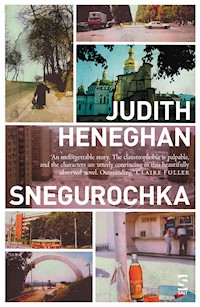
'Something terrible is happening here. Something terrible has already happened.' Snegurochka opens in Kiev in 1992, one year after Ukraine's declaration of independence. Rachel, a troubled young English mother, joins her journalist husband on his first foreign posting in the city. Terrified of their apartment's balcony with its view of the Motherland statue she develops obsessive rituals to keep her three-month old baby safe. Her difficulties expose her to a disturbing endgame between Elena Vasilyevna, the old caretaker, and Mykola Sirko, a shady businessman who sends Rachel a gift. Rachel is the interloper, ignorant, isolated, yet also culpable with her secrets and her estrangements. As consequences bear down she seeks out Zoya, her husband's caustic-tongued fixer, and Stepan, the boy from upstairs who watches them all. Betrayal is everywhere and home is uncertain, but in the end there are many ways to be a mother.
Das E-Book können Sie in Legimi-Apps oder einer beliebigen App lesen, die das folgende Format unterstützen:
Veröffentlichungsjahr: 2019
Ähnliche




















SENGUROCHKA
by
Judith Heneghan
SYNOPSIS
‘Something terrible is happening here. Something terrible has already happened.’
Kiev 1992. Rachel, a troubled young English mother, joins her journalist husband on his first foreign posting in the city. Terrified of the apartment’s balcony, she develops obsessive rituals to keep their baby safe. Her difficulties expose her to a disturbing endgame between the elderly caretaker and a local racketeer who sends a gift that surely comes with a price. Rachel is isolated yet culpable with her secrets and estrangements. As consequences bear down she seeks out Zoya, her husband’s fixer, and the boy from upstairs who watches them all.
Home is uncertain, betrayal is everywhere, but in the end there are many ways to be a mother.
PRAISE FOR THIS BOOK
‘An unforgettable story. The claustrophobia is palpable, and the characters are utterly convincing in this beautifully observed novel. Outstanding.’ —Claire Fuller
REVIEWS OF THIS BOOK
‘This is a fascinating portrayal of Kiev and its people, written with skill, depth and sympathy but never shying away from darker facets. At its heart is the story of a marriage, of motherhood, and of a place contaminated by its terrible history. It is an alluring and gratifying read.’ —Jackie Law, neverimitate
Snegurochka
JUDITH HENEGHAN is a writer and editor. She spent several years in Ukraine and Russia with her young family in the 1990s and now teaches creative writing at the University of Winchester. She has four grown up children.
Published by Salt Publishing Ltd
12 Norwich Road, Cromer, Norfolk NR27 0AX
All rights reserved
Copyright © Judith Heneghan,2019
The right ofJudith Heneghanto be identified as the author of this work has been asserted by her in accordance with Section 77 of the Copyright, Designs and Patents Act 1988.
This book is in copyright. Subject to statutory exception and to provisions of relevant collective licensing agreements, no reproduction of any part may take place without the written permission of Salt Publishing.
Salt Publishing 2019
Created by Salt Publishing Ltd
This book is sold subject to the conditions that it shall not, by way of trade or otherwise, be lent, re-sold, hired out,or otherwise circulated without the publisher’s prior consent in any form of binding or cover other than that in which it is published and without a similar condition including this condition being imposed on the subsequent purchaser.
ISBN 978-1-78463-175-8 electronic
For Rory, Nellie, Jeremy and Meriel
“‘I am talking about mercy,’ Woland explained his words, not taking his fiery eye off Margarita. ‘It sometimes creeps, quite unexpectedly and perfidiously, through the narrowest cracks.’”
from The Master and Margarita
by MIKHAIL BULGAKOV
Chapter 1
Kiev, October 1992
High up onthe fourteenth floor, a boy steps onto a balcony. He is twelve, maybe thirteenwith slender limbs and shorn hair and he is naked apart from a pair of faded underpants. He scratches the bloom of eczema on his hip as he squints towards the neighbouring apartment block. No one is watching him. The steel hulk of the Motherland monument glints from her hillock across the valley, but she is a statue and her eyes are dead.
The boy moves to a pile of junk in the corner and yanks at a rusting bicycle until it breaks free from the chair leg that is jammed between its spokes. The bicycle’s chain has snapped, so he props it against the waist-high wall and hoists himself onto the seat, side-saddle, with one foot on a pedal. Now, perched there with his narrow shoulders hunched forward, one arm hugging the ledge, he waits.
Below him, the air hangs still between the tower blocks and the strand of fractured tarmac that winds down towards the Dnieper. His pale eyes flick across the hazy crenellations of the industrial zone on the horizon. He ignores, to his left, the green and gold canopies of the monastery on the hilltop with those silent, rotting cottages like windfalls at its feet. Instead, lizard-like, he is watching for movement: the cadets playing basketball between crooked hoops on their rectangle of parade ground inside the military academy, the dogs gnawing their rumps in a corner of the car park, and the women spilling out of a tram like spores down on Staronavodnitska Street.
The spores work their way across the waste ground along concrete paths that intersect at sharp angles. Here comes Elena Vasilyevna, the caretaker for Building Number Four. When her dark form disappears between the dump bins far below, the boy shifts on the saddle, leans out and cups his free hand to his mouth. One deep breath, then his jaw juts forward and he makes a sound like a dog’s bark from the back of his throat. For a moment the sound splits the emptiness before it drops down the side of the building. The old woman reappears, her face turning in the wrong direction. The boy smiles, pleased at the effect.
Then, just beneath him, he notices something else.
The balcony on the floor below is glazed, unlike his own, and the glazing abuts the base of his balcony, which forms a roof. One of the windows is open and the smell of a cigarette rises up towards him. Freshly lit – a Camel.
The boy stands up on the pedal and leans further over the edge. He can’t see in through the glass below because the white sky is reflecting back at him, but a man’s left forearm dangles out through the opening, fingers flicking ash.
Someone has moved in.
He studies the man’s hand. The skin is pale with golden hairs. His shirt is unbuttoned at the wrist – white cotton with thin blue checks. His watch is analogue with a leather strap, not metal. This man is in his twenties, maybe thirty, western, but probably not German or American. He wears a gold wedding band and when the arm withdraws a stream of smoke is blown out into the stillness.
The man says something, his voice muffled by the interior. Then a baby starts crying. Its mewls are a new sound, yet within seconds they seem to stake a claim on the building, seeping into the walls, travelling up through the concrete, the steel and the spaces in between.
This is the last day of summer. Tonight, the temperature will plummet and people will wake in the morning, sniff the wind and dig out their winter hats. For now, though, the boy remains balanced on the bicycle, a memory of warmth on his skin as the leaves drop silently from the rowans by the tramline, and the air cools, and the Englishman at the window below mutters to himself and lights another cigarette.
The foreign journalists say the city is holding its breath, but for Stepan it is one long exhalation.
* * *
Lucas, the golden-haired Englishman, and Rachel, his wife, are standing in the kitchen of their flat in Building Four, Staronavodnitska Street. It is a narrow room with a small table at the far end, in front of the window. The floor is covered in shiny brown linoleum and the walls are papered with a pattern of orange swirls. The laminated chipboard cupboards look new and there’s a small freestanding stove in one corner.
Lucas is holding a Geiger counter.
‘The batteries are charged,’ he says, frowning at a leaflet. ‘The switch is on.’ A pause. ‘Nothing showing yet.’ He waves the device in a circle through the air before pointing it at Rachel. ‘So that must be good?’
Rachel stops biting the skin around her thumbnail and stares up at the ceiling, which is covered in the same swirling paper as the walls. There’s a noise above her head, a faint squeaking sound that travels backwards and forwards from the window to the hallway like the wheels of a hospital gurney.
‘Rach?’
Rachel turns her gaze to her husband. ‘I thought they gave you some training,’ she says.
‘The training was for Pripyat and Chernobyl.’ Lucas risks a smile. He has already spent five months in Ukraine, his first posting as a radio journalist on a retainer with the BBC World Service. Everyone agrees that it is perfectly safe for foreigners who weren’t in the danger zone when the reactor exploded back in 1986. ‘Trust me, Rach, I wouldn’t have brought you and Ivan out here if there were hotspots in the city.’
Rachel stares at the gap beneath the stove. It is dark there, too dark to see underneath. This is her first day in Kiev. She arrived from London in the morning, frayed after the flight with their fifteen-week-old son. The airport felt hostile: people pressing all around, the threat of disease or some muttered sanction on their breath. The drive from Boryspil in a car with no seatbelts had done nothing to reassure her.
‘What about seepage underground? Try pointing it at the tap. The water comes from somewhere else.’ She leans across the stainless steel sink and raises the lever. Water gushes, then slows to a brown trickle. There’s a clanking sound in the pipework under the counter. Rachel makes a noise through clamped lips and folds her arms beneath her swollen breasts; her eyes are rimmed red with tiredness and Lucas tries not to notice the dark patch that is spreading across her shirt. She’s leaking again.
‘Hey,’ he murmurs, reaching for her hand. ‘It’ll be okay. I’ll get Zoya to go through the instructions. I’ll get the caretaker to sort out the taps. Until then we’ve plenty of bottled water.’ He looks down at his wife, at her sad, soft face with its high forehead and crooked nose and gently receding chin and feels, not for the first time, a flutter of panic in his chest. They haven’t seen each other for nine weeks because of doctors’ appointments and immunisations. Now he wishes she’d tell him what she’s really thinking: that she can’t bathe their baby in brown water, even if it’s not radioactive; that the cot in which little Ivan has finally fallen asleep won’t pass any British standards of safety; that an amber-coloured cockroach scooted under the bath when she went for a wee; that the flat is on the thirteenth floor and he shouldn’t leave her to go out with his journalist friends tonight so that he can catch up on what he’s missed while he’s been fetching her from the airport. Perhaps nine weeks was too long. Or not long enough. She’s only been in Kiev for six hours and she’s shutting down already. The thought makes him flap at the net curtains above the windowsill until he finds his cigarettes.
‘Come out on to the balcony with me,’ he says. ‘You’ve not seen the view yet. Come out.’
Rachel remembers staring up at the block of flats when Zoya, Lucas’s fixer, had driven them here earlier. The grey concrete balconies looked like something she’d once made for a school project, with matchboxes that fell off as soon as the glue dried.
‘I need to change my shirt,’ she mutters, pulling away.
Then the doorbell rings.
* * *
Once upon a time, Rachel told Lucas a story. She was a little drunk, a little careless and she told this handsome, suntanned student who looked like a famous cricketer or a polo player or maybe the Marlboro Man with his long limbs and blue sleep-with-me eyes that when she was eight, she thought she was having a baby.
Lucas tried to sit up, though the beanbag he was sprawled across made this difficult.
‘What happened?’ he asked, tipping sideways until he could fix the girl with the wonky nose and the large, slightly bulging eyes and the nice arse in his sights.
‘Oh,’ she said, surprising herself as the words came skipping out. ‘I was in love with a boy at my primary school. His name was Charles. But my dad was an engineer and we moved to Swansea for a year for his job. So I had this old box of After Eights – you know, the chocolates with the little waxy envelopes? Well the chocolates were all gone, so I wrote ‘I love Charles’ on little bits of paper and folded them up and tucked them inside the envelopes. Then I took the box to Swansea and hid the notes all around our new house.’
Lucas held his wine glass up to his face and peered at her through its smeary double lens. ‘Funny girl,’ he said, wanting to touch her, but she hadn’t finished.
‘My bedroom was at the end the corridor, away from my parents. I used to lie in bed at night, listening to my stomach gurgling. And I knew that if you loved someone, you had a baby. So I thought I had a baby in my tummy.’ She paused, her mind re-focusing on the soft green light she’d made when she closed her bedroom curtains and the silence she’d made when she held in her breath. ‘I couldn’t tell anyone, of course, because eight-year-old girls who weren’t married weren’t supposed to have babies, so I made a cot for it out of a shoe box and kept it under the sink. I thought it would come out of my belly button.’
‘Oh deary me,’ said Lucas, who hadn’t expected to find her quite so entertaining. He leaned across and kissed her. The wine glass toppled over, spilling its dregs into the beanbag. Rachel felt a wet patch under her hip but it didn’t matter; these things often happened at parties.
* * *
The doorbell keeps ringing and ringing.
Lucas is still fiddling with the locks at the far end of the hallway when Rachel emerges from the bedroom, yanking a clean top down over her bra.
‘Quick!’ she pleads. ‘Before they wake Ivan!’
At last the bolt shoots back and the lever drops, but as Lucas pulls open the front door Rachel sways. She puts her hand against the wall as if it is the tower block that has shifted. Or maybe she’s a little feverish.
‘Oh, and here you both are!’ says a woman’s voice, in an accent that might be Canadian. Rachel sees two figures moving forward from the gloom of the landing. Lucas has mentioned his friends often: Vee, the Harvard-educated stringer for a Toronto daily who learned Ukrainian from her grandparents, and Teddy, the photographer from Michigan. Lucas hangs out with them a lot, he’s told her. They have fun together. Now Rachel can, too.
Lucas moves aside and Vee steps in across the threshold. She is tall, slender, with dark hair cropped short, red lipstick, mannish glasses and a face more striking than beautiful. Rachel tries not to stare.
‘Where’s the baby, Lucas? Where’s little Ivan? He’s not sleeping, is he?’ Vee pouts, clownishly. ‘Dammit, I just knew he’d be sleeping . . .’
‘Hey,’ says Lucas. ‘Rachel, this is Vee. And Teddy.’
‘Hello – lovely to meet you.’ Rachel tries to shake Vee’s hand.
‘Oh, I want a kiss!’ says Vee, pushing her glasses to the top of her head and pulling Rachel towards her. ‘Teddy wants one, too! I told him your witchy-faced caretaker downstairs needed a cuddle but he’s too-too shy, aren’t you, sweetie?’
This is clearly a joke, for Teddy isn’t shy at all. He makes a great show of embracing Rachel, arms pretend-flapping like a penguin. When he stands back he’s smiling, his brown eyes set close together, one hand rubbing the dark stubble on his jaw. He is wearing a faded Lou Reed t-shirt under a sheepskin jacket. Vee, too, has an air of not trying too hard and Rachel is aware of her own slack-waisted skirt, the hint of something sour-smelling on her shoulder, the thick, lumpy breastpad she’s slipped inside her bra. Her vision blurs a little. Perhaps the tower block is swaying after all.
Vee is still talking. ‘We’ve been desperate to get you out here!’ she says, walking into the living room with its shiny parquet flooring and textured wallpaper that makes Rachel think of elbow skin. Pale October light filters through the net-curtained window and the glass door that leads out on to the balcony. ‘We’re sick of Lucas moping around, waiting for you to arrive. Jesus, this flat is amazing! It’s so empty! Where’s all the crap you had in that other place, Lu? Hey, a three-piece suite! That couch must be hiding the cocktail bar . . .’
‘Drinks!’ says Lucas, ducking down the hallway to the narrow kitchen wedged in the corner between the living room and the bedroom. He raises his voice so that they can still hear him. ‘It’s more than we can afford, but I promised Rachel we’d have a bit of space, and Ivan will be crawling before we know it. My old flat was a death-trap.’ He reappears, grinning and eager with three beers in one hand and a bottle opener poking out of his shirt pocket. Then he remembers what has changed. ‘Hang on, there are four of us!’
‘Not for me,’ says Rachel, with a shake of her head.
Lucas slides an arm around her waist and gives her a squeeze. ‘My beloved wife also demanded a lift. And a washing machine!’
‘Well then,’ declares Vee. ‘That’s it. You’ll never see the back of me! I’ll be camping out in the foyer with my bundles of dirty laundry . . .’
‘We haven’t got one yet.’ Rachel’s voice is flatter than she intends; her veneer of sociability is tissue-thin. ‘I’ll rinse things in the bath.’
Vee raises one of her finely arched eyebrows. ‘That won’t be easy – with a baby,’ she says. ‘Hey, you must let us see him – I bet he’s adorable. Is he talking yet?’
‘Are you kidding?’ laughs Lucas, handing round the opened bottles. ‘He’s only three months old! Feeds, sleeps and leaks from every orifice. Now you really need to see this view . . .’ He sweeps aside the net curtain, revealing the balcony beyond. For a moment, a shadow drifts downwards across Rachel’s vision like a dust particle trapped on her cornea – tiny limbs, curling fingers, a floppy neck. She wants to shake her own head, erase the image of the falling child before it can take hold, but Vee’s eyes are upon her, the tip of her tongue just visible through her teeth. Rachel extricates herself from Lucas’s arm and sits down on the sofa.
‘Oh – my – God!’ exclaims Vee. She steps through the glass door with Teddy. ‘The river, the monastery, that crazy Statue of Liberty looky-likey . . . Poor old maiden aunty Baba, they call her, Brezhnev’s dildo, waving her sword for the Motherland. Always looks like surrender to me. I filed a colour piece for The Economist when I arrived. Assholes didn’t run it.’
‘They didn’t have the right image,’ remarks Teddy, his voice low, the base notes to Vee’s contralto. ‘Now, up here, at dawn, long exposure, the smog a little blue in the background . . .’
Lucas follows them out onto the balcony. ‘Rachel used to be a picture researcher. Travel books, that kind of thing.’
‘Is that right?’ says Teddy, turning and smiling through the doorway. ‘Who for?’
Rachel tries to relax. She smiles back. ‘Gallon Press. Near the British Museum. No one’s ever heard of it.’
‘They use authors’ own pics, mainly,’ says Lucas. ‘Tightwads. It’s the same problem at the BBC. My lousy World Service retainer nails me to Bush House for all of three hundred pounds a month. I’m sick of peddling short bulletins that get knocked off the schedule by an old fart on the night desk. I need a story I can sink my teeth into – get a couple of solid half-hour features under my belt, something for Radio Four or a piece in the Sundays.’ He takes a swig of his beer, then leans out through the open window and peers down so that Rachel can’t see his head. ‘Smells like burning plastic down there,’ he declares, pulling his shoulders back inside and turning round to face Vee and Teddy. ‘So, what are you two working on now?’
This, Rachel knows, is not the right question. Her husband seems jumpy, vulnerable in front of his Kiev friends. Here they are, Rachel and Lucas, saying things, stabbing at things, both, in different ways, out of their depth.
Vee, on the other hand, gives nothing away. ‘Oh, you know,’ she says, twisting the silver necklace she wears. ‘Rule by decree. The World Bank’s latest doom-mongerings. Those so-called reformers whining about whether foreign films should be dubbed in Russian or Ukrainian – all talk and no action while the grandmas protest outside St Sophia’s and war vets starve along the boulevards. There’s a press conference tomorrow. They’re printing bigger denominations.’ She reaches into her handbag and pulls out a pack of Marlboro Lights. ‘One hundred kouponi, these cost me – and they’re counterfeit. See? The foil’s too smooth. Now that’s a story that won’t end well for some hapless new kid who tries to follow the money.’ She flips the lid with a glossy fingernail and holds the pack out to Lucas. He hesitates, until she turns and looks back apologetically at Rachel. ‘Sorry. God, that’s stupid of me. No smoking around the baby!’
‘Don’t worry about it,’ says Lucas, quick with his lighter. ‘It’s fine out here. If we shut the door.’ And Rachel sees now why he chose the flat with the glazed balcony where he and his fellow journalists can puff away all winter, guilt-free, even though he promised to give up when Ivan was born. This is his city, his job. These are his friends. Anyway, there are some things that only she knows. Ivan is stirring in his cot in the bedroom and immediately her breasts start to tingle as the let-down reflex floods the vessels behind her nipples. If she doesn’t go quickly, the pads will leak.
Lucas twitches briefly as Ivan breaks into his high-pitched cry, though she’s already on her feet.
‘Can we see him? Will you bring him in here?’ calls Vee.
‘Sounds like an appetite!’ adds Teddy.
‘I have to feed him in the bedroom,’ murmurs Rachel as she slips down the hall.
‘We don’t mind – truly!’
But Rachel is already closing the bedroom door.
* * *
Ivan’s face is turned inside out. His eyes are squeezed shut and his mouth is a red cave with its glistening, quivering uvula and hard ridges of gum. When Rachel lifts him away from the urine-soaked cot sheet he stops crying, but his lips are searching and she must be quick. She sits on the bed with her back against the flimsy headboard and her fingers rummage for the clip on her bra. As soon as she peels off the sodden, sticky pad, milk spurts forward and hits Ivan’s cheek. She hesitates only for a second, then bites down on her lip and brings his head towards her.
When Ivan clamps on, she catches her breath and resists the urge to scream. The cracks in her skin re-open and she can see by the dribbles at Ivan’s mouth that the milk is blushed with blood. It’s the pink of her mother’s gelatinous salmon mousse that always made her want to gag. She closes her eyes, her head bent low over the baby as if this might ease the dragging, the burning. And it does ease, after a few minutes, as the pressure lessens and Ivan’s saliva softens the fissures and the scabs.
Ivan is a big feeder and will drain her to the last drop. When his sucking flattens out into a more contented rhythm she brings her knees up to cradle him and leans her head back once more. Milk from her other breast has pooled across her stomach. She doesn’t wipe it away because she doesn’t care, in here, in this private space. Besides, every second is precious now, when the pain is fading and she knows she has two or three hours before she must endure it again. Her own breathing settles. The voices outside are forgotten. Time to sleep, the midwife would say in her sensible, seen-it-all tone. This same midwife told her to put Ivan on the bottle; that she needed to heal before she took her baby to a place with no emergency numbers, no guarantee of antibiotics. But formula milk means using sodium-rich mineral water that might poison her child, or that brown stuff from the tap in the kitchen.
No, the midwife hadn’t understood. Rachel is staying awake. She needs to do the inventory.
She starts with the bed. It is two singles pushed together; chipboard covered with a yellowish-brown veneer like every other piece of furniture in the flat. The mattress is hard and uneven. The blankets are heavy, boil-washed. Behind the bed, a large rug hangs on the wall. Not a traditional piece from Kazakhstan or the Caucasus but a factory-made brown rug with pink and red flowers. Opposite stands a wardrobe with her few clothes hanging neatly, not touching, where she placed them just two hours before. Lucas’s shirts hang beside them, with underwear hidden in a drawer. Ivan’s vests and babygros are folded on a shelf.
Now she turns her head to the two small bedside cabinets. The one nearest Rachel contains her evening primrose cream and her breast pads and contraceptive pills, neatly spaced on the shelf. On top sit two books: her copy of Baby’s First Year full of words such as ‘weaning’, and a novel, Jurassic Park, which she found on the plane. She isn’t in the habit of picking up other people’s things, yet no one else seemed to want it. She will read ten pages a day, she’s decided. This will take five and a half weeks. The calculation helps her relax.
Her eyes shift to the floor. The bedroom, the hallway and the living room are all coated in the same thick, uneven layer of varnish that reminds her of peanut brittle. Lucas says the landlord had it done so that he could raise the rent. The residue clogs up the gaps beneath the skirting.
The floor brings to mind things she cannot see. Under the bed is a pull-out drawer. If she leans over she can reach it, though you always save the best to last if you know what’s good for you so she focuses instead on the large window. This window doesn’t bother her, despite the fact that the glass is smeared, veiled with a sagging net curtain. There’s no balcony on this side of the flat.
Rachel looks down, still bewildered by the sight of her white arms cradling her son with the small brown spot above his right ear that will one day be a mole, his eyelashes like tiny scratches and his pink, almost translucent nostrils. Earlier, in the living room, she had glimpsed Ivan falling. Such visions, she knows, must be dismissed with a sharp shake of her head before they can fix themselves like premonitions, like memories, but Vee had been watching her, so she hadn’t moved. It’s a long way down from the thirteenth floor. Five seconds, she thinks. Maybe six. As the calculation freefalls, the impulse to lean over the side of the bed is something she can no longer ignore.
Without detaching Ivan she stretches out her arm and gropes under the bed for the drawer. Out it slides, smooth on its castors and she is ready to weep with relief. The nappies sit exactly as she placed them: one hundred and twenty-six Pampers in twelve neat piles; four full packs she lugged over from England. Lucas has bought lots of cheap nappies, rigid and scratchy, imported from Latvia or Poland but they’re not as white or as soft or as absorbent and their tapes don’t stick and she suspects that, even now, a seepage of Ivan’s runny yellow faeces is flowering up his back. She’ll eke out the Pampers as she’ll eke out her reading: one nappy per night. Lucas won’t be allowed near them. He can change Ivan with the cheap ones.
From the hallway beyond the door she hears footsteps. With a swift tap she rolls the drawer back under the bed, then wipes the sticky milk from her stomach and pulls her shirt across her chest. A soft knock, and Lucas’s face appears.
‘Asleep?’ he mouths. Rachel nods. Her husband slides into the room, closing the door behind him with exaggerated care. He is holding something in his hand. Dark green, rectangular, covered in shiny cellophane: a box of After Eights.
‘Vee brought them,’ he whispers, balancing the box on top of Jurassic Park. ‘For you. Can they come in and have a look?’
Rachel eyes the chocolates with suspicion.
‘You didn’t tell them, did you?’
‘Tell them what?’ asks Lucas, staring her down, not blinking in the way he always does when he’s guilty. Of course he’s told them. He’s always telling people how when she was eight she tucked love notes inside the little waxed envelopes and hid them all around her parents’ house in Swansea before convincing herself that she was having a baby. He thinks it is funny, and charming; at their wedding reception he turned it into his story, the story of how he knew she was the one he wanted to marry. ‘Christ, Rach! What’s your problem? It’s just a box of chocolates! People want to meet you, they want to get to know you!’ He sighs, walks over to the window. ‘Look, I know you’ve had a tough time – you’re exhausted. But what else should I say? Just tell me what you want me to say.’
Rachel stares at Lucas’s back, and strokes the plaster on Ivan’s thigh that covers the site of the immunisations he had at the clinic near Clapham Junction only two days before. In those weeks alone after the birth, the fact of her husband had wavered. She would wake in the night when her son moved or murmured, unable to remember how she had arrived in that empty bed in the ground-floor flat with the trains rumbling and the wild, abandoned whoops of the sirens.
‘You’re still going out then?’ she asks, removing Ivan from her breast with a scoop of her little finger. In her head the question seemed conciliatory, disinterested, but these aren’t the sounds that come out of her mouth.
‘Yes, I’m still going out. You could come too, bring Ivan – Zoya could give us a lift in the car. No one would mind.’
‘Or you could stay in. I’ve only just arrived.’
‘This is my job, Rach,’ says Lucas, quietly. ‘This is why we’re here.’
‘Right,’ mutters Rachel. She doesn’t look up until he’s gone.
* * *
Once upon a time, Rachel and Lucas told each other a story.
‘We are going to live in garret,’ said Rachel, as the wind outside the tent whipped across the guy ropes and pummelled the flysheet. ‘In a crumbly old building with mice scratching in the eaves. I will make soup and sing at the window.’
‘And I will pull on my felt boots and go out to bring the news to the people and come home with black bread and bacon. It will be hard,’ said Lucas.
‘We will be cold,’ agreed Rachel, ‘but I’ll learn to knit. And we’ll have a stove that I’ll feed with kindling—’
‘Kindling!’ Lucas roared with laughter and pulled the sleeping bag up closer over their heads. ‘What sort of a word is kindling?’
‘Well,’ said Rachel, undeterred. ‘It’s a fairytale word. It goes with woodcutters and forests and witches.’
‘So I’m the woodcutter, hmm?’ Lucas put his hand up her fleece. ‘In that case, Princess Snow White, I happen to know you’re nothing but a peasant underneath that prim exterior . . . a grubby little Cossack!’
‘Oh yes,’ said Rachel, as he rolled her over. ‘A Cossack. That’s exactly what I am.’
* * *
Rachel wakes a little after three a.m. and listens to the click as the front door closes. She doesn’t move. Ivan is asleep in his new cot at the end of the bed; it took her two hours to settle him after his midnight feed. By the time her husband slides between the clingy nylon sheets her body is rigid with tension.
‘Are you awake?’ whispers Lucas. His hand brushes her shoulder. A nick of his dry skin catches on her t-shirt. ‘Rach?’
Rachel says nothing, her thoughts pinning her down. If she responds, he’ll want to have sex. They haven’t made love properly since Ivan was born. She was too sore from the stitches, too tired. Then he flew back to Kiev. Anyway, sex might wake Ivan. This is what she tells herself. This is the story she’ll tell him.
Lucas, however, is drunk and alcohol makes him persistent.
‘You’re all warm,’ he murmurs, nuzzling his chin against her cheek, moving his hand down her breastbone towards her stretchmarked belly. At this she flinches, turns away from him, fingernails digging into her palms.
‘I love you, Rach. I’ve missed you.’ His moist lips wheedle. Soft words. She’s got to decide. Her body is recoiling, yet her mind still toys with a different version of herself – a hazy, generous version, intent on pleasure, spreading her legs. Let go, Rachel. She knows it shouldn’t feel like being someone else, turning around, unbending, letting his fingers circle her breasts. Maybe she can do this; it’s what couples do and they are a couple. Outside, dogs are barking. It’s only natural – don’t overthink it. Or think yourself into it.
As Lucas pushes on she shuts her eyes and tries to relax, tries to block out the squeaking noise she hears, not from their bed but wheeling somewhere up above their heads. It’s the same noise she heard earlier, in the kitchen. Back and forth it rolls. Up and down. Round and round and round.
Chapter 2
Lucas and Rachelwere supposed to conquer Eastern Europe. So said the best man at their New Forest wedding, the messages in the leaving cards from colleagues and the friends they’d accumulated along the way. Lucas’s mother, a twice-divorced Reader in Renaissance studies at a northern university, teased her youngest son about his pale-faced bride who couldn’t possibly imagine what she was getting herself into. Rachel’s mother, on the other hand, accepted Lucas as afait accompli, seemingly relieved that her secretive daughter with her silent, strangled rebellions was now off her hands.
Lucas, went the story, was a golden-haired adventurer in pursuit of the exotic, the Slavic, the surreal. Rachel, the soft-chinned picture researcher, was swept up in his wake. She wasn’t a Romanian spymaster’s daughter or a dissident-cum-catwalk model or an almond-eyed soloist from the St Petersburg conservatoire, though this was never discussed openly among the junior sub-editors and fledgling lawyers with whom the couple mingled back in London. She liked Cornwall, and expeditions to the National Portrait Gallery, and drinking frothy coffee in cafés along Northcote Road. No one considered that she might long for somewhere else. Running away was what her father had done, and he was a feckless deceitful bastard in anyone’s eyes; most especially, Rachel’s mother’s.
Then one night, a little drunk, Rachel tried to catch a pigeon in Old Compton Street, scooting along with her hands sweeping forward, swearing she’d pluck it and bake it in a pie. Lucas, who felt he was on the cusp of something and might otherwise, at some not-too-distant moment, have ditched her, made a mental note, along with the After Eights story and the Cossack in the sleeping bag and other minor adventures he’d committed to memory. He confessed to his debts, raised a glass to the future and eleven months later, they were married. When he told everyone his new wife was pregnant, eyebrows were raised, but not for long. She’d never made much of an impression.
Now, Rachel has a fever. She doesn’t leave the apartment for a week – a week in which every day stretches out, each minute an hour. Instead she shuffles up and down the echoing hallway, waiting for the unfamiliar antibiotics that Vee has sent over to ease the infection in her milk ducts. When Ivan is feeding she lets out a little scream, because if she clamps her mouth shut she might bite off her tongue. When he is sleeping she bends over the yellowing bath to scrub the faeces off his clothes so that her breasts hang down, burning and engorged. Then when the chores are done, she lies on her back and reads Jurassic Park slowly, ten pages a day, measuring each word from the first deadly mauling to the infants bitten by strange lizards as she sucks on the wafer-thin chocolates by her bed. Luckily it is an extra-large box, the sort they sell in the airport Duty Free to shell-suited mafia men or liquor reps or the new apparatchiks or maybe foreign journalists with sick wives holed up in the flat on the thirteenth floor.
Lucas doesn’t know how to help her, so he closes the front door behind him and strides about the city, looking for ways to make money, ways to make his name or career, anything to convince himself he’s made the right decision and settle the panic in his chest. Radio bulletin after radio bulletin is filed down the wires, grey as President Kravchuk and just as unremarked-upon. The revolutions are over and in London there’s no interest in the government sackings, the strikes and the price rises, the endless press conferences with their blank officialise and incomprehensible squabbles. Editors want colour, Lucas reckons, a nation’s quirks and curiosities served up in ninety-second sound-bites, so he walks down blind alleys and files short fillers about girls in bright headscarves selling jars of smetana outside the monastery or the men in blue overalls who move along the boulevards stripping leaves off the trees. He’ll have to be quick: autumn is a day’s work in Kiev. Along the wide streets and beneath the market archways, women queue to buy bags of buckwheat flour. They lug them up dark stairwells and mix the flour with water to make a thick grey paste. Newspaper is stuffed into window frames then daubed with the paste, which dries into a tight, brittle seal. The city is sucking itself inwards.
Elena Vasilyevna, caretaker of Building Four on Staronavodnitska Street, awakes from her nap and watches to see if the foreign woman on the thirteenth floor will know what to do. She doesn’t hold her breath, for the woman doesn’t show herself for a week; she certainly doesn’t go shopping for the right kind of flour. Instead, when she finally emerges from the lift with her fat little baby in that flimsy foreign buggy, off they dawdle past the kiosks on Kutuzova Street as if there’s no such thing as winter. The baby isn’t dressed properly and shouldn’t be outside. Elena has tried telling her, but the woman just pulls an ugly face and leaves the lobby door wide open. The buggy makes marks on the floor.
Really, someone needs to put her straight and it’s not going to be that lanky husband of hers. He carries a rucksack, for crying out loud. Elena knew a journalist once. He wore a blue serge jacket and a black leather cap. The cap made him look serious – someone who meant business. When they hanged him from the second-floor window of the post office it had fallen to the pavement like a fat drop of ink. No one dared touch it for a week.
* * *




