



23,99 €
Mehr erfahren.
- Herausgeber: John Wiley & Sons
- Kategorie: Wissenschaft und neue Technologien
- Sprache: Englisch
Updated with 100 pages of new content, this edition is better than ever In the newest edition of his top-selling book, social media expert Dave Evans bypasses theory to provide you with practical, hands-on advice on developing, implementing, and measuring social media marketing campaigns. In what can be an overwhelming topic, he demystifies the jargon, dispels the myths, and helps you develop an effective, day-by-day plan. Revised and updated with more than 100 pages of new material on all the latest developments, Evans includes new and updated coverage on Facebook, Twitter, and Google+; the latest on listening and analytics platforms; how to incorporate mobile and location-based services like Foursquare and Gowalla into your plan; and more. * Helps marketers, advertisers, and small business owners quickly develop effective, practical approaches to social media marketing campaigns * Highlights the latest you should know about Facebook, Twitter, and Google+; as well as mobile- and location-based services such as Foursquare and Gowalla * Shows you how to track and measure results and integrate that information into your overall marketing plan * Features case studies, step-by-step instructions, and hands-on tutorials If you've been seeking ways to break down social media marketing into tasks you can handle and campaigns that deliver, this is the book you need.
Sie lesen das E-Book in den Legimi-Apps auf:
Seitenzahl: 691
Veröffentlichungsjahr: 2012
Ähnliche
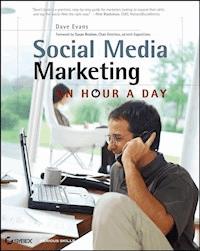


















Table of Contents
Cover
Praise
Title Page
Credits
Copyright
Publisher's Note
Dedication
Acknowledgments
About the Author
Foreword
Introduction
How to Use This Book
Disclosure
Part I The Foundation of Social Media
Chapter 1: Backlash
The Early Social Networks
The Pushback Begins
The Backlash: Measured and Formalized
The Main Points
Chapter 2: The Marketer’s Dilemma
The Roots of Avoidance
Early Online Word of Mouth
The Social Web Blooms
Nielsen Adds Social Metrics
The Main Points
Chapter 3: What Is Social Media?
Social Media Defined
Social Media and Marketing
Social Media as a Guidepost
The Elements of Social Media
The Main Points
Part II Month 1: Prepare for Social Marketing
Chapter 4: Week 1: Web 2.0, The Social Web
Social Networks: The Power of the Collective
Social Media Begins Here
Week 1: Engaging with Social Media
The Main Points
Chapter 5: Week 2: The Social Feedback Cycle
Social Media in Marketing
Consideration and the Purchase Funnel
Consumer-Generated Media
Create Your Social Feedback Cycle
The Main Points
Chapter 6: Week 3: Touchpoint Analysis
Touchpoints and the Social Web
Identifying Touchpoints
Quantifying Touchpoints
The Main Points
Chapter 7: Week 4: Influence and Measurement
Influence and the Social Web
Quantifying the Conversation
The Main Points
Part III Month 2: Social Media Channels
Chapter 8: Week 1: Build a Social Media Campaign
How Is Social Media Different?
Quantifying the Social Feedback Cycle
The Main Points
Chapter 9: Week 2: Social Platforms
Building Social Networks
The Main Points
Chapter 10: Week 3: Social Content—Text, Photos, Audio, and Video
Advertising and the Social Web
The Main Points
Chapter 11: Week 4: Social Content—Ratings, Reviews, and Recommendations
Marketplace Conversations
Building Consensus
The Main Points
Chapter 12: Week 5: Social Interactions
Connecting the Dots
Managing Social Information
The Main Points
Part IV Month 3: Complete Your Plan
Chapter 13: Week 1: Objectives, Metrics, and ROI
The Basis for Social Media Metrics
Choosing Social Media Metrics
Real-World Connections
Planning for Measurement
The Main Points
Chapter 14: Week 2: Present Your Social Media Plan
Create Your Plan
The Main Points
Appendix A: Worksheets
Chapters 4–7
Chapters 8–12
Chapters 13 & 14
Appendix B: Additional Social Media Resources
Industry Experts
Industry Blogs and Resources
Agencies and Social Media Practitioners
Social Networks and Services
Metrics Platforms and Listeners
Index
Advance Praise for Social Media Marketing: An Hour a Day, Second Edition
“If you’re looking for the definitive guide on social media, look no more. You are holding it in your hands. Whether you’re a social media novice or veteran, this book will be an invaluable resource in your journey to social media enlightenment and success.”
—Kip Knight, President, KnightVision Marketing, and former Vice President of Marketing, eBay
“Social Media Marketing: An Hour a Day, Second Edition is an important book not just for marketers but for all business leaders. It focuses on how social technologies are changing the very nature of the ecosystem that businesses operate in—from customers to partners to employees to other stakeholders. Dave covers this wonderfully and focuses on how a company has to change its systems and processes internally to adapt to this ever changing reality. It’s a must read for current and future business leaders of all types!”
—Gautam Ghosh, Platform Evangelist and India Marketing Head, BraveNewTalent
“The thing I appreciate most about Dave’s book is that it is not only prescriptive but it is also built to fit into the busy schedule of any marketer (or executive). A must-read for anyone interested in putting social media marketing into practice.”
—Aaron Strout, Head of Location-Based Marketing, WCG
“Dave Evans gets social media! Social Media Marketing: An Hour a Day, Second Edition is a practical guidebook that integrates social strategy with the tools and metrics. I have used it with clients and business students with great results. If you spend an hour a day you will get social!”
—Ira Kaufman, PhD; Assistant Professor, Lynchburg College; President, Entwine Digital
Senior Acquisitions Editor: Willem Knibbe
Development Editor: Alexa Murphy
Technical Editor: Jake McKee
Production Editor: Dassi Zeidel
Copy Editor: Linda Recktenwald
Editorial Manager: Pete Gaughan
Production Manager: Tim Tate
Vice President and Executive Group Publisher: Richard Swadley
Vice President and Publisher: Neil Edde
Book Designer: Franz Baumhackl
Compositor: Kate Kaminski, Happenstance Type-O-Rama
Proofreader: Candace English
Indexer: Ted Laux
Project Coordinator, Cover: Katherine Crocker
Cover Designer: Ryan Sneed
Cover Image: © Troels Graugaard/iStockPhoto
Copyright © 2012 by John Wiley & Sons, Inc., Indianapolis, Indiana
Published simultaneously in Canada
ISBN: 978-1-118-19449-2
ISBN: 978-1-118-22767-1 (ebk.)
ISBN: 978-1-118-24054-0 (ebk.)
ISBN: 978-1-118-26527-7 (ebk.)
No part of this publication may be reproduced, stored in a retrieval system or transmitted in any form or by any means, electronic, mechanical, photocopying, recording, scanning or otherwise, except as permitted under Sections 107 or 108 of the 1976 United States Copyright Act, without either the prior written permission of the Publisher, or authorization through payment of the appropriate per-copy fee to the Copyright Clearance Center, 222 Rosewood Drive, Danvers, MA 01923, (978) 750-8400, fax (978) 646-8600. Requests to the Publisher for permission should be addressed to the Permissions Department, John Wiley & Sons, Inc., 111 River Street, Hoboken, NJ 07030, (201) 748-6011, fax (201) 748-6008, or online at http://www.wiley.com/go/permissions.
Limit of Liability/Disclaimer of Warranty: The publisher and the author make no representations or warranties with respect to the accuracy or completeness of the contents of this work and specifically disclaim all warranties, including without limitation warranties of fitness for a particular purpose. No warranty may be created or extended by sales or promotional materials. The advice and strategies contained herein may not be suitable for every situation. This work is sold with the understanding that the publisher is not engaged in rendering legal, accounting, or other professional services. If professional assistance is required, the services of a competent professional person should be sought. Neither the publisher nor the author shall be liable for damages arising herefrom. The fact that an organization or Web site is referred to in this work as a citation and/or a potential source of further information does not mean that the author or the publisher endorses the information the organization or Web site may provide or recommendations it may make. Further, readers should be aware that Internet Web sites listed in this work may have changed or disappeared between when this work was written and when it is read.
For general information on our other products and services or to obtain technical support, please contact our Customer Care Department within the U.S. at (877) 762-2974, outside the U.S. at (317) 572-3993 or fax (317) 572-4002.
Wiley publishes in a variety of print and electronic formats and by print-on-demand. Some material included with standard print versions of this book may not be included in e-books or in print-on-demand. If this book refers to media such as a CD or DVD that is not included in the version you purchased, you may download this material at http://booksupport.wiley.com. For more information about Wiley products, visit www.wiley.com.
Library of Congress Control Number: 2011946303
TRADEMARKS: Wiley, the Wiley logo, and the Sybex logo are trademarks or registered trademarks of John Wiley & Sons, Inc. and/or its affiliates, in the United States and other countries, and may not be used without written permission. All other trademarks are the property of their respective owners. John Wiley & Sons, Inc. is not associated with any product or vendor mentioned in this book.
10 9 8 7 6 5 4 3 2 1
Dear Reader,
Thank you for choosing Social Media Marketing: An Hour a Day, Second Edition. This book is part of a family of premium-quality Sybex books, all of which are written by outstanding authors who combine practical experience with a gift for teaching.
Sybex was founded in 1976. More than 30 years later, we’re still committed to producing consistently exceptional books. With each of our titles, we’re working hard to set a new standard for the industry. From the paper we print on, to the authors we work with, our goal is to bring you the best books available.
I hope you see all that reflected in these pages. I’d be very interested to hear your comments and get your feedback on how we’re doing. Feel free to let me know what you think about this or any other Sybex book by sending me an email at [email protected]. If you think you’ve found a technical error in this book, please visit http://sybex.custhelp.com. Customer feedback is critical to our efforts at Sybex.
Best regards,
Neil Edde
Vice President and Publisher
Sybex, an Imprint of Wiley
To my friends Jack and Dewey for showing me how to see what’s out there, and to my family for the drive to chase after it.
Acknowledgments
Social media and the rise of the social web are by definition a collaborative effort, and so the ideas in this book have come from everywhere. Dr. Richard Mancuso (physics) and Dr. Kazumi Nakano (mathematics) put me on a path seeking a quantitative understanding of the world around me. You’ll see the connection in Chapter 13, “Week 1: Objectives, Metrics, and ROI.” Dr. Anthony Piccione (poetry) gave me an appreciation for the written word. Steve Tufts pulled me from R&D into marketing and product management, and then Phil Ashworth pulled me into the space program. Xray introduced me to the “Why?” committee, and Roy Fredericks provided a social context for understanding business as it applies to earning loyalty in the Millennial generation. You’ll see these connections too.
Susan Bratton and everyone at ad:tech, Pete Blackshaw, and Jim Nail provided the mentoring and thought leadership that led me into noninterruptive, trust-based marketing. My experience with the Word of Mouth Marketing Association formed the underpinning of my interest in and exploration of social media as a formal marketing discipline. Special notes to Robert Scoble for his commitment to business blogging and his conceptualization of the social media starfish; to Christopher Locke, aka Rage Boy, and his Entropy Gradient Reversal (he’s never heard of me, but I’ve been reading his stuff for years); and to Dave Ellett for his connection of the purchase funnel and social web through the social feedback cycle. My thanks to Alexa Murphy and everyone at Wiley/Sybex, in particular Dassi Zeidel and Willem Knibbe. I appreciate their continued support.
I am indebted to Jake McKee, the technical editor for this book. Jake is an evangelist for customer collaboration, online communities, and fan groups. Jake was the global community relations specialist for the LEGO Company, where he spent five years on the front lines of customer-company interaction, building social projects and programs. Jake has a rich background in web development, community management, business strategy, and product development that gives his community work and insights into the subject matter of this book a unique spin. Jake is currently the principal and chief ant wrangler at Ant’s Eye View, a Dallas-based customer-collaboration strategy practice. I highly recommend talking with him.
Where would I be if not for Austin, Texas, declared by city charter to be a multimedia industry–supportive city in 1994. My colleagues in Austin’s city government, especially Jim Butler, and the professionals and partners I worked with at GSD&M and FG SQUARED all contributed to this book. My sincere appreciation to each of the businesses and organizations that contributed case studies: Without you and the work that you’ve shared, this book would be significantly less valuable. In the same way, to Warren Sukernek and the rest of my community on Twitter and Amazon whose comments and reviews helped to improve this book, thank you all.
Finally, to my wife, Jennifer, and son, Broch. Writing a book while launching a start-up and running a business in a discipline that has been exploding since mid-2006 is often toughest on those who are closest. For them, my love always.
About the Author
“If I couldn’t interrupt you, how would I reach you?”
That’s the question that Dave starts with as a communications expert focused on social media and its application in business. Dave has worked with global brands in the United States, Europe, and Asia, including Philips, Dell, Meredith Publishing, PepsiCo, United Brands, and the Dallas/Fort Worth and Bangalore International Airports across a wide range of social technology applications.
Dave is the cofounder of Social Dynamx. Based in Austin, Texas, the firm offers a truly enterprise-scale, social, customer-care solution, designed to handle the tens of thousands of social interactions that major brands are presented with each day.
Dave is also a ClickZ columnist and frequent conference speaker. He has served on the advisory board for ad:tech and the measurement and metrics council for the Word of Mouth Marketing Association.
Prior to his work in advertising and digital media, Dave was a product manager with Progressive Insurance Company and a systems analyst for the Voyager deep-space-exploration program with Jet Propulsion Laboratory/NASA. Dave holds a BS in physics and mathematics from the State University of New York/College at Brockport.
In the event that you’d like to interrupt Dave, the easiest way to do it is via Twitter (evansdave) or email ([email protected]). For more information on the book, or to download the worksheets that go along with it, please visit http://www.ReadThis.com or http://www.Facebook.com/SocialMediaSkills.
Foreword
Ten years ago Dave Evans became one of my go-to guys for delivering a fresh stream of case studies from his work for famous brand clients. You see, I was responsible for the competitive job of programming ad:tech, the leading digital marketing conference. I had to snap up the best speakers, like Dave, before my competition could.
Dave had serious marketing chops. His combined experience with rocket science (true!) and consumer marketing gave him insights that wouldn’t even dawn on his peers.
He’s a secret weapon for you now that you’ve smartly chosen this updated version of his solid classic on social marketing.
Dave’s teaching style is reassuringly methodical and inspires you to throw yourself into trying new strategies that frankly can’t be ignored in a world where your grandma is now your friend on Facebook.
Social conversation is the most powerful form of communication. It’s a marketer’s duty to be part of that conversation now. Yet it’s imperative to choose the “right” social channels to leverage, based on your brand’s needs, your collective corporate assets and talents, and knowing where your customers and prospects expect you to be.
This book is a touchstone you’ll use to confidently decide where you’ll be present in the social sphere and what you can selectively ignore without a “gotcha.”
Further, you’ll discover the principles of social marketing in a simple, experiential process. Loaded with examples, the “hour a day” structure gives you the confidence that you’ve surveyed an exhaustive list of options. It’s a practical book that allows the uninitiated as well as the experienced business pro to convert more prospects to customers faster and to delight and grow your existing customer base more quickly.
The sweetest is last….
Do not miss the worksheets in the back of this book. Hah! These are cheat sheets! You are going to look like such a pro in front of your boss and your peers. Your ultimate social media plan is going to be unassailable, bulletproof, and impressive.
Enjoy the process. There’s nothing more fascinating than social media in the world of marketing today.
—Susan Bratton
Chair Emeritus, ad:tech Conferences and CEO, Personal Life Media, Inc.
Introduction
I had (and still have) a dream that the Web could be less of a television channel and more of an interactive sea of shared knowledge. I imagine it immersing us as a warm, friendly environment made of the things we and our friends have seen, heard, believe, or have figured out. I would like it to bring our friends and colleagues closer, in that by working on this knowledge together we can come to better understandings.
—Tim Berners Lee, 1995
When I wrote the first edition of this book in 2007, social media was a fast-growing marketing phenomenon. The crush of the feedback cycle—driven by digital word of mouth in the form of blog posts, pictures, video, ratings and reviews, and more—was having a pronounced impact on marketing. As if a one-two punch, at the same time all of this new consumer-generated digital media was reducing the hours that sections of the mainstream audience were spending with traditional media. The marketing landscape was shifting, permanently.
Five years on, and the vast majority of the hyped-up evangelists have been proven correct. If anything, they understated the impact that global connectivity and ever-present smartphones would have. So now here we are in 2012: Social media marketing, and a common-sense “Hour a Day” approach to getting comfortable with it, is exactly what the doctor ordered.
Like the first edition, this new edition is for marketers wanting to combine social media skills and expertise with their existing, established capabilities. Much of the book is based on my experience as a marketer and product manager, positions where success is largely dictated by what others, outside your direct span of control, think of you. That is, more or less, how the social web works.
Building on the first book, cases have been updated and technologies that were only emerging in 2007 are covered in detail. Like in all of my books, there are numerous references to true experts for those wishing to dive more deeply into the specific tools and techniques that are now part of the very complex social landscape.
My motivation for exploring social media and its use in business arrived one day as I was feeling particularly overwhelmed by the rate of change in advertising and marketing and simultaneously exhilarated by the pure rush of consumer-generated information flowing to me off the Internet. I decided that day that I wanted to see the next generation—my son was about two years old at the time and beginning to make real use of his first iMac—grow up in a world without interruption, where the information needed to make an informed choice was readily available.
Building on the personal empowerment and liberation that the Internet offers, consumers are actively connecting with each other and sharing information about everything from cars and health to scrapbooking techniques and pool chemicals. In the process, they are either reinforcing marketing efforts or beating marketers at their own game by directly sharing their own experiences and thoughts with each other. Because consumers tend to trust conversations among themselves more than they do advertising, marketers are now finding their messages routinely held up for verification in forums over which they and their ad agencies and PR firms have little, if any, control. For these industries—very much used to control—this is the game-changer.
This book is about learning how to properly use the social web to your business advantage and about how to effectively participate as a marketer by adopting the underlying behaviors that power the social web and making them the basis for your business and marketing plans. It’s about the fundamental paradox between giving up control—you can’t control conversations that aren’t yours—and simultaneously gaining influence by becoming a respected member in the communities that matter to you. This book is about realizing and putting to business use the powerful connection between participation and influence, and ultimately preparing for and embracing what’s next.
How to Use This Book
I designed this book to be used in a variety of ways and by a variety of people. Some readers will have prior experience with social media, and some will not. Some will want to jump right in, and some will want to understand what social media is all about before putting their name on a plan that integrates social media into their currently working marketing program. There is something here for everyone.
You can begin reading this book at any point you’d like. Here are some suggested starting points and tips:
Are you already comfortable with social media and looking to jump right in? If you have a good handle on your social reputation, start with Part III, “Month 2: Social Media Channels.” You’ll quickly cover your primary social media options and then get right into metrics and the creation of your plan. Do come back and read Parts I and II at some point, because they contain useful insights and best practices supporting what you already know.If you’re ready to get started but want to first understand how the things you are doing now are driving the conversations you’ll discover on the social web, start with Part II, “Month 1: Prepare for Social Marketing.” If you find you have questions about why social media is emerging, take a quick look at Part I as well.If you are a seasoned marketer, I’d suggest starting with Part I, “The Foundation of Social Media.” The first three chapters are short, about half the length of those that follow. However, they also set the ground rules for the business use of social media and provide a solid transition for experts of traditional marketing looking to build new skills in social media. Read these on the train, on the plane, but please not while driving your car.What if you’re really new to marketing? What if you’re a sole practitioner looking to understand social media and develop a practice of your own? This book is certainly for you. My only assumption is that you have a basic marketing plan now. If not, then you may want to create that first, using the online planning guide written by marketing expert Shama Kabani. It is specifically for independent professionals and service firms. You’ll find the guide at http://www.marketingzen.com/.Regardless of where you start, beginning with Part II, each chapter includes a week’s worth of exercises and is designed to be completed in sequence in about an hour each day. The result, depending on how you approach the exercises, is either your actual social media plan or a framework for a plan or RFP. If you’d like to skip the exercises—perhaps you are reading the book for theory and understanding, or maybe you simply want an overview of social media and its application in marketing—you can do that. The issues, concepts, and techniques presented will still flow logically. Make no mistake, though; if you don’t do the exercises, you will not come out with a plan. Nonetheless, you will come away with a solid understanding of social media and why it’s an important part of contemporary marketing.
Finally, a note to established social media practitioners: You’ll recognize the risk in writing about a subject as dynamic and broad as social media. There are as many ways to approach our emerging discipline as there are early pioneers helping to define it. My hope is that you will find this book useful, if only as a guide to help your clients understand the importance of your counsel on the critical issues of participation, transparency, and quantitative measurement. With those three right, the rest of the pieces tend to fall into place. To download additional resources for this book, go to www.sybex.com/go/socialmediahour.
Mostly, enjoy this book. This is an exciting time, and opportunity is everywhere. Be a part of it.
Disclosure
Within this book, I have included references to over 100 companies and practitioners, a handful of which I am formally associated with—for example, I might be a cofounder, part owner, engaged within a client relationship, or have a similar interest that deserves disclosure. If there is a number-one best practice on the social web, it is being transparent. Let transparency start with me. As referenced in the book, these companies are
Alterian
Bazaarvoice
Dell
FG SQUARED
Friend2Friend
Jive Software
Lithium
Mikons
NetBase
Philips
Radian6
Social Dynamx
Wakesites
Part I: The Foundation of Social Media
Building on the personal empowerment and liberation that the Internet offers, consumers are actively connecting with each other and talking about everything from cars and health to scrapbooking techniques and pool chemicals. In the process, they are either reinforcing marketing efforts or beating marketers at their own game by directly sharing their own experiences and thoughts on the social web. Welcome to social media marketing.
In Part I, you’ll gain an understanding of not only the substantial consumer attraction to social media but also the causes of consumer frustration with traditional media. These trends—each significant in its own right—amplify each other when combined. I’ll end with a working definition of social media and a framework to help you understand how to apply social media to your business or organization.
Chapter 1 Backlash
Chapter 2 The Marketer’s Dilemma
Chapter 3 So What Is Social Media?
Chapter 1
Backlash
In 2004 I read an article written jointly by Jim Nail, at the time a principal analyst at Forrester Research, and Pete Blackshaw, then chief marketing officer for Intelliseek. They quantified and defined the extent to which a sample set of trend-indicating online consumers were “pushing back” against traditional media. This was a turning point for me. I was working at GSD&M Idea City, an ad agency in Austin, Texas, where I was helping develop the online and integrated marketing strategy team. This was around the time when the first social networks began to gain critical mass. This caught my attention and became the focus of my work.
In this opening chapter, I’ll cover the origin of the social web and the events that ushered in the collaborative tools that consumers use as they make daily use of the information available to them on the social web.
Chapter Contents
The Early Social NetworksThe Pushback BeginsThe Backlash: Measured and FormalizedThe Main PointsThe Early Social Networks
My first involvement with online services was in 1986. I had just purchased a Leading Edge Model D (so that I could learn about the kinds of things one might do with a personal computer). I signed up as a member of Prodigy, launched a couple of years earlier by CBS, IBM, and Sears. The underlying premise of Prodigy was that advertisers—attracted by members—would play a key role in the business success of what was called the first “consumer online service.” On the typical Prodigy page, the lower one-third of the screen was devoted to ads. These ads—more or less untargeted by today’s standards—were nonetheless a significant advancement in the potential for a marketer to directly reach an individual. Although it hadn’t been put to use yet, that computer—unlike a TV—had a unique physical address. The opportunity for truly personal adverting took a step forward.
Prodigy and, in particular, its contemporaries CompuServe and America Online, were in many ways the forerunners of present social networks and targeted online advertising. The thinking was that not only was reaching a large number of individuals potentially more valuable than reaching a mass audience, but thatthrough technology, marketers just might be able to actually do something with these individual connections.
Individual, person-to-person connections have always been highly valued. The real-world community status of highly localized professionals—think of doctors, religious leaders, and insurance agents—comes from the fact that they are personally acquainted with each of the individuals who make up their overall customer base. This gives them the advantage of a highly personalized level of service. Assuming the service itself is acceptable (and if it’s not, they are quickly out of business), this personal bond translates directly into loyalty, a top goal of most brand marketers. Rather than a failure to recognize the value of one-to-one efforts—no rocket science there—it was a logistical challenge that thwarted marketwide adoption of highly localized, personal advertising. Simply put, a mechanism to efficiently reach individuals on a large scale didn’t exist. In the early nineties, that changed.
Although it had been in development for a number of years, the Internet as it is now known began its climb when the National Science Foundation (NSF) and its forward-thinking National Science Foundation Network (NSFNET) program laid the ground rules for it. It was the NSF that championed the cause of an “open” Internet—a network that any entity, including a business, could use for any purpose,including commerce. Combined with the proliferation of low-cost personal computers and the savvy foresight of the bulletin board operators, the opening up of the Internet put in place what is taken for granted now. Today, the “Global Village,” a term coined by Wyndham Lewis in 1948 and popularized by Marshall McLuhan in 1964 in his seminal work Understanding Media, is alive and well. The Global Village is understood in both a historical and a contemporary context through a partial excerpt from Wikipedia: The social and personal interactive norms preceding the 1960s are “being replaced …by what McLuhan calls ‘electronic interdependence,’ an era when electronic media replace[s] visual culture, producing cognitive shifts and new social organizations.” That certainly sounds familiar now.
The release of Prodigy and the significance of the potential of its integrated ad platform in targeting individuals are best understood in the context of the prevailing advertising media of the time, and in particular television. Under the leadership and vision of NBC executive Pat Weaver, TV had shifted in the 1950s from a locally controlled, single-advertiser-per-show model to a network-controlled, multi-advertiser (aka “magazine”) model. While this was great for the networks, marketers, and ad agencies—reaching national-scale audiences was good for business because it provided operational and marketing efficiency—it also meant that viewers were treated more and more like a mass audience. With only four networks in place—CBS, NBC, ABC, and for a bonus point (see sidebar), name the fourth—mass advertising was clearly the wave of the future. To be fair, media planning and placement meant that Geritol was directed primarily toward an audience with an older skew or component. As a young kid, however, I saw plenty of Geritol ads while I watched Ed Sullivan and wondered how a person could ever need “more energy.” Fifty years later, I know the answer: I now get my daily wings from Red Bull. Beyond big buckets such as “older” or “female,” the targeting capability we now take for granted wasn’t really possible. While some degree of targeting was achievable on early radio or locally controlled TV prior to the rise of the national networks, the ability to target a message to an individual was severely limited.
Bonus Point:
Figure 1-1: The New York headquarters of the fourth network
Name the fourth TV network active in the 1940s and ’50s. Hint: It’s not Fox, and I’ve given you a clue in Figure 1-1.
150 East 34th Street, New York. (Scott Murphy — http://members.aol.com/smurphy110/mid/515madsn.htm)
The fourth network, known for shows like Faraway Hill, Rhythm Rodeo, and Chicagoland Mystery Players, was the DuMont Television Network.
The Pushback Begins
During the early years of television, ads made up less than 10 minutes of each one-hour show. The time devoted to commercials has more than doubled since then, with many half-hour shows now showing about equal amounts of program content and advertising. With this much time being devoted to what has become “content” in its own right—look no further than the Super Bowl ads for proof of the notion that ads are a distinct form of entertainment—it’s not surprising that a “pushback” began. The pushback was driven in a large part by the confluence of two major factors: the rise of the Baby Boomers and the arrival of the Internet-connected personal computer.
Spurred on by Boomer spending on electronics and the proliferation of the personal computer, by the mid-nineties the number of Internet websites had climbed from the 6,000 or so of 1992 to more than 1 million—and that was just the beginning. Email—still considered to be one of the earliest “killer apps”—had taken off as well. A developing world it was, too: While it seems incredible, into the mid-nineties email servers around the world sat open and unprotected, an oversight that would prove pivotal in the advent of the social web. Back then, if you knew the IP address or name of the server, you could use it to send mail, no questions asked. We’re talking about mail that recipients would actually get and read. Commercial mail hadn’t really happened yet. However, the combination of the NSFNET lifting the ban on using the Internet for commercial purposes and the relatively unprotected nature of mail servers made what happened next inevitable. The big question of when—and not if—this new medium would be used for advertising and whether or not this would be accepted on a large scale was on more than a few people’s minds. It was a question just waiting to be answered.
Hotel Exercise
Don’t try this at home. Instead, try it in a hotel room. When you’re in an unfamiliar city—and when all you have is a relatively crude remote control—try channel surfing to find out what’s on television. Unless you have a favorite channel and can jump right to it, the odds are higher that you’ll find a commercial rather than program content. The ads can be so thick you’ll find yourself surfing commercials. Don’t believe it? Try it.
A Big Boost from an Unlikely Source
On April 12, 1994, husband and wife Laurence Canter and Martha Siegel unknowingly gave social media—still more than 10 years in the future—a big boost when they provided an answer to the question of whether or not email could be used for advertising: It could. The “Green Card” spam that they launched is generally considered the first unsolicited email advertisement sent over the Internet. The result was explosive, on both sides. Enterprising minds quickly realized there was money to be made—lots of money—and relatively little actual regulation that could be applied to constrain them. The term spammer—loosely based, unfairly, on Hormel’s canned meat—was coined to describe people sending email filled with questionable content. But if you could stand the heat coming from those who made it their business to thwart this newfound advertising technique, you could get rich. Real rich. Real fast.
Just as quickly, recipients and their Internet service providers (ISPs) realized that this practice—novel as it was—was fundamentally objectionable, so they went to work on countermeasures. Cancelbot—the first antispam tool developed to automatically cancel the online accounts of suspected spammers—launched an entire movement of antispam tools. In 1997, author and Austin resident Tracy LaQuey Parker filed and won one of the first successful antispam lawsuits. (In case you’d like to read the judicial opinion, I’ve included a reference to it in the appendix of this book.) A domain she owned—Flowers.com—was used by Craig Nowak (aka C.N. Enterprises) to launch a spam campaign falsely identified as originating from Flowers.com and Austin ISP Zilker Internet Park. Oops.
Why Does This Matter?
The arrival of spam—on a communications channel that recipients had control over—shattered a peaceful coexistence that had been in place for 30 years. Viewers had accepted interruptions more or less without complaint as the quid pro quo for free TV (and amazingly, albeit to a lesser extent, on for-pay cable as well). Even if they objected, short of changing channels there was little they could do. Ads were part of the deal. The Internet—and in particular an email inbox—was different. First, it was “my” inbox, and “I” presumed the “right” to decide what landed in it, not least of all because I was paying for it!Second, spam—unlike TV ads—could actually clog my inbox, slow down the Net, and generally degrade “my” experience. People took offense to that, on a collective scale. Spam had awakened a giant, and that giant has been pushing back on intrusive ads ever since. On the social web, interruptions do not result in a sustainable conversation. In their purest form, all conversations are participative and engaged in by choice. This simple premise goes a long way in explaining why interruption and deception on the social web are so violently rejected.
The relevance of these particular events and those that have followed in driving the evolution of social media cannot be overstated. In one sense, the issues raised by spam—the practice of sending a highly interruptive, often untargeted message to a recipient—triggered a discussion about how advertising in an electronic age could, and more importantly should, work. At the same time, in the early days the messages weren’t as bad, the emails not as junky, and the content not so predatory. In the early days, it was about an annoyance for techies and a perceived (and misunderstood) opportunity for marketers. The questions were as much about how to make money as they were anything else, and not enough forethought was given to the recipient experience. Regardless, these discussions gave rise to the idea that recipients should have control over what was sent their way. The fact that their personal attention was worth money—something that ad execs had long known—was suddenly central in the discussions of the thought leaders who pushed all the harder against those who abused the emerging channels.
The offensive nature of spam, in particular, inflicted collateral damage on the ad industry as a whole. Ironically, and much to its own loss, the ad industry did little to stop it. Unsolicited email rallied people against advertising intrusion, and a lot of otherwise good work got caught in the crossfire. In contrast to TV ads, for example, spam fails to pay its own way, fails to entertain, and often contains deceptive messages. These are not the standards on which advertising was built. At GSD&M Idea City, the agency where I spent many years, agency cofounder Tim McClure coined the “Uninvited Guest” credo, which basically holds that a commercial is an interruption. As such, it is the duty of the marketer and advertiser collectively to “repay” the viewer, for example, by creating a moment of laughter or compassion that genuinely entertains. It is this recognized obligation to repay that transforms the interruption into an invitation. This symbiotic relationship sat at the base of an ad system that had worked well, and with relatively few complaints, for 50-plus years. Beginning with Tide’s creation of soap operas and the Texas Star Theater in the ’40s up to the Mobil-sponsored Masterpiece Theater in the ’70s, viewers readily accepted that advertisers were paying the freight in exchange for attention to their products and services. Measurable goodwill accrued to sponsors simply by virtue of their having underwritten these programs.
No more. By violating the premise of the “Uninvited Guest,” spammers brought to the fore a second and much more powerful notion among consumers: Spammers raised awareness of the value of control over advertising at the recipient level. Spammers galvanized an entire audience (against them) and created a demand for control over advertising at a personal level. With TV, radio, magazines, and even direct mail (the United States Postal Service has long enforced the rights of marketers to use its services so long as they pay for them) there was no viable means through which a recipient could select or moderate—much less block—commercial messages short of turning off the device. With digital communications, control elements are now built in; they are an expected part of the fabric that links us. If advertisers and network executives are experiencing angst over contemporary consumer-led “ad avoidance,” they have, among others, Laurence Canter and Martha Siegel to thank. By introducing unsolicited messages into a medium over which recipients can and readily do take ownership and control, the actions of the earliest for-personal-gain commercial spammers created in consumers both the awareness of the need for action and the exercise of personal control over incoming advertising. Antispam tools ranging from simple blacklists to sophisticated spam filters are now the norm.
As spammers continued to proliferate, spam became not only a nuisance but a significant expense for systems owners and recipients alike. It was only a matter of time before legislation followed. In 2003 the CAN-SPAM Act was signed into law. This was significant in the sense that legislation had been enacted that in part had its roots in the issues of recipient control over incoming advertising. This further validated—and pushed into the mainstream—the idea that “I own my inbox.” From this point forward, it would be more difficult as a marketer to reach consumers using email without some form of permission or having passed through at least a rudimentary inbox spam filter.
It wasn’t just email that felt the impact of growing consumer awareness of the control that now existed over interruptive advertising. On the Web, a similar development was taking place. In 1994, HotWired ran what were among the first online ads. Created by Modem Media and partner Tangent Design for AT&T, these ads invited viewers to “click here.” O’Reilly’s Global Network Navigator was running similar ads on its network, and others would follow. That the HotWired ads ran less than two weeks after the initial-release version (0.9) of Netscape’s first browser made clear that advertising and the online activities of consumers were linked from the get-go. The first online ads were simple banners: They appeared on the web page being viewed, generally across the top. Page views could be measured. DoubleClick founder Kevin O’Connor took it a step further: DoubleClick made the business of advertising—online, anyway—quantitatively solid. With online advertising now seen as fundamentally measurable, marketers sat up and took notice. Online advertising quickly established itself as a medium to watch. One of the results of the increasing attention paid by marketers and advertisers to online media was an increased effort in creating ads that would “cut through the clutter” and get noticed. As if right out of The Hucksters, someone indeed figured out a way. It was called the pop-up.
Like an animated “open me first” gift tag, the pop-up is a cleverly designed ad format that opens up on top of the page being viewed. Variants open under the page or even after the page is closed. Here again, it’s useful to go back to TV, radio, and to an extent print. Certainly, in the case of the TV, when the show’s suspense is built to a peak only to cut away to a commercial, that is a supreme interruption. But it was tolerated and even desired. The interruption provided a way to freeze and “stretch out” the moments of suspense. The pop-up is different. It’s not about suspense or entertainment. It’s about obnoxious interruptive behavior that demands attention right now.
So, it wasn’t long before the first pop-up blocker was developed and made available. Its development points out the great thing about open technology, and one of the hallmarks of the social web: Open digital technology empowers both sides. As brands like Orbitz made heavy use of pop-ups, others went to work just as hard on countermeasures (described in Brian Morrissey’s article “Popular Pop-Ups?” at www.clickz.com/showPage.html?page=1561411). Partly in response to marketers such as X10 and Orbitz, in 2002 EarthLink became the first ISP to provide a pop-up blocker free to its members. Again, the notion that an ad recipient had the right to control an incoming message was advanced, and again it was embraced. Pop-up blockers are now a standard add-on in most web browsers. The motivation for the social web and user-centric content control was going mainstream.
Heat Maps: Passive Ad Avoidance
Passive ad avoidance—the practice of sitting within view or earshot of an ad but effectively ignoring it—has been documented by Jakob Nielsen and others through visualizations such as the heat maps shown in Figure 1-2. Using eye movement–detection devices, maps of eye movement during page scans show that most consumers now know where to look … and where not to look. The advertisements in Figure 1-2 are the least-viewed areas on the page. Complete information on Jakob Nielsen’s “Banner Blindness” study may be found at www.useit.com/alertbox/banner-blindness.html.
Jakob Nielsen heat map showing ad avoidance, http://www.useit.com/alertbox/banner-blindness.html
Figure 1-2: The Heat Map and Passive Ad Avoidance
It was therefore only a matter of time before the combination of formal ad avoidance and content control would emerge in the mainstream offline channels. It happened in 1999, with the first shipments of ReplayTV and then TiVo digital video recorders, launched at the Consumer Electronics Show. From the start, the digital video recorder (DVR) concept was loved by viewers. To say it was controversial among advertisers, programmers, and network operators is putting it lightly. While initial penetration was low—just a few percent of all households had a DVR—in the first couple of years after launch, the impact and talk level around a device that could be used to skip commercials was huge. Most of the early DVRs had a 30-second skip-ahead button—a function now curiously missing from most. Thirty seconds is the standard length of a TV spot: This button might as well have been labeled “Skip Ad.” Combined with the fact that a DVR can be used to record shows for viewing later, the DVR was disruptive to TV programming. In one easy-to-use box, a DVR brings control over what is seen—unwanted or irrelevant commercials can be skipped as easily as boring segments of a show—and control over when it is seen.
Right behind the changes affecting TV were those aimed at the telephone. Long a bastion for among the most annoying of interruptive marketers—those who call during dinner—the telemarketing industry felt the impact of consumer control as the Do Not Call Implementation Act of 2003 substantially strengthened the Telephone Consumer Protection Act of 1991. The Implementation Act established a list through which any consumer can register his or her phone number and thereby reduce the number of incoming telemarketing calls. There are some exceptions (nonprofits, political candidates, and a handful of others are still allowed to call) and some misguided efforts at evasion (exploiting loopholes like pretending to be conducting a survey) but in general the combined acts have been viewed as a success. Well in excess of 70 percent of Americans have now registered on the Do Not Call Registry. In 2007, an additional act—the Do Not Call Improvement Act—was undertaken to remove the “five-year renewal” requirement for those who have registered. Sign up once, and you’re on the list forever unless you take yourself off it.
Note: Are you on the Do Not Call list? Here’s where to find out and to obtain information about the list: www.donotcall.gov.
The Backlash: Measured and Formalized
Think back to what has been covered so far. A set of basic points that connect past experiences with email, online media, and traditional media to the present state of the social web emerges:
The genie is out of the bottle: Consumers and their thought-leading advocates recognize that they own their inbox, their attention, and by extension (rightly or wrongly) the Internet itself.Online, people are annoyed with spam and with pop-ups. Spillover happened, and advertising in general got caught in the fray.Offline, people are now looking around asking, “What other interruptive advertising bothers me?” The Do Not Call list was implemented as a result.If you take these events together—antispam filters, pop-up blockers, DVRs, and the Do Not Call Registry—it’s pretty clear that consumers have taken control over the messages directed their way. The genie is indeed out of the bottle, and it isn’t going back in. At the same time, if you consider the number of beneficial product- or service-oriented conversations that occur on Facebook, Twitter, and elsewhere on the social web using content posted and shared through services ranging from YouTube to Digg, it’s also clear that consumers want information about the products and services that interest them. After all, no one wants to make a bad purchase. Consumers want to know what works, and they want to share great experiences right along with bad ones. More information is generally considered better, especially when the information originates with someone you know. Which brings us to trust….
The idea of trust is perhaps the point on which most of the objectionable ad practices share common ground—that is to say, they lack trust—and the central issue on which the acceptance of social media is being built. It’s all about trust. It’s as if the question that consumers are now asking is as follows:
If you have to interrupt or annoy me to get your ad across, how valuable can what you offer really be? If you think I’m dumb enough to fall for this, how can I trust you?
The link between consumer backlash and the rise of social media first occurred to me in 2004. Recall that I was reading a report from Forrester Research, written by Forrester Research Principal Analyst Jim Nail and Intelliseek Chief Marketing Officer Pete Blackshaw. The Executive Summary of the report is as follows:
Consumers feel overwhelmed by intrusive, irrelevant ads. The result: a backlash against advertising—manifesting itself in the growing popularity of do-not-call lists, spam filters, online ad blockers, and ad skipping on digital video recorders (DVRs). Marketing campaigns of the future must facilitate consumers’ cross-channel search for information, going beyond the brand promises made in traditional advertising.
The report further detailed some fundamental insights, all the more impactful given that the source of the data was a joint report done by Forrester Research and Intelliseek, now part of Nielsen. The audience was a very good cross-section of “savvy online users”—about two-thirds female, with an average household income just more than $50K, 60 percent using broadband, and about 80 percent having five-plus years of experience online. This audience was not a snapshot of what was then mainstream, but rather a highly probable indicator of “what’s next,” of what mainstream would become: overwhelmed, with the result being a backlash.
Working in the ad industry at the time, as I read this report I thought, “Wow. This is simultaneously describing what I do as a professional marketer and how I feel as an ordinary consumer.” Being a “glass-half-full” kind of guy, I saw in Jim’s and Pete’s work two distinct opportunities:
The opportunity to develop a formal marketing practice based on information that consumers would readily share with each otherQuite selfishly, the opportunity to ensure better information for me to use when evaluating my own options as a consumerSocial media, and in particular its application in marketing and advertising, is at least part of my response to the first of these opportunities. Implemented well, the second follows from it. What social media is all about, and again especially as applied to marketing, is the smart use of the natural conversational channels that develop between individuals.
These conversations may take a positive or negative path—something I’ll spend a lot of time on in Chapter 6, “ Week 3: Touchpoint Analysis,” and Chapter 7, “Week 4: Influence and Measurement.” Either way, they are happening independently of the actions or efforts of advertisers, with the understanding that just as a marketer can “encourage” these conversations by providing an exceptionally good (or bad!) experience, so too can an advertiser “seed” the conversations by creating exceptional, talk-worthy events. Around these events awareness is created, and a conversation may then flow. Word-of-mouth marketing, like social media, operates in exactly this way. Social media and word of mouth are fundamentally related in that both rely on the consumer to initiate and sustain the conversation.
Advertisers can of course play a role in this: Advertisers can create images, events, happenings, and similar that encourage consumers—and especially potential customers—to talk or otherwise interact with current customers. Social media and word of mouth are also related by the fact that both are controlled by the individual and not by the advertiser or PR agency. This has a deep impact on the link between operations and marketing, a discussion I will take up in Chapter 5, “Week 2: The Social Feedback Cycle.” This theme will recur throughout the balance of Part II of this book.
When you consider the issues that face traditional marketers, and in effect create the motivation for considering complementary methods such as the use of social media in marketing, it’s not surprising that many of them are rooted in the core issues of trust, quality of life, value, and similar undeniable aspirations. The issue of trust can be understood best in terms of the word-of-mouth (including “digital word-of-mouth”) attributes related to trust. Word of mouth is consistently ranked among the most trusted forms of information. As a component of social media, trust seems likely to follow in the word-of-mouth-based exchanges that occur in the context of social media. In fact, it does.
In addition to trust, from an advertiser’s perspective, the primary challenges are generally clutter and fragmentation. The sheer numbers of messages combined with a short attention span (developed at least in part by watching stories with a beginning, middle, and end that together last for exactly 30 seconds) are challenges as well. In Branding for Dummies (Wiley, 2006), a claim is made that consumers receive approximately 3,000 messages per day. Other citations place that figure in the range of a few hundred to well in excess of a few thousand (one set of estimates is available at http://answers.google.com/answers/threadview?id=56750). Even at the low end of the scale, several hundred messages each and every day mean that as humans we have to be actively filtering. That in turn requires some sort of associative decision-making process. In the preface of this book, I made the case that we are social beings and that we have adopted what would be loosely called “social behaviors” because we believe them beneficial. Our ability to deal with incoming information in anything like the volumes estimated makes apparent the need for collaboration in problem solving. Through social media—enabled by the Internet and the emergence of the social web—we are beginning to embrace the tools that significantly extend our collaborative abilities. These tools, taken as a whole, are the new tools of the social marketer.
The Main Points
Chapter 1 has introduced the basic motivation for consumers’ adoption of the social web, and at least partially explained the use of social media to arrive at more informed purchase decisions. Chapter 1 covered the following:
The increasing influence of the consumer via social content and the diminishing role of the marketer and the primary advertising messageThe cause of the backlash that developed when the practice of pushing ads to consumers moved to the digital platform, a platform over which consumers (end users) actually have controlThe role of trust as a central component in marketing effectiveness in contemporary social conversationsLesen Sie weiter in der vollständigen Ausgabe!
Lesen Sie weiter in der vollständigen Ausgabe!
Lesen Sie weiter in der vollständigen Ausgabe!
Lesen Sie weiter in der vollständigen Ausgabe!
Lesen Sie weiter in der vollständigen Ausgabe!
Lesen Sie weiter in der vollständigen Ausgabe!
Lesen Sie weiter in der vollständigen Ausgabe!
Lesen Sie weiter in der vollständigen Ausgabe!
Lesen Sie weiter in der vollständigen Ausgabe!
Lesen Sie weiter in der vollständigen Ausgabe!
Lesen Sie weiter in der vollständigen Ausgabe!
Lesen Sie weiter in der vollständigen Ausgabe!
Lesen Sie weiter in der vollständigen Ausgabe!
Lesen Sie weiter in der vollständigen Ausgabe!
Lesen Sie weiter in der vollständigen Ausgabe!
Lesen Sie weiter in der vollständigen Ausgabe!
Lesen Sie weiter in der vollständigen Ausgabe!
Lesen Sie weiter in der vollständigen Ausgabe!




